 by Tom Gurney
Tom Gurney BSc (Hons) is an art history expert with over 20 years experience
Published on June 19, 2020 / Updated on November 6, 2026
Email: tomgurney1@gmail.com / Phone: +44 7429 011000
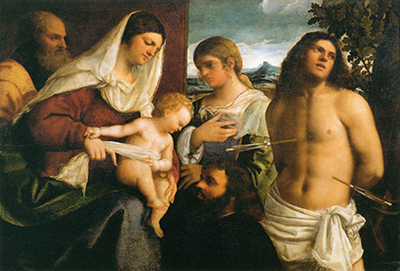
The Holy Family with Saint Catherine, Saint Sebastian and a Donor
The Louvre's Holy Family with Saint Catherine of Alexandria, Saint Sebastian and a Donor brings sacred figures and a contemporary worshipper into a single, closely arranged company. The subject is a sacra conversazione: a devotional gathering rather than an episode in which all the participants met at one historical moment. Its interest lies in the relationships established through proximity, gesture, colour and attention.
The Louvre catalogues the painting under Sebastiano del Piombo as inventory INV 70, an oil on wood measuring 95 by 136 centimetres. Its current online record gives the broad date of the sixteenth century. The attribution and chronology have a scholarly history, so a precise early date should not be presented as though it were securely documented. [1]
At a Glance
- CollectionMusée du Louvre, INV 70
- Recorded dateSixteenth century
- AttributionCatalogued as Sebastiano; scholarly disagreement discussed
Works in context
Contents
A sacred company rather than a narrative episode
The Holy Family consists of the Virgin, the Christ Child and Saint Joseph. Catherine and Sebastian belong to later Christian history, while the donor introduces a person from the world in which the painting was commissioned or used. Their shared space is devotional. It brings different times together so that the relationship between the worshipper and the sacred figures can be contemplated.
This is why identifying a single biblical chapter does not fully explain the composition. The subject is constructed from recognisable figures and their associations. Each can contribute to the painting's meaning without taking part in a literal conversation represented by speech or overt action.
The horizontal format supports that gathering. It allows bodies and faces to be placed beside one another rather than stacked in a narrow vertical hierarchy. The viewer can move across the group, noticing differences of expression and position, while the Virgin and Child remain the principal focus.
Reading the saints
Catherine of Alexandria and Sebastian are identified by the religious traditions and attributes associated with them. Their presence can suggest intercession, patronal devotion and the exemplary endurance of martyrs. Those general associations do not, however, establish why these particular saints were selected for this particular donor.
A saint's name might correspond to a patron's own name, a family devotion, a church or an institutional setting. Establishing which explanation applies requires evidence beyond the fact that the figure appears in the picture. It is better to preserve the question than to invent a commission history around a plausible name.
The saints also have a pictorial role. Their bodies and clothing help articulate the transition between the principal sacred group and the person who seeks access to it. Recognition and composition work together: a figure must be legible as a saint while also participating in the arrangement of the painted surface.
The donor's place
The donor is especially important because the painting gives a mortal worshipper a place within sacred company. This does not imply equality with the divine figures. Position, gesture and direction of attention can make differences of status visible even where the figures occupy a shared setting.
The distinction between an individual likeness and an identified person matters here. A portrait can appear particular enough to suggest observation from life without supplying the sitter's name. The descriptive title “a donor” preserves the function that can be read in the composition while leaving the personal identity open.
For viewers, this creates two kinds of encounter. We look at a person who appears to belong to a distant historical world, and we also see an example of how a worshipper could imagine approaching sacred figures. The portrait's specificity and its devotional role are related, but they are not identical.
Colour and the unity of the group
The painting's unity depends on more than the number of figures assembled. Drapery establishes larger areas of colour, while faces and hands offer smaller points of concentration. The eye can move between these scales, registering the group as a coherent whole before returning to individual participants.
The contrast between an exposed body and heavy cloth is particularly useful in a gathering that includes Sebastian. Flesh and fabric respond differently to light and establish different rhythms of contour. Those material differences help distinguish the figures without requiring an elaborate architectural partition between them.
This is one reason that the work belongs in discussions of Venetian painting even when its exact authorship is debated. Such a discussion concerns the organisation of colour, atmosphere and bodily presence. It should not be reduced to the assumption that a pleasing colour effect is sufficient to identify the hand of one artist.
The attribution question
The Louvre's current record names Sebastiano, while its provenance notes preserve earlier descriptions as Giorgione. This is an instance of a work's changing classification, not evidence that both names refer to different canvases. An inventory records what a collector or cataloguer believed at a particular time. [1]
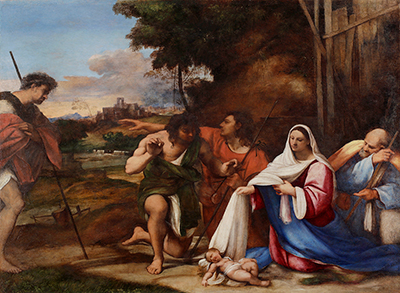
Modern scholarship is not unanimous either. In an essay published by the Hamilton Kerr Institute, Paul Joannides questioned the painting's place in Sebastiano's early development and considered it more likely to be by a follower. That is a specific scholarly judgment and should remain attributed to its author, rather than being silently substituted for the museum's catalogue entry. [2]
The productive way to present the disagreement is to keep the levels of evidence distinct. The Louvre identifies the physical object and its collection history. Scholarship proposes or challenges an authorship and chronology through comparison. The painting itself supplies the forms, surface and relationships that those arguments seek to explain.
A history through royal collections
The Louvre's provenance traces the painting through the collection of Charles I of England, its dispersal and the collection of Everhard Jabach, from whom Louis XIV acquired it in 1662. Those movements place it within the international history of collecting Venetian painting. They also explain why earlier names attached to the work remain part of its documentation. [1]
An old attribution can reveal the reputation that made a picture desirable without establishing the attribution as correct. A collector's Giorgione might later become a scholar's Sebastiano, or a work associated with a wider circle. The changes tell us about connoisseurship as well as about the object.
The painting remains worth studying through those uncertainties. Its sacred company, donor portrait and horizontal design offer a concrete example of how devotion and representation could be joined. Looking at it carefully means attending both to the coherent gathering on the surface and to the distinctions preserved in the evidence around it.
Artworks and records
Selected documented works and records relevant to this article; this is not a complete catalogue.
| Name | Date | Record |
|---|---|---|
| Holy Family with Catherine, Sebastian and a Donor | Sixteenth century | Painting |
| Madonna and Child with Saints and a Donor | 1517 | Painting |
| Martyrdom of Saint Agatha | 1520 | Painting |
| Portrait of a Lady with the Attributes of Saint Agatha | Early 1530s | Painting |
| Visitation | about 1519 | Painting |
Discussion
Share a reading of the figures, materials or relationships discussed in this article.
Reader Insights
Which detail most affects your reading?
Which comparison would you like to explore further?
Join the Conversation
Share a detail, comparison or question about The Holy Family with Saint Catherine, Saint Sebastian and a Donor below.
References
- Musée du Louvre, La Sainte Famille avec sainte Catherine d'Alexandrie, saint Sébastien et un donateur, INV 70, collection record. View source.
- Paul Joannides, “Sebastiano del Piombo's Adoration of the Shepherds: attribution and dating”, Hamilton Kerr Institute Bulletin 10, discussion of the Louvre painting. View source.
- Wellesley College, Davis Museum, comparison of its Holy Family painting with Louvre INV 70 and technical examination. View source.
- National Gallery, Madonna and Child with Saints and a Donor, NG1450. View source.