

 by Tom Gurney
Tom Gurney BSc (Hons) is an art history expert with over 20 years experience
Published on August 4, 2026 / Updated on August 4, 2026
Email: tomgurney1@gmail.com / Phone: +44 7429 011000
The Goldfinch: Introduction
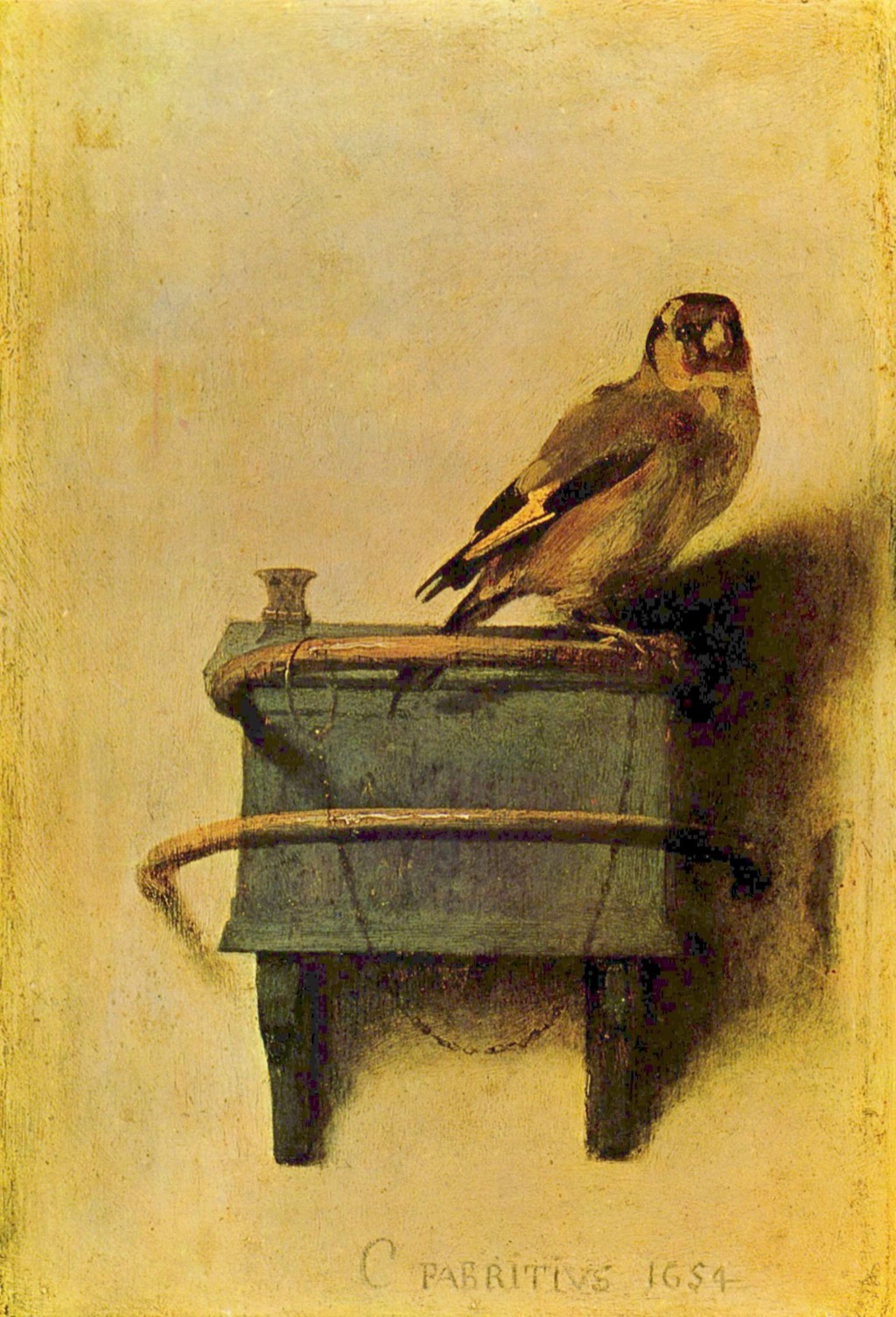
Carel Fabritius's The Goldfinch is one of the smallest great surprises in seventeenth-century Dutch art. The panel is little more than thirty-three centimetres high, almost plain at first glance, and occupied by a single bird on a simple feeder. Yet it has become the work by which Fabritius is known across the world.
Its power lies in the tension between modesty and audacity: a tiny chained bird appears before a pale wall, but the painting also asks what a painting is, how the eye trusts a shadow, and how much life can be made from a few strokes of paint. [1]
The work was painted in 1654, the year Fabritius died in the Delft Thunderclap, the gunpowder explosion that devastated part of the city and destroyed much of his studio. It is now in the Mauritshuis in The Hague, where it is known in Dutch as Het puttertje. The museum's object record identifies it as an oil painting on panel, signed and dated by Fabritius, measuring 33.5 by 22.8 centimetres. The small size matters. This is not a grand bird painting in the manner of a decorative still life.
It is an encounter staged at close range, with just enough detail to make the viewer believe that the bird, the feeder, the chain and the wall belong to the same real space. [2]
Fabritius had been connected with Rembrandt's Amsterdam circle, but The Goldfinch looks very different from the dark drama usually associated with Rembrandt's early pupils. It is bright, exposed and deceptively spare. The bird is not enveloped in shadow; it stands in open light. The background is not a deep interior but a luminous, scuffed wall. The painting's drama is not theatrical action but perception itself. It asks the viewer to look twice at a creature that seems both painted and present. [3]
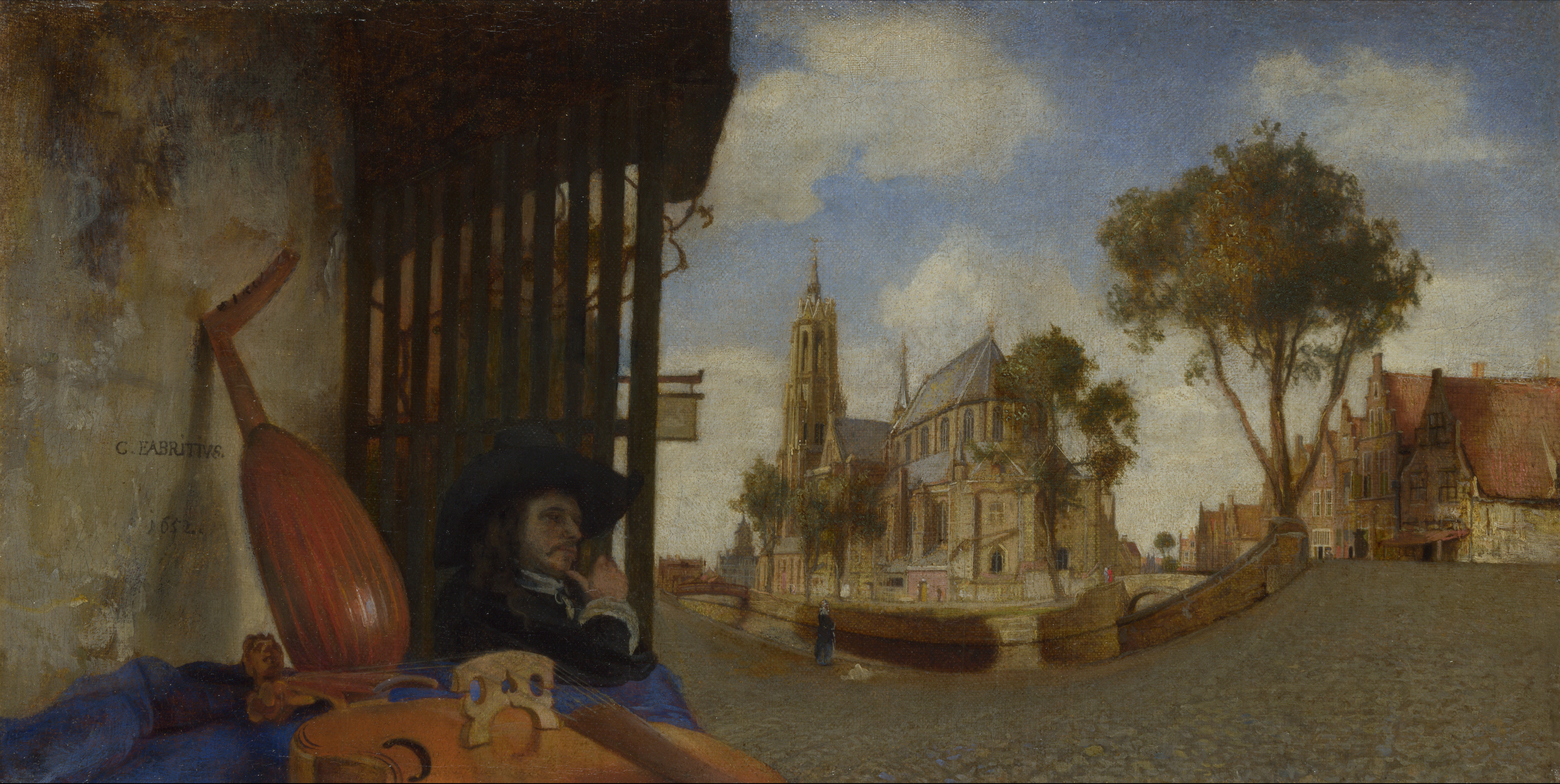
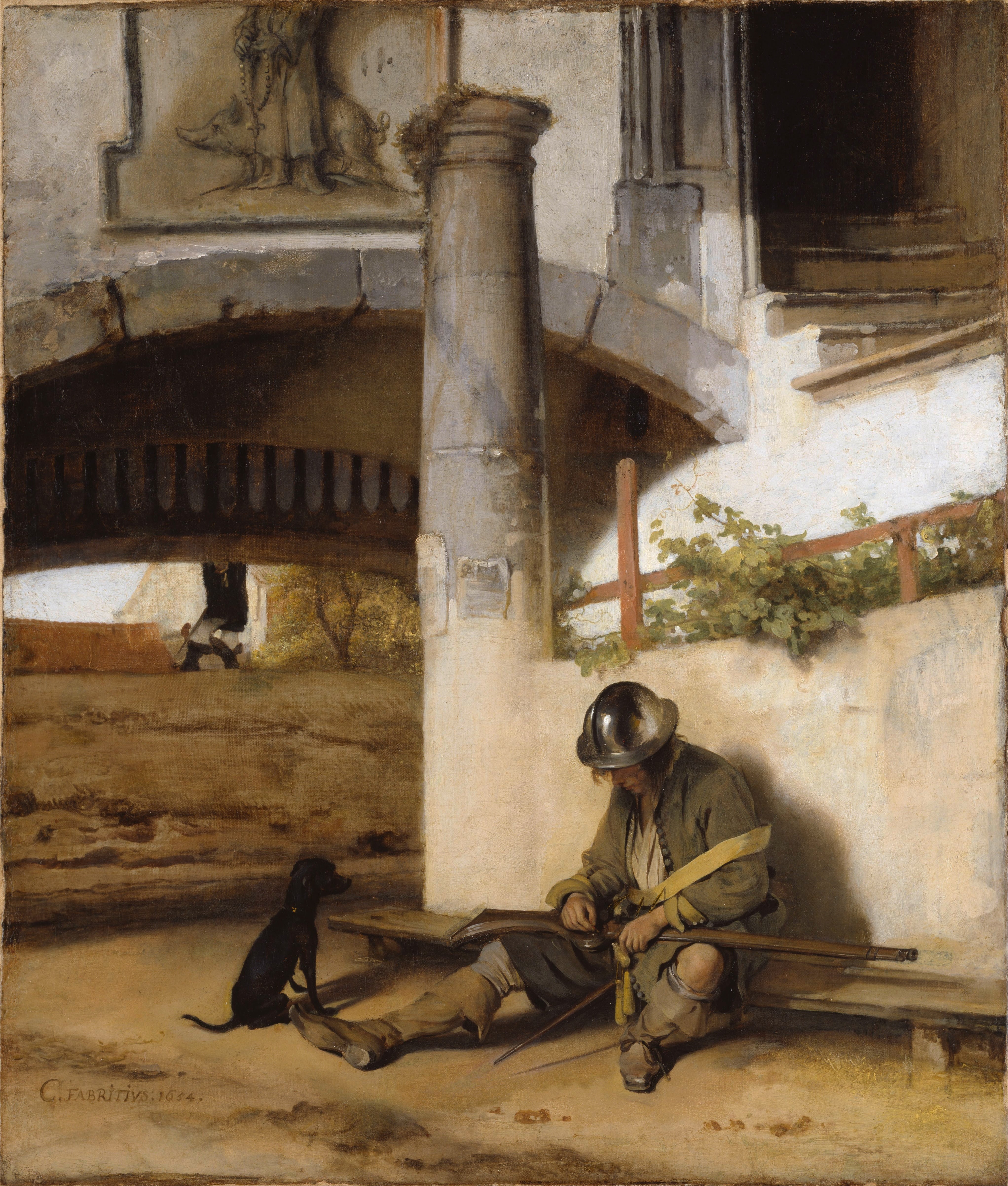
This Goldfinch page belongs within the wider Fabritius paintings guide and the Fabritius biography. It is especially useful to compare its illusionistic wall, perch and shadow with A View of Delft and The Sentry.
At a Glance
- ArtistCarel Fabritius
- Date1654
- MediumOil on panel
- CollectionMauritshuis, The Hague
- Size33.5 x 22.8 cm
Contents
- The Goldfinch: Introduction
- Object Facts
- Why It Is Called `Het Puttertje`
- A Bird Made From Few Strokes
- Annotated Details from The Goldfinch
- The Feeder, Chain And Missing Bucket
- Trompe-l'oeil Without a Simple Trick
- What Was The Painting For?
- The Panel As A Physical Object
- Competing Display Theories
Object Facts
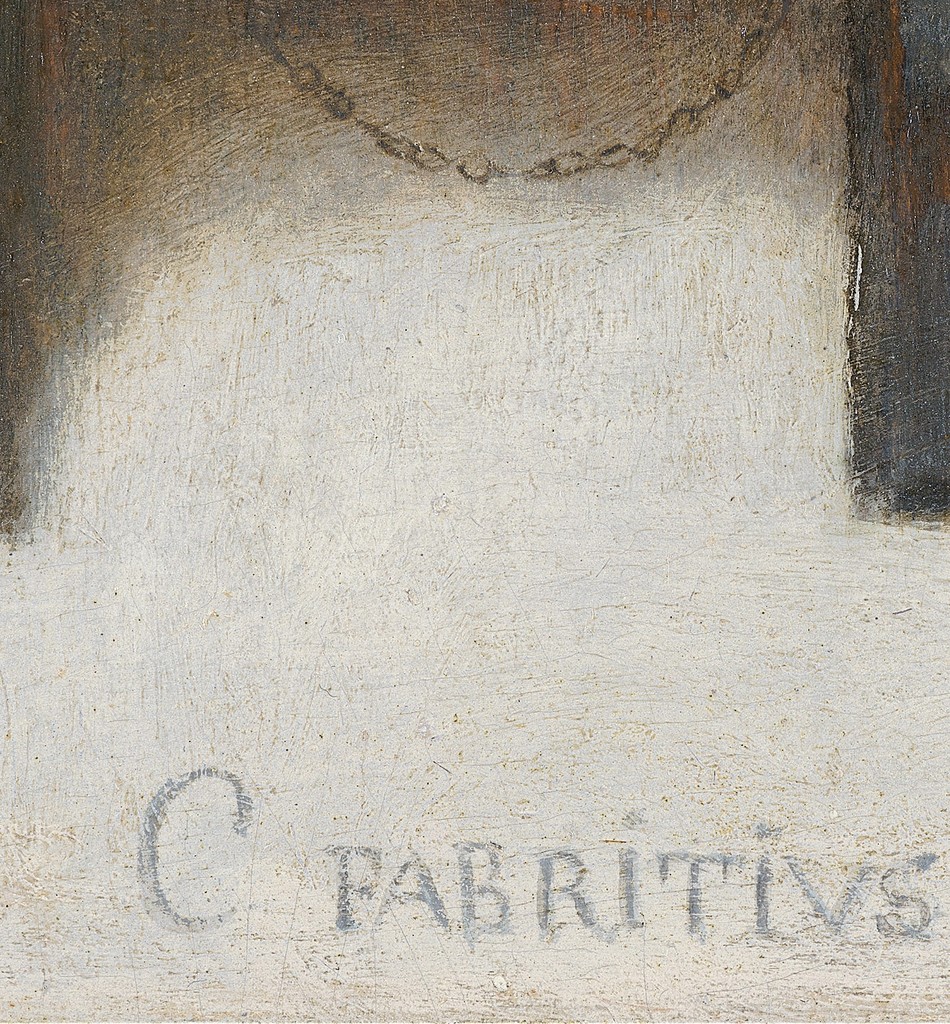
The Goldfinch is signed and dated 1654 near the lower edge. The Mauritshuis records the medium as oil on panel and the dimensions as 33.5 by 22.8 centimetres. The support is wood, not canvas, and technical writers have paid unusual attention to the panel as an object. The Met's Vermeer and the Delft School catalogue notes the panel's thickness, its unbevelled back and the nail holes around its edges, all of which have fed the long debate about how the painting was originally displayed. [1]
The subject is a European goldfinch, a small bird recognisable by its red face, dark cap and yellow wing markings. Fabritius has not painted it as a specimen spread across a natural-history sheet. He has placed it on a little feeding box fixed to a wall, with a metal chain linking the bird's leg to the perch. The bird faces slightly left. One foot grips the upper curved perch while the other is attached to the chain. Its body casts a soft shadow behind it.
A lower perch, a feeder and a pale wall complete the scene. [2]
The composition is radical because so little appears to happen. There is no landscape, cage, owner, window view or narrative episode. The bird is isolated but not abstracted. It remains a pet, a captive creature, and a painted object at once. Its presence depends on the ordinary details around it: the ledge, the feeder, the shadow, the chain, the wall and the light. [3]
That spareness also makes the date poignant. Fabritius painted the work in the same year in which he died, and because so few late works survive, viewers often approach The Goldfinch as if it were a final statement. That is understandable, but it should be handled carefully. We do not know whether Fabritius meant the painting to summarise his art.
What can be said is that the panel belongs to the last known phase of his career, the Delft years in which his art became brighter, stranger and more openly concerned with the conditions of seeing. [4]
The signature matters in that context. Many Fabritius attributions have been debated, and the smallness of the surviving oeuvre means that secure signed works carry special weight. The Goldfinch is not merely famous; it is a key anchor for judging the artist. Its handling, light, scale and illusion help scholars think about other late works, including A View of Delft and The Sentry. It is one of the places where the name Carel Fabritius becomes most concrete. [5]
Why It Is Called Het Puttertje
The Dutch title is essential to the painting. Het puttertje is often translated simply as The Goldfinch, but the word putter carries a more specific cultural association. As the Met catalogue explains, Dutch could call the bird a distelvink, a thistle finch, or a putter, a little water-drawer. The second name refers to the trained pet goldfinch's ability to draw up a tiny bucket of water. [6]
Goldfinches were popular cage birds in early modern Europe. They were admired for their colours, their song and their trainability. A goldfinch could be taught to pull a little vessel by a chain, creating a miniature performance that suited domestic amusement. Fabritius's bird is not shown with the bucket itself, but the chain, perch and feeder evoke that culture of trained pet birds. The title therefore does not merely name a species; it opens a social world. [7]
That context sharpens the painting's emotional balance. The bird is charming, alert and beautifully painted, but it is also tethered. The chain is not a decorative flourish. It is part of the work's meaning and its physical illusion. It tells us that the bird belongs to a human household, that it performs or once performed for human eyes, and that its freedom is limited by the device that makes it visible to us. [8]
Modern bird guides from organisations such as Vogelbescherming Nederland, the RSPB and the British Trust for Ornithology help identify the species' distinctive markings: the red face, the black-and-white head and the yellow wing. They also remind modern viewers that the living bird belongs to fields, gardens, thistles and seed heads, not only to cages and paintings. That contrast gives The Goldfinch some of its continuing force. The panel turns a wild bird into a domestic marvel, and the viewer feels both delight and constraint. [9]
The species' food associations also matter visually. Goldfinches are linked with thistles, teasels and small seeds, which explains older names such as distelvink, the thistle finch. Fabritius does not show the bird feeding among plants. He places it on an artificial feeder, detached from the natural settings that would have defined the bird outdoors. The image therefore depends on a quiet displacement. A bird identified by wild colour and seed-eating habit has been brought into a human-controlled setting. [10]
This displacement is one reason the painting can feel so modern. It does not need an overt moral lesson. It shows a creature whose beauty has made it desirable and whose desirability has led to its captivity. The chain is small, but once noticed it becomes impossible to forget. It complicates every act of admiration. The viewer's delight is real, and so is the bird's confinement. [11]
A Bird Made From Few Strokes
Fabritius's handling is extraordinarily economical. The goldfinch's head and body are not described with smooth, patient finish. Instead, the painting depends on quick, forceful marks that become convincing at the right distance. The yellow of the wing is especially alive. Technical and close-looking discussions of the painting often note the way Fabritius uses paint with a confidence that can look almost casual until the viewer steps back. [12]
The bird is built from a controlled mixture of sharpness and blur. Its eye catches attention, but much of its body is brushed broadly. The wing markings have enough specificity to name the species, yet they are not botanical or zoological description. Fabritius seems less interested in counting feathers than in making a living form flicker into being. [12]
The shadow is just as important as the bird. Cast against the wall, it fixes the goldfinch in space. Without it, the creature might flatten into a sign or emblem. With it, the wall becomes believable and the bird gains weight. The shadow also belongs to the illusion. It is one of the smallest proofs that the panel wants to behave like an object in the viewer's world. [12]
At the same time, the brushwork never disappears entirely. The Goldfinch is not a trick that tries to hide the painter. Its vitality depends on letting paint remain visible. This is part of the reason the work feels modern to many viewers. Fabritius does not simply prove that he can imitate a bird. He shows how quickly paint can cross the boundary between matter and life. [12]
The painting also depends on selective finish. The head is decisive enough for recognition; the body is more suggestive; the wall is spare; the feeder is described only as fully as the illusion requires. This hierarchy guides the eye. Fabritius does not distribute attention evenly. He makes the viewer move from the bird's head to the wing, from the wing to the chain, from the chain to the perch, and from the perch to the shadow. The route through the painting is tiny, but it is carefully organised. [12]
Seen very close, some of the magic loosens into marks. Seen at the right distance, the marks gather back into a bird. That oscillation is central to the work. It keeps the painting from becoming a dead illusion. We are always aware both of the goldfinch and of the act that made it. The bird is alive because the paint is alive. [12]
Annotated Details from The Goldfinch
This staged close-reading package marks six visual details in Carel Fabritius's The Goldfinch: the bird's head, the loosened wing, the perch and foot, the feeding box, the cast shadow and the signed lower edge. Together they show why a very small panel can feel like a real object sharing the viewer's space.
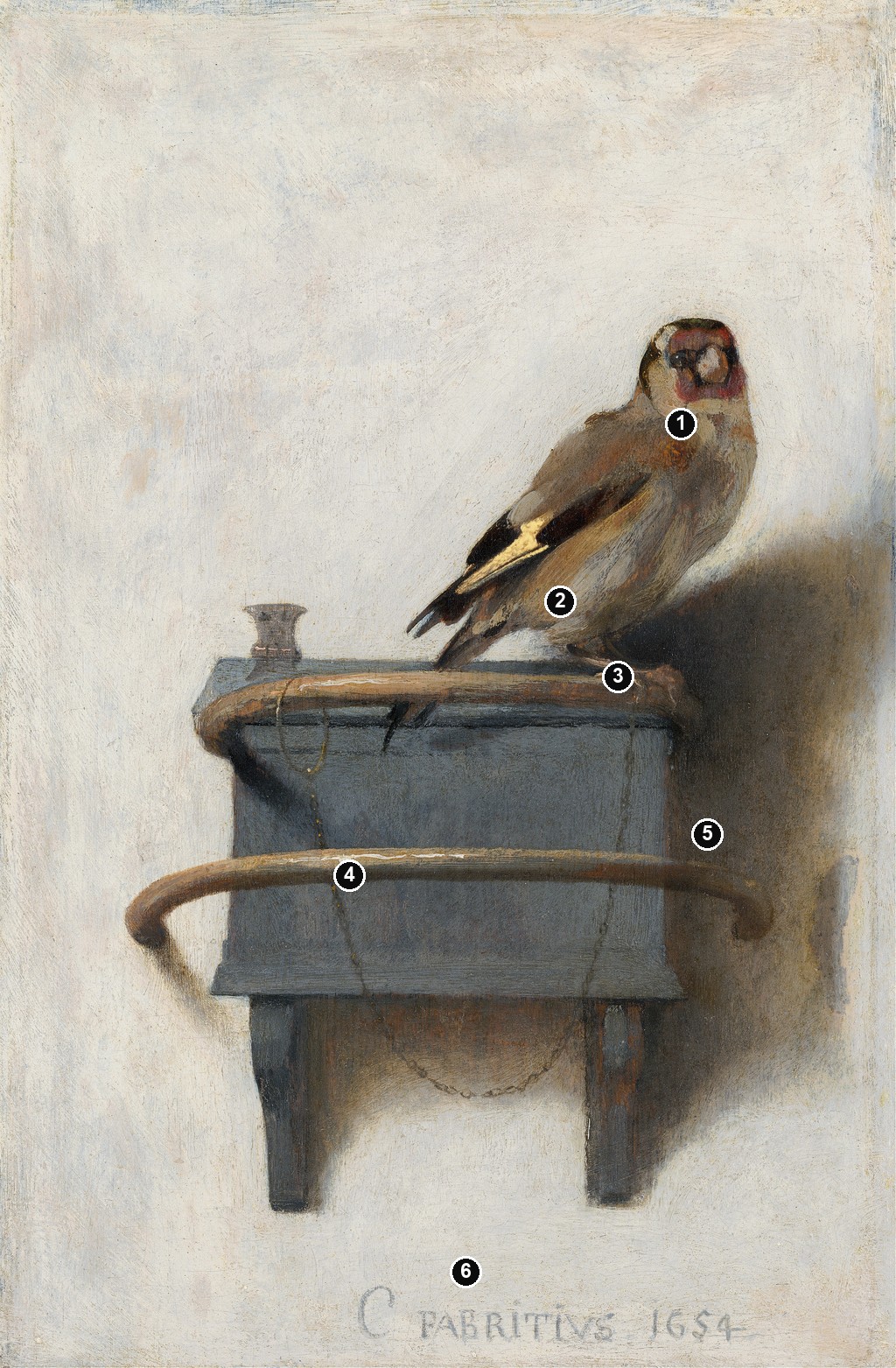
Details from THE GOLDFINCH
These details focus on the painting's illusion: a living bird, a practical feeder, a shallow wall and a signed panel all held in a delicate balance between image and object.
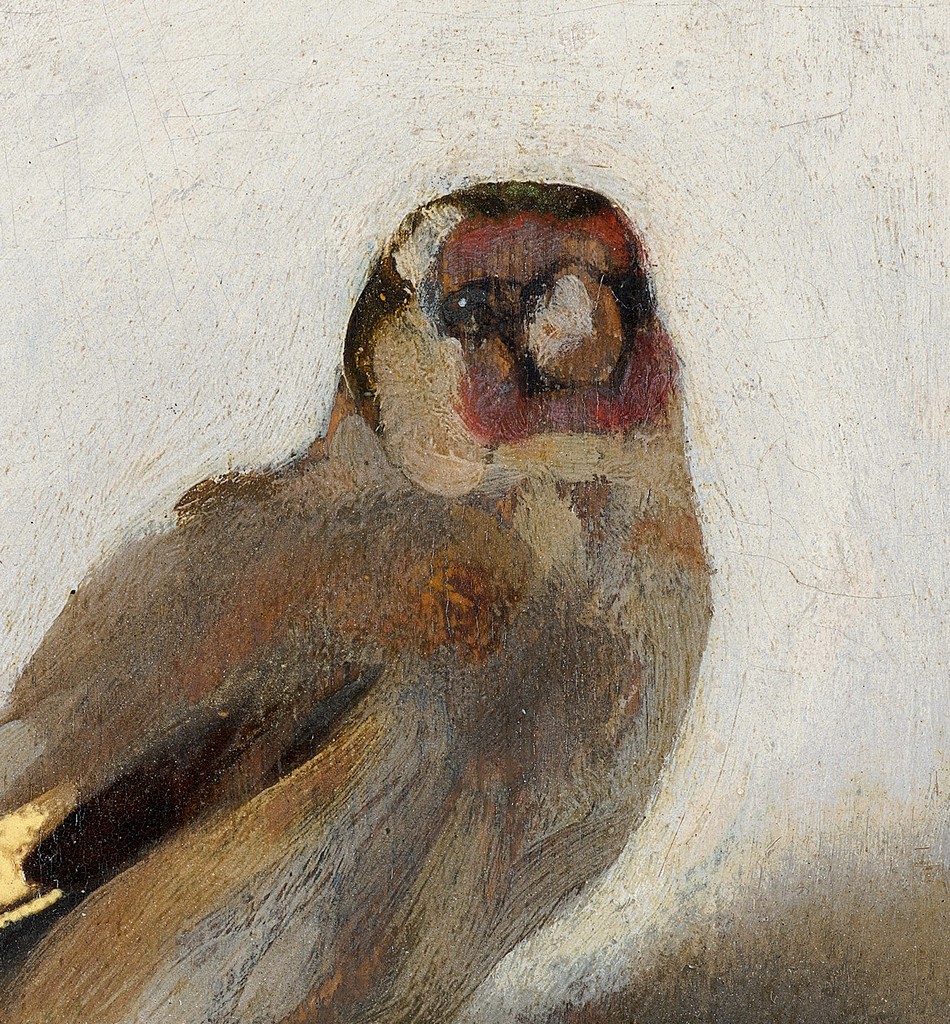
The Bird's Head
The dark cap, pale cheek and small red face identify the bird quickly, but Fabritius does not turn the head into a neat specimen study. A few loaded touches make the bird alert, angled and alive against the pale wall.
Wing and Brushwork
The yellow wing stripe and dark feathers are painted with striking economy. The handling matters because the illusion depends on speed and placement as much as on exact description.
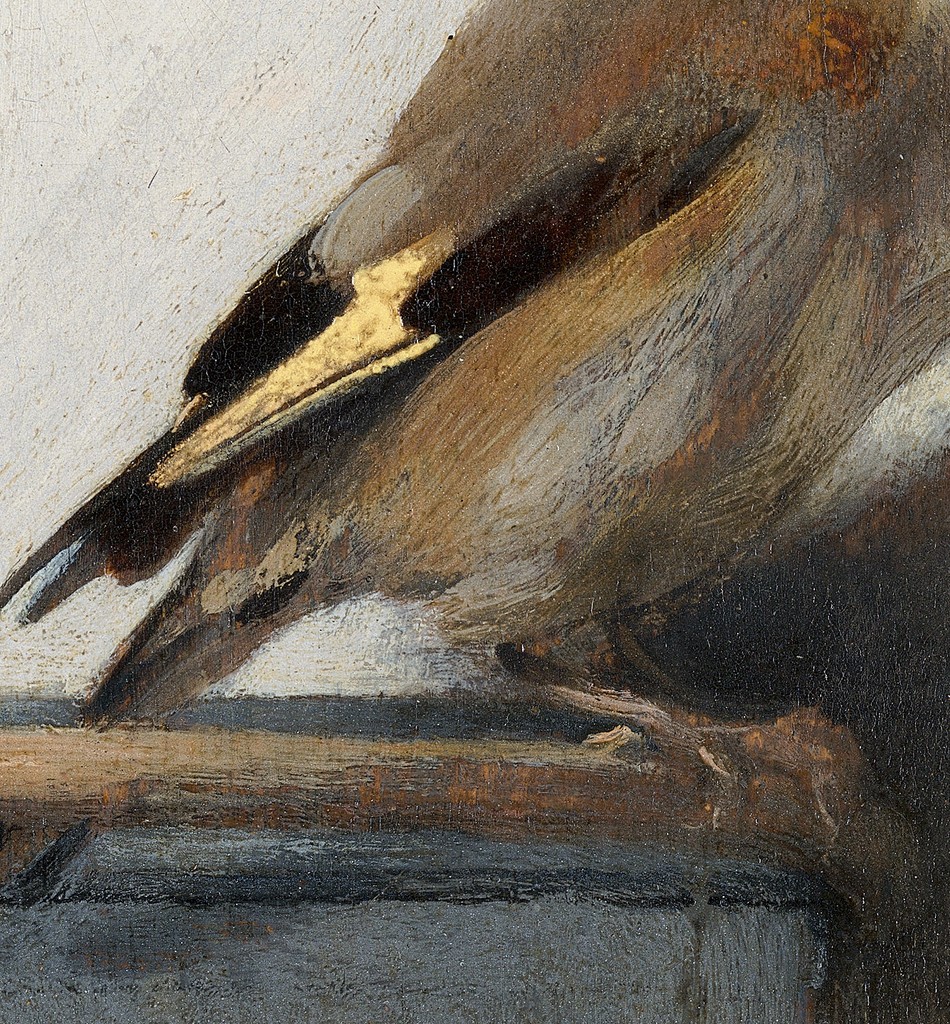
Perch and Foot
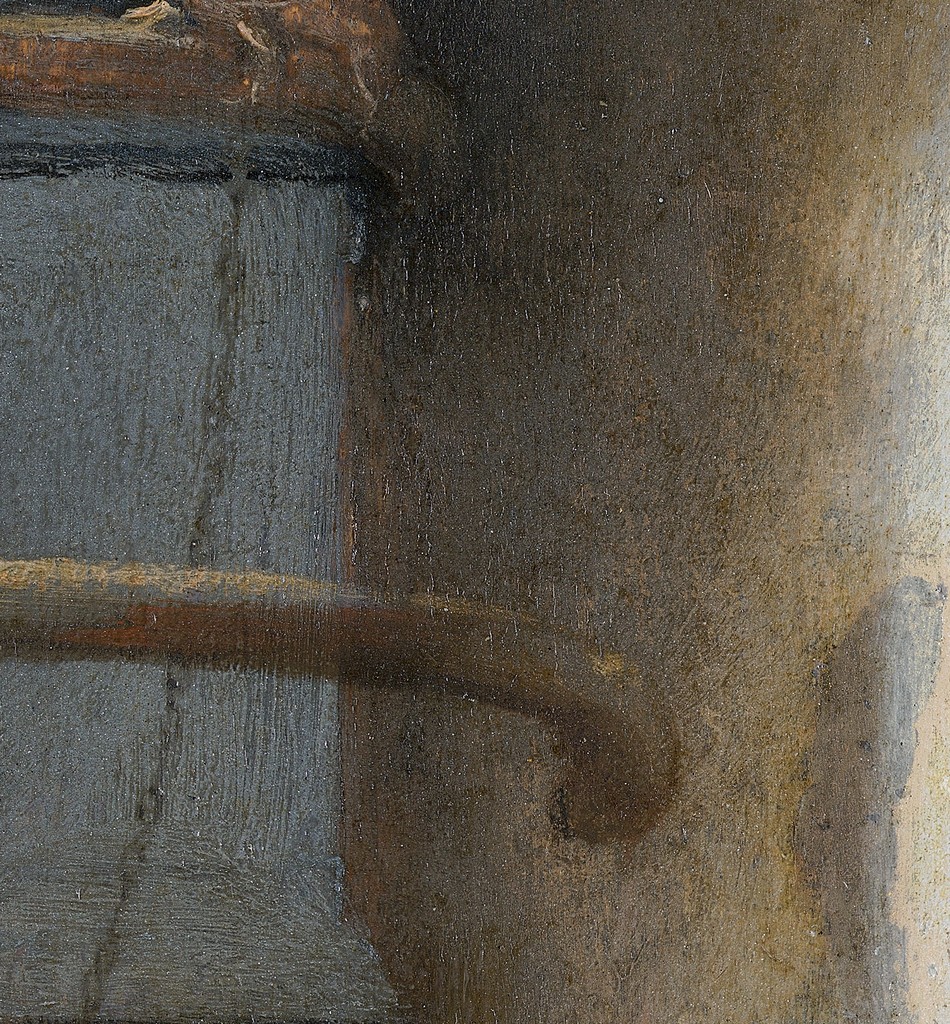
The bird's foot, perch and chain make the image physically specific. They connect the animal to the feeder and turn the panel from a bird portrait into a trompe-l'oeil object.
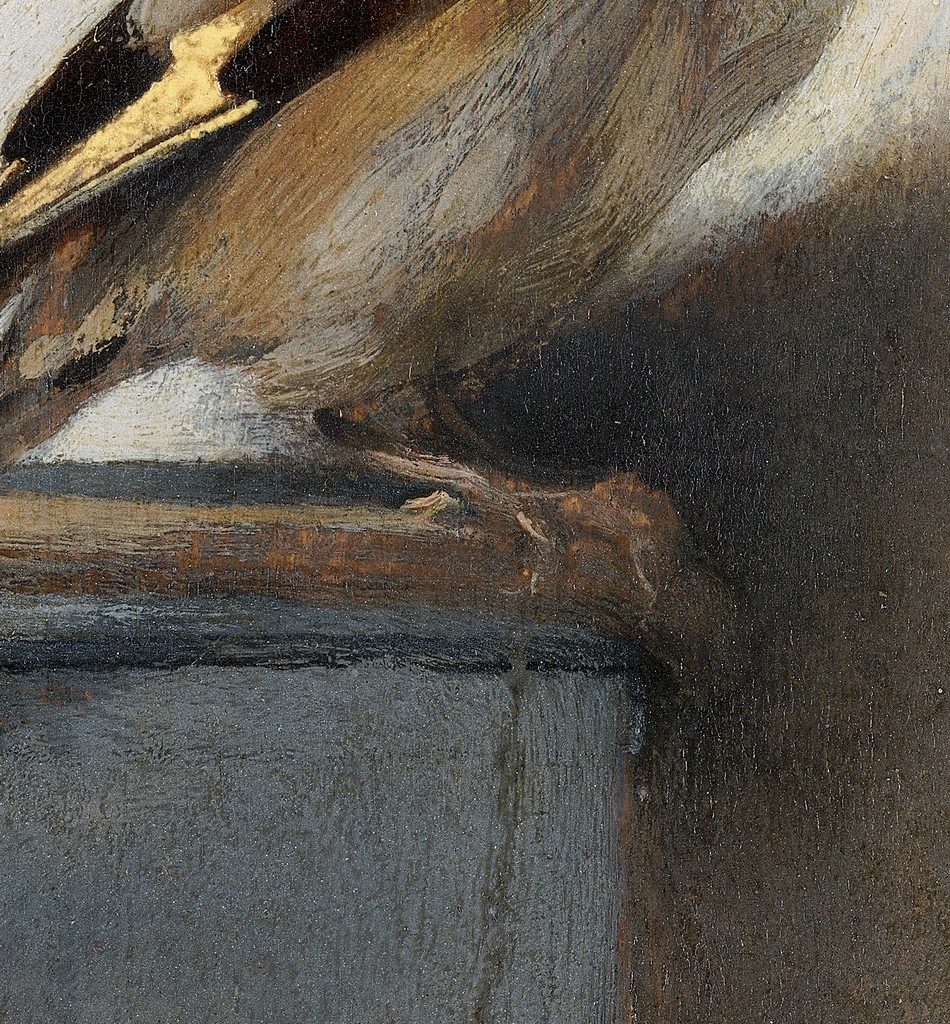
The Feeding Box
The box gives the painting its domestic logic. It also gives Fabritius a hard structure against which the bird, shadow and loose brushwork can appear more immediate.
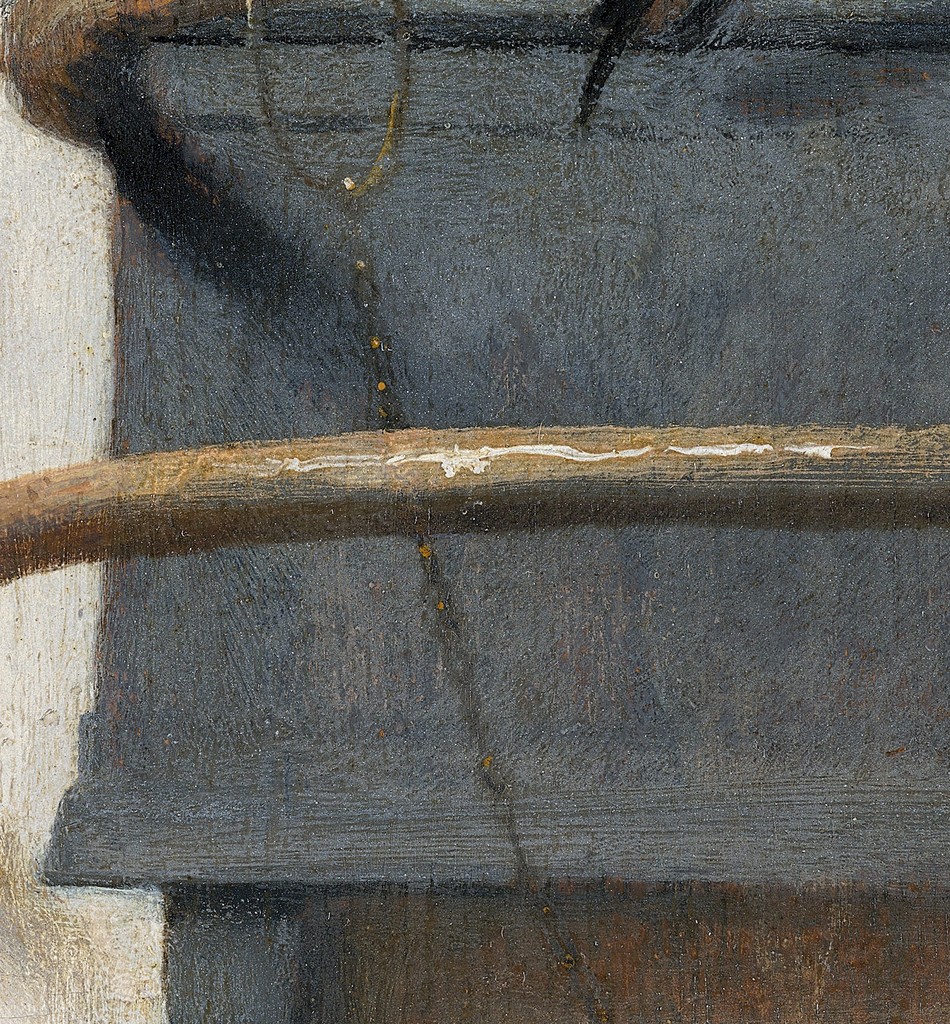
Cast Shadow
The shadow is one of the painting's great effects. It makes the feeder and bird seem to project from the wall, so the viewer reads the panel as both painted surface and staged presence.
Signature and Date
The signature and date fix the work in 1654, the year of Fabritius's death in Delft. Their placement low on the panel keeps the object itself in view, not just the bird perched above.
The Feeder, Chain And Missing Bucket
The little feeding structure is easy to overlook because the bird commands attention first. Yet the device is crucial. It tells us that this is not a goldfinch glimpsed in a hedge or field. It is a bird kept near human habitation, trained or trainable, and placed where people could watch it. The box, curved perch and chain form a small theatre of domestic performance. [12]
The absent bucket is one of the painting's most suggestive details precisely because it is absent. Once the Dutch title is understood, the viewer begins to imagine the apparatus beyond the visible panel: a little container, a chain, a gesture repeated for amusement. Fabritius does not need to paint the whole trick. He paints enough of the equipment to activate the viewer's knowledge, or to make a modern viewer ask what kind of bird this is and why it is tethered. [12]
That restraint makes the painting more compelling than a fuller anecdote might have been. A genre painter could have shown a child, a cage, a window ledge, a household interior and the bird's performance. Fabritius removes almost all of that. The result is not less narrative, but more concentrated narrative. The bird's life is implied by its equipment. The human owner is implied by the chain. The room or street is implied by the wall.
The viewer stands in for the missing spectator who would once have watched the bird's movement. [12]
The chain also changes the painting's emotional temperature. A free bird on a branch would have belonged to nature; a dead bird would have belonged to still life or hunting imagery; a caged bird would have belonged to the familiar language of captivity. Fabritius gives us something more exposed. The bird is not enclosed by bars. It has a small area in which to move, but its range is visibly restricted. The viewer is close enough to admire the goldfinch and close enough to notice the condition of that admiration. [12]
The painting therefore avoids easy sentiment. It is tender without pretending the bird is free. It is charming without making captivity invisible. It belongs to a culture in which trained birds could be household amusements, yet it leaves modern viewers room to feel the tension between affection and control. That tension is one reason the painting continues to feel alive. The goldfinch is not an emblem pinned to a wall; it is a creature whose small freedom is measured by a chain. [12]
Trompe-l'oeil Without a Simple Trick
The Goldfinch is often described as trompe-l'oeil, the kind of art that deceives the eye. That term is useful, but it is not enough by itself. The painting does not present an elaborate illusionistic cabinet, a letter rack full of papers, or a still life with objects spilling over the frame. Instead, it concentrates the problem of illusion into a few essential elements: bird, feeder, chain, wall, light and shadow. [12]
The deception is quiet. It asks not whether the viewer will mistake the panel for a real bird every time, but whether the viewer will feel the pull of reality even while knowing it is painted. The Met catalogue's discussion is especially helpful here because it treats the painting as a meditation on perception, distance and light rather than a simple game of imitation. The work becomes more interesting when seen in that way.
It does not merely say, "this bird looks real." It asks how the eye assembles reality from partial evidence. [12]
The feeder is central to this effect. Its curved perch projects out from the wall; the bird stands on it; the chain hangs down; the lower forms establish a shallow architectural structure. These details imply a real device attached to a wall. The viewer supplies the rest. Fabritius gives just enough information for the mind to build the missing space. [12]
The pale wall is also a participant. It is not a neutral blank. It catches the bird's shadow and the light around the feeder. It creates the physical setting that makes the illusion possible. A darker background would have produced a different kind of drama, closer to Rembrandt's theatrical light. Fabritius chooses a surface that seems exposed, airy and almost ordinary. That ordinariness is daring. It leaves the illusion with nowhere to hide. [12]
The painting's quietness can make its audacity easy to miss. Seventeenth-century Dutch art contains many more obviously virtuosic illusions: curtains that pretend to cover paintings, letter racks full of papers, niches with stone edges, still lifes that push objects into the viewer's space. Fabritius reduces that world of illusion to a bird, a wall and a shadow. He trusts small means. That trust is part of his originality. [12]
It also changes the viewer's role. A complicated trompe-l'oeil still life may overwhelm the eye with evidence. The Goldfinch offers less evidence and demands more participation. We have to accept the wall, infer the room, imagine the bird's movement and understand the chain's function. The painting deceives less by abundance than by precision. [12]
What Was The Painting For?
One of the most fascinating questions about The Goldfinch is also one of the hardest to answer: what was its original function? The panel's physical evidence has encouraged several theories. It has been proposed as part of a wall niche, a door for a small cupboard or painting case, a shop sign, or an element in a perspective-box-like setting. More recent scholarship has also explored the possibility that it belonged to a social space around a window. [12]
The object itself gives clues but not a complete solution. The panel is unusually thick for a conventional framed painting. Its back is not bevelled in the standard way. Nail holes around the edges suggest that it was fixed to something at some point. These facts make it reasonable to ask whether The Goldfinch was originally mounted in a way that made the illusion more immediate than it appears in a modern museum frame. [12]
Older explanations have often tried to solve the painting by choosing one function. The better approach is to preserve the question. The evidence tells us that the work was probably not just a normal small easel painting made for a domestic wall. It also tells us that Fabritius cared about how the viewer's position, the panel's support and the surrounding space affected the illusion. It does not let us reconstruct the original setting with certainty. [12]
Linda Stone-Ferrier's article in the Journal of Historians of Netherlandish Art adds a valuable social dimension to the debate. By connecting the painting with Dutch windows and neighbourhood exchange, the article broadens the question beyond optical trickery. A goldfinch by a window could belong not only to private amusement but also to the life of a street, a housefront or a semi-public threshold. The bird might have addressed people who passed, looked, listened and recognised the familiar culture of caged songbirds. [12]
Whether or not every part of that argument is accepted, it helps keep the painting from becoming a purely technical puzzle. The Goldfinch is an object about looking, but looking in seventeenth-century Delft was also social. Windows, thresholds, shopfronts, signs and domestic display all shaped how people encountered images and objects. Fabritius's panel seems to belong to that world of sudden, close, half-public seeing. [12]
The Panel As A Physical Object
The painting's physical support is not a background fact. It is one of the reasons the work has generated so much debate. A conventional small panel painting could be admired for its illusion, but The Goldfinch appears to have behaved as an object in a more complicated way. Its thickness, edges and nail evidence suggest that the panel was once fixed or installed in a manner that mattered to the viewer's experience. [12]
This helps explain why the painting's plainness is so charged. A goldfinch on a feeder against a pale wall might seem almost empty if imagined only as an ordinary framed picture. But if the panel was once attached to a wall, shutter, niche, cupboard, case or other architectural setting, the spare background begins to make sense. It could have extended or imitated an actual surface. The painted wall might have answered a real wall. The bird's shadow might have been read against a familiar architectural plane. [12]
The nail holes are especially important because they resist the idea of the painting as a purely self-contained image. They suggest attachment, use and placement. They also remind us that the modern museum object is not identical with the original encounter. In the Mauritshuis, The Goldfinch is protected, framed, labelled and studied. In its first setting, it may have been more surprising, more casual, more integrated into a built environment and perhaps more vulnerable to touch, weathering or household movement. [12]
The support also sharpens the work's relation to trompe-l'oeil. Many illusionistic pictures create a fictional object within a normal frame. Fabritius may have made a painted object that relied on its real objecthood. If the panel was set into a structure, the illusion would have depended on both paint and carpentry. The wooden support, the real nails and the painted shadow would have worked together. [12]
That possibility does not solve the painting. It deepens it. The Goldfinch is not only about the representation of a bird. It is about a painted surface behaving as part of the world. The bird's chain asks where the creature ends and the human device begins. The panel asks a parallel question: where does the artwork end and the room, wall or viewing apparatus begin? [12]
For a museum visitor, this means the frame should not be mentally erased. The modern display gives the work a different setting from its first one, but it also lets the viewer study the panel as a surviving object. The painting's edges, dimensions and material history are not secondary to the bird; they are part of the same question. Fabritius made an image that has to be considered as a thing. [12]
Competing Display Theories
The history of interpretation around The Goldfinch is unusually rich for such a small painting. Several explanations have been proposed because the evidence points toward an unusual use without naming it. Each theory catches part of the problem. [12]
One possibility is that the work was connected with a wall niche or cupboard-like setting. This would suit the pale background and the physical evidence of attachment. The painted bird could have appeared as if perched on or near a real architectural surface. If so, the viewer's first impression may have been closer to surprise than to normal picture-viewing. [12]
Another possibility is that the painting functioned as a door or panel for a small case. The older Dutch word casje, sometimes discussed in relation to such objects, suggests a small container or picture case. A painted door could create a double illusion: the panel would be a real hinged or fixed object and also a painted fiction of a bird on a wall. The viewer might open, close or approach it differently from a framed picture. [12]
The shop-sign idea addresses a different kind of public or semi-public function. A goldfinch might have been connected with a name, trade, house sign or street-facing identity. This theory is tempting because Dutch urban life used signs and visual puns in ways that crossed ordinary boundaries between commerce, domestic display and social recognition. Yet it remains a theory, not a settled identification. [12]
The perspective-box or viewing-apparatus idea links The Goldfinch to Fabritius's broader optical interests. His A View of Delft has long been discussed in relation to unusual viewing conditions, and seventeenth-century Dutch artists such as Samuel van Hoogstraten made perspective boxes and illusionistic interiors that depended on controlled viewpoint. The Goldfinch does not require the same kind of elaborate apparatus, but its scale, support and concentrated illusion make the question plausible. [12]
Stone-Ferrier's window argument shifts attention from a mechanical device to a social site. A bird near a window could be part of neighbourhood exchange: seen from inside and outside, heard as well as looked at, belonging to the everyday culture of Dutch houses and streets. This approach is valuable because it treats the painting's illusion as something embedded in social life. It asks not simply, "What trick did Fabritius use?" but "Where and how might such an image have addressed real people?" [12]
None of these theories should be reduced to a slogan. The safest reading is that The Goldfinch was probably made for a more specific mode of display than a normal small framed panel, and that Fabritius used the relationship between image, support, wall and viewer as part of the work. The unanswered question is not a weakness. It is one of the painting's engines. [12]
The debate also protects the painting from overfamiliarity. Because The Goldfinch is so reproduced, it can be easy to treat it as a known icon. The display question restores difficulty. It reminds us that the image we know from books and screens may be only part of the work's original effect. The bird may once have appeared in a setting that made its shadow, perch and wall more startling than they appear in a neutral reproduction. [12]
Restoration And Technical Research
Modern conservation has deepened the painting's mystery rather than flattening it. Mauritshuis discussions of the work describe technical examination with x-radiography, infrared research and CT scanning, as well as changes revealed around the lower perch and background. CODART's public restoration notice and exhibition material also point to the painting's technical interest, while the National Galleries of Scotland summary presented the work to a wider audience through its restoration and research story. [12]
The painting has not always looked exactly as it does now. Varnish, retouching and previous surface conditions shaped how viewers saw it before modern treatment. Cleaning and examination clarified the pale background and the relationship between the bird, perch and wall. Technical research has also made the panel itself more important: its thickness, nail holes and construction are part of the evidence for original display. [12]
Scientific methods can sometimes make a painting seem less mysterious, as if instruments have replaced interpretation. With The Goldfinch, the opposite happens. X-rays, infrared images and CT scans reveal the work's material life, but they do not dictate a single meaning. They show that Fabritius's little panel was an object with a history: painted, mounted, altered, varnished, restored, studied and reinterpreted. [12]
That material history suits the painting's subject. The goldfinch is a creature held by a chain, and the painting is itself an object whose physical attachments matter. The bird is bound to its perch; the panel may once have been fixed into a structure; the viewer's perception is tied to distance and light. The technical evidence gives the work a kind of double body: painted illusion on the front, constructed object behind and around it. [12]
What Conservation Changes In The Way We Look
Restoration and technical study do more than answer specialist questions. They change how a general viewer can look at the painting. If the background has been altered or clarified over time, then the pale wall is not just a passive field; it is a surface with a history. If x-ray or infrared evidence reveals changes around the lower area, then the feeder and perch become part of an evolving composition rather than a simple copied motif. [12]
Technical study also encourages slower looking. A viewer who knows that the panel's thickness and nail holes matter will look toward the edges, not only at the bird. A viewer who knows that the lower perch and background have drawn conservation attention will notice how the painting balances the upper bird against the sparse lower forms. A viewer who knows that varnish once affected the surface will think differently about the current brightness and airiness. [12]
The result is a richer kind of attention. The Goldfinch first seduces the eye with apparent simplicity, then rewards knowledge of its making. It belongs to the Mauritshuis not only as a beloved image but as a studied object. Conservation has helped explain why the painting cannot be separated from its support, surface, mounting history and later restoration. [12]
There is also a useful caution here. Technical images can make viewers hungry for certainty. A scan seems as though it ought to settle the matter. But scans and x-rays often reveal complexity rather than final answers. In this case, they illuminate construction, condition and change while leaving the original function open. That is why the painting remains an art-historical puzzle rather than a solved diagram. [12]
The restoration history is especially important because it has been part of the painting's public life. Conservation did not happen in isolation from viewers. Mauritshuis and CODART material around the painting made the work's technical examination visible to a broad audience, turning restoration into interpretation. The public learned that the goldfinch was not only an image to admire but an object to investigate. [12]
That public restoration story fits the painting's character. The Goldfinch rewards the ordinary viewer first, then opens into more specialised questions. A person can love the bird without knowing anything about panel construction. But once the construction is known, the love becomes more alert. The painting grows without losing its initial directness. [12]
Fabritius, Rembrandt And Delft Light
Fabritius's early career is closely associated with Rembrandt's Amsterdam world. Samuel van Hoogstraten later referred to Fabritius as a fellow pupil, and modern scholarship has long placed Fabritius among the artists who learned from Rembrandt's powerful handling of light, shadow and paint. Yet The Goldfinch shows how far Fabritius had moved by 1654. [12]
Instead of Rembrandt's deep interiors and dramatic chiaroscuro, Fabritius gives the viewer a pale wall, open light and a small isolated form. The paint remains vigorous, but the atmosphere has changed. The bird is not emerging from darkness; it is exposed to daylight. That change is one reason Fabritius has often been discussed in relation to Delft painting and to Vermeer. [12]
The Vermeer connection needs care. There is no firm evidence that Fabritius taught Vermeer. It is safer to speak of Delft proximity, shared interests and later comparison. Fabritius, Vermeer and Pieter de Hooch all invite discussion of light, domestic space, windows and optical attention, but each artist used those interests differently. The Goldfinch is not a Vermeer painting before Vermeer. It is a Fabritius painting, small, concentrated and object-like, made by an artist whose Delft work seems to have opened new possibilities for light and perception. [12]
A View of Delft, with a Musical Instrument Seller's Stall, now in the National Gallery, strengthens this picture of Fabritius as an experimenter. That small canvas plays with viewpoint, distortion and the possibility of a viewing apparatus. Seen beside it, The Goldfinch belongs to a wider late interest in how pictures interact with viewers and spaces. One work bends a city view; the other brings a chained bird into the viewer's physical world. [12]
Delft, Windows And The Viewer
Delft painting is often loved for still rooms, measured light and a feeling of suspended time. Fabritius's The Goldfinch belongs to that world only partly. It has the clarity and quiet that later viewers associate with Delft, but it is more abrupt than a domestic interior. The viewer is not invited to enter a room slowly. The bird is simply there, in front of us, close to the surface. [12]
This closeness makes the viewer unusually active. The painting has no human figure to mediate the encounter. There is no woman reading a letter, no music lesson, no officer, no servant, no child. The viewer becomes the figure who completes the scene. We look at the bird as its unseen owner, neighbour, passer-by or museum visitor might have looked. The lack of narrative figures does not remove human presence; it transfers that presence to the viewer. [12]
The window context is important for that reason. Seventeenth-century Dutch windows were thresholds between private and public life. They admitted light, displayed household order, allowed conversation and made interiors partly visible from the street. A bird by a window could be heard and seen; it could be a domestic companion and a social signal. Fabritius's painting, with its wall-like background and close perch, seems to understand that ambiguous space between inside and outside. [12]
This is another reason the comparison with Vermeer needs nuance. Vermeer often lets light enter from a window and settle across a room. Fabritius concentrates the encounter at the threshold itself. If Vermeer makes the viewer aware of interior silence, Fabritius makes the viewer aware of the sudden appearance of an object in our own space. Both are interested in light and perception, but the experiences differ sharply. [12]
Pieter de Hooch offers another useful point of comparison. His Delft interiors often connect rooms, courtyards and thresholds, showing how domestic space opens into social space. The Goldfinch is far smaller and less narrative, but it shares that interest in the boundary between household and world. The bird belongs to a domestic device, yet the painting seems made for being seen. [12]
The Delft context also gives Fabritius a distinctive place in Dutch art. He is not simply a Rembrandt pupil who changed his palette. He is an artist who seems to have asked how painting could operate in relation to real space. In A View of Delft, the viewer's position may be shaped by optical distortion. In The Goldfinch, the viewer's position is shaped by proximity and objecthood. In both works, the painting is not only something looked at; it is something that arranges looking. [12]
Provenance And Rediscovery
The painting's later history is also part of its fame. The Met catalogue traces an important provenance route through the nineteenth century: the work was known to Joseph-Guillaume-Jean Camberlyn by 1859, connected with Théophile Thoré, sold in Paris in 1892, owned by Martinet according to the sale history, and acquired in 1896 for the Mauritshuis through Abraham Bredius.
Details of nineteenth-century ownership and sale history can be complex, but the larger story is clear. The Goldfinch emerged from relative obscurity into the modern museum world during the same century that Fabritius's reputation was being reconstructed. [12]
Thoré-Bürger matters because he was one of the nineteenth century's great rediscoverers of Dutch painting, especially Vermeer. Fabritius entered that revival of interest in Delft art and Rembrandt's circle. The painting's smallness did not prevent it from becoming central to the artist's identity. On the contrary, its singularity helped. With so few secure Fabritius works surviving, The Goldfinch became a kind of compressed emblem: not a summary of everything he did, but a vivid proof of his originality. [12]
The Mauritshuis setting has amplified that role. The museum does not treat The Goldfinch as a minor curiosity. It has given the painting major interpretive attention, including conservation research, multilingual object records and a dedicated digital story. The work's popularity has also grown through international loans and exhibitions, including the Mauritshuis presentation at the Frick Collection and the National Galleries of Scotland's focused display. [12]
The movement from private ownership and sale rooms into a national museum also changed the painting's audience. A work that may once have depended on a particular domestic or semi-public setting became an object of public looking. The modern viewer encounters it with labels, conservation narratives, reproductions, scholarship and often a memory of the novel or film. This does not erase the original painting. It adds new layers to the act of seeing. [12]
Fabritius's own reputation has followed a similar path from fragment to focus. Because so little survives, each accepted work has had to do unusually heavy work for art history. The Goldfinch has carried more than any other. It stands for Fabritius's late style, for Delft experiment, for the losses of 1654, for the rediscovery of Dutch painting in the nineteenth century and for modern affection. That is a heavy burden for such a small bird, but the painting is strong enough to bear it. [12]
Nineteenth-century rediscovery also shaped the way Fabritius was placed in art history. Writers and collectors who cared about Rembrandt, Vermeer and the Delft school were drawn to artists who seemed to connect those worlds. Fabritius was ideal for that role, but also resistant to it. His surviving works do not form a simple bridge. They are too strange, too few and too independent. The Goldfinch is part of the Rembrandt-to-Delft story, yet it does not behave like a transitional footnote. It feels like a destination in itself. [12]
Modern Reception
Few seventeenth-century bird paintings have crossed into modern popular culture as strongly as The Goldfinch. Donna Tartt's novel The Goldfinch, published in 2013, brought Fabritius's painting to a huge literary audience. The later film adaptation extended that recognition, even among people who had never visited the Mauritshuis. The novel's use of the painting is not art history in a narrow sense, but it is now part of the work's reception. It turned a small Dutch panel into a symbol of loss, survival, beauty and attachment for millions of readers. [12]
The painting's modern appeal is understandable. It carries a powerful contradiction. The bird looks immediate and fragile, but the painting has survived catastrophe, travel, restoration and changing taste. Fabritius died in an explosion that destroyed much of his work; The Goldfinch endures as one of the few remaining late statements by him. Modern viewers often sense that history even before they know it. The little bird seems vulnerable because it is chained, and the painting seems vulnerable because so much around it was lost. [12]
Laura Cumming's Thunderclap and related writing have renewed interest in the relationship between Fabritius's death, the Delft explosion and the painting's survival. Some claims about surface evidence and the explosion require careful checking against conservation sources before being treated as settled fact. As reception, however, the connection is powerful: a small image of a chained bird has become linked with sudden disaster, art's fragility and the strange accident of survival. [12]
The Mauritshuis's 2026 BIRDS exhibition, curated around The Goldfinch and Simon Schama's bird-focused framework, shows another modern turn. The painting now speaks not only to Dutch art history but also to human relationships with birds: admiration, captivity, beauty, ownership, food, hunting, song and ecological care. A seventeenth-century pet bird can become a prompt for modern reflection on how people look at and use the natural world. [12]
This reception should stay proportionate. The Goldfinch is not important because a modern novel made it famous. The novel and film matter because they show how easily the painting's central tensions travel beyond art history. Loss, survival, attachment, beauty, captivity and chance are all already present in the panel's own story. Modern culture did not invent those themes; it recognised them. [12]
The painting also circulates today through digital images, museum pages, postcards, exhibition banners and social media. That circulation risks making it seem familiar too quickly. The best response is to return to the object. Reproduction can show the bird, but it cannot fully convey the panel's scale, edge, surface, thickness or museum presence. Much of the painting's force depends on realising how small it is. The modern image often enlarges the bird; the Mauritshuis object makes the viewer lean toward it. [12]
The dedicated Mauritshuis story site, multilingual object records and international exhibitions have helped slow that encounter again. They remind viewers that the painting is not only an icon but a thing made, mounted, damaged, restored, studied and loved. Its fame is therefore not just literary or popular. It rests on the continuing ability of the work itself to generate questions. [12]
The painting's scale is crucial to that continuing surprise. Reproductions often enlarge it. Posters, book covers and digital images can make the bird seem more monumental than it is. In front of the real panel, the viewer has to adjust downward. The work is intimate, almost pocket-sized by the standards of major museum icons. That smallness changes the emotional register. It makes the painting feel less like a proclamation and more like a discovery. [12]
This is one reason the work suits literature so well. A small object can carry private intensity. Tartt's novel understood that quality: the painting is portable in imagination, bound up with survival, memory and obsession. But the same quality was already in Fabritius's art. The panel invites a form of looking that is close, possessive and uneasy. The viewer wants to keep looking, yet the painting keeps reminding us that possession is part of the problem. [12]
Symbol, Pet Or Living Creature?
Goldfinches have older symbolic associations in European art, especially in Christian imagery where the bird can be connected with Christ's Passion because of its red face and thistle associations. That wider tradition is worth knowing, but it should not be forced onto Fabritius's painting as the main explanation. The Goldfinch does not show the bird with the Christ Child or within a devotional scene. It shows a trained pet on a feeder. [12]
The stronger evidence points toward domestic bird culture, optical display and the painting's physical function. Still, older symbolism may form part of the background a seventeenth-century viewer could have known. A goldfinch was not a neutral bird in European visual culture. It could evoke song, training, delicacy, captivity, colour, Christological symbolism or household amusement depending on context. [12]
Fabritius's achievement is to keep the bird from collapsing into any one of these categories. It is not only a symbol. It is not only a pet. It is not only a technical exercise. It is not only a living creature. It is all of these possibilities held in a small, vivid form. The painting's restraint lets meanings gather without forcing them into an allegory. [12]
That restraint is one reason the picture resists exhaustion. A more explicit symbolic painting might be decoded and finished. A more elaborate trompe-l'oeil might be admired for its cleverness and then left behind. The Goldfinch keeps returning the viewer to the same unresolved presence: a bird that is visibly captive and yet visually alive. [12]
The absence of a single symbolic key is important for public interpretation. It would be easy to turn the goldfinch into an emblem of the soul, captivity, resurrection, art, survival or loss. Some of those meanings may resonate, especially after Fabritius's death and the painting's later reception. But the painting itself is more exact and more restrained. It begins with a bird on a feeder. Its meanings grow from looking, not from a prefabricated allegory. [12]
That is why the best reading remains close to the object. The title, species, chain, feeder, panel, wall and shadow are enough. They do not reduce the painting to fact; they keep interpretation anchored. Fabritius's genius lies in making those facts feel inexhaustible. [12]
Why The Painting Feels Alive
The Goldfinch feels alive because Fabritius never separates illusion from sympathy. The bird is convincing, but it is not merely a demonstration of skill. Its slight turn, alert head and small chained foot make the viewer aware of its presence as a living creature. The feeder and wall make the illusion work; the chain makes the situation morally and emotionally sharper. [12]
The painting also feels alive because it is unfinished in the viewer's mind. We do not see the room, the owner, the window, the bucket or the original mounting. We infer them. Fabritius's restraint leaves space for the viewer to complete the scene, and that completion changes from person to person. One viewer sees a trompe-l'oeil marvel. Another sees a beloved pet. Another sees captivity. Another sees the remnant of a lost Delft world. [12]
Its greatness lies in holding all of those responses without becoming diffuse. Every major question returns to the same small form. Why this bird? Why this wall? Why this shadow? Why this support? Why this chain? Why does so little paint create so much presence? Fabritius's answer is not verbal. It is the bird itself, standing there in light, caught between nature and artifice. [12]
The painting's life is also a matter of timing. The bird seems caught between movements: perched but not settled, alert but not flying, tethered but not still. Fabritius gives no dramatic action, yet the image feels temporary, as if the bird could shift its weight or flick its head. That suspended instant is more convincing than a busy scene might have been. [12]
The same suspension applies to the painting's meanings. It rests between Rembrandt and Delft, between pet culture and natural life, between trompe-l'oeil and open brushwork, between object and image, between seventeenth-century household display and modern museum fame. It is a small work made of thresholds. That is why it can support so many readings without losing its centre. [12]
For Fabritius's cluster as a whole, The Goldfinch is the natural starting point because it gathers nearly every major issue in his art. It shows his late light, his interest in illusion, his distance from Rembrandt's darkness, his relevance to Delft looking, his unusual physical supports and the fragility of his surviving reputation. But it is not only useful as evidence. It is a moving work of art. Its scholarship deepens its beauty; it does not replace it. [12]
Frequently Asked Questions
The Goldfinch is in the Mauritshuis in The Hague. The museum records it as inv. no. 605 and presents it as one of its best-known works.
The title refers to a goldfinch, but also to the trained bird's association with drawing water in a tiny bucket. The Dutch putter is connected with that water-drawing trick, which helps explain the chain and pet-bird setting.
It is often discussed as trompe-l'oeil because the bird, shadow and feeder create an illusion of real presence. The painting is more than a simple trick, though. Its physical panel, possible original mounting, light and viewer position are all part of its meaning.
There is no firm evidence that Fabritius taught Vermeer. The safer connection is Delft context and shared interest in light, space and optical effects. Fabritius's late works help explain the artistic environment in which Vermeer later worked, but the relationship should not be overstated.
Its fame comes from several layers: its extraordinary visual economy, its rarity within Fabritius's small surviving oeuvre, its Mauritshuis prominence, its conservation and exhibition history, and its modern reception through Donna Tartt's novel and later cultural responses.
Discussion
Share what you notice, question or want to compare after reading this page. Reader discussion works best when it stays close to the object, the evidence and the surviving Fabritius corpus.
Reader Insights
What detail in The Goldfinch by Carel Fabritius most changes how you understand Carel Fabritius?
How does this page change the relationship between Rembrandt's workshop, Delft light and Fabritius's surviving works?
Which object fact, provenance detail or attribution caution feels most important for the way the work is presented?
Join the Conversation
Join the conversation below with a source-aware observation or question.
References
- Mauritshuis, `The Goldfinch`, inv. 605, collection record. Source
- Mauritshuis, `The Goldfinch: small, ordinary and world-famous`. Source
- Mauritshuis, `The Goldfinch, A Bird's Eye View`, press release, 2017. Source
- Walter A. Liedtke, Michiel C. Plomp and Axel Ruger, `Vermeer and the Delft School`, Metropolitan Museum of Art / Yale University Press, 2001, cat. no. 21. Source
- Linda Stone-Ferrier, `The Goldfinch` and Dutch window/social-exchange interpretation, `Journal of Historians of Netherlandish Art`.
- CODART, Fabritius/Mauritshuis restoration and exhibition records; CODART Canon entry for `The Goldfinch`. Source
- National Galleries of Scotland, `The Goldfinch` exhibition material.
- Frick Collection, Mauritshuis exhibition material.
- Vogelbescherming Nederland, species guide for `putter`.
- RSPB, European goldfinch species guide.
- British Trust for Ornithology, Goldfinch birdfacts.
- Cornell Lab of Ornithology, European Goldfinch species guide.