

 by Tom Gurney
Tom Gurney BSc (Hons) is an art history expert with over 20 years experience
Published on October 6, 2016 / Updated on February 1, 2026
Email: tomgurney1@gmail.com / Phone: +44 7429 011000
Artist's Garden at Giverny (1900) by Claude Monet
Artist's Garden at Giverny (French: Le Jardin de l'artiste à Giverny) is one of the most celebrated garden paintings by Claude Monet. Created in 1900, the work captures the vibrant flower beds of Monet's own garden at Giverny in Normandy.
The painting reflects Monet's deep fascination with horticulture, colour harmony and the changing effects of natural light. Today the artwork forms part of the permanent collection of the Musée d'Orsay in Paris, where it remains one of the museum's most admired Impressionist works.
The Impressionist movement aimed to capture the fleeting sensations of modern life and the natural world. Instead of carefully polished academic compositions, artists like Monet painted rapidly to record the effects of light and atmosphere.
In Artist's Garden at Giverny Monet achieves this goal with remarkable success. The energetic brushwork and vibrant colour palette evoke the sounds, scents and warmth of a summer garden. Viewers often describe feeling immersed in the scene, as if they are standing on the path surrounded by flowers while bees buzz through the air.
In this article we will examine this painting in detail, placing it within the context of Monet's career, discussing his technical qualities and also trying to identify the types of flowers and trees displayed in his garden in giverny at that time. We will also discuss how Monet's garden helped him to overcome personal tragedies in his life.
- Artist: Claude Monet
- Title: Artist's Garden at Giverny
- French Title: Le Jardin de l'artiste à Giverny
- Year: 1900
- Medium: Oil on canvas
- Movement: Impressionism
- Painted In: Giverny, Normandy, France
- Dimensions: 92 x 81 cm
- Location: Musée d'Orsay, Paris
- Subject: Monet's flower garden at Giverny
- Notable Features: Rows of purple irises and garden pathways
Background to the Painting
When Claude Monet painted Artist's Garden at Giverny he had been living at his country retreat for almost twenty years and in that time had created a garden of breath-taking beauty.
For almost two decades Monet had given daily instructions to his gardener in order to construct a meticulous and unrivalled landscape where he could enjoy nature and crucially work to recreate it's infinite variations in his paintings.
Monet had planted the lilies in the ponds for which he became justly famous, but also the long flowerbeds we can see in Artist's Garden at Giverny. The painting has a formality that was not present in all of Monet's work during this stage of his life.
Monet studied horticulture in great depth, with many books and magazines of modern and traditional gardening techniques littered around his house.
This was as much a passion as his art, but is only known to those who look more deeply into his career, rather than simply enjoying the aesthetic beauty of his main highlights. His earlier garden was inspired by French and British trends of the time, whilst the water lily pond that followed on afterwards had more of an Asian theme to it.
When he first moved into this property, he was actually renting, before later purchasing the house out right. The light within this part of France appears to have suited his painting style and may have been part of the reason behind his decision to settle in Giverny.
The climate also seemed suitable for growing a variety of different species of plants which was important for someone who liked to experiment, as well as attempting to learn from many different sources.
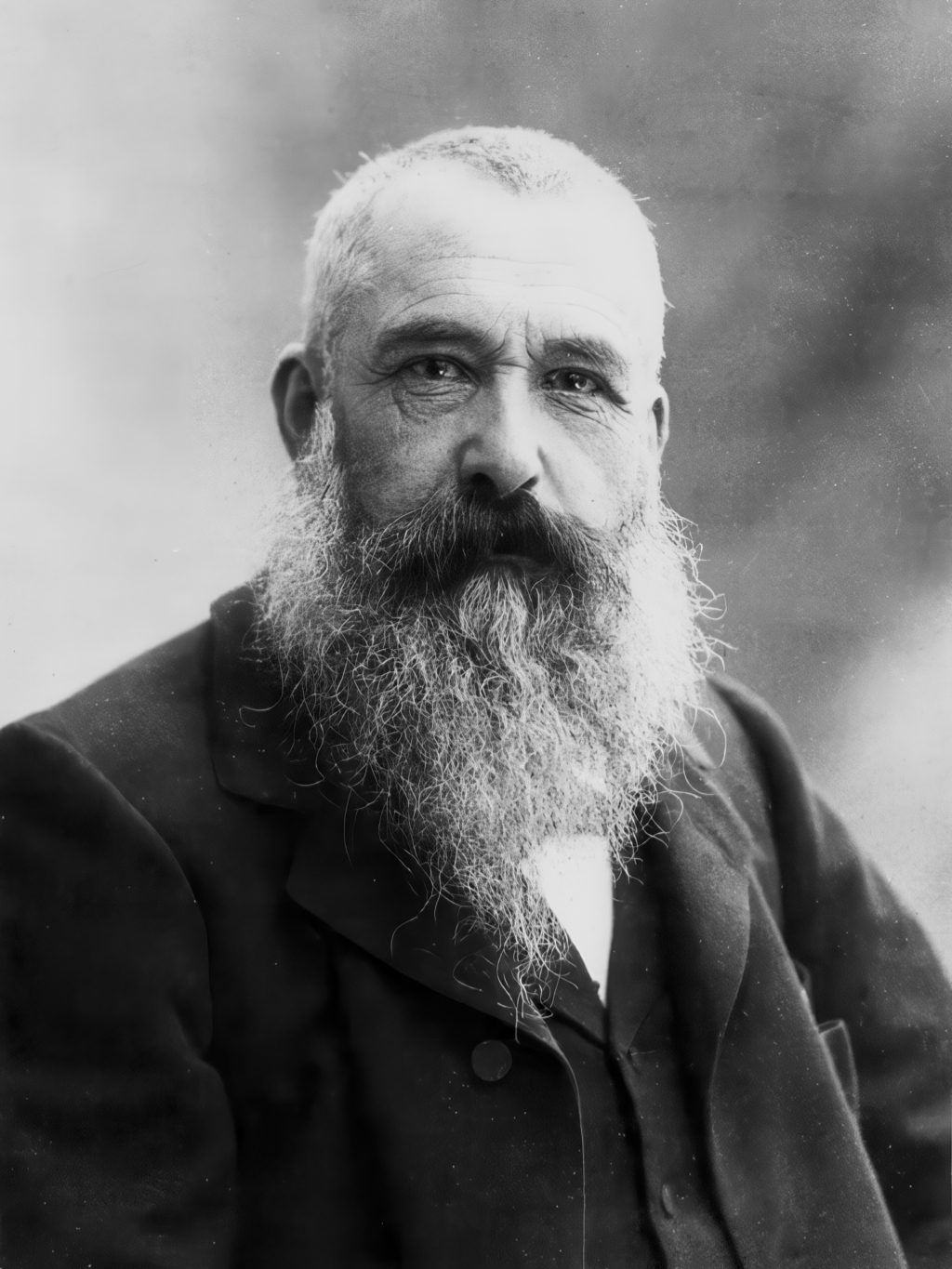
My garden is a slow work, pursued with love and I do not deny that I am proud of it.
Monet's Garden Explained
Claude Monet's Artist's Garden at Giverny from 1900 was produced in the Clos Normand section of his garden in Giverny.
When Monet painted Artist's Garden at Giverny, he had been living at his country home in Giverny since 1883. During this time he gradually transformed the property into a spectacular garden designed specifically to inspire his art.
Monet treated the garden as a living studio. He worked closely with several gardeners and gave daily instructions about planting arrangements, colour combinations and seasonal rotations of flowers. Over the years the property evolved into one of the most famous artist gardens in history.
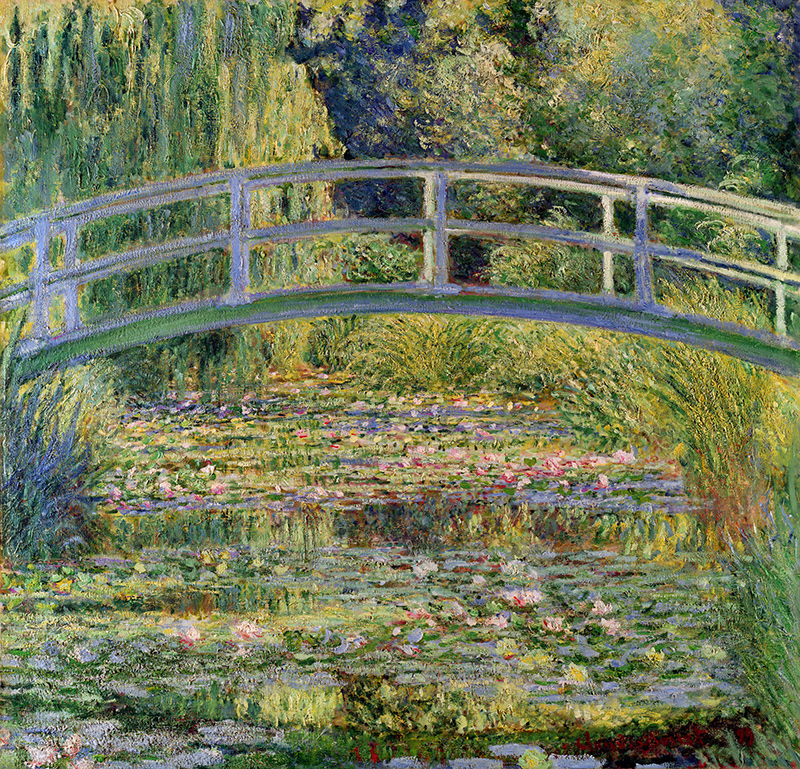
This part of his garden is around one hectare in size and was the first part to be completed. Monet then later bought additional land, and on this new area he would construct his water lily pond with Japanese bridge.
Art historians and horticultural researchers have attempted to identify the different plant species visible in Artist's Garden at Giverny. Photographs and written records of Monet's garden suggest the presence of several varieties including Iris germanica and Rosa alba as well as long formal flowerbeds, winding pathways and carefully arranged colour schemes..
The purple irises dominating the composition were among Monet's favourite flowers. Their strong vertical stems and rich colour made them ideal subjects for Impressionist painting.
Many of the same plants cultivated by Monet continue to grow in the restored gardens at Giverny today.
Claude Monet in the Year 1900
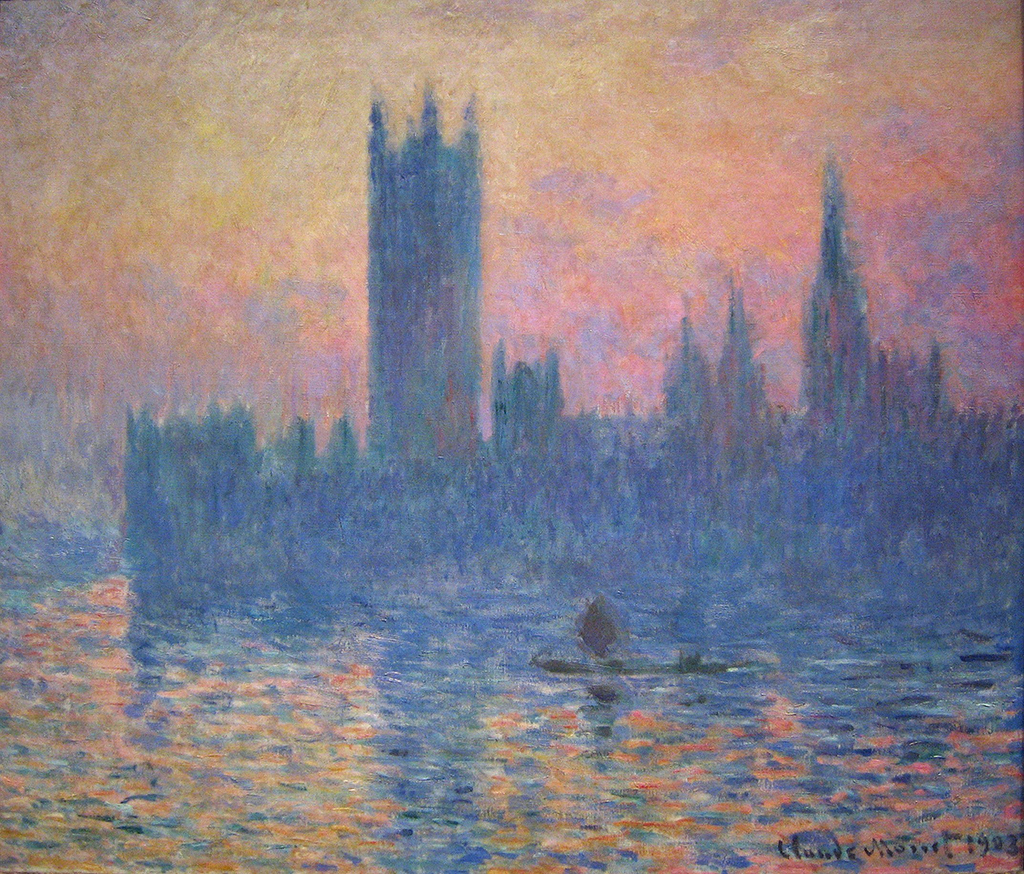
In the year 1900 we also now that he worked in London for a series of depictions of the Houses of Parliament as well as some of his famous depictions of water lilies, elsewhere in his garden.
Large Image of Artist's Garden at Giverny
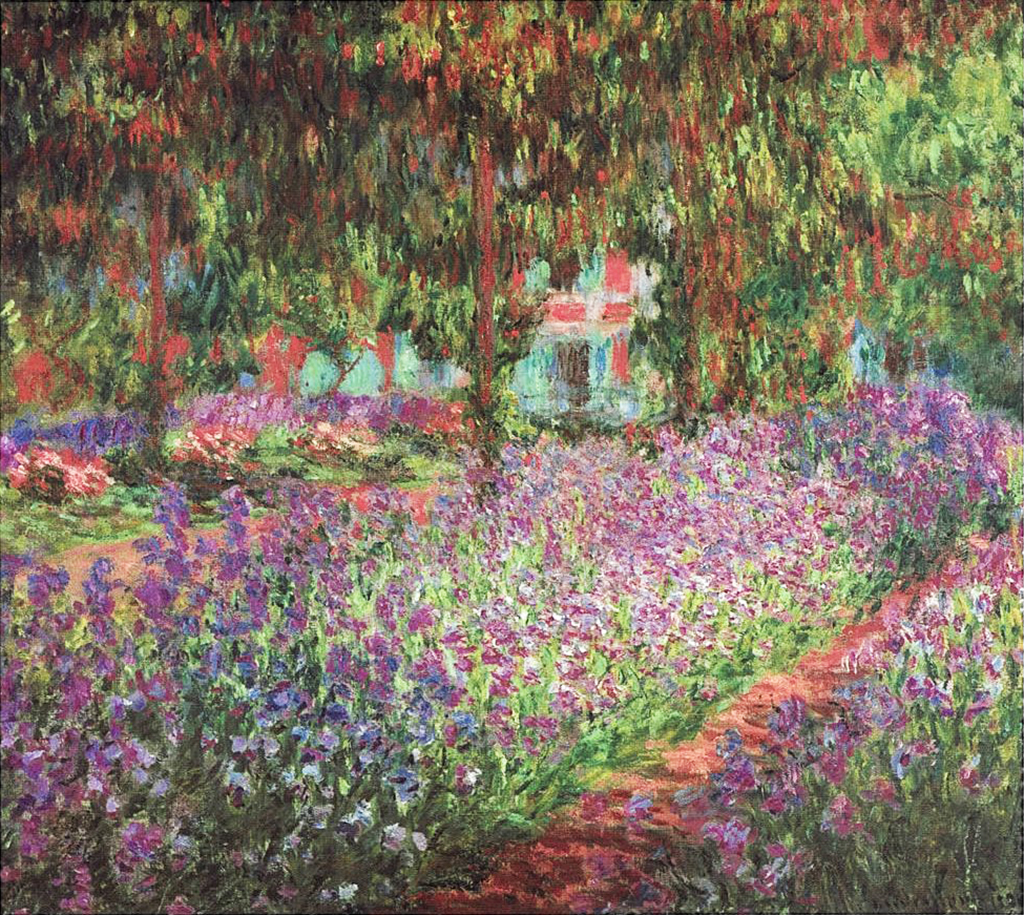
Artist's Garden at Giverny, Claude Monet, 1900, Musée d'Orsay, Paris, France
Further Images of Artist's Garden at Giverny
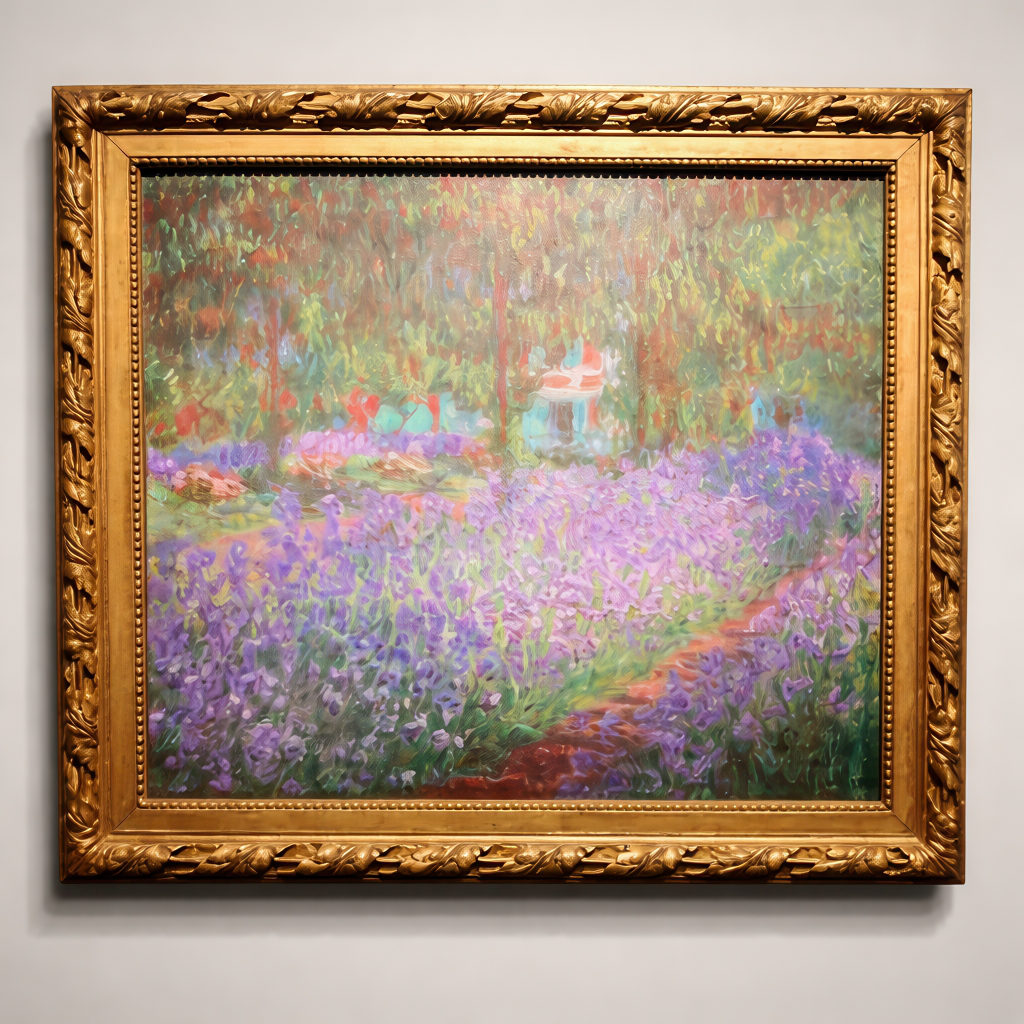
Artist's Garden at Giverny on Display at Musee d'Orsay, Paris
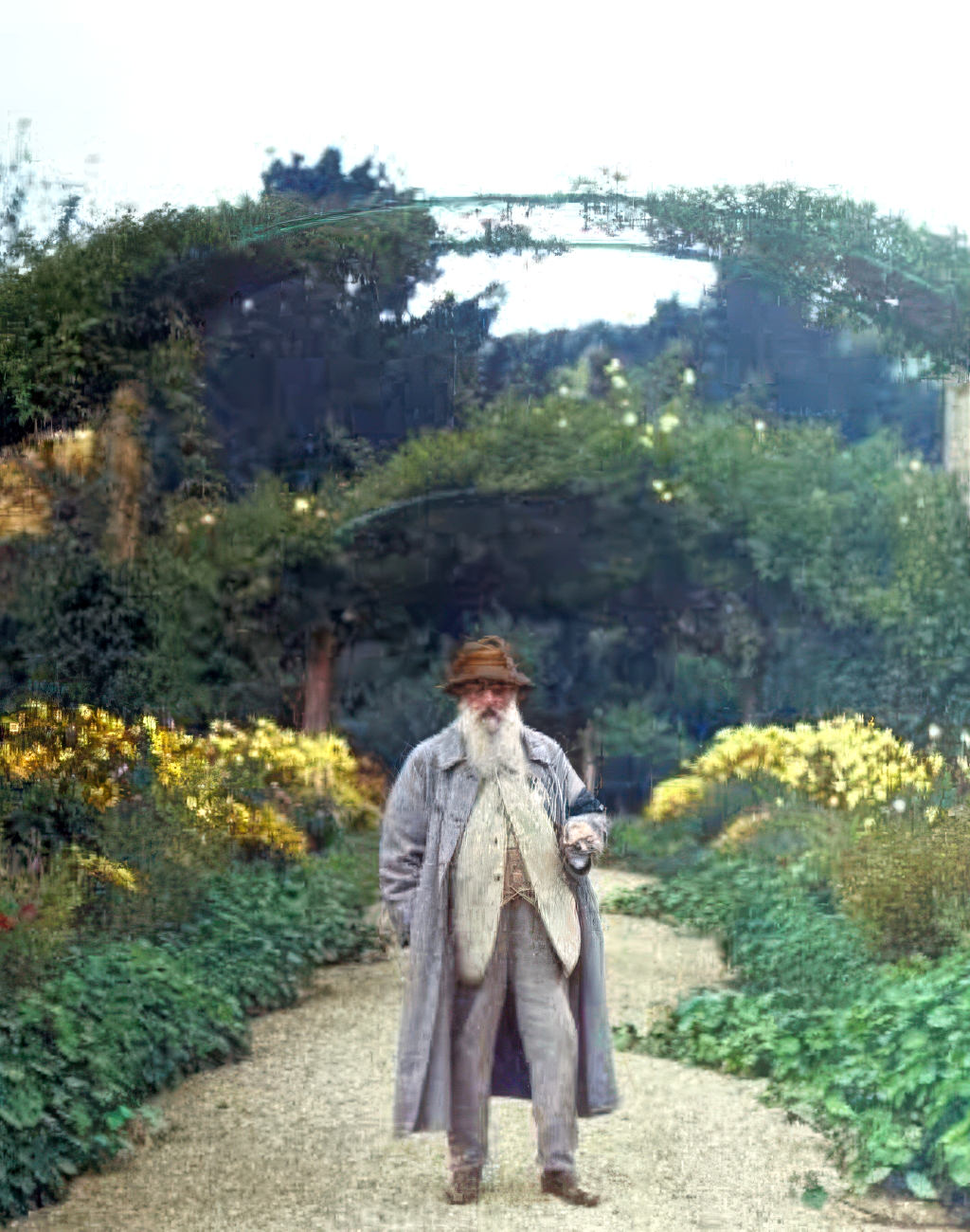
Monet in his Garden, 1899
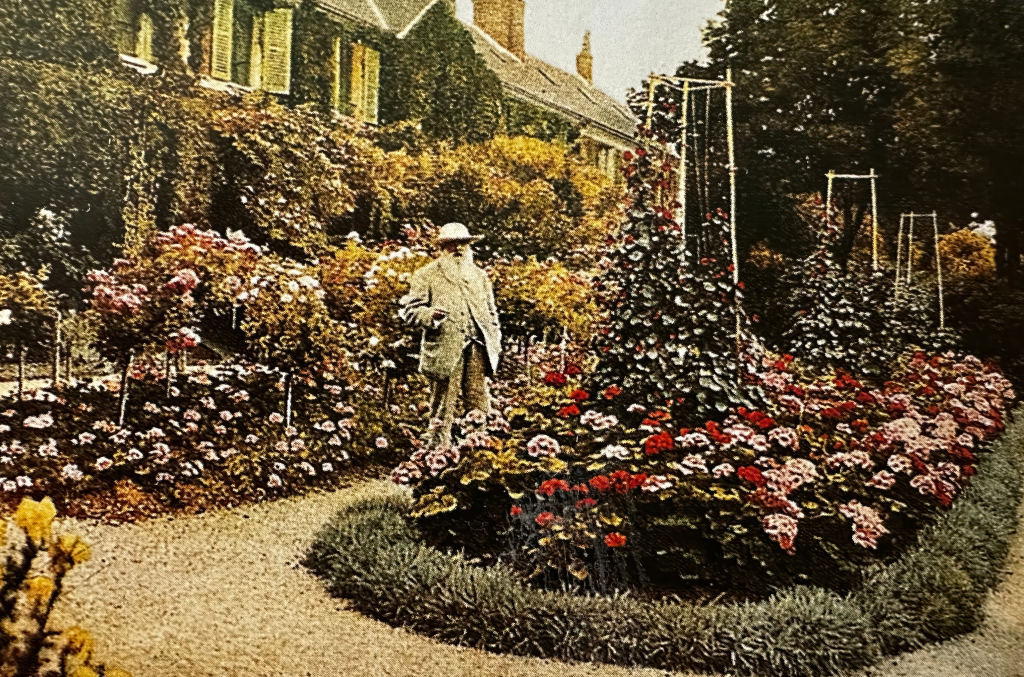
Claude Monet Admiring his Garden in Bloom
Description
Perhaps the most striking feature of Artist's Garden at Giverny however is the extraordinary use of colour. While the deep purples of the lilacs dominate the canvas, we can see reds, golds, blues and browns spread across the work, merging into each other with a mastery that few other painters of his era could rival.
It was easy for Monet to understand this garden, having worked so hard to put it together over a number of years, and even the elements that were already then when he moved in would be cared for and developed into very much his own creation.
There is a strip of purple headed flowers striking across the centre of the painting. They are lined by paths on either side and the same species of plant appears to continue into the distance on both sides of the canvas.
At the back are several tall trees which add a vertical structure to the composition, and around their trunks there exists a small gap that reveals the facade of Monet's house. The brushwork is frenzied, with light and colour discovered in variations of every corner of the canvas.
Efforts have been made to document the different species of flowers and trees that were added by the artist during his own lifetime and there is a contrast between those that are pictured here, and then those that were added afterwards as part of the extension which was centered around his water lily pond.
Technique
Monet was an artist who loved freedom and avoided curated content as much as possible. In the example of this section of his garden, however, he did carefully plan the walkways, and angles them in the painting. In between, though, the flowers can spread freely, and after planting he loved to see a more natural formation appear over time.
These paths run along both sides of the flowerbed, creating strong perspective lines that draw the viewer's eye deeper into the scene. At the far end of the garden tall trees form a dark canopy, partially revealing the façade of Monet's house behind them.
The artist carefully captures these in order to provide clear vertical and horizontal lines around which the flowers can co-exist. It also helps to provide perspective in this scene, despite so much detail being delivered in a relatively abstract manner.
Use of Colour
One of the most striking features of the painting is Monet's bold and sophisticated use of colour. The dominant purples of the irises are balanced by patches of red, yellow, green and blue distributed throughout the garden.
Rather than blending colours smoothly, Monet applies paint in quick, energetic brushstrokes. This technique allows individual colours to vibrate against one another, producing a shimmering visual effect that mimics the sensation of sunlight falling across flowers.
This painting technique ensures that viewers of Artist's Garden at Giverny from 1900 will have different experiences, depending on how close they stand to the painting. Up close, they will see individual brushstrokes, in a seemingly haphazard manner, but further back it all combines seamlessly.
The result is a painting that feels alive with movement and atmosphere, capturing the fleeting sensory experience of walking through a garden on a warm summer day. This is classical Impressionism, in every way.
Provenance
Find below a list of provenance, outlining the ownership of Monet's Artist's Garden at Giverny since its completion in 1900.
- From 1900: in the Montaignac collection (acquired from the artist in November)
- Wolkovyski collection, Paris
- Until 1928: in the Laffon collection
- 1928: sale [Laffon], Paris, Hôtel Drouot, 23 June 1928, lot 78 (under the title “The Irises”, withdrawn from sale)
- 1928: returned to the Laffon collection (withdrawn from the sale)
- 1929: in the Durand-Ruel collection, Paris (acquired on 15 May)
- 1983: accepted by the French State as a dation in payment of inheritance taxes for the National Museums (committee 30/09/1982; council 06/10/1982; interministerial approval commission 08/11/1982; decision of the Minister of Budget 23/02/1983; decree 09/03/1983)
- 1983: assigned to the Musée d'Orsay, Paris
Exhibitions
The following is a comprehensive list of major exhibitions in which Monet's Artist's Garden at Giverny has featured from the year 1900 up to the present day.
- 1900 - Monet, Durand-Ruel Gallery - Paris, France
- 1931 - Claude Monet: Retrospective Exhibition, Musée de l'Orangerie - Paris, France
- 1952 - Claude Monet 1840-1926, Kunsthaus Zürich - Zurich, Switzerland
- 1952 - Claude Monet, Gemeentemuseum - The Hague, Netherlands
- 1970 - Claude Monet, Durand-Ruel Gallery - Paris, France
- 1980 - Tribute to Claude Monet, Grand Palais - Paris, France
- 1984 - A Day in the Country: Impressionism and the French Landscape, Los Angeles County Museum of Art - Los Angeles, USA
- 1984-1985 - A Day in the Country: Impressionism and the French Landscape, Art Institute of Chicago - Chicago, USA
- 1985 - Impressionism and the French Landscape, Grand Palais - Paris, France
- 1997 - Émile Verhaeren: An Imaginary Museum, Musée Charlier - Brussels, Belgium
- 2000-2001 - Impressionism and Modern Art, Deoksu Palace - Seoul, South Korea
- 2001 - Monet and Japan, National Gallery of Australia - Canberra, Australia
- 2001 - Monet and Japan, Art Gallery of Western Australia - Perth, Australia
- 2004-2005 - Monet's Garden, Kunsthaus Zürich - Zurich, Switzerland
- 2007 - Monet: His Art and Legacy, National Art Center - Tokyo, Japan
- 2007-2008 - In Monet's Garden: Artists and the Lure of Giverny, Columbus Museum of Art - Columbus, USA
- 2010-2011 - Claude Monet 1840-1926, Grand Palais - Paris, France
- 2011 - The Revolution of the Gaze: Impressionist and Post-Impressionist Masterpieces from the Musée d'Orsay, MART - Rovereto, Italy
- 2014 - Musée d'Orsay Masterpieces, Vittoriano Complex - Rome, Italy
- 2015-2016 - Painting the Modern Garden: Monet to Matisse, Cleveland Museum of Art - Cleveland, USA
- 2016 - Painting the Modern Garden: Monet to Matisse, Royal Academy of Arts - London, United Kingdom
- 2017-2018 - Christian Dior: Designer of Dreams, Musée des Arts Décoratifs - Paris, France
- 2022 - Monet, Hoschedé-Monet and the Butler Family: A Family Saga, Musée Alphonse-Georges Poulain - Vernon, France
- 2023-2024 - The Garden: Art and Nature over Six Centuries, Nationalmuseum - Stockholm, Sweden
- 2025 - 100 Works that Tell the Story of Climate, Musée Médard - Lunel, France
Critical Analysis
"He was meticulous in his approach to planning the garden, which expanded over the years to incorporate his now famous pond. Monet undertook extensive research for his garden and planned and planted his flowerbeds with the colour of his blooms and the time of their flowering foremost in his mind to produce a coherent aesthetic throughout.
His garden was a constant source of inspiration to him, particularly in later life and included one especially important flowerbed planted in memory of his beloved aunt. The flowerbed was below the artist's bedroom window and was an exact copy of one that his aunt had had, and he had painted, at her home in Saint-Adresse."
Tamsin Pickeral, Monet - The World's Greatest Art, Flame Tree Publishing, 2011, PP198-199
"Flowers and shrubs were scattered far and wide in specific colour combinations that set each other off to advantage so that, viewed from a distance as with Monet's Impressionist paintings, they dissolve into shimmering patches of colour to make a kind of flower carpet."
Birgit Zeidler, Monet - Art in Focus, Konemann, 2005, PP80-81
When Monet moved to Giverny, the long pink render house had a 1-hectare garden comprising an apple orchard and a kitchen garden. A central path lined with cypress and spruce.
Claudemonetgiverny.fr
The land is divided into flowerbeds where flower clumps of different heights create volume. Fruit trees or ornamental trees dominate the climbing roses, the long -stemmed hollyhocks and the coloured banks of annuals. Monet mixed the simplest flowers (daisies and poppies) with the most rare varieties.
The central alley is covered over by iron arches on which climbing roses grow. Other rose trees cover the balustrade along the house. At the end of the summer nasturtiums invade the soil in the central alley.
Claude Monet did not like organized nor constrained gardens. He married flowers according to their colours and left them to grow rather freely.
With the passing years he developed a passion for botany, exchanging plants with his friends Clemenceau and Caillebotte. Always on the look-out for rare varieties, he bought young plants at great expense.
Giverny.org
Location of the Painting Today
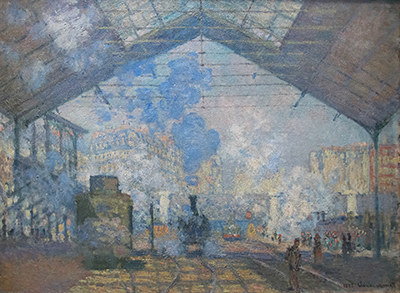
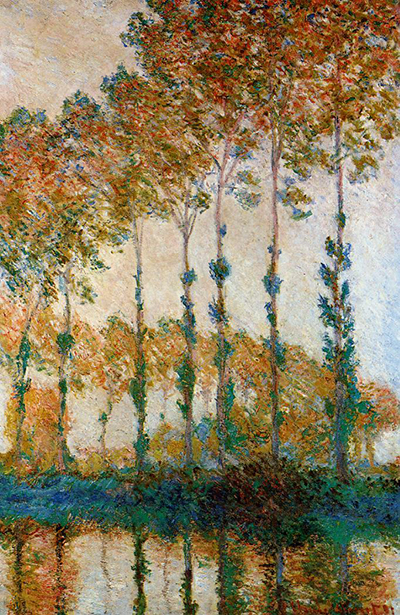
This original painting from 1900 is now to be found at the Musée d'Orsay, Paris, as part of their impressive collection of work by Claude Monet. Alongside Artist's Garden at Giverny, you will also find many other significant artworks from his career including The Saint-Lazare Station, The Rue Montorgueil in Paris, The Poplars, Rouen Cathedral, Haystacks, The Magpie and Women in the Garden.
Besides all of that, there are also a number of other famous French artists featured in this institution as well, making this an exceptional venue for those looking to understand more about this nation's art history, with a particular focus on the period of the 18th to 20th centuries.
Art visitors to the city will normally head to the Louvre first, which is understandable, but it would be a crying shame to miss out on a trip to the Musée d'Orsay as its collection is also highly impressive.
Although the Louvre attracts the largest crowds in Paris, many art historians consider the Musée d'Orsay the finest museum in the world for understanding the development of nineteenth-century French painting.
Artist's Garden at Giverny is not a particularly large artwork, measuring 92cm by 82cm which is about standard for the impressionist movement, but much smaller than some of the artist's own water lily murals, for example. He seemed to want to produce something here that was personal and intimate, just like the garden from which he was working at the time.
Le jardin de l'artiste à Giverny, to give it it's original French title as given to the painting by the artist back in 1900, has been involved in at least 20 different exhibitions since its inception.
It has travelled around Europe as well as to the USA in order to be seen by a wider audience but will generally be out on display in the permanent collection of the d'Orsay.
The Legacy of Monet's Garden Paintings
Monet returned to the gardens at Giverny as a subject for the rest of his life. The property inspired hundreds of paintings, including the famous Water Lilies series that would dominate the final decades of his career.
Today the gardens at Giverny are preserved as part of the Fondation Claude Monet and attract hundreds of thousands of visitors each year. Walking through the flowerbeds and lily ponds allows visitors to experience the same landscape that inspired some of the most famous paintings in the history of art, whilst the lily and Japanese bright displays that came in the second phase brought about his most impressive series of work.
Artist's Garden at Giverny therefore represents more than a simple garden scene. It is a portrait of the environment that shaped Monet's late artistic vision and one of the most beautiful visual records of the garden he spent decades creating. We must also remember that gardening brought great relief to the troubled mind of Monet, who had experienced tragedy several times in his lifetime.
The simple action of growing, caring and observing nature continues to provide respite for artists and non-artists alike.
Frequently Asked Questions
References
- Tamsin Pickeral, Monet - The World's Greatest Art, Flame Tree Publishing, 2011, PP198-199
- Birgit Zeidler, Monet - Art in Focus, Konemann, 2005, PP80-81
- Claudemonetgiverny.fr
- Giverny.org