


 by Tom Gurney
Tom Gurney BSc (Hons) is an art history expert with over 20 years experience
Published on October 6, 2016 / Updated on May 7, 2026
Email: tomgurney1@gmail.com / Phone: +44 7429 011000
Claude Monet's Japanese Bridge paintings show the artist turning his garden at Giverny into one of the most famous subjects in modern art.
Claude Monet's Japanese Bridge paintings are among the most recognisable images from his final decades. They show the arched wooden bridge that Monet built across the water-lily pond at his home in Giverny, surrounded by willow trees, water lilies, reflections and dense garden foliage.
The bridge was not simply a decorative feature. Monet created the water garden himself after acquiring additional land beside his property in 1893, enlarging the pond, planting water lilies and designing a setting that would provide him with motifs to paint. 1
Monet owned Japanese prints and was deeply interested in Japanese design. The bridge at Giverny reflects this wider fascination with Japanese prints and Japonisme. Its curve, the flattened surface of the pond and the decorative spread of foliage all helped Monet move away from traditional European perspective.
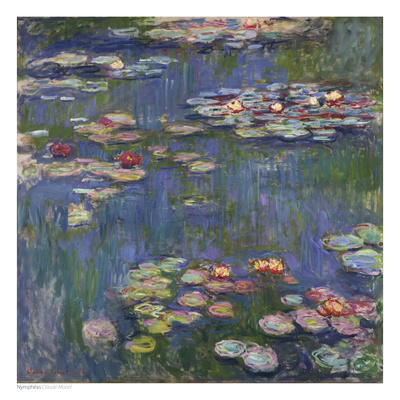
The Japanese Bridge paintings are closely connected to Monet's wider Water Lilies series. In the early works, the bridge gives the composition a clear structure. Later, Monet moved closer to the pond surface, gradually removing the bridge, banks and horizon until water, flowers and reflections became the whole subject.
Claude Monet Japanese Bridge: Summary
- Artist: Claude Monet
- Main subject: The Japanese-style bridge over Monet's water-lily pond
- Location: Giverny, Normandy, France
- Main period: 1899-1900, with later bridge paintings after 1918
- Related series: Water Lilies / Les Nymphéas
- Influence: Japanese prints, garden design and Impressionist colour
Table of Contents
- What is Monet's Japanese Bridge?
- Giverny and the Creation of the Bridge
- Japanese Influence and Japonisme
- The 1899 Japanese Bridge Series
- Composition and Colour
- Connection with the Water Lilies
- Late Japanese Bridge Paintings
- Famous Japanese Bridge Paintings
- Where to See Monet's Japanese Bridge Paintings
What is Monet's Japanese Bridge?
Monet's Japanese Bridge was a wooden arched footbridge built over the lily pond in his water garden at Giverny. It became one of the key motifs of his late career, appearing in a group of paintings from 1899 and 1900 and again in more expressive later works.
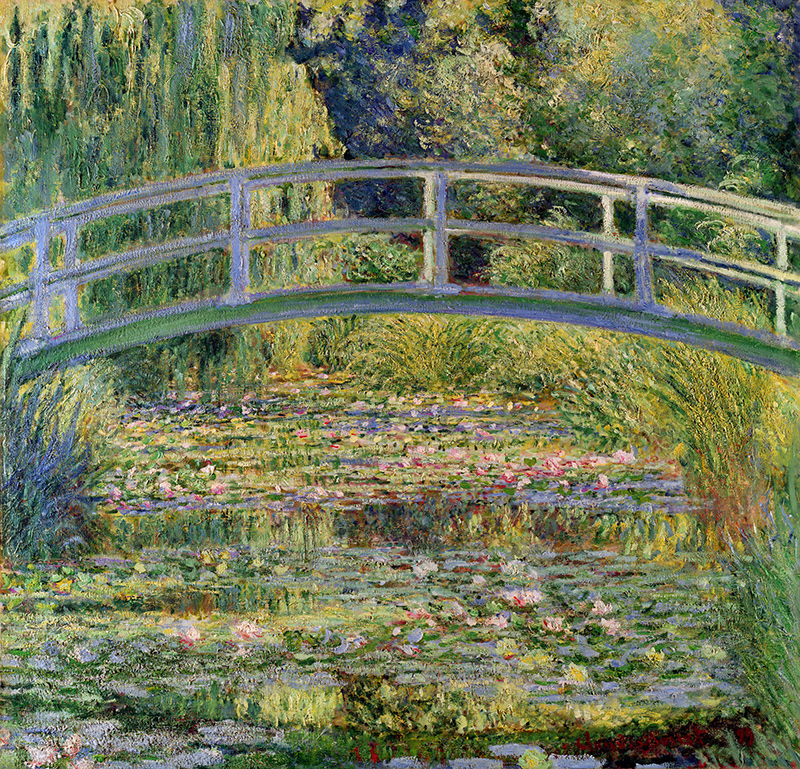
The bridge usually stretches across the width of the canvas, dividing the composition into two zones. Above it are trees, willows and dense foliage; below it are water lilies, flowers and reflections. This gives the paintings a powerful sense of enclosure, as if the viewer has stepped directly into Monet's garden.
In the best-known versions, the bridge is painted green rather than red, giving it a softer relationship with the surrounding plants and water. The Fondation Claude Monet notes that the bridge was inspired by Japanese prints but painted green to distinguish it from the red often associated with Japanese bridges. 2
Giverny and the Creation of the Bridge
Monet moved to Giverny in 1883 and gradually transformed the property into a carefully planned environment of colour, plants and reflections. The garden was not merely a place of relaxation. It became a living studio.
In 1893, he acquired land near his house and began creating the water garden. The National Gallery describes how Monet enlarged the existing pond, filled it with exotic hybrid water lilies and built a humpback bridge inspired by Japanese prints. 1
Hiring craftsmen and gardeners to do the work, a lot of attention was paid to developing it to his detailed designs. It meant that there were weeping willows, iris and bamboo growing around what had become a pond.
In that pond were clusters of water lilies and blossoms that floated on the still water. In creating the garden, he used craftsman to build the Japanese bridge that crossed over the pond.
The garden is considered by some to be a major work of environmental art. For Monet, the garden was a passion and a source of artistic inspiration for almost 30 years.
The Met records that Monet bought land with a pond near his property with the intention of creating something "for the pleasure of the eye and also for motifs to paint." 3 This phrase is crucial: the Japanese Bridge was not just a garden ornament. It was part of a painter's working environment.
For a wider guide to the setting, see Monet's Garden at Giverny.
Japanese Influence and Japonisme
The bridge reflects Monet's interest in Japanese art, particularly the prints that were widely collected by European artists in the second half of the nineteenth century. Monet himself owned Japanese prints, and their influence can be seen in his taste for asymmetry, decorative surface, cropping and flattened space.
In the Japanese Bridge paintings, the garden is not organised like a traditional European landscape with a distant horizon. Instead, the bridge, foliage, water and reflections press toward the surface of the canvas. The effect is decorative, intimate and enclosed.
This is one reason the bridge matters so much. It shows Monet combining Japanese visual ideas with Impressionist colour and brushwork. The result is not a copy of Japanese art, but a personal transformation of it inside his own garden at Giverny.
For a fuller discussion of this subject, see Claude Monet and Japanese Prints.
The 1899 Japanese Bridge Series
In 1899 Monet began a concentrated group of paintings showing the bridge over the water-lily pond. The Metropolitan Museum of Art notes that he began eighteen views of the wooden footbridge over the pond and completed twelve paintings that summer, including the Met's own Bridge over a Pond of Water Lilies. 3
These works are among the clearest links between the Japanese Bridge and the Water Lilies. The bridge gives the scene structure, while the pond below introduces the floating lilies and reflections that would later take over the whole composition.
Monet was not simply repeating the same view. Each painting explores a slightly different balance of colour, light, foliage, water and reflection. In some versions, the bridge appears pale and luminous; in others, it is absorbed into a dense green harmony.
Composition and Colour
The Japanese Bridge paintings are built around a simple but powerful structure. The bridge arcs across the middle or upper part of the painting, while the pond below holds the reflections, water lilies and shifting patches of colour.
This structure allows Monet to balance stability and movement. The bridge provides architecture, but everything around it seems fluid: leaves shimmer, reflections break apart, water lilies float, and brushstrokes dissolve the edges of forms.
| Element | Role in the painting | Visual effect |
|---|---|---|
| Japanese bridge | Provides structure and a focal point | Creates an arch across the pond |
| Water lilies | Float across the lower part of the canvas | Add rhythm, colour and surface pattern |
| Willows and foliage | Frame the bridge and enclose the garden | Creates a dense green atmosphere |
| Reflections | Mirror trees, bridge and light in the pond | Blur the line between surface and depth |
| Green harmony | Unifies bridge, leaves and water | Makes the scene feel decorative and immersive |
Connection with the Water Lilies
The Japanese Bridge paintings are best understood as part of the larger development of Monet's Water Lilies. In the early bridge paintings, the viewer still understands the garden as a place: a bridge, a pond, trees, flowers and banks.
Over time, Monet moved closer to the water. The bridge and banks disappeared from view, while the pond surface became the main subject. This shift led to the later Water Lilies, where reflections, flowers and colour fill the entire canvas.
The Japanese Bridge therefore connects three things: Monet's collecting, his gardening and his painting. To understand the visual source behind this transformation, see Monet's love of Japanese prints.
Late Japanese Bridge Paintings
Monet returned to the bridge motif in later years, producing more expressive and sometimes more turbulent versions. These late paintings are very different from the calm green harmonies of 1899. The forms are looser, the colours stronger and the brushwork more forceful.
Some late Japanese Bridge paintings show the bridge almost engulfed by paint. Reds, oranges, blues, greens and purples can dominate the canvas, while the structure of the bridge becomes harder to read. These works are often discussed alongside Monet's late style and his struggle with cataracts.
They should not be dismissed as merely the result of impaired eyesight. Like the late Water Lilies, they show Monet pushing colour and brushwork toward a more expressive, modern language.
Famous Japanese Bridge Paintings
Several major versions of Monet's Japanese Bridge and related water-lily pond paintings are now held in important museum collections.
| Painting | Date | Collection | Why it matters |
|---|---|---|---|
| The Water-Lily Pond | 1899 | National Gallery, London | One of the most famous bridge views, with the bridge spanning the pond in a green garden setting. 1 |
| Bridge over a Pond of Water Lilies | 1899 | Metropolitan Museum of Art, New York | A vertical version that emphasises the bridge, pond surface and reflected foliage. 3 |
| Water Lilies and Japanese Bridge | 1899 | Princeton University Art Museum | Links Monet's garden design directly with the paintings it inspired. 4 |
| Le Bassin aux nymphéas, harmonie verte | 1899 | Musée d'Orsay, Paris | A dense green harmony in which bridge, foliage and water merge into a decorative surface. 5 |
Where to See Monet's Japanese Bridge Paintings
Important Japanese Bridge and related water-lily pond paintings can be seen in London, New York, Princeton and Paris. The National Gallery's The Water-Lily Pond, the Met's Bridge over a Pond of Water Lilies, Princeton's Water Lilies and Japanese Bridge and Musée d'Orsay's Le Bassin aux nymphéas, harmonie verte are among the best places to begin.
Visitors can also see the real bridge and water garden at Giverny. Although the garden has changed and been restored over time, it remains one of the most important artist sites in France and gives valuable context for understanding the paintings.
FAQs about Monet's Japanese Bridge
References
- National Gallery, London, “Claude Monet, The Water-Lily Pond,” The National Gallery, View source.
- Fondation Claude Monet, “Water Lily Pond,” Maison et jardins de Claude Monet, View source.
- Metropolitan Museum of Art, “Claude Monet, Bridge over a Pond of Water Lilies,” The Met, View source.
- Princeton University Art Museum, “Water Lilies and Japanese Bridge,” Princeton University Art Museum, View source.
- Musée d'Orsay, “Le Bassin aux nymphéas, harmonie verte,” Musée d'Orsay, View source.