

 by Tom Gurney
Tom Gurney BSc (Hons) is an art history expert with over 20 years experience
Published on May 7, 2026 / Updated on May 9, 2026
Email: tomgurney1@gmail.com / Phone: +44 7429 011000
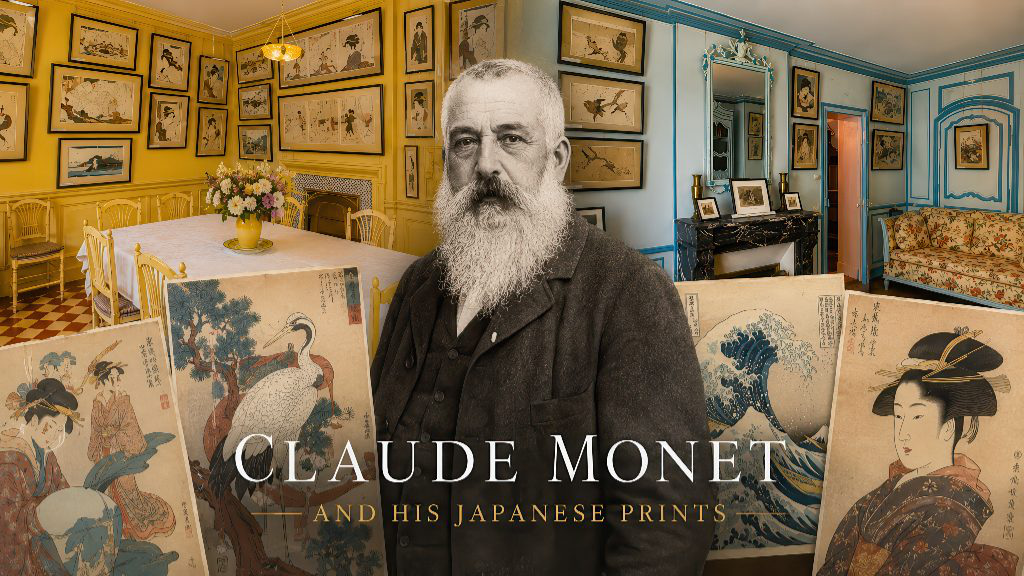
Claude Monet's love of Japanese prints helped transform the way he composed paintings, designed his garden at Giverny and imagined the world of the Water Lilies.
Claude Monet is remembered as the great painter of French light: the Seine, the coast of Normandy, the fields of Giverny and the changing atmosphere of modern life.
Yet one of the most important influences on his art came from far beyond France. Monet was a passionate collector of Japanese prints, and the visual language of Japan shaped his work in ways that are easy to overlook but impossible to ignore once seen.
His house at Giverny still preserves one of the clearest signs of this fascination: the Japanese woodblock prints he collected and displayed in his home.
The Fondation Claude Monet records a large collection of prints, including works by major ukiyo-e masters such as Kitagawa Utamaro, Katsushika Hokusai and Utagawa Hiroshige. 1
Monet's interest in Japanese art was not isolated. It formed part of a wider nineteenth-century movement known as Japonisme, when Japanese prints, ceramics, fans, lacquerware and textiles flooded into Europe after Japan reopened to international trade in the 1850s.
For artists in Paris, Japanese prints offered something radically different from academic painting: flattened space, unusual viewpoints, bold outlines, asymmetry, cropped figures and a fresh sense of everyday life.
For Monet, this was not simply a passing fashion. Japanese prints helped him think differently about composition, colour, surface and the relationship between art and nature. They influenced early works such as Garden at Sainte-Adresse, helped shape the theatrical La Japonaise, and later found deeper expression in the Japanese Bridge, the Giverny water garden and the late Water Lilies.
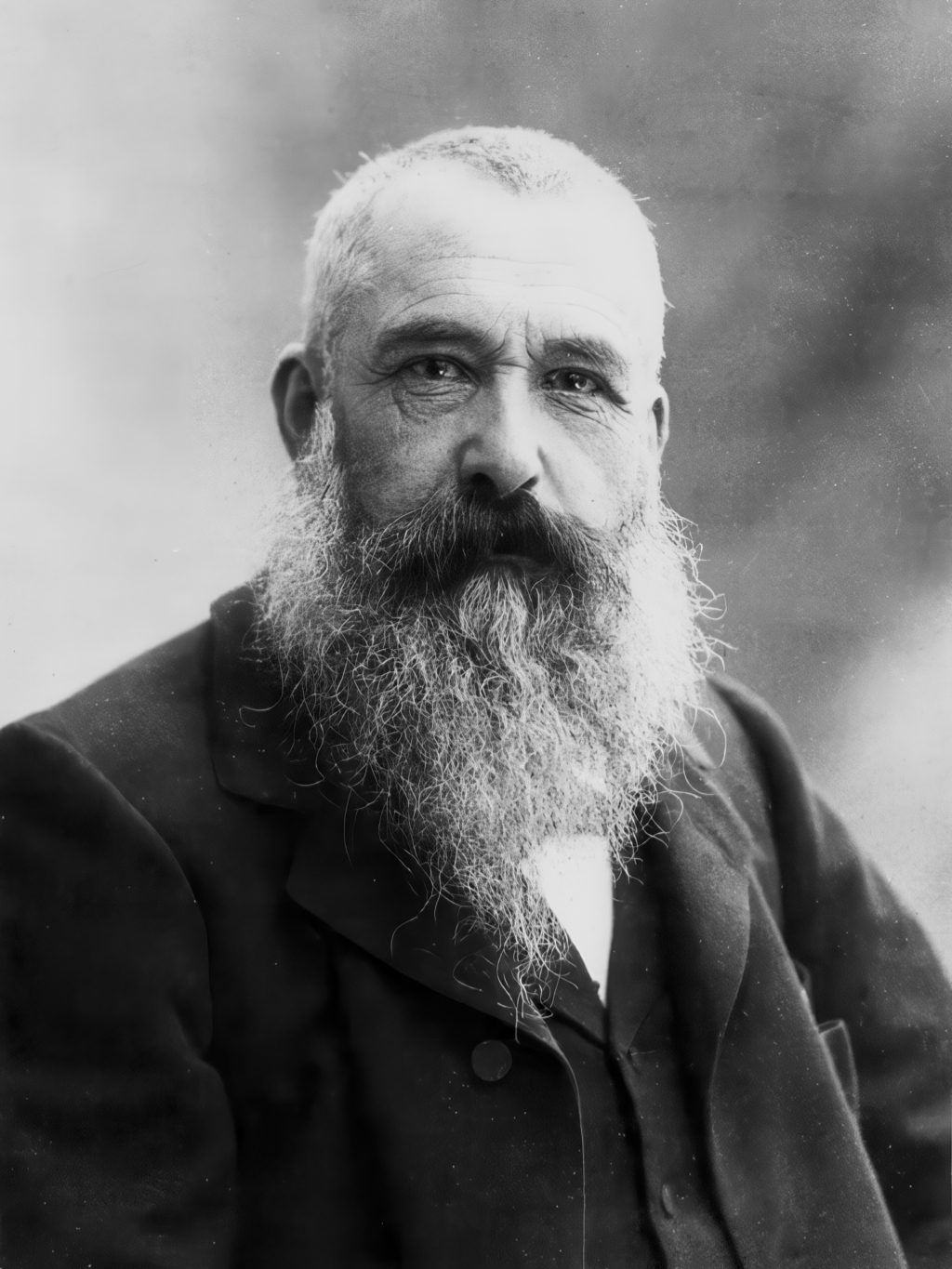
[I have] the deepest admiration for Japanese art and a great liking for the Japanese people.
Claude Monet and Japanese Prints: Summary
- Artist: Claude Monet
- Main influence: Japanese ukiyo-e woodblock prints
- Movement: Japonisme
- Key Japanese artists: Hokusai, Hiroshige, Utamaro
- Monet collection: More than 200 Japanese prints at Giverny
- Related works: La Japonaise, Japanese Bridge, Water Lilies
- Importance: Helped Monet rethink composition, colour, flatness and garden design
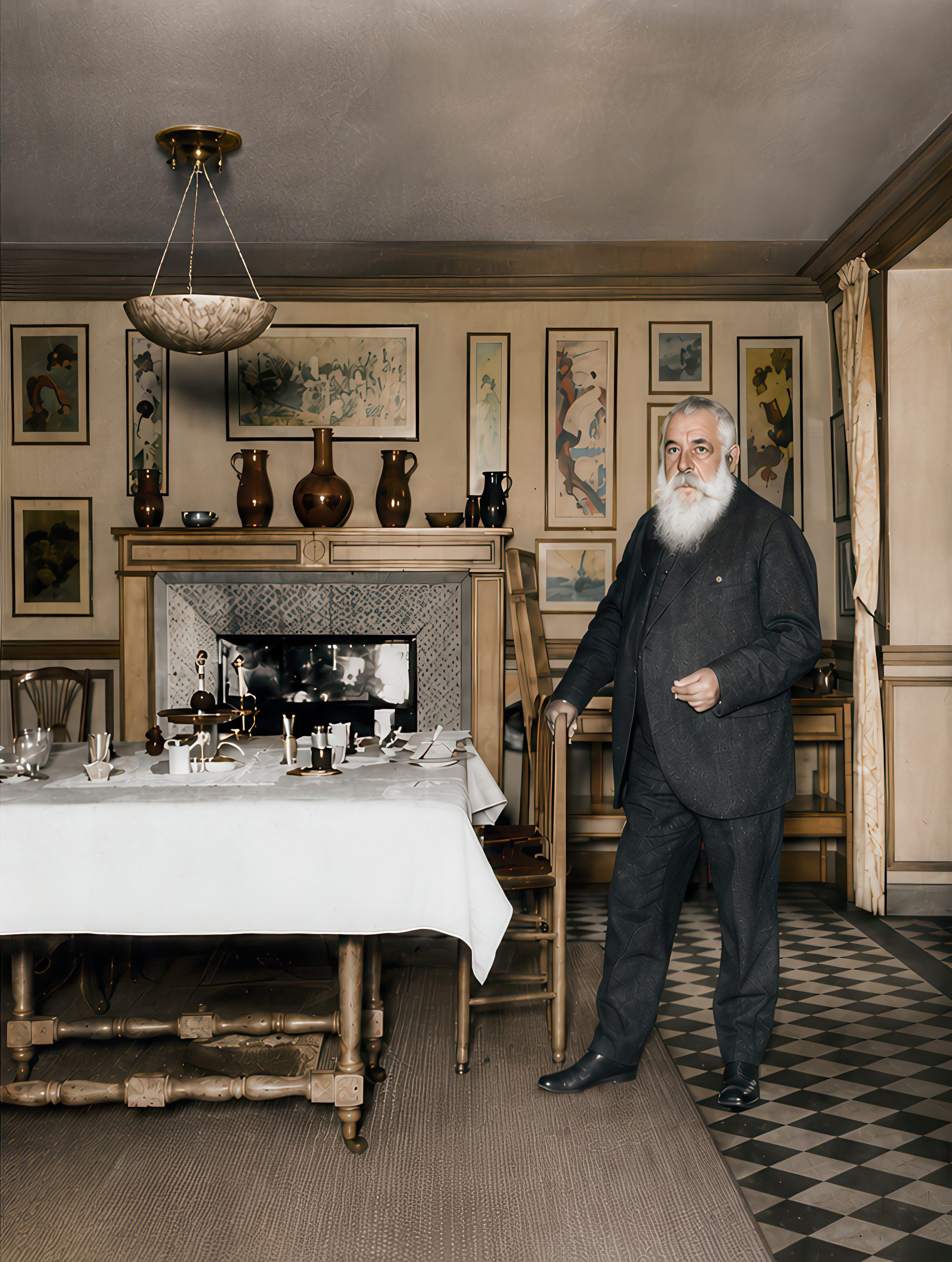
A restored historic photograph showing Claude Monet surrounded by Japanese woodblock prints inside his home at Giverny.
Table of Contents
- What are Japanese prints?
- What was Japonisme?
- Monet's Japanese Print Collection at Giverny
- What Monet Learned from Japanese Prints
- Hokusai, Hiroshige and Monet Comparison Gallery
- La Japonaise: Fashion, Performance and Japonisme
- Garden at Sainte-Adresse and Japanese Composition
- Giverny as a Japanese-Inspired World
- The Japanese Bridge at Giverny
- Japanese Prints and the Water Lilies
- Monet, Degas, Cassatt and Van Gogh
- Legacy of Japanese Prints in Monet's Art
What are Japanese prints?
The Japanese prints that fascinated Monet were mostly ukiyo-e woodblock prints. The phrase ukiyo-e is often translated as “pictures of the floating world”, referring to images of entertainment, theatre, pleasure districts, landscapes, travel, flowers, seasons and everyday life in Edo-period Japan.
These prints were not made like European oil paintings. A designer first created the image, which was then carved into wood blocks, inked and printed on paper. Separate blocks could be used for different colours. This collaborative process allowed prints to be produced in multiple impressions and circulated widely.
To European artists, ukiyo-e looked startlingly modern. They often used flat colour, strong contours, bold diagonals, cropped figures and asymmetrical compositions. They did not depend on Renaissance perspective, heavy modelling or dramatic chiaroscuro. Instead, they created visual rhythm through line, pattern, placement and contrast.
| Japanese print feature | Effect | Why it mattered to Monet |
|---|---|---|
| Flat colour | Reduces modelling and shadow | Encouraged colour as design rather than description |
| Asymmetry | Moves the subject away from the centre | Helped Monet break from balanced academic composition |
| Cropping | Figures or objects may be cut by the edge | Created more immediate, modern-looking scenes |
| High viewpoints | Shows scenes from above or at unusual angles | Encouraged new ways of seeing landscape |
| Decorative pattern | Surfaces become visually active | Linked nature, fabric, foliage and water through repeated forms |
| Everyday subjects | Actors, women, travellers, gardens and landscapes | Confirmed that modern life and ordinary experience could be serious art |
What was Japonisme?
Japonisme was the nineteenth-century European fascination with Japanese art and design. It accelerated after Japan reopened to international trade in the 1850s, following more than two centuries of restricted contact with the West. Japanese goods then entered European markets in greater numbers, especially through ports and international exhibitions.
By the 1860s and 1870s, Paris had become one of the great centres of this enthusiasm. Japanese prints, fans, ceramics, lacquerware and textiles appeared in shops, studios and private collections. Dealers and critics helped popularise the new taste, while artists discovered in Japanese art a visual alternative to the rules of the Academy.
For some painters, Japonisme was mainly decorative: a kimono, a screen, a fan, a fashionable prop. For more adventurous artists, it was more profound. Japanese prints suggested a different way to organise a picture. They showed that a composition could be cropped, flattened, asymmetrical and still visually powerful.
This distinction is important for Monet. His early La Japonaise belongs partly to the world of spectacle and fashion, but his later use of Japanese ideas was deeper. At Giverny, Japonisme became a way of shaping space, water, colour and nature itself.
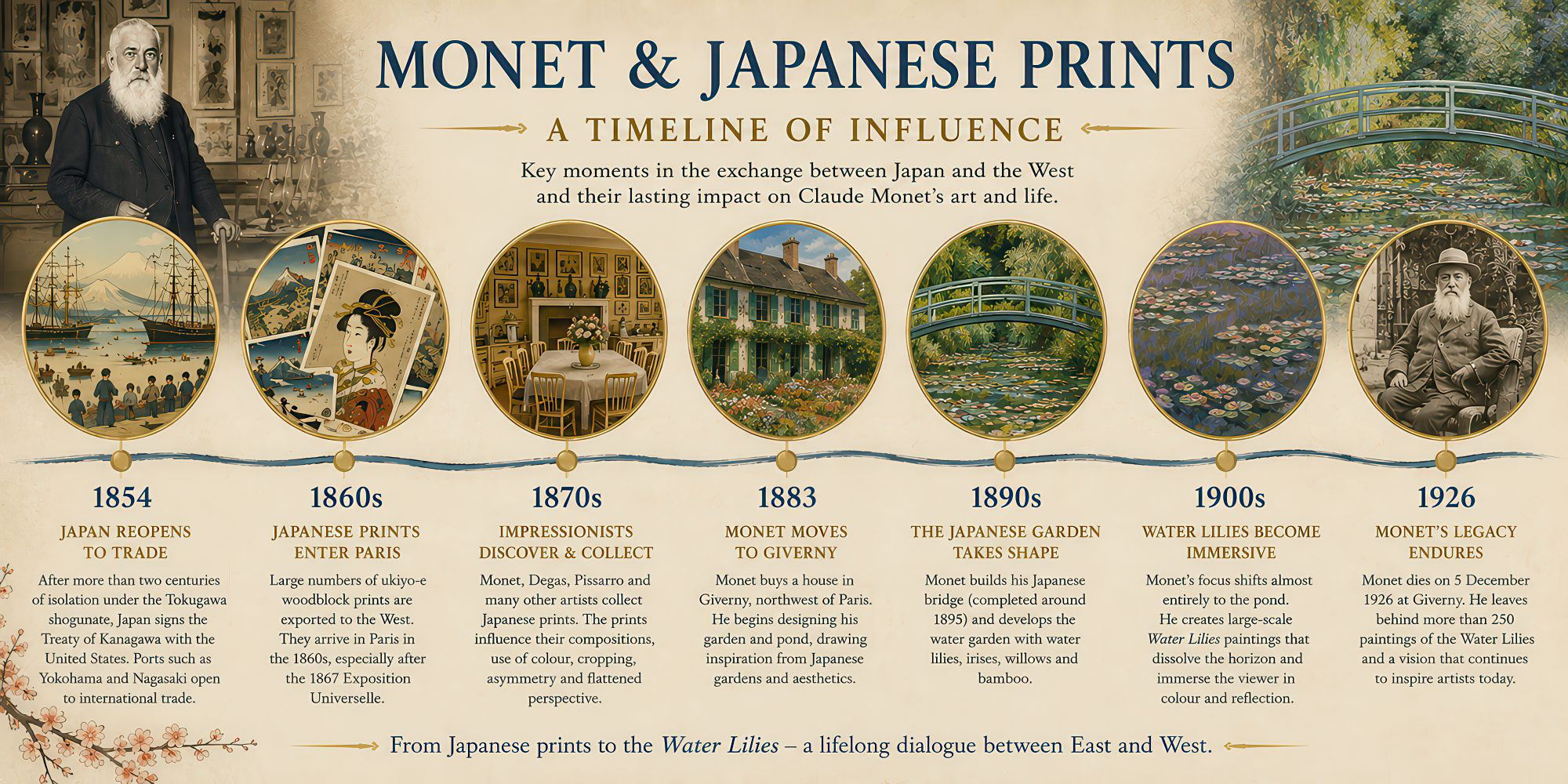
Illustrated timeline of Claude Monet and Japanese prints (click to enlarge).
It shows the rise of Japonisme, Monet's collection of ukiyo-e prints, the Japanese bridge at Giverny, and the development of the Water Lilies series.
Monet's Japanese Print Collection at Giverny
Monet did not merely admire Japanese prints from a distance. He collected them seriously and lived with them every day. At Giverny, his prints were displayed throughout the house, especially in the dining room, where their flat colours and clear designs would have formed part of the visual environment of daily life.
The Fondation Claude Monet records that Monet's collection includes major groups by Utamaro, Hokusai and Hiroshige, with 211 prints on display and additional works in storage.1 This is not a minor collection. It demonstrates a sustained, lifelong interest.
| Japanese artist | Known for | Relevance to Monet |
|---|---|---|
| Kitagawa Utamaro | Elegant images of women, intimate interiors, refined line | Helped European artists rethink figure placement, contour and domestic intimacy |
| Katsushika Hokusai | Landscapes, waves, Mount Fuji, dynamic design | Offered powerful models for movement, cropping, pattern and landscape rhythm |
| Utagawa Hiroshige | Rain, bridges, roads, rivers, seasons and atmospheric landscapes | Especially relevant to Monet's interest in weather, water, bridges and changing light |
Hokusai's landscapes, especially his Mount Fuji series, and Hiroshige's views of roads, bridges, rain and seasonal weather gave European artists a new model for landscape design. See also Hokusai's One Hundred Views of Mount Fuji and Hiroshige's Fifty-Three Stations of the Tōkaidō.
Monet's collection includes major groups by Katsushika Hokusai, Utagawa Hiroshige and Kitagawa Utamaro, three of the most important names in ukiyo-e printmaking.
Monet's Japanese Rooms at Giverny
Claude Monet's house at Giverny was not simply decorated with Japanese prints — it was effectively a lived-in private museum of ukiyo-e. By the time of his death in 1926, he owned around 231 Japanese woodblock prints, including major works by Kitagawa Utamaro, Katsushika Hokusai and Utagawa Hiroshige 1.
The Fondation Monet notes that his collection included 46 prints by Utamaro, 23 by Hokusai and 48 by Hiroshige alone 1. These works were distributed throughout the house, but two rooms are especially important: the yellow dining room and the blue sitting room, often known as the “blue salon”. Both rooms survive today at Giverny and reveal how deeply Japanese art entered Monet's daily life.
The Yellow Dining Room
The yellow dining room was one of the social centres of Monet's home. Family members, visiting artists, collectors and dealers gathered here beneath walls covered with Japanese woodblock prints. Rather than treating the prints as isolated museum objects, Monet integrated them into everyday life, surrounding himself constantly with Japanese imagery and design 1.
The room itself was radical for its time. Monet painted the walls, furniture and woodwork in a luminous chrome yellow, contrasting them with a red-and-cream tiled floor and dark framed prints. Modern visitors often remark that the room feels almost like stepping inside one of Monet's paintings 8.
Unlike many bourgeois interiors of the late nineteenth century, Monet avoided heavy dark decoration. Instead, the room emphasises flat areas of colour, strong outlines and rhythmic arrangements — qualities closely connected to Japanese ukiyo-e prints.
The walls were hung salon-style, with prints extending from eye level almost to the ceiling. The arrangement itself recalls nineteenth-century Parisian Japonisme interiors, but Monet's version was unusually immersive and personal.
Colour and Layout
The yellow dining room demonstrates how Japanese aesthetics influenced not only Monet's paintings but also his understanding of interior design. The room combines:
- intense yellow walls and furniture
- strong black framing lines
- flat decorative colour fields
- asymmetrical arrangements
- repetition and rhythm across the walls
- an emphasis on atmosphere over Victorian ornament
These characteristics closely parallel Japanese printmaking traditions, especially the bold contour lines and flattened decorative surfaces found in ukiyo-e 9.
Japanese Prints in the Dining Room
Precise identification of every print is difficult because the display evolved over time and surviving photographs are often low resolution. However, several works and artists can be identified with reasonable confidence.
| Artist | Likely Prints / Subjects Visible | Notes |
|---|---|---|
| Kitagawa Utamaro | Bijin-ga (pictures of elegant women) | Several tall vertical female portraits appear beside the fireplace. |
| Utagawa Hiroshige | Landscape prints and bridge scenes | Likely connected to One Hundred Famous Views of Edo. |
| Katsushika Hokusai | Landscape compositions and bird imagery | Hokusai prints are documented in Monet's collection. |
| Suzuki Harunobu | Elegant courtly figures | Possible smaller vertical works visible in photographs. |
| Utagawa Kunisada | Actor prints and bijin-ga | Some vertically framed portraits resemble Kunisada compositions. |
The fireplace wall is especially revealing. Large vertical bijin-ga prints flank the fireplace, while landscape scenes and bird imagery create a rhythmic decorative field across the room. The black frames against the yellow walls produce a graphic effect that strongly echoes the visual clarity of ukiyo-e prints.
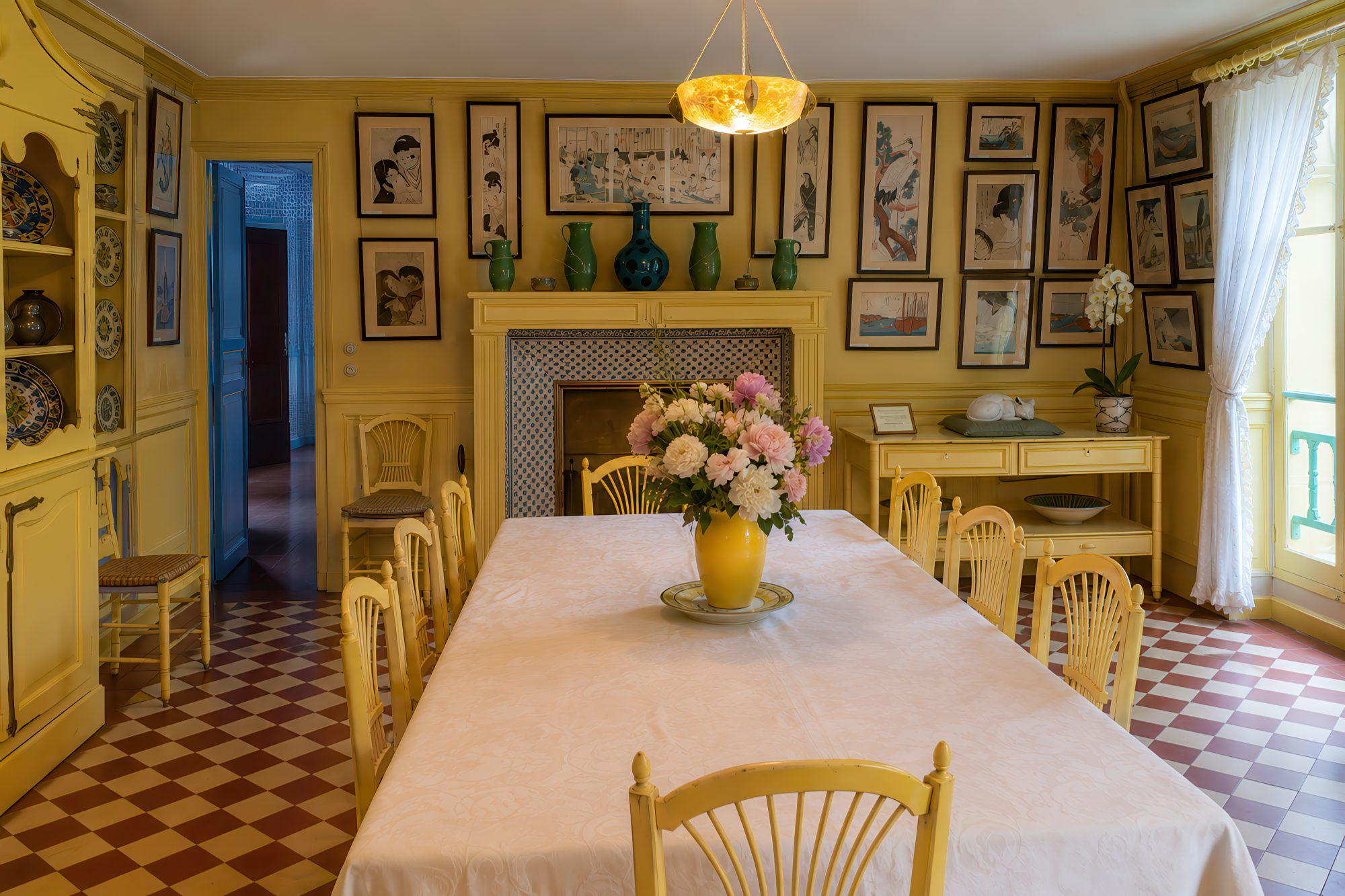
Claude Monet's yellow dining room at Giverny, where Japanese ukiyo-e prints covered the walls alongside ceramics and decorative objects.
The Blue Sitting Room
The blue sitting room, often referred to as the “blue salon”, was quieter and more intimate than the dining room. It functioned as a reception room, reading space and private retreat within the house.
Where the yellow dining room feels energetic and social, the blue room feels contemplative and restrained. The contrast between the two spaces reflects the balance often found in Japanese aesthetics between vivid decorative intensity and quiet atmospheric calm.
The room is painted in pale blue and white tones with carefully designed trim and integrated cabinetry. Japanese prints are spaced more selectively here, allowing each work more visual breathing room.
Atmosphere and Design
The blue room demonstrates Monet's extraordinary sensitivity to colour relationships beyond painting alone. Important visual elements include:
- cool blue-and-white colour harmony
- symmetrical wall divisions
- carefully spaced framed prints
- soft atmospheric lighting
- elegant curved furniture
- integrated decorative cabinetry and clock
Many historians interpret the room as evidence that Monet thought spatially and decoratively in ways deeply connected to Japanese art 1. The room feels almost like a three-dimensional extension of ukiyo-e colour harmony.
Japanese Prints in the Blue Room
| Artist | Likely Prints / Subjects Visible | Notes |
|---|---|---|
| Utagawa Hiroshige | Coastal scenes, bridges and water landscapes | Several framed landscapes strongly resemble Hiroshige compositions. |
| Katsushika Hokusai | Wave and Mount Fuji imagery | Some blue-toned prints resemble Hokusai aizuri-e landscape works. |
| Kitagawa Utamaro | Female portraits | Smaller vertical compositions appear near the clock and cabinet. |
| Utagawa Kuniyoshi | Narrative or figurative prints | Possible dramatic figurative scenes visible in photographs. |
The blue room especially recalls the atmospheric mood of Hiroshige. His work emphasised weather, quiet architecture, reflections, asymmetrical composition and contemplative space — qualities that later became central to Monet's Water Lilies, Japanese Bridge paintings and Thames series 7.
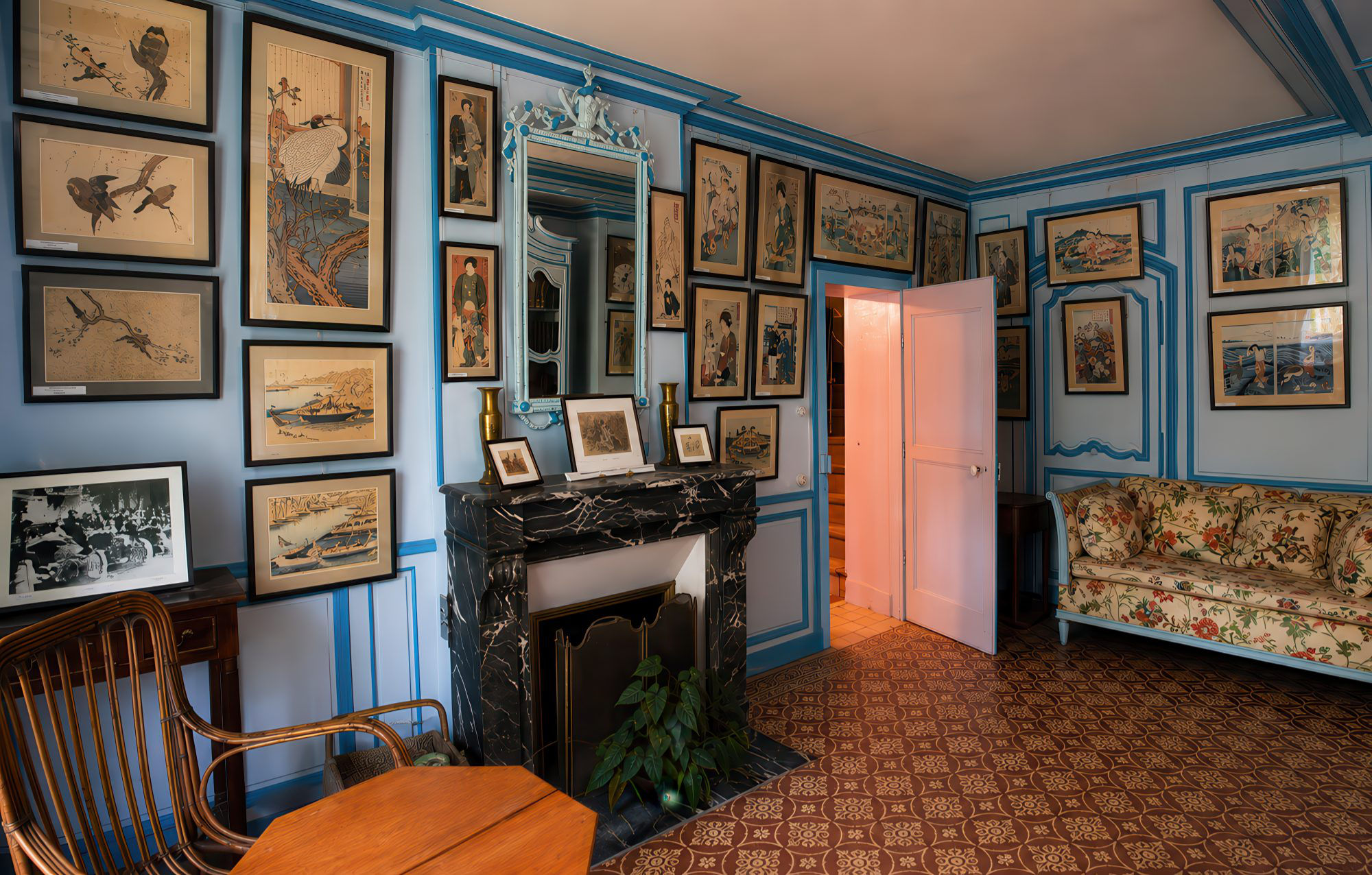
The blue sitting room at Giverny, where Monet displayed Japanese prints by artists such as Hiroshige, Hokusai and Utamaro.
Monet Living Among Japanese Art
One of the most remarkable aspects of Giverny is that Monet did not store these prints away in private portfolios or cabinets. He lived among them daily — eating beneath them, reading beside them and designing his garden while surrounded by Japanese imagery.
The Japanese bridge in Monet's garden can therefore be understood as more than decorative exotica. It emerged from decades of close engagement with Japanese prints, garden aesthetics and compositional ideas 1.
Many qualities associated with Monet's late paintings can also be found in ukiyo-e:
- flattened pictorial space
- cropped compositions
- decorative surface pattern
- asymmetry
- atmospheric colour
- reflections without conventional horizon lines
These were not occasional borrowings. Japanese art became part of how Monet understood colour, composition and atmosphere itself.
What Monet Learned from Japanese Prints
Monet did not imitate Japanese prints mechanically. Their influence is often subtler and more interesting. He absorbed principles rather than copying designs: flattened space, unusual framing, decorative surface, strong colour relationships and the idea that a scene could feel immediate rather than formally arranged.
European academic painting had long valued depth, modelling, historical subjects and central composition. Japanese prints suggested another path. A picture could be shallow, cropped, unbalanced, patterned and still beautiful. It could feel like a moment glimpsed in passing.
1. Flattened space
Japanese prints often compress space into strong surface design. In Monet's work, this helped loosen the traditional distinction between foreground, middle ground and background. The effect becomes especially important in the later Water Lilies, where pond surface, reflections, flowers and sky merge into one field.
2. Cropping and partial views
Rather than presenting a complete scene from a stable viewpoint, Japanese prints often crop figures, trees, bridges or objects at the edge. This makes the composition feel more immediate. Monet's own landscapes increasingly use partial views and strong framing devices.
3. Asymmetry
Japanese prints often avoid the centred, balanced compositions expected in European academic art. Monet's mature works frequently use off-centre placement, diagonal movement and irregular spacing, allowing the viewer's eye to move more freely.
4. Pattern and decorative surface
Japanese prints turn fabric, foliage, waves, rain and clouds into rhythmic pattern. Monet's gardens, bridge paintings and Water Lilies often work in a similar way: leaves, flowers, ripples and reflections become surface design as much as natural description.
5. Nature as atmosphere
Hiroshige's rain, mist, snow, rivers and bridges offered European artists a poetic model for changing weather. Monet had always cared about light and atmosphere, but Japanese prints helped confirm that weather itself could structure a picture.
Hokusai and MONET Compared
Hokusai's prints fascinated European artists because they organised the world differently from traditional Western painting. Space could be flattened, forms cropped dramatically, and movement turned into rhythm across the picture surface. Monet absorbed many of these ideas during the rise of Japonisme, especially in his later paintings of water, bridges, reflections and repeated motifs.
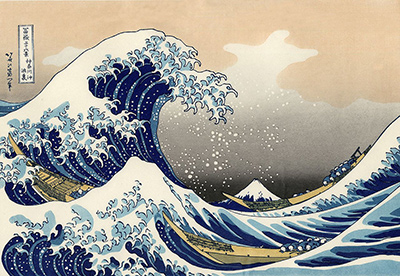
Hokusai: The Great Wave off Kanagawa
Artist: Katsushika Hokusai
Date: c.1831
Series: Thirty-Six Views of Mount Fuji
Hokusai transforms a wave into a monumental living form. The claw-like spray, compressed boats and distant Mount Fuji create a composition based on movement and tension rather than stable perspective. The print became one of the defining images of Japonisme in Europe.
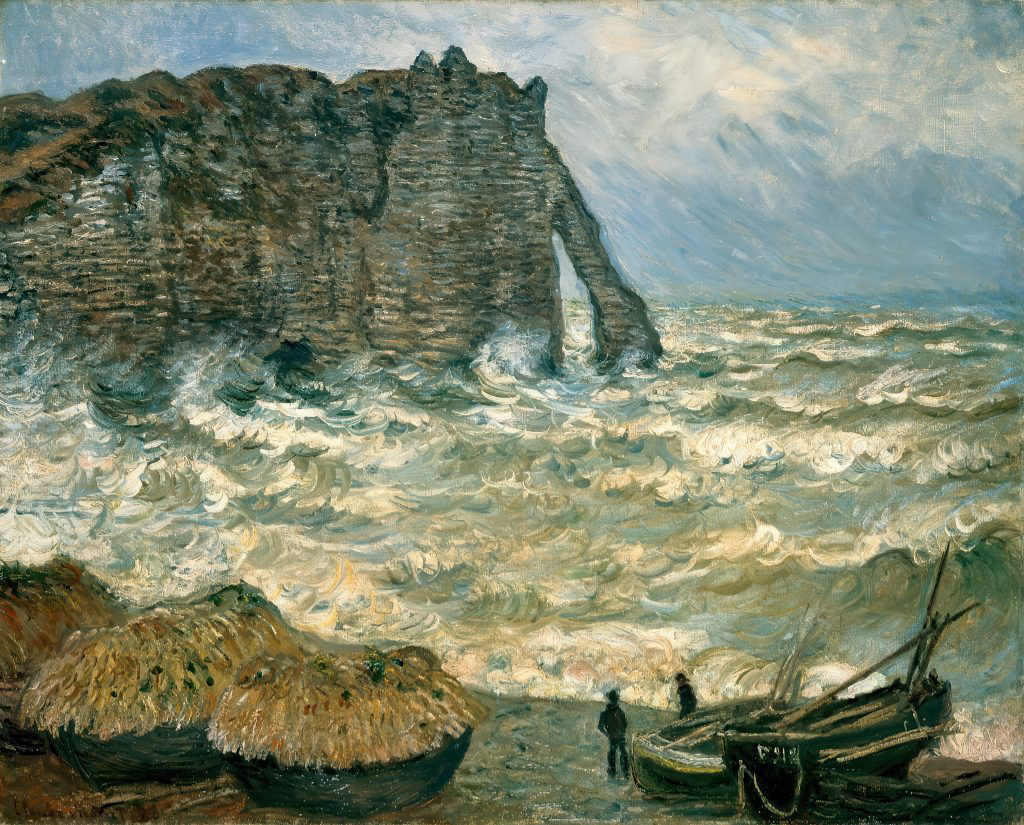
Monet: Stormy Sea at Étretat
Artist: Claude Monet
Date: 1883
Subject: Normandy coast
Monet's Normandy seascapes similarly treat water as energy and motion rather than calm description. The crashing waves, broken brushwork and shifting atmosphere create a sense of instability that recalls the dynamism of Hokusai's marine compositions.
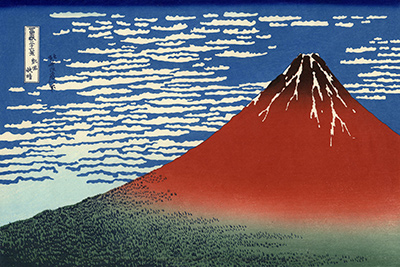
Hokusai: Fine Wind, Clear Morning
Artist: Katsushika Hokusai
Date: c.1831
Series: Thirty-Six Views of Mount Fuji
Hokusai repeatedly returned to Mount Fuji under changing conditions of weather, light and season. The subject remains constant while atmosphere transforms the image, anticipating the serial logic that later fascinated Monet.
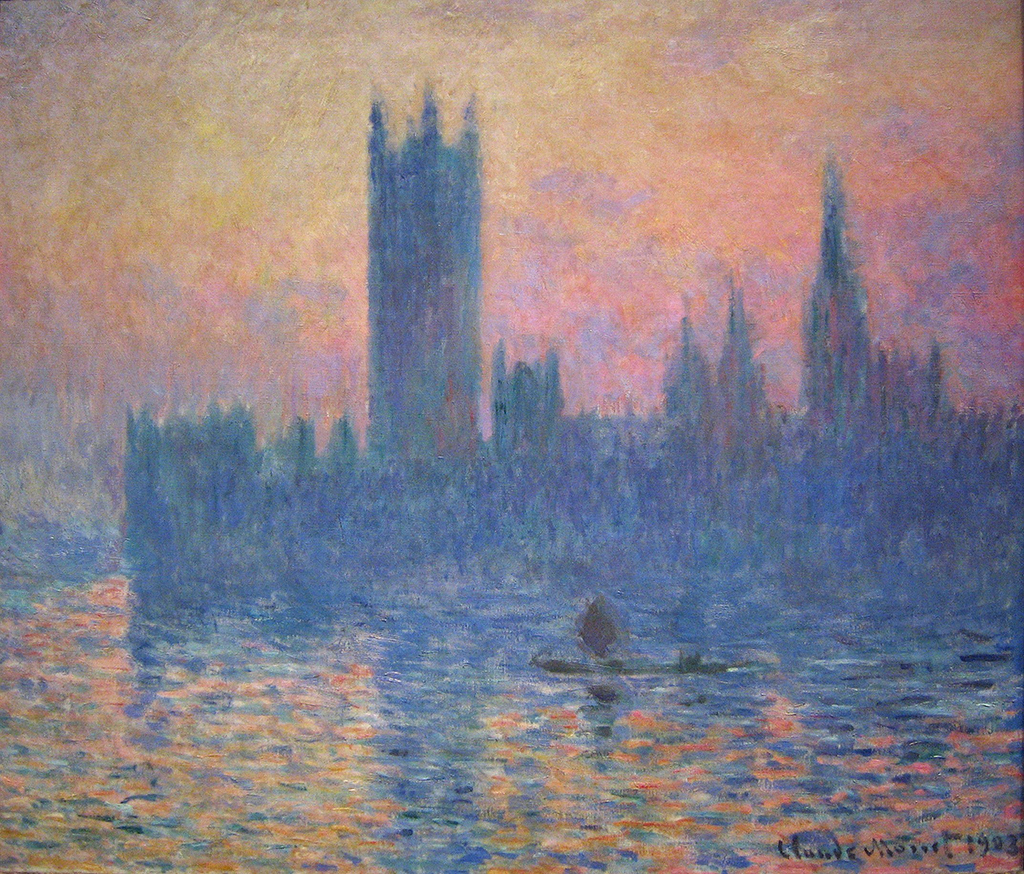
Monet: Houses of Parliament
Artist: Claude Monet
Date: 1899-1904
Series: Houses of Parliament
Monet's serial paintings use the same principle. The Houses of Parliament remain structurally similar from canvas to canvas, but changing fog, sunlight and colour create entirely different experiences. The idea that atmosphere could become the true subject links Monet closely with Japanese print design.
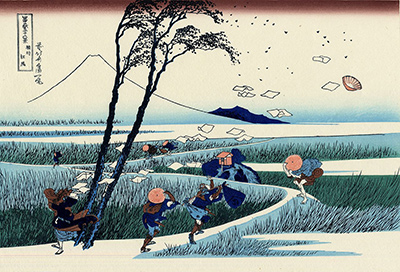
Hokusai: Ejiri in Suruga Province
Artist: Katsushika Hokusai
Date: c.1831
Series: Thirty-Six Views of Mount Fuji
In this famous design, sheets of paper blow violently across the landscape, creating diagonal rhythm across the entire surface. Hokusai turns movement itself into composition, using repeated forms to guide the eye through the print.
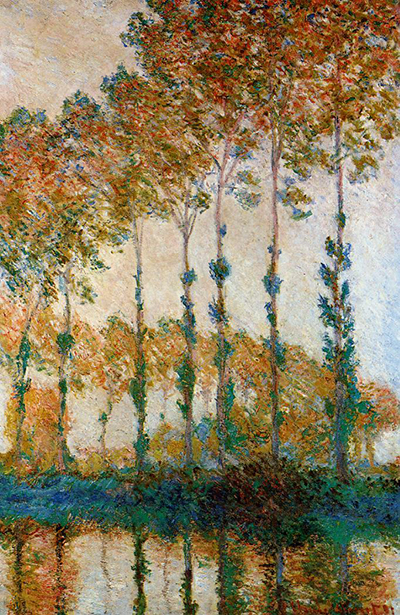
Monet: Poplars
Artist: Claude Monet
Date: 1891
Series: Poplars
Monet's Poplars paintings similarly organise the surface through repeated rhythmic forms. The trees become decorative vertical structures stretching across the canvas, creating movement and pattern rather than conventional depth.
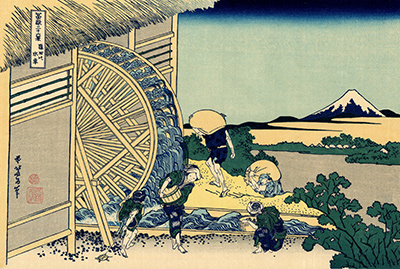
Hokusai: Waterwheel at Onden
Artist: Katsushika Hokusai
Date: c.1830s
Subject: Waterwheel and reflective water
Hokusai frequently explored circular movement and reflective water surfaces. The wheel, flowing water and layered curves create a decorative rhythm that transforms an ordinary rural scene into a dynamic arrangement of shape and motion.
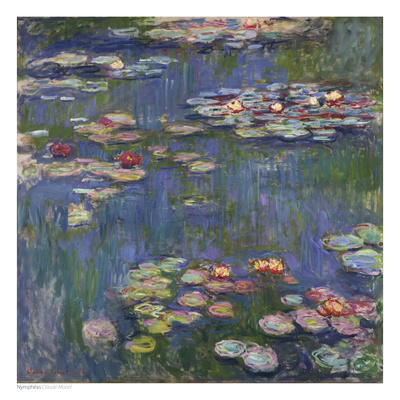
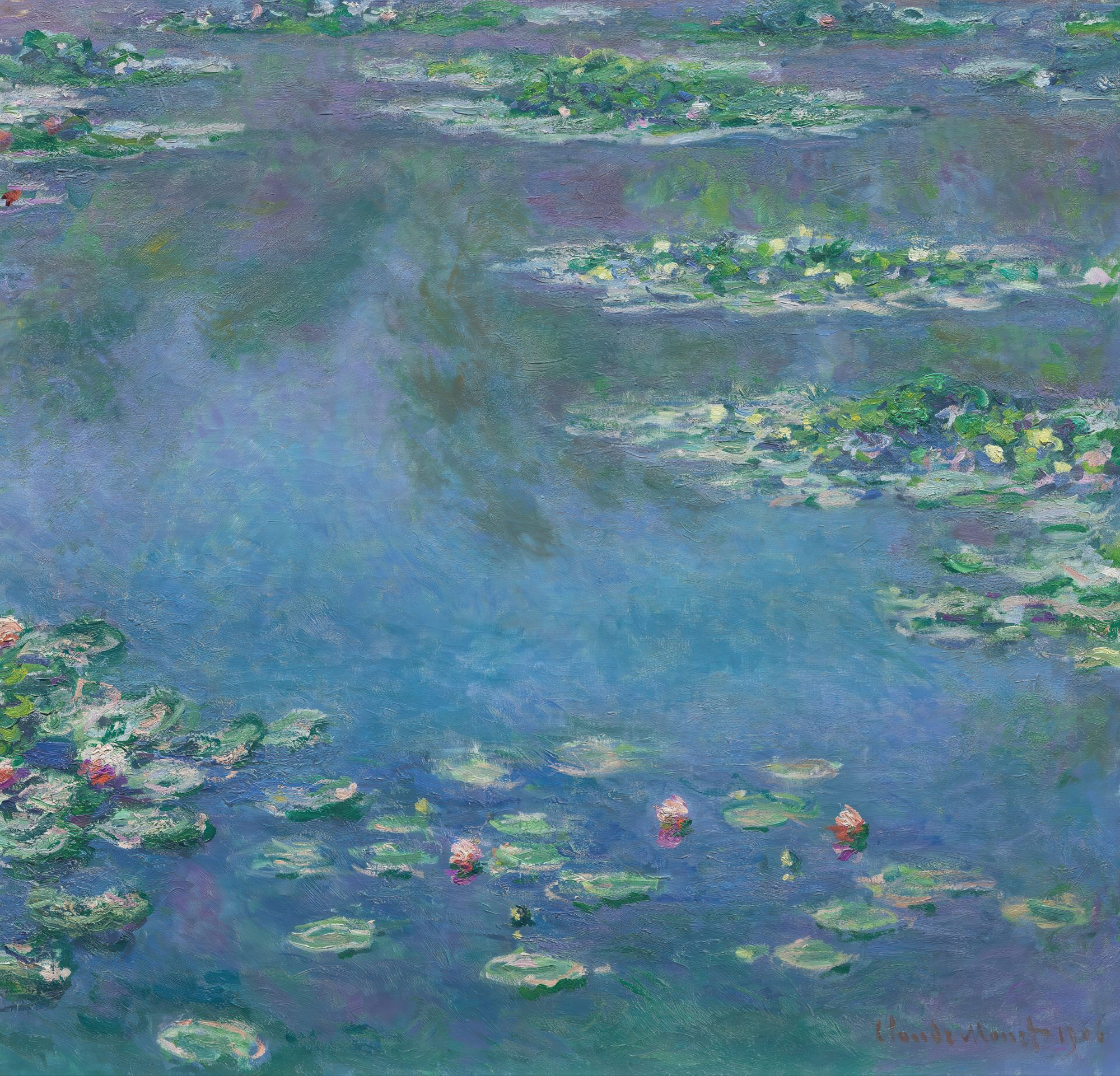
Monet: Water Lilies
Artist: Claude Monet
Date: 1906 onwards
Series: Water Lilies
In Monet's late Water Lilies, reflections and surface patterns become more important than traditional perspective. Water is no longer simply a setting, but a field of colour, movement and abstraction spread across the canvas.
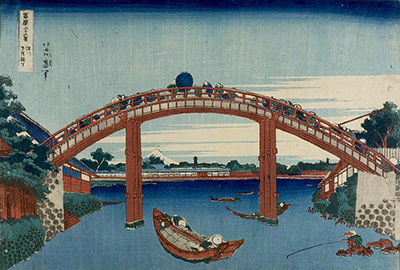
Hokusai: Mannen Bridge at Fukagawa
Artist: Katsushika Hokusai
Date: c.1830s
Series: Thirty-Six Views of Mount Fuji
Hokusai's bridge compositions often use dramatic curves and compressed viewpoints to frame the landscape. The bridge becomes a structural device that guides movement across the print while flattening space into decorative pattern.
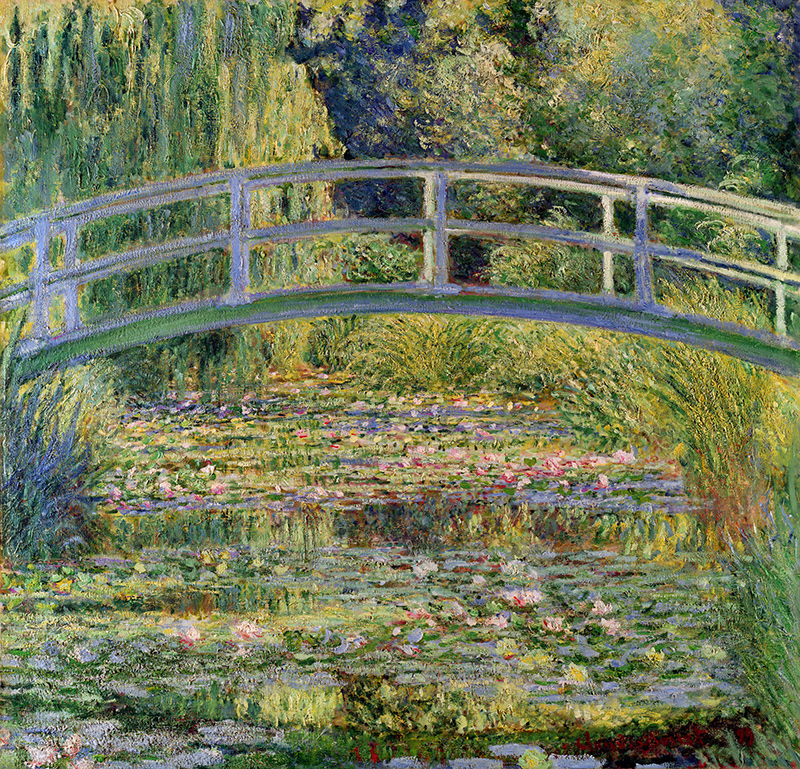
Monet: The Japanese Bridge
Artist: Claude Monet
Date: 1899 onwards
Subject: Giverny water garden
Monet's Japanese Bridge paintings similarly use the bridge as both motif and compositional framework. The arch cuts across the picture while water lilies and reflections dissolve the surrounding space into colour and pattern.
Hiroshige and MONET Compared
Hiroshige did not influence Monet through direct copying in the way he influenced Van Gogh, but his prints helped European artists imagine landscape differently. Rain, bridges, rivers, trees, snow and mist could become decorative structures of atmosphere and rhythm. These five comparisons show how Monet's landscapes share some of the visual ideas that made Hiroshige so important to Japonisme.
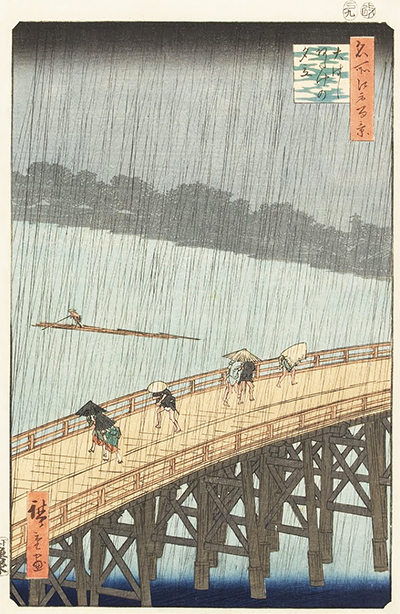
Hiroshige: Sudden Shower over Shin-Ōhashi Bridge and Atake
Artist: Utagawa Hiroshige
Date: 1857
Series: One Hundred Famous Views of Edo
Hiroshige turns rain into the subject of the print. Diagonal lines sweep across the scene, the bridge is sharply cropped, and the figures hurry through a landscape transformed by weather. This is exactly the kind of atmospheric vision that fascinated European artists in the age of Japonisme.
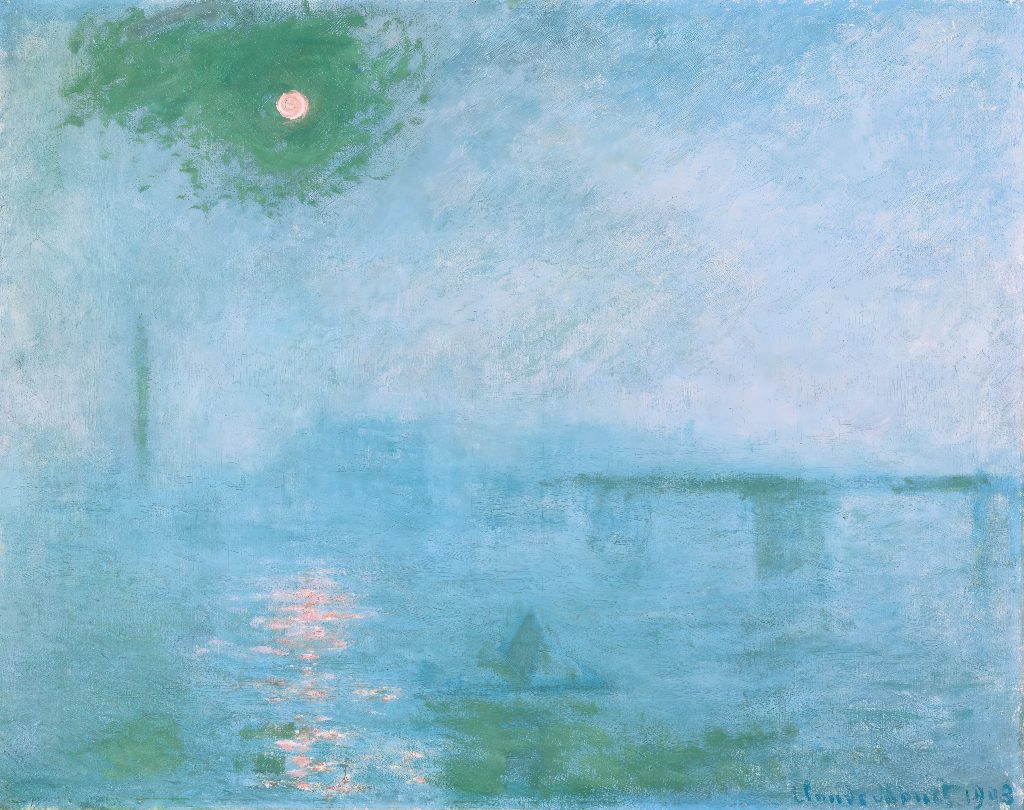
Monet: Charing Cross Bridge, Fog on the Thames
Artist: Claude Monet
Date: 1903
Series: London Thames paintings
Monet's London bridge paintings also make atmosphere more important than architecture. The bridge is still present, but fog, light and reflected colour dissolve its solidity. Like Hiroshige, Monet treats weather not as background, but as the real visual event.
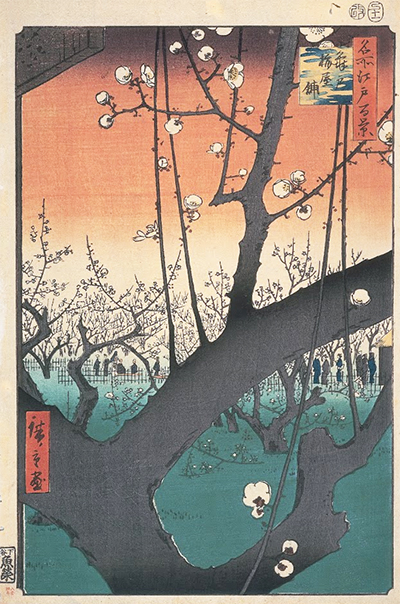
Hiroshige: Plum Park in Kameido
Artist: Utagawa Hiroshige
Date: 1857
Series: One Hundred Famous Views of Edo
This print is famous for its radical foreground cropping. The thick branch dominates the image, while the garden and visitors appear beyond it. Hiroshige turns a tree into a decorative frame, pulling the viewer into the scene through an unexpected viewpoint.
Monet: Poplars on the Epte
Artist: Claude Monet
Date: 1891
Series: Poplars
Monet's poplar paintings use trees as vertical rhythms across the surface. The trunks and their reflections create a patterned screen rather than a conventional landscape depth. This makes the comparison with Hiroshige especially useful: both artists allow trees to organise the whole picture.
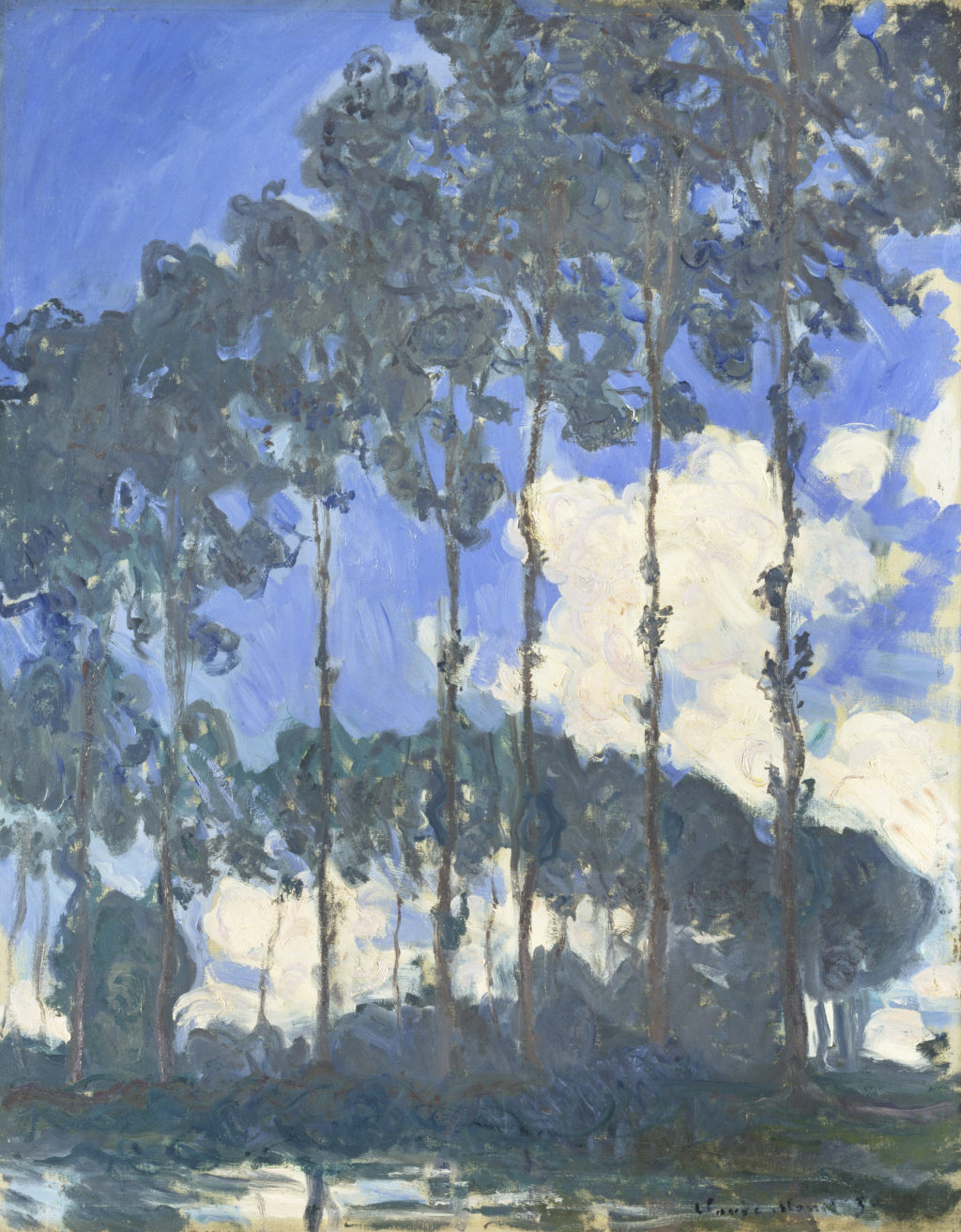
Hiroshige: Okazaki, Yahagi Bridge
Artist: Utagawa Hiroshige
Series: Fifty-Three Stations of the Tōkaidō
Subject: Yahagi Bridge over the river
Hiroshige often used bridges and rivers to create long horizontal movement. In views such as Okazaki, the bridge draws the eye across the print while boats, banks and distant landscape create a layered but flattened sense of space.
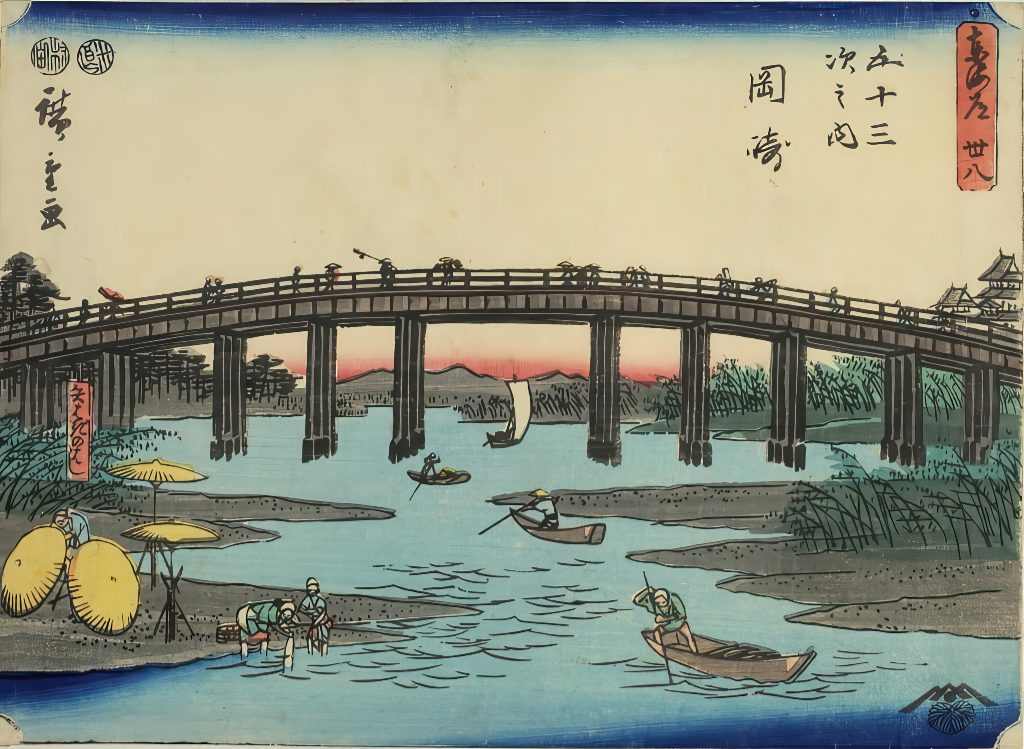
Monet: The Seine at Giverny
Artist: Claude Monet
Date: 1897
Subject: The Seine near Giverny
Monet's views of the Seine near Giverny similarly depend on horizontal movement, reflections and riverbank forms. Instead of using the river only as scenery, Monet makes its surface the structure of the painting, allowing trees and sky to dissolve into water.
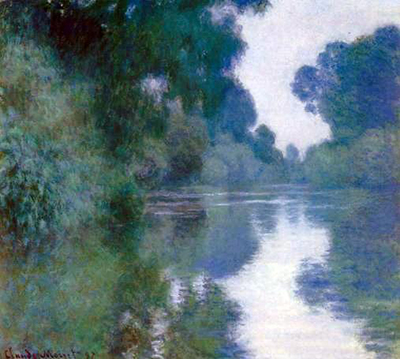
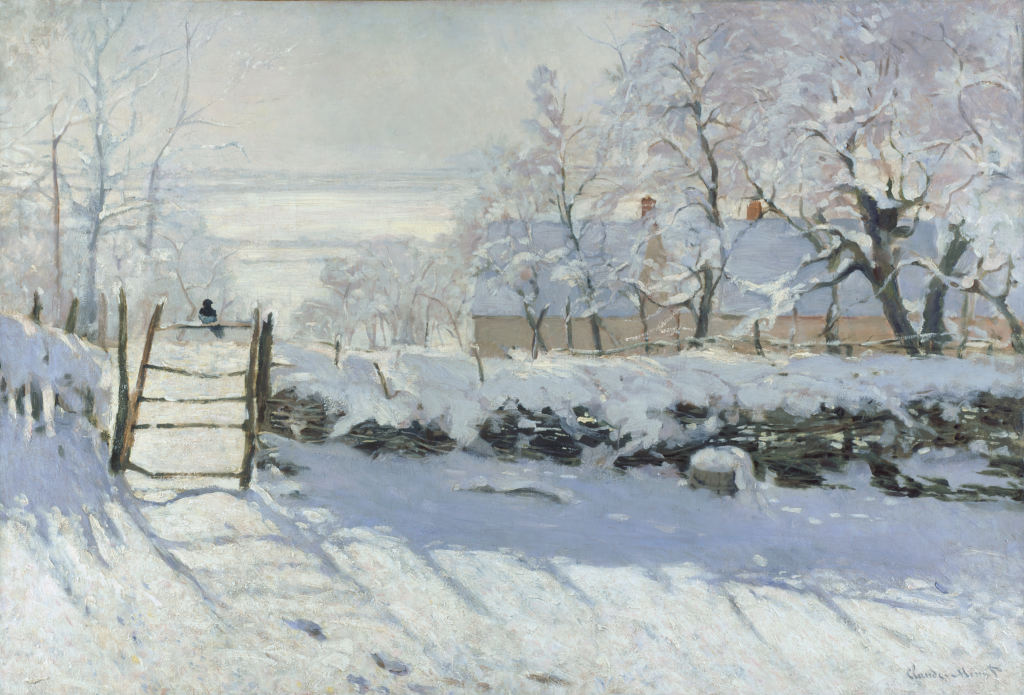
Hiroshige: Evening Snow at Kanbara
Artist: Utagawa Hiroshige
Date: 1833-1834
Series: Fifty-Three Stations of the Tōkaidō
Hiroshige's snow scenes reduce the landscape to quiet shapes, soft tonal contrast and atmospheric silence. Snow simplifies the world, flattening forms and turning the scene into a poetic arrangement of dark and light.
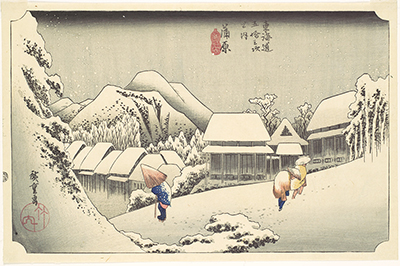
Monet: The Magpie
Artist: Claude Monet
Date: 1868-1869
Location: Normandy
Monet's snow paintings share this interest in quiet atmosphere and reduced colour. In The Magpie, the scene is almost emptied of drama. Like Hiroshige, Monet allows snow, silence and subtle tonal shifts to become the real subject.
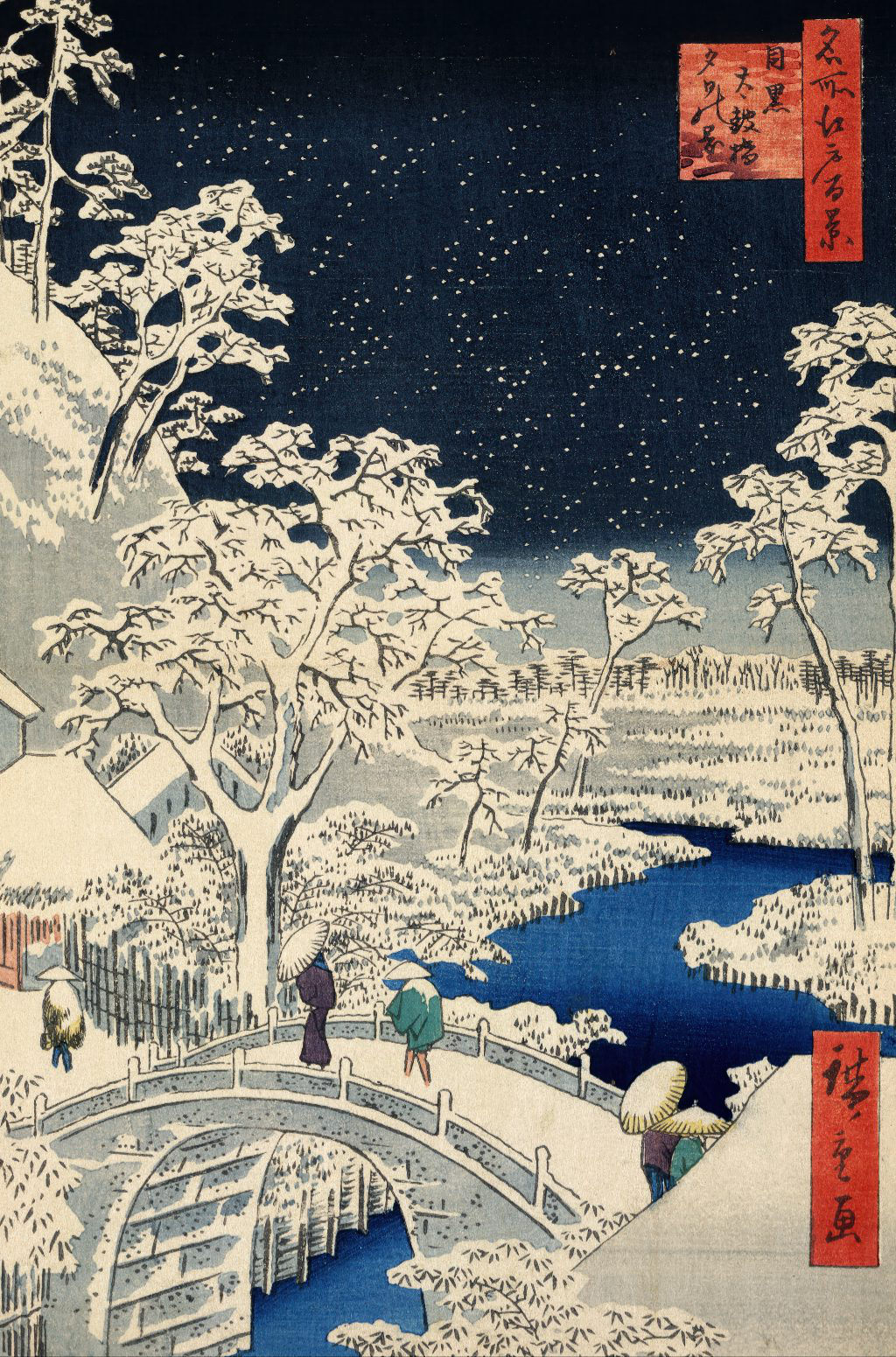
Hiroshige: Meguro Drum Bridge and Sunset Hill
Artist: Utagawa Hiroshige
Date: 1857
Series: One Hundred Famous Views of Edo
Hiroshige's bridge prints often use the curve of a crossing to organise the whole view. In Meguro Drum Bridge and Sunset Hill, the bridge becomes both architecture and rhythm, guiding the eye through a compressed, decorative landscape.
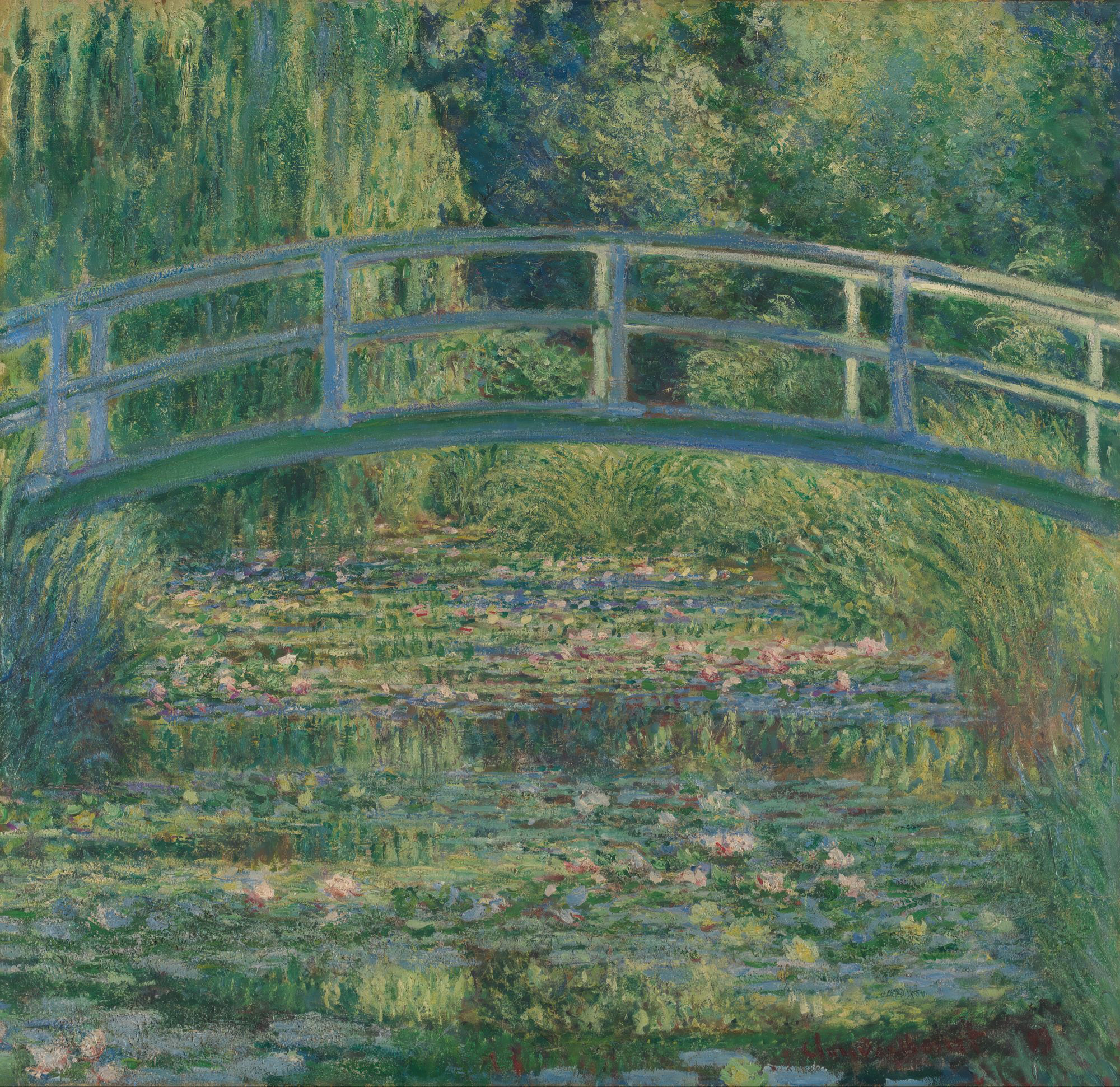
Monet: The Water-Lily Pond
Artist: Claude Monet
Date: 1899
Subject: Japanese bridge at Giverny
Monet's Japanese Bridge paintings transform a real garden structure into a pictorial device. The bridge gives the scene rhythm and enclosure, while the pond below begins to dissolve into water lilies, reflections and colour. This is where Japanese-inspired design becomes central to Monet's late art.
La Japonaise: Fashion, Performance and Japonisme
Monet's most obvious early engagement with Japanese fashion was La Japonaise, painted in 1876 and now in the Museum of Fine Arts, Boston. The painting shows Camille Monet dressed in an elaborate red kimono, standing before a wall of Japanese fans.
The MFA notes that Monet exhibited the painting in 1876 under the title Japonerie, a word associated with Western works imitating Japanese objects. 2 This matters because the painting is not a quiet study of Japanese aesthetics. It is theatrical, decorative and self-conscious.
In La Japonaise, Japanese art appears as spectacle. The kimono, fans and pose belong to the Parisian taste for all things Japanese, but the painting also feels exaggerated, almost like a performance of Japonisme. Camille's blonde wig and the flamboyant costume emphasise that this is a European fantasy of Japan, not a Japanese scene.
For that reason, La Japonaise should not be treated as the final word on Monet's relationship with Japanese art. It is an early, theatrical stage. The deeper influence came later, when Japanese ideas entered the structure of his compositions and the design of his garden.
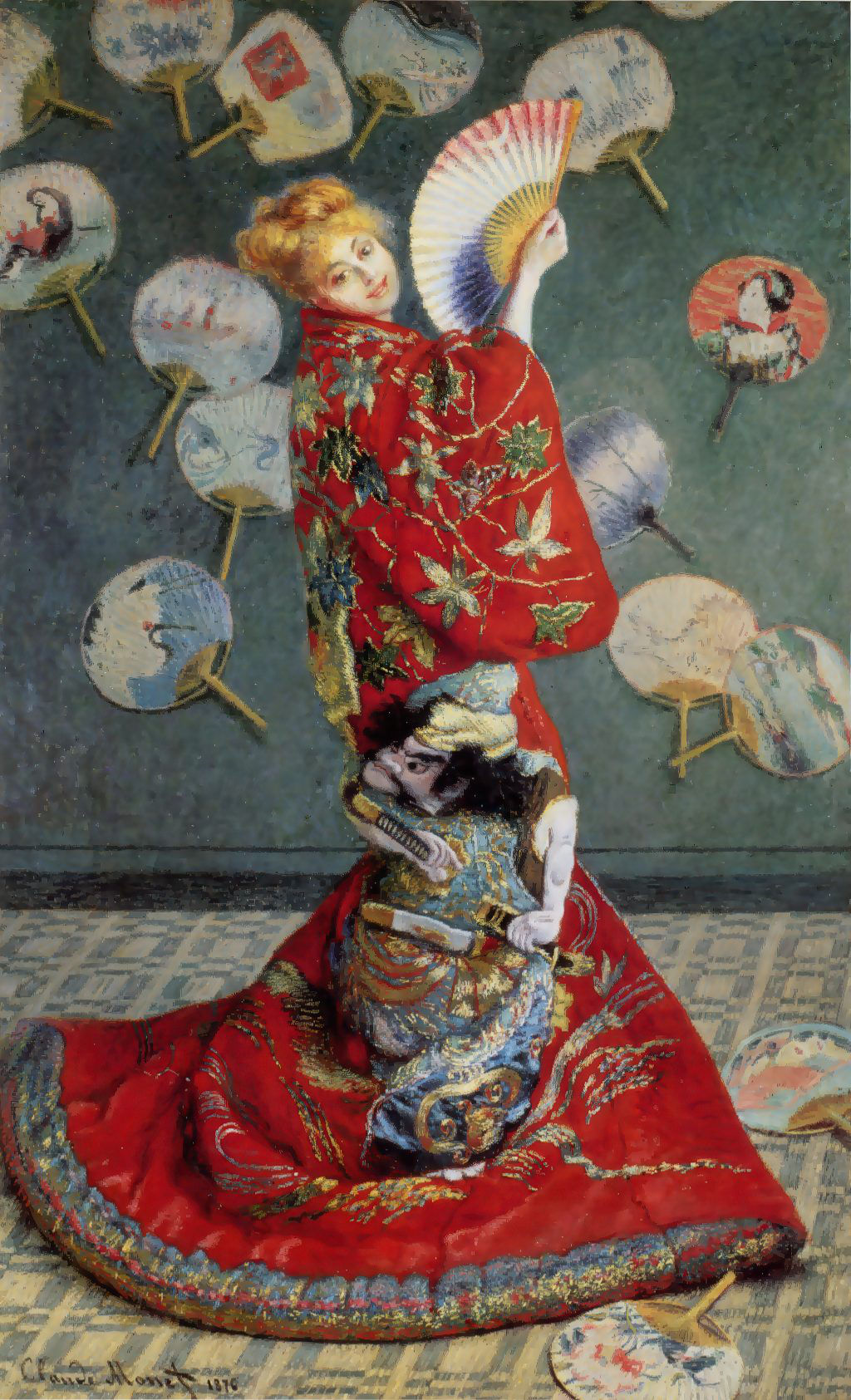
La Japonaise, Claude Monet, 1876, Museum of Fine Arts, Boston
Garden at Sainte-Adresse and Japanese Composition
Even before Giverny, Monet's compositions sometimes suggest the influence of Japanese prints. Garden at Sainte-Adresse, painted in 1867, is a particularly useful example. The scene is arranged in clear bands of colour, with strong diagonals, cropped figures and a high viewpoint looking down across the garden toward the sea.
This is not a Japanese subject. It is a French coastal garden scene. Yet the way Monet organises it feels close to ukiyo-e principles: flat colour areas, patterned surfaces, tilted perspective and an emphasis on design across the picture plane.
The painting shows why Japanese influence cannot be reduced to obvious props. Monet did not need to include a kimono, fan or screen for Japanese art to matter. The deeper lesson was compositional: how to arrange the world differently on the canvas.
| Feature in Garden at Sainte-Adresse | Possible Japanese print connection |
|---|---|
| High viewpoint | Similar to elevated views in many Japanese landscape prints |
| Strong diagonals | Creates movement across the surface rather than deep recession |
| Flat bands of sea, sky and garden | Echoes the printmaker's use of simplified colour zones |
| Cropped and placed figures | Feels less staged than academic composition |
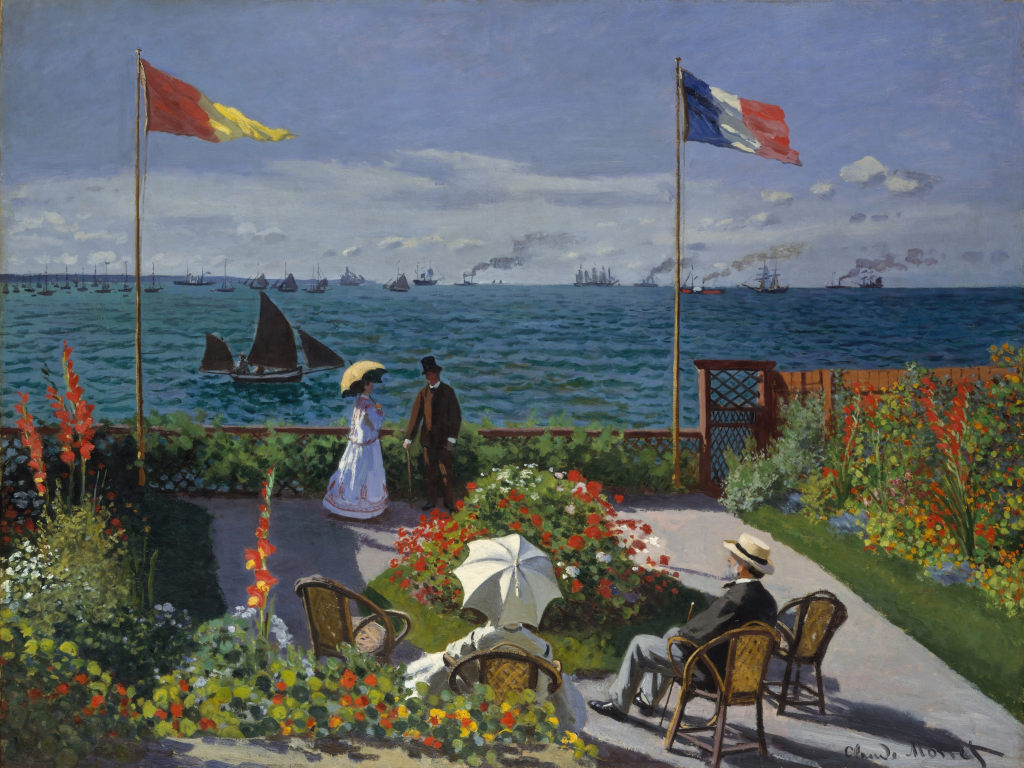
Garden at Sainte-Adresse, Claude Monet, 1867, Metropolitan Museum of Art, New York
Giverny as a Japanese-Inspired World
Monet's deepest response to Japanese art may not be a single painting, but the environment he created at Giverny. After moving there in 1883, he gradually transformed the property into a carefully orchestrated world of colour, flowers, water and reflection.
In 1893, Monet acquired additional land and began creating the water garden. This was where he built the Japanese-style bridge, planted water lilies and arranged a pond that would later become the source of his most famous late works.
The water garden was inspired by Japanese design, but it was not a literal Japanese garden. It was Monet's own interpretation: Japanese prints filtered through French Impressionist colour, personal horticulture and the needs of a painter searching for motifs.
The garden allowed Monet to do something extraordinary. Rather than travelling to find a subject, he made one. He built a world shaped by Japanese-inspired taste, then painted it obsessively for the rest of his life.
For more on the garden itself, see Monet's Garden at Giverny.
The Japanese Bridge at Giverny
The Japanese bridge is the clearest architectural sign of Monet's love of Japanese art. It crosses the lily pond at Giverny and appears in a group of important paintings from 1899 and 1900.
In these works, the bridge often arches across the canvas, dividing the image between foliage above and pond surface below. The bridge gives the painting structure, while the water lilies and reflections introduce the more fluid world that would later dominate Monet's art.
The National Gallery describes how Monet enlarged the pond, filled it with exotic hybrid water lilies and built a Japanese-style bridge inspired by prints.3 The bridge therefore connects three things: Monet's collecting, his gardening and his painting.
The bridge also shows how Monet transformed Japanese influence. It is not a quotation from a single print. It is a physical object in his garden, designed to generate new pictorial possibilities.
For a fuller guide, see Claude Monet's Japanese Bridge.
Japanese Prints and the Water Lilies
The connection between Japanese prints and the Water Lilies is subtle but powerful. By the time Monet painted the late Water Lilies, he was no longer making obvious images of Japanese objects. The bridge often disappeared. The kimono and fans of La Japonaise were long gone. Yet the Japanese lesson remained in the structure of seeing.
The late Water Lilies often remove the horizon. They flatten water, flowers, sky and reflections into a continuous surface. The viewer is not led into deep space in the traditional European way. Instead, the eye moves across the picture, following colour, rhythm and pattern.
This is where Monet's love of Japanese prints becomes most profound. The influence is no longer decorative. It has become pictorial. Japanese print culture helped Monet imagine a landscape without conventional depth, a painting built from surface, pattern, asymmetry and atmosphere.
In the Orangerie Water Lilies, this becomes immersive. The paintings surround the viewer with water and reflection. Monet's Japanese-influenced garden has become a modern painting environment.
Monet, Degas, Cassatt and Van Gogh
Monet was not alone in responding to Japanese prints. Many artists in Paris were fascinated by them, but each absorbed the influence differently.
| Artist | How Japanese prints mattered | Best comparison |
|---|---|---|
| Claude Monet | Flattened space, garden design, water, bridges, decorative surface and atmospheric serial painting | Japanese Bridge, Water Lilies, Garden at Sainte-Adresse |
| Edgar Degas | Cropping, off-centre figures, empty space and unusual viewpoints | Dance classes, bathers and interiors |
| Mary Cassatt | Print technique, women in private interiors, flattened design and refined contour | The Coiffure |
| Vincent van Gogh | Direct copying, bold outline, bright colour and Japan as an artistic ideal | Copies after Hiroshige and Portrait of Père Tanguy |
| James McNeill Whistler | Japanese objects, tonal harmony, decorative interiors and atmospheric restraint | The Peacock Room and nocturnes |
This comparison helps clarify Monet's originality. Van Gogh often copied Japanese prints directly. Cassatt adapted Japanese print technique. Degas borrowed cropping and viewpoints. Monet did something different: he turned Japanese influence into an environment, then used that environment to create some of the most radical paintings of his late career.
Legacy of Japanese Prints in Monet's Art
Monet's love of Japanese prints changed more than a few compositions. It helped him see painting as a surface of colour and rhythm rather than a window into deep space. It encouraged him to value asymmetry, pattern, reflection and the fragmentary view.
Most importantly, Japanese prints helped Monet move from Impressionism toward modern art. The late Water Lilies are still based on nature, but they no longer behave like traditional landscapes. They approach abstraction through water, colour and reflection.
This is the real importance of Monet's Japonisme. It was not simply a taste for foreign objects. It was a creative encounter with another visual tradition, one that helped him rethink what painting could do.
FAQs about Monet and Japanese Prints
Join the Conversation
Have a thought or observation about Monet's love of Japanese prints? Share it below — thoughtful responses may be added to this section.
References
- Fondation Claude Monet, “Japanese Prints,” Maison et jardins de Claude Monet, View source.
- Museum of Fine Arts, Boston, “Conservation in Action: La Japonaise,” MFA Boston, View source.
- National Gallery, London, “Claude Monet, The Water-Lily Pond,” The National Gallery, View source.
- Musée des Impressionnismes Giverny, “Japonism,” Musée des Impressionnismes Giverny, View source.
- Fondation Claude Monet, “Claude Monet's Collection of Japanese Prints,” Maison et jardins de Claude Monet, View source.
- The Met Museum, “Timeline of Art History - Japonisme”, Metmuseum.org, View source.
- InterMonet, “Monet's Collection of Japanese Woodblocks,” InterMonet, View source.
- Architectural Digest, “Forget the Gardens: The Best Part of Giverny Is Monet's Kitchen,” Architectural Digest, 2017, View source.
- Asian Arts Collection, “Famous Collections: The Collection of Claude Monet,” AsianArtsCollection.com, View source.
- Geneviève Aitken and Marianne Delafond, La Collection d'Estampes Japonaises de Claude Monet, La Bibliothèque des Arts, 2003.
- Office of the Historian, “The United States and the Opening to Japan, 1853”, View source.
- V&A Museum, “Japan's encounter with Europe, 1573-1853”, View source.
- Kjeld Duits, “From Dejima to Tokyo”, Dejima-Tokyo.com, View source.
- Vangoghletters.org, “Letter To Theo van Gogh. Arles, on or about Tuesday, 5 June 1888”, View source.
- Ciaran Lawler, “How Japanese Painters Took Inspiration From European Artists”, Tokyoweekender.com, View source.
- Claude Monet, “19th February, 1920, Giverny - Letter to Shintarō Yamashita” Art Institute of Chicago Publications, PP254, View source.
- British Museum, “Hiroshige: artist of the open road,” British Museum, View source.
- Van Gogh Museum, “Flowering Plum Orchard (after Hiroshige),” Van Gogh Museum, View source.
- National Gallery, London, “Monet's London,” Google Arts & Culture / National Gallery, View source.
- National Galleries of Scotland, “Claude Monet, Poplars on the Epte,” National Galleries of Scotland, View source.
- National Gallery of Art, Washington, “Claude Monet, The Seine at Giverny,” National Gallery of Art, View source.