


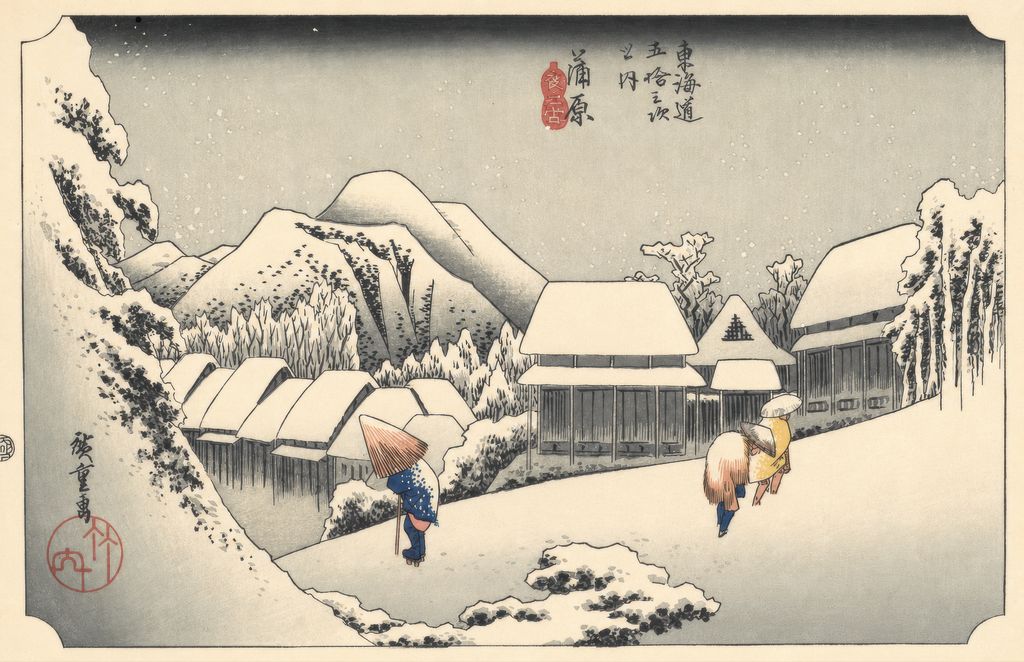
Hiroshige, Kanbara: Evening Snow, Hōeidō Tōkaidō. Public-domain design reproduction; the physical impression and printing date are unidentified.
 by Tom Gurney
Tom Gurney BSc (Hons) is an art history expert with over 20 years experience
Published on June 19, 2020 / Updated on September 23, 2026
Email: tomgurney1@gmail.com / Phone: +44 7429 011000
Hiroshige's Fifty-three Stations of the Tōkaidō
A small group of travellers moves through a dark, snow-covered Kanbara. At Shōno, other travellers lean into a sudden downpour. At Yokkaichi, wind turns a riverside view into a scene of motion. These prints belong to Utagawa Hiroshige’s Tōkaidō gojūsan tsugi no uchi (東海道五拾三次之内), usually called the Hōeidō Fifty-three Stations of the Tōkaidō. The work follows the great road from Edo to Kyoto, but it does more than name places. Changing weather, time, food, labour and company make the sequence feel like a journey. The Shizuoka City Tōkaidō Hiroshige Museum [3] identifies the series, issued around 1833, as the success that made Hiroshige widely known as a landscape print designer.
The familiar complete route contains 55 views: the departure at Nihonbashi in Edo, one view associated with each of the 53 post stations, and the arrival at Sanjō Bridge in Kyoto. The name counts the intermediate stations rather than all the sheets. Sagawa Art Museum’s Japanese catalogue [1] and Suntory Museum of Art’s exhibition list [2] both set out this standard road sequence. The British Museum’s Kyoto print [5] is explicitly numbered 55. “Hōeidō” identifies the publishing project and helps distinguish it from Hiroshige’s many later treatments of the same road. It does not mean that every surviving photograph shows a single first printing of a fixed set of 55 unaltered blocks.
Contents
- Hiroshige's Fifty-three Stations of the Tōkaidō
- What was the Tōkaidō?
- Why is it called the Hōeidō edition?
- Did Hiroshige travel the whole road himself?
- From departure to mountain pass
- Kanbara: snow and the imagined road
- The road feeds, carries and employs people
- Weather is a subject, not just a backdrop
- Read the wind at Yokkaichi
- Arriving in Kyoto
- How a colour print could change
- A different kind of landscape series from Hokusai’s Fuji views
- How does the Hōeidō series relate to Hiroshige’s later Tōkaidō prints?
- What should a complete set mean to a reader today?
- The complete 55-view road sequence
- Explore more Hiroshige pages
The prints are best read at three levels. They form an east-to-west itinerary; each sheet is a composition with its own visual idea; and each surviving impression is an object with its own printing, wear and collecting history. That distinction matters when comparing museums’ copies or choosing images for this article. The view called Evening Snow at Kanbara is a recognisable design, but a photograph of one Kanbara sheet cannot establish the ink, wear or issue date of every other sheet carrying that title. Suntory’s catalogue [2] explicitly places early and later Kanbara impressions beside one another, while also recording alternate compositions for some stops.
What was the Tōkaidō?
The Tōkaidō connected Edo, the centre of the shogunal government, with Kyoto, the imperial capital. The Metropolitan Museum of Art [6] describes a road of roughly 290 miles, travelled over many days, with 53 post stations serving travellers between the cities. The stations supplied a structure for the series, but Hiroshige’s views do not confine themselves to a neat portrait of each inn town. Some show the approach or departure, others a nearby river crossing, mountain track, famous product, religious site or stretch of coast. The title promises the route, not a set of 53 uniform street scenes.
This distinction is visible in a 55-view analysis by Yokkaichi City Museum curator Hirose Takeshi [4]. His table separates views of post towns from views of the road, rivers, bridges, sea and other settings. The classification is the curator’s analysis, not a set of labels printed by Hiroshige. It nevertheless gives a useful way to read the complete sequence. Nihonbashi: Morning Scene begins with a bridge and traffic. Hakone: View of the Lake draws attention to difficult terrain. Mitsuke: View of the Tenryū River turns to crossing water. Goyu: Women Stopping Travellers centres an interaction within a station. A series often reduced to “landscapes” repeatedly returns to what moving along a road required of people.
There was also an audience ready for road stories. The Shizuoka specialist museum [3] places Hiroshige’s prints alongside Jippensha Ikku’s comic travel narrative Tōkaidōchū Hizakurige, published over a long span in the early nineteenth century. Its popular travellers, Yaji and Kita, helped make the route an imaginative space for readers. The prints did not need to function as an official survey to be meaningful: they could prompt recognition, memory or the pleasure of travelling in the mind. Tokugawa Art Museum’s exhibition handout [9] likewise describes the series as offering a vicarious journey shaped by weather and atmosphere. Such responses tell us about an artful experience of travel, not that every pictured incident happened to Hiroshige.
The road was a social system as well as a line through the landscape. The RISD Museum’s Tōkaidō exhibition [10] notes that many travellers walked, while horses and palanquins were available to those who could pay. Hiroshige’s subjects include porters, processions, ferries, inns and roadside sellers. These figures supply scale and movement, but they also show that a journey depended on other people’s work. A useful way to follow the 55 stops is therefore to ask, at each one, who is moving, who is working, and what local condition shapes the movement.
Why is it called the Hōeidō edition?
Hōeidō was the publishing name of Takenouchi Magohachi. According to the Suntory Museum of Art’s Japanese exhibition account [2], the series began as a joint 1833 publication by Hōeidō and Senkakudō, the publishing name of Tsuruya Kiemon, before Hōeidō continued alone. The designation “Hōeidō edition” is a convenient modern handle for the group, especially because Hiroshige returned to the Tōkaidō again and again. Tokugawa Art Museum [9] says he eventually produced more than twenty separate series on the road. Names derived from publishers, inscription styles and formats help distinguish them.
The Japanese title on the familiar set is generally given as 東海道五拾三次之内, Tōkaidō gojūsan tsugi no uchi: “from the Fifty-three Stations of the Tōkaidō.” Modern catalogues sometimes write the number with 五十三 instead of the older 五拾三, and place names or subtitles may be recorded with different character forms. The Sagawa catalogue [1] and the Yokkaichi City Museum research table [4] align on all 55 road positions. Their exact writing differs on seven station or subtitle rows, such as 鞠子/丸子 for Mariko and 由井/由比 for Yui. The forms preserve different cataloguing and historical spellings; they do not point to different destinations.
Sagawa catalogues eleven sheets with Takenouchi and Tsuruya together, forty-three with Takenouchi alone and one with Tsuruya alone. This is a count of that museum catalogue’s publisher labels, arranged in road order. It is not a chronological issue ledger. A publisher’s seal or inscription may vary among impressions; a worn, altered or recut block can change a print while the station name remains the same. We should therefore describe the well-supported joint-to-Hōeidō publishing transition, then identify the maker and publisher of an illustrated sheet from that sheet’s own museum record. The British Museum’s Nihonbashi label [5], for example, credits Takenouchi and Tsuruya jointly; its Kyoto object [5] credits Hōeidō.
Dates require the same care. Suntory describes publication beginning in Tenpō 4, or 1833. The British Museum gives 1833–34 for its Kyoto sheet and around 1833–35 for some objects in a recent exhibition. The Shizuoka specialist museum [3] calls the standard set a project published around 1833. These ranges need not be forced into one precise series-wide date for every surviving impression. A concise reader-facing description is early 1830s, beginning around 1833; individual captions should retain their holding museum’s date. Suntory’s 1835 alternate Nihonbashi and other designs demonstrate why “the 1833 sheet” is too blunt a label for every later version.
Reading the titles in Japanese
Many Japanese print titles have several parts. In this series, 東海道五拾三次之内 names the larger project; a station name such as 庄野 identifies one point on the road; and a subtitle such as 白雨 identifies the scene or its condition. Read together, 庄野 白雨 tells more than “Shōno” alone. The same place name can recur in another Hiroshige series, whereas the combination of series, station and subtitle brings us closer to a specific design. English museum titles often rearrange those parts for clarity. “Driving Rain at Shōno,” for instance, foregrounds the weather that the Japanese subtitle conveys.
The writing of Japanese place names can also change between objects and catalogues without moving a town. The Sagawa [1] and Yokkaichi City Museum [11] tables agree on the 55 positions, yet have differences such as 藤澤/藤沢, 濱松/浜松 and 臺之景/台之景. Some involve older and newer character forms; others reflect source-specific title transcription. Transliteration adds another layer: Tōkaidō may appear without macrons as Tokaido, and Shōno as Shono. Keeping the Japanese beside a readable English title makes searching more reliable and lets readers see which differences are in spelling and which point to a genuinely different composition.
No one list should silently erase all these forms. A road sequence can choose one clear display name for each stop while recording common alternatives. An object caption, however, should preserve the title and attribution of the physical sheet it identifies. This approach also protects a reader from a subtle error: a later print with “53 Stations” in its English title may have the same station but a different Japanese series title, publisher and design. The name of the road is only the first clue.
Did Hiroshige travel the whole road himself?
A traditional account says that Hiroshige accompanied a shogunal procession to Kyoto in 1832, sketching the route before producing the series. It is often retold as the explanation for the prints’ apparent immediacy. The evidence is less settled than the story suggests. RISD Museum [10] calls the trip an assumption; a Cernuschi museum-affiliated essay [10] reports that some specialists dispute the official-procession account and point to earlier illustrated guides. A Japanese discussion in the Sabo journal [10] lists doubts about the later testimony, the absence of the journey from an autobiographical record and the use of earlier compositions. These arguments do not prove Hiroshige never went to Kyoto. They make it unsafe to treat every image as the record of one confirmed expedition.
Nor would a real trip, if established, make every sheet a literal transcription. The Met’s Kanbara record [6] interprets the snow scene as imagined, and the Cleveland Museum of Art’s Yokkaichi essay [7] points out that Hiroshige chose a windswept river landscape instead of depicting the town’s known market. Changes in season and dramatic weather organise the experience of looking. The prints invite viewers to feel travel while also seeing Hiroshige select, compose and transform it. The safest statement is that the series constructs a journey along the Tōkaidō, drawing on real places and an established culture of travel, while the extent of Hiroshige’s own 1832 journey remains debated.
From departure to mountain pass
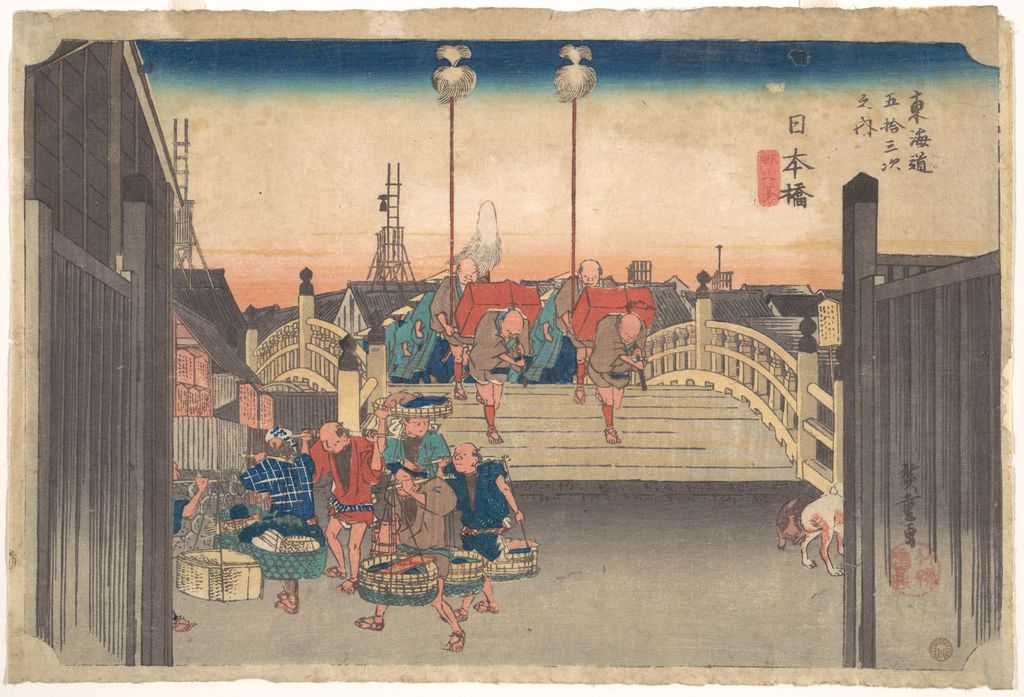
The first view, Nihonbashi: Morning Scene (日本橋 朝之景), starts at the eastern endpoint before any post station has been counted. A British Museum exhibition label [5] reads the foreground as a daimyō procession at daybreak and notes a fire watchtower in the distance. The bridge was a point from which distances were reckoned. Its crowd gives the traveller’s departure a public setting: the road is already busy with people whose journeys have different purposes. The Art Institute of Chicago’s object 25544 [12] catalogues a corresponding Hōeidō Morning Scene, while the British Museum separately catalogues a different Nihonbashi design [13]. These two compositions should not be mixed in a single illustration caption.
The set moves west through the stations and across rivers. The Yokkaichi curator’s 55-scene table [4] identifies ferries and foot crossings at multiple points. The trip is not a single uninterrupted walk: water interrupts the road, and crossing methods vary. At Hakone, the emphasis shifts to steep terrain and the lake. The Art Institute’s Hakone: View of the Lake [16] identifies a surviving Hōeidō impression of standard road position 11. The title names the lake, but does not alone establish the exact viewpoint or elevation.
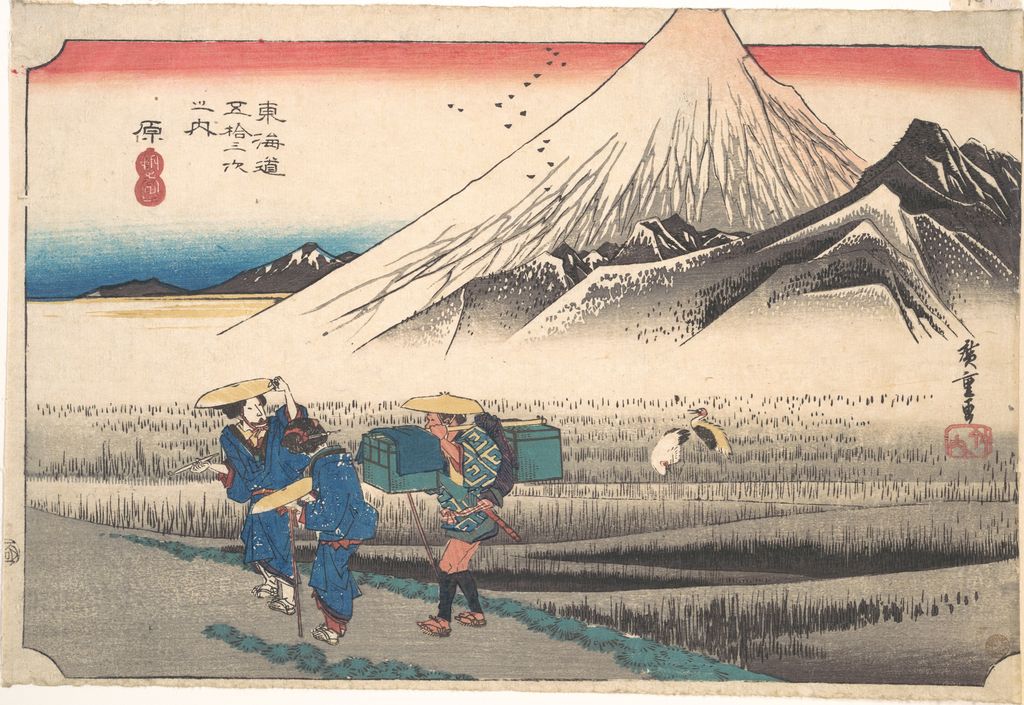
The difference between a road itinerary and a survey becomes clearer beside Mount Fuji. Hara: Fuji in the Morning and Yoshiwara: Fuji on the Left are not two interchangeable pictures of the mountain. Their titles place Fuji in relation to travel, position and changing light. Sagawa [1] puts Hara at road position 14 and Yoshiwara at 15, before Kanbara at 16. A reader moving through the set encounters a recognisable mountain and then a radically different snowy village. That change is an editorial and visual sequence, not evidence that the weather suddenly changed between adjacent stops on one journey. The British Museum’s Hiroshige exhibition [5] explicitly presents the appeal of different times and weather as part of the series’ design.
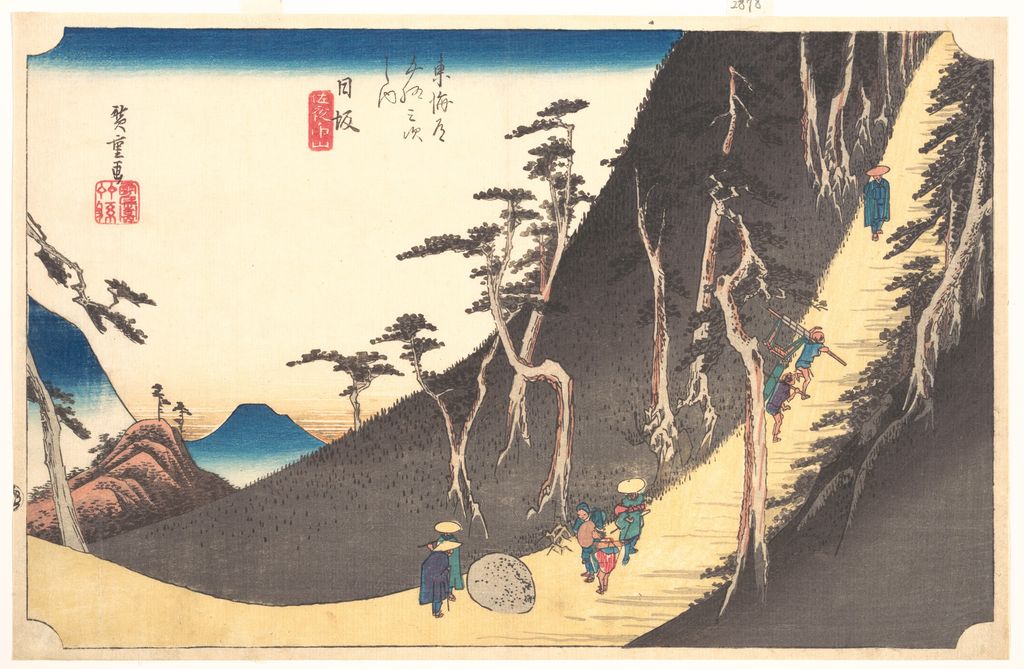
Further west, Nissaka: Sayo-no-Nakayama (日坂 佐夜ノ中山), road position 26, turns the journey into a steep climb. In the Met’s impression JP2878 [18], tiny travellers ascend a bright track cut between dark slopes. The composition gives a bodily sense of the road’s difficulty without serving as a measured topographical profile. The subtitle points to a named pass and its cultural associations, while the visible path and figures show Hiroshige’s particular pictorial solution.
Kanbara: snow and the imagined road
In Kanbara: Evening Snow (蒲原 夜之雪), the world seems reduced to dark outlines, warm points of colour and an expanse of snow. Three figures move through the station while the weather softens buildings and hills. The scene invites a viewer to feel the weight and quiet of a winter journey. The British Museum’s 2025 exhibition guide [5] observes that this is the only one of Hiroshige’s Kanbara designs to show the station itself rather than the ferry crossing more commonly associated with the place. That comparison is useful: the artist did not give every station one inevitable, documentary view. He could choose what an audience would remember.
The Metropolitan Museum’s Kanbara object [6] describes its deep snow as an imaginary scene, noting that such heavy snow would be unusual there. Its explanation also refers to Hiroshige travelling in summer. Because the journey tradition is disputed, the sounder conclusion is narrower: the image is an artistic winter conception, not proof that the artist stood in that snow at Kanbara. It is also wrong to infer that every Kanbara impression has identical tones. Colour can depend on the particular printing, the state of the blocks, later fading and photography. Suntory’s exhibition list [2] juxtaposes impressions identified as early and later. A direct comparison of identified museum impressions can show the differences more reliably than anonymous reproductions.
The design is often reproduced as if one familiar image stood for every surviving print. A museum accession number, however, identifies a particular physical object. The Met’s Kanbara impression, the British Museum’s example and a privately held print should not acquire one another’s printing histories by association. This is more than a technical distinction: visible changes in tone or line may belong to the print’s production and life after printing. Any comparison begins by identifying the impressions actually in view.
The road feeds, carries and employs people
Several Hōeidō views ask us to look beyond scenery. At Mariko, Famous Tea Shop (鞠子 or 丸子 名物茶店) turns a local food stop into the subject of the sheet. The Shizuoka Tōkaidō Hiroshige Museum [3] shows the design in an exhibition joining Hiroshige’s route to popular travel literature. The Yokkaichi curator’s road table [4] identifies a roadside grated-yam tea house outside the station. A named speciality is not incidental ornament: it gives the reader a reason to imagine stopping. Yet the spelling of Mariko differs in institutional lists, and Suntory’s early/later display [2] uses different forms for its catalogued impressions. The difference deserves explanation wherever the two forms appear together.
The Yokkaichi study [4] identifies river crossings at Mitsuke and both sides of the Ōi River, among other points. At Mitsuke: View of the Tenryū River (見附 天竜川図), water and the work of moving people across it interrupt any notion that the journey was simply a succession of inns. The Art Institute of Chicago’s Hōeidō object 18262 [19] documents one surviving impression of this design. Its title and the Japanese road study establish the crossing theme; details of its boats, people and riverbanks belong to a close reading of that particular sheet.
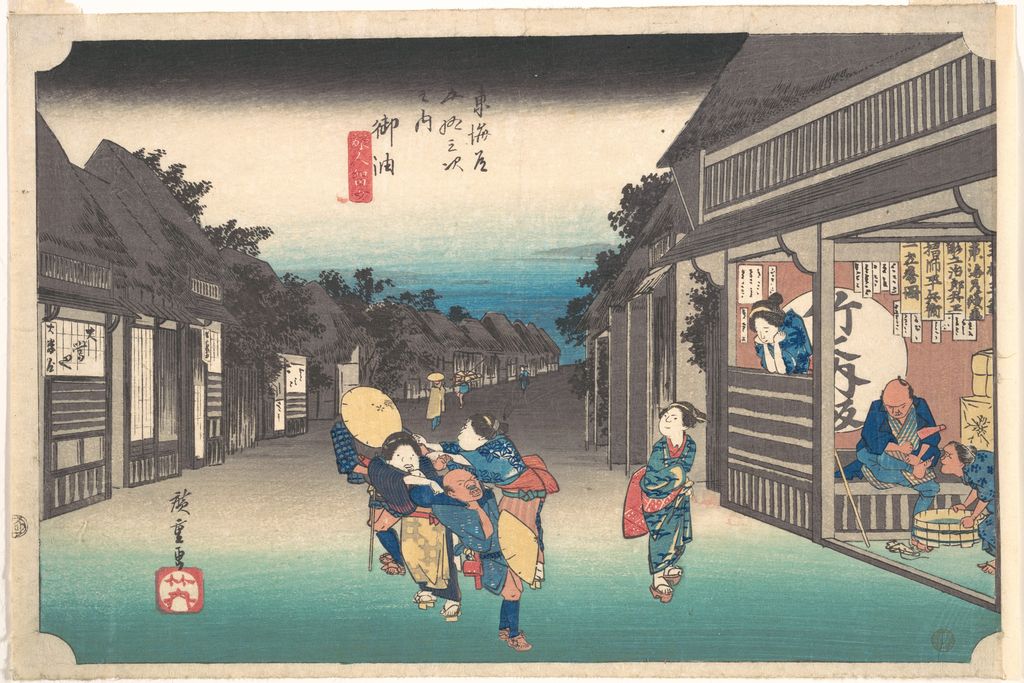
At Goyu, Hiroshige gives social exchange a sharper edge. Women Stopping Travellers (御油 旅人留女) represents solicitation for lodgings. The Suntory Museum’s collection essay [20] explains that Goyu and Akasaka lay close together and that inns competed to intercept travellers. It also draws attention to the print’s recession into depth and to writing embedded within the scene, including maker and publisher information. Together, the street, the women and the printed words turn commerce into a visual encounter. The Art Institute’s Goyu record [21] identifies another Hōeidō impression; the two museums’ objects must still be distinguished when discussing a particular mark or colour.
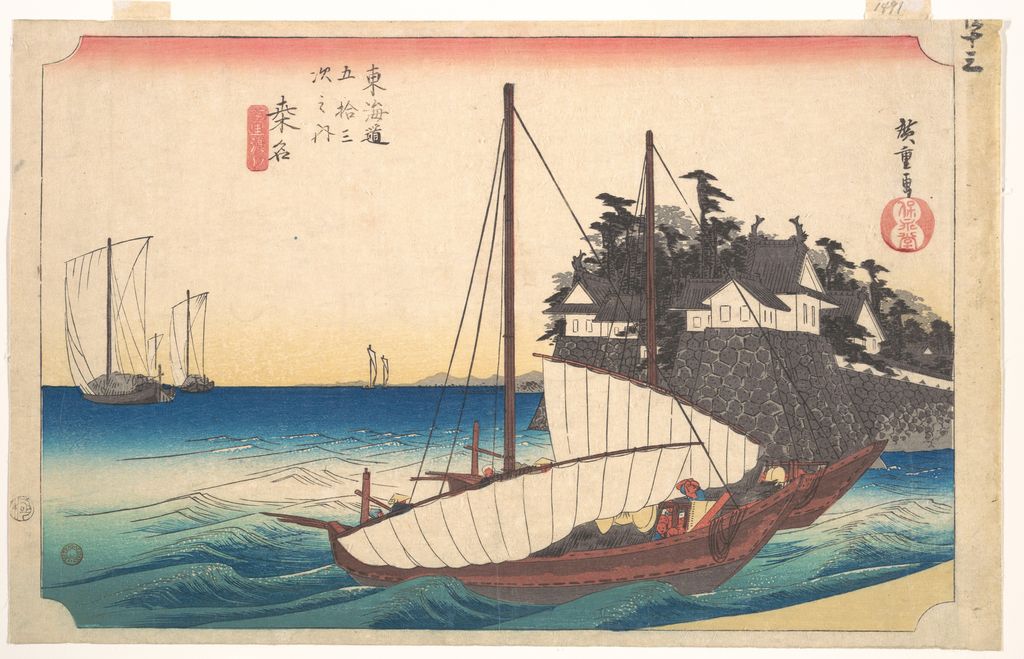
The crossing from Miya to Kuwana interrupts the walking itinerary more dramatically. In the Met’s Kuwana: Seven-Ri Ferry impression JP1491 [23], two boats approach the port across choppy blue water, with the castle behind them. The Met describes a journey of about two hours from Miya. This is a particular pictured arrival at road position 43, not an assertion that every traveller had the same crossing or that each ferry used the same vessel.
The social range continues near the end of the route. Ōtsu: Hashirii Teahouse (大津 走井茶店), standard sequence no. 54, offers another named stop before Kyoto. It can be read beside Mariko as a reminder that a journey was punctuated by eating, buying and rest. The Art Institute records a Hōeidō Ōtsu [24], while the Met holds an Ōtsu from the later Reisho Tōkaidō [6]. The station name alone is insufficient to identify a series.
The work behind a picturesque route
Other sheets deepen this social reading. Fujieda: Changing Horses and People (藤枝 人馬継立) puts the station’s transport organisation into its title. The Yokkaichi City Museum’s 55-view study [4] identifies the setting as a station transport office. That is a reminder that travel involved arranging fresh people and animals, not merely admiring sights. Two consecutive views, Shimada: Suruga Bank of the Ōi River and Kanaya: Far Bank of the Ōi River, hold the river between them. Their pairing makes a crossing into a sequence: first one bank, then the other. These are interpretive readings of the road order and titles, not claims that the two designs were issued as a same-day pair.
The itinerary also records local reputations. Narumi: Famous Arimatsu Tie-Dyed Cloth (鳴海 名物有松絞) names a textile associated with the area; Mizuguchi: Famous Dried Gourd (水口 名物干瓢) names a food product. Nissaka: Sayo-no-Nakayama (日坂 佐夜ノ中山) directs attention to a named mountain pass and its story-bearing landscape. The Sagawa catalogue [1] preserves the original subtitles, while the Yokkaichi curator [4] locates the depicted scenes within or near each station. The Japanese subtitles deserve to stay beside the readable station names: the names are evidence for what Hiroshige and his publishers chose to advertise in a view.
These subjects resist a single simplified account of the road. A wealthy procession, walking travellers, workers, ferries, lodging callers, sellers and local producers occupy different positions in the travel economy. RISD’s exhibition [10] offers useful context for movement on foot, by horse and by palanquin. The prints themselves still need to be read one by one. We should not treat every small figure as a generic “pilgrim” or “merchant” unless dress, inscription or a museum’s object research supports the identification. Visible tools, signs and gestures can ground a close reading; an indistinct figure should not be assigned a confident but invented occupation.
Weather is a subject, not just a backdrop
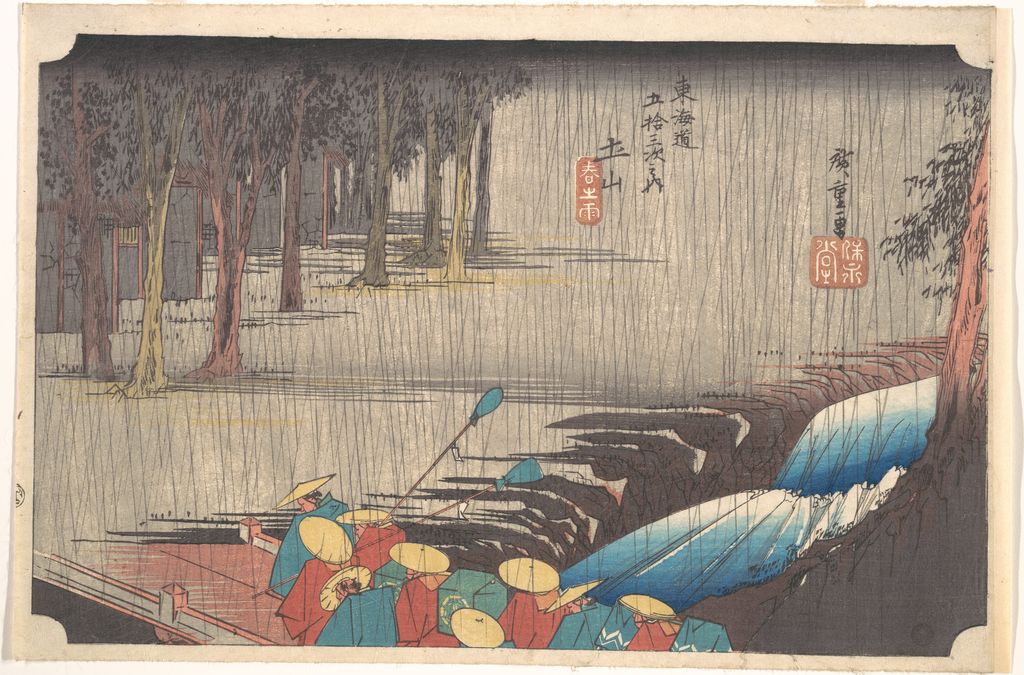
Kanbara is still and snow-filled; Shōno: Sudden Shower (庄野 白雨) is compressed into movement. Travellers and carriers meet the slope while rain cuts across the scene. The Cleveland Museum of Art’s Shōno object [7] describes two groups of travellers, bamboo in the background, three grey tones printed from separate blocks and a publisher’s name hidden on an umbrella. The British Museum’s technical account [5] explains the role of the printer’s controlled colour gradation in giving Shōno depth. The scene shows how a print’s weather is made. The rain is a visual design, but its effect also depends on carving, printing and the pressure of pigment on paper.
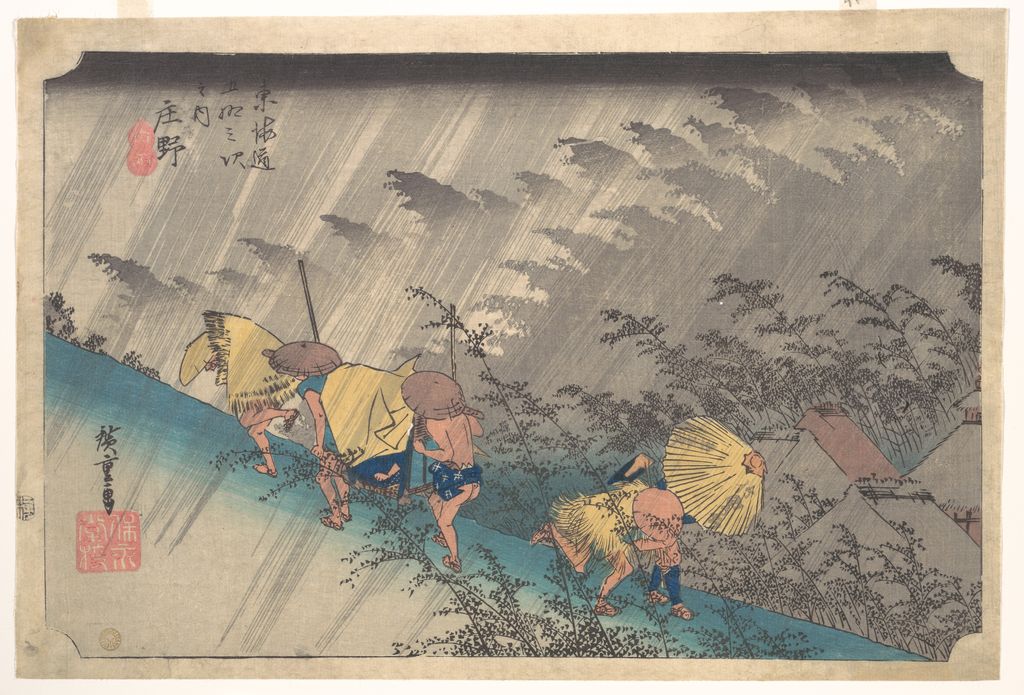
Hōeidō Shōno should also be distinguished from Hiroshige’s Sudden Shower over Shin-Ōhashi Bridge and Atake. Both involve abrupt rain, but the latter belongs to the much later One Hundred Famous Views of Edo. The Art Institute’s Shōno record 130691 [26] and Cleveland’s separate Shōno impression [7] identify the Hōeidō work by its full series title.
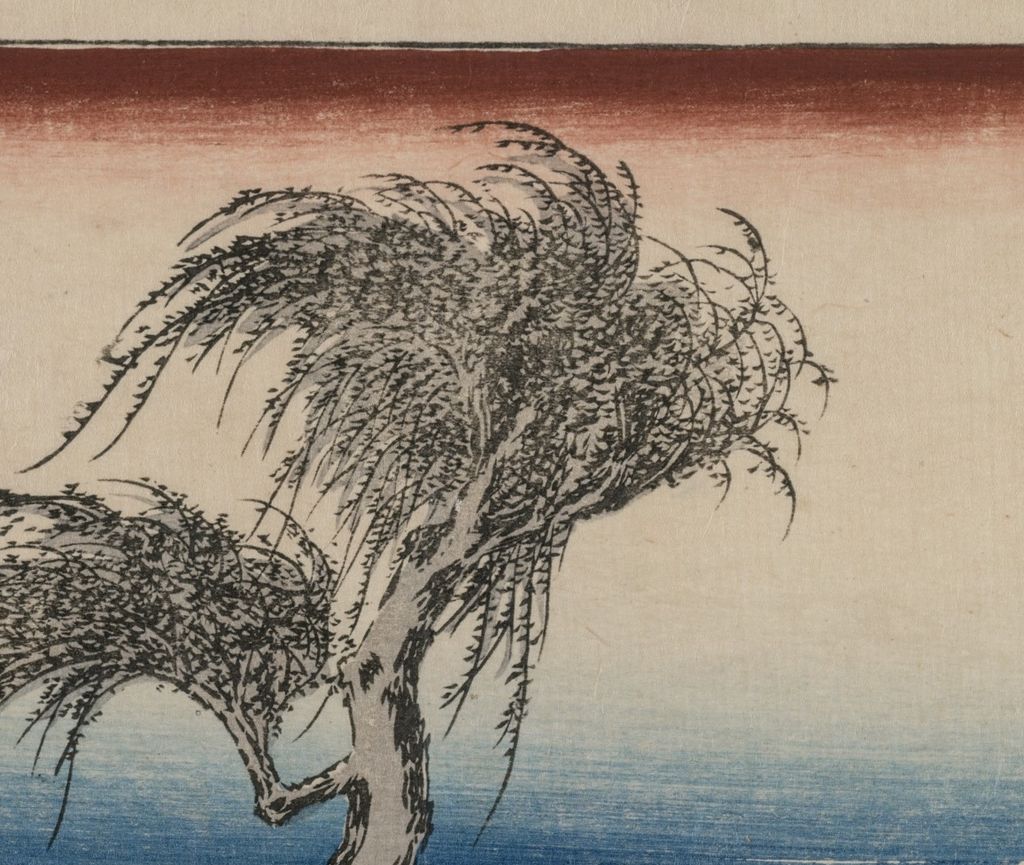
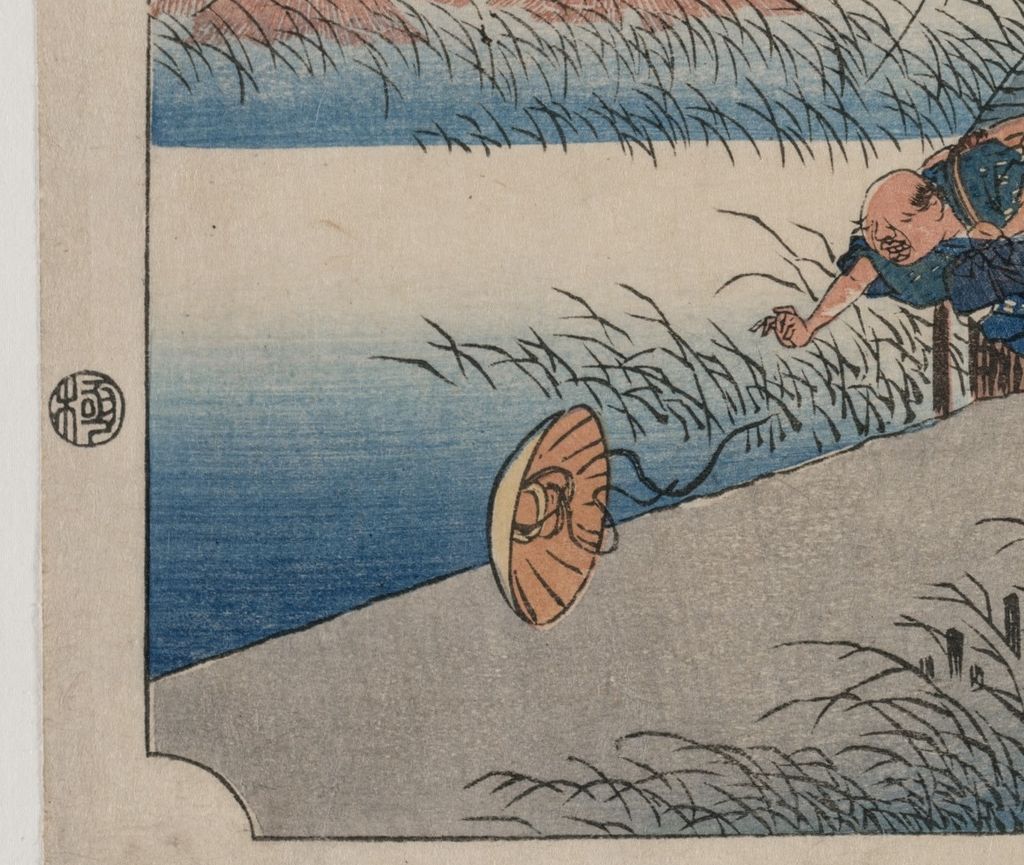
At Yokkaichi, Mie River (四日市 三重川) turns wind into the subject. Cleveland’s object essay [7] points out that Yokkaichi had a famous periodic market, yet the artist chose a marshy river scene instead. A visitor expecting each station’s best-known commercial site encounters an exposed figure, an unsettled landscape and the pressure of air. Cleveland expressly says that no written record explains Hiroshige’s reason for choosing this view. Its visual effect is clear; the artist’s private motive remains unknown.
Read the wind at Yokkaichi
Choose a marker on Cleveland's Hōeidō impression. The three notes are also listed below the image.
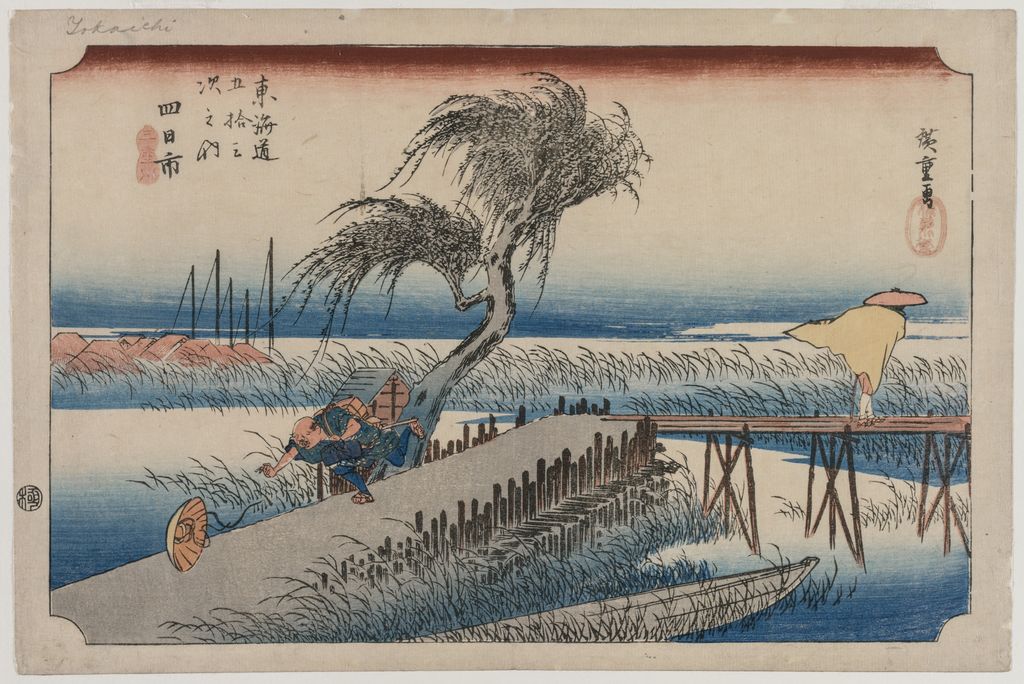
Annotated image details
Select a numbered point to read below; select a detail image to enlarge it. Detail crops come from a retained high-resolution 300 dpi working master.
Willow
Willow: the tree's branches bend sharply across the river view, making the wind visible.
Blown hat
Blown hat: a traveller lunges toward the runaway hat; one small incident gives the weather a human scale.
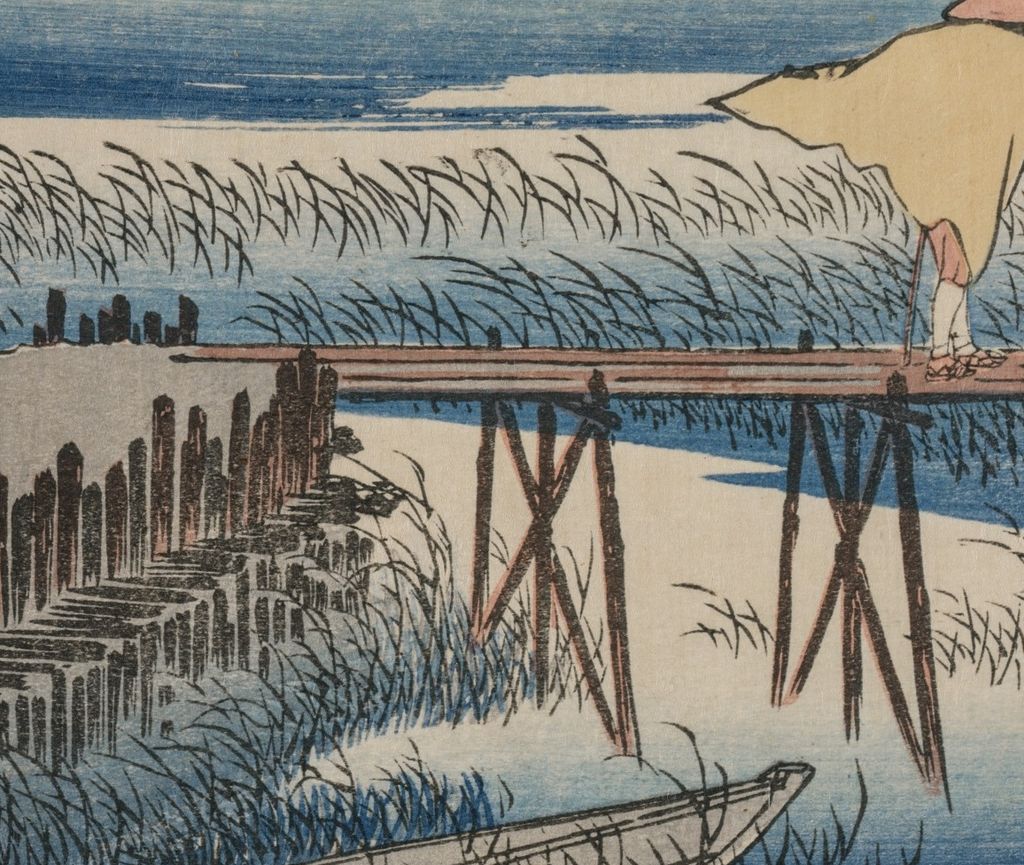
Bridge
Bridge: another figure crosses a low bridge. Yokkaichi City Museum's proposed historical location is research, not a viewpoint proved by this impression.
Hiroshige, Yokkaichi: View of the Mie River, c. 1833–34. The Cleveland Museum of Art, 1948.307; Gift of Mrs. T. Wingate Todd from the Collection of Dr. T. Wingate Todd. Object record [7] · Open Access CC0 [27].
The place itself has prompted research. In a Yokkaichi City Museum paper [4], Hirose Takeshi examines the long-standing identification of the small bridge as Mitaki Bridge. He argues that the bridge’s size and the old road’s direction are inconsistent with that identification. Comparing historical maps and local records, he places the depicted bridge near today’s Inaba Bridge and proposes a viewpoint around Minato Bridge. This is a reasoned local interpretation, not a final answer to where Hiroshige stood or whether he personally saw the scene; Hirose leaves that latter question open. It is valuable because it shows how apparently precise print titles can conceal historical questions. The bridge and blown hat are visible; the exact historical viewpoint remains debated.
The series contains more than snow, rain and wind. The Sagawa road list [1] names Mishima: Morning Mist, Numazu: Twilight, Hara: Morning Fuji, Kameyama: Snow Clearing and Tsuchiyama: Spring Rain. Suntory’s collection essay [20] calls Numazu the series’ one moonlit design. The changing conditions stop the 55 views feeling like a single afternoon’s journey. They are part of how Hiroshige creates variety, rhythm and anticipation across a long sequence. The complete road table below lets readers search the standard sequence by station or Japanese subtitle without imposing a weather label where the title does not support one.
Arriving in Kyoto
The final view, Kyoto: The Great Bridge at Sanjō (京師 三条大橋), completes the journey beyond the 53 stations. The British Museum’s object 1906,1220,0.826 [5] calls it no. 55 and describes a view across the Kamo River with a procession, other bridge users, porters and goods. The bridge is both destination and continued passage. Read against the departure at Nihonbashi, it gives the set two busy civic endpoints. Hiroshige has not told the story of one named traveller’s arrival; he has created a frame through which many travellers enter and leave.
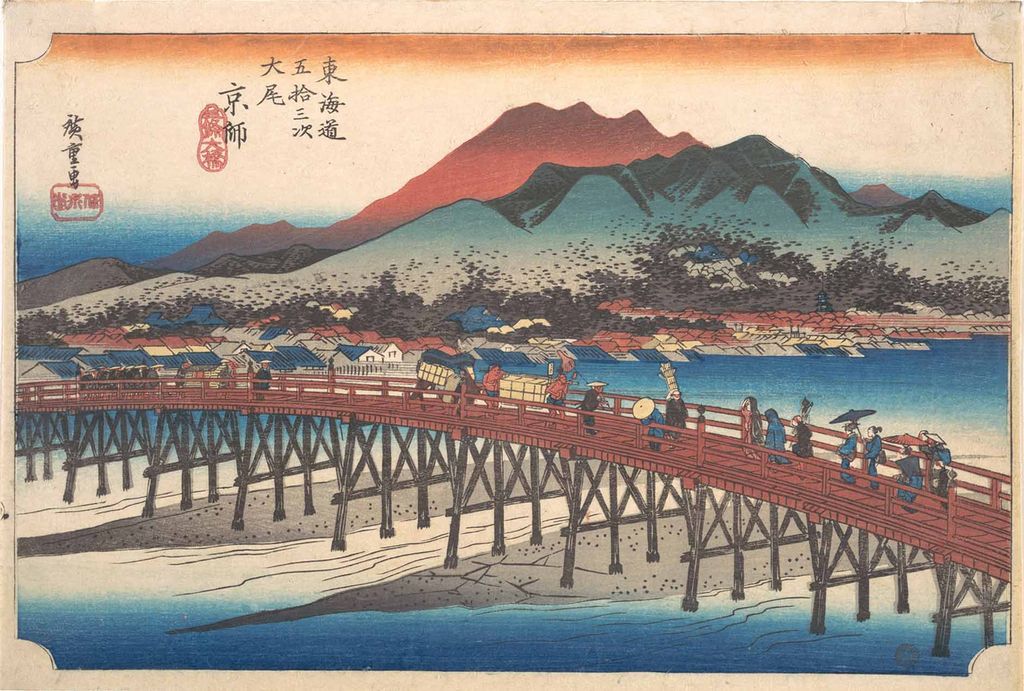
This endpoint also makes the arithmetic memorable. If a reader counts only the post stations, Kyoto can seem like a “missing” fifty-fourth or fifty-fifth print. The physical sequence is simpler: one Edo departure + 53 intermediate stations + one Kyoto arrival = 55 standard views. The Sagawa catalogue [1], Suntory exhibition list [2] and Yokkaichi research table [4] all end with Sanjō Bridge. Later alternate designs do not change the road’s 53-station count.
The Art Institute’s Kyoto object 25789 [30] is another impression of the design, distinct from the British Museum’s print. Both belong to the last stop, but each has its own accession, printing and collecting history. The route title can be shared; the physical objects are not identical.
How a colour print could change
Hiroshige designed the image, but a colour woodblock print was the result of several specialists’ work. The publisher commissioned and organised production; a block cutter carved outlines and colour areas; a printer applied pigments and transferred them to paper. The Metropolitan Museum’s essay on ukiyo-e woodblock prints [6] describes this four-part collaboration, and the British Museum’s Hiroshige printmaking guide [31] explains key-block carving, colour blocks, registration and the printer’s use of a baren. In ordinary language, Hiroshige’s design was not a single painted master copied photographically 55 times. Each colour required a controlled printing step, and each physical sheet is evidence of one production event.
One especially expressive method is bokashi, a gradation of colour or tone achieved by how pigment is worked on the block. The British Museum’s technical essay [5] uses Shōno as an example and notes that hand-made gradation varies from impression to impression. Such variation is one reason two photographs of the same design can look different without either being the “wrong” print. Other differences may stem from a block’s wear, deliberate recutting, altered colour plans, fading, trimming, conservation or the digital photograph itself. Those causes should not be guessed merely by looking at a small web image; a careful comparison uses exact objects and institutional research.
Suntory’s exhibition checklist [2] makes the issue concrete. It separates early and later Kanbara, Mariko and Okazaki impressions and records alternate Hōeidō compositions at several road stops. A new design is not the same as a later pull from the same design, while a state indicates a meaningful change to a print’s blocks or image. Looking closely at identified impressions can reveal differences in lines, marks and colour that a familiar reproduction conceals.
The standard 55-stop sequence is thus a route through Hiroshige’s subjects, not a complete catalogue of all extant impressions. It helps a reader move from one named place to the next while leaving room for variant titles, alternate designs and the material history of each surviving sheet.
A different kind of landscape series from Hokusai’s Fuji views
Hiroshige’s early Tōkaidō and Hokusai’s Thirty-six Views of Mount Fuji both use repeated subjects to let a viewer compare difference within a whole. Their organising questions are distinct. Hokusai can keep returning to one mountain as it appears from a changing range of places, frames and human activities. Hiroshige’s Tōkaidō moves along an itinerary. A reader expects the next station, then the next, while the image at each stop may turn toward a bridge, a meal, a sudden change of weather or the work of crossing water. The Tokugawa Art Museum’s comparison [9] recognises Hokusai’s pioneering landscape series and Hiroshige’s particular use of atmosphere and travellers. It supports comparison without making Hiroshige merely a successor who repeated Hokusai’s solution.
This distinction also clarifies the relationship between the two artists’ landscape series. Yui: Satta Pass and the Fuji views at Hara and Yoshiwara belong to Hiroshige’s road story even when the mountain is prominent. They do not belong to Hokusai’s Thirty-six Views merely because Fuji appears in them. Conversely, the human labour in Hokusai’s series should not be mistaken for an east-to-west Tōkaidō itinerary. Two questions help keep the series distinct: Where is Fuji? in Hokusai’s views, and Where has the traveller reached? in Hiroshige’s road sequence. They direct attention to different ways of organising a landscape series.
How does the Hōeidō series relate to Hiroshige’s later Tōkaidō prints?
Hiroshige returned to the road repeatedly, changing format, publisher, lettering and emphasis. The Shizuoka City Tōkaidō Hiroshige Museum [32] has exhibited several distinct Tōkaidō series side by side. Suntory’s Hōeidō and Reisho exhibition [2] makes the distinction especially clear. The later series called Reisho Tōkaidō takes its nickname from the formal script in its title cartouches. The Met’s Ōtsu object [6] dates that later series to around 1848–49, while its Hōeidō counterpart belongs to the early 1830s. They share place names, but they are separate visual projects.
Names such as “Hiroshige Ōtsu” or “Hiroshige Yokkaichi” can identify works from different series. Even a genuine museum print may depict a later treatment of the same place. The full series title, publisher attribution, date, orientation and design help tell them apart. The same care applies to Hokusai’s Thirty-six Views of Mount Fuji and Hiroshige’s own later Fuji views: a shared mountain or road does not erase series identity.
The Hōeidō set also matters within Hiroshige’s career because it shows the form he could give to a long itinerary. The Tokugawa Art Museum [9] contrasts Hiroshige’s lyrical treatment of weather and travellers with the landscape-print field that Hokusai helped establish. That is a curatorial comparison, not a claim that one artist simply copied the other. Hiroshige’s later One Hundred Famous Views of Edo would use a different organising premise and often a bold vertical format. Readers coming from that series may recognise his love of weather and framed views while seeing how the Hōeidō road demands a continuous east-to-west sequence.
What should a complete set mean to a reader today?
Museums can show the complete standard route, but no single display resolves every question about original issue order, alternate plates or particular impressions. The Sagawa Art Museum list [1] is a strong starting point because it keeps 55 road positions and Japanese subtitles together. Suntory [2] and Yokkaichi City Museum [4] help check names and complicate the simple idea of one immutable set. A “complete” route guide should therefore be honest about what is complete: the standard itinerary, not the total surviving print history.
The 55 stops are easiest to understand in road order, with Japanese and English names beside one another. Looking across them, patterns emerge: river crossings interrupt walking, food and lodging mark pauses, and changing rain, snow, fog or dusk alter the road’s mood. The sequence offers one way to study Hiroshige’s choices, while the wider body of his work shows how often he returned to the same places with new designs.
Consider ten stops together: Nihonbashi and Kyoto form the endpoints; Hakone changes the terrain; Kanbara, Shōno and Yokkaichi make different weather palpable; Mitsuke interrupts the road with a river; Mariko, Goyu and Ōtsu reveal the people and businesses that sustained travel. They show why the series is more than a checklist of places.
The complete 55-view road sequence
One Edo departure, 53 post stations and one Kyoto arrival form the standard Hōeidō itinerary. This is road order, not a proved printing or publication order. Japanese station and subtitle forms follow Sagawa Art Museum's catalogue [1]; familiar English station spellings are supplied for navigation. Other catalogues may record different character forms or alternate designs.
55 of 55 views shown
On a narrow screen, swipe the table sideways to see the role column.
| Road no. | Station or endpoint | View subtitle | Role |
|---|---|---|---|
| 1 | Nihonbashi 日本橋 | 朝之景 | Edo departure |
| 2 | Shinagawa 品川 | 日之出 | Post station 1 |
| 3 | Kawasaki 川崎 | 六郷渡舟 | Post station 2 |
| 4 | Kanagawa 神奈川 | 臺之景 | Post station 3 |
| 5 | Hodogaya 保土ヶ谷 | 新町橋 | Post station 4 |
| 6 | Totsuka 戸塚 | 元町別道 | Post station 5 |
| 7 | Fujisawa 藤澤 | 遊行寺 | Post station 6 |
| 8 | Hiratsuka 平塚 | 縄手道 | Post station 7 |
| 9 | Ōiso 大礒 | 虎ヶ雨 | Post station 8 |
| 10 | Odawara 小田原 | 酒匂川 | Post station 9 |
| 11 | Hakone 箱根 | 湖水図 | Post station 10 |
| 12 | Mishima 三島 | 朝霧 | Post station 11 |
| 13 | Numazu 沼津 | 黄昏図 | Post station 12 |
| 14 | Hara 原 | 朝之富士 | Post station 13 |
| 15 | Yoshiwara 吉原 | 左富士 | Post station 14 |
| 16 | Kanbara 蒲原 | 夜之雪 | Post station 15 |
| 17 | Yui 由井 | 薩埵嶺 | Post station 16 |
| 18 | Okitsu 奥津 | 興津川 | Post station 17 |
| 19 | Ejiri 江尻 | 三保遠望 | Post station 18 |
| 20 | Fuchū 府中 | 安部川 | Post station 19 |
| 21 | Mariko 鞠子 | 名物茶店 | Post station 20 |
| 22 | Okabe 岡部 | 宇津之山 | Post station 21 |
| 23 | Fujieda 藤枝 | 人馬継立 | Post station 22 |
| 24 | Shimada 嶋田 | 大井川駿岸 | Post station 23 |
| 25 | Kanaya 金谷 | 大井川遠岸 | Post station 24 |
| 26 | Nissaka 日坂 | 佐夜ノ中山 | Post station 25 |
| 27 | Kakegawa 掛川 | 秋葉山遠望 | Post station 26 |
| 28 | Fukuroi 袋井 | 出茶屋ノ図 | Post station 27 |
| 29 | Mitsuke 見附 | 天竜川図 | Post station 28 |
| 30 | Hamamatsu 濱松 | 冬枯ノ図 | Post station 29 |
| 31 | Maisaka 舞坂 | 今切真景 | Post station 30 |
| 32 | Arai 荒井 | 渡舟ノ図 | Post station 31 |
| 33 | Shirasuka 白須賀 | 汐見阪図 | Post station 32 |
| 34 | Futagawa 二川 | 猿ヶ馬場 | Post station 33 |
| 35 | Yoshida 吉田 | 豊川橋 | Post station 34 |
| 36 | Goyu 御油 | 旅人留女 | Post station 35 |
| 37 | Akasaka 赤阪 | 旅舎招婦ノ図 | Post station 36 |
| 38 | Fujikawa 藤川 | 棒鼻ノ図 | Post station 37 |
| 39 | Okazaki 岡崎 | 矢矧之橋 | Post station 38 |
| 40 | Chiryū 池鯉鮒 | 首夏馬市 | Post station 39 |
| 41 | Narumi 鳴海 | 名物有松絞 | Post station 40 |
| 42 | Miya 宮 | 熱田神事 | Post station 41 |
| 43 | Kuwana 桑名 | 七里渡口 | Post station 42 |
| 44 | Yokkaichi 四日市 | 三重川 | Post station 43 |
| 45 | Ishiyakushi 石薬師 | 石薬師寺 | Post station 44 |
| 46 | Shōno 庄野 | 白雨 | Post station 45 |
| 47 | Kameyama 亀山 | 雪晴 | Post station 46 |
| 48 | Seki 関 | 本陣早立 | Post station 47 |
| 49 | Sakanoshita 阪之下 | 筆捨嶺 | Post station 48 |
| 50 | Tsuchiyama 土山 | 春之雨 | Post station 49 |
| 51 | Minakuchi 水口 | 名物干瓢 | Post station 50 |
| 52 | Ishibe 石部 | 目川ノ里 | Post station 51 |
| 53 | Kusatsu 草津 | 名物立場 | Post station 52 |
| 54 | Ōtsu 大津 | 走井茶店 | Post station 53 |
| 55 | Kyoto 京師 | 三条大橋 | Kyoto arrival |
Explore more Hiroshige pages
| Name | Date | Medium |
|---|---|---|
| One Hundred Famous Views of Edo | 19th century | Woodblock print |
| Sudden Shower over Shin-Ōhashi Bridge and Atake | 19th century | Woodblock print |
| Plum Park in Kameido | 19th century | Woodblock print |
| Flower Pavilion near Dangozaka Slope | 19th century | Woodblock print |
| View to the North from Asukayama Hill | 19th century | Woodblock print |
| The Sixty-nine Stations of the Kisokaidō | 19th century | Woodblock print |
Frequently asked questions
The 53 are the intermediate post stations between Edo and Kyoto. The familiar route adds a departure view at Nihonbashi and an arrival view at Sanjō Bridge: 1 + 53 + 1 = 55. Sagawa [1] and the British Museum’s no. 55 Kyoto record [5] confirm the endpoints.
The extent of his personal 1832 journey is disputed. Some institutions repeat the traditional procession story, while RISD [10] labels it an assumption and a Cernuschi-affiliated essay [10] notes specialist doubts. The series uses real places, but weather and composition are artistic choices; the Met describes Kanbara’s snow as imagined [6].
It identifies the early Tōkaidō publishing project associated with Hōeidō, the firm of Takenouchi Magohachi. Suntory Museum [2] records initial joint publication with Tsuruya Kiemon’s Senkakudō and later Hōeidō-only publication. The label distinguishes this group from Hiroshige’s many other Tōkaidō series; it does not guarantee that a particular surviving impression was among the first printed.
No. They cover many of the same stations but use different designs, publishers and title treatments. Suntory displayed them as separate complete series [2]. The Met’s Reisho Ōtsu record [6] is a useful comparison precisely because it should not be used as an image of the Hōeidō Ōtsu.
They can be distinct impressions, states, recuts or alternate compositions. Printer-controlled colour gradation also varies by hand. The British Museum explains that variation with Shōno [5], while Suntory explicitly displays early and later impressions and alternate designs [2]. Fading, trimming and photography can add further differences. A reliable comparison begins with exact object records, not two anonymous thumbnails.
Discussion
Every station changes the journey's pace, weather or social setting.
Reader Insights
Which view makes travel feel most physical to you?
What changes when you move from Kanbara's snow to Shōno's rain?
Which worker or task on the route did you notice first?
Join the Conversation
Share a stop or a detail that changed how you see Hiroshige's road.
References
- Sagawa Art Museum, complete Hōeidō exhibition catalogue (Japanese PDF).
- Suntory Museum of Art, Hōeidō/Reisho exhibition account (Japanese) and complete exhibition list (Japanese PDF).
- Shizuoka City Tōkaidō Hiroshige Museum, Hiroshige overview and Tōkaidō travel literature exhibition.
- Hirose Takeshi, Yokkaichi City Museum research paper on Yokkaichi: Mie River (Japanese PDF).
- British Museum, Hiroshige exhibition large-print guide, printmaking technique and Kyoto object.
- Metropolitan Museum of Art, Kanbara object, Reisho Ōtsu object and woodblock-print overview.
- Cleveland Museum of Art, Yokkaichi and Shōno.
- Art Institute of Chicago, API documentation and selected Hōeidō object records.
- Tokugawa Art Museum, Hiroshige’s Travelscapes exhibition handout.
- RISD Museum, Tōkaidō exhibition, Cernuschi museum-affiliated essay and Japanese Sabo journal discussion for the disputed journey story.
- Yokkaichi City Museum
- Art Institute of Chicago’s object 25544
- British Museum separately catalogues a different Nihonbashi design
- Object record
- Open Access CC0
- Art Institute’s Hakone: View of the Lake
- Object record
- Met’s impression JP2878
- Art Institute of Chicago’s Hōeidō object 18262
- Suntory Museum’s collection essay
- Art Institute’s Goyu record
- Object record
- Met’s Kuwana: Seven-Ri Ferry impression JP1491
- Art Institute records a Hōeidō Ōtsu
- Object record
- Art Institute’s Shōno record 130691
- Open Access CC0
- Object record
- Object record
- Art Institute’s Kyoto object 25789
- British Museum’s Hiroshige printmaking guide
- Shizuoka City Tōkaidō Hiroshige Museum