


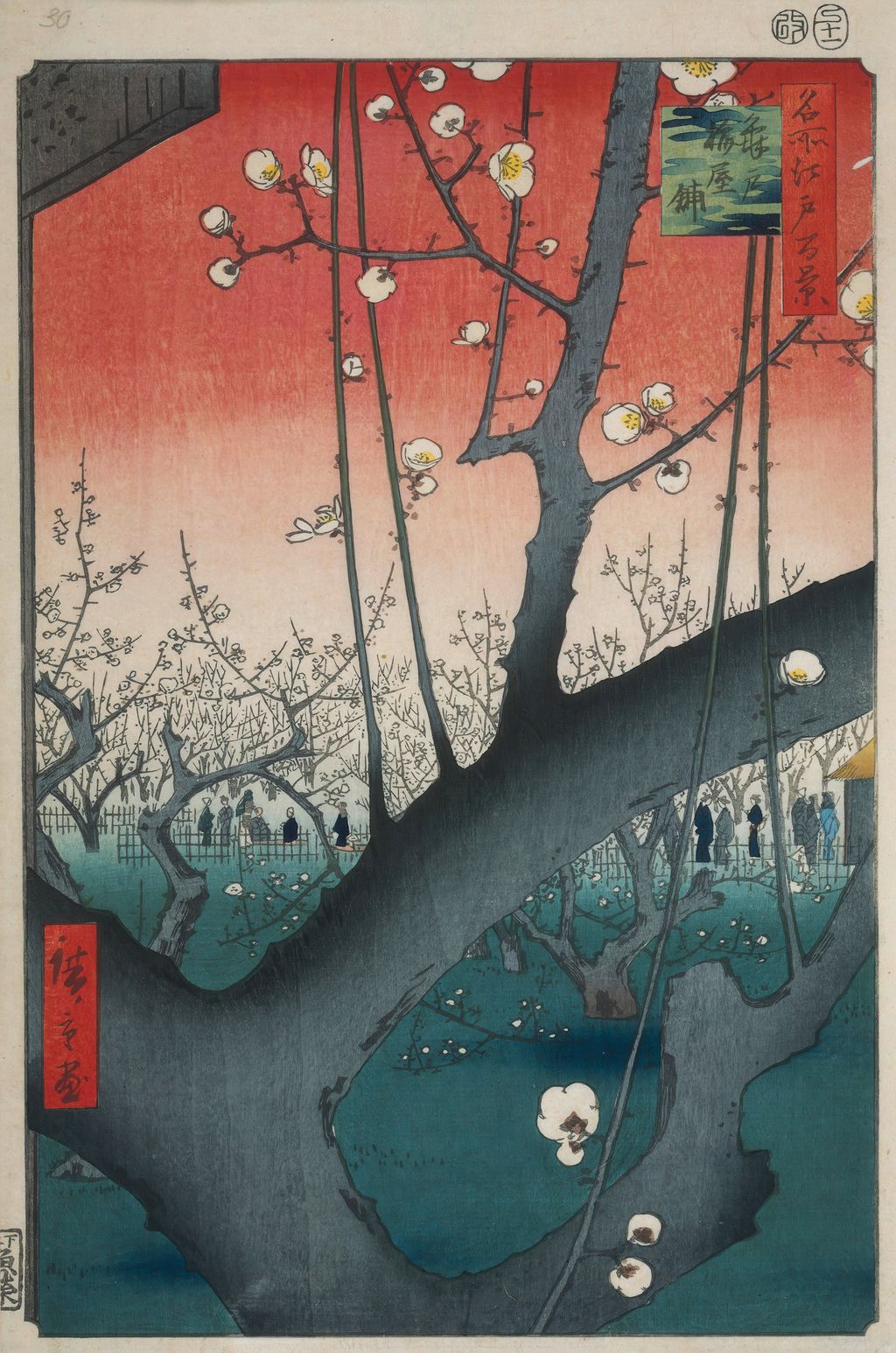
Hiroshige, Plum Garden at Kameido. Public-domain design reproduction; exact physical impression and printing state unidentified.
 by Tom Gurney
Tom Gurney BSc (Hons) is an art history expert with over 20 years experience
Published on June 19, 2020 / Updated on September 23, 2026
Email: tomgurney1@gmail.com / Phone: +44 7429 011000
Hiroshige's One Hundred Famous Views of Edo
Hiroshige's One Hundred Famous Views of Edo (名所江戸百景, Meisho Edo hyakkei) is a late series of colour woodblock prints that leads the viewer through the city now called Tokyo and the places around it. A bridge can be seen through the legs of a turtle; a plum tree nearly fills the foreground of a garden; a festival rises above the rooftops; a bird of prey looks down over a snowy expanse. These are recognisable places, but Hiroshige repeatedly changes where the viewer appears to stand. He makes looking at Edo as important as identifying its landmarks. British Museum, 2025 exhibition guide [1]
The familiar title is a round number, not a count of surviving designs. One hundred and eighteen views bear Hiroshige I's signature. Hiroshige II added one more in 1859. A separately printed title and contents sheet brings the standard complete group to 120 sheets: 119 views and one contents sheet. The distinction matters when a catalogue, exhibition or book says “118,” “119” or “120.” They may be counting different parts of the same publishing history. Shizuoka City Tōkaidō Hiroshige Museum [2] Tokyo University of the Arts University Art Museum [3]
Contents
- Hiroshige's One Hundred Famous Views of Edo
- How Hiroshige and his publisher made a city series
- What counted as a famous place?
- Ten views to look at closely
- The four seasons, and why their order matters
- The printed sheet is not the whole design
- From Edo to later viewers
- Explore all 119 Edo views
- Continue through Hiroshige
The series is usually dated 1856–58, the period in which the 118 signed designs appeared. Its publisher was Uoya Eikichi, also rendered Sakanaya Eikichi (魚屋栄吉). The additional Hiroshige II design was issued after Hiroshige I's death, and the contents sheet also belongs to that later assembly of the series. These facts make the work a long publishing project rather than a single album completed at one moment. Suntory Museum of Art [4] British Museum, title and contents sheet [5]
At a glance
- Japanese title
名所江戸百景(Meisho Edo hyakkei) - Artist118 views signed by Utagawa Hiroshige I; one later view by Hiroshige II
- PublisherUoya/Sakanaya Eikichi (
魚屋栄吉) - IssuedHiroshige I signed views: February 1856 to October 1858; Hiroshige II addition: April 1859
- Standard complete group119 pictorial views plus a separate contents sheet, 120 sheets in total
- Contents sheetDesigned by Baisotei Gengyo; groups the original 118 views by spring, summer, autumn and winter
- Medium and formatColour woodblock prints, mostly vertical ōban sheets
- What this guide offersPublishing context, ten close readings, and a searchable 119-design Japanese contents-order catalogue
The seasonal sequence below follows a later printed contents list. It is not a month-by-month publication diary. Suntory's research notes that the contents order does not consistently agree with dated censor seals, and it places the Hiroshige II addition outside the four seasonal groups. Suntory Museum of Art [4] Tokyo National Museum description via Japan Search [6]
How Hiroshige and his publisher made a city series
The series began more than two decades after the Hōeidō Fifty-three Stations of the Tōkaidō had made Hiroshige's road imagery famous. The two projects invite the viewer to travel through pictures, but they do not do the same job. The Tōkaidō series follows a named route between Edo and Kyoto and frames each design as a stage of a journey. One Hundred Famous Views repeatedly returns the viewer to the metropolis and its orbit. Its destinations include bridges, ferry points, temples, gardens, neighbourhoods, waterways and ground that had not previously been established as a conventional landmark. The British Museum describes it as an expansion of the classical idea of meisho, or famous places. British Museum, exhibition announcement [7]
The 1855 Ansei Edo earthquake forms part of the city's immediate background. It would be too simple to claim that every design records damage or that the series was a straightforward rebuilding campaign. The British Museum's more careful formulation is that recent research suggests the prints may have helped inspire residents as the city was rebuilt. Some views show renewed sites; others dwell on seasonal pleasures, older associations or the sheer play of viewpoint. That variety is essential to the series. British Museum, large print exhibition guide [1]
Production was collaborative. A design passed from artist to block cutter and printer under a publisher's direction; a purchaser acquired a printed sheet, not Hiroshige's brush drawing. The often startling effect of a foreground silhouette against a distant landscape depended on cutting and registration, and the series' dense colours and gradations were made in printing. The British Museum points to engraving, mica, overprinting and gradation among the techniques visible in well-preserved impressions. The maker names and publisher marks on individual sheets can add a layer of evidence that a generic digital reproduction cannot supply. British Museum, large print exhibition guide [1]
The signed group was issued from February 1856 through October 1858. Hiroshige I died in 1858. Three sheets with his signature bear censor seals dated after his death, and Suntory notes scholarly suggestions that a pupil may have produced them under his name. This is an authorship question, not a reason to erase those sheets from the established count. “118 signed designs” is a precise description of the evidence; “118 designs personally finished by Hiroshige before his death” is more than that evidence securely proves. Suntory Museum of Art [4]
Hiroshige II's Akasaka Kiribatake in Evening Rain was added in April 1859. The separate contents sheet was drawn by Baisotei Gengyo after Hiroshige I's death. Its graceful seasonal ordering offers a way to browse the published body, but the order was not necessarily the artist's preferred sequence. The later addition is no. 119 in the present reference catalogue, outside Gengyo's four season lists. The series' edges are therefore as historically revealing as its most reproduced prints: title, contents, signature and date each answer a different question. Suntory Museum of Art [4] Shizuoka City Tōkaidō Hiroshige Museum [2]
What counted as a famous place?
Meisho can carry a place's literary memory as well as its visual recognisability. A viewer might know a river crossing from a poem, a temple visit, a festival or an earlier illustrated guide. Hiroshige's late series makes that inherited idea feel mobile. The title promises famous views, yet the sheets also turn ordinary roofs, an animal at a window, a hanging streamer or marshland into the privileged viewpoint. The site named in the cartouche is often some distance from the most conspicuous object in the picture. National Diet Library, famous places essay [8] British Museum, exhibition announcement [7]
“Edo” in the series should not be read as a neat outline of today's central Tokyo. The Shizuoka City Tōkaidō Hiroshige Museum separates central-city, nearby and more distant suburban locations in its discussion. The pleasure of the series comes partly from moving between crowded urban surfaces and the outer reaches of the city. A bridge, garden or field could give a buyer a mental excursion without a physical trip. Conversely, a nearby resident might recognise local routines or question how closely the printed view matched the ground. Shizuoka City Tōkaidō Hiroshige Museum [2]
The National Diet Library's Japanese place exhibition is especially helpful here because it connects print titles to older descriptions, topographic history and other pictures of a site. At Suidōbashi and Surugadai, for example, it gives the district's historical name and later transformation. At Meguro, it describes the river, sloping plateau, Drum Bridge and the steep Gyōnin-zaka. Those place records do not make Hiroshige's compositions into literal street photographs. They help a reader understand what the named locations were and what the artist selected or rearranged. NDL, Surugadai [9] NDL, Meguro [10]
Ten views to look at closely
The ten illustrations here range across the later contents sheet's four seasonal groups. They are distinct designs, not ten printed copies of one image. Five are identified Metropolitan Museum of Art impressions with accession numbers. Five come from user-owned public-domain files whose designs can be identified visually but whose physical impression and state remain unknown. The captions preserve that difference. This matters most when an argument depends on colour, a printer's change or the presence of a mark: the design may be Hiroshige's while a particular surviving sheet has its own history. Met Open Access [11] British Museum, Korenberg on print states [12]
Spring: Plum Garden at Kameido (亀戸梅屋舗)
A dark trunk enters the picture so close to the eye that it obstructs a conventional garden panorama. Its branches carry the viewer across a field of flowers and small human figures. The distant people make the tree's scale feel almost architectural. The view is not a neutral diagram of where to stand in a garden: it offers an impossible intimacy with the flowering branch while still naming Kameido as a place to visit. The National Diet Library identifies the design as a Hiroshige print issued by Uoya Eikichi in Ansei 4 (1857), and its record links to different printings. NDL, Kameido Plum Garden [13]
Annotated image details
Select a numbered point to read below; select a detail image to enlarge it. Detail crops come from a retained high-resolution 300 dpi working master.
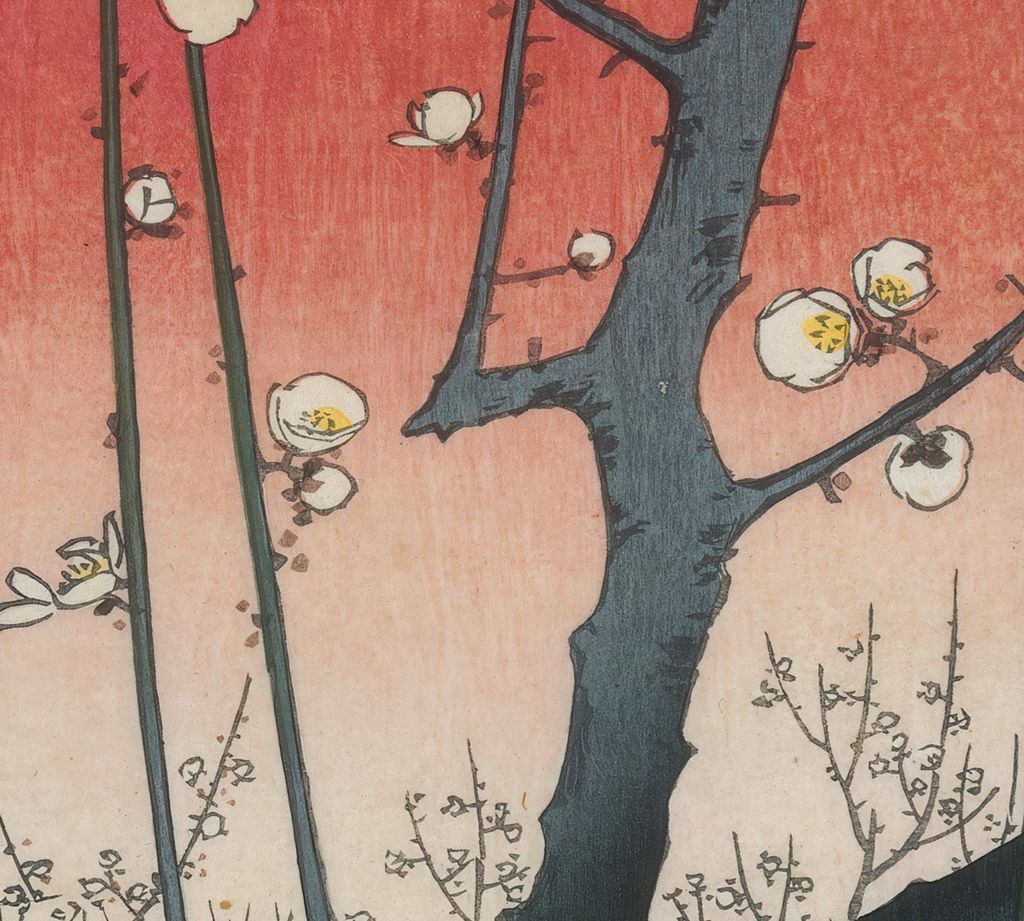
Near tree
Near tree: the trunk and branch nearly divide the sheet, forcing the viewer to look through them.
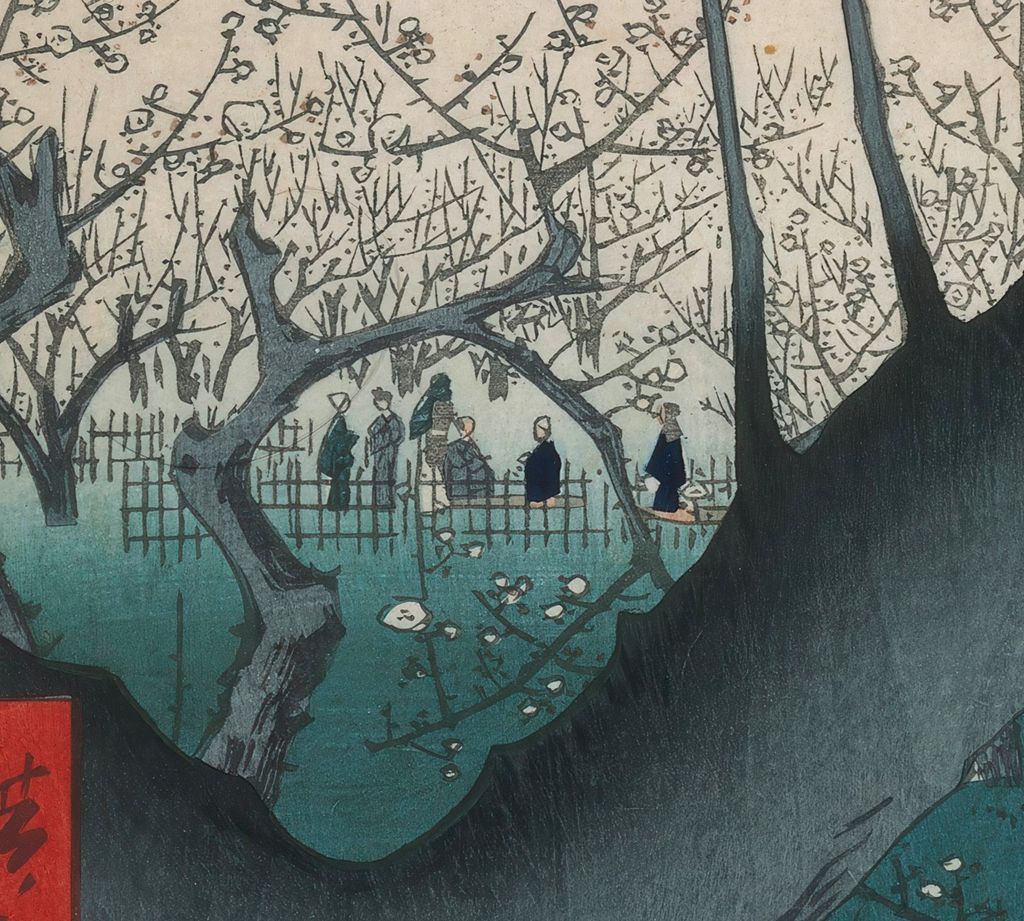
Visitors
Visitors: small figures below give the plum tree its dramatic scale and keep the named garden visible.
Sky
Sky: colour varies across documented print states. This unverified image cannot be assigned to an early or late state from colour alone. British Museum state study [12].
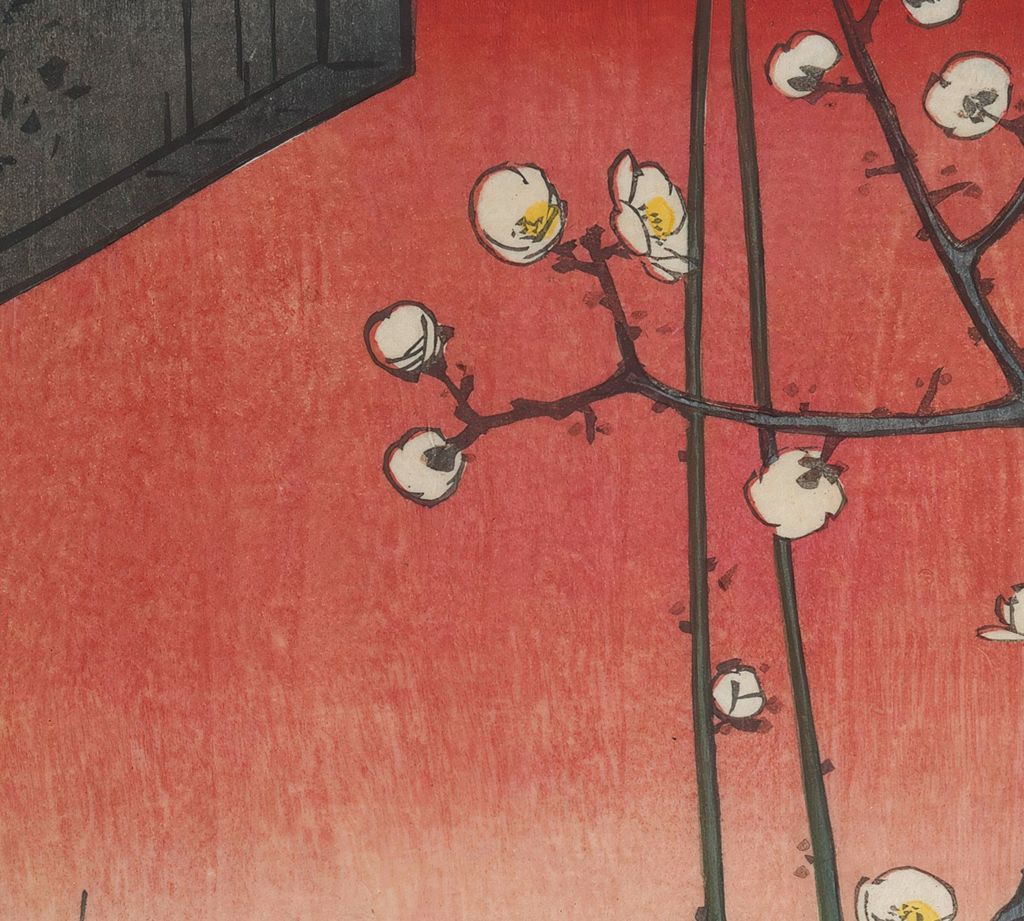
It is also an unusually good lesson in the life of a woodblock design. British Museum scientist Capucine Korenberg compared 82 impressions and distinguished four states. Early sheets have a luminous pink-red gradation in the sky; a later change introduced purple at the top. Other differences affect grass, branches and colour bands. The user-owned image reproduced here is assigned to the design, but its exact state has not been established. It would be misleading to identify it as Korenberg's “first state” merely because it looks vivid. British Museum, Korenberg [12]
Vincent van Gogh owned a later, fourth-state impression, traced it using a grid and made Flowering Plum Orchard (after Hiroshige) in 1887. His painting appears to borrow some colours associated with an early state rather than mechanically reproducing his own sheet. This is a documented relationship between particular objects; it is more informative than the blanket claim that “Van Gogh copied Japanese prints.” It also shows why later reception belongs after close looking at the original printmaking history, not in place of it. British Museum, Korenberg [12]
Summer: Suidōbashi and Surugadai (水道橋駿河台)
Here the largest shape is a carp streamer crossing the sky. It appears closer to us than the bridge and district named in the title, while Mount Fuji settles on the distant horizon. The bright, apparently weightless cloth makes a scene of human construction into one of seasonal display and movement. The British Museum describes several carp streamers, Suidō Bridge to the right, Edo Castle to the left and Fuji far away. Its object record also notes that early impressions contain printing refinements absent from the museum's particular sheet. British Museum, accession 1948,0410,0.72 [14]
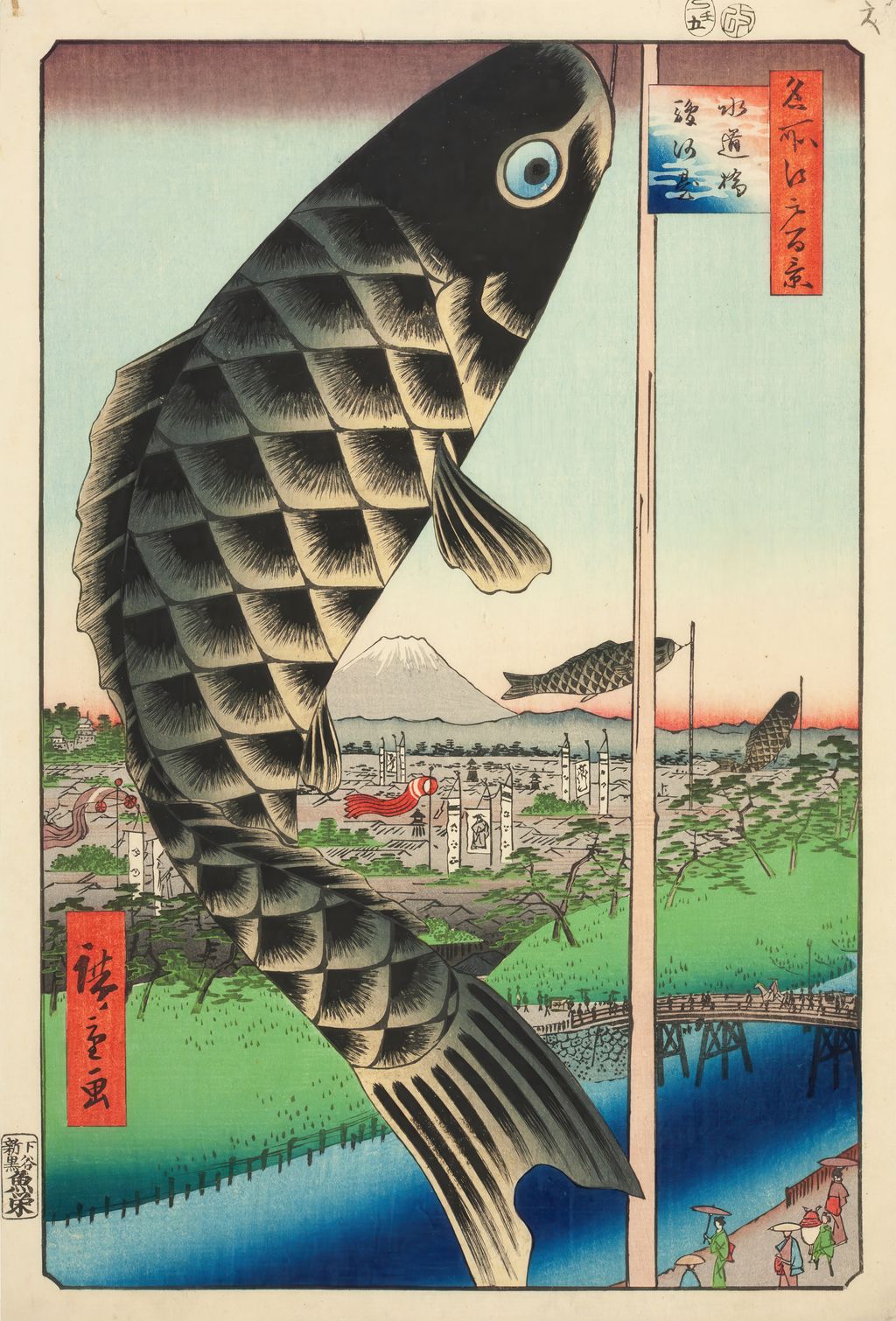
The picture's axes compete: the streamer spans the vertical sheet, the bridge carries travellers horizontally, and the city stretches back toward Fuji. Hiroshige is making a viewer change scale and distance in an instant. The streamer is not just decorative “Japanese colour.” Its proximity is the very device by which the city view becomes surprising. The NDL's district record identifies Surugadai as an area named after retainers who moved there from Suruga province in the early seventeenth century; the print makes the place legible through an Edo seasonal emblem rather than through a mapped street plan. NDL, Surugadai [9]
Summer: Mannen Bridge, Fukagawa (深川萬年橋)
A turtle hangs near the viewer as the bridge, water, boats and Fuji recede beyond it. The animal is so large in relation to the bridge that the scene first reads as a close encounter and only then as a topographic view. Looking past the turtle becomes the viewer's action. The animal and bridge are not competing subjects: the near object gives a frame through which the distant place is discovered. The Met identifies its impression as JP1184, dated 1858. Met, JP1184 [15]
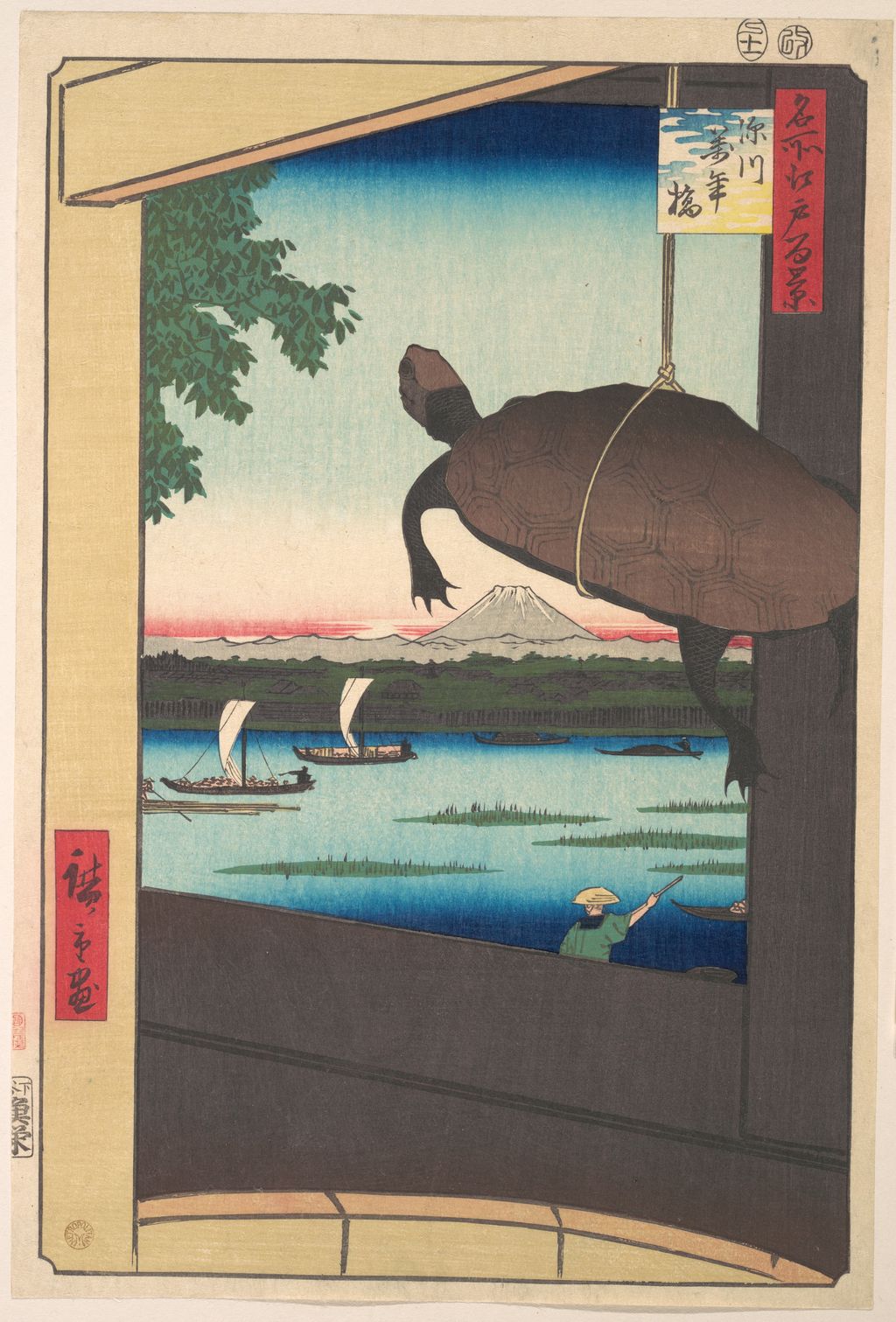
This visual trick is characteristic of the series but not a mechanical formula. In Plum Garden, a massive living branch takes over the foreground; at Mannen Bridge the foreground object is portable and apparently suspended. Fuji is again present, yet this is a print about a Fukagawa crossing, not a member of Hokusai's Thirty-six Views of Mount Fuji. The mountain is one visual anchor in a work that tests how many distances a single narrow sheet can hold. British Museum, exhibition guide [1] Met, JP1184 [15]
Summer: Sudden Shower over Shin-Ōhashi Bridge and Atake (大はしあたけの夕立)
In this view the bridge cuts diagonally across the river as people lean into a downpour. The slashing rain is not a soft veil; it gives the foreground figures an urgent, shared task. The bridge carries them across one part of the scene while the opposite shore and the dark cloud lead the eye in other directions. The British Museum describes this as a combination of looking down to the bridge, across the river and up toward the storm. It dates the design's first-edition example to the ninth month of 1857. British Museum, exhibition guide [1]
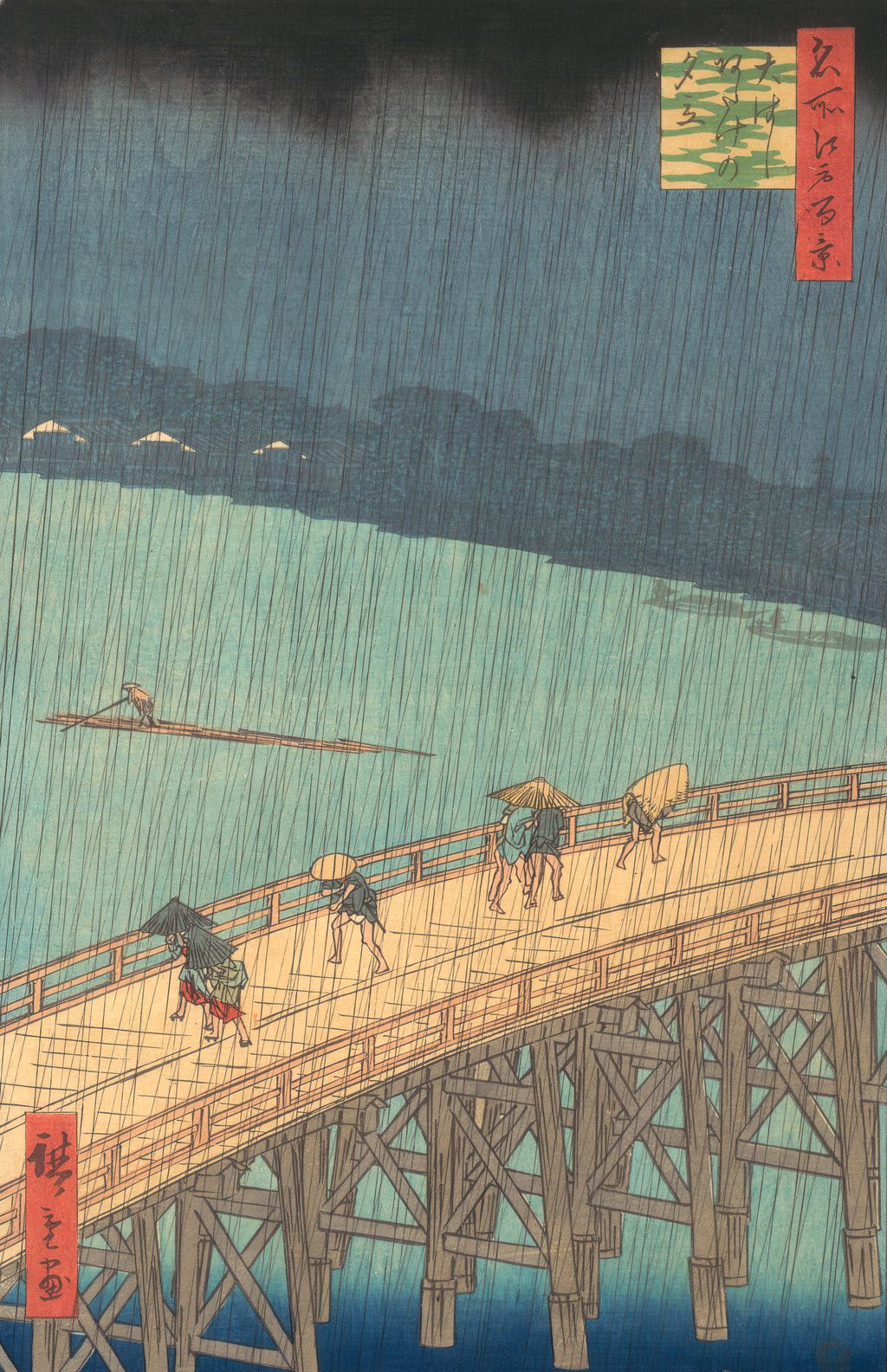
This series page shows the design in the wider Edo project; the separate Sudden Shower article will carry the longer study. An identified first-edition British Museum impression has two boats silhouetted near the far shore and a pale cutting error under the bridge that was corrected later. Those details cannot be used to certify the state of the user-owned image here until that image is checked at corresponding points. Sarah E. Thompson's MFA Boston book preview, p. 129, identifies three pale gables on the opposite bank as the shogun's boathouses; this is a promising annotation only where the cleared production image actually shows them. British Museum, exhibition guide [1] MFA Boston preview, p. 129 [16]
Autumn group: The Tanabata Festival in the Flourishing City (市中繁栄七夕祭)
Festival decorations rise above the roofs, and a large open sky lets their shapes register against the city. The viewpoint does not gather the festival into a crowd scene at street level. It lets a viewer see many households or buildings participating from above, turning a seasonal observance into an urban pattern. The Met dates accession JP62 to the seventh month of Ansei 4 (1857). Met, JP62 [17]
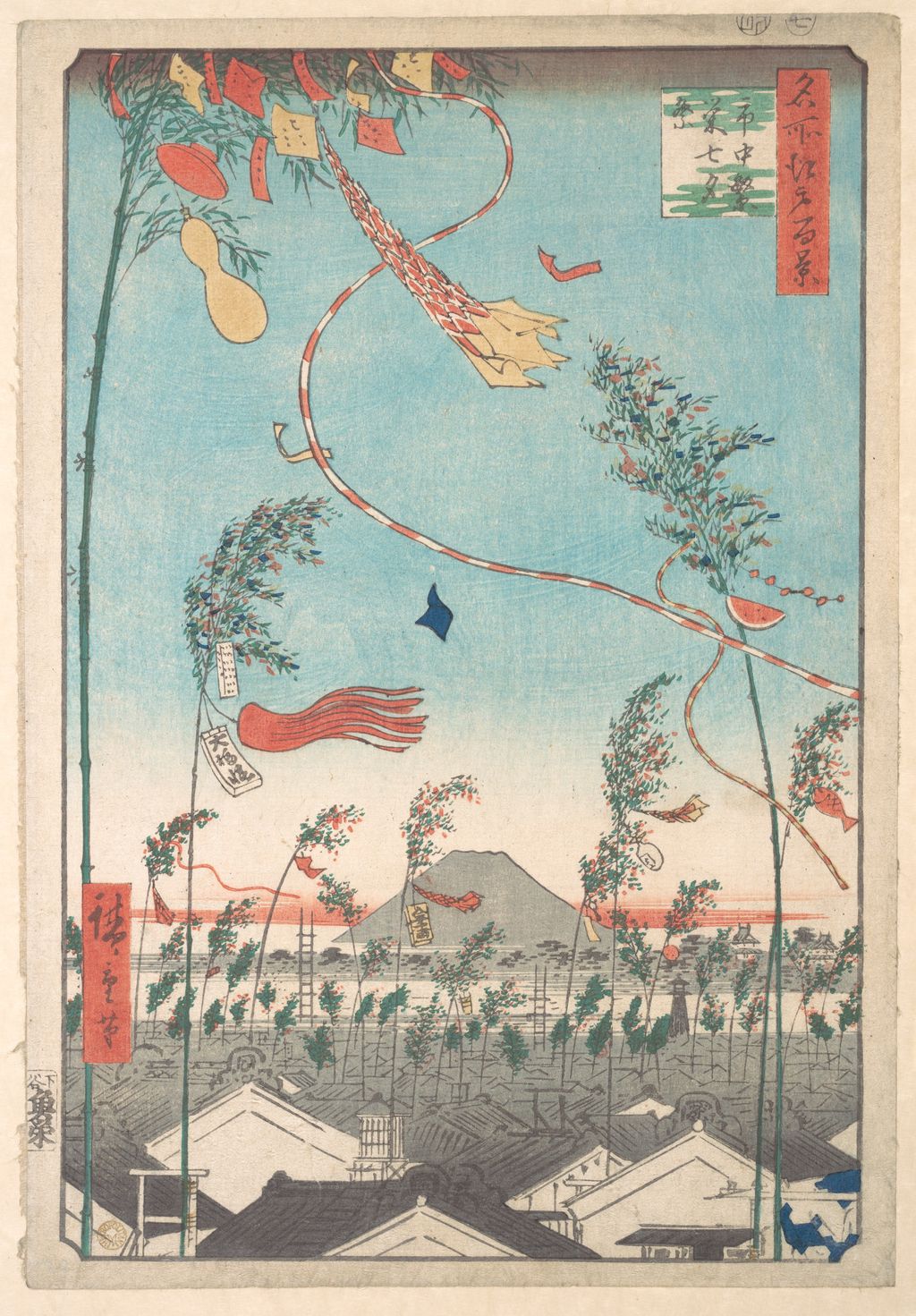
The print sits in the autumn group of the later contents sheet, even though a modern reader may reflexively associate Tanabata with summer. This is a useful reminder that the seasonal headings are historical catalogue categories rather than our own automatic weather labels. The festival, its month of issue and the contents position are three distinct facts. The Japanese title Shichū han'ei Tanabata matsuri names the festival in a flourishing city; “rooftop streamers” is a way to describe what is visible, not a replacement title. Tokyo National Museum description via Japan Search [6] Met, JP62 [17]
Autumn group: Fireworks at Ryōgoku Bridge (両国花火)
Against the dark sky, the burst of a firework pulls the gaze upward. Boats gather on the river and the bridge crosses the lower scene. The picture has space for both a public spectacle and the social geography that makes it possible: spectators above, people on the bridge, viewers and vendors on the water. The British Museum notes that Ryōgoku fireworks attracted crowds from late summer into late autumn and interprets the elevated viewpoint as resembling that from an upper-level riverside restaurant. Its exhibition guide gives the eighth month of 1858 for the displayed impression. British Museum, exhibition guide [1]
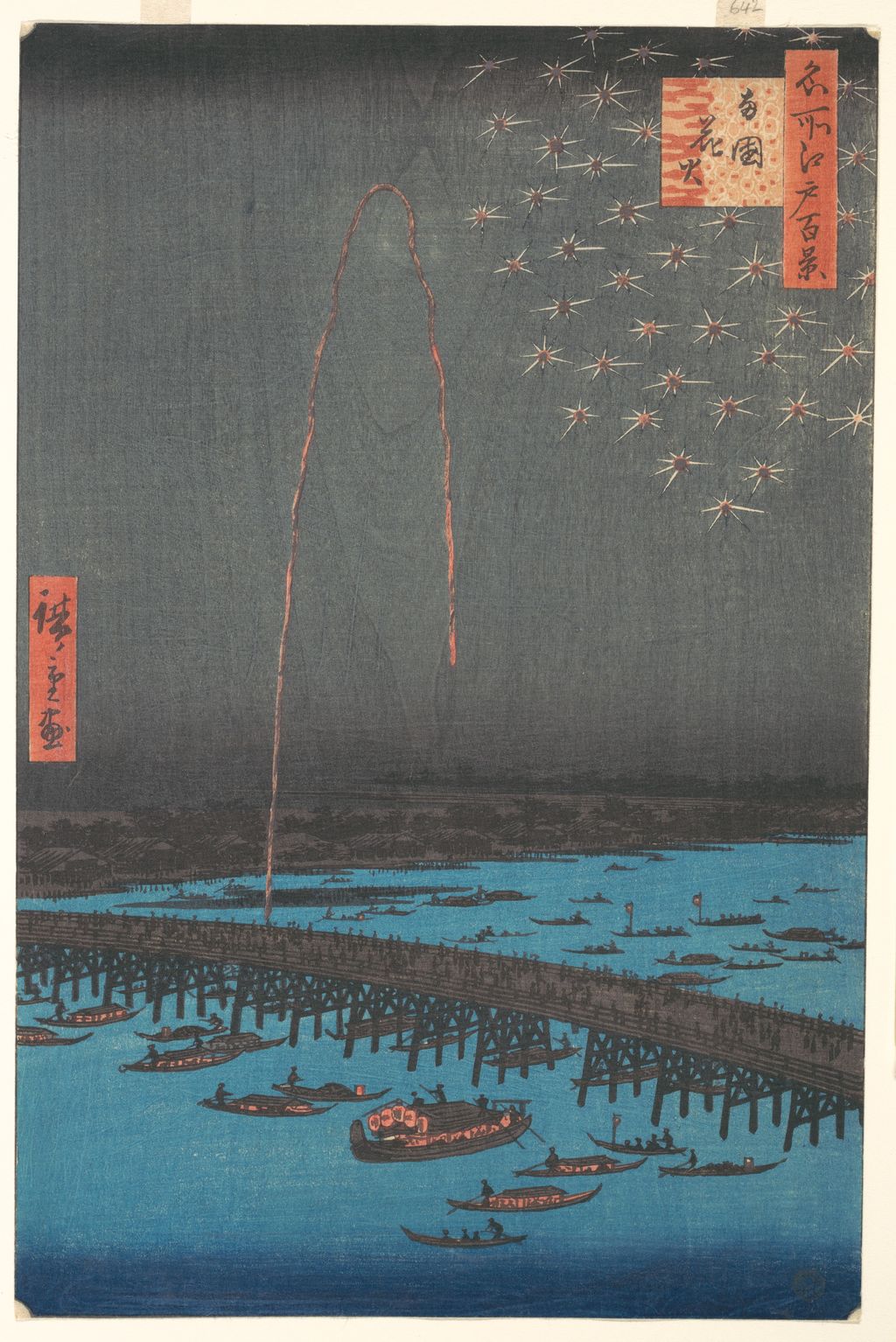
The Met's JP642 is a separate public-domain impression, catalogued simply as 1858. We should not transfer the British Museum's object-specific printing qualities or loan history to this Met sheet. What they share is Hiroshige's design: an event spread through a carefully orchestrated night view. It demonstrates that “landscape” in the Edo series can be crowded, commercial and temporary. The named place is not only the physical bridge but a kind of public life associated with it. Met, JP642 [18] British Museum, exhibition guide [1]
Winter: Pilgrimage to the Torinomachi Festival across Asakusa Ricefields (浅草田甫酉の町詣)
A cat sits at a window while a pale landscape opens beyond the lattice. The animal is the closest body in the picture, but the Japanese title names the Asakusa ricefields and the journey to the Torinomachi festival. That gap between foreground and title asks the viewer to connect a private interior to movement outside. The British Museum's object record describes the cat looking through a lattice window toward ricefields and identifies its own accession 1906,1220,0.664 as no. 101 in the series, 1857. The image used here is a user-owned file of the same design, not that British Museum impression. British Museum, Asakusa object [19]
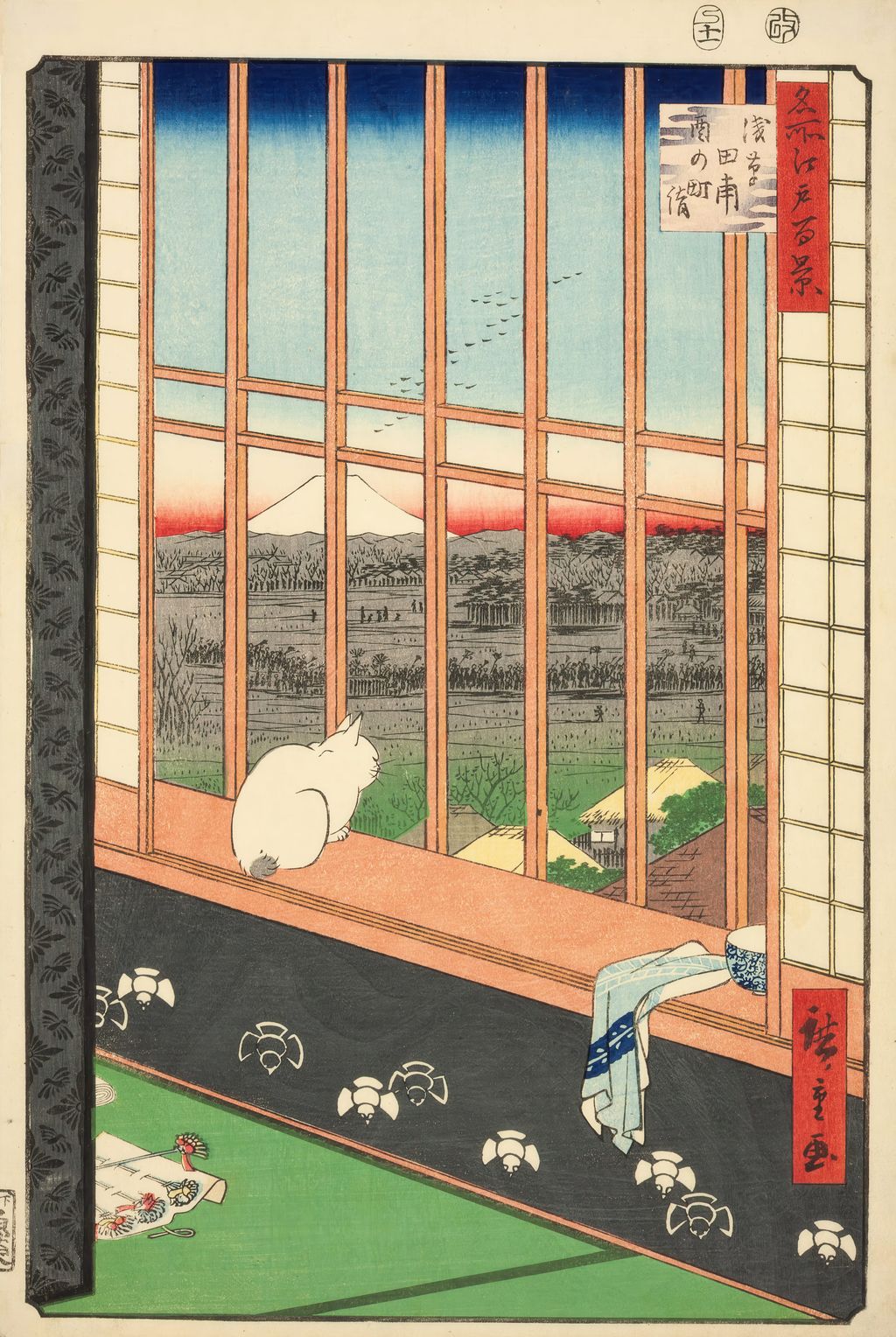
The NDL's place exhibition connects the subject to the area north of Asakusa and Shin-Yoshiwara. Its local historical material gives a broader setting, but the print itself should not be turned into an exact record of an identifiable room or owner. The cat's vantage point is an artistic decision: a small domestic witness to activity on the edge of the city. This design rewards a visitor who first asks why a seemingly quiet interior is a “famous view.” NDL, Shin-Yoshiwara [20] NDL Image Bank, cats [21]
Winter: Jūmantsubo Plain at Fukagawa Susaki (深川洲崎十万坪)
A bird of prey dives across the foreground above a flat, snow-covered marsh. Its spread wings nearly command the sheet, while the whitened ground below becomes a vast measuring surface. The Met calls the bird a hawk and describes Jūmantsubo as a name referring to approximately one hundred thousand tsubo of ground. The Japanese title identifies the Fukagawa Susaki locality. The identity of the bird is rendered differently across English sources, so “bird of prey” is the safest general description here. The Met's exact impression is JP2520, dated 1856. Met, JP2520 [22]
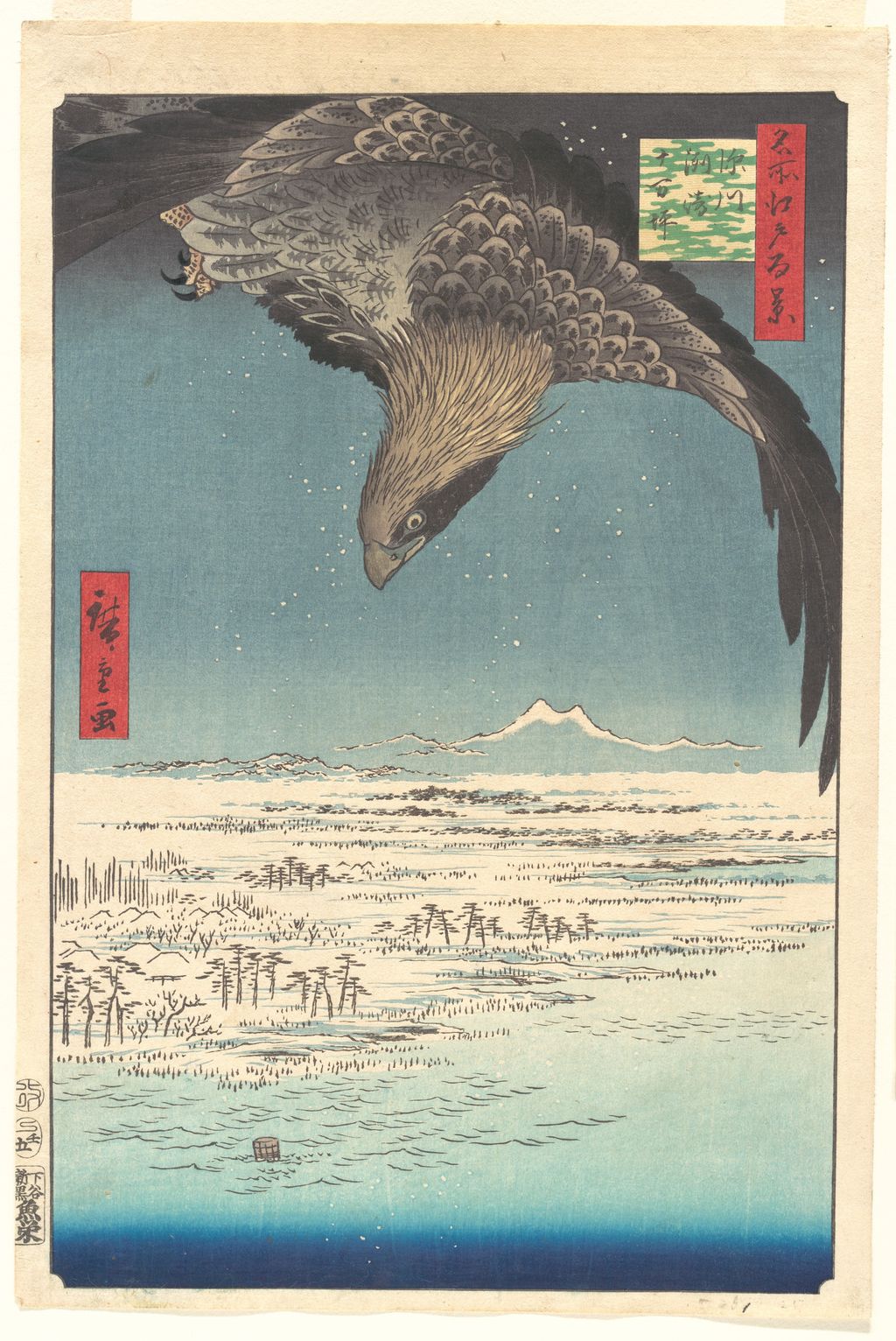
The novelty is not just a bird's-eye view. The image gives the viewer a flying body's point of urgency while holding the wintry terrain steady beneath it. Where Plum Garden compresses the view against a tree, Jūmantsubo suddenly makes the space feel open and severe. They demonstrate the range of foreground strategies within one series. The scene also refutes any impression that “Edo views” means built-up streets in every sheet: a place at the city's edge can carry the series' most dramatic sense of scale. Met, JP2520 [22] Shizuoka City Tōkaidō Hiroshige Museum [2]
Winter: Meguro Drum Bridge and Sunset Hill (目黒太鼓橋夕日の岡)
People move through snow beside a distinctive curved bridge, and the road or slope leads the eye through the landscape. In contrast to the stark overhead space of Jūmantsubo, this is a place negotiated on foot. A crossing, slope and weather condition are enough to make the viewer imagine the exertion of arrival. The National Diet Library identifies the location as the Meguro River crossing by Taiko-bashi and the steep Gyōnin-zaka, with nearby older illustrations and texts. The supplied image's filename says “Moon Bridge,” but the title is Drum Bridge (Taiko-bashi). NDL, Meguro [10]
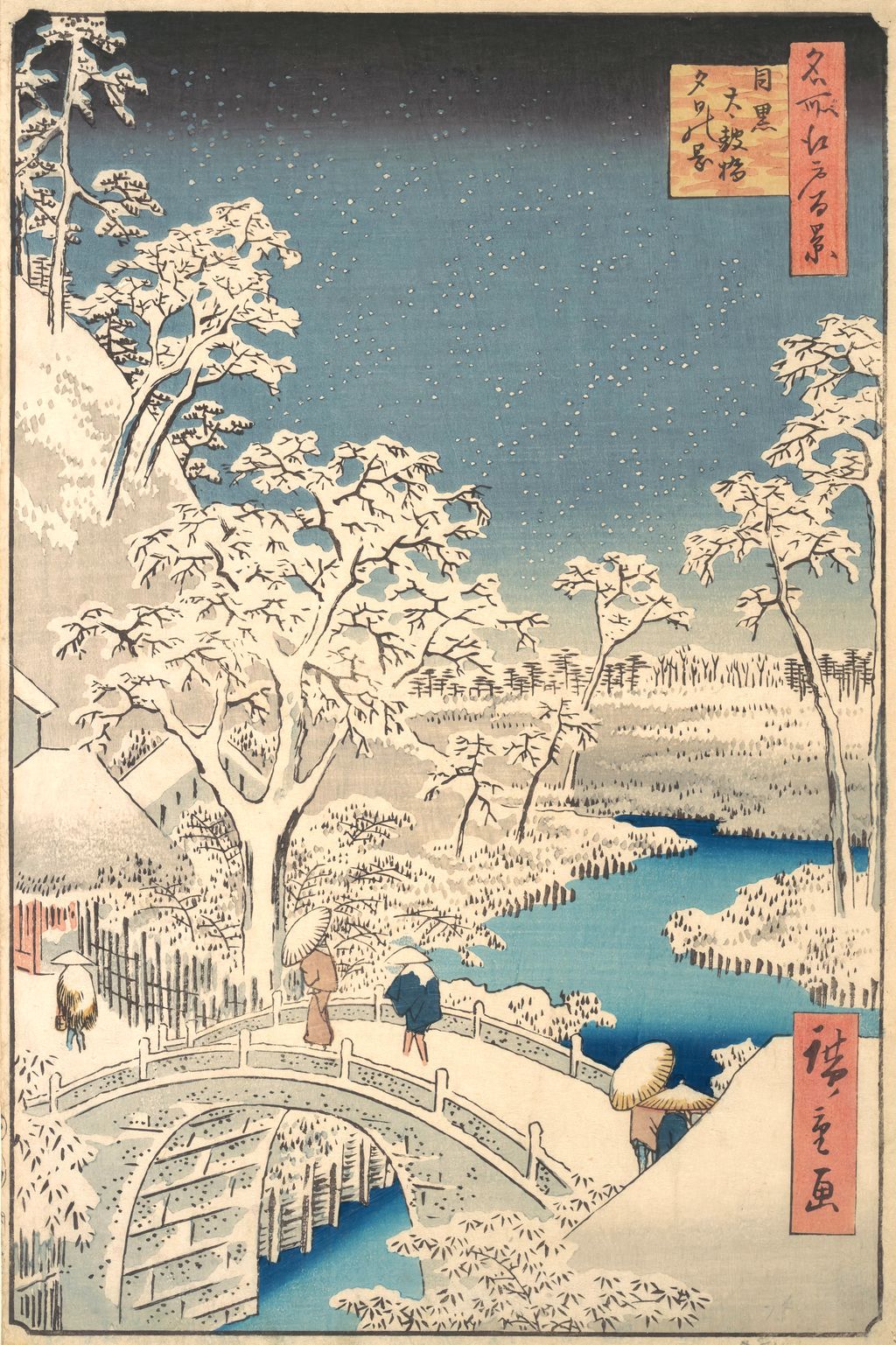
This correction is more than a spelling preference. The named bridge is a specific local feature; “moon bridge” would suggest an unsupported substitute landmark. As elsewhere in the series, the composition remains an artwork rather than a survey drawing. The NDL's topographic context helps situate the view, while the print asks us to notice the rhythm of bent figures and the change from heavy snow to open sky. The exact physical impression used here is unidentified, so it is not given a museum accession or a state claim. NDL, Meguro [10]
Winter: Foxfires at the Shōzoku Tree, Ōji (王子装束ゑの木大晦日の狐火)
Points of orange light appear among trees and dark ground beneath an evening sky. The title places the scene at the Shōzoku tree in Ōji on New Year's Eve and names the lights as foxfires. Its subject belongs to a local legendary tradition, not a report that the artist witnessed luminous foxes. The Met's JP2523 is dated 1857 and its object record preserves the full Japanese title. Met, JP2523 [23]
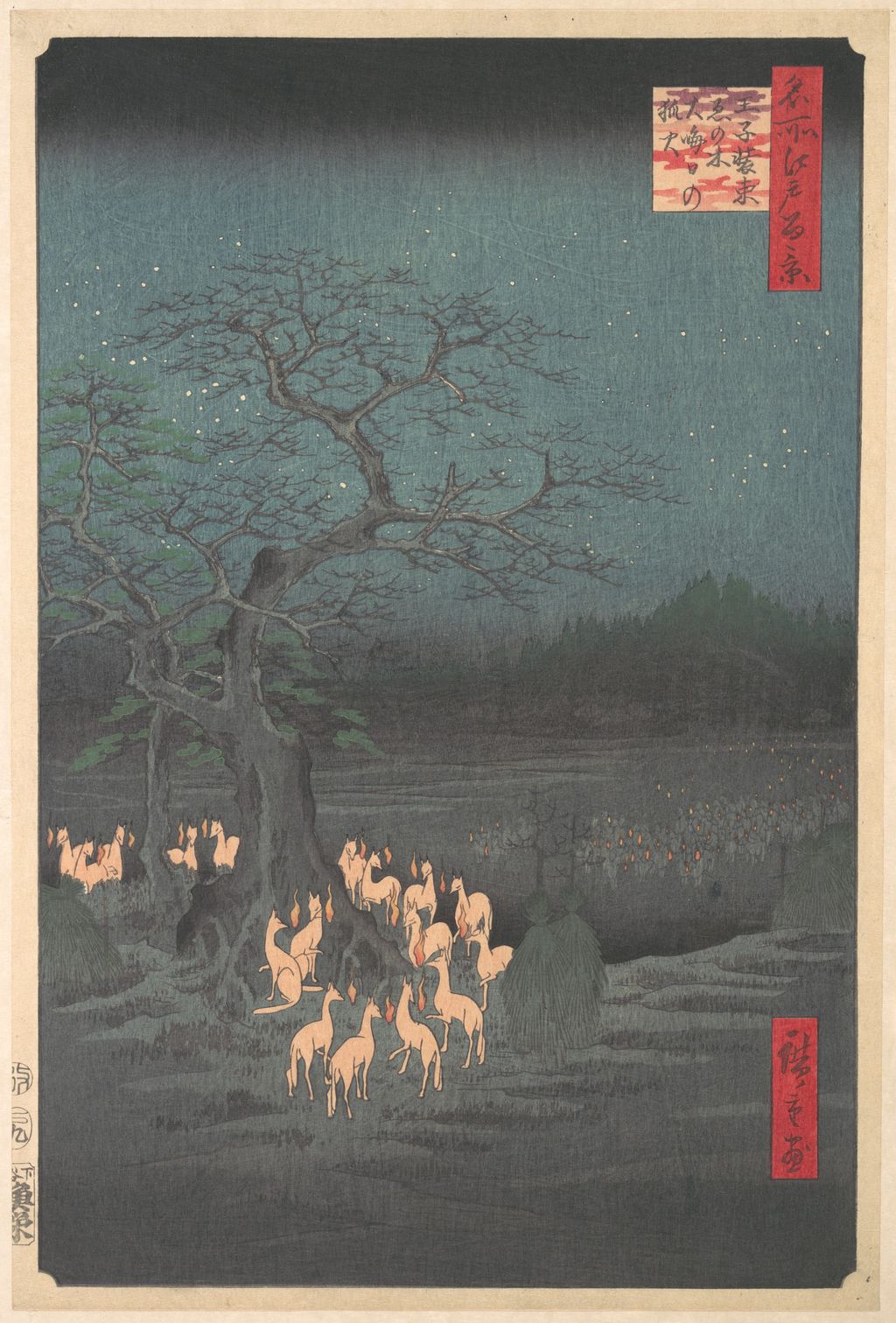
The print turns the wide idea of a “famous view” toward story. Its setting is recognisable by name, yet the central event asks for cultural memory and imagination. It also slows the pace after the festival city and the drama of snowfall. A reader searching for a single Hiroshige style should look across these works: rain is cut into slants, firework light punctures darkness, snow flattens distance and foxfires make darkness the carrier of a tale. All belong to one late publication without becoming interchangeable mood pictures. Met, JP2523 [23] Shizuoka City Tōkaidō Hiroshige Museum [2]
The four seasons, and why their order matters
The contents sheet groups 42 views under spring, 30 under summer, 26 under autumn and 20 under winter. These 118 entries correspond to the Hiroshige I signed group. The Hiroshige II addition is the 119th pictorial design, not a fifth season. The searchable catalogue below preserves the abbreviated Japanese labels and numbering in the Tokyo National Museum description presented through Japan Search. Those labels are useful for finding a design, but they do not pretend to transcribe every mark on every individual print. Tokyo National Museum description via Japan Search [6]
This arrangement makes a pleasurable reading itinerary. Spring can be garden and renewal; summer can be bridges, moving water and sudden rain; autumn can gather civic spectacle; winter can range from actual snow to New Year's Eve legend. But the groups do not correspond one-to-one with the month in which a sheet was printed. Nor can we safely treat the order as Hiroshige's final instruction to the viewer: Gengyo's sheet was made after his death. Some images also resist a simple modern seasonal label. The Tanabata print belongs to the autumn contents group although its Met object record gives a seventh-month issue date. Browsing by group is useful precisely when the historical status of the group is kept visible. Suntory Museum of Art [4] Met, Tanabata JP62 [17]
An album can further complicate what “complete” means. The Tokyo University of the Arts University Art Museum has a complete 120-sheet holding acquired for Tokyo Art School in 1910; the formerly bound album was conserved and opened into individual sheets in the early twenty-first century. The Japan Search description of a Tokyo National Museum volume mentions a Hiroshige portrait in addition to a contents sheet and 119 pictures. Such material can travel with a particular album, but the portrait is not a 120th pictorial Edo view. A careful catalogue keeps the series count and the makeup of an individual collected volume separate. Tokyo University of the Arts University Art Museum [3] Tokyo National Museum description via Japan Search [6]
The printed sheet is not the whole design
Surviving impressions of the same woodblock design can differ. Paper, wear, new blocks, colour choices, printing pressure, fading and later handling all affect what we now see. Korenberg's four-state account of Plum Garden at Kameido gives unusually strong object evidence: she compared lines, coloured areas and material clues across 82 impressions rather than relying on a single side-by-side reproduction. The changes matter because an early red sky and a later purple band give materially different experiences of the garden, even while the tree and title remain recognisable. British Museum, Korenberg [12]
The British Museum guide offers a second example in Sudden Shower. In an identified first-edition sheet, two boats appear near the far shore and a pale cut mark under the bridge was corrected in later versions. A web image of the design is not automatically evidence for those details. The ten images on this page include both accession-identified museum impressions and user-supplied images of identified designs without an established physical history. Their captions say which is which. This keeps discussion of a print's publication date distinct from unsupported dating of a particular photograph or sheet. British Museum, exhibition guide [1]
The same care applies to digital image rights. An institution can be an excellent research authority while withholding reuse rights for the image on its page. The Metropolitan Museum's five pictures reproduced here are individually marked Public Domain and fall under its Open Access terms. The other five files were supplied by the owner as public-domain images; their unverified impression identities are disclosed. British Museum, Suntory, NDL and other pages cited for their scholarship are not silently treated as production-image licences. Met, Open Access policy [11]
From Edo to later viewers
The series circulated long after Hiroshige's death and reached viewers outside Japan. Van Gogh's relationship with Plum Garden can be reconstructed unusually closely because his owned print and gridded tracing survive, along with his oil adaptation. The British Museum also identifies Bridge in the Rain (after Hiroshige) as his response to Sudden Shower. These are strong cases of documented reworking; they do not prove that every dramatic diagonal in European painting came from Hiroshige. British Museum, exhibition guide [1] British Museum, Korenberg [12]
For the first purchasers, the prints were also a way to look at their own city: its celebrated and overlooked places, immediate pleasures, seasonal expectations, and the imaginative stories attached to land and water. For present readers, the series works at several levels at once. One can follow a title to a place, search the whole 119-design set, compare multiple impressions, or simply look at how a tiny human figure changes beside a huge bridge or branch. None of those approaches needs to flatten the group into only a precursor of European art. British Museum, introduction to Hiroshige [24] National Diet Library, famous places essay [8]
Explore all 119 Edo views
These are the abbreviated Japanese labels in a Tokyo National Museum catalogue description, arranged as on the posthumous contents sheet. They are aids to finding designs, not complete print inscriptions or issue dates. The separate Hiroshige II addition appears last. Catalogue source [6].
Showing all 119 views.
| No. | Japanese contents label | Contents group | Signature group |
|---|---|---|---|
| 1 | 日本ばし | Spring | Hiroshige I signed group |
| 2 | 霞が関 | Spring | Hiroshige I signed group |
| 3 | 山下御門内 | Spring | Hiroshige I signed group |
| 4 | 永代白魚船 | Spring | Hiroshige I signed group |
| 5 | 両国ノ相撲 | Spring | Hiroshige I signed group |
| 6 | 初音の馬場 | Spring | Hiroshige I signed group |
| 7 | 大伝馬町 | Spring | Hiroshige I signed group |
| 8 | 駿河町 | Spring | Hiroshige I signed group |
| 9 | 八辻が原 | Spring | Hiroshige I signed group |
| 10 | 神田明神 | Spring | Hiroshige I signed group |
| 11 | 上野清水 | Spring | Hiroshige I signed group |
| 12 | 同山下 | Spring | Hiroshige I signed group |
| 13 | 同広小路 | Spring | Hiroshige I signed group |
| 14 | 日暮里 | Spring | Hiroshige I signed group |
| 15 | 同諏訪 | Spring | Hiroshige I signed group |
| 16 | 千駄木団子坂 | Spring | Hiroshige I signed group |
| 17 | 飛鳥山 | Spring | Hiroshige I signed group |
| 18 | 王子いなり | Spring | Hiroshige I signed group |
| 19 | 同大滝 | Spring | Hiroshige I signed group |
| 20 | 川口のわたし | Spring | Hiroshige I signed group |
| 21 | 芝あたご | Spring | Hiroshige I signed group |
| 22 | ふる川 | Spring | Hiroshige I signed group |
| 23 | 千代が崎 | Spring | Hiroshige I signed group |
| 24 | 目黒新ふじ | Spring | Hiroshige I signed group |
| 25 | 同元ふじ | Spring | Hiroshige I signed group |
| 26 | 八景坂 | Spring | Hiroshige I signed group |
| 27 | 蒲田の梅 | Spring | Hiroshige I signed group |
| 28 | 御てん山 | Spring | Hiroshige I signed group |
| 29 | 砂むら | Spring | Hiroshige I signed group |
| 30 | 梅屋しき Featured here: 亀戸梅屋舗 · Plum Garden at Kameido · See image | Spring | Hiroshige I signed group |
| 31 | 吾妻森 | Spring | Hiroshige I signed group |
| 32 | やなきしま | Spring | Hiroshige I signed group |
| 33 | 四ツ木の引舟 | Spring | Hiroshige I signed group |
| 34 | 墨水夜景 | Spring | Hiroshige I signed group |
| 35 | 水神の杜 | Spring | Hiroshige I signed group |
| 36 | 真先の辺 | Spring | Hiroshige I signed group |
| 37 | 今戸の煙 | Spring | Hiroshige I signed group |
| 38 | 新吉原 | Spring | Hiroshige I signed group |
| 39 | 大川ばし | Spring | Hiroshige I signed group |
| 40 | 関口水道端 | Spring | Hiroshige I signed group |
| 41 | 市谷八幡 | Spring | Hiroshige I signed group |
| 42 | 玉川堤 | Spring | Hiroshige I signed group |
| 43 | 日本橋 | Summer | Hiroshige I signed group |
| 44 | おなしく通一丁め | Summer | Hiroshige I signed group |
| 45 | 八つ見のはし | Summer | Hiroshige I signed group |
| 46 | 鎧のわたし | Summer | Hiroshige I signed group |
| 47 | 昌平はし | Summer | Hiroshige I signed group |
| 48 | 水道橋 Featured here: 水道橋駿河台 · Suidōbashi and Surugadai · See image | Summer | Hiroshige I signed group |
| 49 | 王子不動のたき | Summer | Hiroshige I signed group |
| 50 | 十二荘 | Summer | Hiroshige I signed group |
| 51 | 糀まち | Summer | Hiroshige I signed group |
| 52 | 赤坂桐はたけ | Summer | Hiroshige I signed group |
| 53 | 増上寺 | Summer | Hiroshige I signed group |
| 54 | 外さくら田 | Summer | Hiroshige I signed group |
| 55 | 佃住よし | Summer | Hiroshige I signed group |
| 56 | 万年はし Featured here: 深川萬年橋 · Mannen Bridge, Fukagawa · See image | Summer | Hiroshige I signed group |
| 57 | 中洲 | Summer | Hiroshige I signed group |
| 58 | 大はしの夕立 Featured here: 大はしあたけの夕立 · Sudden Shower over Shin-Ōhashi Bridge and Atake · See image | Summer | Hiroshige I signed group |
| 59 | 両国川船中 | Summer | Hiroshige I signed group |
| 60 | 同大かははた | Summer | Hiroshige I signed group |
| 61 | 首尾の松 | Summer | Hiroshige I signed group |
| 62 | こまかた堂 | Summer | Hiroshige I signed group |
| 63 | あやせ川 | Summer | Hiroshige I signed group |
| 64 | ほり切 | Summer | Hiroshige I signed group |
| 65 | 亀戸の藤 | Summer | Hiroshige I signed group |
| 66 | 五百羅かむ | Summer | Hiroshige I signed group |
| 67 | 逆井 | Summer | Hiroshige I signed group |
| 68 | 深川八まん山開 | Summer | Hiroshige I signed group |
| 69 | 三十三けん堂 | Summer | Hiroshige I signed group |
| 70 | 中川くち | Summer | Hiroshige I signed group |
| 71 | とねかは | Summer | Hiroshige I signed group |
| 72 | はねた | Summer | Hiroshige I signed group |
| 73 | 市中の七夕 Featured here: 市中繁栄七夕祭 · The Tanabata Festival in the Flourishing City · See image | Autumn | Hiroshige I signed group |
| 74 | 大丸屋 | Autumn | Hiroshige I signed group |
| 75 | 紺屋町 | Autumn | Hiroshige I signed group |
| 76 | 京ばし | Autumn | Hiroshige I signed group |
| 77 | 鉄炮洲 | Autumn | Hiroshige I signed group |
| 78 | つきぢ | Autumn | Hiroshige I signed group |
| 79 | 芝明前 | Autumn | Hiroshige I signed group |
| 80 | 金杉橋 | Autumn | Hiroshige I signed group |
| 81 | 高なは | Autumn | Hiroshige I signed group |
| 82 | 月の岬 | Autumn | Hiroshige I signed group |
| 83 | 品川洲崎 | Autumn | Hiroshige I signed group |
| 84 | 目黒爺茶や | Autumn | Hiroshige I signed group |
| 85 | 紀伊くに坂 | Autumn | Hiroshige I signed group |
| 86 | 内藤新宿 | Autumn | Hiroshige I signed group |
| 87 | 井の頭 | Autumn | Hiroshige I signed group |
| 88 | 滝の川 | Autumn | Hiroshige I signed group |
| 89 | 月の松弁天 | Autumn | Hiroshige I signed group |
| 90 | 猿若街 | Autumn | Hiroshige I signed group |
| 91 | 向島秋葉 | Autumn | Hiroshige I signed group |
| 92 | 木母寺 | Autumn | Hiroshige I signed group |
| 93 | にい宿 | Autumn | Hiroshige I signed group |
| 94 | 真間 | Autumn | Hiroshige I signed group |
| 95 | 鴻の台 | Autumn | Hiroshige I signed group |
| 96 | 堀江猫実 | Autumn | Hiroshige I signed group |
| 97 | 小名木川の松 | Autumn | Hiroshige I signed group |
| 98 | 両国の花火 Featured here: 両国花火 · Fireworks at Ryōgoku Bridge · See image | Autumn | Hiroshige I signed group |
| 99 | 浅草寺の雪 | Winter | Hiroshige I signed group |
| 100 | 日本堤 | Winter | Hiroshige I signed group |
| 101 | 酉の市 Featured here: 浅草田甫酉の町詣 · Pilgrimage to the Torinomachi Festival across Asakusa Ricefields · See image | Winter | Hiroshige I signed group |
| 102 | 三川しま | Winter | Hiroshige I signed group |
| 103 | 千住大橋 | Winter | Hiroshige I signed group |
| 104 | 小梅つゝみ | Winter | Hiroshige I signed group |
| 105 | 御厩川岸 | Winter | Hiroshige I signed group |
| 106 | 木場 | Winter | Hiroshige I signed group |
| 107 | 十万坪 Featured here: 深川洲崎十万坪 · Jūmantsubo Plain at Fukagawa Susaki · See image | Winter | Hiroshige I signed group |
| 108 | 芝浦 | Winter | Hiroshige I signed group |
| 109 | さめ洲 | Winter | Hiroshige I signed group |
| 110 | 千束の池 | Winter | Hiroshige I signed group |
| 111 | 目黒太鼓橋 Featured here: 目黒太鼓橋夕日の岡 · Meguro Drum Bridge and Sunset Hill · See image | Winter | Hiroshige I signed group |
| 112 | 藪小路 | Winter | Hiroshige I signed group |
| 113 | とらのもん | Winter | Hiroshige I signed group |
| 114 | ひく尼はし | Winter | Hiroshige I signed group |
| 115 | 高田の馬場 | Winter | Hiroshige I signed group |
| 116 | 姿見のはし | Winter | Hiroshige I signed group |
| 117 | ゆしま天神 | Winter | Hiroshige I signed group |
| 118 | 王子装束榎 Featured here: 王子装束ゑの木大晦日の狐火 · Foxfires at the Shōzoku Tree, Ōji · See image | Winter | Hiroshige I signed group |
| 119 | 赤坂桐畑雨中夕けい | Later addition | Hiroshige II |
Continue through Hiroshige
| Name | Date | Medium |
|---|---|---|
| Hiroshige | 1797–1858 | Artist |
| Fifty-three Stations of the Tōkaidō | c. 1833–34 | Woodblock print series |
| Sudden Shower over Shin-Ōhashi Bridge | 1857 | Woodblock print |
| Plum Park in Kameido | 1857 | Woodblock print |
Frequently asked questions
The title is a round-number title. The standard count is 118 views signed by Hiroshige I, one view added by Hiroshige II, and one separate contents sheet. That gives 119 pictorial designs and 120 sheets in the usual complete group. Shizuoka City Tōkaidō Hiroshige Museum [2]
No. The seasonal list follows Baisotei Gengyo's posthumous contents sheet. Suntory Museum notes discrepancies between that arrangement and date seals on individual prints. Use the catalogue to browse by its historical contents order, not to reconstruct publication chronology. Suntory Museum of Art [4]
No. The 119th view was supplied by Hiroshige II in 1859. Of the original 118, all bear Hiroshige I's signature, although three posthumous censor-seal dates have prompted authorship questions. Suntory Museum of Art [4]
A digital picture may record an original surviving impression, a later impression or a reproduction of a design. To describe one physical sheet precisely, check its holding institution and accession, date, marks, condition and rights record. The identified Met objects on this page have accession numbers; the user-owned files are not assigned museum identities. Met, JP1184 [15] British Museum, Korenberg [12]
Two documented responses are Flowering Plum Orchard (after Hiroshige), based on Plum Garden at Kameido, and Bridge in the Rain (after Hiroshige), based on Sudden Shower. His own later-state Plum Garden impression and tracing survive; the painting's colours also point toward an early state. British Museum, exhibition guide [1] British Museum, Korenberg [12]
Discussion
Each sheet chooses a different way of looking at Edo and the country around it.
Reader Insights
Which nearby object makes you see a familiar place differently?
Which view best conveys a time of year without relying on its title?
What changes when two impressions of the same design are compared?
Join the Conversation
Share a view or visual detail that changed how you picture Hiroshige’s city.
References
- British Museum, Hiroshige: Artist of the Open Road large print exhibition guide.
- Shizuoka City Tōkaidō Hiroshige Museum,
名所江戸百景exhibition research. - Tokyo University of the Arts University Art Museum, complete series holding and conservation.
- Suntory Museum of Art, Hiroshige Vivid exhibition account and series chronology.
- British Museum, series title and contents sheet object.
- Tokyo National Museum series description surfaced by Japan Search, 119 abbreviated Japanese contents labels.
- British Museum, Hiroshige: Artist of the Open Road exhibition announcement.
- National Diet Library, essay on Japanese famous places.
- National Diet Library, Surugadai place account.
- National Diet Library, Meguro place account.
- Metropolitan Museum of Art, Open Access and public-domain image terms.
- Capucine Korenberg, “Tracking down the Plum Garden: Hiroshige, Van Gogh and the Edo ‘Instagram’,” British Museum, 2025.
- National Diet Library, Kameido Plum Garden object account.
- British Museum, Suidōbashi and Surugadai, accession 1948,0410,0.72.
- Metropolitan Museum of Art, Mannen Bridge, JP1184.
- Sarah E. Thompson, Hokusai, Hiroshige, Hasui: Japanese Landscapes in Print, MFA Publications, Boston, 2026, available sample p. 129.
- Metropolitan Museum of Art, Tanabata Festival, JP62.
- Metropolitan Museum of Art, Fireworks at Ryōgoku Bridge, JP642.
- British Museum, Asakusa ricefields and Torinomachi, accession 1906,1220,0.664.
- National Diet Library, Shin-Yoshiwara place account.
- National Diet Library Image Bank, cat subject gallery.
- Metropolitan Museum of Art, Jūmantsubo Plain, JP2520.
- Metropolitan Museum of Art, Foxfires at the Shōzoku Tree, JP2523.
- British Museum, introduction to Hiroshige's career and late city views.