


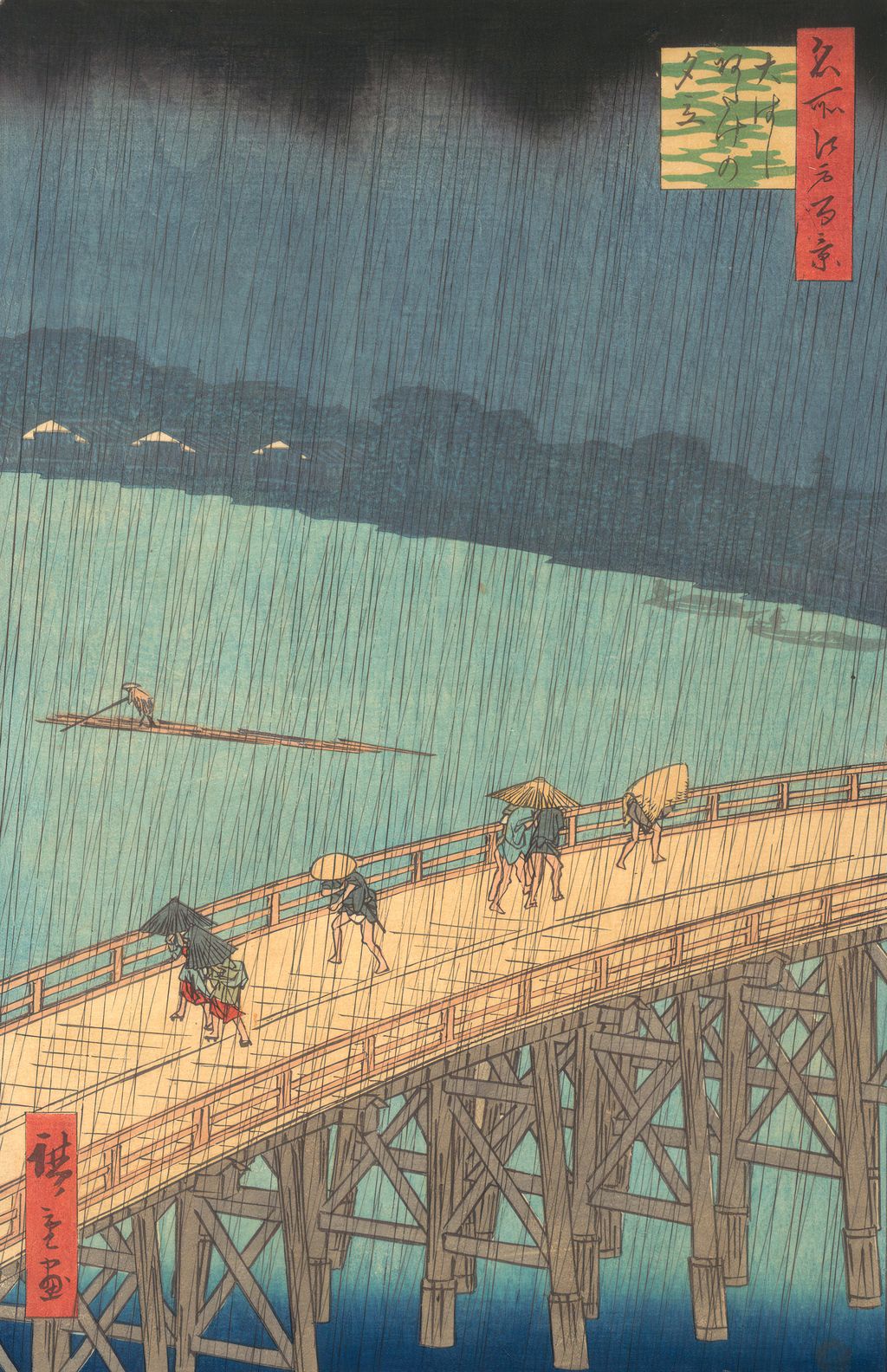
Hiroshige, Sudden Shower over Shin-Ōhashi Bridge and Atake. Public-domain design reproduction; exact physical impression and printing state unidentified.
 by Tom Gurney
Tom Gurney BSc (Hons) is an art history expert with over 20 years experience
Published on June 19, 2020 / Updated on September 23, 2026
Email: tomgurney1@gmail.com / Phone: +44 7429 011000
Hiroshige’s Sudden Shower over Shin-Ōhashi Bridge and Atake
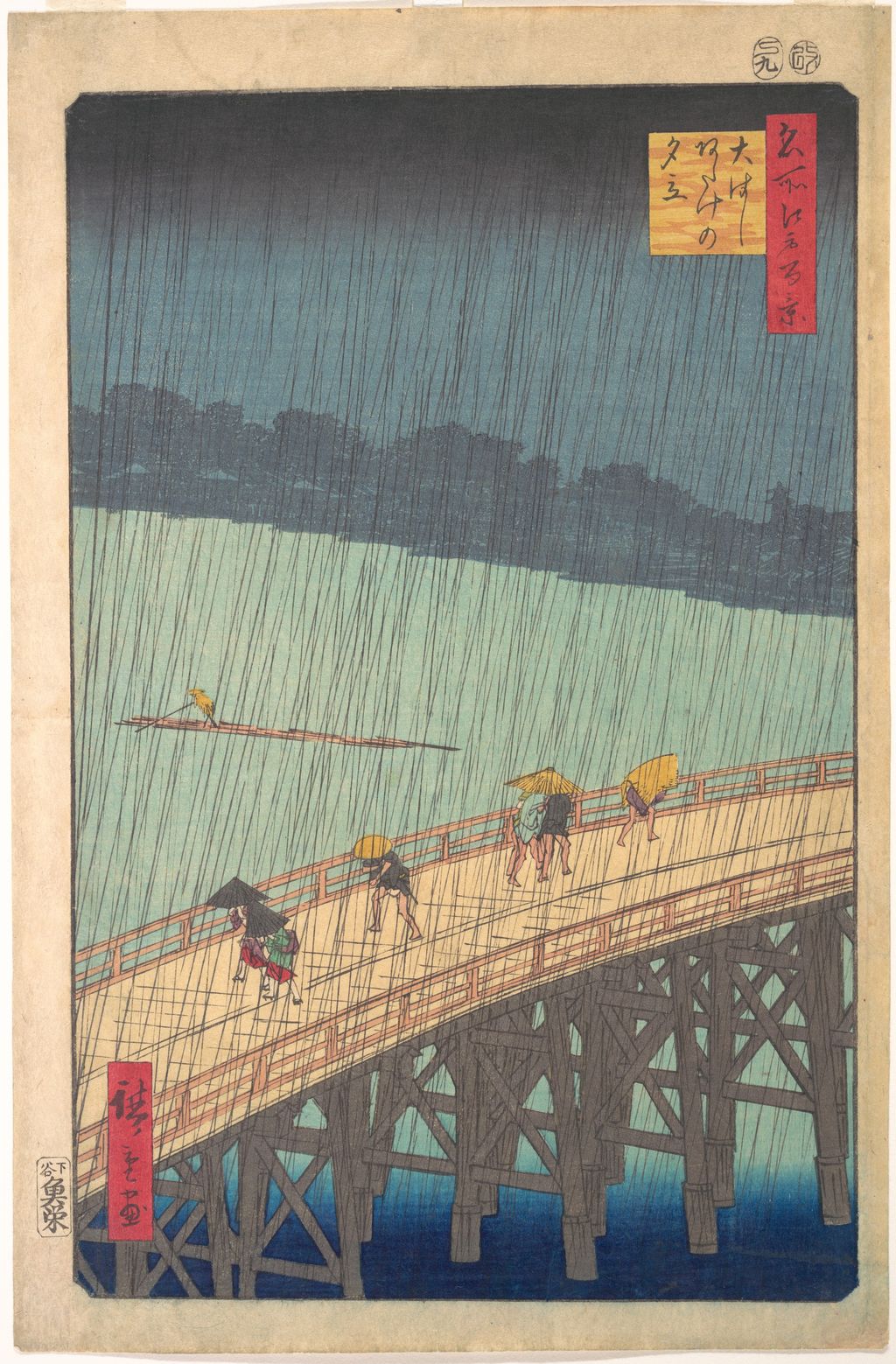
Hiroshige’s Sudden Shower over Shin-Ōhashi Bridge and Atake shows a few people caught between the first violent drops of a storm and the far side of a bridge. Its Japanese title, 大はしあたけの夕立 (Ōhashi Atake no yūdachi), names both the Great Bridge and the Atake district beyond it. The design appeared in 1857, in the late series One Hundred Famous Views of Edo. It is an image of a specific crossing of the Sumida River, but it makes that crossing feel like a brief, shared experience: people hurry in opposite directions under rain that reaches the bridge, water and distant shore. The Metropolitan Museum of Art [1] dates its impression to 1857 and identifies the bridge as the Ōhashi across the Sumida; Tokyo Fuji Art Museum [2] gives the Japanese title and identifies today's Shin-Ōhashi with the bridge in the print.
This is more than a famous picture of rain. The bridge moves diagonally through a tall sheet, carrying our eye across the river even as the moving figures pull it back toward the foreground. Above them the sky darkens by degrees; across them fine oblique lines seem to fall in waves. The open water beneath the bridge supplies a moment of comparative calm. In the image reproduced here, three small pale roof shapes can be discerned on the distant shore and a raft moves below the bridge. A reader can trace these features in the annotated image and then compare four different, accession-identified impressions of the same design. Those copies are useful precisely because they are distinct objects, not because one unverified photograph can stand for every printing of the work.
Contents
- Hiroshige’s Sudden Shower over Shin-Ōhashi Bridge and Atake
- Where is Shin-Ōhashi, and what is Atake?
- A close reading of the storm
- Explore the print: five details
- Four Met impressions: one design, four objects
- An earlier storm: Shōno on the Tōkaidō
- Van Gogh's later bridge in the rain
- Why this sheet belongs to One Hundred Famous Views of Edo
- Continue exploring Hiroshige
At a glance
- ArtistUtagawa Hiroshige I (1797–1858)
- Japanese title名所江戸百景 大はしあたけの夕立
- English titlesSudden Shower over Shin-Ōhashi Bridge and Atake; also Sudden Shower over Ōhashi and Atake
- SeriesOne Hundred Famous Views of Edo (名所江戸百景)
- Design date1857; the British Museum's first-edition impression [3] is dated to the ninth month
- MediumColour woodblock print on paper, vertical large-sheet format
- PlaceŌhashi, later called Shin-Ōhashi, across the Sumida River; Atake on the far bank
- PublisherUoya/Sakanaya Eikichi, named in the British Museum's series guide [3]
- Image on this pageA public-domain design reproduction; the exact physical impression, edition and printing date are not independently identified
Where is Shin-Ōhashi, and what is Atake?
The print names a place, but it does not behave like an ordinary topographical record. The bridge runs from near the lower left across the middle of the sheet toward the right. We look down on its deck and on people who are only a few strides from one bank or the other. Beyond it the river opens out, a low shore fades, and the dark mass of weather occupies the upper part of the composition. Japan's Agency for Cultural Affairs, describing a Tokyo National Museum copy [4], identifies the Great Bridge as the later Shin-Ōhashi, notes a raft passing below it and says the far Atake shore is obscured by rain. The description also locates the bridge downstream from Ryōgoku Bridge.
The Atake in the title is therefore not a second bridge. It is the district on the opposite side of the river, scarcely visible through the storm. Tokyo Fuji Art Museum's Japanese object explanation [2] describes the bridge from a high view and places Atake beyond it. Kanagawa Prefectural Museum's print guide [6] also identifies the far district. The double place-name sets up a useful reading: a distinct near crossing and a far destination that the weather almost erases.
The historical bridge gives the work another layer. Cleveland Museum of Art's object record [5] explains that this design was published two years after the destructive Edo earthquake and fire of 1855, and shows a rebuilt Great Bridge. The scene does not narrate the disaster or reconstruction. It shows a functioning crossing in a later moment of everyday pressure. That distinction matters: a storm in the picture should not be treated as a picture of the earthquake. It is a temporary interruption of routine on a city structure that had a recent history.
The print's high viewpoint is also a designed viewpoint. We are not standing among the people on the deck; we see their heads and the bridge's long diagonal from above. The British Museum's 2025 exhibition guide [3] describes three simultaneous directions of looking: down to the bridge, across the river and up to the storm clouds. This helps explain why the image seems wider than its narrow sheet. It joins the close human story on the deck to the open river and the weather over it.
A close reading of the storm
The bridge makes a route through the sheet
The bridge is both object and visual path. Its rails and deck cut obliquely through the vertical format. That diagonal resists the fixed upright of the print and keeps the image moving even when the people appear briefly trapped by rain. The far end draws the eye toward Atake; the near section lets us inspect hats, sleeves, umbrellas and changing postures. The bridge's structural lines are steadier than the rain lines, so the storm is felt against a built form that holds its shape.
The bridge is not a simple strip of brown in a storm. The railing divides the hurried figures from the darker river below. Its posts give a repeated beat along the diagonal, while the thin rain marks cross that beat at another angle. A person follows the bridge with the eye and then loses it temporarily in the veiling rain. When the line returns, the bridge has become a measure of how much of the scene the storm can conceal without making it unreadable.
People run in opposite directions
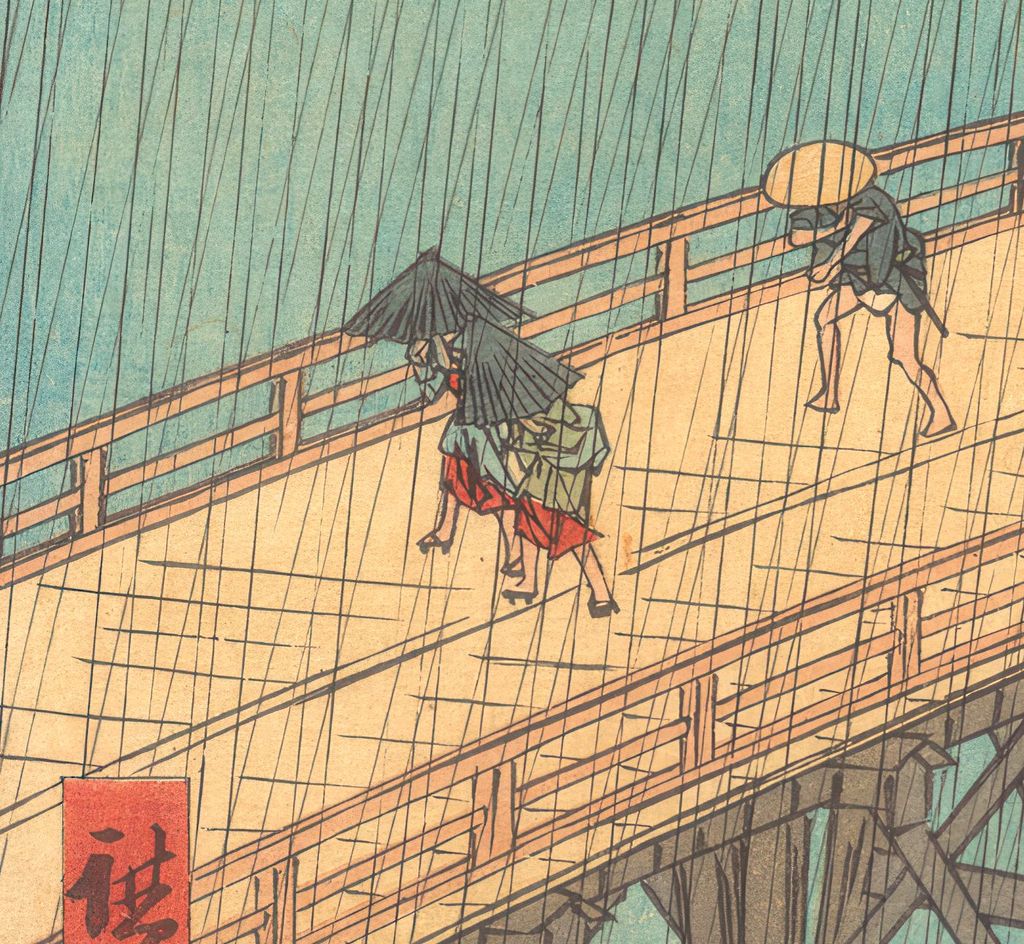
The image's small figures do not form one orderly procession. Some hurry toward the viewer's left; others move in the opposite direction. The change of direction is a practical part of the scene: the sudden shower has caught travellers already committed to crossing. Cleveland's description [5] explicitly identifies people moving in opposite directions and trying to protect themselves. Tokyo Fuji Art Museum [2] singles out three men sharing one umbrella, while other townspeople race for both banks.
That group under one umbrella is one of the print's most economical stories. Their bodies press together, but the umbrella shelters only a small area. Nearby, others improvise with separate umbrellas, hats or garments. We can read the speed in shortened steps and leaning torsos, even though there is no facial close-up. Hiroshige gives us enough to know that the rain is sudden and inconvenient without turning the figures into theatrical actors. The human details make the weather credible; the weather makes the ordinary crossing memorable.
The viewers of different impressions should still read cautiously. Fine human marks may print more clearly in one copy than another, and a digital image may sharpen or flatten them further. The interpretation above concerns the visible design; it does not certify the condition of any particular paper, block or pigment layer.
The raft and distant shore
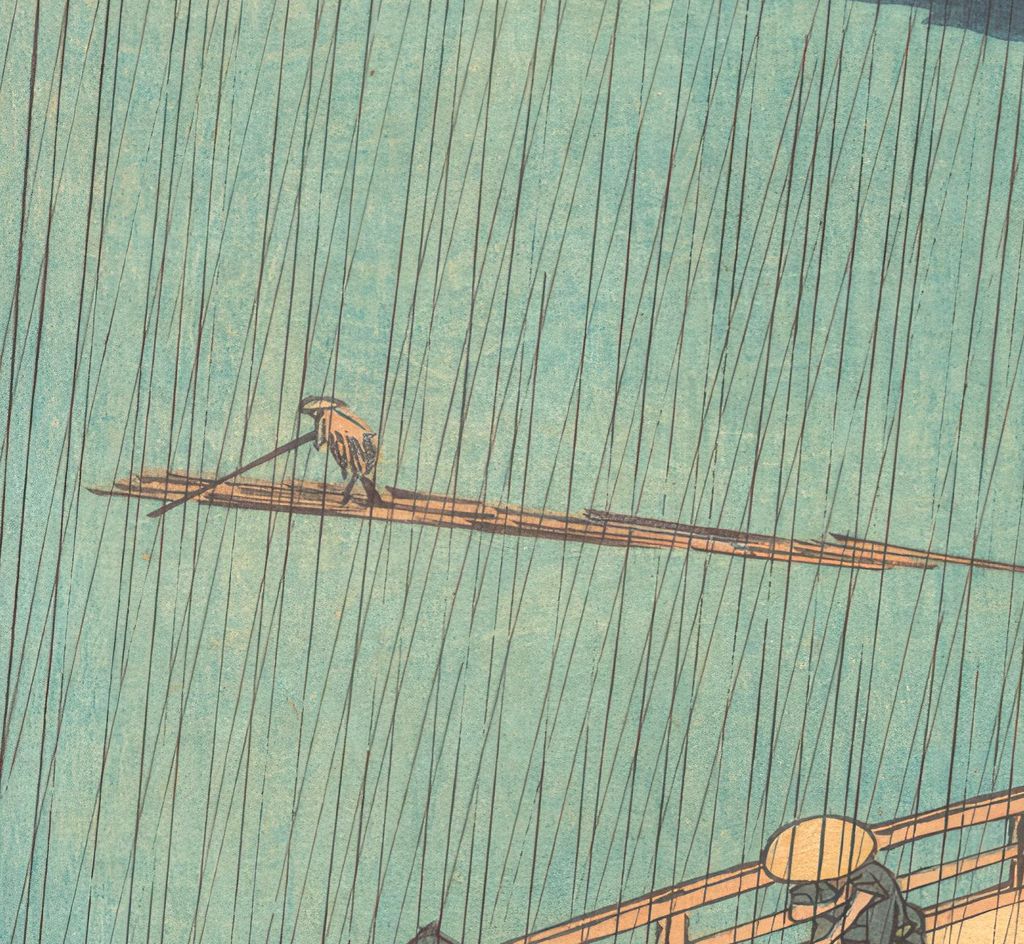
Beyond the bridge a narrow raft is being guided through the river. The Agency for Cultural Affairs' Tokyo National Museum description [4] mentions one raft travelling under the crossing. Its presence makes the river an active route, not merely an empty plane. The people on the bridge are crossing the river; someone in a raft is travelling along it. Because both activities continue in the storm, the city feels inhabited beyond the few figures who command our first attention.
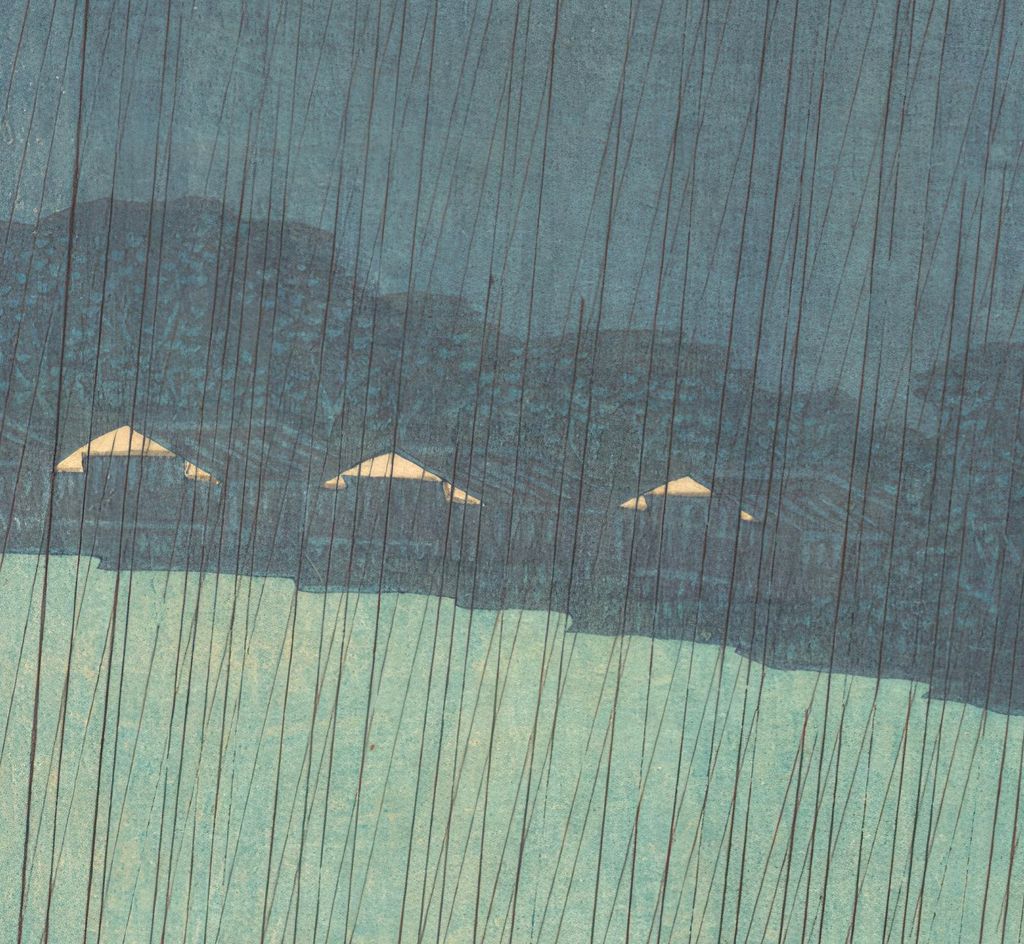
The far bank is deliberately less secure. Atake can be named by the title, but it appears through rain as a dim edge and a few structures. Page 129 in Sarah E. Thompson's Museum of Fine Arts, Boston publication preview Hokusai, Hiroshige, Hasui [7] identifies three pale triangular forms on the opposite bank as roofs of shogunal boathouses. Those shapes are visible in the supplied image used for the annotation here. The identification gives a small architectural fact to an almost abstract distance. It should be attached to the visible gables, however, rather than projected onto a reproduction in which they cannot be made out.
The distance is a measure of rain as much as of geography. Close bridge, middle river and far Atake are separate spatial bands, yet the oblique rain crosses them all. Atake is barely a place one can walk toward in this moment; it is a place the title guarantees while the storm withholds a clear view. That tension between naming and seeing is a reason this sheet belongs so well within a series of famous places. A well-known site can be pictured by showing how weather changes our access to it.
Rain has more than one printed colour
The falling lines are often described as simply black. Hiroshige's rain is subtler. Hinohara Kenji, chief curator at the Ōta Memorial Museum of Art [8], observes that the lines in Ōhashi Atake no yūdachi use black and a lighter grey. This is a useful correction to the usual shorthand, especially when examining a high-resolution image. Slight differences of tone help the rain thicken without becoming a single opaque screen. The Met [1] describes the crisscrossing fine lines as a difficult woodblock technique.
The rain is not an independent transparent layer laid over a finished scene by a modern editor. It belongs to the printmaking process. Hiroshige supplied a design, but cutters and printers had to make fine lines legible in impressions pulled from woodblocks. A British Museum account of the Hiroshige printing process [9] explains the division of work among publisher, designer, carvers and printers and the layering of colours. The light rain against dark cloud and the dark rain against lighter water depend on the actual sequence and control of printing, even though the article cannot reconstruct every block used for this particular impression from a digital photograph alone.
The lines change their effect across the print. Against the upper sky they merge into a heavy surface; near the pale bridge and water they become easier to count. Around the figures they act as a common pressure that binds otherwise separate movements. They create a sensation of weather at a specific moment while remaining a deliberately made graphic pattern. A close view therefore rewards two forms of attention: to what a person on the bridge might feel and to what the workshop had to print.
A cloud made by gradation
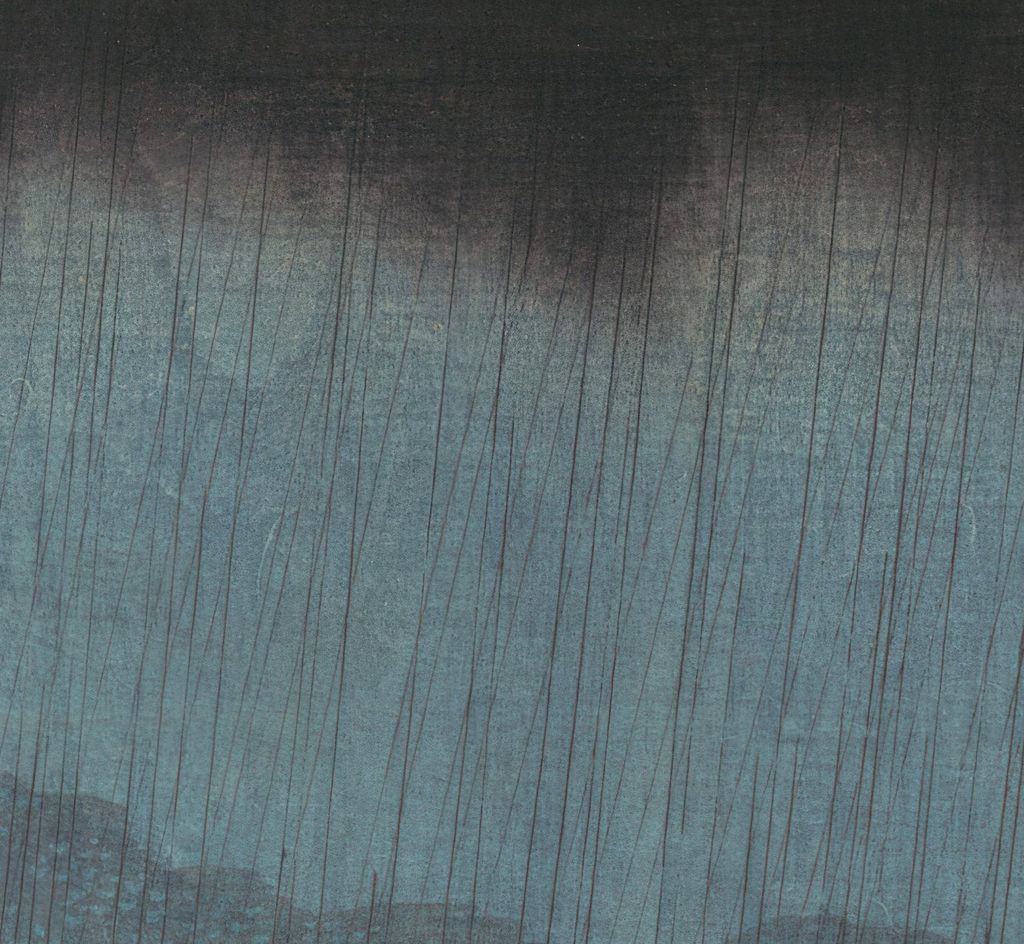
The dark sky does not stop at a hard contour. Tokyo Fuji Art Museum [2] attributes its dramatic storm-cloud effect to atenashi bokashi (当てなしぼかし), a freehand gradation made by the printer. The tonal change helps the cloud feel dense and unstable, contrasting with the precise bridge. It also reminds us that the designer's named artwork required controlled work by others: the atmospheric result is not reducible to an ink drawing by Hiroshige alone.
The gradation is one reason different photographs of the design can seem different at first glance. A darker upper band or a stronger transition can change the apparent time of day and the weight of the rain. Actual variation may arise from printing, later fading, paper condition, photographic lighting or digital adjustment. Without an accession-specific technical study, colour differences cannot securely sort the four Met examples below into a chronological sequence. They are evidence of how surviving copies look, not a ready-made chart of “first” to “late.”
Explore the print: five details
The numbered image markers on the local page point to five details: the darkening sky, the shared umbrella, the slanted rain, the raft and the pale roofs across the river. Their positions are tied to the public-domain image supplied for this project. Its exact physical impression is unidentified, so the notes do not assign it to the British Museum's documented first edition. The notes may also be read as a list without using the image.
Annotated image details
Select a numbered point to read below; select a detail image to enlarge it. Detail crops come from a retained high-resolution 300 dpi working master.
The cloud
The cloud: the sky grows darker through a printed gradation, not a single flat block of black. The Japanese museum term is atenashi bokashi. Tokyo Fuji Art Museum [2]
The shared umbrella
The shared umbrella: three travellers briefly become a group because a limited shelter forces them together. Tokyo Fuji Art Museum [2]
The slanted rain
The slanted rain: the lines cross the architecture and the people. Hinohara Kenji notes black and lighter grey rain lines in this design. Ōta Memorial Museum of Art [8]
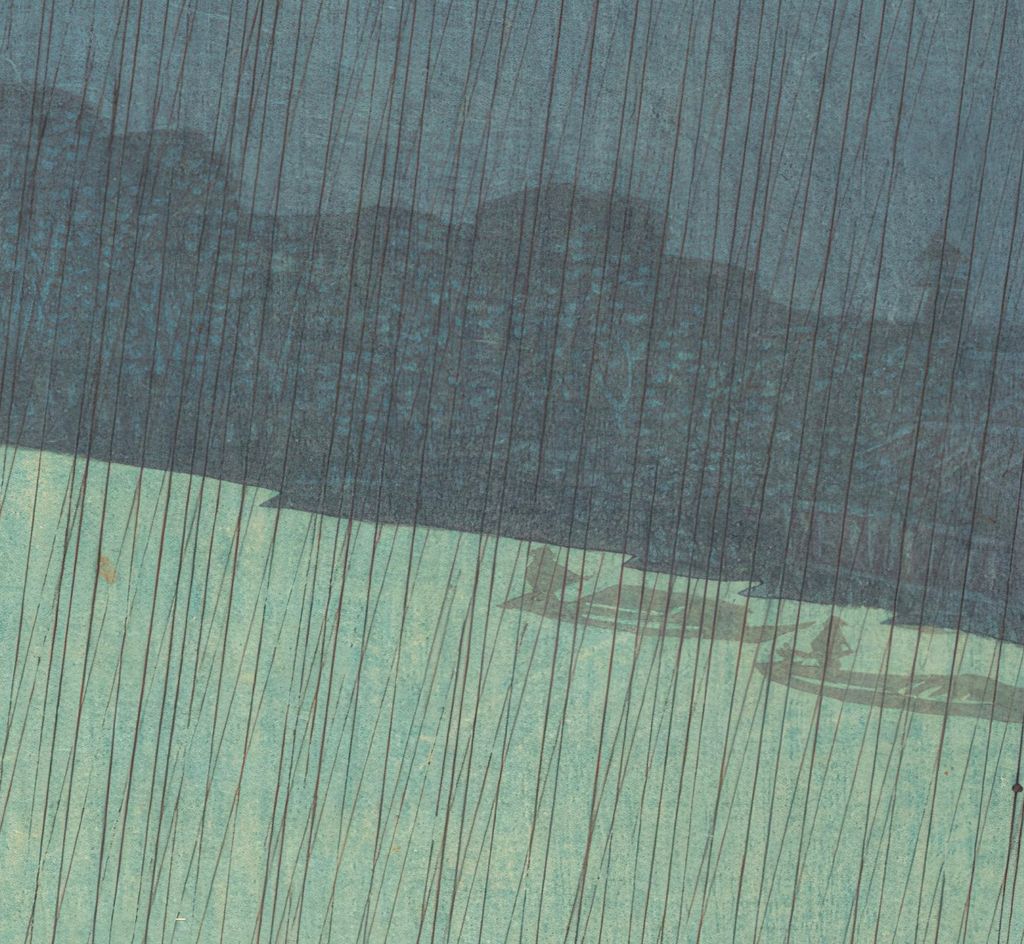
The raft
The raft: an active route along the river intersects the route across it. Agency for Cultural Affairs/Tokyo National Museum [4]
The pale roofs
The pale roofs: three roof shapes on the far shore have been identified in the MFA Boston publication preview as boathouses associated with the shogun. MFA Boston publication preview, p. 129 [7]
Four Met impressions: one design, four objects
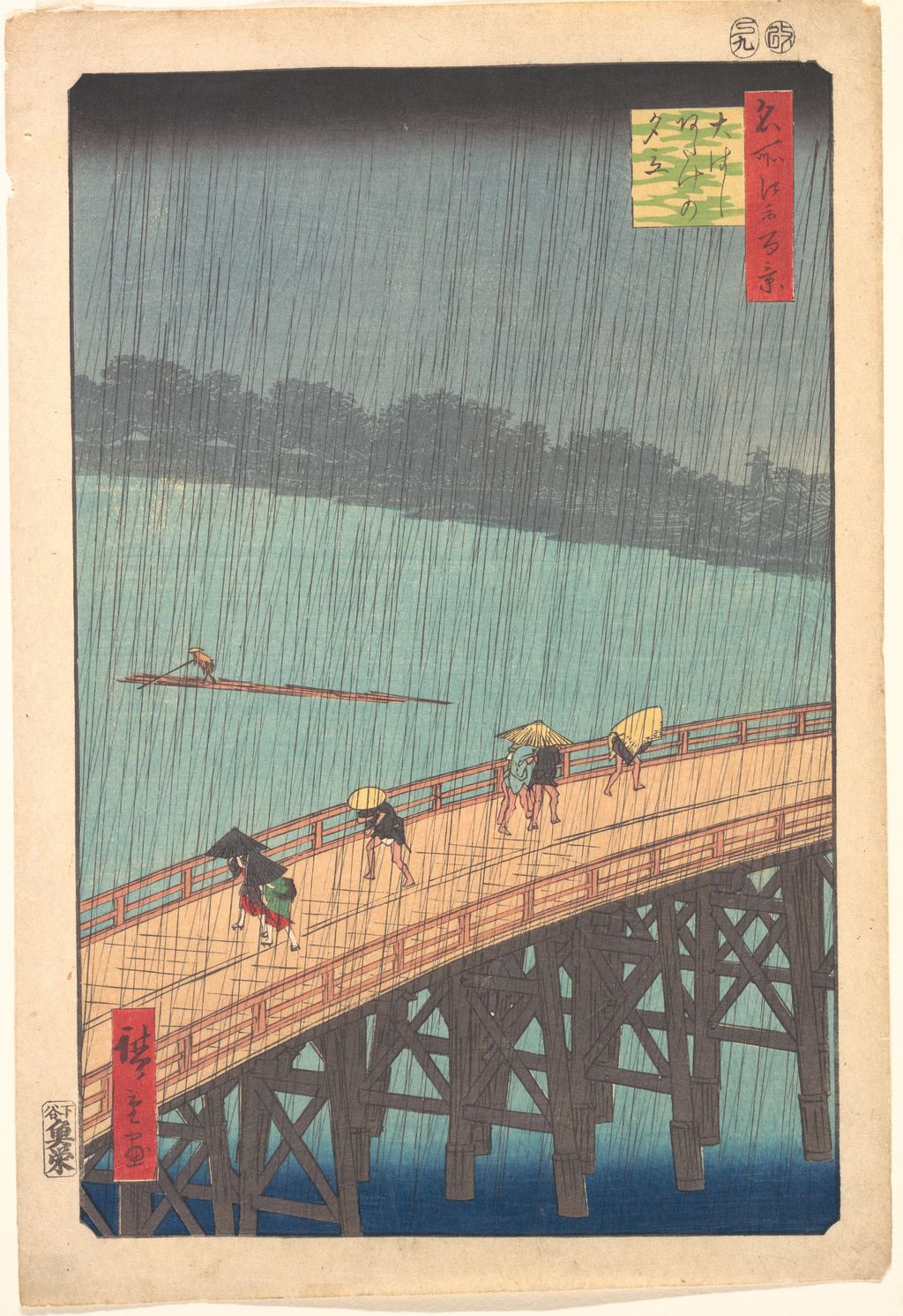
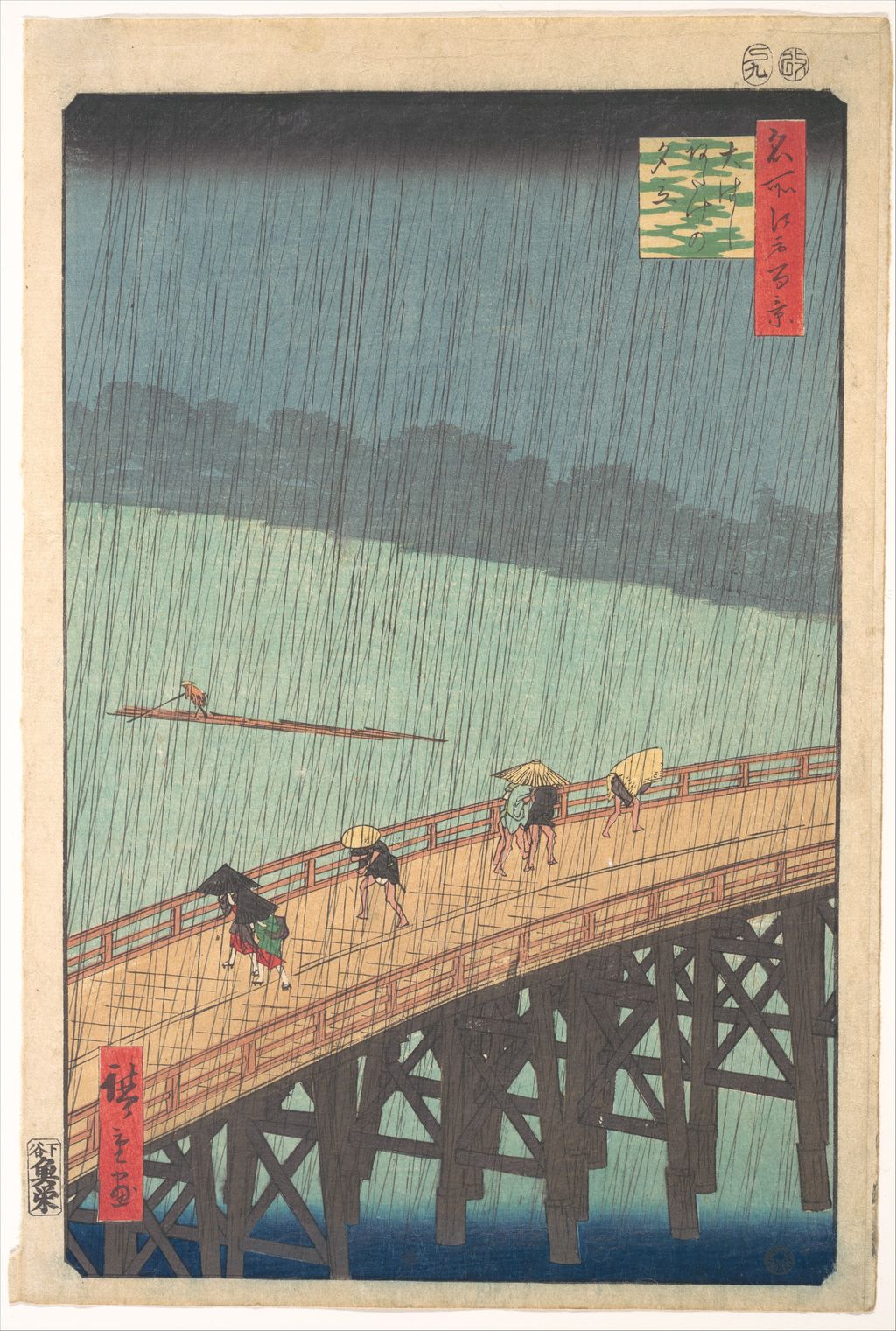
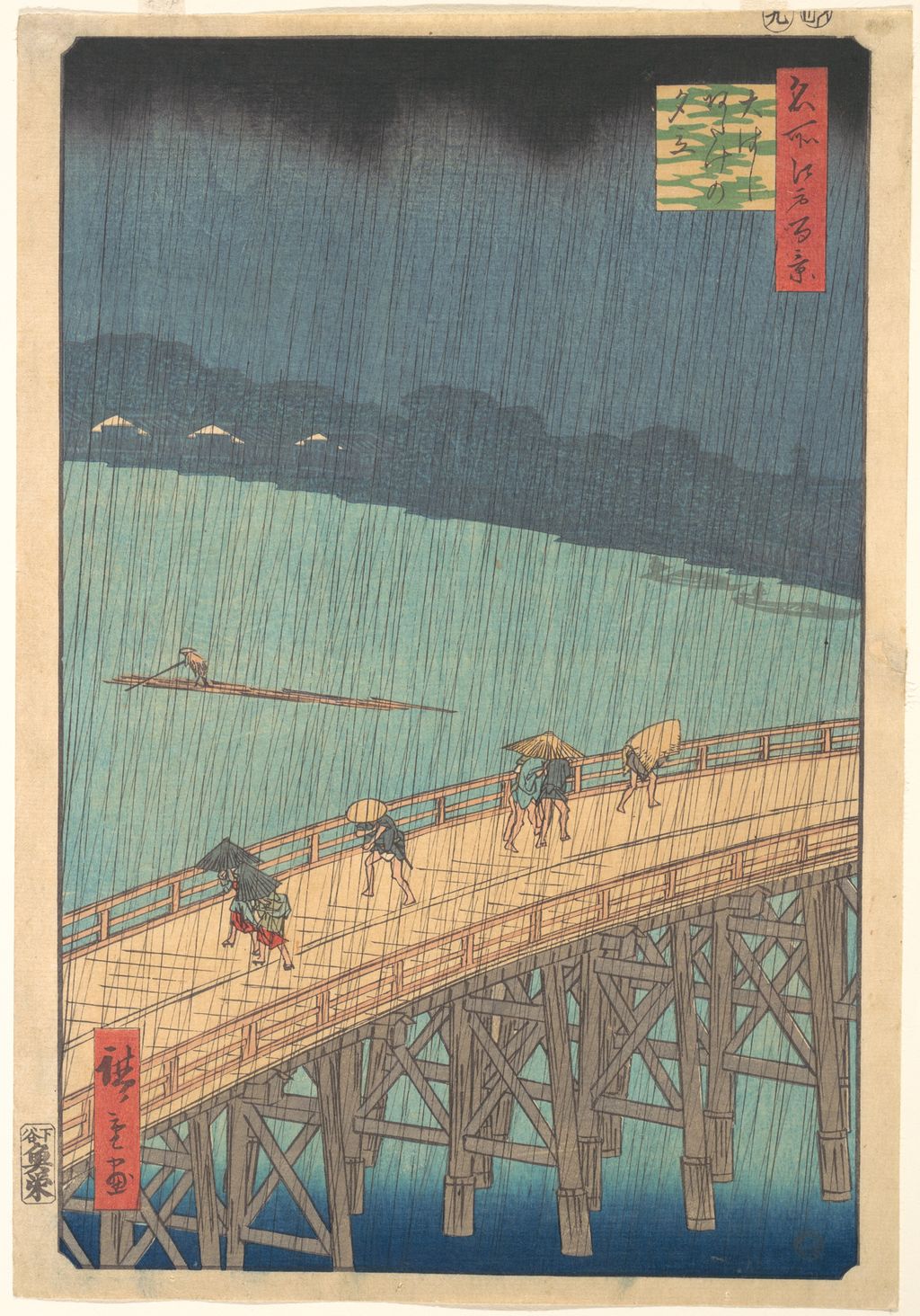
The Metropolitan Museum of Art [14] marks the four accession-specific images below as public domain and makes them available under its Open Access terms. They show the same Hiroshige design, but they are not four different paintings. Each impression is the result of printing from blocks, collecting, preservation and photography. The Met identifies each by an object number, which is more useful than an unqualified claim that one reproduction is “the original.”
Met JP2522: a Mansfield Collection impression
JP2522 [1], accessioned with the Howard Mansfield Collection in 1936, is the image attached to the Met's main interpretive text. Its listed size is 34 by 24.1 centimetres, measured as an ōban print. The museum dates it to 1857 and describes the fine rain lines over the Sumida crossing. It provides a clear institutional reference point for the design, but a single museum dimension is the measurement of this object, not a size specification for every surviving sheet.
Met JP644 and JP643: two Pulitzer Bequest sheets
JP644 [10] and JP643 [11] are separately catalogued Met objects, both associated with the 1918 Joseph Pulitzer Bequest purchase. Putting them together asks a practical question: how much of what a viewer calls “Hiroshige's colour” belongs to the design, and how much depends on the particular sheet or its reproduction? Their catalogued title and date match, yet the appearance of the cloud, shore and rain can be compared rather than assumed to be identical. This page does not assign either one a printing sequence, since these object summaries do not supply the specialist evidence needed for that conclusion.
Met JP3174: another collected impression
JP3174 [12] entered the Met as a gift from Mr and Mrs A. I. Sherr in 1956. It is another direct view of the same composition. A reader can compare the amount of margin visible, apparent darkness of the upper cloud, legibility of the roof shapes and density of rain. Such observations are a beginning, not a verdict about block wear or edition. Cropping and colour calibration in online files can also affect what appears most prominent. The accession number keeps the comparison attached to a real museum sheet.
The British Museum's 2025 guide [3] provides a genuinely specific state observation for its own first-edition impression, accession 1948,0508,0.5: two boats appear by the upper-right shore, and a light mark under the bridge made by the block cutter was corrected in later versions. These details should not be silently transferred to JP2522, JP644, JP643, JP3174 or the unidentified image supplied for this page. They show what a documented comparison can establish when the exact object is known. They also explain why a visitor looking at two otherwise familiar versions might encounter small differences beyond overall colour.
An earlier storm: Shōno on the Tōkaidō
Hiroshige had already made weather central to a travel print more than twenty years earlier. The Met's Sudden Shower at Shōno [13], JP41, belongs to the Hōeidō Fifty-three Stations of the Tōkaidō and is dated 1834–35 by the museum. It is a horizontal scene: travellers and palanquin bearers move through slanting rain on a country road. The Met notes that the scenery appears imaginative rather than a topographically exact view of Shōno. Even the umbrella functions differently: its inscriptions carry the publisher's family name and part of the series title.
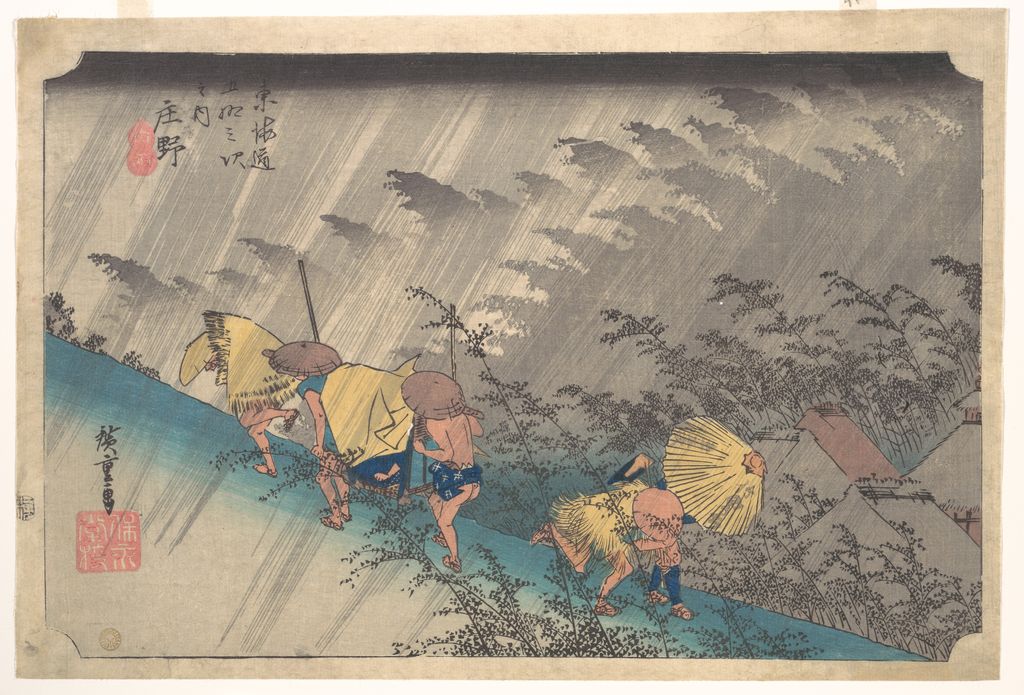
The comparison shows continuity without flattening the two works into a single formula. Both designs make precipitation legible through diagonal lines and make people react physically to it. Yet Shōno is a roadside storm in a horizontal journey series; Ōhashi is an urban river crossing in a vertical city series. In Shōno the slope and travelling parties dominate the whole frame. In Ōhashi the bridge cuts through a larger arrangement of sky, water and near and far banks. The later sheet gives more of its space to the atmosphere itself, while the human scene remains small but sharply intelligible.
Neither picture is a photograph of a storm that an artist happened to witness from the precise printed viewpoint. A landscape print can include a named place and still be deliberately constructed. The difference matters especially for Shōno, where the Met explicitly cautions that the setting may be imaginary, and for Ōhashi, where the high viewpoint and three directions of looking are compositional decisions. We can admire the sensation of sudden weather without making unsupported claims about an exact afternoon.
Van Gogh's later bridge in the rain
In 1887 Vincent van Gogh made an oil painting after Hiroshige's bridge print, now usually called Bridge in the Rain (after Hiroshige). The British Museum's guide [3] explicitly links its first-edition Hiroshige print with Van Gogh's later oil copy. The Van Gogh Museum's presentation through Google Arts & Culture [15] dates the painting to October–November 1887 and describes the changed colour relationship to the Japanese woodcut. This is a history of looking at Hiroshige, not evidence that the English title used now was printed on the 1857 sheet.
Van Gogh retained the slanting bridge, its running figures and the force of the rain, but translated them into oil paint and added his own border treatment. A viewer can recognise Hiroshige's arrangement without mistaking the later painting for a colour photograph of an Edo impression. The comparison also cautions against treating the print as a fixed image without a material history. Van Gogh saw a particular impression, processed it through his own painting practice and produced a new object with its own date, surface and reception.
The fame of Van Gogh's copy can sometimes make the Japanese sheet seem mainly like a prelude to European art. It is more useful to reverse the order of attention. First read the Edo bridge, its place-names, printer's sky and moving inhabitants on its own terms. Then Van Gogh's painting becomes one documented example of the print's later life. Hiroshige's work remains a late Edo city view whether or not the later artist encountered it.
Why this sheet belongs to One Hundred Famous Views of Edo
The print is one sheet in Hiroshige's late city-and-environs series. It is also one of the clearest examples of the series' willingness to make a famous place strange by changing the viewer's position and the conditions of visibility. The bridge is named and structurally legible; Atake is named yet nearly hidden. The setting is recognisable enough to be a meisho, a famous place, while the storm makes seeing it contingent. The British Museum's series account [3] frames the project as a set of varied views of Edo, not one continuous bird's-eye map.
The full series page on this site gives the 119-design contents order and explains why a title containing “one hundred” does not mean there are exactly one hundred surviving designs. This work belongs to the series' summer grouping in that posthumous contents arrangement. That is a catalogue placement, not proof that the exact shower pictured occurred on a documented summer day. The British Museum dates its own first-edition print to the ninth month of 1857, which is an issue date associated with that print, not a weather diary.
This page therefore offers three levels of reading. The first is immediate: a city crossing in a violent shower. The second is formal: diagonal bridge, layered rain and shifting viewpoint make a narrow sheet expand. The third is material: individual impressions can differ, and an image of a specific museum print must retain its accession and rights record. Keeping those levels distinct helps the design remain vivid without asking the evidence to support more than it can.
Continue exploring Hiroshige
| Name | Date | Medium |
|---|---|---|
| One Hundred Famous Views of Edo | 1856–58 | Woodblock print series |
| Fifty-three Stations of the Tōkaidō | c. 1833–34 | Woodblock print series |
| Hiroshige | 1797–1858 | Artist |
Frequently asked questions
The design was issued in 1857 as part of One Hundred Famous Views of Edo. The British Museum [3] dates its identified first-edition impression to the ninth month of that year. An unidentified impression should not automatically be described as printed in that same month.
No. Shōno [13] is an earlier horizontal Tōkaidō road design, dated 1834–35 by the Met. Ōhashi is a vertical view of an Edo bridge and river, designed in 1857. Both use driving rain and moving people, but they are different works in different series.
Atake is the far district across the Sumida River from the Great Bridge, according to Tokyo Fuji Art Museum's Japanese object text [2]. It is difficult to see because Hiroshige shows it through the downpour.
Surviving impressions are separate printed objects; printing, condition, cropping, photography and digital colour can all influence their current appearance. The four Met objects [1] shown here have distinct accession numbers. The British Museum [3] has documented specific first-edition details in its own copy. A visual difference alone is not enough to assign an unrecorded impression to an edition.
Yes. The British Museum [3] identifies Van Gogh's oil copy, made in 1887. It is a later painting after a Hiroshige print, not an 1857 Japanese woodblock impression.
Some are black, but Ōta Memorial Museum curator Hinohara Kenji [8] notes that this design uses both black and lighter grey lines. Their interplay helps convey the density of rain.
Discussion
A sudden shower changes how every person and place in the view is seen.
Reader Insights
Which printed marks make the shower feel sudden?
Which traveller catches your eye first, and why?
What changes when you compare two documented impressions?
Join the Conversation
Share a detail in the bridge, rain or distant shore that changed your reading of the print.
References
- The Metropolitan Museum of Art, Sudden Shower over Shin-Ōhashi Bridge and Atake, JP2522. Object title, date, medium, dimensions and account of the fine rain lines.
- Tokyo Fuji Art Museum, 名所江戸百景 大はしあたけの夕立 (Japanese). Place, umbrella group, printer's atenashi bokashi, date and open-licence note on this institution's own image.
- British Museum, Hiroshige: Artist of the Open Road large print guide. The Museum's documented first-edition object 1948,0508,0.5, ninth-month date, two-boat and cutter-mark detail, viewpoint and Van Gogh connection.
- Agency for Cultural Affairs, Cultural Heritage Online, Tokyo National Museum's 大はしあたけの夕立 (Japanese). Bridge, raft, distant Atake, high viewpoint and 1857 date. Image reuse is not inferred from the text record.
- Cleveland Museum of Art, Sudden Shower over Shin-Ōhashi Bridge and Atake, 1921.318. Rebuilt bridge context, opposing travellers, Atake and exact-object catalogue information.
- Kanagawa Prefectural Museum of Cultural History, Hiroshige print guide (Japanese). Location of Atake relative to the bridge.
- Sarah E. Thompson, Hokusai, Hiroshige, Hasui, Museum of Fine Arts, Boston, 2026, preview p. 129. Identification of the three pale roofs as shogunal boathouses. Only this accessible preview passage was used; the whole book has not been claimed as consulted.
- Hinohara Kenji, Ōta Memorial Museum of Art, “What colour are the rain lines in ukiyo-e?”, 2021 (Japanese). Two printed tones in this design's rain lines.
- British Museum, “How to make a woodblock print like Hiroshige”. Publisher, designer, carver and printer roles and layered printing.
- The Metropolitan Museum of Art, Sudden Shower over Shin-Ōhashi Bridge and Atake, JP644. Exact Met accession and credit.
- The Metropolitan Museum of Art, Sudden Shower over Shin-Ōhashi Bridge and Atake, JP643. Exact Met accession and credit.
- The Metropolitan Museum of Art, Sudden Shower over Shin-Ōhashi Bridge and Atake, JP3174. Exact Met accession and credit.
- The Metropolitan Museum of Art, Sudden Shower at Shōno, JP41. Earlier Tōkaidō design, date, route and umbrella inscriptions.
- The Metropolitan Museum of Art, Open Access image policy. Terms for Met public-domain images.
- Van Gogh Museum via Google Arts & Culture, Bridge in the Rain (after Hiroshige). Date and comparison; no image downloaded from this presentation.