


 by Tom Gurney
Tom Gurney BSc (Hons) is an art history expert with over 20 years experience
Published on September 23, 2026 / Updated on September 23, 2026
Email: tomgurney1@gmail.com / Phone: +44 7429 011000
Utagawa Hiroshige: a life in prints, books and painting
Utagawa Hiroshige (conventionally 1797–1858) built a career in the commercial image culture of Edo while carrying a hereditary duty in the shogun’s fire service. He learned under Utagawa Toyohiro, spent years making figure and book designs, and only later became a leading designer of celebrated places. His Hōeidō Fifty-three Stations of the Tōkaidō made the road itself a sequence of memorable encounters. He kept returning to Edo, the provinces, birds, flowers, books and painting, and he was working on One Hundred Famous Views of Edo when he died. The Shizuoka City Tōkaidō Hiroshige Museum’s Japanese biography [1] provides the basic local chronology; the British Museum’s collection biography [2] and its 2025 exhibition guide [3] add details about work, travel and surviving evidence.
His life resists a neat legend. The story that a single 1832 trip to Kyoto produced all the drawings for the Hōeidō series has often been repeated, but Matthi Forrer’s published analysis, pp. 17–18 [4] traces it to a much later, uncorroborated report. By contrast, the British Museum can point to Hiroshige’s own 1841 Kai Province diary, and to sketchbooks whose physical evidence supports later travel. The distinction between a documented journey, a plausible journey and an attractive story is central to this biography. The images likewise distinguish accessioned museum objects from the one user-supplied portrait reproduction.
Contents
At a glance
- Full artist nameUtagawa Hiroshige; also called Andō Hiroshige
- Birth and deathConventionally 1797–1858; the birth year is inferred from a posthumous age record
- BirthplaceYaesugashi district of Edo, now central Tokyo
- Family roleHereditary fire warden in the shogun’s service until formal resignation in 1832
- TeacherUtagawa Toyohiro; early Kanō-style instruction is also reported
- Key projectsEarly Edo views; Hōeidō Tōkaidō; Kiso Road; Eight Views of Ōmi; later national views; One Hundred Famous Views of Edo
- Evidence to treat cautiouslyExact birth date, the traditional 1832 white-horse journey, individual impressions behind modern reproductions, cause of death
Seven phases of a working life
The chronology below follows dated publications, museum records and the readable passages of Forrer’s Prestel monograph. Dates on an individual print can be less secure than the modern catalogue label suggests. As Forrer explains, p. 17 [4], precise dating before the introduction of date seals in 1852 can be especially difficult. One year should not carry more historical weight than the object can support.
1797–1810: Edo family and fire service
The artist was born in Edo’s Yaesugashi area to a family holding a hereditary low-ranking samurai appointment as fire wardens near the shogun’s castle. His childhood name was Tokutarō; later personal names included Jūemon and Tokubei. The British Museum’s curator [5] explains that the Andō family’s post joined practical fire protection to the shogunate’s service. This was neither the life of a court painter nor the life of a purely independent street artist. Household duty, rank and the need for income formed the setting in which the young Hiroshige learned to draw.
The Shizuoka museum [1] states that his parents died in 1809 and he inherited the fire-service position as a youth. The British Museum’s collection biography [2] also records succession on his father’s death. Forrer’s research, pp. 11–12 [4] adds an important caution: much of the early-life account depends on later sources, and the accepted birth year is inferred from Kunisada’s memorial portrait, which states an age at death of sixty-two by Japanese counting. These facts are strong enough for a responsible outline, but they do not justify an exact birthday or invented description of the household’s emotions.
A superior in the fire service is said by the British Museum’s 2025 gallery guide [3] to have taught him elements of Kanō-school painting. Forrer notes a reported teacher, Okajima Rinsai, an amateur painter and fellow fireman. The sources do not let us reconstruct a school curriculum or identify a surviving drawing as its certain product. The point is that Hiroshige’s entry into art could be aided by instruction within his working community even before he entered a print studio.
1811–1829: Toyohiro, names and early subjects
Around 1811, Hiroshige became a pupil of Utagawa Toyohiro. The Shizuoka museum [1] explains the art name as combining a character from Toyohiro’s name with one from Hiroshige’s own. The British Museum’s curator [5] recounts failed attempts to enter Toyokuni’s and Toyohiro’s studios before the latter accepted him. Yet the account is not equally firm in every detail: Forrer, p. 12 [4], traces important versions of the rejection story to late biographies and calls early career documentation fragmentary. It is safer to say that Toyohiro was his teacher than to stage the refusals as a documented dramatic scene.
During the 1810s and 1820s he tried subjects familiar in ukiyo-e: actors, fashionable women, warriors, history, novels and illustrated books. Forrer’s account, pp. 12–13 [4], discusses early actor designs, a New Year print, book commissions and the difficulty of finding regular publisher work. The British Museum’s collection biography [2] likewise names actors, warriors and beauties in the 1820s. The artist later praised for restrained snow and rain had begun within a much broader commercial picture world. His later speciality did not erase those beginnings.
The early part of this career should not be illustrated by falsely dated objects. The surviving prints often have approximate dates or later attribution debates. That is why the first artwork shown in this chronology is a securely catalogued 1830s sheet rather than an unidentified “young Hiroshige” image. The absence of a convenient early image is a documentation problem, not proof that nothing was made before the famous road series.
1830–1835: Edo views, birds and the Tōkaidō
Hiroshige resigned formally from the fire department in 1832, according to the British Museum’s biographical record [2]. The Shizuoka museum [1] describes him as passing the family work to a relative and concentrating on art. The change matters, but it should not be told as though he had made no images beforehand. Forrer’s analysis of the early 1830s, pp. 13–16 [4], shows overlapping development of Edo views and bird-and-flower subjects, pursued through different publishers and formats.
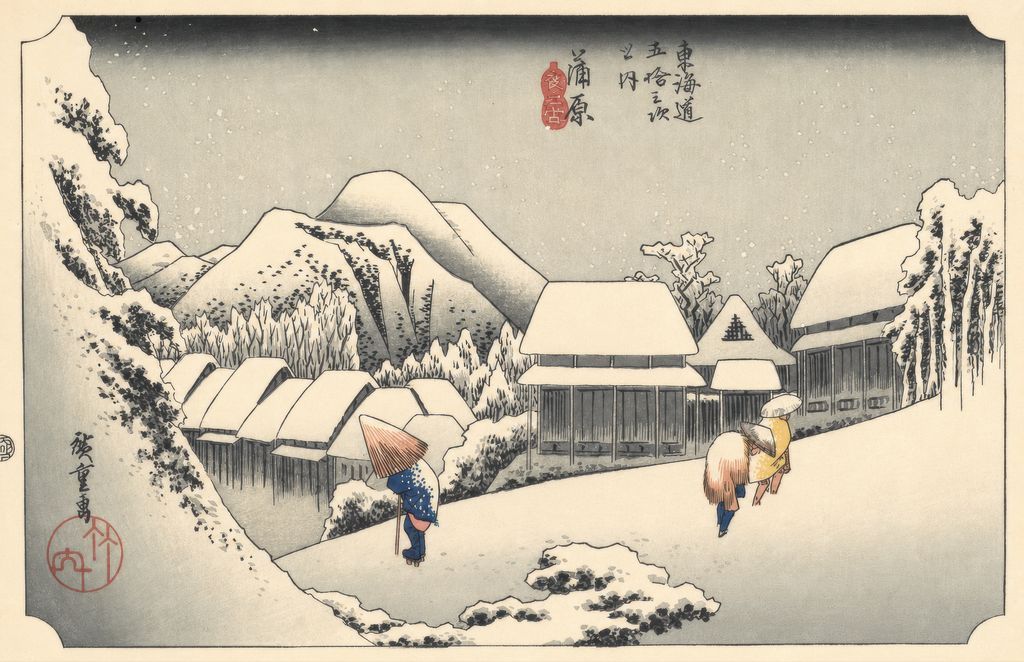
The Hōeidō Fifty-three Stations of the Tōkaidō appeared around 1833–35 in standard museum chronologies and was a major success. The Met’s exact A Snowy Evening at Kanbara Station [6], JP486, is an accessioned example from around 1833–34. Its lightly printed snow and small trudging figures make weather felt through a few large tonal masses. The reproduction at the top of this page follows the same design but its physical impression is unidentified; it should not be labelled as Met JP486. The Hōeidō guide follows all 55 designs and explains why there are fifty-three stations but two extra endpoints.
The journey behind the series is less certain than the artwork. A popular narrative says that in 1832 Hiroshige escorted a white horse presented to the emperor, travelled the road to Kyoto and returned with drawings. Forrer, pp. 17–18 [4], locates this account in Iijima Kyōshin’s 1894 biography, based on a statement attributed to Hiroshige III. Forrer notes an 1834 album foreword as firm publication evidence and argues that the chronology may require a longer production period. His revised early start is an argument, not a consensus date to substitute mechanically for museum catalogues. The artist may have travelled, but neither a picture of Kanbara nor the later story independently establishes the exact itinerary or mission. This is the central difference between dating a series and narrating its origin.
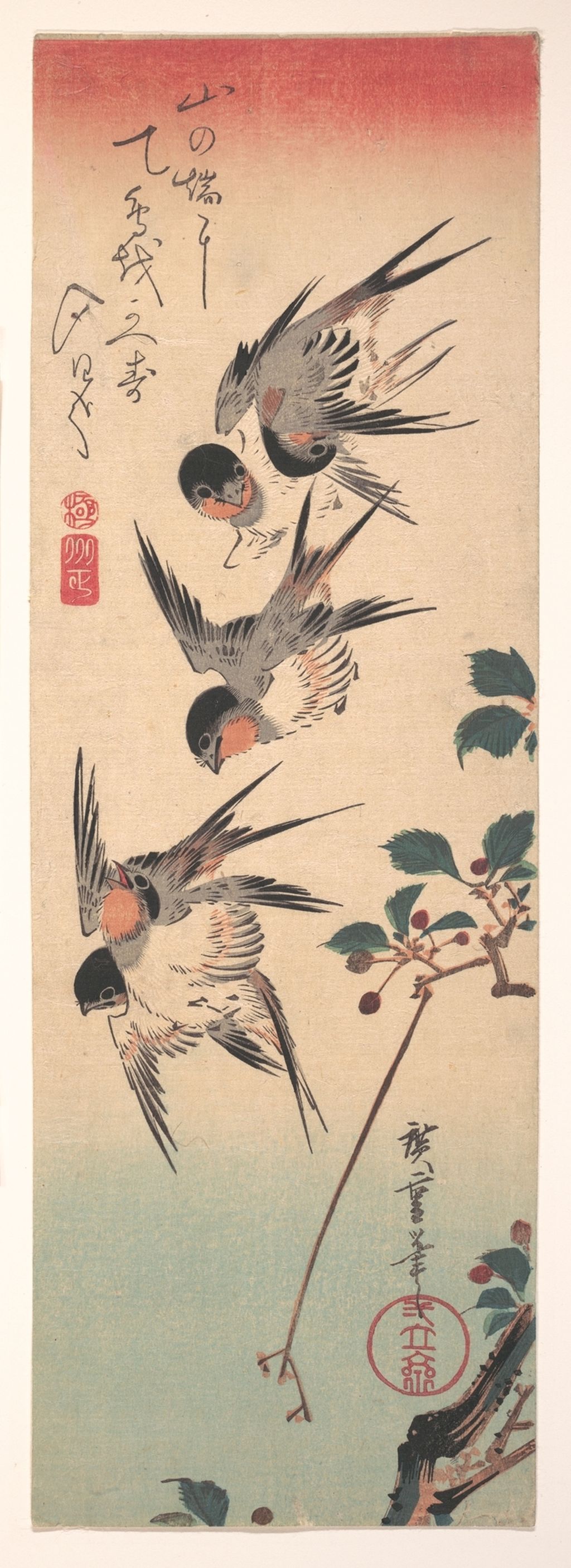
He was not making road views alone. The Met’s Swallows and Budding Wild Cherry [7], about 1835, shows a narrow nature format. Forrer, pp. 15–16 [4], relates such bird-and-flower sheets to poetry, earlier Japanese and Chinese traditions, and several publishers. A single year can thus hold weathered landscapes and close seasonal studies, rather than a succession of airtight career “styles.”
1835–1842: Ōmi, the Kiso road and observed journeys
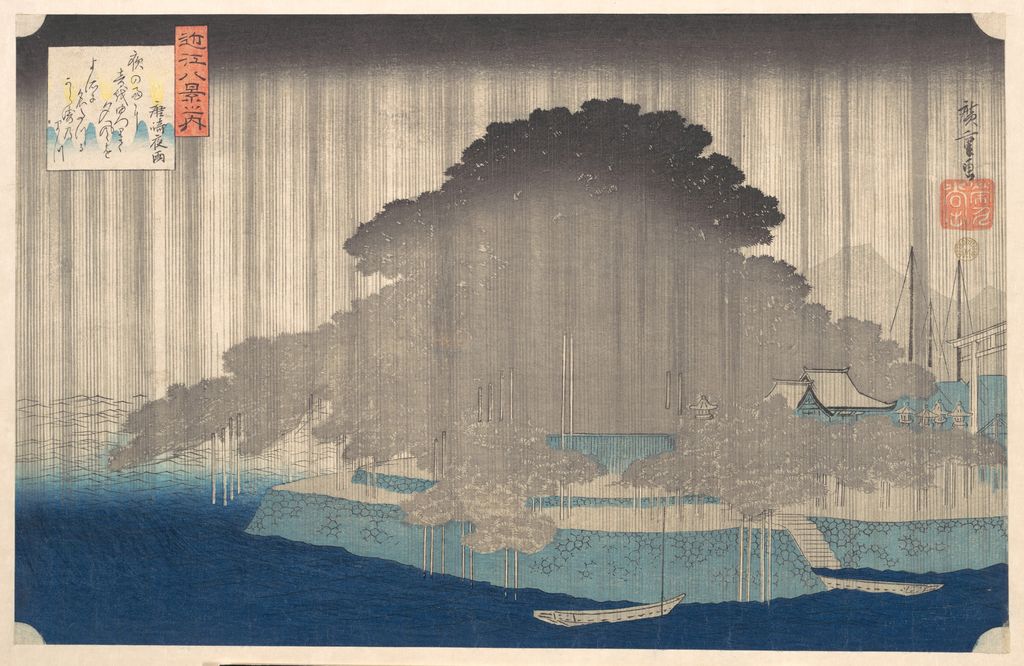
The eight traditional views of Lake Biwa in Ōmi Province gave Hiroshige a compact framework inherited from Chinese poetry and Japanese adaptations. In the Met’s Night Rain at Karasaki [8], about 1835, the dark pine and fine rain serve a named poetic place. Forrer, pp. 19–21 [4], places the series in a longer Eight Views tradition and discusses its restrained colour, mist and selective perspective. Its achievement lies in using an established programme with fresh decisions about light and distance, not in inventing the motif of eight views from nothing.
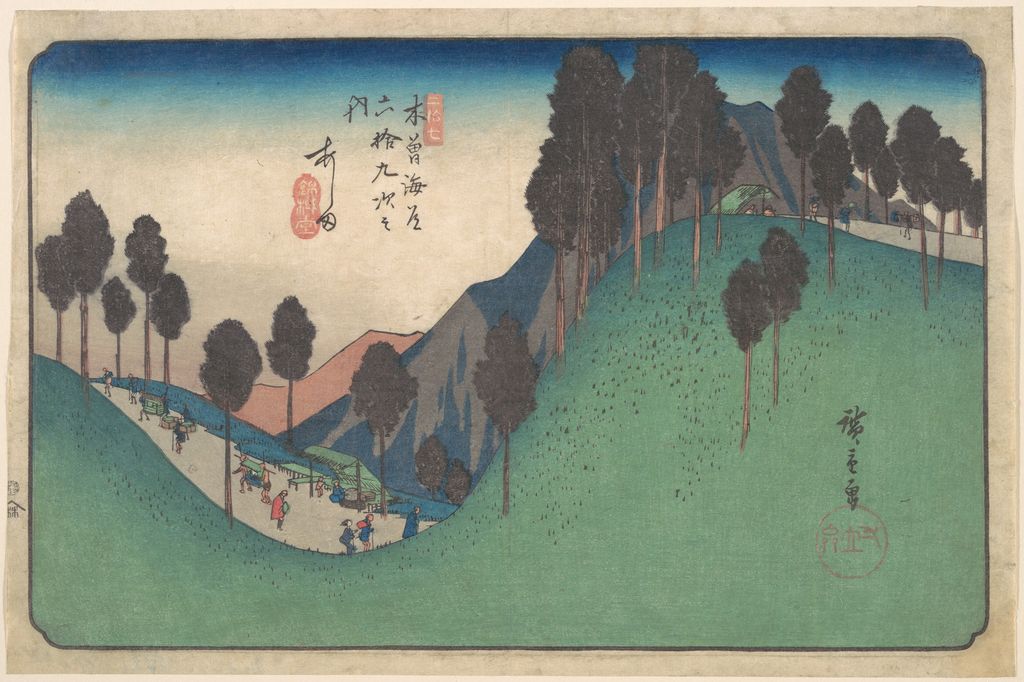
The Kiso road or Kisokaidō, also called the Nakasendō, linked Edo and Kyoto by a more northerly route. Hiroshige contributed to The Sixty-nine Stations of the Kiso Road, a project initially associated with Keisai Eisen. The Met’s Ashida Station [9], catalogued about 1836, is one object from that larger work. Forrer, pp. 18–19 [4], stresses the role of publishers and the uncertain date at which Eisen’s and Hiroshige’s contributions began. Calling the entire series an unaided Hiroshige work would hide Eisen and the production history.
Unlike the 1832 Kyoto story, some later travel has direct written or material support. The British Museum’s 2025 guide [3] displays Hiroshige’s Diary of a Trip to Kai Province, dated 1841, and uses a passage describing changing mountain views and the Katsura River. The British Museum’s Kisokaidō sketchbook record [10] says a group of sketches may be on-site notes from a journey around 1837; the “may” preserves curatorial uncertainty. The diary is stronger evidence of the 1841 journey than a later biographical anecdote is of the white-horse escort. Both sources show how place-based work could draw on travel without proving that every printed scene was copied from a single viewpoint.
1842–1855: historical narratives, books and painting
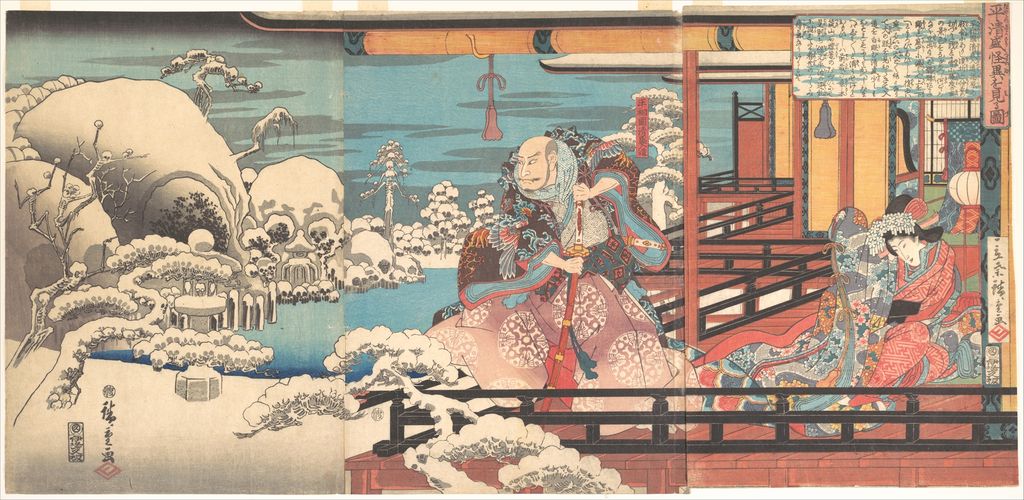
After the road breakthrough Hiroshige kept working across subjects. The Met’s Taira no Kiyomori’s Spectral Vision [11], a triptych dated around 1845, belongs to a world of dramatic historical storytelling. Its ghostly snowy landscape and figures answer a different readerly demand from a station print. The museum’s image records all three sheets as accession JP2540a–c. Displaying the triptych complete matters: removing one panel would change the relationship of its human actors and threatening vision. The British Museum’s exhibition [12] deliberately places Hiroshige’s work beyond the single category of landscape.
His illustrated books created still another way to carry views. The Met’s Views of Famous Places in Japan [13], dated 1839, is a bound printed work, not a loose colour sheet. Hiroshige’s pictures could reach readers who handled sequences, turned leaves and read inscriptions alongside images. The British Museum’s curator [5] estimates dozens of illustrated books and hundreds of paintings across the career; those broad totals are institutional estimates rather than an exact census of individual pages.
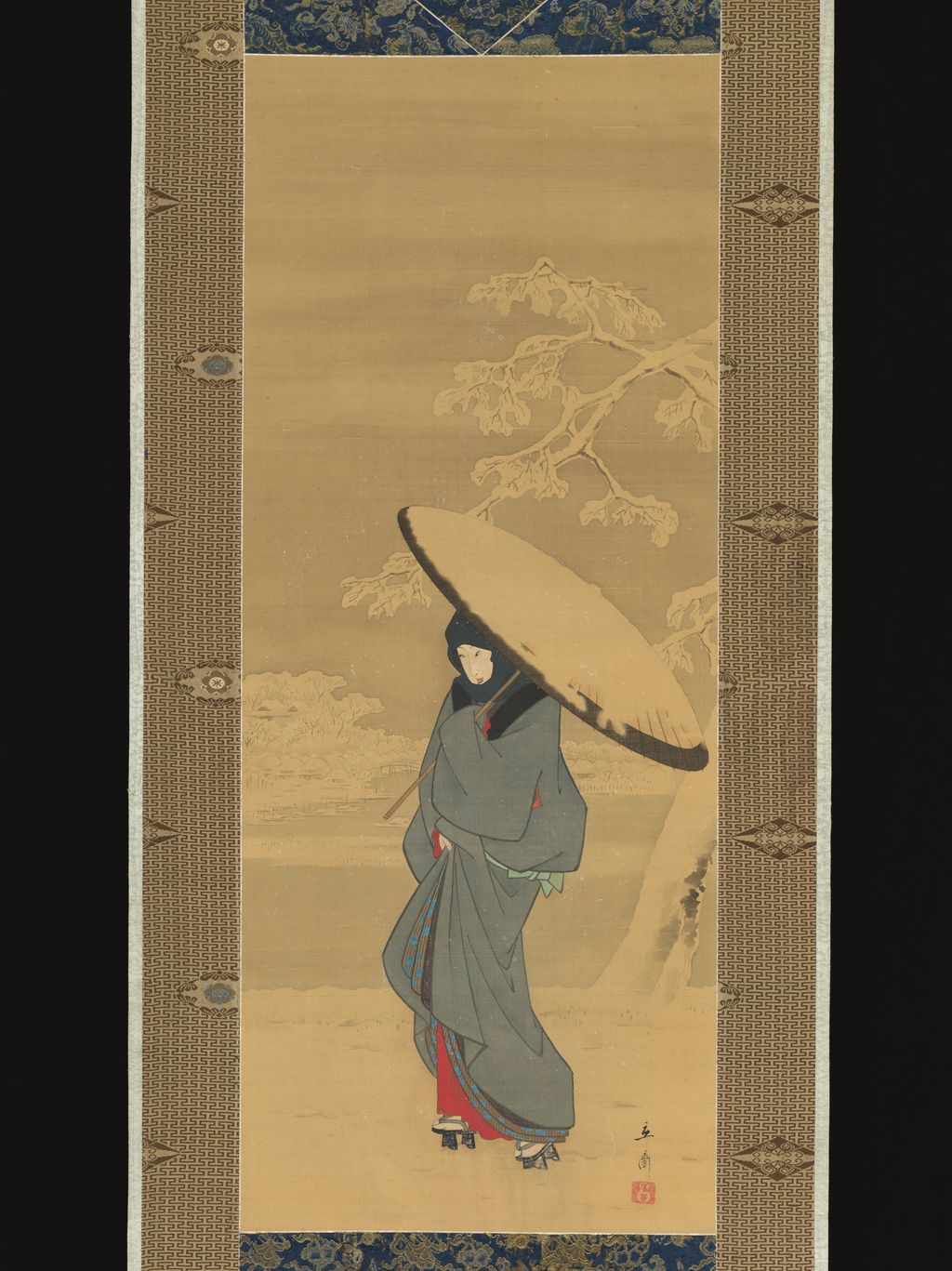
A painting such as the Met’s Woman Walking in the Snow [14], dated to the 1840s or early 1850s, demonstrates why “printmaker” is insufficient. It is ink and colour on silk, mounted as a hanging scroll. The museum explains how reserved silk suggests snow and how a touch of red animates the figure. The artist’s brush and the printer’s blocks were separate techniques, even when both addressed weather. The scroll also sustains his interest in people. A chronological account of Hiroshige’s life that leaps from Hōeidō in the 1830s to late Edo in the 1850s would erase this working middle.
1856–1858: late Edo, national views and religious status
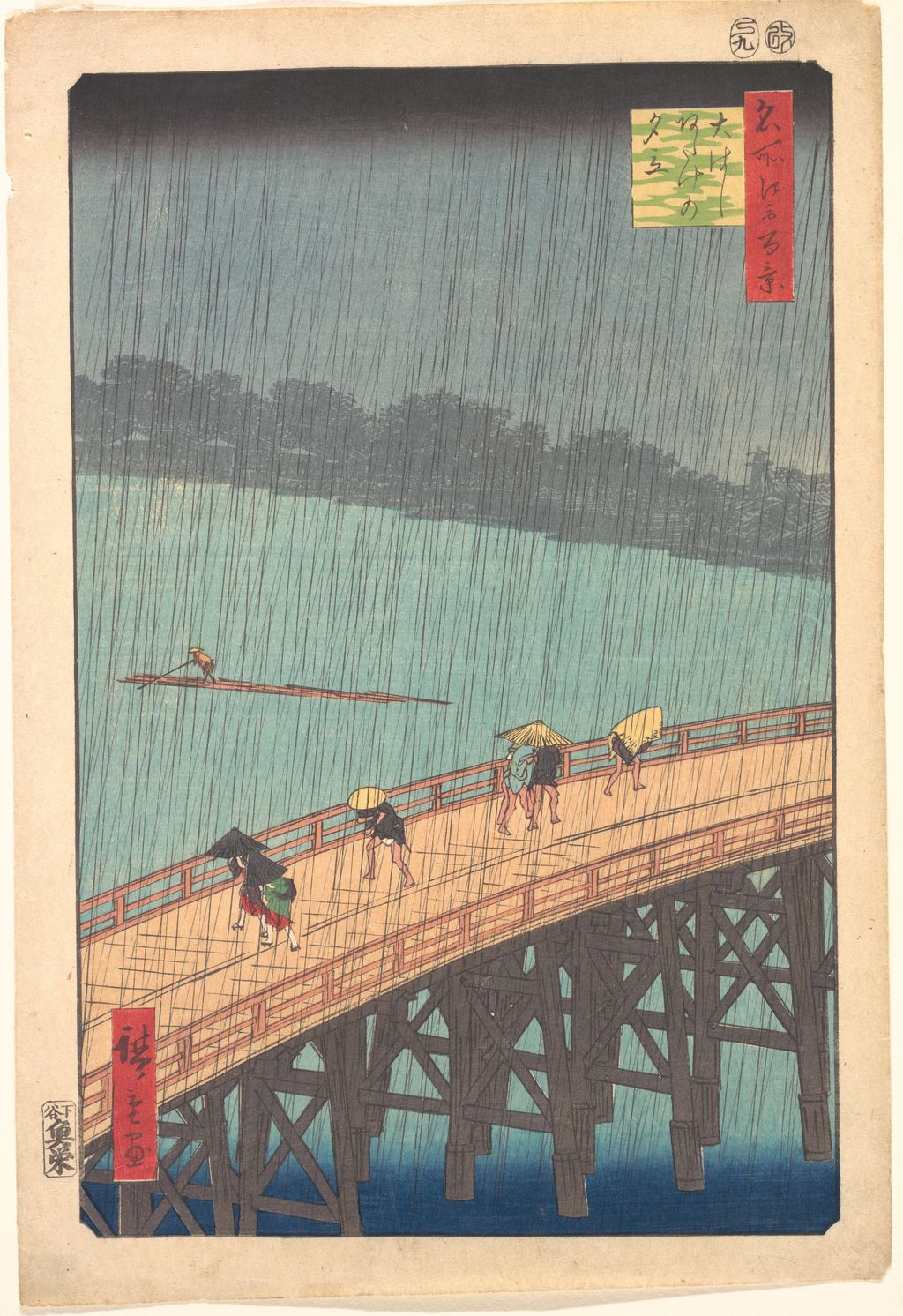
In 1856 Hiroshige took the tonsure as a Buddhist layperson, according to the British Museum’s collection biography [2]. That change is visible in the posthumous portrait, but it does not mean he stopped making secular pictures. The late One Hundred Famous Views of Edo, issued from 1856 to 1858, is among his most experimental print programmes. The Ōta Memorial Museum [15] describes the surprising large foreground motifs, elevated viewpoints and contemporary urban detail. The Met’s Sudden Shower over Shin-Ōhashi Bridge and Atake [16], JP2522, is one exact 1857 object from the series; the single-work guide compares multiple identified impressions.
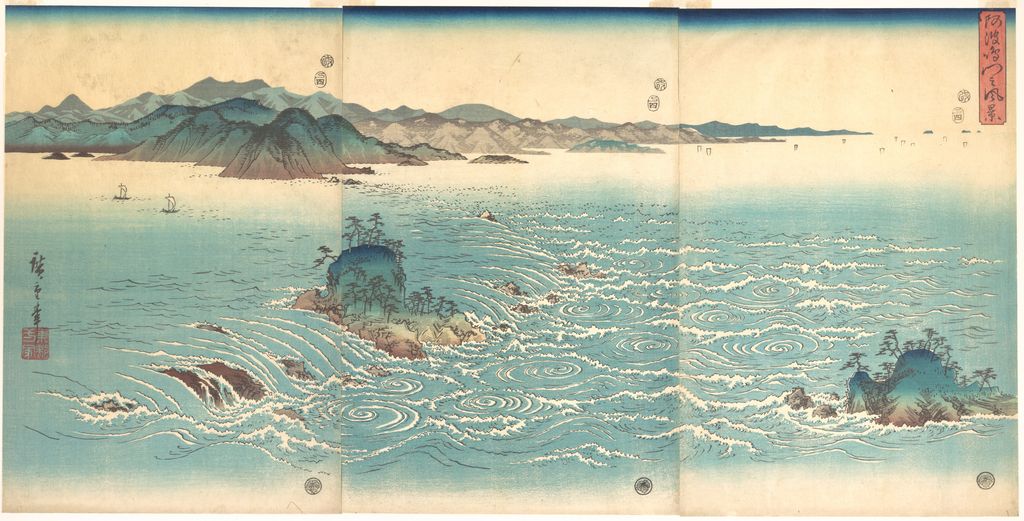
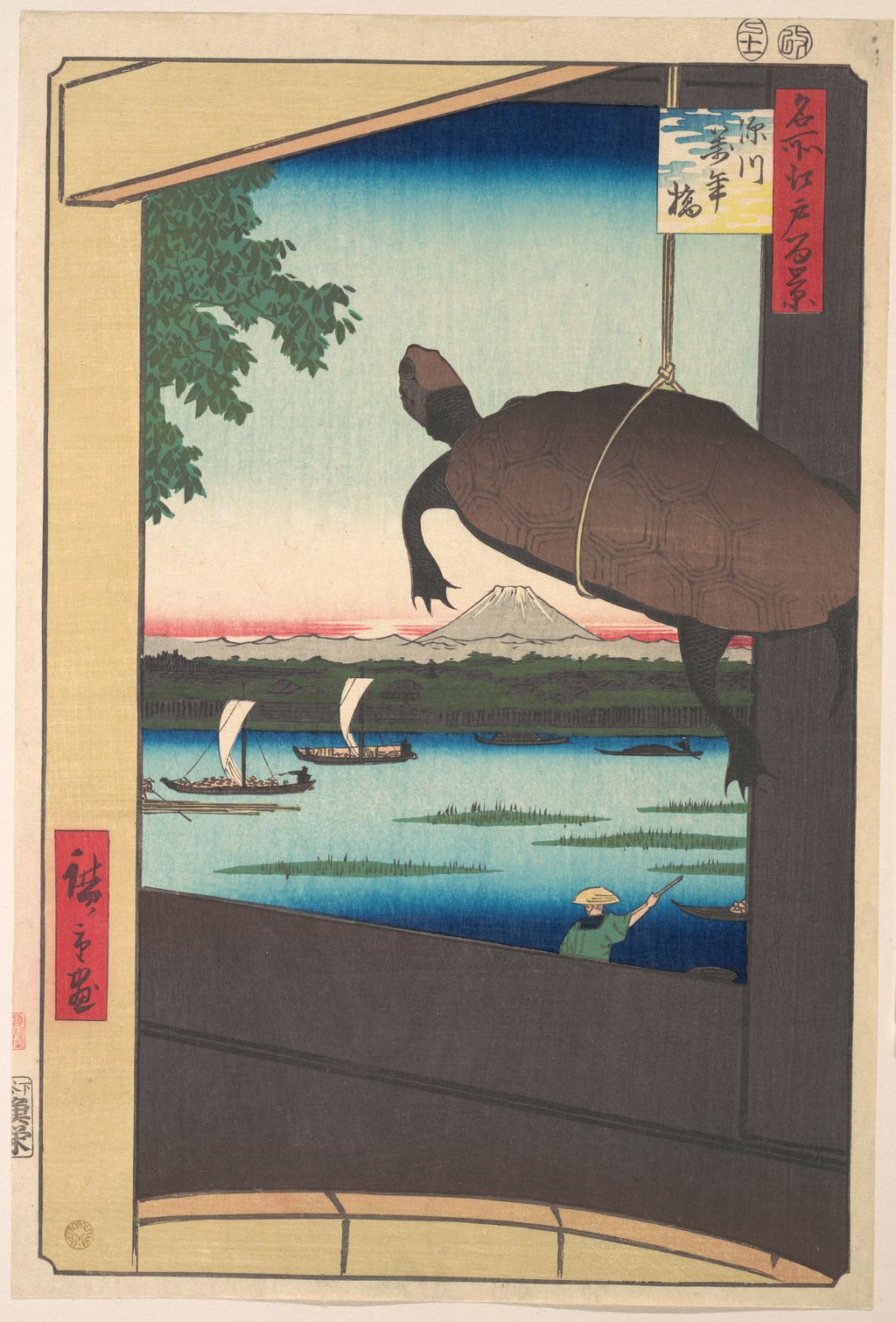
The late prints also reached beyond Edo. The Met’s Rapids at Naruto [17], dated 1857, shows a turbulent provincial water scene with a very different rhythm from the calm snow of Kanbara. The Met’s Mannen Bridge, Fukagawa [18], catalogued 1858, returns to Edo through a striking near object and distant bridge. These two images show a late artist still testing composition and subject. They counter the easy claim that his later work was a gradual decline after an early masterpiece.
The count of the Edo programme also needs care. The Shizuoka museum’s account [19] attributes 118 designs to Hiroshige. The Ōta museum’s 2026 exhibition [15] describes 118 Hiroshige sheets, one by Hiroshige II and a contents sheet: 120 printed items in its complete display. The site’s Edo series guide lists the 119 pictured designs and distinguishes the separate contents sheet. The title’s “one hundred” should not be converted into a claim that exactly one hundred images were planned, made or sold.
1858 and after: death, memorial image and a continuing name
Hiroshige died in Edo in 1858 while the late Edo series was still part of his working world. The British Museum press release [20] gives 12 October 1858 in the Western calendar and says he was perhaps a victim of cholera. The Shizuoka museum’s biography [1] gives the sixth day of the ninth month of Ansei 5 and age sixty-two by traditional Japanese counting. The day systems differ; the disease remains uncertain. Neither source warrants a dramatic invented deathbed scene.
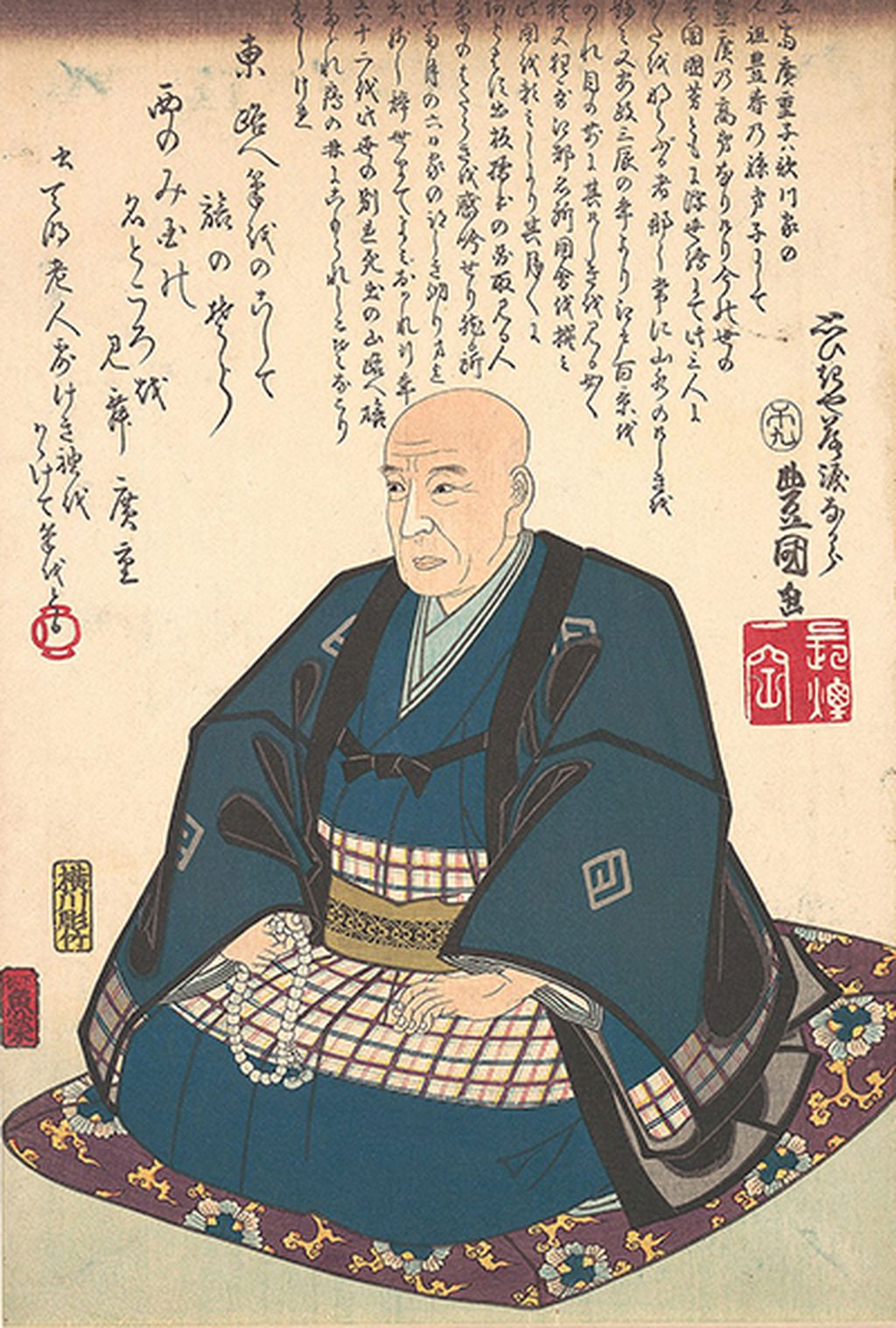
Soon after his death, Utagawa Kunisada designed a memorial portrait, or shini-e, showing Hiroshige in Buddhist clothing. The British Museum’s exact object record [21] identifies Kunisada as the print artist, Uoya Eikichi as publisher and Yokokawa Takejirō as carver. It says the accompanying poem was supposedly written on Hiroshige’s deathbed. The user-owned reproduction at the top of this page follows the design but cannot be assigned to that British Museum sheet. It is a posthumous image made by another artist, not Hiroshige’s self-portrait or a documentary photograph. Its value for biography is precisely that it shows how contemporaries chose to remember him.
The name also continued in a workshop lineage. The British Museum’s painting record [22] identifies the pupil Suzuki Shigenobu, who took the name Hiroshige II after 1858. That attribution matters for the late Edo set’s extra design and for later works signed “Hiroshige.” A name on a sheet is not enough to assign it to the first artist. After the original Hiroshige’s death, publishers, pupils and later collectors shaped the surviving corpus and its labels.
Hiroshige’s own account of looking and making
Biography is usually built from other people’s records, but a few remarks attributed to Hiroshige give a narrower view of how he presented his own work. In the first twenty-three pages available from Forrer’s Hiroshige: Prints and Drawings, pp. 22–23 [4], the author discusses the preface to a posthumously issued One Hundred Views of Mount Fuji, an 1851 Tōkaidō landscape album and an unfinished 1849 drawing manual. The texts describe observed places, the omission of details that lack grace and the combination of elements needed to make a view. These are short printed statements, sometimes transmitted through publication after the artist’s death; they deserve attention without being treated as a private diary of unfiltered intentions.
The distinction between seeing and composing matters throughout the career. An 1841 travel diary can tell us that Hiroshige moved through Kai Province and found the changing mountain scenery difficult to capture. A completed print may instead combine observations with earlier images and a publisher’s plan for a series. In Forrer’s reading, pp. 22–23 [4], Hiroshige’s written emphasis on choosing and arranging forms helps explain why a plausible view need not be a literal transcription. It would be just as reductive to call all the landscapes inventions. The useful historical question is how a particular image turns travel, inherited place knowledge and printmaking into one saleable sheet.
Forrer discusses rough Lake Biwa sketches that convey major landscape elements with economical brush marks. He also warns that a polished drawing used for block cutting might have been prepared by a copyist employed by a publisher or by a pupil, and that responsibility for particular corrections cannot always be established. The production chain therefore complicates the singular phrase “Hiroshige drew this print.” The artist’s design guided the object; another hand could refine the drawing, a carver cut the blocks, a printer applied gradations and the publisher marketed the resulting impressions. The British Museum’s curator [5] emphasises the same consultation among designers and craft specialists, particularly for bokashi colour gradation. This shared work is a feature of the medium, not a reason to diminish Hiroshige’s invention.
The chronology of publishers also changes how his life reads. Forrer, pp. 13–15 [4], argues that publishers in different Edo districts reached different buyers: carefully printed large views near the city centre, and more portable, sometimes smaller views for people moving along roads or visiting famous sites. He does not supply a transaction ledger for every sheet, and his account should remain an argument about likely markets. Still, it makes clear that Hiroshige’s later productivity required relationships, capital, paper and distribution. The shift from an uncertain early commission stream to recurring Edo and road series is a business story as well as an artistic one.
One published document makes that point especially well. Forrer notes an advertisement associated with the 1834 Hōeidō albums that announced other possible road, Ōmi and Kiso projects. Not every advertised project survives as a complete print series, but the notice suggests that Hiroshige and the publisher were thinking across multiple sets rather than completing one miraculous journey picture after another. The Hōeidō designs had to be carved, printed, placed with buyers and integrated into album form. The artist’s lifetime achievement is more remarkable when it is seen as a long sequence of decisions within that working network.
What the evidence lets us say
The chronology has several distinct strengths. Museum records can identify a physical sheet, material, approximate date and attribution. An artist’s dated diary can attest a journey and words he used. A later memorial print can show how friends and colleagues represented him. A nineteenth-century biography can preserve a tradition while leaving its source too thin to be treated as fact. Forrer’s analysis of the white-horse story [4] is particularly useful because it names the late source and tests the proposed schedule against an 1834 publication document. We can say the Hōeidō series transformed his career without claiming to know exactly how every sketch was gathered.
The objects also prevent a compressed personal myth. An early fire-service post did not make him a passive amateur; the 1820s show an artist seeking commissions. The road series did not make every later project a repetition; Ōmi poems, Kiso collaboration, historical triptychs, paintings and late Edo compositions each had distinct forms. A late Buddhist status did not end commercial work; the memorial portrait was made by peers in that world. The story of this life is best told with those overlaps visible.
Continue with the works
Use the Hiroshige homepage for a cross-medium overview. The Hōeidō Tōkaidō guide supplies the full 55-design route and documents the disputed origin story in more depth. One Hundred Famous Views of Edo has the searchable late-series directory. The Sudden Shower close reading compares physical impressions and explains the printed rain. The biography gives the order of a life; those pages show what individual objects can support.
Frequently asked questions
That is the accepted year, but Forrer, p. 11 [4], explains that it is inferred from the age on Kunisada’s 1858 memorial print. An exact birthday is not established by that evidence.
He inherited a hereditary fire-warden position in the shogun’s service after his father’s death and formally resigned in 1832, according to the British Museum [2]. The role formed part of his family’s standing and income while he pursued art.
The white-horse escort story is uncorroborated. Forrer, pp. 17–18 [4], traces it to a late source, while an 1834 album foreword anchors the series’ publication. Hiroshige may have travelled the road, but the precise mission and timing should not be stated as settled fact.
Yes. The British Museum’s career account [5] covers early actors and beauties, birds and flowers, books and paintings. Exact Met examples on this page include a historical triptych, nature prints and a hanging scroll.
Possibly. The British Museum [20] uses cautious wording rather than presenting a confirmed diagnosis. His death in 1858 and Kunisada’s contemporary memorial print are secure.
Utagawa Kunisada designed the posthumous portrait. The British Museum identifies an exact 1858 impression [21], but the physical impression represented by the user-owned file shown here is unidentified. It should not be called a Hiroshige self-portrait.
Discussion
Use the dates and surviving objects to compare the secure parts of Hiroshige’s career with later stories.
Reader Insights
What would make a travel story persuasive beyond a convincing print of a place?
Which work best unsettles the idea of a neat landscape-only career?
How does Kunisada’s memorial image shape a later viewer’s picture of the artist?
Join the Conversation
Share an object or source that changed your view of Hiroshige’s life.
References
- Shizuoka City Tōkaidō Hiroshige Museum, “Hiroshige Utagawa and Ukiyo-e” (Japanese). Local life chronology and subject range.
- British Museum, Hiroshige biographical term. Fire-service resignation, teacher, early subjects and tonsure.
- British Museum, Hiroshige: Artist of the Open Road, large-print gallery guide. Career, memorial, Kai diary and exhibition object labels.
- Matthi Forrer, Hiroshige: Prints and Drawings, Prestel, 2011, readable preview, pp. 11–23. Actual consulted text for early evidence, publishers, formats, dated album and disputed 1832 journey. The unpreviewed chapters were not used.
- British Museum, Alfred Haft, “Introduction to Hiroshige”. Fire-warden background, training, travel, broad oeuvre and print collaboration.
- The Met, A Snowy Evening at Kanbara Station, JP486. Exact Hōeidō impression.
- The Met, Swallows and Budding Wild Cherry, JP2531. Exact bird-and-flower sheet.
- The Met, Night Rain at Karasaki, JP52. Exact Ōmi sheet.
- The Met, Ashida Station, JP2496. Exact Kiso series sheet.
- British Museum, Kisokaidō sketchbook, 1913,0501,0.292. Curatorial travel interpretation.
- The Met, Taira no Kiyomori’s Spectral Vision, JP2540a–c. Exact historical triptych.
- British Museum, Hiroshige exhibition. Media and career scope.
- The Met, Views of Famous Places in Japan, 2013.689. Exact printed book.
- The Met, Woman Walking in the Snow, 36.100.22. Exact hanging-scroll painting.
- Ōta Memorial Museum, One Hundred Famous Views of Edo exhibition (Japanese). The late-series count and framing.
- The Met, Sudden Shower, JP2522. Exact Edo impression.
- The Met, Rapids at Naruto, JP1892. Exact 1857 provincial sheet.
- The Met, Mannen Bridge, Fukagawa, JP1184. Exact 1858 Edo sheet.
- Shizuoka City Tōkaidō Hiroshige Museum, Edo series exhibition (Japanese). 118 Hiroshige designs.
- British Museum, Hiroshige exhibition press release. Western death date and qualified cholera wording.
- British Museum, Kunisada, Memorial Portrait of Hiroshige, 1912,1112,0.16. Exact institutional comparator and production credits, not source of the user-owned file.
- British Museum, Suzuki Shigenobu / Hiroshige II object record. Pupil and name succession.
- The Met, Open Access image resources. Rights basis for the eight accessioned object files.