 by Tom Gurney
Tom Gurney BSc (Hons) is an art history expert with over 20 years experience
Published on June 19, 2020 / Updated on November 29, 2026
Email: tomgurney1@gmail.com / Phone: +44 7429 011000
The Girlhood of Mary Virgin: Introduction
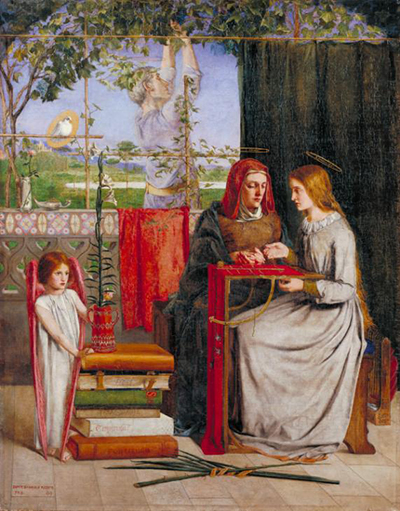
In Dante Gabriel Rossetti’s The Girlhood of Mary Virgin (1848–49), Mary takes her pattern for a piece of embroidery from a living lily. Her mother, Saint Anne, watches her work, while a small angel waters the plant. The oil on canvas belongs to Tate (N04872) and is catalogued as S40 in the Rossetti Archive. First exhibited in 1849, it carried the initials of the newly formed Pre-Raphaelite Brotherhood and was accompanied by verse. The needlework, the signature and the sonnets each tell us something about how the young painter wanted the picture to be seen. [1] [2]
At a Glance
- ArtistDante Gabriel Rossetti
- Date1848–49, with retouching and reframing in 1864
- MediumOil on canvas
- Dimensions83.2 × 65.4 cm (canvas)
- CollectionTate, N04872
This work across Dante Gabriel Rossetti’s career
Arthur’s Tomb
1855Bocca Baciata
1859Beata Beatrix
about 1864–70The Blue Bower
1865Lady Lilith
1866–68, altered 1872–73La Ghirlandata
1873Proserpine
1874The Blessed Damozel
1875–78Contents
- The Pre-Raphaelite initials at Hyde Park Corner
- An education in looking
- The Rossetti household and the making of the picture
- Reading the signs from the ground up
- What the two sonnets do
- From the exhibition catalogue to the frame
- How the picture was seen
- The lily after Girlhood
The Pre-Raphaelite initials at Hyde Park Corner
Rossetti was twenty when the picture went on view at the Free Exhibition of Modern Art at Hyde Park Corner in March 1849. He had attended the Royal Academy Schools and studied briefly with Ford Madox Brown. He began the canvas in 1848 while sharing a studio in Cleveland Street with William Holman Hunt, and both Hunt and Brown advised him as he worked. Hunt and John Everett Millais showed their early Pre-Raphaelite works at the Royal Academy that spring. Rossetti’s public debut took place in a separate exhibition without a selection jury. [2] [3]
The lower left of the painting bears the name Dante Gabriele Rossetti, the letters P.R.B. and the date 1849. Those letters stood for Pre-Raphaelite Brotherhood, founded the previous year. They appeared in public on this picture before most viewers knew what they meant. There is a parallel between the compact initials at the edge of the scene and the rest of its writing. The eye can register the signature as part of the painting long before the mind can supply the name of the group, just as it can recognise the stack of books before deciphering their titles. [2] [4]
This was his first major oil painting and his first exhibited picture. The distinction matters because he was already trying out the medium on a smaller scale. Bottles at the Delaware Art Museum, for example, preserves a still life from his training with Brown, painted in oil on paper mounted on wood. The Tate picture has a woven canvas support measuring 83.2 by 65.4 centimetres. The New Gallery’s winter catalogue of 1897–98 called it a panel, but the title, signature, description and lender show that the entry was for the same object. Tate’s collection record establishes the medium and support. [1] [2] [4] [5]
An education in looking
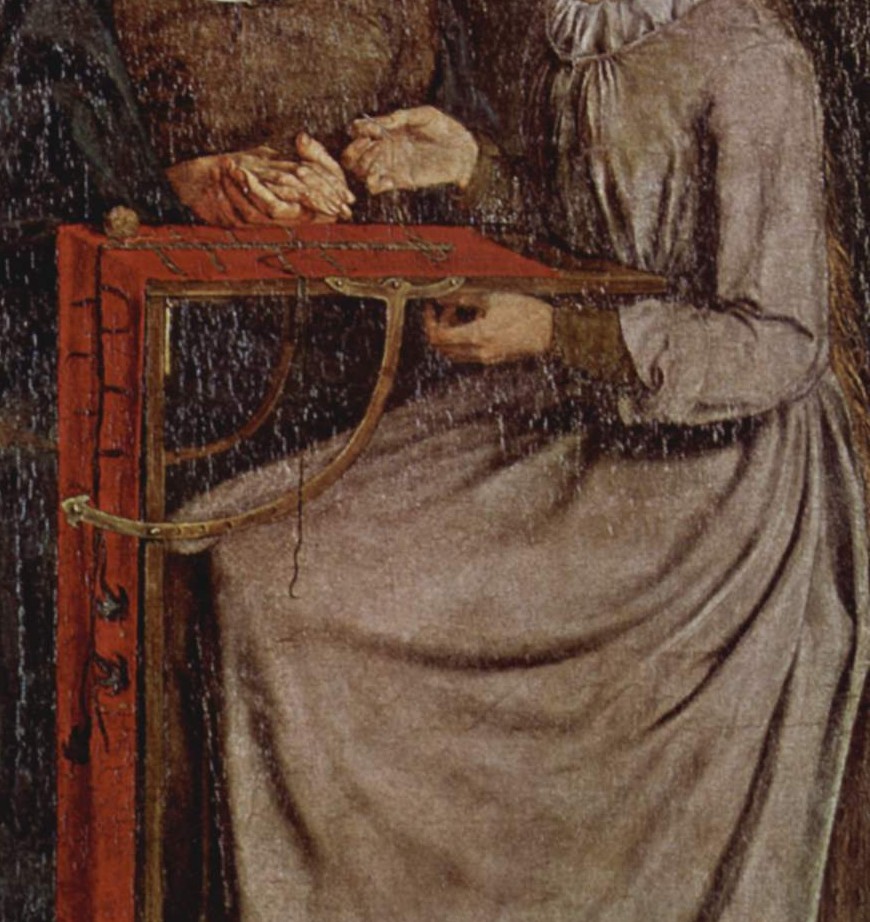
The young Mary bends over a red cloth suspended on an embroidery frame. Her mother sits immediately behind her. The two figures are close enough to read as a pair, yet their attention has different directions. Anne can watch her daughter’s progress at the frame while Mary can compare that work with the plant at her left. The painter has arranged the room so that the viewer can look back and forth between their faces, Mary’s working hand and the lily. It is the modest distance between the plant and the cloth that makes the act of copying visible. [1] [2] [5]
Rossetti explained his choice in a letter to Charles Lyell on 14 November 1848. He called the subject the education of the Virgin and referred to earlier treatments by Murillo and others in which Anne teaches Mary to read. He thought the conventional reading lesson historically implausible except as a symbolic device. He proposed embroidery as a likelier occupation and described Mary copying a lily under Anne’s direction. This was Rossetti’s argument for the change, which leaves ample room in the scene for other departures from everyday life. His letter even describes two angels holding the model flower. In the finished painting a single angel tends the lily in its pot. [2]
Books remain prominent in the composition. Rossetti moved them out of Mary’s hands and made them the support for the thing she studies. This brings into the picture the early Pre-Raphaelite concern with learning through the scrutiny of nature, as Małgorzata Hołdys observes. It also gives Mary a task whose materials differ markedly from her model. A stem stands upright and flowers in its own time. Needlework requires Mary to turn the plant she sees into marks made a few at a time on a flat ground. Rossetti, studying his models and working with a fine brush, faced a comparable problem of transferring a living subject into another material. [2] [5] [6]
At the back, Mary’s father Joachim tends the vine. The raised arms and the stretch of the foliage make his work easy to pick out beyond the foreground. The three tasks fit together without proceeding at the same speed. A plant has to be established and tended before it blooms, a vine has to be trained as it grows, and an embroidery has to be worked stitch by stitch. Rossetti makes time felt through each activity before either sonnet directs the reader towards a future event. [2] [6]
The Rossetti household and the making of the picture
Rossetti drew on people close to him. His sister Christina, herself already writing poetry, sat for Mary, and their mother Frances sat for Anne. In a November 1848 letter to his brother William Michael, the painter expressed delight with how Anne’s head had turned out. Virginia Surtees’s catalogue identifies a man employed by the family, Williams, as the model for Joachim. There is greater uncertainty about the angel. Surtees gives Thomas Woolner’s half-sister as the reported original model, and William Michael records a head study taken from a girl recommended by James Collinson when Gabriel was revising the picture in 1849. [2] [5] [7] [8]
The family sittings supplied particular faces and gestures. Other parts of the picture were planned separately. In August 1848 Rossetti reported a study for the colour and a nude study for Anne. In November he told Lyell about chalk studies as well as his compositional design. A pencil study catalogued by Christie’s sets out the raised arms and weight of a standing man for Joachim with much of the body exposed. The painted figure, clothed and seen across the trellis, gives a slight gesture of work to a pose that took considerable preparation. The auction catalogue also points to a rough sketch in which Joachim faces the opposite way from the final painting. [2] [7] [9]
Mary’s costume is a good example of what a sitter’s identity can establish. Her pale dress has a rounded neck and plain fabric, and its sleeves are folded back at the wrists. The dress historian Robyne Erica Calvert points out that an early drawing shows a more overtly historical arrangement of garments. Christina’s role as model is documented, but surviving evidence leaves open whether the dress on the canvas came from her wardrobe or was devised by the painter. The more confident claim sometimes made for it, as the first Pre-Raphaelite dress, goes beyond the evidence. [8] [10]
The colours also have a history. The Rossetti Archive records retouching to Mary’s dress and to the angel’s face before delivery to the Dowager Marchioness of Bath. The picture came back to Rossetti in 1864 from Lady Louisa Fielding, its owner by then. That time he changed the wings from white to deep pink and the sleeves from yellow to brown, as well as replacing the frame. The angel’s present wings provide a strong colour accent beside the lily and across from the red cloth. A visitor in 1849 would have seen that part of the composition differently. [2] [10]
Reading the signs from the ground up
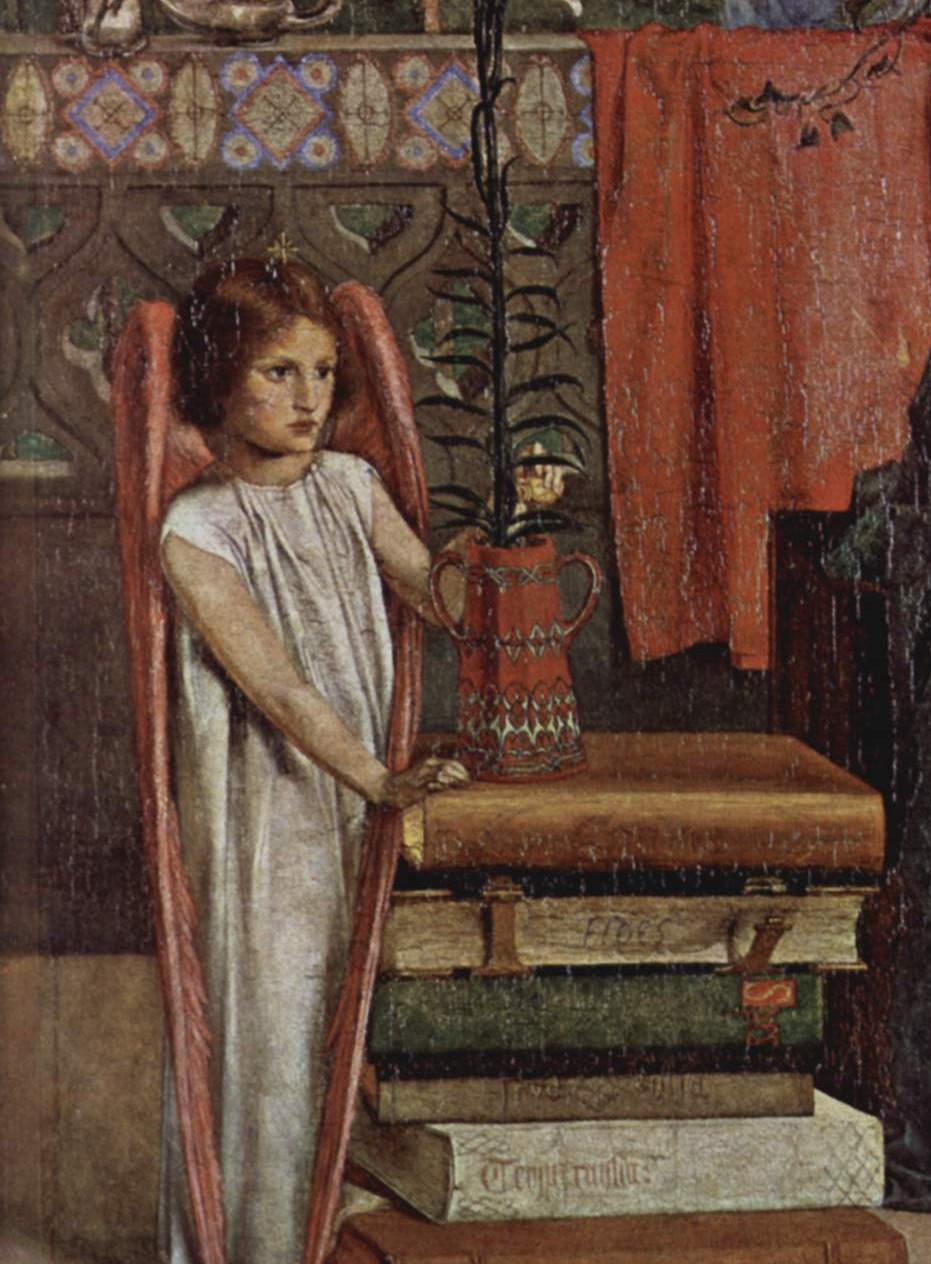
The inscription on the uppermost book gives a place to begin. Rossetti’s second sonnet singles out golden Charity, invoking Saint Paul’s placing of charity above faith and hope. Beneath Charity are Faith and Hope, then Prudence, Temperance and Fortitude. Naming the virtues on the spines gives an ordinary household object something of the function of an inscription in a church. The labels also reward the same patient inspection that Mary gives the lily. Rossetti then gives a reason for placing the lily directly on it. The flower represents innocence, and the books are its foundation. Seen from this angle the still life has a vertical order, with the qualities that sustain Mary’s innocence literally beneath the plant. [2] [5]
The lily changes as it moves from one part of the painting to another. At the left it is alive, with a watering vessel and an attending angel. On the red cloth it becomes a pattern and the work of Mary’s hand. Rossetti calls the design’s three-pointed device a Tripoint. In the second sonnet, its unfinished second point is the sign that Christ is yet to be born. The poem makes an absence legible. Once the reader knows to look for the point, the state of Mary’s work becomes an indication of when the story is taking place. [2]
Lower down, a scroll draws a palm branch and a thorned briar together. Its Latin inscription, “Tot dolores tot gaudia”, sets sorrows and joys in balance. Rossetti’s second sonnet specifies seven thorns and seven leaves, interpreting the two branches in terms of sorrow and reward. The two plants remain bound together at the family’s feet while Mary and Anne attend to the needlework. Their place near the floor gives the observer a view of what lies ahead of Mary, without requiring the girl within the scene to be visibly thinking about it. [2] [5]
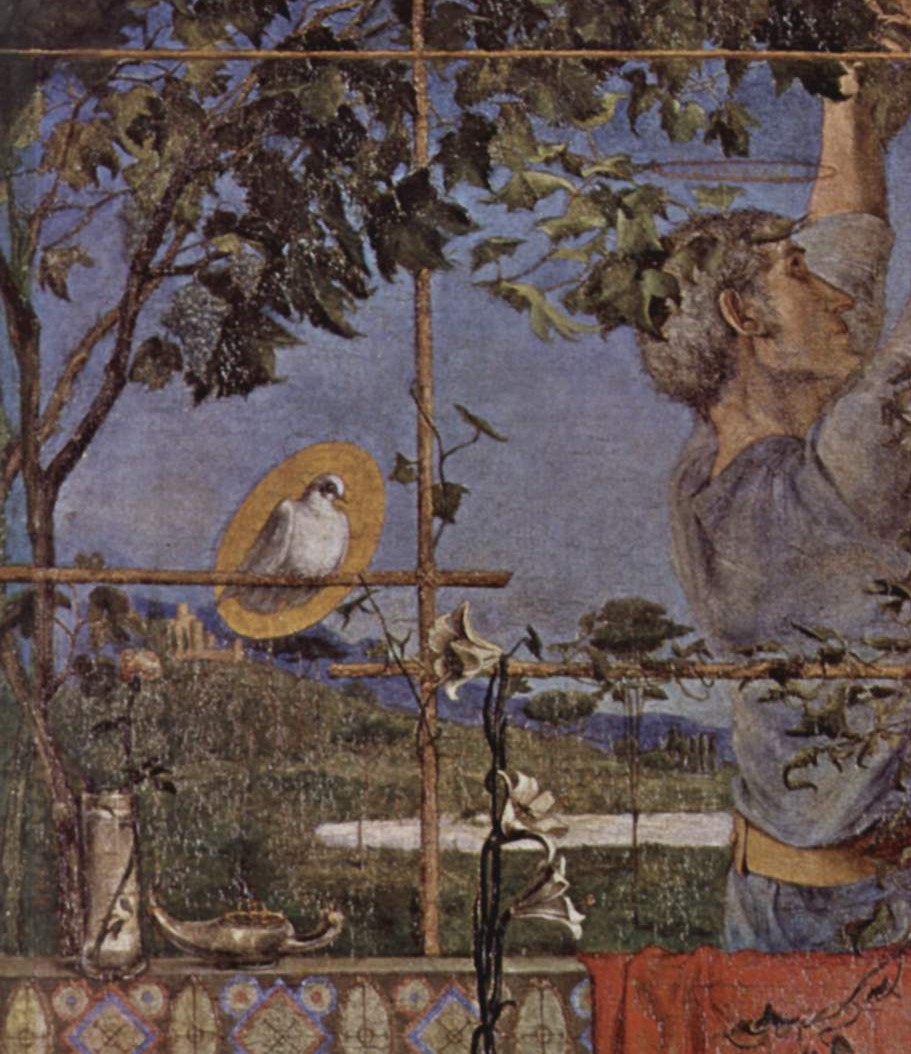
The haloed dove is set farther back on the cross-shaped trellis. It represents the Holy Spirit, and the second sonnet describes the Holy One as waiting outside until the proper time. The intersecting bars belong to Joachim’s work as a gardener. The cross they form anticipates Christ’s death, and the vine can call to mind Christ’s description of himself as the true vine in John’s Gospel. Other marks invite a closer look. Surtees sees the ivy at the cross as a sign of enduring memory. The small organ behind Mary bears the initial M and a devotional inscription, while the names of the figures are written into their haloes. The canvas leaves such details for the eye to discover after reading the verses. [2] [5]
Gold draws the eye to several of those details at once. Laura Anne Kalba traces its selective application to the haloes and to objects as small as the angel’s vessel and Mary’s thread. This use of actual gold allows the hair, the stitch and the holiest signs to catch light in the same room. Kalba also discusses the proposed relationship with early Italian altarpiece panels by Lorenzo Monaco that entered the National Gallery in 1848. In Rossetti’s scene the subsidiary touches of gold are picked out against interior and garden colours, so the precious medium can be followed in a line or a pinprick across ordinary things. [11]
Annotated Details from The Girlhood of Mary Virgin
Dante Gabriel Rossetti, The Girlhood of Mary Virgin, 1848–49, Tate, N04872. Collection record.
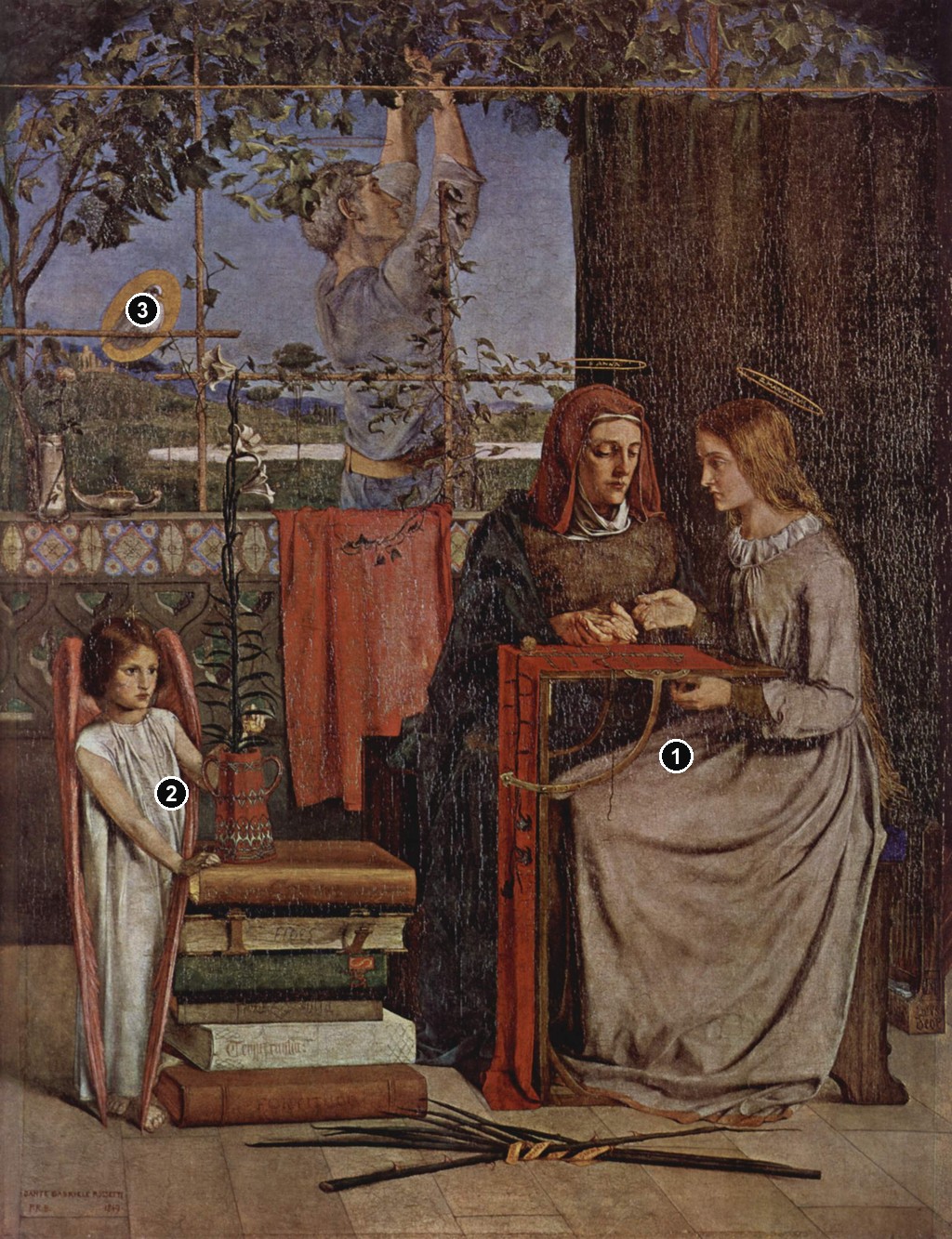
Details from THE GIRLHOOD OF MARY VIRGIN
Select a numbered point to compare each detail with its place in the painting.
The embroidery and Mary’s hands
Mary bends over the embroidery frame. The fabric takes on the pattern of the living plant beside it, one form passing from the angel’s care to Mary’s close observation.
Lily, angel and books
The young angel waters the lily, which rises from a pot set on books. The vertical sequence connects the painted plant with the scene of learning.
The dove on the trellis
The small haloed dove perches on a crossbar in the garden. The branches and leaves make it easy to overlook as a visitor first attends to Mary and Anne.
What the two sonnets do
Rossetti wrote the first sonnet in November 1848 while the canvas was in progress. He sent an early copy to William Michael in a letter that also mentions the painting of Anne’s head. Published in the 1849 exhibition catalogue, the sonnet identifies Mary and places her girlhood in Nazareth. It describes what she has learnt at her mother’s knee and likens her to an “angel-watered lily”. The equation reverses the one enacted at the embroidery frame. In the painting Mary studies the lily, and in the poem the lily gives the reader a way to think about Mary’s growth. [2] [7] [12] [13]
The turn comes in the closing lines, when the poem moves from the years of upbringing to a single morning. In the version printed in Poems in 1881, Mary wakes in her white bed, feels no fear, yet weeps and is awed. The bedroom at dawn gives the painted lesson a future. It also sets Mary’s tears beside her absence of fear and leaves those feelings in tension. Its wording changed in successive versions. The surviving Penkill proofs for the 1870 Poems, for example, show Rossetti revising Mary’s dutiful regard for her family into a more explicit regard for God’s will. The lines recorded on the frame preserve the earlier emphasis on kin. [2] [12] [13] [14]
The second sonnet followed in 1849. Its opening, “These are the symbols”, is addressed to a viewer already looking at things. It leads the reader from the cloth to the books and lily, then to the paired branches and the Holy One beyond the room. The first sonnet crosses the threshold to Mary’s awakening. The second holds the action just before it, using the incomplete stitch and the waiting presence outside to keep the immediate scene in suspense. Read together, they lend the still picture different kinds of time. Hołdys, drawing on Brian Donnelly’s study, distinguishes the first sonnet’s narrative role from the second sonnet’s treatment of the design. The Rossetti Archive also treats the texts and the picture as works that can be read on their own, a relation it calls the double work. [2] [6] [12] [15]
From the exhibition catalogue to the frame
The first sonnet appeared as part of entry 368 on page 18 of the Free Exhibition catalogue. The second has a different early history. According to William Michael’s account cited by the Rossetti Archive, both were printed on a gilded slip attached to the frame, although only the first appeared in the exhibition catalogue. Surtees subsequently located the slip on the back of the picture. The Archive reports that Tate could not confirm its presence there. Its reported attachment in 1849, its later reported location and the inscriptions surviving on the frame are three separate pieces of evidence. [2] [12]
The original frame had curved top corners. In 1864 Rossetti exchanged it for a rectangular design of the type he had developed with Brown and had the sonnets inscribed side by side beneath the canvas. The New Gallery’s catalogue confirms that by 1897–98 there were two poems on the frame. William Sharp printed the second sonnet in his 1882 study of Rossetti, apparently using the frame text, and William Michael included it in the 1886 Collected Works. The two poems that now sit together in editions thus reached general print by different routes. [2] [5] [12] [16]
Rossetti’s correspondence shows that he paid close attention to the look and wording of frames. The National Portrait Gallery’s account of his letters draws a connection between these early paintings and his response to Van Eyck, Memling and Gerard David on his 1849 travels. The visit to Bruges followed the Free Exhibition, so the letters give evidence of a developing interest in earlier painting and its presentation. With Girlhood the frame in effect became a place to read at length, after which the eye could return to the shorter inscriptions already woven into the painted room. [2] [17]
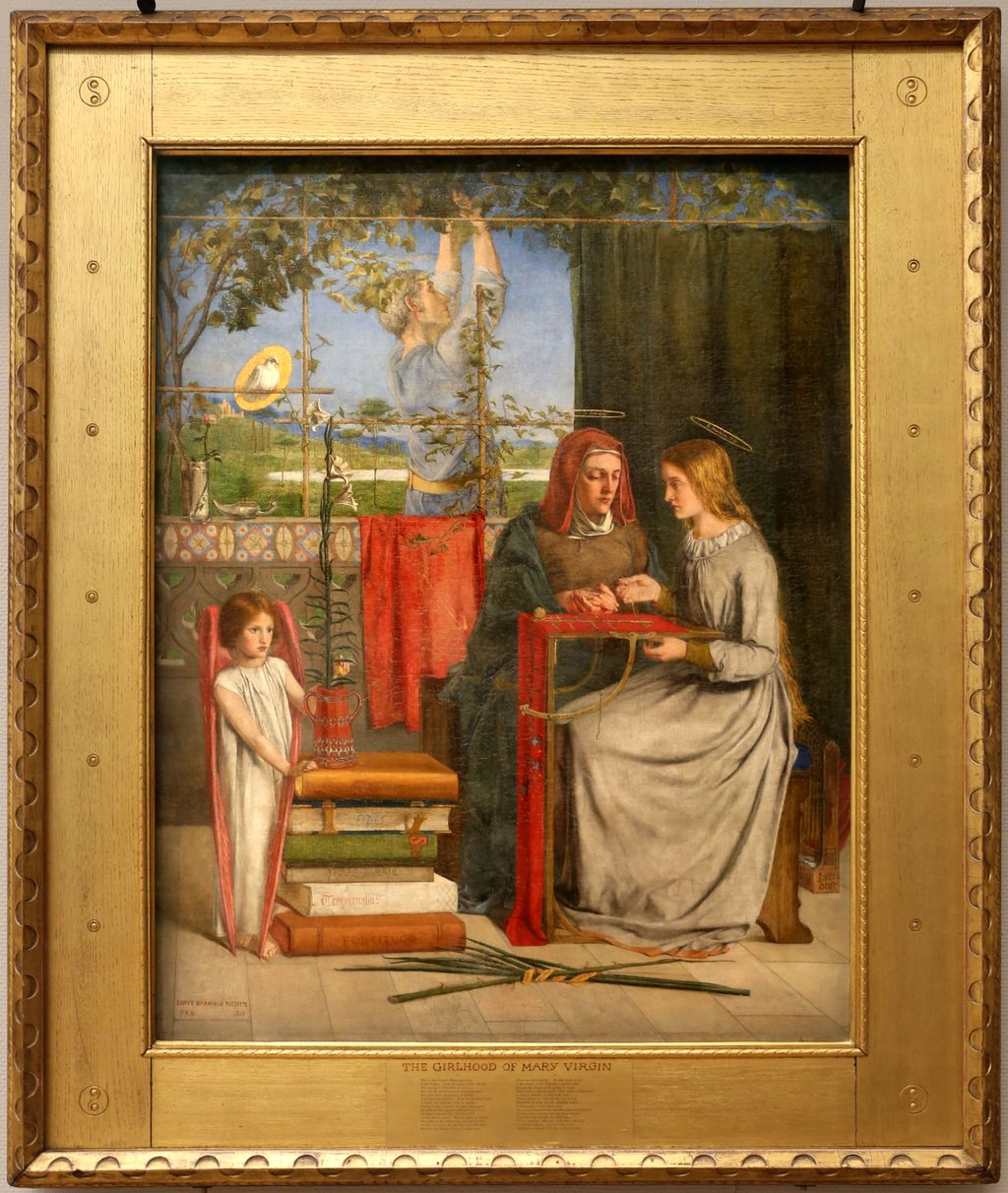
The Girlhood of Mary Virgin with the two sonnets below the painting, Tate, N04872 Photograph by Sailko. Image source. CC BY 3.0. Resized for web.
How the picture was seen
Its first showing was an early success for Rossetti. In the review from The Athenæum reproduced by William Michael, the author saw an inexperienced hand and praised the invention and sensitivity of the design. The critic likened its earnestness to that of early Florentine monastic painters, a telling recognition of the historical register in which Rossetti had chosen to work. [18]
The painter John Orchard responded by writing a pair of sonnets of his own and corresponding with him about the use of earlier styles. There was already an audience prepared to engage with the picture’s experiment in painting and poetry. Late in the century, the Brotherhood member F. G. Stephens described the colour as comparatively grey and the handling as thin, while admiring the care in the drawing and modelling. William Bell Scott, remembering the work in progress, describes Rossetti using small watercolour brushes to spread the oil thinly over a smooth white preparation. The latter is an account of how the surface was made, while Stephens’s comment records how the finished surface struck a sympathetic critic. [2] [3] [12] [19]
The Dowager Marchioness of Bath bought the painting in 1849 and gave it to Lady Louisa Fielding. William Graham acquired it in 1885. It passed to his daughter Agnes, Lady Jekyll, who lent it to the New Gallery exhibition and bequeathed it to Tate in 1937. The signature dates the first exhibited work, the colour records some of Rossetti’s later decisions, and the frame keeps the poems visible beside the picture. Together they preserve a history of how he presented the work to different viewers over time. [1] [2] [5]
The lily after Girlhood
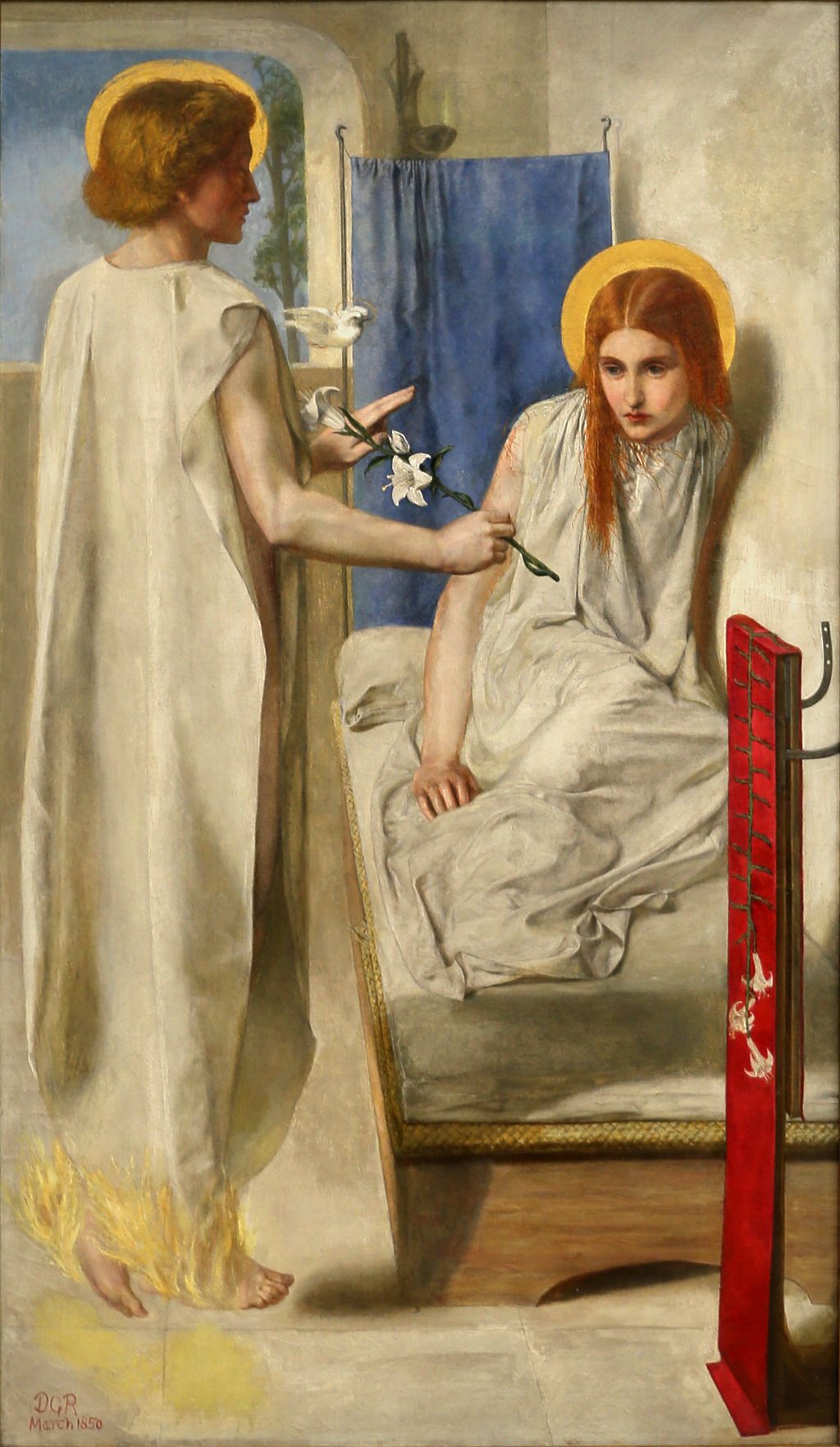
The lily and the red embroidery return in Ecce Ancilla Domini! (The Annunciation), a separate Tate canvas made in 1849–50. The embroidered cloth there hangs close to Mary’s bed, and Gabriel brings a real lily into the room. William Michael drew a connection between that picture and the closing lines of the first Girlhood sonnet. Readers following the two together have a reason to linger over the earlier needlework. They have seen how long Mary’s part in making that textile takes and what its incomplete design once meant. An object a viewer might otherwise pass over in the later painting carries the memory of an activity shared with her mother. [11] [16] [20]
The pleasure of The Girlhood of Mary Virgin lies partly in how much time it gives to that activity. On a first look the scene gathers around two women at work. On a second, the raising of the little pot on its books, the branches lying underfoot and the wooden trellis start to carry a story beyond the room. The poems clarify certain details, yet the pace remains set by the painter’s most ordinary invention. Mary has work still to do. [2] [12]
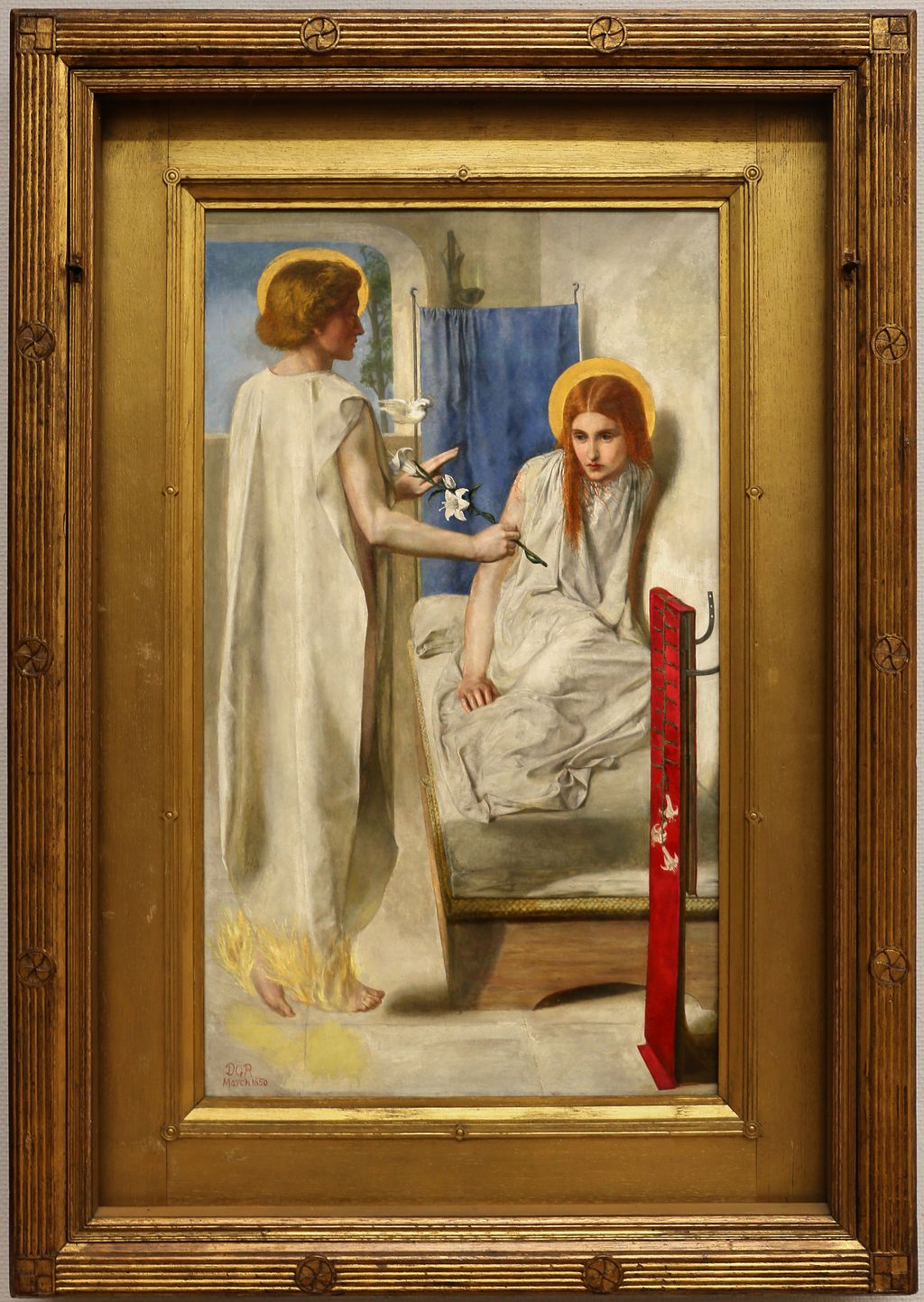
Ecce Ancilla Domini! (The Annunciation), 1849–50, Tate, N01210 Photograph by Sailko. Image source. CC BY 3.0. Resized for web.
Artworks directory
Explore paintings, drawings and prints by title or date. The medium filter uses confirmed media. Other entries link to their numbered catalogue records. Rossetti Archive picture catalogue
| Name | Date | Medium |
|---|---|---|
| Grotesque Sketches of a Man and a Dragon, etc. | 1830-1835? | See catalogue S744. |
| The Rocking-Horse | 1834 | See catalogue S1. |
| The Castle Spectre | 1836 October | See catalogue S2. |
| Designs for Title Pages of Four Novels | 1840 | See catalogue S5. |
| Homeward Bound | 1840 | See catalogue S12. |
| Juvenilia: Bolingbroke | 1840 c. | See catalogue S613. |
| Playing-Cards | 1840-1845 | See catalogue S4. |
| The Arabian Nights Illustrations | 1840 | See catalogue S7. |
| The Heir of Linne | 1840 | See catalogue S6. |
| The Iliad | 1840 February | See catalogue S3. |
| The Nun | 1840? | See catalogue S610. |
| A Fencing Match | 1842? | See catalogue S724. |
| Two Warriors | 1842? (early 1840s) | See catalogue S614. |
| Blanche and the Dauphin | 1843 | See catalogue S9. |
| Death of Marmion | 1843 July | See catalogue S8. |
| Back View of Man and Woman | 1844 | See catalogue S616. |
| Man with a Woman Wearing Trousers | 1844 December | See catalogue S615. |
| A Boy Smoking | 1845 January | See catalogue S618. |
| Juliette | 1845-1846 (circa) | See catalogue S16. |
| Man and Woman in Eighteenth Century Costume | 1845? | See catalogue S683. |
| Man Dancing with a Woman in Trousers | 1845 January | See catalogue S617. |
| Man With a Dagger Bending Over a Woman | 1845 July | See catalogue S15. |
| Pair of Lovers | 1845 (circa) | See catalogue S620. |
| Sketch of a House | 1845? | See catalogue S749. |
| Sketch of Boy Reading | 1845 | See catalogue S619. |
| The Bivouac after the Ball | 1845 | See catalogue S13. |
| The Day After the Ball | 1845 | See catalogue S14. |
| A Girl and a Demon | 1846 (circa) | See catalogue S654. |
| A Man and a Girl | 1846 (circa) | See catalogue S635. |
| A Servant Girl | 1846 (circa) | See catalogue S652. |
| A Woman Arming a Man | 1846 (circa) | See catalogue S630. |
| A Young Girl | 1846? | See catalogue S737. |
| A Young Man | 1846? | See catalogue S730. |
| A Young Woman | 1846? | See catalogue S735. |
| A Young Woman | 1846? | See catalogue S736. |
| Beggar and Woman | 1846 September | See catalogue S627. |
| Caricature of a Man | 1846 July | See catalogue S626. |
| Caricature of a Man in Evening Dress | 1846 (circa) | See catalogue S642. |
| Childe Waters | 1846 (circa) | See catalogue S27. |
| Christina Rossetti | 1846 | See catalogue S420. |
| Crouching Female Figure | 1846 (circa) | See catalogue S648. |
| Faust | 1846 (circa) | See catalogue S18. |
| Faust: Mephistopheles Outside Gretchen's Cell | 1846 April | See catalogue S17. |
| Five Heads (mostly Caricatures) and One Figure | 1846 (circa) | See catalogue S656. |
| Girl Reading at a Table | 1846 (circa) | See catalogue S651. |
| Girl Seated | 1846 (circa) | See catalogue S650. |
| Girl Walking or Flying | 1846 | See catalogue S23. |
| Grotesque Figure | 1846 (circa) | See catalogue S658. |
| Hermia and Helena | 1846 (circa) | See catalogue S26. |
| Man and Woman in Conspiratorial Attitude | 1846 (circa) | See catalogue S634. |
| Man and Woman in Medieval Dress | 1846 (circa) | See catalogue S631. |
| Man and Woman in the Sixteenth Century Costume | 1846 April | See catalogue S621. |
| Man and Woman Seated Under a Tree | 1846 July | See catalogue S625. |
| Man and Woman Seated under a Tree | 1846-1847 (circa) | See catalogue S660. |
| Man and Woman with Arms Entwined, Moving to Left | 1846 (circa) | See catalogue S632. |
| Man in Costume | 1846 (circa) | See catalogue S641. |
| Man with a Riding Crop Conversing with a Woman | 1846 (circa) | See catalogue S629. |
| Man with Peepshow | 1846 (circa) | See catalogue S644. |
| Old Woman Brooding by the Fire | 1846 (circa) | See catalogue S649. |
| Seated Man | 1846 (circa) | See catalogue S640. |
| Sketch of a Girl | 1846 (circa) | See catalogue S653. |
| Sketch of a Woman | 1846 September | See catalogue S628. |
| Sketch of Two Men | 1846 (circa) | See catalogue S638. |
| Sketches of Figures | 1846 (circa) | See catalogue S657. |
| Study of a Man's Head, and Three Nude Studies | 1846 (circa) | See catalogue S645. |
| Study of Man and Woman in Medieval Costume | 1846-1847 (circa) | See catalogue S661. |
| The Children in the Wood | 1846 (circa) | See catalogue S24. |
| The Ladies of Marlboro' Street | 1846 (circa) | See catalogue S21. |
| The Raven: Angel Footfalls | 1846-1848 | See catalogue S19. |
| The Shadowless Man | 1846 (circa) | See catalogue S28. |
| The Sleeper | 1846-1847 (circa) | See catalogue S29. |
| Three Studies of Heads | 1846 (circa) | See catalogue S659. |
| Touchstone and Audrey | 1846 September | See catalogue S20. |
| Two Female Figures | 1846 June | See catalogue S624. |
| Two Female Figures with Cross and Serpent | 1846 (circa) | See catalogue S22. |
| Two Lovers Seated | 1846 (circa) | See catalogue S633. |
| Two Men and a Dog | 1846 (circa) | See catalogue S636. |
| Two Men Fighting | 1846 (circa) | See catalogue S637. |
| Two Women in Eighteenth Century Costume with a Negro Servant | 1846? | See catalogue S684. |
| Unidentified Composition | 1846 May | See catalogue S623. |
| William Michael Rossetti | 1846 | See catalogue S452. |
| Winged Demon | 1846 (circa) | See catalogue S655. |
| Woman in Fancy Dress | 1846 April | See catalogue S622. |
| Woman Standing by a Bed | 1846 (circa) | See catalogue S647. |
| Woman Striding to the Right | 1846 (circa) | See catalogue S646. |
| Young Men Playing Chess | 1846 (circa) | See catalogue S639. |
| Youth Sitting in a Chair | 1846 (circa) | See catalogue S643. |
| ‘The Romaunt of Margret’ | 1846 (circa) | See catalogue S25. |
| Christina Rossetti | 1847 | See catalogue S421. |
| Christina Rossetti | 1847 (circa) | See catalogue S422. |
| Dante Gabriel Rossetti | 1847 March | See catalogue S434. |
| Man and Woman Standing under a Tree | 1847 December | See catalogue S662. |
| Ulalume | 1847-1849 | See catalogue S30. |
| A Young Woman | 1848-1849 (circa) | See catalogue S665. |
| Bottles | 1848 | See catalogue S31. |
| Christina Rossetti | 1848 | See catalogue S423. |
| Christina Rossetti | 1848 | See catalogue S424. |
| Faust | 1848 (circa) | See catalogue S36. |
| Faust: Gretchen and Mephistopheles in the Church | 1848 July | See catalogue S34. |
| Faust: Margaret in Church | 1848 | See catalogue S35. |
| Faust: Margaret in the Church | 1848 | Drawing |
| Gabriele Rossetti | 1848 | See catalogue S442. |
| Gaetano Polidori | 1848 June | See catalogue S412. |
| Genevieve | 1848 August | See catalogue S38. |
| Henrietta Polydore | 1848 October 10 | See catalogue S415. |
| La Belle Dame Sans Merci | 1848 April | See catalogue S32. |
| Sketch of Two Women and a Child | 1848 | See catalogue S663. |
| The First Anniversary of the Death of Beatrice | 1848-1849 | See catalogue S42. |
| The Girlhood of Mary Virgin | 1848–49 | Painting |
| Walter Deverell | 1848-1852 (circa) | See catalogue S315. |
| “The Sun May Shine and We Be Cold” | 1848 May | See catalogue S33. |
| Dorothy and Theophilus | 1849 | See catalogue S43. |
| Ecce Ancilla Domini! | 1849 November - 1853 January | See catalogue S44. |
| Ecce Ancilla Domini! (The Annunciation) | 1849–50 | Painting |
| Major Calder Campbell | 1849 (circa) | See catalogue S279. |
| Portrait of an Unidentified Young Girl | 1849 (circa) | See catalogue S544. |
| Study for ‘Ecce Ancilla Domini! (The Annunciation)’ | c.1849 | Drawing |
| Study of a Man Smoking a Long Pipe | c.1849 | Drawing |
| Study of a Woman | 1849 | See catalogue S667. |
| Taurello’s First Sight of Fortune | 1849 | Drawing |
| The Laboratory | 1849 | See catalogue S41. |
| “Hist!” Said Kate the Queen | 1849 - 1851 | See catalogue S49. |
| A Girl and a Knight | 1850? | See catalogue S726. |
| A Kneeling Man and a Seated Girl | 1850-1852 (circa) | See catalogue S676. |
| A Nun Looking out of a Quatrefoil Window | 1850? | See catalogue S733. |
| A Painter at Work | 1850-1852 (circa) | See catalogue S677. |
| A Parable of Love | 1850 (circa) | See catalogue S668. |
| Benedick and Beatrice | 1850 September | See catalogue S46. |
| Borgia | 1850 - 1863 | See catalogue S48. |
| Christina Rossetti | 1850 (circa) | See catalogue S425. |
| Composition of Six Figures in Medieval Dress | 1850 (circa) | See catalogue S673. |
| Designs for Engraving on the Back and Face of a Watch | 1850? | See catalogue S747. |
| Elizabeth Siddal | 1850 (circa) | See catalogue S457. |
| Elizabeth Siddal | 1850-1865 | See catalogue S458. |
| Elizabeth Siddal | 1850-1860 | See catalogue S481. |
| Old Man Walking between Young Man and Woman | 1850 (circa) | See catalogue S674. |
| Page from a Sketch Book | 1850 (circa) | See catalogue S671. |
| Rossovestita | 1850 | See catalogue S45. |
| Sketches of Heads and Figures | 1850 (circa) | See catalogue S672. |
| Study of a Young Girl | 1850? | See catalogue S664. |
| Thomas Woolner | 1850 | See catalogue S538. |
| Two Figures | 1850? | See catalogue S742. |
| Two Men | 1850 (circa) | See catalogue S670. |
| Two Pugilists and Figure Studies | 1850 (circa) | See catalogue S669. |
| “The Duenna” | 1850-1852 (circa) | See catalogue S675. |
| “To Caper Nimbly in a Lady's Chamber/ To the Lascivious Pleasing of a Lute” | 1850 | See catalogue S47. |
| "How They Met Themselves" | 1851-1864 | See catalogue S118. |
| Beatrice Meeting Dante at a Marriage Feast, Denies Him Her Salutation | 1851-1855 | See catalogue S50. |
| Sir John Everett Millais | 1851-1853 (circa) | See catalogue S592. |
| The Three Fates | 1851 (circa) | See catalogue S589. |
| William Holman Hunt | 1851-1853 (circa) | See catalogue S591. |
| William Holman Hunt (?) | 1851 (circa) | See catalogue S340. |
| A Young Man | 1852 January 28 | See catalogue S678. |
| A Young Man | 1852 (circa) | See catalogue S692. |
| Christina Rossetti | 1852 October | See catalogue S426. |
| Christina Taking Down the Verses of Swynfen Jervis | 1852 August 4 | See catalogue S590. |
| Design for an Unknown Subject | 1852 (circa) | See catalogue S690. |
| Eliza Polidori | 1852 (circa) | See catalogue S409. |
| Elizabeth Siddal | 1852 | See catalogue S459. |
| Elizabeth Siddal | 1852 (circa) | See catalogue S460. |
| Elizabeth Siddal | 1852? (1850-1862) | See catalogue S491. |
| Ford Madox Brown | 1852 November | See catalogue S269. |
| Ford Madox Brown | 1852 | See catalogue S271. |
| Giotto Painting the Portrait of Dante | 1852-1859 | See catalogue S54. |
| Juliet and her Nurse[?] | 1852 (circa) | See catalogue S681. |
| Man Holding a Girl's Hand | 1852 (circa) | See catalogue S680. |
| Man Walking between Two Women | 1852 (circa) | See catalogue S682. |
| Mrs. Gabriele Rossetti | 1852 October | See catalogue S445. |
| Mrs. James Hannay | 1852 December 8 | See catalogue S322. |
| St. Elizabeth of Hungary Kneeling with her Companions | 1852 (circa) | See catalogue S691. |
| Study for ‘Giotto Painting the Portrait of Dante’ | 1852 | Drawing |
| The Annunciation | 1852 (circa) | See catalogue S688. |
| The Maries at the Foot of the Cross | 1852 (circa) | See catalogue S52. |
| The Munros' Maid | 1852 (circa) | See catalogue S687. |
| The Virgin and Child | 1852 | See catalogue S689. |
| The Virgin Mary Being Comforted | 1852 May | See catalogue S51. |
| Thomas Woolner | 1852 July | See catalogue S539. |
| Two Mothers | 1852 | See catalogue S53. |
| Uncle Tom | 1852 (circa) | See catalogue S593. |
| Unidentified Woman in a Bonnet | 1852? (early 1850s) | See catalogue S545. |
| William Bell Scott | 1852 October | See catalogue S456. |
| Woman and Child Walking | 1852 (circa) | See catalogue S686. |
| Woman in Evening Dress | 1852 January | See catalogue S679. |
| Woman in Evening Dress | 1852? | See catalogue S739. |
| Woman with Two Children | 1852 (circa) | See catalogue S685. |
| Young Man in Medieval Costume | 1852? | See catalogue S729. |
| A Young Man | 1853 (circa) | See catalogue S696. |
| Battlements of Wetheral | 1853 | See catalogue S693. |
| Boatmen and Siren | 1853 (circa) | See catalogue S63. |
| Carlisle Wall | 1853 June | See catalogue S60. |
| Carlisle Wall (The Lovers) | 1853 | Drawing |
| Charles Cayley | 1853 (circa) | See catalogue S282. |
| Charlotte Polidori | 1853 September | See catalogue S407. |
| Charlotte Polidori | 1853 July | See catalogue S408. |
| D.G. and W.M. Rossetti | 1853 (circa) | See catalogue S594. |
| D.G. Rossetti and Elizabeth Siddal | 1853-1862 | See catalogue S441. |
| D.G. Rossetti Sitting to Elizabeth Siddal | 1853 September | See catalogue S440. |
| Dante Gabriel Rossetti | 1853 | See catalogue S435. |
| Elizabeth Siddal | 1853 December | See catalogue S461. |
| Elizabeth Siddal | 1853-1858 (circa) | See catalogue S494. |
| Elizabeth Siddal | 1853-1858 (circa) | See catalogue S496. |
| Elizabeth Siddal | 1853? | See catalogue S497. |
| Elizabeth Siddal | 1853-1858 (1850-1862) | See catalogue S505. |
| Elizabeth Siddal | 1853-1858 (circa) | See catalogue S512. |
| Elizabeth Siddal | 1853-1858 (1850-1862) | See catalogue S513. |
| Elizabeth Siddal | 1853-1858 (circa) | See catalogue S515. |
| Found | Designed 1853; unfinished | Painting |
| Fra Angelico Painting | 1853 (circa) | See catalogue S694. |
| Gabriele Rossetti | 1853 April | See catalogue S443. |
| Gabriele Rossetti | 1853 (circa) | See catalogue S444. |
| Gaetano Polidori | 1853 May 4 | See catalogue S413. |
| Giorgione Painting | 1853 (circa) | See catalogue S695. |
| Girl Singing to a Lute | 1853 June | See catalogue S59. |
| Girl Trundling an Infant | 1853 July | See catalogue S61. |
| Hesterna Rosa | 1853 | Drawing |
| Michael Scott's Wooing | 1853 | See catalogue S56. |
| Mrs. Ford Madox Brown | 1853 May | See catalogue S272. |
| Mrs. Gabriele Rossetti | 1853 | See catalogue S446. |
| Ruding Deverell | 1853 December 22 | See catalogue S313. |
| Sir John Everett Millais | 1853 (circa) | See catalogue S352. |
| Sir John Everett Millais | 1853 (circa) | See catalogue S353. |
| The First Anniversary of the Death of Beatrice | 1853 | See catalogue S58. |
| Two Lovers | 1853? | See catalogue S725. |
| W. W. Pearce | 1853-1858 (circa) | See catalogue S406. |
| Walter Deverell | 1853 (circa) | See catalogue S314. |
| William Holman Hunt | 1853 April 12 | See catalogue S341. |
| William Holman Hunt | 1853 | See catalogue S342. |
| William Michael Rossetti | 1853 (circa) | See catalogue S453. |
| Ballad of Fair Annie | 1854-1856 | See catalogue S68. |
| Day and Night Songs | 1854 | See catalogue S65. |
| Elizabeth Siddal | 1854 | See catalogue S462. |
| Elizabeth Siddal | 1854 May | See catalogue S463. |
| Elizabeth Siddal | 1854 May | See catalogue S464. |
| Elizabeth Siddal | 1854 June | See catalogue S465. |
| Elizabeth Siddal | 1854 June | See catalogue S466. |
| Elizabeth Siddal | 1854 | See catalogue S467. |
| Elizabeth Siddal | 1854 | See catalogue S468. |
| Elizabeth Siddal | 1854 | See catalogue S469. |
| Elizabeth Siddal | 1854 September | See catalogue S470. |
| Elizabeth Siddal | 1854 | See catalogue S471. |
| Elizabeth Siddal | 1854? (1850-1862) | See catalogue S486. |
| Elizabeth Siddal | 1854 | See catalogue S489. |
| Elizabeth Siddal | 1854? | See catalogue S503. |
| Hamlet and Ophelia | 1854, 1858 | See catalogue S108. |
| Maids of Elfen-Mere | 1854 | See catalogue S67. |
| Mrs. Gabriele Rossetti | 1854 July | See catalogue S447. |
| Mrs. Gabriele Rossetti | 1854 | See catalogue S448. |
| The Queen's Page | 1854 June | See catalogue S66. |
| Two Children | 1854 (circa) | See catalogue S697. |
| Wykeham Deverell | 1854 February 8 | See catalogue S316. |
| A Woman Walking | 1855? | See catalogue S738. |
| Alfred Chaworth Lyster | 1855 January 28 | See catalogue S348. |
| Angel with Cymbals | 1855 (circa) | See catalogue S699. |
| Arthur’s Tomb | 1855 | Drawing |
| Beatrice | 1855 (circa) | See catalogue S701. |
| Cat's Cradle | 1855 | See catalogue S77. |
| Christina Rossetti | 1855? (1850s) | See catalogue S427. |
| Dante Gabriel Rossetti | 1855 September | See catalogue S436. |
| Dante's Vision of Mathilda Gathering Flowers | 1855 | See catalogue S72. |
| Dante’s Vision of Rachel and Leah | 1855 | Drawing |
| Elizabeth Siddal | 1855 February 6 | See catalogue S472. |
| Elizabeth Siddal | 1855 July | See catalogue S473. |
| Elizabeth Siddal | 1855 November 21 | See catalogue S474. |
| Elizabeth Siddal | 1855? (1850-1862) | See catalogue S483. |
| Elizabeth Siddal | 1855? | See catalogue S495. |
| Elizabeth Siddal | 1855? | See catalogue S507. |
| Head of a Young Child | 1855-1870 (circa) | See catalogue S741. |
| Head of a Young Man | 1855 | See catalogue S706. |
| Henry Polydore | 1855 April | See catalogue S417. |
| John Ruskin | 1855 (circa) | See catalogue S595. |
| La Belle Dame Sans Merci | 1855 | See catalogue S76. |
| Louisa Jane Parke | 1855 (circa) | See catalogue S405. |
| Maids of Elfen-Mere, engraved by the Dalziel Brothers | published 1855 | |
| Paolo and Francesca da Rimini | 1855 | Drawing |
| Robert Browning | 1855 October | See catalogue S275. |
| Ruth and Boaz | 1855 | See catalogue S70. |
| Tennyson Reading Maud | 1855 September | See catalogue S526. |
| The Annunciation | 1855 | See catalogue S69. |
| The Carol | 1855-1856 | See catalogue S79. |
| The Nativity | 1855 June | See catalogue S71. |
| The Seed of David | Commissioned 1855, delivered 1864 | Painting |
| Two Heads | 1855? | See catalogue S727. |
| Two Women on either Side of a Tree | 1855 (circa) | See catalogue S698. |
| Unidentified Portrait | 1855-1860 (circa) | See catalogue S578. |
| Unidentified Portrait: 41 | 1855? | See catalogue S584. |
| Young Woman at a Window) | 1855 (circa) | See catalogue S702. |
| “Era in Pensier D'Amor” | 1855 (circa) | See catalogue S700. |
| A Girl | 1856-1869 | See catalogue S734. |
| A Man and a Woman | 1856 (circa) | See catalogue S703. |
| Dante’s Dream at the Time of the Death of Beatrice (Tate watercolour) | 1856 | Drawing |
| Eliza Polidori | 1856 (circa) | See catalogue S410. |
| Eliza Polidori | 1856? | See catalogue S411. |
| Elizabeth Siddal | 1856 October | See catalogue S475. |
| Elizabeth Siddal | 1856? (1850-1862) | See catalogue S487. |
| Elizabeth Siddal | 1856? | See catalogue S490. |
| Elizabeth Siddal | 1856? | See catalogue S493. |
| Elizabeth Siddal | 1856? | See catalogue S499. |
| Elizabeth Siddal | 1856-1857 (circa) | See catalogue S514. |
| Faust: Faust and Margaret in Prison | 1856 (circa) | See catalogue S82. |
| Fra Pace | 1856 | See catalogue S80. |
| King Arthur and the Weeping Queens | 1856-1857 | See catalogue S84. |
| Mariana in the South | 1856-1857 | See catalogue S86. |
| Mrs. Ford Madox Brown | 1856 September | See catalogue S273. |
| St. Cecilia | 1856-1857 | See catalogue S83. |
| The Lady of Shalott | 1856-1857 | See catalogue S85. |
| The Passover in the Holy Family | 1856 | Drawing |
| The Seed of David (small version) | about 1856 | Drawing |
| The Sisters | 1856 (circa) | See catalogue S704. |
| Unidentified Profile of a Young Girl | 1856 (circa) | See catalogue S546. |
| ‘Red Lion Mary’ | 1856-1859 (circa) | See catalogue S418. |
| A Christmas Carol | 1857 December; 1857-1858 | See catalogue S98. |
| Caricature of William Morris Presenting a Ring to his Future Wife | 1857 September | See catalogue S597. |
| Figure Studies | 1857 October | See catalogue S705. |
| Figure Studies | 1857? | See catalogue S743. |
| Mary Magdalene leaving the house feasting | 1857 | Drawing |
| Mary Magdalene Leaving the House of Feasting | 1857 | See catalogue S88. |
| Mary Nazarene | 1857 | Drawing |
| Mrs. John Hungerford Pollen | 1857 | See catalogue S414. |
| Mrs. William Morris | 1857 October | See catalogue S363. |
| Sir Galahad and an Angel | 1857 | See catalogue S96. |
| Sir Galahad, Sir Bors and Sir Percival Receiving the Sanc Grael | 1857 | See catalogue S94. |
| Sir Launcelot in the Queen's Chamber | 1857 | See catalogue S95. |
| Sir Launcelot's Vision of the Sanc Grael | 1857 | See catalogue S93. |
| St Catherine | 1857 | Painting |
| St. John Comforting the Virgin at the Foot of the Cross | 1857-1858 | See catalogue S104. |
| The Blue Closet | 1857 | Drawing |
| The Chapel before the Lists | 1857–64 | Drawing |
| The Damsel of Sanct Grael | 1857 | Drawing |
| The Damsel of the Sanct Grael | 1857 | See catalogue S91. |
| The Death of Breuze Sans Pitié | 1857; 1865 (reworked) | See catalogue S101. |
| The Gate of Memory | 1857 | See catalogue S100. |
| The Palace of Art, engraved by the Dalziel Brothers | published 1857 | |
| The Skeleton in Armour | 1857-1858 | See catalogue S103. |
| The Tune of Seven Towers | 1857 | See catalogue S92. |
| The Tune of the Seven Towers | 1857 | Drawing |
| The Wedding of St George and Princess Sabra | 1857 | Drawing |
| The Wedding of St. George and the Princess Sabra | 1857 | See catalogue S97. |
| Before the Battle | 1858 | See catalogue S106. |
| David | 1858–64 | Drawing |
| Elizabeth Siddal | 1858? (1850-1862) | See catalogue S482. |
| Elizabeth Siddal | 1858? | See catalogue S500. |
| For the Benefit of Miss Herbert | 1858 July 12 | See catalogue S599. |
| Golden Water | 1858 | See catalogue S107. |
| King David | 1858–64 | Drawing |
| Lady Dalrymple | 1858-1862 (circa) | See catalogue S312. |
| Louisa Ruth Herbert | 1858 | See catalogue S325. |
| Mrs. William Morris | 1858 October | See catalogue S364. |
| Ruth Herbert | 1858 September 20 | See catalogue S326. |
| Ruth Herbert | 1858 December | See catalogue S327. |
| Ruth Herbert | 1858 | See catalogue S328. |
| Ruth Herbert | 1858-1859 (circa) | See catalogue S329. |
| Ruth Herbert | 1858-1859 (circa) | See catalogue S330. |
| Ruth Herbert | 1858-1859 (circa) | See catalogue S331. |
| Ruth Herbert | 1858-1859 | See catalogue S332. |
| Ruth Herbert | 1858-1859 | See catalogue S333. |
| Ruth Herbert | 1858-1859 | See catalogue S335. |
| Ruth Herbert | 1858-1859 | See catalogue S336. |
| Stunner No.1 | 1858 (circa) | See catalogue S598. |
| The Adoration | 1858–64 | Drawing |
| Unidentified Woman Wearing a Bonnet | 1858 (circa) | See catalogue S548. |
| Woman Kneeling | 1858? | See catalogue S732. |
| Writing on the Sand | 1858-1859 | See catalogue S111. |
| Bocca Baciata | 1859 | Painting |
| Dinner Time | 1859 April | See catalogue S600. |
| Elizabeth Siddal | 1859? (1850-1862) | See catalogue S485. |
| Fanny Cornforth | 1859 | Drawing |
| Mary in the House of St John | 1859 | Drawing |
| My Lady Greensleeves | 1859 | See catalogue S113. |
| Ruth Herbert | 1859 October | See catalogue S334. |
| Sir Galahad at the Ruined Chapel | 1859 (1857) | See catalogue S115. |
| The Bower Garden | 1859 | See catalogue S112. |
| The Salutation of Beatrice (Ottawa panels) | 1859 | Painting |
| Unidentified Woman in Profile Wearing a Bonnet | 1859-1860 (circa) | See catalogue S549. |
| A Girl | 1860-1865 (circa) | See catalogue S710. |
| A Girl | 1860-1865 (circa) | See catalogue S711. |
| A Pelican | 1860 (circa) | See catalogue S707. |
| Algernon Charles Swinburne | 1860 August | See catalogue S522. |
| Annie Miller | 1860 | See catalogue S354. |
| Annie Miller | 1860 January | See catalogue S355. |
| Annie Miller | 1860 (circa) | See catalogue S356. |
| Annie Miller | 1860 (circa) | See catalogue S357. |
| Annie Miller | 1860 (circa) | See catalogue S358. |
| Annie Miller | 1860-1863 (circa) | See catalogue S359. |
| Annie Miller | 1860 (circa) | See catalogue S708. |
| Annie Miller | 1860 (circa) | See catalogue S709. |
| Arthur’s Tomb (Tate watercolour) | 1860 | Drawing |
| Dante Gabriel Rossetti | 1860 (circa) | See catalogue S437. |
| Dantis Amor | 1860 | Painting |
| Design for a Sofa | 1860 | See catalogue S122a. |
| Design for Decorations on a Sofa | 1860 (circa) | See catalogue S746. |
| Dr Johnson at the Mitre | 1860 | Drawing |
| Elizabeth Siddal | 1860 | See catalogue S476. |
| Elizabeth Siddal | 1860 | See catalogue S477. |
| Elizabeth Siddal | 1860? | See catalogue S501. |
| Elizabeth Siddal | 1860? (circa 1850-1862) | See catalogue S502. |
| Giuseppe Maenza | 1860 | See catalogue S349. |
| Joseph Accused Before Potiphar | 1860 | See catalogue S122. |
| King René's Honeymoon | 1860-1864 | See catalogue S175. |
| Lady Burne-Jones | 1860 (circa) | See catalogue S276. |
| Lucrezia Borgia | 1860–1 | Drawing |
| Mrs. Ford Madox Brown | 1860 November | See catalogue S274. |
| Mrs. William Morris | 1860 December | See catalogue S365. |
| Regina Cordium | 1860 | See catalogue S120. |
| The Farmer's Daughter | 1860 | See catalogue S158. |
| Unidentified Portrait | 1860 November | See catalogue S550. |
| Unidentified Portrait | 1860 | See catalogue S551. |
| Unidentified Portrait | 1860? (circa) | See catalogue S577. |
| Algernon Charles Swinburne | 1861 | See catalogue S523. |
| Burd Alane | 1861 | See catalogue S144. |
| Dante Gabriel Rossetti | 1861 October | See catalogue S438. |
| Elizabeth Siddal | 1861 June | See catalogue S478. |
| Elizabeth Siddal | 1861 (circa) | See catalogue S479. |
| Elizabeth Siddal | 1861 | See catalogue S480. |
| Elizabeth Siddal | 1861? (1850-1862) | See catalogue S484. |
| Elizabeth Siddal | 1861? (1850-1862) | See catalogue S488. |
| Elizabeth Siddal | 1861? (1850-1862) | See catalogue S492. |
| Elizabeth Siddal | 1861? (1850-1862) | See catalogue S498. |
| Elizabeth Siddal | 1861? (circa 1850-1862) | See catalogue S504. |
| Elizabeth Siddal | 1861? (1850-1862) | See catalogue S506. |
| Elizabeth Siddal | 1861? (1850-1862) | See catalogue S508. |
| Elizabeth Siddal | 1861? (1850-1862) | See catalogue S509. |
| Elizabeth Siddal | 1861? (1850-1862) | See catalogue S510. |
| Elizabeth Siddal | 1861? (1850-1862) | See catalogue S511. |
| Fair Rosamund | 1861 | See catalogue S128. |
| Goblin Market (various designs) | 1861 | See catalogue S143. |
| John Ruskin | 1861 | See catalogue S455. |
| Lachesis | 1861 | See catalogue S130. |
| Mrs. Aldam Heaton | 1861 October | See catalogue S323. |
| Mrs. Burrell's Child | 1861? | See catalogue S277. |
| Regina Cordium | 1861 | See catalogue S129. |
| St. George and the Princess Sabra | 1861-1862 | See catalogue S151. |
| The Annunciation | 1861 | See catalogue S131. |
| The Last Judgment | 1861 (circa) | See catalogue S141. |
| The Parable of the Vineyard: Judgment and Condemnation by the Lord of the Vineyard. | 1861 | See catalogue S139. |
| The Parable of the Vineyard: The Arrival of the Lord's Son | 1861 | See catalogue S136. |
| The Parable of the Vineyard: The Feast of the Vintage | 1861 | See catalogue S137. |
| The Parable of the Vineyard: The Letting of the Vineyard to the Husbandmen | 1861 | See catalogue S134. |
| The Parable of the Vineyard: The Planting of the Vine | 1861 | See catalogue S133. |
| The Parable of the Vineyard: The Sending of a Servant to Receive the Fruit, and the Stoning and Killing of the Servant | 1861 | See catalogue S135. |
| The Parable of the Vineyard: The Slaying of the Lord's Son | 1861 | See catalogue S138. |
| The Rose Garden | 1861 October | See catalogue S125. |
| The Sermon on the Mount | 1861 (circa) | See catalogue S142. |
| The Story of St. George and the Dragon: St. George and the Dragon | 1861-1862 | See catalogue S148. |
| The Story of St. George and the Dragon: The Princess Sabra Drawing the Lot | 1861-1862 (pen and ink design), 1868 (painted over in watercolour) | See catalogue S146. |
| The Story of St. George and the Dragon: The Princess Sabra Taken to the Dragon | 1861-1862 | See catalogue S147. |
| The Story of St. George and the Dragon: The Return of the Princess | 1861-1862 | See catalogue S149. |
| The Story of St. George and the Dragon: The Skulls Brought to the King | 1861-1862 | See catalogue S145. |
| The Story of St. George and the Dragon: The Wedding of St. George | 1861-1862 | See catalogue S150. |
| Winifred or Monica Heaton | 1861 | See catalogue S324. |
| Aggie | 1862 | See catalogue S262. |
| Aggie | 1862 | See catalogue S263. |
| Aggie | 1862 | See catalogue S264. |
| Alice Boyd | 1862 December 20 | See catalogue S268. |
| Christ in Glory | 1862 (circa) | See catalogue S155. |
| Girl at a Lattice | 1862 | See catalogue S152. |
| Joshua | 1862 (circa) | See catalogue S157. |
| Monna Rosa | 1862 | See catalogue S153. |
| Mrs. Beyer | 1862 (circa) | See catalogue S266. |
| Mrs. Beyer | 1862 (circa) | See catalogue S267. |
| Mrs. Gabriele Rossetti | 1862 February | See catalogue S449. |
| Mrs. James Leathart | 1862 December | See catalogue S343. |
| Mrs. James Leathart | 1862 December | See catalogue S344. |
| Mrs. James Leathart | 1862 | See catalogue S345. |
| St George and Princess Sabra | 1862 | Drawing |
| St. Jude | 1862 (circa) | See catalogue S156. |
| Sweet Tooth | 1862 | See catalogue S123. |
| The Crucifixion | 1862 | See catalogue S140. |
| The Heart of the Night (Mariana in the Moated Grange) | 1862 | Drawing |
| Threshing | 1862 (circa) | See catalogue S154. |
| Unidentified Portrait | 1862? (early 1860s) | See catalogue S552. |
| Unidentified Portrait | 1862? (early 1860s) | See catalogue S553. |
| A Young Woman | 1863 (circa) | See catalogue S713. |
| Ada Vernon | 1863 | See catalogue S527. |
| Ada Vernon | 1863-1865 (circa) | See catalogue S528. |
| Aurelia (Fazio’s Mistress) | 1863–73 | Painting |
| Belcolore | 1863 | See catalogue S160. |
| Bethlehem Gate | 1863 | Drawing |
| Brimfull | 1863 | See catalogue S167. |
| Ellen Smith | 1863 | See catalogue S516. |
| Fazio's Mistress | 1863; 1873 | See catalogue S164. |
| Helen of Troy | 1863 | Painting |
| Henrietta Polydore | 1863 | See catalogue S416. |
| La Castagnetta | 1863 (circa) | See catalogue S166. |
| My Lady Greensleeves | 1863 May | See catalogue S161. |
| Woman Holding a Dog | 1863 (circa) | See catalogue S712. |
| Woman in Yellow | 1863 | Drawing |
| Aspasia Teaching Socrates to Dance | 1864 (circa) | See catalogue S176. |
| Beata Beatrix | about 1864–70 | Painting |
| How Sir Galahad, Sir Bors and Sir Percival Were Fed with the Sanct Grael; but Sir Percival’s Sister Died by the Way | 1864 | Drawing |
| Joan of Arc | 1864 | Drawing |
| Monna Pomona | 1864 | Drawing |
| Morning Music | 1864 | See catalogue S170. |
| Roman de la Rose | 1864 | Drawing |
| The First Madness of Ophelia | 1864 April | See catalogue S169. |
| The Laurel | 1864 | See catalogue S172. |
| Venus Verticordia | 1864–68 | Painting |
| Woman Combing her Hair | 1864 | See catalogue S174. |
| A Fight for a Woman | 1865 | See catalogue S180. |
| A Girl in Sixteenth Century Costume | 1865? | See catalogue S731. |
| Charles Augustus Howell | 1865 | See catalogue S337. |
| Christina Rossetti | 1865 May | See catalogue S428. |
| Christina Rossetti in a Tantrum | 1865 | See catalogue S601. |
| Circe | 1865 (circa) | See catalogue S187. |
| Diana | 1865 (circa) | See catalogue S188. |
| Head of Little Girl in a Bonnet | 1865 (circa) | See catalogue S547. |
| Il Ramoscello | 1865 | See catalogue S181. |
| Miss Burton | 1865 | See catalogue S278. |
| Mrs Vernon Lushington | 1865 | Painting |
| Mrs. Charles Augustus Howell | 1865 July 31 | See catalogue S338. |
| Mrs. William Morris | 1865 | See catalogue S366. |
| Mrs. William Morris | 1865 | See catalogue S367. |
| Mrs. William Morris | 1865 | See catalogue S368. |
| Mrs. William Morris | 1865 (circa) | See catalogue S369. |
| Mrs. William Morris | 1865 (circa) | See catalogue S370. |
| Mrs. William Morris | 1865-1870 (circa) | See catalogue S371. |
| Prince's Progress (frontispiece design) | 1865 December | See catalogue S185. |
| Prince's Progress (title page design) | 1865 December | See catalogue S186. |
| Risen at Dawn | 1865-1880 (circa) | See catalogue S253. |
| Study for ‘The Bride’ | 1865 | Drawing |
| Study of a Female Head | 1865 | See catalogue S714. |
| The Beloved | 1865-1866 | See catalogue S182. |
| The Beloved (‘The Bride’) | 1865–66 | Painting |
| The Blue Bower | 1865 | Painting |
| The Merciless Lady | 1865 | See catalogue S177. |
| Three Sang of Love Together | 1865 (circa) | See catalogue S184. |
| Unidentified Portrait | 1865 | See catalogue S554. |
| Unidentified Portrait | 1865 (circa) | See catalogue S555. |
| Unidentified Portrait | 1865? (mid-1860s) | See catalogue S556. |
| Unidentified Portrait | 1865? | See catalogue S581. |
| Washing Hands | 1865 August | See catalogue S179. |
| Alexa Wilding | 1866 | See catalogue S530. |
| Alexa Wilding | 1866 | See catalogue S531. |
| Alexa Wilding | 1866 | See catalogue S532. |
| Christina Rossetti | 1866 September | See catalogue S429. |
| Christina Rossetti | 1866 (circa) | See catalogue S430. |
| Fiammetta | 1866 | See catalogue S192. |
| Hamlet and Ophelia | 1866 | See catalogue S189. |
| Heartsease | 1866 | See catalogue S194. |
| Lady Lilith | 1866–68, altered 1872–73 | Painting |
| Miss Robertson | 1866 (circa) | See catalogue S419. |
| Miss Robertson (Mrs Fernandez) | c.1866 | Drawing |
| Monna Vanna | 1866 | Painting |
| Mrs. Gabriele Rossetti | 1866 | See catalogue S450. |
| Regina Cordium | 1866 | See catalogue S190. |
| A Christmas Carol | 1867 | See catalogue S195. |
| Alexa Wilding | 1867 (circa) | See catalogue S533. |
| Aurora | 1867 | See catalogue S202. |
| Contemplation | 1867 | See catalogue S204. |
| Ellen Smith | 1867 | See catalogue S517. |
| Ford Madox Brown | 1867 January 31 | See catalogue S270. |
| Henry Treffry Dunn | 1867? (late 1860s) | See catalogue S317. |
| Joli Coeur | 1867 | See catalogue S196. |
| Lady Lilith (Met watercolour) | 1867 | Drawing |
| Monna Rosa | 1867 | See catalogue S198. |
| Peace | 1867 | See catalogue S197. |
| Rosa Triplex | 1867 | Drawing |
| Sir Tristram and La Belle Yseult Drinking the Love Potion | 1867 | See catalogue S200. |
| Study for Fair Rosamund | 1867? | See catalogue S576. |
| Tessa la Bionda | 1867 | See catalogue S203. |
| The Loving Cup | 1867 | Painting |
| The Rose: A Lady at a Window | 1867 (circa) | See catalogue S199. |
| Unidentified Portrait | 1867 | See catalogue S557. |
| Unidentified Portrait | 1867 | See catalogue S580. |
| A Woman | 1868? (late 1860s) | See catalogue S715. |
| Alexa Wilding | 1868 | See catalogue S534. |
| Aurea Catena | 1868 (circa) | See catalogue S209. |
| La Penserosa | 1868 | See catalogue S208. |
| La Pia de’ Tolomei | 1868–80 | Painting |
| La Pia de’ Tolomei (Fitzwilliam study) | 1868 | Drawing |
| Mrs. Murray Marks | 1868 | See catalogue S350. |
| Mrs. Murray Marks | 1868 | See catalogue S351. |
| Mrs. William Morris | 1868 | See catalogue S372. |
| Mrs. William Morris | 1868 (circa) | See catalogue S373. |
| Reverie | 1868 | See catalogue S206. |
| Study of a Woman Holding up her Necklace | 1868-1872 | See catalogue S716. |
| The Bard and the Petty Tradesmen | 1868 | See catalogue S609. |
| Unidentified Portrait | 1868 | See catalogue S558. |
| Unidentified Portrait | 1868? (late 1860s) | See catalogue S560. |
| Bianca Dorata | 1869 (circa) | See catalogue S717. |
| Calliope Coronio | 1869 February | See catalogue S311. |
| Dante Gabriel Rossetti | 1869? | See catalogue S602. |
| Frances Graham | 1869 | See catalogue S318. |
| La Mandolinata | 1869 | See catalogue S211. |
| Mrs. Charles Augustus Howell | 1869 July 29 | See catalogue S339. |
| Mrs. William J. Stillman | 1869 July-August | See catalogue S519. |
| Mrs. William J. Stillman | 1869 | See catalogue S520. |
| Mrs. William Morris | 1869 July 14 | See catalogue S374. |
| Mrs. William Morris | 1869-1870 (circa) | See catalogue S375. |
| Mrs. Zambaco | 1869 (circa) | See catalogue S540. |
| Penelope | 1869 | See catalogue S210. |
| Resolution; or, The Infant Hercules | 1869 August | See catalogue S604. |
| The German Lesson | 1869 August 4 | See catalogue S603. |
| The M's at Ems | 1869 July | See catalogue S605. |
| Unidentified Portrait | 1869 | See catalogue S559. |
| Willie Graham | 1869 March | See catalogue S319. |
| A Woman Lolling on a Sofa | 1870 (circa) | See catalogue S718. |
| Dante Gabriel Rossetti | 1870 | See catalogue S439. |
| Designs for Engraving on the Back of a Watch | 1870 | See catalogue S748. |
| Girl Eating Cherries | 1870 (circa) | See catalogue S723. |
| Girl Plucking Fruit | 1870 (circa) | See catalogue S720. |
| Girl with a Fan | 1870 (circa) | See catalogue S721. |
| Girl with a Musical Instrument | 1870 (circa) | See catalogue S722. |
| Jane Burden, Mrs William Morris | Started about 1870, later finished by Ford Madox Brown | Painting |
| La Donna Della Fiamma | 1870 | See catalogue S216. |
| Man with Child on his Knee | 1870? | See catalogue S728. |
| Mariana | 1870 April | See catalogue S213. |
| Mrs. Coronio | 1870 | See catalogue S310. |
| Mrs. Virtue Tebbs | 1870 | See catalogue S524. |
| Mrs. William Morris | 1870 April 30 | See catalogue S376. |
| Mrs. William Morris | 1870 May | See catalogue S377. |
| Mrs. William Morris | 1870 July 25 | See catalogue S378. |
| Mrs. William Morris | 1870 July 26 | See catalogue S379. |
| Mrs. William Morris | 1870 July 27 | See catalogue S380. |
| Mrs. William Morris | 1870 August 12 | See catalogue S381. |
| Mrs. William Morris | 1870 August 12 | See catalogue S382. |
| Mrs. William Morris | 1870 November 29 | See catalogue S383. |
| Mrs. William Morris | 1870 | See catalogue S384. |
| Mrs. William Morris | 1870 | See catalogue S385. |
| Mrs. William Morris | 1870 (circa) | See catalogue S386. |
| Mrs. William Morris | 1870 (circa) | See catalogue S387. |
| Mrs. William Morris | 1870 (circa) | See catalogue S388. |
| Mrs. William Morris | 1870 (circa) | See catalogue S389. |
| Mrs. William Morris | 1870 (circa) | See catalogue S390. |
| Mrs. William Morris | 1870 (circa) | See catalogue S391. |
| Mrs. William Morris | 1870-1875? | See catalogue S402. |
| Mrs. Zambaco | 1870 | See catalogue S541. |
| Mrs. Zambaco | 1870 | See catalogue S542. |
| Mrs. Zambaco | 1870 | See catalogue S543. |
| Study for the Head of Love, for ‘Dante’s Dream at the Time of the Death of Beatrice’ | 1870 | Drawing |
| Study for ‘Desdemona’s Death Song’ | 1870 | Drawing |
| The Countess of Carlisle | 1870 | See catalogue S280. |
| The Countess of Carlisle | 1870 June | See catalogue S281. |
| The Loving Cup (reproductive print) | about 1870–1913 | |
| The Prisoner's Daughter | 1870 | See catalogue S218. |
| The Roseleaf | 1870 | See catalogue S215. |
| Unidentified Portrait | 1870 | See catalogue S561. |
| Unidentified Portrait | 1870 | See catalogue S562. |
| Unidentified Portrait | 1870 (circa) | See catalogue S563. |
| Unidentified Portrait | 1870-1879 (circa) | See catalogue S579. |
| Unidentified Portrait | 1870-1880 (exact date unknown) | See catalogue S582. |
| Unidentified Portrait (Head of a Man) | 1870 | See catalogue S585. |
| William J. Stillman | 1870 | See catalogue S518. |
| Woman Seated at an Embroidery Frame | 1870 (circa) | See catalogue S719. |
| Woman with a Fan | 1870 | See catalogue S217. |
| Wood Nymph | 1870-75 | See catalogue S223. |
| Dante’s Dream at the Time of the Death of Beatrice | 1871 | Painting |
| Jenny Morris | 1871 | See catalogue S360. |
| May Morris | 1871 | See catalogue S361. |
| Mrs. William Morris | 1871 February 18 | See catalogue S392. |
| Water Willow | 1871 | See catalogue S226. |
| Alexa Wilding | 1872 | See catalogue S535. |
| Dr. Thomas Gordon Hake | 1872 | See catalogue S321. |
| George Gordon Hake | 1872 | See catalogue S320. |
| La Gitana | 1872 (circa) | See catalogue S231. |
| May Morris | 1872 | See catalogue S362. |
| Mrs. William Morris | 1872 January 6 | See catalogue S393. |
| Paetus and Arria | 1872 | See catalogue S230. |
| Study of Hands | 1872 | See catalogue S586. |
| The Bower Meadow | 1872 | Painting |
| Unidentified Portrait | 1872? (early 1870s) | See catalogue S573. |
| Veronica Veronese | 1872 | Painting |
| Alexa Wilding | 1873 | See catalogue S536. |
| Blanzifiore | 1873 | See catalogue S227. |
| La Ghirlandata | 1873 | Painting |
| Ligeia Siren | 1873 March | See catalogue S234. |
| Marigolds | 1873 | See catalogue S235. |
| Mrs. William Morris | 1873 January | See catalogue S394. |
| Mrs. William Morris | 1873 February | See catalogue S395. |
| Mrs. William Morris | 1873 | See catalogue S396. |
| Mrs. William Morris | 1873 | See catalogue S397. |
| Mrs. William Morris | 1873 (circa) | See catalogue S398. |
| Mrs. William Morris | 1873 (circa) | See catalogue S399. |
| Study of Hands [Unidentified Poertrait: 45] | 1873? | See catalogue S587. |
| Unidentified Portrait | 1873 | See catalogue S564. |
| Unidentified Portrait | 1873 | See catalogue S565. |
| Mrs. William Michael Rossetti | 1874 | See catalogue S454. |
| Portrait of Fanny Cornforth | 1874 | See catalogue S569. |
| Proserpine | 1874 | Painting |
| Roman Widow | 1874 | See catalogue S236. |
| Rupes Topseiana | 1874 | See catalogue S611. |
| Sancta Lilias | 1874 | Painting |
| The Marchioness of Northampton | 1874 November 16 | See catalogue S403. |
| The Roman Widow (Dis Manibus) | 1874 | Painting |
| Theodore Watts-Dunton | 1874 | See catalogue S529. |
| Unidentified Portrait | 1874 March | See catalogue S566. |
| Unidentified Portrait | 1874 | See catalogue S567. |
| Unidentified Portrait | 1874 | See catalogue S568. |
| Unidentified Portrait | 1874 | See catalogue S570. |
| Unidentified Portrait | 1874 | See catalogue S571. |
| Woman's Head and Angel's Wing | 1874? | See catalogue S740. |
| Mrs. Alderson-Smith | 1875 (circa) | See catalogue S265. |
| Mrs. William Morris | 1875 August 28 | See catalogue S400. |
| Mrs. William Morris | 1875 (circa) | See catalogue S401. |
| Orpheus and Eurydice | 1875 | See catalogue S243. |
| Sketch of Angels’ Heads | ?c.1875 | Drawing |
| The Blessed Damozel | 1875–78 | Painting |
| The Blessed Damozel (reduced replica) | 1875–79 | Painting |
| The Death of Lady Macbeth | 1875 (circa) | See catalogue S242. |
| Unidentified Portrait | 1875 October | See catalogue S572. |
| Astarte Syriaca | 1876–77 | Painting |
| Domizia Scaligera | 1876 | See catalogue S246. |
| Lady Mount Temple | 1876 August | See catalogue S525. |
| Mrs. Holme Sumner | 1876 August | See catalogue S521. |
| The Spirit of the Rainbow | 1876 | See catalogue S245. |
| Unidentified Portrait | 1876? | See catalogue S583. |
| A Sea-Spell | 1877 | Painting |
| Christina Rossetti | 1877 | See catalogue S431. |
| Christina Rossetti | 1877 | See catalogue S432. |
| Christina Rossetti and Mrs. Gabriele Rossetti | 1877 September | See catalogue S433. |
| Forced Music | 1877 | See catalogue S247. |
| Mary Magdalene | 1877 | See catalogue S250. |
| Mrs. Gabriele Rossetti | 1877 | See catalogue S451. |
| The Marchioness of Northampton | 1877? (late 1870s) | See catalogue S404. |
| A Vision of Fiammetta | 1878 | Painting |
| Bruna Brunelleschi | 1878 | See catalogue S251. |
| Desdemona's Death-Song | 1878-1881 (circa) | See catalogue S254. |
| From a Statue | 1878 September 20 | See catalogue S612. |
| Unidentified Portrait | 1878? (late 1870s) | See catalogue S574. |
| Beatrice | 1879 | See catalogue S256. |
| Edith Williams | 1879 April 28 | See catalogue S537. |
| Frederick Richards Leyland | 1879 | See catalogue S346. |
| La Donna Della Finestra | 1879 | See catalogue S255. |
| Unidentified Portrait | 1879 | See catalogue S575. |
| Study of an Arm | 1880 (circa) | See catalogue S588. |
| The Day Dream | 1880 | Painting |
| The Salutation of Beatrice | 1880–82 | Painting |
| Proserpine (Birmingham version) | 1882 | Painting |
| Elizabeth Siddall in a Chair | date not known | Drawing |
| Elizabeth Siddall Plaiting her Hair | date not known | Drawing |
| Miss Siddal Hiding a Drawing and Rossetti Finding It | Undated | See catalogue S596. |
Discussion
Look again at the images and ideas explored in The Girlhood of Mary Virgin. These editorial prompts invite your observations.
Reader Insights
What does Mary’s partly stitched lily tell you about when the scene takes place?
How does the first sonnet’s shift from the embroidery lesson to Mary waking at dawn change how you look at the painting?
Join the Conversation
Share a detail, comparison or question about The Girlhood of Mary Virgin below.
References
- Tate, The Girlhood of Mary Virgin, N04872. View source.
- Rossetti Archive, The Girlhood of Mary Virgin, S40. View source.
- National Portrait Gallery, Dante Gabriel Rossetti, biography. View source.
- Delaware Art Museum, Bottles, 1935-24. View source.
- The New Gallery, Exhibition of Pictures Ancient and Modern, 1897–98, catalogue no. 27. View source.
- Małgorzata Hołdys, She “felt no fear at all”? The Virgin Mary and the Feminist Voice in Dante Gabriel Rossetti’s The Girlhood of Mary Virgin and Ecce Ancilla Domini!. View source.
- Dante Gabriel Rossetti, His Family-Letters with a Memoir, vol. II. View source.
- Rossetti Archive, The Girlhood of Mary Virgin, study and model records, S40a. View source.
- Christie’s, A standing male nude with arms raised, with a subsidiary study of a male torso. View source.
- Robyne Erica Calvert, Fashioning the Artist: Artistic Dress in Victorian Britain, 1848–1900, PhD thesis, University of Glasgow, 2012. View source.
- Laura Anne Kalba, Gold is the New [ ]: Rossetti, Ruskin, and the Political Economy of Victorian Avant-Garde Art. View source.
- Rossetti Archive, Mary’s Girlhood (For a Picture), textual and publication history. View source.
- Dante Gabriel Rossetti, Mary’s Girlhood (for a Picture), Poems, 1881. View source.
- Dante Gabriel Rossetti, Poems, Penkill proofs, Princeton copy 1. View source.
- Rossetti Archive, Double Works exhibit. View source.
- William Michael Rossetti, ed., The Collected Works of Dante Gabriel Rossetti, vol. I, 1886. View source.
- Lynn Roberts, Framing references in Dante Gabriel Rossetti’s Correspondence. View source.
- William Michael Rossetti, Dante Gabriel Rossetti: His Family-Letters with a Memoir, vol. I, “First Exhibited Picture”. View source.
- FitzRoy Carrington, ed., Pictures & Poems, 1899. View source.
- Tate, Ecce Ancilla Domini! (The Annunciation), N01210. View source.