by Tom Gurney
Tom Gurney BSc (Hons) is an art history expert with over 20 years experience
Email: tomgurney1@gmail.com / Phone: +44 7429 011000
What is A Distinguished Member of the Humane Society?
A Distinguished Member of the Humane Society is a large oil painting of a black-and-white Newfoundland dog lying on a stone quay. Sir Edwin Henry Landseer exhibited it at the Royal Academy in 1838. The canvas measures 111.8 by 143.5 centimetres and now belongs to Tate, where it has the accession number N01226 and the credit “Bequeathed by Newman Smith 1887”.[1] Those facts identify a specific object. They do not, by themselves, explain the extraordinary life that its title seems to give the dog.
The title sounds documentary. It presents the animal as a distinguished participant in an institution devoted to saving human life. A huge body beside open water, a backward-turning head and paws hanging over the edge can then look like the signs of an experienced rescuer waiting for another emergency. Yet the painting contains no rescue. There is no person in danger, no boat, no collar and no medal. Even the sitter's familiar story has been attached to the wrong dog.
The Newfoundland in the painting was Paul Pry, a dog belonging to the Newman Smith household. He was not Bob, did not live at the Royal Humane Society's Receiving House and was not awarded a medal by the Society. Its archivist has traced that distinction through the organisation's records, while a letter by Landseer himself identifies the model as Paul Pry.[2][3] This is more than a correction to a name. The Bob story supplies years of service, accumulated rescues and official honours that the evidence does not support for the animal on the canvas.
Paul Pry's real connection with the Royal Humane Society was created through art. Landseer gave an individually owned dog a public title. His brother Thomas translated the image into a widely circulating mezzotint. In 1863 the Society itself asked for an impression while mistakenly believing that the subject had been its own dog; Edwin supplied one and allowed copies to be sold for the Society's benefit.[2] Image, title, print and institutional memory had begun to reinforce one another.
That history makes the painting more interesting, not less. Landseer did not merely record a celebrated rescue animal. He made a private dog appear capable of holding civic office. The animal's tremendous physical presence gives the fiction credibility, while the absence of any event leaves viewers to imagine what distinguished service might look like. Paul Pry remains a portrait sitter, but he also becomes a role performed by composition, words and spectators.
At a Glance
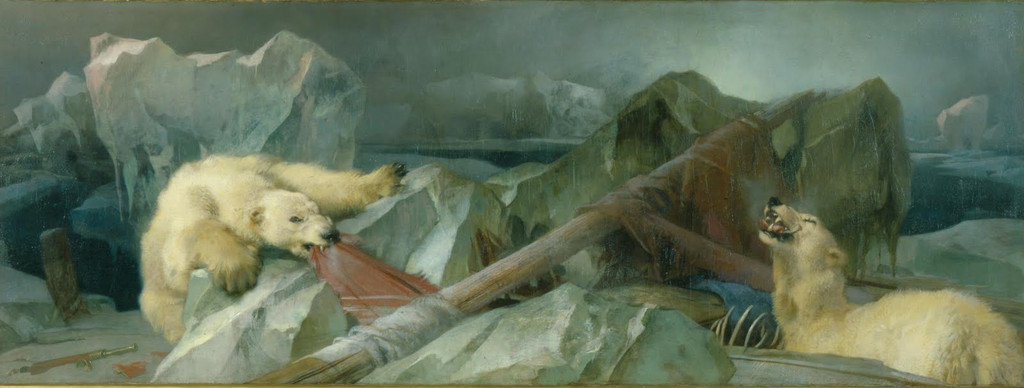
This work across Edwin Landseer’s career
The Cat's Paw
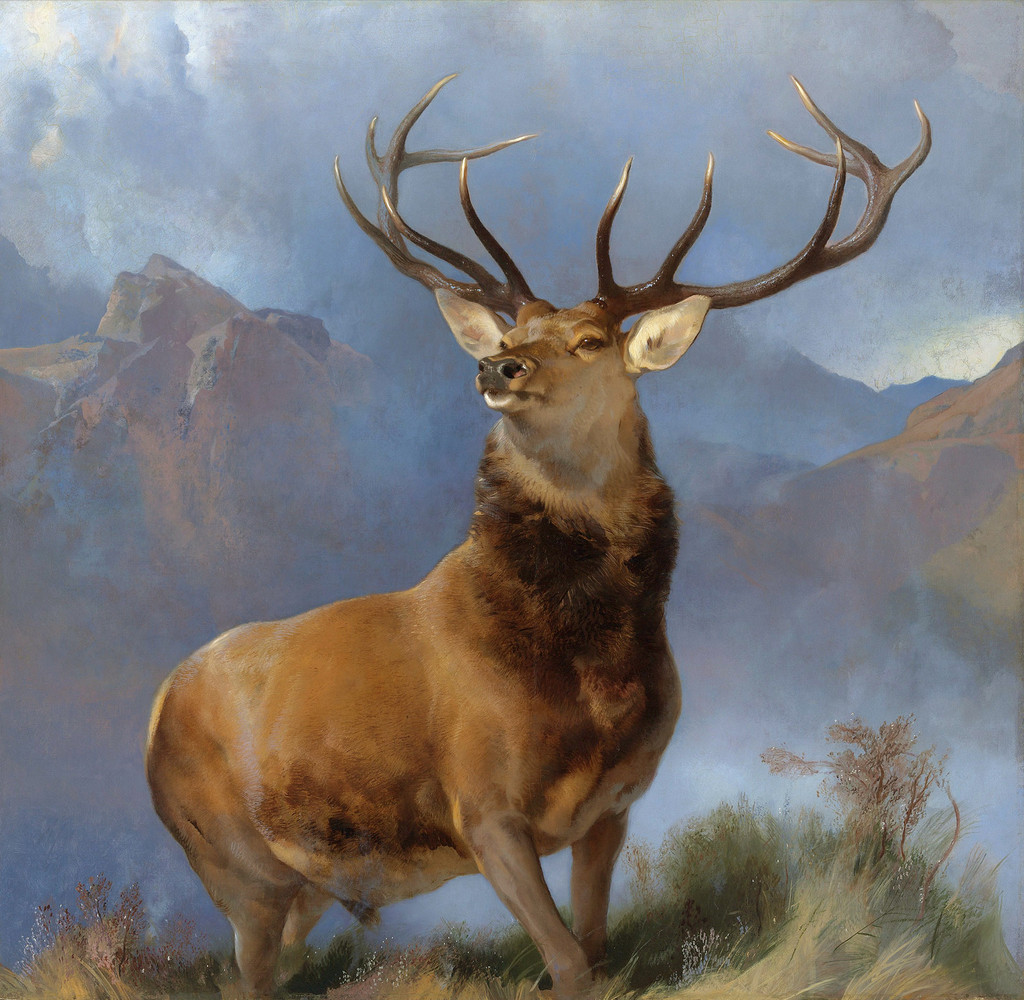
c. 1824 [5]The Hunting of Chevy Chase
1825–26 [6]The Monarch of the Glen
about 1851 [11]Contents
- What is A Distinguished Member of the Humane Society?
- Paul Pry, not Bob
- A Newfoundland stretched across the quay
- The head turns while the body rests
- Paws, water and the mooring ring
- A rescue scene with no rescue
- What the Humane Society title meant
- A portrait discovered with a flower basket
- A title written on the way to the Academy
- Number 462 at the Royal Academy in 1838
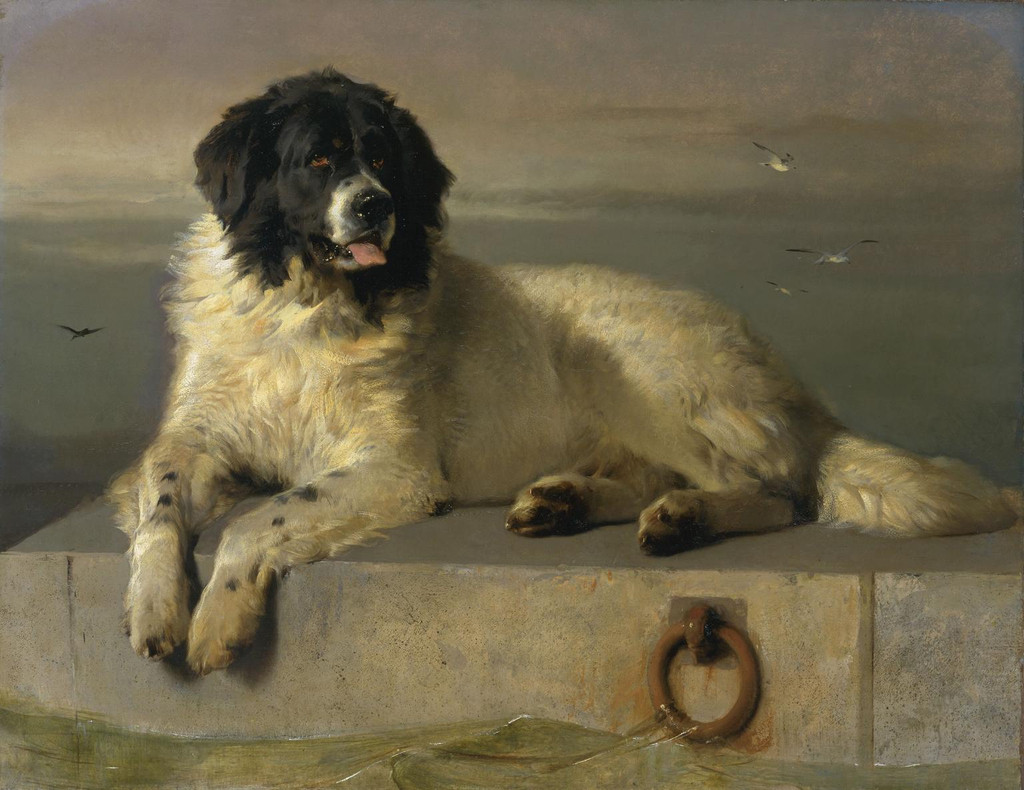
A Distinguished Member of the Humane Society. Tate. Image source. Public domain.
Paul Pry, not Bob
The distinction between Paul Pry and Bob begins in the Royal Humane Society's own archive. A review published in its 2021 annual report examined a file labelled “Landseer” and earlier research by Diana Coke. It concluded that Paul Pry was the dog whom Landseer painted. Newman Smith of Croydon owned him, and the animal had no connection with the Society or its premises.[2] The artist's account, published in The Athenaeum in 1885, independently calls the model Paul Pry.[3]
There was a reason for later confusion. The Royal Humane Society did keep Newfoundland dogs near its Receiving House, and one may have been called Bob. What the surviving evidence does not provide is a secure image of that dog or confirmation of the heroic tally later assigned to him. The archive therefore separates two histories: a possibly named institutional dog whose record is uncertain, and a household dog whose likeness is certain but whose institutional career is fictitious.[2]
The inherited legend removes that separation. It has Paul Pry living at the Society, saving people over many years, receiving food and becoming a member. It also gives him a medal and sometimes describes him as a replacement after Bob disappeared. None of those propositions follows from the archive. Most decisively, the Society states that it never awarded a medal to an animal; its awards were for people who saved, or attempted to save, human life.[2][14]
That last point matters visually. Viewers who know the legend may search the dog for a badge of honour, but no collar or medal is visible. A rust-coloured iron circle set into the quay is a mooring ring. Converting it into an animal's decoration would repeat the same error as the written myth: institutional meaning would displace the literal thing in front of us.
The name Bob has nevertheless proved persuasive because it seems to complete the title. A dog based at a lifesaving station, with a record of rescues, would be a literal “member” of the Society. Paul Pry introduces a more complicated relation. He was recognisable to his owner and appears to have been painted from close observation, but Landseer declined to exhibit the picture simply under the dog's name. A portrait was converted into an honourable office without any claim that its sitter had occupied that office in life.[3]
It is useful to state the correction early because every later question depends on it. If the model were a documented Society dog, the quay might look like a workplace and the pose like an episode in a career. Once Paul Pry is restored, setting and posture have to be examined without that ready-made biography. The title remains, but it becomes an imaginative prompt rather than an archival label.
Nor does the correction require replacing one complete canine biography with another. Paul Pry's exact birth and death dates, formal pedigree and full sitting history have not been established in the checked records. Later family testimony preserves useful details, but uncertainty remains. The sound historical method is asymmetric: the evidence is strong enough to reject Bob as the sitter and weak enough to prevent an embellished life of Paul Pry.
A Newfoundland stretched across the quay
Landseer builds the painting around length. Paul Pry extends almost from one side of the horizontal canvas to the other, his chest and forequarters towards the left and his hindquarters and tail reaching right. Sky and sea occupy comparatively narrow surrounding zones. The result is not a dog placed in a generous landscape but a landscape compelled to accommodate a dog.[1]
The canvas itself is substantial—more than 1.4 metres wide—and Paul Pry fills much of it.[1] His apparent scale is produced not only by measurement but by the scarcity of competing objects. There is no human body to act as a ruler. The gulls are tiny, the horizon remote and the water reduced to a strip beneath the stone. The mooring ring provides the clearest manufactured comparison, and it makes the adjacent paws and torso seem larger still.
The dog's colour pattern divides this immense shape into unequal visual masses. The head is predominantly black, relieved by a white muzzle and blaze. Dark and grey markings gather around the forequarters, while a broad pale, shaggy torso carries the eye across the centre. The rear body returns to darker accents before the tail reaches the right edge. Landseer can therefore make one reclining form alternate between concentration and expansion rather than read as a single flat silhouette.[1]
The white fur is not an empty interval between black patches. Soft grey changes give the shoulder and flank volume, and directional marks suggest the uneven fall of a thick coat. The darkest head has a different visual density. Nose, eyes, mouth and ears are gathered into a comparatively compressed area, so the face becomes expressive against the spacious torso. This concentration of features helps explain why a small turn of the head can govern such a large canvas.
Paul Pry's body also establishes weight. The broad side rests along the stone rather than hovering above it, and the forelegs descend towards the edge. The quay is not a decorative strip behind the animal; it is the horizontal support that makes his mass credible. Its hard plane and iron fitting contrast with pliant fur, while the water below turns the edge into a real drop.
The relationship between figure and setting is consequently double. The sea gives the title its lifesaving possibility, but the dog controls nearly all the pictorial space. At first glance the work can seem to be about maritime danger. At sustained view it is equally about an animal's occupation of a threshold: solid ground ends immediately beneath a body that appears thoroughly at ease.
That ease should not be turned into sleep. Paul Pry's head is raised and turned; the mouth is open and the ears are articulated. Nor should bodily repose become exhaustion after a rescue. Nothing visible tells us what occurred before this moment. Landseer gives the dog enough stillness to look dependable and enough facial animation to invite a story, while withholding the event that could settle it.
The head turns while the body rests
The principal action in the painting is a change of direction within Paul Pry's own body. His torso runs across the quay, but the head turns back towards the centre and the viewer's right. The movement interrupts the long horizontal sweep. Without it, the composition would be dominated by a recumbent pale mass. With it, the concentrated dark head becomes a hinge between bodily rest and apparent attention.[1]
Landseer does not show a simple frontal appeal. The head is in profile or partial turn rather than symmetrically directed at the spectator. A dark nose projects from the pale muzzle; the white blaze rises into the black forehead; the eyes catch limited light. One ear seems to lift or open away from the head while the other participates in the turn. These features can suggest that something has attracted attention, but they do not reveal what that something is.
The partly open mouth is especially easy to overinterpret. A tongue is visible against the dark-and-white head. In a still image, that fact does not distinguish a bark from a pant, ordinary breathing from excitement, or recent exertion from a momentary expression. Landseer supplies animation without audible evidence. The viewer may almost hear the animal only by completing what paint leaves silent.
This distinction separates description from sentiment. “The mouth is open” is visible. “The dog has heard a drowning person” imports the title as an event. “He has just returned from a rescue” adds an unpainted past. “He is about to leap” adds an unpainted future. The picture is powerful because all those temporal extensions remain available, not because one can be verified.
The ears operate in the same way. Their asymmetry contributes to alertness, and later writers made much of their responsiveness. Yet no cry, whistle or instruction appears. Paul Pry's head can therefore seem vigilant while his body remains settled. That internal contrast is the foundation of the “on duty” response recorded in 1838, but it is not proof that the animal had a duty in life.[15]
Paws, water and the mooring ring
Paul Pry's forepaws bring the body to the dangerous edge without sending it into action. They rest at or hang over the quay, crossing the visual boundary between the secure stone top and the narrow water below. Their downward extension gives depth to a composition otherwise organised laterally. It also allows the viewer to imagine how easily a resting posture might become movement.[1]
The paws are not posed like human hands, but they acquire something of a gesture through placement. They project into the lower field and make bodily scale tangible. Their pale fur catches against darker stone and water, while their apparent heaviness confirms that Paul Pry is not floating in a generalized maritime setting. He is supported by a particular ledge whose edge matters.
Near them sits the mooring ring. Its circular form and warm rust colour are conspicuous because the surrounding palette is dominated by black, white, grey, stone and subdued blue. It is a working object designed for fastening boats, even though no boat appears. Like the title, it implies a larger world beyond the depicted instant; unlike the title, its function is material rather than honorific.
The temptation to read that ring as a disguised medal shows how thoroughly the legend can govern looking. Literally, the dog wears no award. At most, a modern viewer might notice an ironic visual echo between a circle of iron fixed to the quay and the honour imagined by the title. Such an echo belongs to interpretation. It cannot convert the ring into evidence that the Royal Humane Society decorated Paul Pry.
The water occupies little space, yet it gives the entire scene its stakes. Without it, the dog might simply be reclining on masonry. With it, hanging paws and turned head can be linked to rescue. Landseer does not need a struggling figure or overturned boat. The strip below the ledge establishes the element in which a Newfoundland's strength could matter, while its emptiness keeps the action hypothetical.
Small gulls widen that emptiness. They place the scene in open coastal or marine space and punctuate the otherwise muted distance. Their presence does not determine weather, tide or location. They are signs of environment, not meteorological instruments. Their scale also intensifies Paul Pry's dominance: the dog occupies the near world; the birds and horizon recede.
A rescue scene with no rescue
Calling the painting a rescue scene sounds natural because the title has already given Paul Pry an institutional role. Look only at represented actions, however, and no rescue occurs. The dog lies down. Water moves or reflects below. Gulls occupy the distance. A ring waits for a rope. Everything required to suggest maritime activity is present except an emergency.[1]
That absence is structurally important. A completed rescue would turn attention towards narrative sequence: who fell in, how the dog reached the person and what happened next. An imminent rescue would demand a visible stimulus. Landseer instead suspends Paul Pry between portrait and possibility. The dog can be admired for what he appears capable of doing rather than for one depicted feat.
The title makes capability resemble office. “Distinguished” implies recognition already earned. “Member” suggests belonging. “Humane Society” supplies a known public institution. Taken together, the words create a past career outside the canvas, even though the image gives no factual account of it. Viewers are invited to infer reputation from bearing.
The inference depends on a finely balanced pose. If Paul Pry were shown plunging into the water, the picture would be an action narrative. If he were completely asleep, the title might become comic contradiction. His long body is at rest, but the head is turned and the face animated. Landseer locates heroism in readiness, then leaves the source and object of that readiness unspecified.
This is why correcting the sitter does not empty the work of rescue meaning. Paul Pry need not have saved anyone for the painting to explore how a lifesaver should look. The fiction operates through bodily credibility. Great size, thick coat, waterside position and apparent alertness make the imagined role feel earned before any story is supplied.
What the Humane Society title meant
The Royal Humane Society was not an animal-welfare association. It began in 1774 with the recovery of people thought to have drowned and received royal status in 1787. Its Hyde Park Receiving House opened in 1835, and the Society introduced a bronze medal in 1837.[14] When Landseer's painting appeared the following year, the title therefore invoked a visible culture of lifesaving, resuscitation and public reward.
The distinction changes the joke and the seriousness of the painting. Paul Pry is not a distinguished animal protected by humane people. He is grammatically one of the lifesavers. The title elevates a dog into a human system of membership and honour while relying on the Newfoundland's established association with water. It can be affectionate, comic and morally admiring at once.
The Society's purpose also explains why later medal stories were so easy to invent. An award belonged naturally to its institutional world, and a dog presented as “distinguished” seemed to require a visible token. Yet the archive is explicit: the Society did not award medals to animals.[2] The bronze-medal date provides historical context, not an exception for Paul Pry.
Nor does the Receiving House locate the painting. The Society kept Newfoundland dogs there, which encouraged the later Bob story, but Paul Pry did not live on the premises.[2] Nothing in the composition identifies Hyde Park. Tate's subject terms point broadly to dock, sea and coast, and the image shows a quay or pier beside open water.[1] A precise Thames embankment or London dock would be an attractive narrative convenience rather than a demonstrated site.
The title therefore works through public knowledge without functioning as a caption. An 1838 viewer could understand the reference to a lifesaving institution while remaining free to imagine the dog's service. That openness may have been part of the painting's immediate appeal. It offered civic virtue in animal form, but did so without the apparatus of history painting—no crisis, no witnesses, no aftermath and no named human beneficiary.
Paul Pry's membership is fictional, yet the fiction eventually affected the institution. By 1863 Lambton Young could write to Landseer under the mistaken impression that the picture represented the Society's own dog. The title had ceased merely to suggest affiliation and had begun to manufacture memory.[2] That transformation is one of the work's most remarkable afterlives.
A portrait discovered with a flower basket
The surviving making story begins far from a rescue. The Royal Humane Society's archival account says that Landseer noticed Paul Pry carrying a flower basket. He approached the owner, Newman Smith of Croydon, obtained permission to paint the dog and received £80 for the picture.[2] Manson's 1902 biography preserves a similar narrative and adds details about the sitting.[16]
The basket does not appear in the finished canvas. It belongs to the encounter that made the dog visible to the artist, not to the public role eventually assigned to him. The distinction is revealing. Carrying a domestic object may have demonstrated trainability, strength or striking appearance, but Landseer discarded that anecdotal prop. He replaced a particular observed action with the open possibility of lifesaving.
Manson says Paul Pry posed on a table in Landseer's St John's Wood Road studio.[16] As a practical arrangement, raising a large dog could have brought the long body and hanging forepaws into a useful relation with the artist's working height. That is a reasonable inference, not a documented technical procedure. The source gives no table dimensions, sitting calendar, preparatory sequence or exact division between direct observation and studio invention.
The same biography reports information that Mrs Newman Smith supplied to Algernon Graves. Philip Bacon was said to have bred Paul Pry and given him to the household as a puppy; the dog then remained with the family throughout life.[16] These details preserve the path of owner memory, but their late publication should remain visible. They are not a contemporary kennel register, and they do not provide exact life dates or a formal pedigree.
What the accounts establish securely is the relation between specificity and transformation. Landseer did not construct an anonymous Newfoundland solely from a breed ideal. He sought access to a particular owned animal, and the owner cared how that animal was named. Paul Pry's likeness mattered. At the same time, the finished work omits the basket, household and owner. The individual dog is placed on a public quay and given a title more memorable than his own.
The reported £80 also belongs to the owner-artist relationship, not to the Royal Humane Society. There is no evidence that the Society commissioned the oil. Treating it as institutional patron would recreate the very affiliation the archive has disproved. Newman Smith's payment and later family possession keep the picture anchored in private portraiture even as exhibition and print carried it into public culture.
A title written on the way to the Academy
Landseer's clearest explanation appeared through a letter to Lambton Young, published in The Athenaeum on 7 February 1885. The artist identified the dog as Paul Pry and recalled writing A Distinguished Member of the Humane Society hurriedly on the back of the canvas as it went to the Royal Academy.[3] The famous words were not, in this account, a formal institutional designation or the culmination of a documented rescue biography.
The same letter says that Newman Smith was disappointed. The owner apparently expected the animal to be presented by his own name and instead saw him exhibited “in character”.[3] That short phrase captures the picture's double identity. Paul Pry remains the recognisable sitter, but the public meets a role: an eminent guardian of the water's edge.
A hurried title need not be a trivial title. Its speed may help explain its imaginative openness. Rather than describe a rescue that viewers could verify, it gave them a framework broad enough to invent one. The phrase joined institution, rank and animal character in a form that could travel easily through reviews and prints.
The account was published long after 1838, so it cannot answer every question about intention. It does not preserve the exact moment at which Landseer conceived the words, nor does it prove that nobody had heard them before the inscription. It does establish what the artist later said he had done, and it aligns with the Royal Academy title recorded by the contemporary press.[15][3]
Most importantly, Landseer's recollection corrects the assumption that the title records the sitter's established status. If Paul Pry had truly belonged to the Society, the owner's disappointment at losing the dog's name would be difficult to explain. The contrast between name and character instead shows the painting's mechanism: private identity was deliberately subordinated to a public fiction.
Number 462 at the Royal Academy in 1838
The Royal Academy exhibition opened on 7 May 1838 and ran until 28 July.[17] Landseer's painting appeared as number 462 under its familiar title. A review in The New Sporting Magazine describes the great Newfoundland resting on a quay or wall above the water and reads him as seemingly “on duty”.[15] The response demonstrates how quickly the title activated an unwritten story.
The review is unusually useful because its praise was discriminating. Elsewhere in the same account, the writer found Landseer's The life's in the old dog yet very indifferent and unworthy of him. Number 462, by contrast, was judged by far the best of his animal paintings in that exhibition.[15] This does not establish universal acclaim, but it shows strong approval from a critic willing to reject another Landseer work.
The writer praised apparent sagacity and treated Paul Pry's waterside repose as professional vigilance.[15] Those words belong to reception. They reveal what a contemporary viewer thought the pose meant, not what the sitter had done before entering the studio. The critic already participates in the transformation that later legend would complete: physical observation becomes a service record.
Catalogue number 462 matters because it fixes the painting within an actual exhibition rather than a floating story of instant fame. Dafforne's later list also preserves the number, but the contemporary periodical shows title and interpretation operating while the exhibition was current.[15][18] The image was not retrospectively renamed after a famous rescue tale; its public fiction was present at the first display.
Nothing in the checked review quantifies visitors, print buyers or press consensus. Nor does it record a prize or exhibition sale. “By far the best” should remain one critic's judgement. Its historical value lies in specificity: the same eye that disliked another Landseer found this combination of dog, quay and implied duty particularly convincing.
The reaction also helps explain why a narrative without action could succeed. The reviewer did not complain that no person was drowning. The dog's look and location were enough. Landseer had shifted the centre of interest from heroic deed to heroic capacity, allowing the title to make stillness feel like service.
How later viewers changed the weather
Nineteenth-century writers agreed that the dog seemed capable of rescue, but they did not agree on the world around him. Their differences warn against turning atmosphere into fixed fact. The same muted sky, water and gulls could support calm summer observation or an approaching storm.
In 1873 James Dafforne described the Newfoundland with his forefeet over the pier, apparently watching for an opportunity to save life.[18] The imagined emergency remains outside the canvas, but the dog has acquired a habitual purpose. Dafforne's account shows how the 1838 review's “on duty” response had matured into a standard explanatory narrative.
Frederic George Stephens looked more minutely in 1880. He noted the black head and white muzzle, the ears, shadows, thick fur and hanging paws. He also described broad sunlight and summer ripples around the mooring ring.[19] His weather is comparatively open and calm. The drama lies in the dog's likeness and concentrated expression rather than a threatening sky.
Manson's 1902 biography reads the atmosphere differently. It places Paul Pry at the seaward end of a pier beneath a darkening sky, with gulls responding to rough weather.[16] That account has become attractive because it supplies the emergency implied by the title. Yet it cannot simply be combined with Stephens's sunlight and summer water as though both described a documented day.
The contradiction reveals an important quality of Landseer's design. The sky is muted enough to receive a storm narrative but not explicit enough to demand one. The gulls animate distance but do not forecast weather. The open mouth and lifted ear can seem responsive without identifying a sound. Every suggestive detail stops just before becoming an event.
Later criticism can therefore be used in two ways. It records the painting's historical power to prompt narrative, and it identifies features that rewarded close attention. It cannot replace the visual witness. Dafforne's coming rescue, Stephens's summer light and Manson's threatening weather are acts of looking shaped by different expectations.
This is particularly important for a work surrounded by myth. Once Bob's supposed career is assumed, storm clouds and vigilance seem like illustrations of fact. Once Paul Pry's identity is restored, those features return to their proper status: painted forms capable of carrying several stories. The canvas does not become empty of meaning; it becomes visibly responsible for how meaning is made.
Newman Smith and the 1887 bequest
Newman Smith connects the sitter, commission and national collection. The archival account identifies him as Paul Pry's owner and says he permitted Landseer to make the portrait for £80.[2] The later family testimony places the dog within the Smith household rather than at a lifesaving station.[16]
Landseer's published letter says that Mrs Newman Smith owned the picture and that he believed she had left it to the National Gallery.[3] That wording is valuable but should remain his recollection. Tate provides the precise current acquisition statement: “Bequeathed by Newman Smith 1887”.[1] The legal mechanics and item-by-item institutional route are not required to understand the work and should not be invented.
The surviving chain is sufficient. A household dog became the subject of an owned oil painting; the work was publicly exhibited and reproduced; it entered the national collection through the Newman Smith bequest; and Tate now holds it as N01226.[1] Private possession and public fame are not opposing histories. They are the two conditions that made Paul Pry's transformation possible.
Smith's reported disappointment about the title gives ownership an interpretive dimension. The painting's public identity did not merely preserve the owner's preferred record. It displaced Paul Pry's name with a more expansive character. The bequest later secured the oil itself, while print and legend allowed that character to circulate independently.
From Thomas Landseer's print to Society fundraising
Thomas Landseer's mezzotint made the image portable very soon after the Royal Academy display. Royal Collection Trust dates the mixed-media print to 1839, identifies R. Lloyd as printer and F. G. Moon as publisher, and records it as RCIN 815187.[20] Its description preserves the same essentials: a Newfoundland on a quayside, body extended across the composition, head turned and forepaws over the edge.
The print was a new object, not the oil changing form without consequence. Mezzotint translated black-and-white coat, water, sky and stone into a tonal language suited to ink and paper. It could preserve the strong silhouette and expressive head while altering scale, surface and viewing circumstances. Most importantly, it carried the title with the design.
That combination helps explain the 1863 exchange with the Royal Humane Society. Lambton Young asked Edwin Landseer for an engraving while believing that the pictured dog had belonged to the Society. Landseer supplied an impression and permitted the sale of copies to raise funds.[2] The artist's generosity created a genuine institutional connection, but it did so a quarter-century after the oil's exhibition and did not retroactively make Paul Pry a resident animal.
The episode is a small history of memory in motion. First the title imagined membership. Then a print repeated title and image outside the exhibition. An institutional correspondent treated the imagined relation as biography. Finally, Landseer's gift placed the reproduction inside the Society's fundraising activity. Fiction produced an error, and the error helped produce a real afterlife.
A later engraving at the Metropolitan Museum shows continued circulation. George J. Zobel made the mixed-method print on chine collé, published by Louis Brall on 9 July 1869. Its plate measures 55.2 by 68.2 centimetres and the complete sheet 57.5 by 70.6 centimetres; the museum numbers it 52.588.8.[21] Those details identify one material object rather than an abstract “copy”.
By 1873 Dafforne could call the composition well known through engraving and name Thomas Landseer among its reproductive makers.[18] The remark supports widespread familiarity in a qualitative sense. It does not supply an edition size, price, sales total or number of viewers. Thomas's 1839 mezzotint, the 1863 Society exchange and Zobel's 1869 engraving form a representative sequence, not a complete print census.
Reproduction amplified the title's power because the words travelled with an image whose narrative remained open. A print buyer did not need to know Newman Smith or Paul Pry. The great black-and-white dog, the waterside edge and the institutional phrase were sufficient to create an exemplary lifesaver. Each new impression could detach that character further from the sitter's household history.
The oil and prints nevertheless retain different evidential capacities. Tate's canvas establishes colour, physical scale and painted surface. The engravings establish publication dates, makers, publishers and the composition's movement through paper culture. Neither category can supply the other's facts automatically, and none of the accessible digital images grants publication rights merely by being viewable online.
When Landseer's name became a colour
Paul Pry lost his own name in the popular Bob story, but his colour pattern belongs to another kind of naming afterlife. The current Royal Kennel Club standard recognises “Landseer (white and black)” as a Newfoundland colour, predominantly white with black markings and generally a black head relieved by a blaze.[22] The description closely evokes the broad tonal organisation that makes Paul Pry so striking on the quay.
The American Kennel Club's archive connects the term with the artist's repeated representation of black-and-white Newfoundlands: the colour type became known by Landseer's name.[23] This is cultural reception, not a claim that an artist produced the biological pattern. Paintings made a visible variety memorable enough to acquire his identity.
The modern terminology must not be projected backwards as a registration certificate for Paul Pry. The current standard cannot establish his exact pedigree, breeding classification or individual temperament in 1838. Nor can a general statement about Newfoundland work in water prove that this dog performed a rescue. The breed association made Landseer's fiction plausible; it did not turn fiction into biography.[22]
There is still an elegant reversal. Newman Smith reportedly wanted the sitter recognised as Paul Pry, while the exhibition gave him a role instead of his name.[3] Later legend renamed him Bob. At breed level, meanwhile, dogs with a similar black-and-white pattern came to be called Landseers. Individual, character and artist exchanged names as the image entered public memory.
That reversal belongs to this painting's afterlife because Paul Pry's body is so visually commanding. The pale expanse and dark head do more than identify coat markings. They organise the entire canvas, allowing the dog to remain legible at a distance and in tonal reproduction. A named colour type grew from the wider cultural force of such images, not from a hidden label within the oil.
How to look at A Distinguished Member now
Begin by setting the title aside. Follow Paul Pry's body from the dark forequarters across the pale torso to the tail. Notice how little space remains for sea and sky. Then return to the head, which turns against that horizontal movement. Look at the open mouth and uneven ears without supplying a sound. Trace the paws over the stone edge and identify the rust-coloured circle as a mooring ring.[1]
Now restore the title. Water becomes a field of possible duty; the backward turn becomes vigilance; repose becomes confidence earned through service. None of those meanings is arbitrary, because Landseer has built them from body, setting and pose. None is documentary, because the person in danger and the act of rescue remain absent.
Finally, restore the sitter's name. Paul Pry was an owned dog whom Landseer reportedly first noticed with a flower basket, not a decorated resident of the Royal Humane Society.[2][3] The correction does not diminish the painting's admiration for canine capacity. It shows exactly how that admiration was made: a particular animal was observed closely enough to sustain an invented public character.
The history of the picture repeats its central operation. An 1838 critic saw the dog “on duty”; engravings carried the role beyond the Academy; the Society later partly mistook the role for its own history; modern breed language attached the artist's name to the visible colour pattern.[2][15][20][22] Representation did not merely preserve identity. It generated new identities around the dog.
A Distinguished Member of the Humane Society is therefore both a portrait and a proposition. Paul Pry's weight, fur, turned head and hanging paws are observed with conviction. The membership, distinction and rescues are supplied by words and viewers. Landseer's achievement lies in making the proposition feel almost like memory—and in leaving enough visible silence for careful looking to separate the real dog from the life imagined for him.
Artworks directory
This directory gathers works discussed in the articles, including drawings, original etchings and prints after Landseer. It is not a complete catalogue of every drawing, version, plate or impression. Distinct media are kept separate; uncertain dates are left blank. Linked titles open individual articles.
| Name | Date | Medium |
|---|---|---|
| A Bellowing Stag | Drawing | |
| A Deerhound | 1826 | Painting |
| A Distinguished Member of the Humane Society | 1838 | Painting |
| A Highland Breakfast | 1834 | Painting |
| A Highland Landscape | c. 1830 | Painting |
| A Highland Shepherd's Home | Painting | |
| A Horse, Goat and Bull | 1811 | |
| A Hunting Horse | Drawing | |
| A Jack in Office | Painting | |
| A Lion Disturbed at His Repast | Painting | |
| A Random Shot | Painting | |
| A Scene at Abbotsford | Painting | |
| Adversity | Painting | |
| Alexander and Diogenes | exhibited 1848 | Painting |
| Alpine Mastiffs Reanimating a Distressed Traveler | 1820 | Painting |
| Contending Group after Nature | Drawing | |
| Copy after Rubens's Wolf and Fox Hunt | c. 1824–26 | Painting |
| Dash | Painting | |
| Deer and Deer Hounds in a Mountain Torrent ('The Hunted Stag') | c. 1832 / exhibited 1833 | Painting |
| Deer Family | ||
| Dignity and Impudence | 1839 | Painting |
| Dog Resting Upon a Couch | Drawing | |
| Eos | 1841 | Painting |
| Favourites, the Property of H.R.H. Prince George of Cambridge | 1834–35 | Painting |
| Her Majesty Sketching at Loch Laggan | ||
| High Life | 1829 / exhibited 1831 | Painting |
| Highland Lassie | Drawing | |
| Isaac van Amburgh and his Animals | 1839 | Painting |
| Lady Godiva's Prayer | Painting | |
| Laying Down the Law | 1840 | Painting |
| Lion Defending Its Prey | c. 1840 | Painting |
| Lioness | Drawing | |
| Little Strollers | ||
| Low Life | 1829 / exhibited 1831 | Painting |
| Man Proposes, God Disposes | 1864 | Painting |
| Nell Gwynne / Diana Vernon | Painting | |
| Neptune | ||
| No Hunting Till the Weather Breaks | Painting | |
| Otterhounds | Drawing | |
| Peace | Painting | |
| Pensioners | Painting | |
| Portrait of a Mule | Painting | |
| Portrait of Mr Van Amburgh, as He Appeared with His Animals at the London Theatres | 1846–47 | Painting |
| Portraits of a Pointer Bitch and Puppy | Painting | |
| Pray Let Me Out | ||
| Prosperity | Painting | |
| Ptarmigan in a Landscape | by 1833 | Painting |
| Queen Victoria and Prince Albert at the Bal Costumé of 12 May 1842 | 1842–46 | Painting |
| Queen Victoria at Loch Laggan | Painting | |
| Queen Victoria at Osborne | 1865–67 | Painting |
| Queen Victoria landing at Loch Muick | Painting | |
| Rat-catching | 1823 | |
| Reclining Lion | Drawing | |
| Reclining Lion, From Back | Drawing | |
| Rent-day in the Wilderness | 1855–68 | Painting |
| Return from Deer Stalking | 1839 | |
| Royal Sports on Hill and Loch | Painting | |
| Sam Lovill, Porter at the Royal Academy | Drawing | |
| Scene from A Midsummer Night's Dream | 1848–51 | Painting |
| Scene in the Highlands, with portraits of the Duchess of Bedford, the Duke of Gordon and Lord Alexander Russell | Painting | |
| Scottish Highlands, Lochs and Figures | Drawing | |
| Shoeing | exhibited 1844 | Painting |
| Sleeping Bloodhound | exhibited 1835 | Painting |
| Spaniel and Rabbit | Painting | |
| Stag at Bay | 1866 | Sculpture |
| Stag at Bay | 1846 | Painting |
| Studies of a staghound and the head of a stag for painting ‘The Hunting of Chevy Chase’ | Drawing | |
| Study for Alpine Mastiffs Reanimating a Distressed Traveler | Drawing | |
| Study for the Monkey in The Cat's Paw | Drawing | |
| Study of a Dog | Drawing | |
| Study of a herding dog facing right | Drawing | |
| Study of the horse of Selene, from the East pediment of the Parthenon | Drawing | |
| Suspense | Painting | |
| Taking a Buck | ||
| The Arab Tent | c. 1865–66 | Painting |
| The Barn | Drawing | |
| The Best Run of the Season | ||
| The Cat's Paw | c. 1824 | Painting |
| The Cavalier’s Pets | ||
| The Challenge | Painting | |
| The Chase | Drawing | |
| The Connoisseurs: Portrait of the Artist with Two Dogs | 1865 | Painting |
| The Death of a Stag in Glen Tilt | Painting | |
| The Drive—Shooting Deer in the Pass | Painting | |
| The Drover's Departure | Painting | |
| The Highland Shepherd’s Dog | 1824; portfolio issue 1848 | |
| The Honourable Mrs Norton | Painting | |
| The Hunting of Chevy Chase | 1825–26 | Painting |
| The Illicit Highland Whisky Still | Painting | |
| The Keeper John Crerar with his Pony | Painting | |
| The Larder Invaded | ||
| The Lion-Dog of Malta | ||
| The Lions at the Base of Nelson's Column | 1867 | Sculpture |
| The Monarch of the Glen | about 1851 | Painting |
| The Mountain Torrent | ||
| The Old Shepherd's Chief Mourner | 1837 | Painting |
| The Sanctuary | 1842 | Painting |
| The Stricken Deer | Painting | |
| The Twa Dogs | Painting | |
| Time of Peace | ||
| Two stags running | Drawing | |
| Victoria, Princess Royal, with Eos | Painting | |
| View of Glenfeshie | Painting | |
| War | Painting | |
| White Horse in a Stable | Painting | |
| Windsor Castle in Modern Times | 1841–43 | Painting |
| Woburn Abbey Game Card | 1825; portfolio issue 1848 |
Discussion
Use the article’s images and evidence to develop your own reading of A Distinguished Member of the Humane Society.
Reader Insights
Which detail is most revealing when you consider “What is A Distinguished Member of the Humane Society?”?
How does the evidence in “Paul Pry, not Bob” affect your reading of A Distinguished Member of the Humane Society?
What further question would you bring to “How to look at A Distinguished Member now”?
Join the Conversation
Share a detail, comparison or question about A Distinguished Member of the Humane Society below.
References
- Tate, Sir Edwin Henry Landseer, A Distinguished Member of the Humane Society, exhibited 1838, oil paint on canvas, N01226, current object record, API data and principal digital image: and and View source 1. View source 2. View source 3.
- Royal Humane Society, “A Distinguished Member of the Humane Society”, archival research in Annual Report 2021, pp. 34–35: View source.
- Sir Edwin Henry Landseer, letter to Lambton Young, published in The Athenaeum, no. 2989, 7 February 1885, p. 192: View source.
- National Gallery of Art, Alpine Mastiffs Reanimating a Distressed Traveler. View source.
- Minneapolis Institute of Art, The Cat's Paw. View source.
- Birmingham Museums Trust, The Hunting of Chevy Chase. View source.
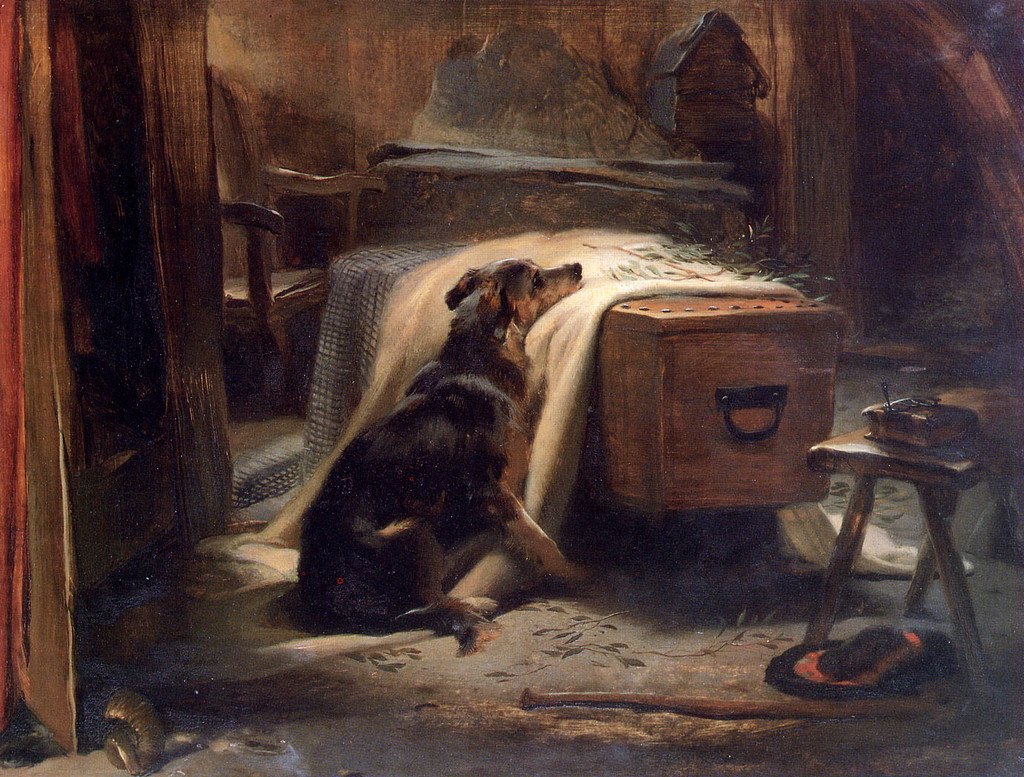
- Victoria and Albert Museum, The Old Shepherd's Chief Mourner. View source.
- Tate, A Distinguished Member of the Humane Society. View source.
- Tate, Dignity and Impudence. View source.
- Royal Collection, Eos. View source.
- National Galleries of Scotland, The Monarch of the Glen. View source.
- Royal Holloway, University of London, Man Proposes, God Disposes. View source.
- Trafalgar Square / Greater London Authority, The Lions at the Base of Nelson's Column. View source.
- Royal Humane Society, current history, research and awards records: and and View source 1. View source 2. View source 3.
- The New Sporting Magazine, vol. 14, 1838, “Exhibition at the Royal Academy”, no. 462, printed p. 426: and View source 1. View source 2.
- James A. Manson, Sir Edwin Landseer, R.A., 1902, pp. 92–93: View source.
- Royal Academy Chronicle, “1838”: View source.
- James Dafforne, Pictures by Sir Edwin Landseer, Royal Academician, with Descriptions and a Biographical Sketch of the Painter, 1873, pp. 18, 80 and 86: View source.
- Frederic George Stephens, Sir Edwin Landseer, 1880, p. 79: View source.
- Royal Collection Trust, Thomas Landseer after Sir Edwin Henry Landseer, A Distinguished Member of the Humane Society, published 1839, mixed-media mezzotint, RCIN 815187: View source.
- Metropolitan Museum of Art, George J. Zobel after Sir Edwin Henry Landseer, A Distinguished Member of the Humane Society, 9 July 1869, 52.588.8: View source.
- Royal Kennel Club, current breed standard for the Newfoundland, last updated 1 April 2025: View source.
- American Kennel Club Library & Archives, Newfoundland Club of America collection guide: View source.
- Splash image, A Distinguished Member of the Humane Society. Tate. Image source. Public domain.
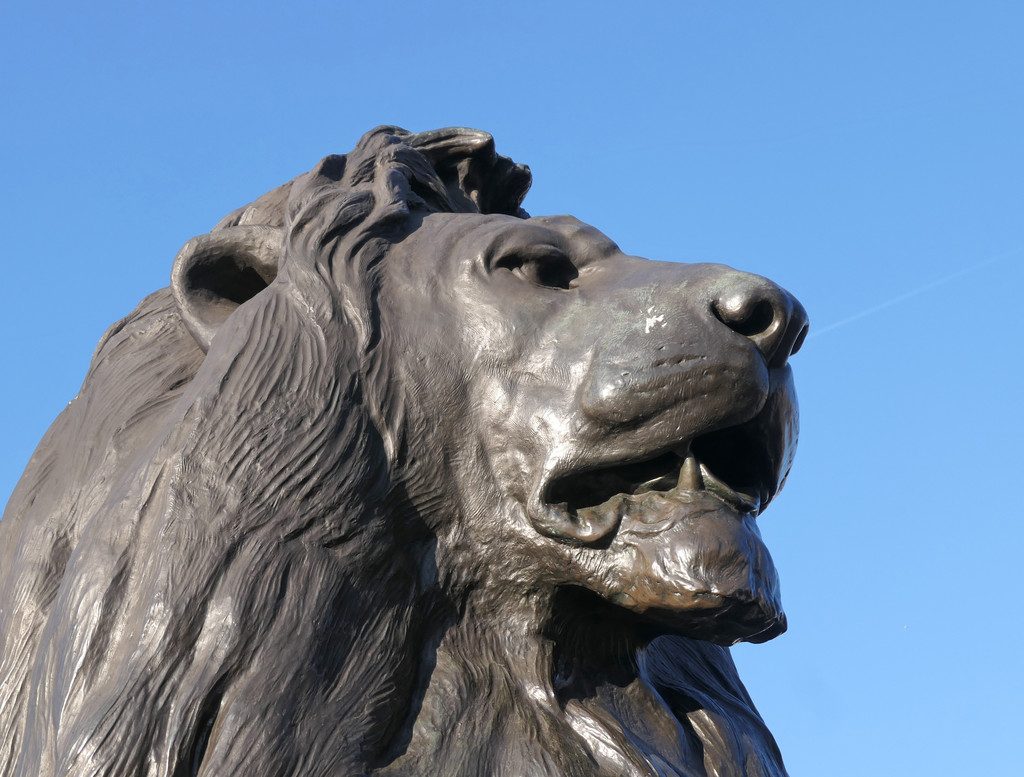
- Navigation image, One of the bronze lions at Nelson’s Column: modelled by Edwin Landseer and cast by Carlo Marochetti. Photograph by Amanda Slater. CC BY-SA 2.0. Image source. CC BY-SA 2.0. Resized.