

 by Tom Gurney
Tom Gurney BSc (Hons) is an art history expert with over 20 years experience
/
Email: tomgurney1@gmail.com / Phone: +44 7429 011000
War and Pacifism: Introduction
Evelyn De Morgan opposed war without painting soldiers in combat. Her dragons, sea serpents, storms and darkened landscapes translate organised violence into a Symbolist struggle, while isolated women, angels and rainbows keep open the possibility of rescue. The distance from battlefield realism was deliberate: allegory gave her a way to condemn conflict, confront death and imagine peace without turning suffering into spectacle.
That visual response was joined to practical action. In 1916 De Morgan opened her London studio for an exhibition intended to raise money for British and Italian Red Cross organisations. Paintings made under the pressure of the First World War therefore served both as public persuasion and as instruments of aid.[1][2]
At a Glance
- Conflicts in her lifetimeThe Crimean War, the Boer Wars and the First World War
- PositionPacifist; she used art to oppose violence and advocate eventual peace
- Visual methodSymbolist allegory rather than direct scenes of the front line
- Benefit exhibitionA 1916 studio display supporting British and Italian Red Cross organisations
- Key worksOur Lady of Peace, The Red Cross, S.O.S. and other wartime allegories
- Recurring hope signThe rainbow, often set against darkness, storm or death
Contents
- A Pacifist Language Before 1914
- Why She Did Not Paint the Battlefield
- Women, Children and Innocence
- S.O.S.: A Distress Call in Paint
- The Red Cross and the Field Below
- The 1916 Studio Benefit
- Hope Without Sentimental Comfort
A Pacifist Language Before 1914
The First World War intensified De Morgan’s response to conflict, but it did not create her ethical vocabulary from nothing. She was born during the Crimean War and lived through the Boer Wars as well as the 1914–1918 conflict. The De Morgan Foundation places her pacifism beside her spiritualism and support for women’s suffrage as a continuing part of her social consciousness.[1][3] Her full biography shows how these commitments grew within a long professional career.
Earlier paintings had already made peace visible through ideal figures and changes of light. The Foundation describes Lux in Tenebris (1895) as a personification of peace in classical drapery. Our Lady of Peace (1907) stages a soldier kneeling before a radiant apparition, with child figures carried upward through prismatic colour. Both pictures establish a pattern that the wartime works would sharpen: danger belongs to the earthly setting, while spiritual or moral aspiration enters through another plane.[3]
This approach also separates De Morgan from a narrow “Pre-Raphaelite” label. Her precise figures and saturated colour can recall later Pre-Raphaelitism, but her language joins Renaissance composition, academic training, spiritualism and Symbolism to a personal political purpose. Sarah Hardy argues that De Morgan used those resources to articulate feminism, spiritual belief and pacifism rather than to join a single inherited movement.[2] The broader study of symbolism and allegory traces how that language changes from one subject to another.
Why She Did Not Paint the Battlefield
De Morgan’s war paintings should not be read as absent-minded escapism. She knew that literal battle imagery could not adequately express her horror at modern conflict. Instead of depicting a particular trench or military engagement, she constructed moral situations: a vulnerable body surrounded by monsters, a soldier in prayer, the dead lying below a red-robed Christ, or light breaking through oppressive darkness.[2][3]
Symbolism allowed several registers to coexist. A storm can describe physical peril and spiritual crisis; a dragon can stand for destructive power without identifying one national army; an ascent can mean death, release or the difficult movement towards peace. These images are less specific than documentary art, but not less serious. Their refusal to supply uniforms, victories or heroic charges keeps attention on threatened life and the cost borne by victims.
The method also avoids celebrating weaponry. De Morgan’s most forceful presences are often not combatants at all. Women, children, angels and the dead displace generals from the centre of the story. Her visual argument is built around vulnerability, mourning and moral judgement rather than military achievement.
Women, Children and Innocence
Female figures carry much of De Morgan’s pacifist imagery, but they should not all be treated as identical emblems. In Lux in Tenebris, an ethereal woman embodies peace. In S.O.S., the woman is a person caught in extreme danger. Elsewhere, female bodies may figure the soul or the hope of release. The women, spiritualism and freedom discussion places those roles beside documentary evidence for De Morgan’s politics without turning every figure into a direct suffrage statement.
Children introduce another kind of vulnerability. The preparatory study for Our Lady of Peace records the child models from whom the winged figures were developed. The Foundation interprets their upward gaze and innocence as corresponding to those called to fight.[3] This is an institutional reading, not something that can be proved from expression alone, but it fits the painting’s contrast between martial armour below and an unarmed vision of peace above.
The repeated choice of innocent or defenceless figures changes the scale of the argument. War is not presented as a contest whose meaning lies in its outcome. It is an assault on bodies and souls that have little power over the decisions producing it.
S.O.S.: A Distress Call in Paint
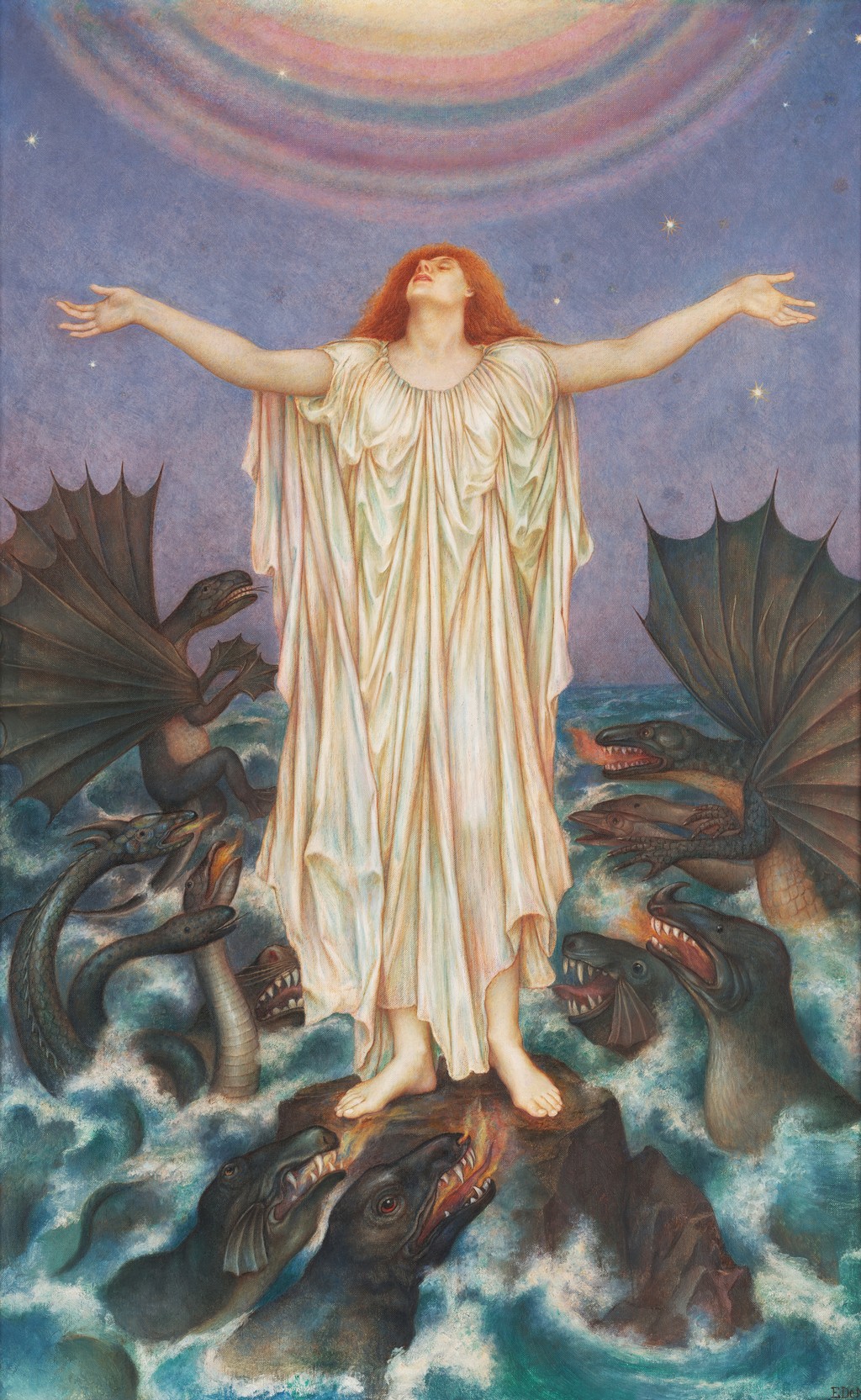
S.O.S. was painted in 1914–1916. The controlling Foundation record identifies it as oil on canvas, framed at 934 × 655 × 50 mm, signed EdeM, and numbered P_EDM_0056.[4] Its title refers to the relatively new Morse distress signal. The familiar reading “save our souls” is especially apt for a painting that places physical rescue and spiritual deliverance together.
What is visible is stark. One white-robed woman stands on an isolated rock, twisting upwards with both arms extended. Dark water churns around her as serpentine creatures rise from the waves. Above, a rainbow breaks into the storm. No rescuer has yet entered the scene; the gesture remains a plea.
The Foundation interprets the woman as the innocence of war’s victims, the dragons and sea monsters as signs of evil and death, and the rainbow as hope for salvation or an afterlife.[4] Those associations give the scene a spiritual structure, but they do not cancel its immediate terror. The rock offers little security, the monsters remain close, and the saving colour is remote. A close reading can therefore hold desperation and hope together without deciding that hope has already prevailed.
Art UK’s Sarah Hardy places the rainbow within a longer pattern in De Morgan’s art, where light emerging from darkness accompanies ideas of spiritual ascent. In the wartime works, colour binds signs of war and peace into the same composition.[5] That tension matters more than a one-word equation between rainbow and optimism.
The Red Cross and the Field Below
The Red Cross uses Christian imagery on a larger collective scale. A Christ figure in a billowing blood-red cloak is borne by angels above a field of the slain. The Foundation’s account reads him as watching over the dead and the souls ascending from the devastation.[3] The red cloak connects the crucified body, the emblem of medical relief and the bloodshed beneath it without making those things interchangeable.
The field below is essential. If attention rests only on the airborne group, the painting risks becoming a reassuring vision detached from death. The bodies prevent that. Salvation is imagined in response to mass killing, not as a decorative promise floating free of it. The contrast also shows why De Morgan’s war art belongs within the wider paintings story: her established interest in ascent, spirit and divided realms becomes newly urgent under modern conditions.
The Red Cross and S.O.S. share an upward movement, but they do not repeat the same solution. One gathers many dead beneath a Christian figure; the other leaves a lone woman reaching into an uncertain sky. Together they show De Morgan varying her symbolic grammar rather than applying a fixed code.
The 1916 Studio Benefit
In 1916 De Morgan displayed her war pictures at her London studio to raise funds for the British Red Cross and its Italian counterpart. The Foundation biography identifies the beneficiaries as the British Red Cross and the Italian Croce Rossa, while Hardy’s essay confirms that S.O.S. and The Red Cross were included.[1][2] The event gave her images a direct charitable function alongside their pacifist message.
This conjunction deserves careful wording. Fundraising for organisations caring for people harmed by war is not the same as endorsing the conflict. De Morgan’s response addressed immediate suffering while her paintings rejected the moral logic of violence. The Foundation’s later Artist of Hope exhibition describes her intention as active advocacy for peace and notes her hope that sales would support Red Cross work.[3]
The studio setting also matters. It brought public purpose into the place of artistic labour. Rather than waiting for a commercial gallery to define the group, De Morgan assembled the works around a present crisis and a practical objective. Her war painting close reading begins with one object; the 1916 exhibition reveals the force of seeing several related visions together.
Hope Without Sentimental Comfort
Rainbow colour is the most recognisable hopeful sign in De Morgan’s conflict imagery. It carries biblical associations of survival after catastrophe and, in her spiritualist framework, the promise that darkness is not the final condition.[4][5] Yet to describe these pictures simply as uplifting would ignore their waves, bodies, blood-red cloth and predatory creatures.
Hope functions as resistance rather than consolation. It gives figures a direction in situations they have not mastered. The soldier still kneels, the dead remain in the field, and the woman on the rock is still surrounded. Even a vision of spiritual release cannot repair the historical violence that made such an image necessary.
De Morgan’s pacifism therefore rests on a productive strain. She condemns war by showing it as monstrous and destructive, but refuses to let destruction define the whole imaginative field. Light, ascent and colour preserve the possibility of another order. That possibility is demanding precisely because peace has not yet arrived.
About this directory: These 72 entries form a reproducible researched online works census assembled from current public records. It is not a catalogue raisonné and does not claim absolute completeness.
Artworks directory
| Name | Date | Medium |
|---|---|---|
| A Soul in Hell | Date unknown | Painting |
| Ariadne in Naxos | 1877 | Painting |
| Aurora Triumphans | 1877 | Painting |
| Blindness and Cupidity Chasing Joy from the City | 1897 | Painting |
| Boreas and Oreithyia | 1896 | Painting |
| Boreas and the Fallen Leaves | 1910 | Painting |
| By the Waters of Babylon | 1882 | Painting |
| Cadmus and Harmonia | 1877 | Painting |
| Cassandra | 1898 | Painting |
| Clytie | 1886 | Painting |
| Daughters of the Mist | 1909 | Painting |
| Death of a Butterfly | 1910 | Painting |
| Death of the Dragon | 1916 | Painting |
| Deianira | 1878 | Painting |
| Demeter Mourning for Persephone | 1906 | Painting |
| Drapery study | 1890 | Drawing |
| Earthbound | 1897 | Painting |
| Eos | 1895 | Painting |
| Evening Star over the Sea | 1910 | Painting |
| Flora | 1894 | Painting |
| Helen of Troy | 1898 | Painting |
| In Memoriam | 1904 | Painting |
| Life and Thought Emerging from the Tomb | 1893 | Painting |
| Love's Passing | 1883 | Painting |
| Luna (Moon) | 1885 | Painting |
| Lux in Tenebris | 1895 | Painting |
| Medea | 1889 | Painting |
| Medusa | 1879 | Painting |
| Mercury | Date unknown | Painting |
| Moonbeams dipping into the Sea | 1918 | Painting |
| 'Music Sweet Music' (Saint Cecilia) | 1884 | Painting |
| Night and Dawn | 1910 | Painting |
| Night and Sleep | 1878 | Painting |
| Our Lady of Peace | 1907 | Painting |
| Phosphorus and Hesperus | 1881 | Painting |
| Port after Stormy Seas | 1905 | Painting |
| Portrait John Roddam Spencer Stanhope | 1880 | Painting |
| Queen Eleanor and the Fair Rosamund | Date unknown | Painting |
| S.O.S. | 1914–1916 | Painting |
| Sleep and Death: the Children of Night | 1883 | Painting |
| Study for 'Saint Christina' | 1904 | Painting |
| Study from the life | 1890 | Drawing |
| Study of Arms for "The Cadence of Autumn | 1905 | Drawing |
| Sunbeam and Summer Shower | 1910 | Painting |
| The Angel of Death I | 1880 | Painting |
| The Barred Gate | 1910 | Painting |
| The Cadence of Autumn | 1905 | Painting |
| The Captives | Date unknown | Painting |
| The Dryad | 1884 | Painting |
| The Garden of Opportunity | 1892 | Painting |
| The Gilded Cage | probably 1901–1902 | Painting |
| The Grey Sisters | 1880 | Painting |
| The Hourglass | 1904 | Painting |
| The Kingdom of Heaven Suffereth Violence and the Violent Take It by Force | 1878 | Painting |
| The Light Shineth in Darkness and the Darkness Comprehendeth It Not | 1906 | Painting |
| The Little Sea Maid | 1880 | Painting |
| The Love Potion | 1903 | Painting |
| The Martyr (Nazuraea) | 1880 | Painting |
| The Mourners | 1915 | Painting |
| The Passing of the Soul at Death | 1910 | Painting |
| The Poor Man Who Saved the City | 1901 | Painting |
| The Prisoner | 1907 | Painting |
| The Red Cross | 1915 | Painting |
| The Salutation | 1883 | Painting |
| The Sea Maidens | 1885 | Painting |
| The Soul's Prison House | 1880 | Painting |
| The Storm Spirits | 1900 | Painting |
| The Worship of Mammon | 1909 | Painting |
| Twilight | 1910 | Painting |
| Venus and Cupid | 1878 | Painting |
| William De Morgan | 1909 | Painting |
| William De Morgan (1839–1917) | 1893 | Painting |
Frequently Asked Questions
It invokes the Morse distress signal. The Foundation also draws out the phrase “save our souls”, which suits the painting’s combination of physical peril and a reach towards spiritual deliverance.[4]
Discussion
What should readers notice when looking closely at War and Pacifism?
Reader Insights
Trace the visual route from surrounding danger to a small but persistent sign of hope.
Remember that these are Symbolist responses to war, not eyewitness records of a battlefield.
Does the promise of salvation strengthen the pacifist argument or make its danger harder to hold in view?
Join the Conversation
Share your reading below, keeping observations specific and evidence clear.
References
- De Morgan Foundation, Evelyn De Morgan (1855–1919), View source
- De Morgan Foundation, Why Evelyn De Morgan Is Not a Pre-Raphaelite Painter, View source
- De Morgan Foundation, Artist of Hope, View source
- De Morgan Foundation, S.O.S., View source
- Art UK, The Rainbow as a Symbol of Hope in Evelyn De Morgan’s Paintings, View source