


 by Tom Gurney
Tom Gurney BSc (Hons) is an art history expert with over 20 years experience
Published on June 19, 2020 / Updated on July 9, 2026
Email: tomgurney1@gmail.com / Phone: +44 7429 011000
San Lorenzo Basilica by Filippo Brunelleschi: Introduction
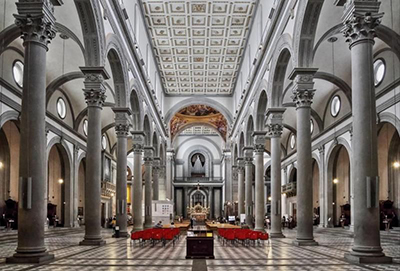
San Lorenzo Basilica is one of the most important places to understand Filippo Brunelleschi's architecture at interior scale. Unlike the dome of Florence Cathedral, which dominates the skyline, San Lorenzo works through rhythm, proportion and repeated forms inside a church. Its architecture is calmer, lower and more sequential, but it is no less important for understanding Brunelleschi's Renaissance language.
The San Lorenzo source connects the basilica's reconstruction with Brunelleschi's direction and with later completion by Manetti. [1] That detail is crucial. San Lorenzo is a building with phases, patrons and later work, not a single object completed entirely and personally by Brunelleschi.
The basilica matters because it shows how Brunelleschi organised space. Columns, arches, bays and horizontal lines create a steady rhythm through the nave. The architecture does not depend on dramatic surface decoration. Its power lies in clarity.
At a Glance
- Architect: Filippo Brunelleschi, with later continuation and completion history
- Building: Basilica of San Lorenzo, Florence
- Type: church / basilica
- Location: Florence
- Key architectural interest: ordered nave rhythm, repeated arches, columns and modular space
- Related Brunelleschi project: Old Sacristy of San Lorenzo
- Related later context: Medici patronage and later Michelangelo associations at San Lorenzo
- Editorial caution: distinguish Brunelleschi's role from later execution and additions
Contents
- Why San Lorenzo Matters
- Looking Carefully
- Brunelleschi's Role and Later Completion
- The Nave as Architectural Rhythm
- The Old Sacristy Connection
- Comparison with Santo Spirito
- Comparison with the Hospital of the Innocents
- Medici and Later San Lorenzo
- Things You Might Miss
- Interpretation
Why San Lorenzo Matters
San Lorenzo matters because it shows Brunelleschi's architecture without the drama of the cathedral dome. The achievement here is not a huge technical problem solved above a crossing. It is the organisation of a church interior into a measured, readable sequence.
The basilica helps explain one of Brunelleschi's central gifts: making space feel ordered. The viewer experiences the interior through repeated architectural units. Columns support arches. Arches lead into bays. The nave moves forward in a rhythm that can be read by the eye and body together.
This makes San Lorenzo a vital comparison with the Hospital of the Innocents. Both buildings use repeated arches and columns, but the effect is different. The hospital creates a public civic facade; San Lorenzo creates an interior route through sacred space. [2]
San Lorenzo also belongs to a larger Florentine story. It is tied to the Medici, to later architectural history and to the broader development of Renaissance church design. But the first task is to understand the building itself: a clear, disciplined space where proportion becomes experience.
Looking Carefully
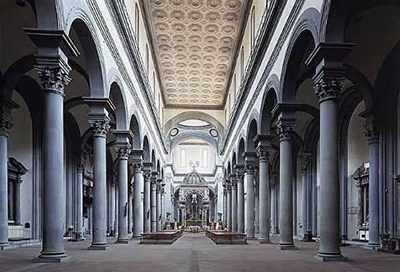
The first thing to notice is the nave rhythm. The interior is organised by repeated arches, columns and bays. This repetition gives the church a calm forward movement, guiding the viewer through the space.
The second thing to notice is the relationship between structure and visual order. Columns are not only supports. They are markers in a measured sequence. The eye reads the space through their regular spacing.
The third thing to notice is restraint. San Lorenzo does not need overwhelming decoration to make its point. Its power comes from the way parts relate: arch to column, bay to bay, nave to aisle, horizontal line to vertical support.
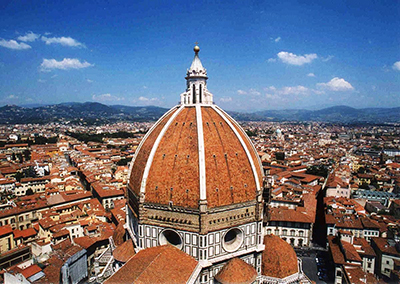
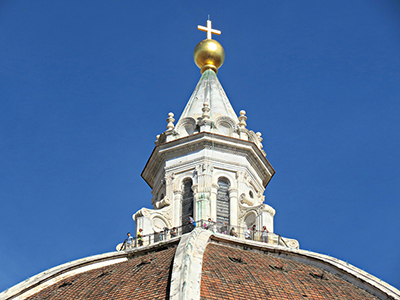
The fourth thing to notice is how different this is from the dome of Florence Cathedral. The dome is a massive external and structural achievement. San Lorenzo is an interior order. Both belong to Brunelleschi's architectural intelligence, but they answer different problems.
Brunelleschi's Role and Later Completion
The San Lorenzo source is useful because it makes clear that the basilica's history involves Brunelleschi's direction and later completion by Manetti. [1] This helps avoid a common problem in architectural writing: treating a building as if it emerged in one finished moment from one person.
Early Renaissance churches often carry complicated histories. Design, construction, patronage, later changes and later decoration can all overlap. San Lorenzo is no exception. Brunelleschi's importance lies in the architectural language and direction associated with the rebuilding, but the visible building must be described with attention to phases.
This does not weaken Brunelleschi's achievement. It makes it more real. Architecture is not only invention; it is process. The basilica's order had to be carried through by builders, patrons and later figures.
The Nave as Architectural Rhythm
San Lorenzo is one of the best Brunelleschi pages for explaining rhythm. In painting, rhythm can mean repeated colours or forms across a surface. In architecture, rhythm is experienced by moving through space. A column passes, then another. An arch opens, then another. A bay frames space, then another bay repeats the pattern.
This repetition creates calm. The viewer does not feel lost in decorative complexity. The building offers a clear grammar of space. It is possible to understand the interior almost by counting its parts.
That does not mean the building is cold. Its restraint gives it dignity. The steady sequence of supports and openings creates an atmosphere of order, which suits the church setting without becoming theatrical.
This is why San Lorenzo is so useful for understanding Brunelleschi. It shows that Renaissance architecture could be intellectually ordered and physically experienced at the same time.
The Old Sacristy Connection
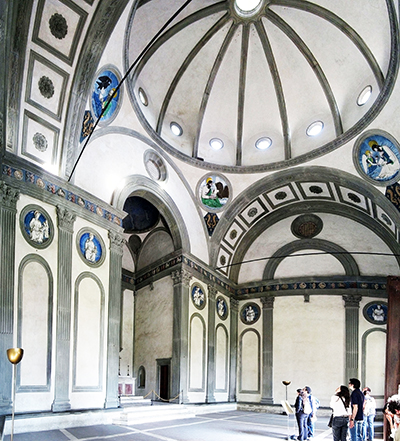
The Old Sacristy is one of the most important related spaces at San Lorenzo. The San Lorenzo source treats it within the wider basilica context, and it deserves its own focused page because it concentrates Brunelleschi's geometry in a smaller setting. [1]
The relationship between basilica and sacristy is useful for readers. The basilica shows rhythm across a larger church interior. The Old Sacristy shows geometry in a compact sacred space. Together, they reveal two sides of Brunelleschi's architectural thinking.
The Old Sacristy also prepares readers for the later history of San Lorenzo, including the Medici and Michelangelo. Those later histories are important, but they should not confuse the account of Brunelleschi's earlier architectural role.
Comparison with Santo Spirito
Santo Spirito is the natural comparison for San Lorenzo. Both are Florentine church projects connected with Brunelleschi, and both reveal his interest in spatial rhythm. The official Santo Spirito architecture page describes the basilica through rhythm, proportion and light. [3]
The comparison is helpful because it prevents San Lorenzo from being treated in isolation. Brunelleschi's church architecture was not a single experiment. It was a way of thinking about repeated forms, movement and proportion across different settings.
Santo Spirito also reminds readers that architectural projects can have complex execution histories. Its official history notes the sequence of construction and the continuation after Brunelleschi's death. [4] San Lorenzo benefits from the same kind of careful reading.
Comparison with the Hospital of the Innocents
The Hospital of the Innocents is another useful comparison because it shows Brunelleschi using related architectural elements for a different public purpose. The Museo degli Innocenti connects the hospital's 1419 commission with the Arte della Seta and Brunelleschi's role. [2]
Both San Lorenzo and the hospital use rhythm and repetition, but they create different experiences. The hospital's loggia faces a square and gives a charitable institution a civic presence. San Lorenzo organises a church interior for worship and movement.
This comparison helps define Brunelleschi's flexibility. His architecture is recognisable, but not repetitive in a dull sense. Similar principles can serve different functions.
Medici and Later San Lorenzo
San Lorenzo is also inseparable from Medici Florence. The site became one of the major architectural and dynastic settings of the city, especially through later additions and associations. For Brunelleschi, that later history matters, but it should not take over the account of his earlier architectural role.
The most useful approach is to treat San Lorenzo as layered. Brunelleschi's basilica and Old Sacristy context form one part of the story. Later Medici and Michelangelo associations form another. The site grew in meaning over time.
This layered history is part of why San Lorenzo is valuable for the cluster. It can link Brunelleschi to later Renaissance architecture without pretending that all later work belongs to him.
Things You Might Miss
San Lorenzo's power lies in rhythm, not spectacle.
The repeated arches and columns make the church interior easy to read.
Brunelleschi's role must be separated from later completion and later additions.
The Old Sacristy is a closely related but distinct architectural experience.
Santo Spirito helps explain San Lorenzo by comparison.
San Lorenzo shows Brunelleschi at interior scale, in contrast to the external drama of the cathedral dome.
Interpretation
San Lorenzo is best interpreted as an architecture of measured sequence. Its importance lies in how clearly it organises space. The building teaches the viewer how to move, look and understand through repeated forms.
This makes it essential to the Brunelleschi cluster. Without San Lorenzo, Brunelleschi can look like the creator of one extraordinary dome and one civic loggia. With San Lorenzo, his architecture becomes a broader language: a way of shaping interiors, movement and sacred order.
The basilica also shows why restraint can be powerful. San Lorenzo does not need to overwhelm. It persuades through clarity.
FAQs
San Lorenzo's reconstruction is connected with Brunelleschi's direction, while the building history also includes later completion by Manetti. [1] The safest approach is to describe Brunelleschi's role clearly while acknowledging later execution and additions.
San Lorenzo is important because it shows Brunelleschi organising a church interior through rhythm, proportion and repeated architectural elements. It reveals a different side of his architecture from the dome of Florence Cathedral.
Both churches show Brunelleschi's interest in rhythm and ordered space. Santo Spirito offers a useful comparison because its official architecture page also emphasises proportion, rhythm and light. [3]
The Old Sacristy belongs to the San Lorenzo complex and offers a more concentrated example of Brunelleschi's geometric and spatial thinking. It deserves separate treatment because it is a different kind of architectural experience from the basilica nave.
Discussion
San Lorenzo turns Brunelleschi's architectural thinking into a church interior. Does its repeated rhythm make the space feel more spiritual, more rational, or both?
Reader Insights
San Lorenzo shows how repetition can guide movement. The eye reads bay after bay, gradually understanding the church as a measured system.
Is the basilica's restraint part of its beauty, or does it make the space feel less dramatic than later Renaissance churches?
Join the Conversation
Have a thought or observation about San Lorenzo Basilica? Share it below. Thoughtful responses may be added to this section.
References
- San Lorenzo Firenze, La Basilica di San Lorenzo, https://sanlorenzofirenze.it/la-basilica-di-san-lorenzo/ (in Italian).
- Museo degli Innocenti, Architettura, https://www.museodeglinnocenti.it/museo/percorsi-espositivi/architettura/ (in Italian).
- Basilica di Santo Spirito, Architecture of the Basilica of Santo Spirito, https://www.basilicasantospirito.it/en/the-basilica/architecture-of-the-basilica-of-santo-spirito/.
- Basilica di Santo Spirito, History, https://www.basilicasantospirito.it/en/the-basilica/history-of-the-basilica-of-santo-spirito/.
 Filippo Brunelleschi.jpg)
 Filippo Brunelleschi.jpg)
 Filippo Brunelleschi.jpg)