


1931–2024 · Portraits, drawings and London landscapes
 by Tom Gurney
Tom Gurney BSc (Hons) is an art history expert with over 20 years experience
Page Created: September 16, 2026 / Page Updated: September 16, 2026
Email: tomgurney1@gmail.com / Phone: +44 7429 011000
Frank Auerbach: Looking Again
Frank Auerbach (1931–2024) painted familiar people and nearby London places with extraordinary persistence. His dense surfaces and urgent lines can appear spontaneous, yet an image might take months or years of revision. Looking at his work means holding those two impressions together: the force of the finished mark and the patient observation that made it possible. A refugee from Nazi Germany, he built a long artistic life in London, returning to subjects he knew intimately. [1]
At a Glance
- Lived1931–2024
- Born / workedBerlin / London
- Principal subjectsPortraits and London landscapes
- TrainingSt Martin’s, Royal College of Art; David Bomberg’s evening classes
The following connections distinguish documented teachers, earlier paintings and fellow artists. The timeline uses dated studies, subjects and exhibition history; its bars do not imply a single organised movement or uninterrupted collaboration. [2] [3] [4] [5] [6]
Frank Auerbach in Context
London figurative practice
Auerbach’s mature working context, c.1950–2024Postwar building sites
Dated series, 1952–62School of London
Debated label proposed in 1976David Bomberg
Evening-class teaching during Auerbach’s 1948–55 studiesLeon Kossoff
Friend in Auerbach’s 1950s London circleLucian Freud and Francis Bacon
Friends in Auerbach’s 1950s London circleContents
- Life and Training
- Painting and Revision
- Portraits and Sitters
- Charcoal Drawings
- London Landscapes and Building Sites
- Learning from Earlier Paintings
- Exhibitions and Recognition
- Known-Work Directory
Life and Training
Auerbach was born in Berlin in 1931. His Jewish parents sent him to England in 1939 to escape Nazi persecution; they were later murdered at Auschwitz. The childhood separation belongs to his biography, but it should not become a ready-made explanation for every dark colour or agitated brushstroke. His mature work also arose from education, daily routines, friendships and the particular demands of representing a person or place. [1]
After the war he studied in London, attending St Martin’s School of Art and the Royal College of Art between 1948 and 1955. David Bomberg’s evening teaching at Borough Polytechnic was especially important. This was not a simple choice between tradition and modernity: training and repeated encounters with earlier paintings helped Auerbach develop an intensely personal way of working. He held his first solo exhibition at the Beaux Arts Gallery in 1956. [2] [7]
Painting and Revision
Thickness alone does not explain an Auerbach painting. In his early work, successive applications could remain on the surface, producing a substantial physical build-up. The National Gallery distinguishes this approach from his later practice of removing earlier attempts before beginning another session. A heavy-looking image therefore should not automatically be imagined as an untouched record of every previous stage. [4]
National Galleries of Scotland describes extensive preparatory drawing and a process in which paint was regularly scraped away so that the image could be started afresh. The final surface is the outcome of decisions, not simply the sum of labour. Revision allowed him to resist a merely serviceable likeness and search again for something that felt alive. [3]
For the viewer, this suggests a useful change of pace. First notice the organisation of the whole picture: where the head sits, how a road turns, or which diagonal holds the space together. Then return to individual marks. The apparent turbulence becomes easier to follow when it is read as a structure rather than as expressive texture alone.
Portraits and Sitters
Auerbach often painted people who returned regularly over many years. Repeated sittings created familiarity without removing the difficulty of making a new image. The artist’s subjects were not interchangeable models: a portrait could depend on a longstanding relationship and on the renewed act of looking during a particular session. [3]
Head of E.O.W. IV (1961), held by National Galleries of Scotland, depicts Estella West. She was a companion and an important sitter in the portraits Auerbach made from the 1950s into the 1970s. The museum records frequent evening sittings under electric light and notes that economic constraints contributed to his limited early palette. The painting’s oil on plywood is markedly different from a thinly painted, smoothly modelled likeness. [8]
Rather than asking only whether a portrait looks realistic, consider what establishes its presence. A turn of the head, the distance between features and the pressure of surrounding space may do more than polished detail. The initials in titles identify recurring sitters; they do not mean the work is an abstract exercise without a particular person behind it.
Charcoal Drawings
The charcoal heads of the 1950s and early 1960s show that Auerbach’s search was not confined to oil paint. He drew, erased and worked again over extended periods. Paper could wear through and require repair; the resulting surface carries the consequences of revision as well as the final image. Erasure was an active part of making, not just a concealed correction. [9]
The Courtauld’s 2024 exhibition presented these drawings alongside related paintings, emphasising their independence. It is misleading to treat every charcoal head as a preliminary sketch waiting to become a canvas. Drawing and painting could proceed alongside one another, with different materials creating different conditions for the same sustained attention. [9]
When viewing a museum reproduction, look for contrasts between dark masses, rubbed areas and sharper lines. Where a photograph reveals damaged or patched paper, that physical history matters too. It helps explain why a head can seem both firmly present and difficult to settle into a single, clean outline.
London Landscapes and Building Sites
Postwar building sites supplied Auerbach with places where the city was visibly changing. The Courtauld’s exhibition of the 1952–62 series brought together fourteen paintings and associated drawings. Excavations, demolition and construction offered spatial problems as well as subjects: a cavity in the ground, a rising framework, or a street altered by rebuilding. His slow painting process could outlast the construction stage that first attracted him. [10]
The early earth colours were partly a practical response to the cost of pigments. By Maples Demolition (1960) and Rebuilding the Empire Cinema, Leicester Square (1962), brighter reds and yellows entered the series. These paintings should not be reduced to documentary views of reconstruction; their space and paint transform the observed site into a worked pictorial construction. [10]
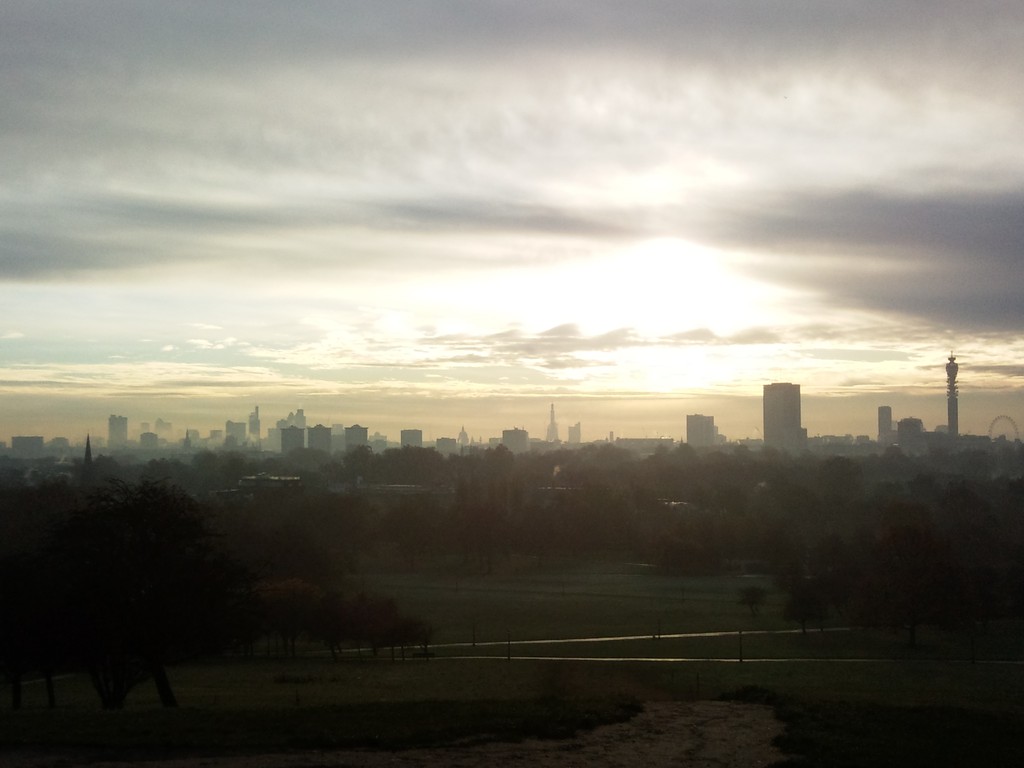
Camden, Mornington Crescent and Primrose Hill remained important nearby subjects. For Primrose Hill, High Summer (1959), the Scottish collection record explains the relationship between drawings made outdoors and paintings developed in the studio. In Tree on Primrose Hill (1984/85), held by the British Council, the emphasis is a tree and the ground around it, not the familiar tourist panorama of London. [11] [12]
Learning from Earlier Paintings
Auerbach’s encounters with earlier art were acts of looking and remaking, not a rejection of his London subjects. His After Rembrandt’s The Lamentation over the Dead Christ (1961) dramatically enlarged a small original. The National Gallery describes a geometric framework that translates elements of the composition into a new pictorial organisation. The result is not a straightforward copy intended to disappear behind its source. [4]
For Bacchus and Ariadne (1971), after Titian, he made fresh drawings in front of the original before returning to the studio. The Gallery stresses that photographs were not his working substitute. Drawing renewed the encounter, while the eventual painting recast the figures, colour and energy in his own terms. [5]
After Rubens’s Samson and Delilah (1993) followed a comparable process, with new drawings preceding painting sessions. The National Gallery points out how the original’s people and objects remain within Auerbach’s looser handling. Comparison with Rubens or Rembrandt can therefore begin with composition and relationships between figures, rather than with a checklist of copied details. [6]
Exhibitions and Recognition
Auerbach represented Britain at the Venice Biennale in 1986 with twenty-four paintings and eight drawings. He shared the Golden Lion for best artist with Sigmar Polke. The award marked international recognition, but the selection also brought drawing and painting together rather than presenting his achievement as impasto alone. [14]
The label “School of London”, promoted by R. B. Kitaj in 1976, can help locate Auerbach among painters such as Francis Bacon, Lucian Freud and Leon Kossoff. It needs a qualification: the National Gallery describes the term as debated and rejected by the artists themselves. Friendship and a commitment to painting did not make their work identical. [2]
Auerbach died in 2024. The institutional records linked below offer a starting point for exploring his work across painting, drawing and printmaking. Collection ownership does not guarantee that a work is currently on display; check the museum before planning a visit. [1]
This is a partial directory of nineteen works and related print objects documented in the institutional sources below, not a catalogue raisonné or a complete census. Titles link to museum or collection records; no separate artwork pages are implied. [7] [15]
Known-Work Directory
| Name | Date | Medium |
|---|---|---|
| Primrose Hill, High Summer | 1959 | Painting |
| Maples Demolition | 1960 | Painting |
| Head of E.O.W. IV | 1961 | Painting |
| After Rembrandt’s The Lamentation over the Dead Christ | 1961 | Painting |
| Rebuilding the Empire Cinema, Leicester Square | 1962 | Painting |
| Sketch from Titian’s Bacchus and Ariadne | 1970–71 | Drawing |
| Bacchus and Ariadne | 1971 | Painting |
| Camden Theatre | 1976 | Painting |
| Head of Ken Garland | 1977/78 | Painting |
| Head of J.Y.M. III | 1980 | Painting |
| Drawing after Rubens’s Samson and Delilah | 1984 | Drawing |
| Tree on Primrose Hill | 1984/85 | Painting |
| After Rubens’s Samson and Delilah | 1993 | Painting |
| Ruth Bromberg Seated I | 1994 | Drawing |
| Ruth (1995.13.1) | 1994 | Etching and aquatint |
| Ruth (II) (1995.13.2) | 1994 | Etching and aquatint |
| Ruth [wrapper for etched copper plates] (1995.92.3) | 1994 | Etching, aquatint and ballpoint pen |
| Ruth [gray] (1995.92.2) | 1994 | Etched and aquatinted copper plate |
| Ruth [black] (1995.92.1) | 1994 | Etched and aquatinted copper plate |
Frequently Asked Questions
Discussion
Which helps you understand an Auerbach image most: the first impression of its surface, or a slower recognition of the person or place? Share an observation about a particular work, and identify the museum record or exhibition you are discussing.
Reader Insights
Try following the largest diagonal or the position of a head before examining individual marks. Does the picture become more legible when you step back?
Compare an early accumulated paint surface with the worn paper of a charcoal head. What different traces of making does each material preserve?
Auerbach revisited nearby London subjects. Does knowing a place change how you read a painting that transforms its appearance?
Join the Conversation
Add your perspective below. Please keep comments specific to the art and respectful of other readers.
References
- The Courtauld, Remembering Frank Auerbach (1931–2024), 12 November 2024, View source.
- The National Gallery, Frank Auerbach — Colin Wiggins on training, peers and the National Gallery, View source.
- National Galleries of Scotland, Frank Auerbach — artist biography, View source.
- The National Gallery, Frank Auerbach — Rembrandt, View source.
- The National Gallery, Frank Auerbach — Titian, Bacchus and Ariadne, View source.
- The National Gallery, Frank Auerbach — Rubens, Samson and Delilah, View source.
- British Council Visual Arts, Frank Auerbach — collection biography and four object records, View source.
- National Galleries of Scotland, Head of E.O.W. IV, 1961 (GMA 1537), View source.
- The Courtauld, Frank Auerbach: The Charcoal Heads opens at The Courtauld Gallery, 2024, View source.
- The Courtauld, Frank Auerbach: London Building Sites 1952–62, 2009–10 exhibition, View source.
- National Galleries of Scotland, Primrose Hill, High Summer, 1959 (GMA 1302), View source.
- British Council Collection, Tree on Primrose Hill, 1984/85 (P5359), View source.
- Image source, George Tsiagalakis, Primrose Hill – London, 15 November 2010, own photograph; CC BY-SA 4.0; proportionately resized, View source.
- British Council, Venice Biennale — the 1980s, Frank Auerbach in 1986, View source.
- National Gallery of Art, Washington, Frank Auerbach — collection records, View source.