by Tom Gurney
Tom Gurney BSc (Hons) is an art history expert with over 20 years experience
Published on June 19, 2020 / Updated on November 6, 2026
Email: tomgurney1@gmail.com / Phone: +44 7429 011000
James McNeill Whistler painted Crepuscule in Flesh Colour and Green: Valparaiso during his 1866 stay in Chile. The catalogue raisonné identifies the horizontal marine as YMSM 073. It belongs to Tate, accession N05065, and bears both Whistler's written signature and the inscription “Valparaiso. 66.”[1][4]
Tall sailing ships gather across calm grey-green water beneath a darkening sky. A little sunset warmth remains among the clouds, and two tiny red flags sharpen the muted field. No shells, flames or damaged buildings appear, although the scene was made during the crisis that culminated in Spain's bombardment of Valparaiso.[1][8]
The picture's apparent immediacy conceals a complicated object. Whistler reused a canvas that probably carried large figures, laid several preparatory layers over it, sketched more masts than he painted and built the marine in an ordered sequence. Tate's examination disproves the famous claim that everything happened in one sitting.[2][5]
At a Glance
- CatalogueYMSM 073
- Date1866
- MediumOil on canvas
- InscriptionWhistler. / Valparaiso. 66
- Dimensions58.6 × 75.9 cm
- SubjectTwilight fleet; 30 March withdrawal reading is probable
- GroundWhite preparation and pale flesh-coloured imprimatura
- CollectionTate, N05065
- FrameGrau Whistler frame, 1891; not original
- DisplayCheck with Tate; no object-specific room claimed
Contents
- The painting at a glance
- Which Valparaiso painting is this?
- Three known pictures and two lost
- From *Twilight at Sea* to *Crepuscule*
- The journey to Chile
- Why did Whistler go?
- The war in the harbour
- What happened on 31 March 1866?
- Was it painted on 30 March?
- Whistler's later bombardment story
The painting at a glance
YMSM and Tate record an oil painting on canvas measuring 58.6 × 75.9 centimetres. The signature and place-date inscription sit at lower left in separated letters that incline upwards to the right. Its format is wider than it is tall.[1][2][4]
A dark horizon divides the open bay from clouded sky. Around six prominent sailing ships cross the middle distance, their masts forming a loose vertical rhythm. Numerous smaller vessels collect at the far right, where a slight strip of shore becomes visible.[1]
The sea is not perfectly still. Broad horizontal handling gives it a rolling surface, while the ships seem anchored, becalmed or gently moving. Because little land appears, the canvas communicates harbour atmosphere more securely than it identifies an exact observation point.[1][11]
Scale is carried by repetition rather than a dominant flagship. Nearer hulls are only modestly larger than the dispersed craft beyond them, and the shoreline never becomes a detailed cityscape. Whistler gives viewers enough rigging to understand a crowded roadstead, then lets dusk weaken distinctions among naval vessel, merchant ship and distant mark. That refusal to label every craft is formally coherent, but it also limits attempts to reconstruct the withdrawing squadrons ship by ship.[1][2][7]
Which Valparaiso painting is this?
This is YMSM 073, Tate N05065. It is not YMSM 072, Symphony in Grey and Green: The Ocean, a larger horizontal canvas at the Frick. The Frick painting has its own longer work history and must not supply details to the Tate scene.[1][13]
Nor is this the upright local “Valparaiso Harbor.” That route corresponds to YMSM 074, Sketch for “Nocturne in Blue and Gold: Valparaiso Bay”, at the Smithsonian American Art Museum. Its elevated view includes a diagonal pier, figures and hills.[14]
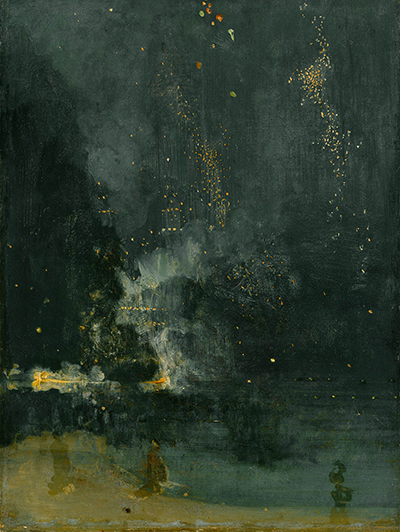
YMSM 075, The Morning after the Revolution, Valparaiso, belongs to the Hunterian. YMSM 076, the vertical Nocturne in Blue and Gold: Valparaiso Bay, belongs to the Freer and was worked on after 1866. Pier, people and downward viewpoint belong to those upright compositions, not here.[15]
Three known pictures and two lost
Whistler later said that he made three Valparaiso pictures that were known and two more that had disappeared. Catalogue scholarship associates his “known” group with YMSM 072, 073 and 076.[1][10]
That recollection does not account neatly for every surviving canvas. YMSM 074 and 075 also represent the port, and the term “known” may have reflected what Whistler considered exhibitable or worth remembering when he spoke. It is not a complete 1866 inventory.[14][15]
Keeping catalogue numbers visible prevents a tempting composite story. The horizontal Tate twilight, Frick ocean, Smithsonian sketch, Hunterian morning and Freer nocturne share a journey and harbour, but their formats, motifs, later histories and present collections differ.[1][13][14][15]
From *Twilight at Sea* to *Crepuscule*
The 1867 Paris Exposition catalogue called the picture either Twilight at Sea or Twilight on the Ocean. At the 1879 Grosvenor Gallery it became The Pacific; Harmony in Green and Gold. Whistler later used variants involving flesh colour, green and Valparaiso.[1][3]
The Société Nationale des Beaux-Arts exhibited Marine (harmonie en vert et opale) in 1891, and Munich used the German Dämmerung in 1892. Goupil's 1892 retrospective established Crepuscule in Flesh Colour and Green: Valparaiso, the preferred catalogue title.[1][3]
“Crepuscule” means twilight. The title binds time of day to colour without requiring a narrative of military action. “Flesh colour” is especially precise because the marine's pale pink-orange key begins in an actual flesh-tinted preparation beneath much of the visible paint.[1][2]
The journey to Chile
Whistler left Southampton on 2 February 1866 and arrived at Valparaiso on 12 March after about six weeks at sea. His notebook records the voyage and stay. He remained until early September, apart from journeys to Santiago and nearby countryside.[1][6]
This was not an ordinary painting holiday. Spain and Chile were at war, Valparaiso was under naval blockade, and foreign squadrons crowded its exposed roadstead. Whistler entered a port where diplomacy, commerce, weapons and shipping had immediate consequences.[7][8]
The sea journey nevertheless gave him sustained access to changing water, weather and vessels. His South American paintings connect the direct physical experience of a Pacific harbour with the increasingly selective colour structures that would lead towards the nocturnes.[1][15]
Why did Whistler go?
Older accounts often say that Whistler travelled simply to help the Chilean cause. That answer is too certain and too heroic. His notebook connects him to Captain Horace Doty and to payments, weapons and experimental torpedo activity.[6][9]
Daniel Sutherland has argued from newly assembled documents that Whistler joined an effort to sell torpedo technology or arms to Chile and hoped for financial gain. Glasgow's correspondence editors agree that he may have served as intermediary, distributor or would-be mercenary, but state that his exact role is unclear.[6][9]
Other pressures may also have mattered: financial uncertainty, family tension, political associations and a wish to escape London. The evidence does not make him a commissioned war artist, and it does not prove that he undertook the voyage chiefly to paint YMSM 073.[6][9]
The war in the harbour
The conflict grew from Spain's seizure of Peru's Chincha Islands and the resistance of a South American alliance. Chile declared war on Spain in September 1865. Spanish naval forces then blockaded the long Chilean coast, including its principal commercial port.[7][8]
After other operations failed to provide a decisive result, Admiral Casto Méndez Núñez announced on 27 March 1866 that he would bombard Valparaiso four days later. The town was essentially undefended. Its warehouses held valuable Chilean and foreign property.[7][8]
British and United States squadrons lay in the bay. Diplomats and merchants appealed for intervention, but neither neutral power chose to fight Spain. Their warships left before the attack, placing the withdrawal of foreign fleets at the centre of Tate's proposed reading of Whistler's marine.[1][7]
What happened on 31 March 1866?
Five Spanish vessels opened fire on Valparaiso on 31 March and continued for roughly three hours. The bombardment caused extensive material destruction in a commercial city unable to answer the guns effectively. It was an attack on the port, not a Spanish landing or “invasion” of the harbour.[8]
Most inhabitants had received warning and moved away from the waterfront, limiting immediate casualties while leaving property exposed. Warships, stores, homes, trade and civilian movement belong to the event's history even if Whistler's canvas transforms the crowded crisis into distant shipping and tonal calm.[7][8]
The painting does not depict the shelling. No smoke plume rises from buildings, no flash crosses the water and the city is nearly absent. Political context can identify what the ships may be doing without converting every brushstroke into documentary combat information.[1][8]
Was it painted on 30 March?
Tate has proposed that the picture records neutral fleets beginning to leave on the evening of 30 March, after the bombardment notice and before the attack. The timing fits Whistler's presence and the withdrawn ships.[1][4][7]
Yet the canvas is inscribed only “Valparaiso. 66.” Its limited shoreline does not establish a precise site, and the flags are too abbreviated to identify a complete naval order. The 30 March reading is plausible interpretation rather than a fully proven timestamp.[1][2]
That distinction does not empty the scene of history. It places the twilight within a documented crisis while admitting what painting, inscription and later records cannot settle. The work may condense observed shipping rather than transcribe one fixed hour.[1][7]
Whistler's later bombardment story
Around 1900 Whistler gave the Pennells a lively reminiscence. He described multiple foreign fleets, their departure, the Spanish attack and a ride into the hills with officials. A shell sent the observers fleeing before they returned after the bombardment.[1][10]
The story contains credible features but was told more than three decades later. It compresses chronology, adds theatrical timing and displays Whistler's taste for presenting himself as a bold West Point man. It should not override his contemporary notebook or diplomatic evidence.[6][7][10]
His amused language about a “performance” and panic also sits uneasily beside the destruction of an undefended port. Quoting the anecdote as comic adventure alone would make the affected inhabitants and merchants disappear from their own history.[7][8][10]
A harbour at twilight
Dark blue sky gathers above grey clouds tinged with lingering warmth. Below, green and blue water is modified by pale undercolour and earthier shadows. The ships inhabit the boundary, where their sails catch enough light to remain legible as the day closes.[1][2]
Whistler does not use one-point perspective to drive the eye into the bay. Repeated hulls, masts and cloud bands spread laterally. The horizontal format lets differences in height and spacing animate an otherwise broad, quiet field.[1][11]
The tiny red flags matter because they are rare concentrated accents. They also carry possible national and historical meaning, but their material role is more secure than a complete fleet identification: warm marks enliven a network of flesh pink, green, grey and blue.[2][5]
The ships are both specific and abbreviated
Six larger sailing vessels are visible enough to distinguish hull, mast and sail. Many more are suggested by short marks or distant silhouettes. The scene therefore oscillates between maritime description and an inventory of verticals and pale shapes.[1][5]
Some ships appear anchored, others becalmed or slowly under way. The 1867 Athenaeum admired their sleepy motion and the breathing sea. Its response confirms that early viewers saw atmosphere and movement rather than an exact naval diagram.[3][11]
Abbreviation is not lack of observation. Whistler selected which vessels to develop, which mast proposals to suppress and which rigging details to let clouds cover. Omission was an active part of the design.[2][5]
The canvas had another picture beneath it
Digital X-radiography suggests that Whistler reused a canvas carrying at least one earlier figure composition. Two tall draped forms may stand on opposite sides of a stretcher cross-bar. One may lean or sit, but the image is too indistinct for firm poses or identities.[2][5]
A possible smaller central figure and rounded foreground objects are more speculative. Infrared photography and raking light support two tall forms but not the central proposal. The canvas might also have been rotated, changing the apparent depth and placement of whatever came first.[2][5]
The earlier work may have been only a light sketch, or Whistler may have removed it extensively with turpentine. It should not be assigned a lost title or sitter. Imaging establishes reuse more securely than subject.[2][5]
Commercial priming and white preparation
The canvas arrived with a commercial double-white ground made from lead white, chalk and oil. Such priming supplied an even starting surface before Whistler's own preparatory layers.[2][5]
A white lower imprimatura may have helped efface the buried figure study. Above it Whistler applied two pale flesh-coloured layers. The lower of these contains lead white and chalk in oil, producing an absorbent surface on which diluted colour would lose gloss and show its dried tone quickly.[2][5]
That absorbency suited sketching. It also means the final colour key cannot be separated from preparation: the pinkish ground remains visible between marks and influences thin passages laid over it.[2]
What made the “flesh colour”?
The upper tinted imprimatura includes traces of zinc white as well as lead white. Small quantities of vermilion, red lake, synthetic ultramarine, bone black and raw sienna or umber create its quiet pink-orange cast.[2][5]
This mixture is not a painted body. “Flesh colour” was a historical colour term, and here it describes the prepared surface on which sea, clouds and ships develop. The title makes an invisible technical decision part of the public identity.[1][2]
Because much later paint is thinned, the ground acts throughout the image rather than disappearing under a sealed top layer. It warms greens, softens pale areas and helps join water to sky.[2][5]
Pencil before paint
Whistler did not improvise every vessel directly with the brush. The ship at left was drawn in pencil and then painted along that plan. Several other hull positions were indicated with graphite on the dried flesh ground.[2][5]
Light vertical pencil strokes proposed many more masts than the final image contains. Only a minority became painted structures. Planning therefore included deliberate rejection, with unused graphite surviving as evidence of alternatives.[2]
Three of the four largest ships, however, were not fully drawn first. Rapid horizontal graphite lines marked sails or cross-beams, after which Whistler made hull and sail together in small strokes of greatly diluted paint.[2][5]
The order of ships, clouds and flags
The horizon and principal cloud masses were established early, without covering every patch of ground. Ships developed among those open spaces. Distant craft received lighter paint, and an upward mast stroke sometimes pressed hard enough to wipe rather than deposit colour.[2]
Whistler then elaborated clouds over many potential masts. The sky was adjusted up to the edges of shipping and water, with late applications refining the atmospheric field. Rigging does not simply sit on top of a completed sky.[2][5]
The nearest ship's red flag came last. That tiny sequence matters: a vivid historical-looking detail is not the documentary foundation of the work but a final accent after ground, ships and atmosphere had been negotiated.[2]
Paint thickness and drying problems
The sky and water are made with paint that is still relatively substantial by comparison with Whistler's later nocturnes. It can cover earlier marks and retains the drag of brush hairs. Thin-looking colour does not mean an absence of body everywhere.[2][5]
Masts were often applied more forcefully in highly diluted paint, and cracks formed along those narrow strokes. Other drying defects suggest that turpentine may have evaporated too quickly for a continuous paint film in Chile's unfamiliar warmth.[2]
Analysis also hints at a medium modifier in addition to thinner, but it has not been identified securely. Heat and additive remain technical explanations graded from material behaviour, not facts Whistler recorded in a recipe.[2][5]
The marine palette
Sea, sky and clouds combine lead white with vermilion, red ochre, madder, mars yellow, synthetic ultramarine and bone black. Cobalt and Prussian blues contribute especially to the greener water.[2][5]
Ultraviolet fluorescence suggests that two red flags may contain an unusual madder lake. “May” is important: fluorescence supports a proposal but does not by itself identify a complete commercial pigment formulation.[2]
Tate's examination found no evidence that fading had removed the original colour. Present tonality is affected by varnish history, but a supposed lost brilliance should not be invented to make the marine conform to modern expectations.[2][5]
The one-sitting story is wrong
Arthur Jerome Eddy wrote that Whistler prepared his colours in advance and completed the picture at a single sitting during the chosen hour. The catalogue raisonné explicitly rejects that anecdote.[2][10]
The object supplies the rebuttal. It contains an earlier figure image, commercial priming, white and flesh imprimaturas, dried graphite planning, rejected masts, sequential ships and clouds, a final flag and drying defects. These stages cannot belong to one uninterrupted twilight.[2][5]
Some individual passages may have been executed quickly while a particular light effect remained in mind. Rapid brushing and a prolonged material history are compatible. The myth works only by confusing speed within stages with the duration of the whole painting.[2]
Did Whistler paint it from memory?
The exact balance of observation, recollection and studio adjustment is not documented. He was physically present in Valparaiso and inscribed the place and year. The ships, weather and war context therefore have direct experiential grounding.[1][6]
At the same time, pencil alternatives, overlapping clouds and selection among many masts show composition rather than automatic transcription. The image may condense repeated looking or later adjustment around an effect remembered from the harbour.[2][5]
Calling it purely “from memory” is as unwarranted as calling it a photographic report. Whistler transformed observation through material decisions, and the surviving evidence does not assign every stage to shore, hotel, ship or London studio.[1][2]
Early praise and a condition accusation
The Athenaeum described dusk, becalmed ships and the apparently breathing sea in January 1867. The review praised Whistler's power to convey motion through a harbour whose identifying land remained minimal.[3][11]
Philip Gilbert Hamerton later that year called the work Sunset on the Pacific and claimed that it had already deteriorated. The criticism became part of a wider argument about Whistler's thin painting and durability.[2][11]
Whistler annotated the clipping with a furious denial, insisting the picture was unaltered and lovely. He probably wrote that response around or after 1878 despite associating it with the 1867 press. Neither accusation nor rebuttal is a neutral technical report.[2][11]
What conservation found
At an unknown date before 1963 the canvas was trimmed, lined with glue paste and fitted to a new stretcher. The lining did not impregnate it as heavily as comparable treatments sometimes did.[2][5]
A strip at the right was either cleaned more thoroughly or varnished more thinly in an earlier campaign. In 1963 conservators removed some yellow natural-resin varnish and applied a cyclohexanone synthetic coating.[2]
Damaged passages were retouched with Paraloid B-67, probably in sea and sky. Traces of older yellowed resin remain, notably in a cloud right of centre. Together the coatings give the surface a moderately yellowed appearance.[2][5]
Three frame stages
The whereabouts and design of the 1866 frame are unknown. In 1879 Whistler asked Charles Augustus Howell to have Foord and Dickinson frame the picture for the Grosvenor Gallery.[2][16]
That surround probably carried a painted seigaiha, or repeating blue sea-wave, pattern like designs used on other Whistler frames. By 1890 the artist judged it rickety, too large and wrong in colour.[2][16]
Whistler instructed Frederick Henry Grau to make a tighter gold frame for Graham Robertson. The present 16.5-centimetre Grau Whistler frame is pencilled on the reverse “F. H. Grau, London, 1891.” It replaces, rather than preserves, the first two surrounds.[1][2][16]
Manet and modern naval painting
Scholars compare YMSM 073 with Édouard Manet's Battle of the Kearsarge and the Alabama. Manet also treated contemporary naval conflict through sea, distant ships and atmospheric effects instead of conventional heroic close combat.[3][12]
An 1872 critic linked Manet and unspecified Whistler marines through luminous shadow, silver tone and delicacy. The reference might concern another Valparaiso picture, so its page-specific application needs caution.[3][13]
The broader comparison remains useful without declaring a copy. Both artists made modern ships and political violence available to painterly experiment, but Whistler's twilight suppresses the event's action more radically.[12]
Exhibition history and changing reception
The picture probably appeared at the Dudley Gallery and certainly entered the Paris Exposition Universelle in 1867. Whistler complained that his works hung in the American section, in a corridor where hostile viewers could dismiss them.[3][11]
At the Grosvenor Gallery in 1879, critics praised ships that floated like phantoms and a mysterious harmony of delicate hues. Satire also followed: The Mask folded the marine into a cartoon about Whistler's fashionable reception.[3]
Paris and Munich showed it in 1891–92; Goupil's 1892 retrospective made it a prominent marine and reproduced it, though Whistler thought some photographic proofs too dark. Antwerp, Venice and the 1905 memorial exhibitions extended its international afterlife.[3]
Howell, Robertson and repeated loans
A possible Christie's sale in 1878 was bought in. By 1879 the work was with Charles Augustus Howell. Thomas Way's later reference to a Valparaiso sunset may concern YMSM 073, but could instead refer to the Smithsonian sketch.[3][14]
After Howell's death, Walford Graham Robertson bought The Pacific: Valparaiso at Christie's in November 1890 for £126. Whistler called it one of two “pet works” Robertson owned, the other being the Rosa Corder portrait.[3]
The artist repeatedly pressed Robertson for exhibition loans. Robertson refused the lengthy Chicago request but eventually yielded for Antwerp and Venice, sometimes protesting that parting with “his—or rather your—pictures” was a serious operation.[3]
The gift to Tate
Robertson retained the painting for half a century after his purchase and gave it to the Tate Gallery in 1940. Tate's accession N05065 preserves that gift and remains the secure current collection identity.[3][4]
Tate Britain is presenting a major Whistler retrospective from 21 May to 27 September 2026. Its official guide singles out the separate Freer Valparaiso nocturne among the nocturne highlights; it does not publish an object-specific room assignment for this Tate canvas.[15][17]
The safest visitor guidance is therefore to confirm N05065 with Tate before travelling. Ownership, exhibition programme and exact on-view status are separate claims, and only the first is unambiguous in the available object record.[4][17]
Why this twilight matters
The picture occupies a hinge between observed marine and the later nocturne. Ships remain numerous and materially described, yet colour, spacing and hour already displace conventional naval narrative. War is context rather than visible climax.[1][3][15]
Its technical construction also challenges Whistler's legend of effortless immediacy. Reuse, layered preparation, graphite selection, thinned rigs, cloud overlap and varnish history reveal sustained choices behind a scene that seems to breathe in one quiet interval.[2][5]
Finally, the object complicates the artist's self-myth. A journey possibly tied to profit and weaponry produced a painting valued for peaceable tonal beauty. The gap between those histories is not hypocrisy to solve but a central tension to recognise.[6][8][9]
Route and image status
The existing route is `/james-whistler/crepuscule-in-flesh-colour-and-green-valparaiso/`. It returns a live standalone page, has its own canonical, appears in the Whistler sitemap and receives a link from the paintings hub.[18]
Its local reproduction resolves as `Crepuscule in Flesh Colour and Green Valparaiso James Abbott McNeill Whistler.jpg`. The route and asset remain later implementation scaffolding, subject to final image-rights and quality review.[18]
The inherited 455 words are not reused. Their one-sitting claim, exact date certainty, heroic trip motive and blurred fleet history fail the object evidence. This account is an editorial replacement only; no live HTML, image, redirect, canonical, sitemap or hub file has changed.[18]
Frequently Asked Questions
Discussion
How does a calm twilight marine hold the pressure of a nearby war?
Trace the fleets, pencil-planned masts, pale ground, clouds and final red flag, then distinguish what the image shows from what later historical interpretation proposes.
Reader Insights
Which ships feel individually observed, and which dissolve into the distant harbour?
Where does the pale flesh-coloured preparation remain active in sky and water?
What changes when the probable 30 March reading is separated from the 31 March bombardment?
Join the Conversation
Share a close observation or an object-history question.
References
- Margaret F. MacDonald and Grischka Petri, “Crepuscule in Flesh Colour and Green: Valparaiso,” YMSM 073, date and subject record, The Paintings of James McNeill Whistler: A Catalogue Raisonné, University of Glasgow, 2021. https://www.whistlerpaintings.gla.ac.uk/catalogue/display/?mid=y073&xml=sub
- Margaret F. MacDonald and Grischka Petri, “Crepuscule in Flesh Colour and Green: Valparaiso: Technical Description,” YMSM 073, University of Glasgow, 2021. https://www.whistlerpaintings.gla.ac.uk/catalogue/display/?mid=y073&xml=tec
- Margaret F. MacDonald and Grischka Petri, “Crepuscule in Flesh Colour and Green: Valparaiso: History and Bibliography,” YMSM 073, University of Glasgow, 2021. https://www.whistlerpaintings.gla.ac.uk/catalogue/display/?mid=y073&xml=his
- Tate, “Crepuscule in Flesh Colour and Green: Valparaiso,” N05065, collection and reproduction record. https://www.tate.org.uk/art/artworks/whistler-crepuscule-in-flesh-colour-and-green-valparaiso-n05065
- Joyce H. Townsend, technical and conservation report on N05065, Tate, April 2018, published in the YMSM 073 technical record.
- James McNeill Whistler, South America notebook, February 1866–January 1867, GUW 04335, The Correspondence of James McNeill Whistler, University of Glasgow. https://www.whistler.arts.gla.ac.uk/correspondence/recno/display/?cid=04335
- U.S. Department of State, diplomatic correspondence from Valparaiso, March 1866, Foreign Relations of the United States, 1866, part 2. https://history.state.gov/historicaldocuments/frus1866p2/d317
- Armada de Chile, “Bombardeo de Valparaíso—31 de marzo de 1866.” https://www.armada.cl/armada/tradicion-e-historia/principales-acciones-navales/la-guerra-contra-espana/bombardeo-de-valparaiso-31-de-marzo-de-1866/2014-05-14/152220.html
- Daniel E. Sutherland, “James McNeill Whistler in Chile: Portrait of the Artist as Arms Dealer,” American Nineteenth Century History, vol. 9, no. 1, 2008, pp. 61–73. https://doi.org/10.1080/14664650701800575
- Elizabeth Robins Pennell and Joseph Pennell, The Life of James McNeill Whistler, London and Philadelphia, 1908; The Whistler Journal, Philadelphia, 1921, pp. 42–43.
- “The Winter Exhibition at the French Gallery,” Athenaeum, 5 January 1867; Philip Gilbert Hamerton, “Pictures of the Year,” Saturday Review, 1 June 1867; Whistler's later press-cutting annotation.
- Édouard Manet, The Battle of the U.S.S. Kearsarge and the C.S.S. Alabama, Philadelphia Museum of Art; Art Institute of Chicago, Manet and the Sea, 2003. https://philamuseum.org/collection/object/101808
- MacDonald and Petri, “Symphony in Grey and Green: The Ocean,” YMSM 072, University of Glasgow. https://www.whistlerpaintings.gla.ac.uk/catalogue/display/?mid=y072
- MacDonald and Petri, “Sketch for ‘Nocturne in Blue and Gold: Valparaiso Bay,’” YMSM 074; Smithsonian American Art Museum 1929.6.159. https://www.whistlerpaintings.gla.ac.uk/catalogue/display/?mid=y074&xml=sub
- MacDonald and Petri, “The Morning after the Revolution, Valparaiso,” YMSM 075, and “Nocturne in Blue and Gold: Valparaiso Bay,” YMSM 076; Hunterian and Freer Gallery records.
- James McNeill Whistler frame correspondence, GUW 02822, 09403, 07575 and 07580; Sarah L. Parkerson Day, Whistler frame report, 2017.
- Tate, “James McNeill Whistler,” Tate Britain, 21 May–27 September 2026, exhibition page and guide. https://www.tate.org.uk/whats-on/tate-britain/whistler
- James McNeill Whistler Waterhouse+ route, sitemap, hub, image, carryover, inherited-prose and protected-live inventories, frozen 25 August 2026.