 by Tom Gurney
Tom Gurney BSc (Hons) is an art history expert with over 20 years experience
Published on June 19, 2020 / Updated on November 6, 2026
Email: tomgurney1@gmail.com / Phone: +44 7429 011000
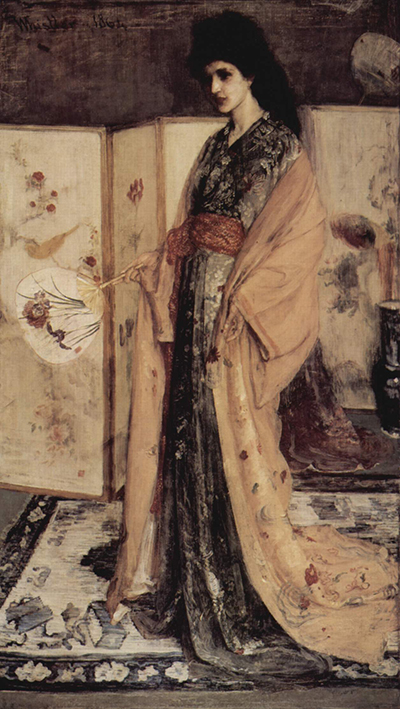
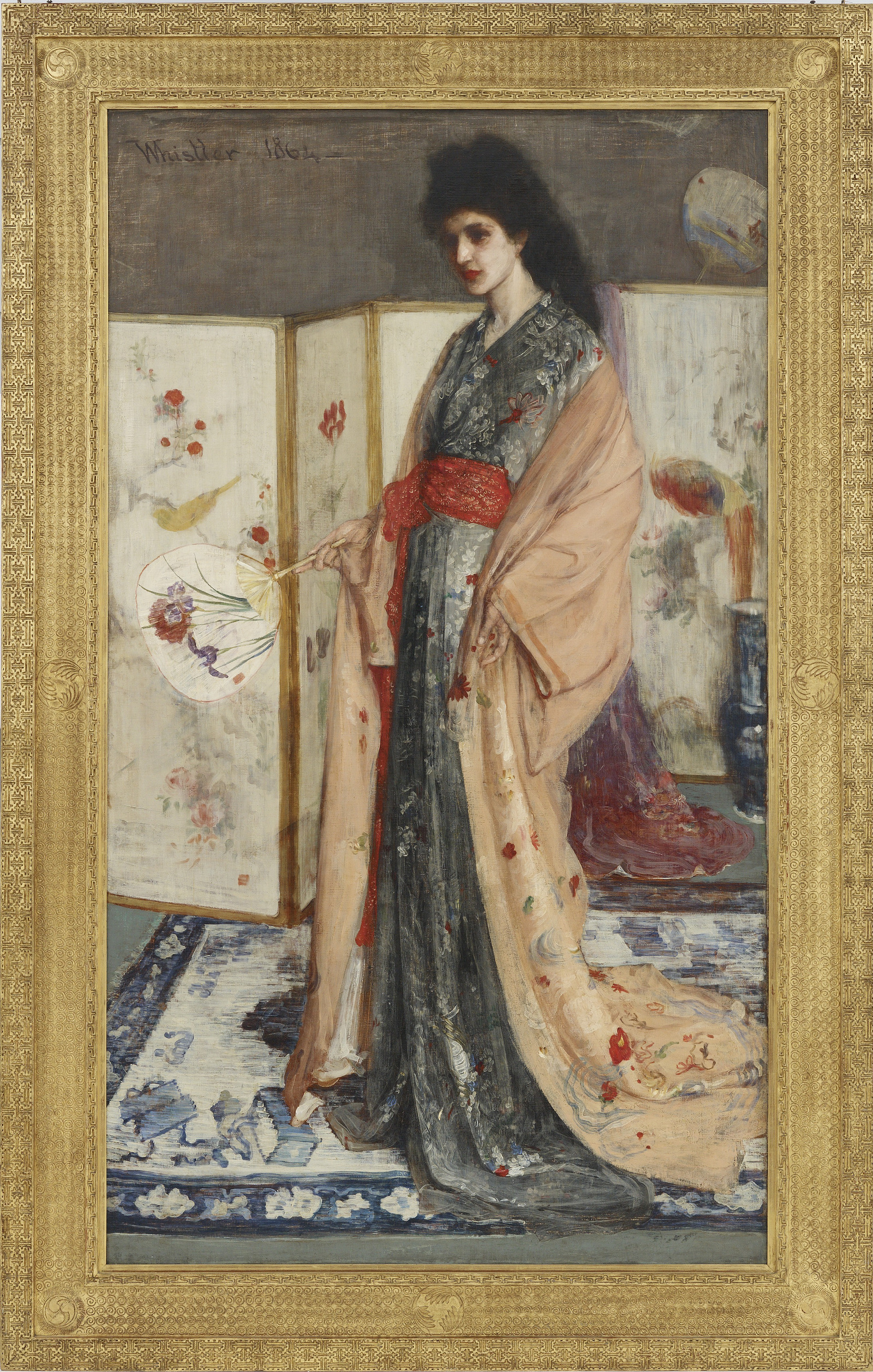
James McNeill Whistler's La Princesse du pays de la porcelaine, familiar in English as The Princess from the Land of Porcelain, is a life-size oil on canvas begun in 1863, signed “Whistler 1864” and completed for the Paris Salon of 1865. The University of Glasgow catalogue identifies it as YMSM 050. The Freer Gallery of Art, part of the Smithsonian's National Museum of Asian Art, holds it as accession F1903.91a-b.[1][4][5][6]
A dark-haired woman in patterned robes leans across a tall, narrow field. She holds an iris-decorated fan above a blue-and-white carpet. A folding screen, hanging fan, embroidered cloth and porcelain vessel surround her. Christina Spartali, a London-born woman from a Greek family, posed for this imaginary princess. The objects and costume evoke China and Japan without depicting either place as lived reality.[2][5][7][10]
The painting was already more than a decade old when Frederick Leyland placed it above his dining-room mantel. Thomas Jeckyll designed that room for Chinese blue-and-white porcelain; Whistler's colour advice expanded into the 1876–77 interior now called Harmony in Blue and Gold: The Peacock Room. The portable canvas and the architectural room remain distinct works, even though the painting now hangs again in the setting it helped inspire.[3][4][5][8]
At a Glance
- Catalogue titleLa Princesse du pays de la porcelaine
- English titleThe Princess from the Land of Porcelain
- CatalogueYMSM 050
- DateBegun 1863; signed 1864; completed 1865
- SitterChristina Spartali
- MediumOil on fine-weave canvas
- DimensionsSmithsonian: 201.5 × 116.1 cm
- AccessionF1903.91a-b
- Current displayFreer Gallery, Gallery 12
- Image rightsSmithsonian Open Access / CC0
Contents
- The painting at a glance
- Which title is correct?
- What does “land of porcelain” mean?
- Christina Spartali, the sitter
- Portrait or costume picture?
- The difficult standing pose
- The two fans
- Robes, sash and invented dress
- The carpet and lower edge
- Screen, hanging robe and porcelain vessel
The painting at a glance
The composition is oil on a fine-weave canvas. Glasgow records 199.9 × 116 centimetres, while the Smithsonian gives 201.5 × 116.1 centimetres. These are slightly different institutional measurements of the same support, not evidence that its height was altered. The upper-left signature reads “Whistler 1864,” although the documented working span reaches from 1863 to 1865.[1][3][5][6]
Spartali stands in three-quarter view towards the left and leans back towards the right. Her body describes a long reverse curve: the feet anchor one side, the hips and torso move away, and the fan-bearing arm returns attention across the picture. Critics later complained that the pose challenged gravity. That sense of suspension is precisely what gives the figure its arresting, porcelain-like poise.[2][4][13][14]
The eye moves between face and objects rather than settling on a conventional portrait hierarchy. Dark hair and red lips sharpen the pale head against a vaporous grey passage. Below, silver, cream, blue, purple and red patterning becomes denser. The figure remains recognisable, yet textile, screen, rug and vase demand nearly equal attention.[2][3][10]
Which title is correct?
The preferred catalogue title is the French phrase first published in the Salon catalogue of 1865: La Princesse du pays de la porcelaine. The Princess from the Land of Porcelain is its familiar English equivalent and the wording used by the Smithsonian. Both identify YMSM 050 and F1903.91a-b.[1][2][5]
Whistler changed the framing of the title over time. At the 1872 London International Exhibition it became The Princess, Variations in Flesh Colour, Gray, and Blue. By 1898 and again in 1905 it appeared as Rose and Silver: La Princesse du pays de la porcelaine. Those variants show the artist increasingly placing colour relations before narrative description.[2][4][14]
The early title should not be silently replaced by a later harmony formula. “Princess” and “land of porcelain” explain the represented fantasy; “variations,” “rose” and “silver” direct attention to pictorial organisation. Taken together, the names record a change in public emphasis rather than a change of object.[2][4][14]
What does “land of porcelain” mean?
To many Victorian viewers, the “land of porcelain” meant China, whose ceramic traditions had long been admired and imitated in Europe. Whistler reinforces that association with the tall blue-and-white vessel at the right. Yet the robe, fans and screen also evoke Japan, and no geographical setting is represented with documentary consistency.[5][7][10]
This mingling was characteristic of a European collecting culture in which trade moved objects more quickly than reliable historical knowledge. Chinese porcelain, Japanese prints, textiles of uncertain attribution and Western imitations could be admired together as signs of a distant aesthetic realm. The title turns that unequal circulation into a poetic country ruled by a fictional princess.[2][10][12]
The fantasy is attractive by design, but its cultural conditions should not disappear inside praise of colour. Whistler never travelled to Asia. He selected objects available in London and Paris, dressed a European model and constructed an imagined place for Western spectators. The painting can be both formally inventive and an example of nineteenth-century appropriation.[5][6][10]
Christina Spartali, the sitter
Christina Spartali was born in London in the mid-1840s to a prosperous family of Greek origin. Her father, Michael Spartali, was a merchant who later served as Greek consul-general in London. Her elder sister Marie Spartali Stillman became a painter and preserved the most detailed account of the sittings. Christina later married and became Countess Edmond de Cahen.[2][5][9][18]
Older Whistler literature often calls her Christine. The current Smithsonian record uses Christina, as do museum materials about the Peacock Room. The variant should not obscure her identity or turn her represented role into biography. She was neither Chinese nor Japanese, and “princess” was not her social title when she posed.[2][5][7]
Whistler knew the Spartali family through an Anglo-Greek social and artistic circle that included the Ionides family. Both Christina and Marie were celebrated for their appearance, but beauty alone does not explain the painting. Christina supplied a demanding full-length pose over an extended series of sittings, while Marie's attendance made her an unusually important witness to the work's construction.[2][3][11]
Portrait or costume picture?
The Smithsonian describes the painting as one of Whistler's mid-1860s costume pictures and says it was not intended as a conventional portrait. The designation is useful because costume, objects and formal pattern compete with individual likeness. Spartali is asked to embody a new ideal, not to appear in her ordinary dress or domestic identity.[5][6][7]
Yet portrait and costume study never separate completely. A Society of Portrait Painters catalogue in 1892 identified “Portrait de Miss S...,” and Whistler later called the work a portrait of Miss Spartali in Japanese dress. He even compared its status with his portrait of Thomas Carlyle, differing because one sitter wore a Japanese dressing gown and the other did not.[2][4][15]
Michael Spartali's reported refusal to buy the canvas exposes the same ambiguity. According to the Pennells, he objected to it as a portrait of his daughter. His reaction cannot settle Whistler's purpose, but it shows that contemporaries could read the recognisable sitter beneath the imaginary princess. The picture works at the boundary between likeness, type and decorative figure.[2][4][11]
The difficult standing pose
Spartali's weight seems to shift backwards while her head and fan remain alert. The lean lengthens the torso and causes the robe to fall in a diagonal sweep. Her feet are partly absorbed by the patterned floor, reducing the stable platform expected in an academic full-length portrait. The viewer senses balance as an active problem.[2][4][10]
Marie recalled that Whistler established the pose at the first sitting. The robe, rug and screen were already arranged when the sisters entered the studio. A related study, YMSM 049, shows the same broad attitude with another model, confirming that Whistler developed the pose separately from Christina's final likeness.[3][11]
The posture has been compared with elongated figures on Chinese porcelain and women in Japanese ukiyo-e prints. Such comparisons illuminate stylisation, but they do not turn the canvas into a direct copy. A Western model occupies a near life-size format; observed standing, repeated sittings and changes to the head remained essential to the result.[3][5][7]
The two fans
Spartali holds a fan with a bamboo handle in her right hand. Irises spread across its surface, creating a compact display of curved stems and coloured petals. The open fan repeats the directional movement of her arm while interrupting the grey zone around the head. It is prop, pattern and compositional counterweight at once.[2][7]
A second fan hangs high at the right. Because it is detached from the figure, it behaves more like a sign pinned against the surface. The two forms establish a rhythm between hand-held object and wall decoration, just as the blue-and-white vessel answers the patterned carpet below.[2][10]
Calling both objects simply “Asian” would lose the point. Fans circulated through different Chinese and Japanese traditions and through European trade. The available catalogue identifies the held fan's bamboo handle and iris decoration but does not securely attribute a maker. Description should remain exact where origin does not.[2][7][10]
Robes, sash and invented dress
The main garment is grey and silver, tied with a red sash. A cream decorated robe falls over it, creating broad pale passages edged and interrupted by pattern. The ensemble is commonly called a kimono in museum interpretation, but it is a studio costume rather than evidence of historically correct Japanese dressing.[2][5][7]
Whistler arranged garments around colour and silhouette. The red sash holds the middle of the figure, dark hair caps the upper field, and cream fabric carries the eye down into the blue-and-white floor. Because the body turns while the robe trails, pattern can seem to continue independently of anatomy.[3][10]
That independence troubled critics who wanted the clothing to reveal a fully modelled body. It also gives the picture its distinctive effect. Spartali appears both corporeal and like an image painted on porcelain: present as a standing person, yet translated into a long configuration of coloured surfaces.[4][10][13]
The carpet and lower edge
The carpet beneath Spartali is blue and white, heavily patterned and tilted towards the picture plane. It does not open a measured floor far into depth. Instead, it makes a dense base across which the hem, feet and lower accessories are distributed.[2][3]
This surface helps explain why “flattening” alone is inadequate. Overlap still establishes space: figure covers rug, robe covers support, vase stands before screen. At the same time, repeated blue and pale marks insist on the canvas as a decorated field. Depth and surface operate together rather than one abolishing the other.[3][10]
The carpet also prepares the painting's later relationship with Leyland's dining room. Whistler objected when reds in the room's rug competed with the rose tones of the picture. That complaint belonged to the 1870s installation, not the original studio design, but it shows how insistently he judged the environment around the canvas by colour.[4][8][16]
Screen, hanging robe and porcelain vessel
The folding screen fills much of the background with birds, flowers and sprays of blossom. Its hinges divide the field into sections, but painted decoration crosses those divisions. The screen therefore supplies both an architectural barrier and an active pictorial surface.[2][10]
At the right, a purple embroidered robe is thrown over an unseen stool or chair. The concealed support makes the textile seem almost animate, a secondary cascade answering Spartali's standing body. Beside it, the tall blue-and-white vessel provides a rigid vertical that checks the figure's lean.[2][3]
These objects do not simply advertise Whistler's possessions. Each carries a different kind of surface: screen painting, textile embroidery and ceramic glaze. Their placement lets oil paint imitate and compare materials. The canvas becomes an encounter among ways of making images as much as a display of imported luxury.[3][10]
Inside the Lindsey Row studio
The work was made at 7 Lindsey Row in Chelsea, in a modest upper room overlooking the Thames district where Whistler lived and worked. Later descriptions called this the setting for his Japanese pictures. The objects belonged to a real London studio even though their arrangement created an unreal country.[2][12]
Henri Fantin-Latour visited in July 1864 and wrote to his parents that life there felt like an impossible paradise, invoking Nagasaki, the Chinese Summer Palace, China and Japan in one breath. His delight documents the imaginative atmosphere shared by Whistler's circle. It also demonstrates how readily distinct places were collapsed into a European dream.[2][10][12]
Aileen Tsui stresses that this fantasy could attach itself both to genuine East Asian objects and to European imitations. That distinction matters because the painting's truth is not ethnographic authenticity. Its truth lies in how imported things, mistaken knowledge, desire and painterly decisions met inside one Chelsea room.[2][10]
Preparing the composition
Marie Spartali Stillman remembered that the scheme looked prepared from the first day. Whistler had arranged robe, carpet and screen and immediately gave her sister the pose. The account suggests substantial advance thought, yet it should not be inflated into a claim that every surviving sketch preceded the final canvas.[3][11]
YMSM 049 preserves a closely related pose but a different model. Marie also remembered several small studies in oil and pastel, although the present catalogue does not identify a secure surviving group matching that description. Memory and surviving evidence overlap without being identical.[3][11]
A later pastel of a Japanese lady decorating a fan echoes the pose in reverse, but its butterfly signature dates it to about 1870–72. It relates to a subsequent decorative project rather than functioning as evidence for the first conception. Whistler revisited the solution after completing the Princess.[3]
Twice-weekly sittings and delay
The Spartali sisters came twice a week through the winter of 1863–64. Marie recalled that progress began quickly and then slowed. Whistler repeatedly scraped down passages that seemed nearly finished, compelling the sitter to resume a demanding position.[3][11]
The head gave him the greatest trouble. Christina was expected to stand without relaxing the entire pose and concealed her fatigue as long as she could. When illness interrupted the sittings, another model may have worn the gown. The catalogue proposes Emelie “Millie” Eyre Jones, but the identification remains tentative.[2][3]
After Christina recovered, Whistler reportedly made a pencil drawing of her head and obtained a few more sittings. The drawing's whereabouts are unknown. Her illness also appears in Whistler's 1865 correspondence explaining why the painting had been set aside and why he was again working intensively to finish it for the Salon.[1][3][11][12]
Light, distance and a single stroke
Whistler partially closed the shutters to remove direct light. That choice softened illumination and reduced abrupt changes during the long session. It helps explain the diffuse grey surrounding the head, where atmosphere seems less tangible than the patterned lower field.[3][11]
Marie watched him stand away from the canvas, inspect it and then dash forward to make one stroke before retreating again. The anecdote is retrospective, but it describes a method consistent with the picture: individual marks were judged for their effect on the whole arrangement.[3][11]
He could work past the expected lunch hour, absorbed in recalibrating the canvas. This was neither rapid transcription nor mechanical finish. Observation, memory, removal and sudden intervention alternated. The apparent ease of the final curve conceals an extended sequence of decisions.[3][11][12]
Scraping and repainting
Scraping was not an exceptional rescue undertaken once. Marie remembered repeated reductions of the figure, and Whistler's correspondence records frustration with the prolonged work. Passages were sacrificed even after observers believed them close to completion.[3][11][12]
That process complicates the idea that the canvas simply transfers decorative Japanese design into oil. Whistler had to sustain a standing body, a recognisable head, varied materials and a difficult pose across a very large support. Decorative unity emerged through correction, not through avoidance of representation.[3][10]
The 1864 signature records a major stage rather than the unquestionable end. A work can be signed and still remain in progress. The Salon date of 1865, the sitter's interruption and the artist's renewed labour together justify the catalogue's three-year span.[1][3][4][12]
Mist, patches, dashes and streaks
The upper section is thinly atmospheric. Grey paint around Spartali's head appears vaporous, leaving her face and dark hair suspended against an uncertain depth. Below, flatly brushed patches, dots, dashes and elongated streaks articulate costume and objects.[3][10]
The contrast prevents one technique from governing the whole canvas. Soft transitions suit air and face; sharper marks make embroidery, carpet and screen optically assertive. Whistler does not fully model every form before adding ornament. Pattern can participate in constructing the form itself.[3][10]
Tsui argues that these decorative surfaces rival the human figure in visual intensity. That is a stronger and more precise observation than saying the painting becomes abstract. The face still carries expression and identity, while objects insist that visual value is not reserved for human flesh.[3][10]
Colour without a single hierarchy
Silver-grey, cream, rose-red, blue, white, purple and black recur at different scales. No local hue remains confined to one object. Pale notes travel from face to robe and floor; dark accents connect hair, folds and screen; blue circulates between rug and porcelain.[2][3][7]
This recurrence helps the eye cross cultural and material boundaries, but it does not erase them. Ceramic blue has a glazed crispness, cloth spreads colour through folds, and the grey upper band appears airy. Harmony is a relation among differences, not a claim that everything is made of the same substance.[3][10]
Whistler's 1872 programme described his exhibited works as complete harmonies obtained from many variations within a limited colour range. The statement came after this painting's creation, yet it explains why later titles shifted towards “variations,” “rose” and “silver.” The canvas already offered the visual argument later words made explicit.[2][14]
Chinese porcelain and Japanese print comparisons
The tall vessel and title invite comparison with elongated women painted on Chinese blue-and-white porcelain. The standing figure's length, patterned dress and graceful curve can resemble a human image carried around a ceramic surface. Victorian critics recognised the analogy, although some used it to complain that Spartali lacked life.[5][7][10][13]
Japanese ukiyo-e prints offered another model: women whose silhouette, garment pattern and gesture organise a sheet without Western academic modelling. The held fan and asymmetrical placement intensify that connection. Museum interpretation rightly presents both sources rather than reducing the painting to either Chinese or Japanese influence.[5][7]
Whistler did not reproduce a specific print or pot in enlarged form. He combined selected possibilities with European oil painting, a life-size support and repeated posing from a living model. “Influence” is therefore a relation of adaptation, collecting and invention, not a statement of faithful transmission.[3][5][10]
The artist-designed carved frame
Whistler designed the frame in 1864. Its raised flat outer edge carries a carved cross-hatch pattern compared with lacquer boxes. Within that border, carved whorls and roundels alternate with stylised chrysanthemums and tripod-like forms. A Greek-key pattern and bevelled sight edge complete the inner transition.[3][17]
The frame is English-made and may have been constructed by Joseph Green, a craftsman associated with Pre-Raphaelite artists. “Possibly” is essential. Whistler determined the design, but no evidence requires him to have carved its ornament personally.[3][17]
Glasgow calls it one of the artist's finest and most intricate frames. It is believed to have remained with the picture from 1864. Its patterns prepare the viewer for the world inside and make the physical edge another site where European craftsmanship interprets Asian-associated forms.[3][17]
A frame inside another frame
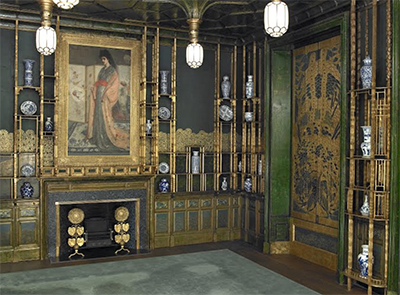
When the painting was later installed in Leyland's dining room, Jeckyll's shelving was designed to enclose it over the mantel. The picture already had its carved frame; the architecture added a second gilded boundary. Ceramic shelves extended outward on both sides, linking the imaginary land inside the canvas to actual porcelain in the room.[3][8][16]
That installation was historically powerful but chronologically later. The frame was made with the painting around 1864. The shelving belonged to a dining room completed and transformed in the mid-1870s. Treating both as one original conception would erase more than a decade of separate ownership and development.[1][3][4]
The painting's ability to anchor the room does not make it a detachable component without its own identity. It kept accession F1903.91a-b, while the Peacock Room entered the Freer collection as F1904.61. Their reunion is a collection history, not a merger.[5][6][8]
Conservation history of the canvas
Freer Gallery files record several interventions: cleaning and repair in 1922, relining in 1931, resurfacing in 1942, all three treatments in 1950, and cleaning, retouching and revarnishing in 1970. The sequence shows that the present surface has a documented material history.[3]
These brief records do not justify a dramatic claim that the painting was ruined, nor do they support language of pristine untouched paint. Relining affects the canvas support; cleaning and varnishing alter how the surface is protected and seen; retouching addresses losses or disruptions. A responsible account names the work without inventing present condition findings.[3]
The frame has its own history, and the architectural room has undergone separate conservation campaigns. Current display brings the three together visually, but treatment records must remain assigned to the correct object. Canvas, carved frame and interior are materially related yet administratively and physically distinct.[3][8]
The Paris Salon of 1865
The painting debuted at the 83rd Paris Salon, catalogue 2220, under its French title. Théodore Duret later recalled that it hung on the line, a prominent height rather than a remote upper position. Its scale, pose and unfamiliar combination of objects made it difficult to overlook.[1][4][13]
Several critics judged it by expectations for a living figure. Paul Mantz reduced it to a costume study; others complained of deficient modelling, expression or movement. Ernest Chesneau's response turned the title against the picture by arguing that the porcelain country should not be a land of shadows.[4][10][13]
Such remarks identify the canvas's challenge. Pattern and surface compete with anatomical animation, while the sitter's lean refuses stable academic posture. The reviews also reveal a readiness to treat East Asian-associated art as lifeless ornament. Their language must be cited as period reception, not repeated as neutral description.[4][10][13]
Admiration, discomfort and the “sphinx”
The Salon response was not uniformly hostile. Théophile Gautier found the figure both alluring and disturbing, a confrontation that resisted easy cultural placement. Louis Gallet compared the dark-haired, red-lipped head to an antique sphinx capable of stopping a passer-by.[4][13]
These reactions recognised force where other critics saw vacancy. The same reduced modelling could appear bloodless to one observer and enigmatic to another. The same long pose could look mechanically porcelain-like or powerfully self-contained.[4][10][13]
Reception therefore belongs inside the work's history rather than at the end as a scorecard. The critics show that colour, costume and figure could not be separated cleanly. Their disagreement helps modern viewers see the calculated tension between living sitter and fabricated icon.[4][13]
London in 1872
At the London International Exhibition the canvas appeared as The Princess, Variations in Flesh Colour, Gray, and Blue. The new wording invited viewers to judge a restricted chromatic scheme rather than search for a story about an actual royal subject.[2][4][14]
The Times did appreciate the clever colour study, yet attacked the face and argued that the backward lean exceeded possible equilibrium. The review captures both recognition and resistance. Whistler's formal intelligence was visible even to a critic unwilling to accept its figure.[4][14]
That exhibition also brought the work into Frederick Leyland's ownership. Whistler reported in November that it hung by the fireplace in the “Velasquez Room,” visible from the hall. The location preceded the famous dining room and shows that Leyland valued the painting independently before it became the centre of an architectural ensemble.[4][15]
The uncertain first sale
Christina and Marie reportedly hoped their father would acquire the picture, but he declined. Dante Gabriel Rossetti then displayed it in his studio for a prospective buyer. One collector allegedly objected to Whistler's conspicuous signature, and that transaction failed.[2][4][11]
The Smithsonian provenance records an unidentified collector who bought the picture from Rossetti's studio, followed by Leyland's purchase from that owner's estate. The identity of the intermediary remains unresolved. Whistler later remembered receiving either one hundred pounds or fifty and admitted uncertainty himself.[4][5][15]
Those contradictions should be preserved rather than smoothed into a confident sale price. What can be stated securely is the sequence from Rossetti's mediation through an early unidentified owner to Leyland by 1872. The vague beginning contrasts with the much better documented auction and transfers after 1892.[4][5]
Thomas Jeckyll and Leyland's dining room
Leyland's new dining room at 49 Prince's Gate was designed by Thomas Jeckyll. Intricate wooden shelving displayed prized blue-and-white Chinese ceramics, especially wares attributed to the Kangxi era. Antique gilded leather covered the walls, and the Princess received the central place above the mantel.[5][7][8]
This was conceived as a porcelainzimmer: a luxurious room in which collecting, dining and social status met. Jeckyll's repeated uprights turned individual ceramics into an ordered display. The painting's imaginary porcelain realm became a visual ruler above an actual collection.[5][7][16]
Jeckyll's authorship must remain visible. Whistler did not design the room from an empty shell. He entered a substantially developed architectural project, initially to advise on colour and later to transform surfaces Jeckyll had structured.[8][9][16]
How the painting inspired the Peacock Room
Whistler thought red roses on the gilded leather and red in the carpet damaged the delicate rose tones of his painting. Leyland allowed limited alterations. Yellow and gold adjustments then seemed to clash with the leather, prompting further changes.[4][8][16]
While Leyland was away and Jeckyll was ill, Whistler expanded his intervention. He gilded shelving, covered the ceiling with imitation gold and peacock-feather patterns, painted shutters and eventually coated leather in Prussian blue. The result was Harmony in Blue and Gold: The Peacock Room, completed in 1877.[7][8][9]
The story is often told as if the painting and room were born together. They were not. The canvas was made for the Salon in the 1860s, changed owners and acquired its place in Leyland's home. Only later did its colour become a standard against which Whistler judged the dining room.[1][4][8]
Painting and room are separate works
The distinction is physical. The Princess is oil on canvas with a carved wooden frame. The Peacock Room incorporates oil paint and metal leaf across canvas, leather, mosaic tile, glass and wood. One can be removed from the other, as the 1892 sale demonstrated.[3][5][8]
The distinction is also historical. YMSM 050 covers the painting's 1863–65 making; YMSM 178 covers the 1876–77 interior. Leyland bought the canvas before commissioning the room. Charles Lang Freer bought the canvas in 1903 and the room in 1904 as two transactions.[1][4][5][8]
Their current unity is meaningful because it is reconstructed. The canvas again presides over the mantel, but museum records preserve separate accessions and media. Visitors can experience the visual relationship without losing the independence of each object.[5][6][8]
Sale after Leyland's death
Leyland died in 1892, and the painting was removed from the dining room for sale at Christie's on 28 May. Whistler urged dealers to compete for it and worried that an important early picture might be sold cheaply. Alexander Reid acquired it for 420 guineas.[4][5][15]
Whistler complained about the price even though it far exceeded his uncertain original payment. Beatrice Whistler encouraged Reid to clean and varnish the canvas and suggested much higher resale ambitions. Their letters combine concern for appearance, reputation and market value; none should be treated as disinterested condition evidence.[4][15]
The sale proved that the frame and canvas could leave the room while Jeckyll and Whistler's interior remained at Prince's Gate. It also opened a twelve-year interval during which the two works followed separate paths before Freer reunited them.[3][4][8]
Reid, Burrell and Freer
Reid lent the picture widely after purchasing it. It appeared with the Society of Portrait Painters in 1892 and travelled to the World's Columbian Exposition and the Pennsylvania Academy in 1893. Whistler pressed for prominent hanging and used the work to represent his achievement internationally.[4]
Around 1894 or 1895 Reid sold it to Glasgow collector William Burrell. Burrell lent it to exhibitions in Glasgow, London and Venice. In 1901 one catalogue annotator praised its colour while finding its character affected, evidence that the nineteenth-century tension between chromatic admiration and discomfort remained active.[4]
Charles Lang Freer bought the painting from Burrell on 20 August 1903. Glasgow records a price of £3,750. In 1904 he acquired the Peacock Room separately, had it dismantled and shipped to Detroit, and restored the framed painting to its architectural place.[3][4][5][8]
From Detroit to Washington
Freer installed the room in his Detroit house and filled it with his own ceramics rather than recreating Leyland's collection exactly. The contents therefore changed the setting's cultural argument. A British shipping magnate's porcelainzimmer became an American collector's comparative display.[7][8]
Freer signed the deed giving his collection to the United States in 1906. After his death in 1919, the collection was received in Washington, and the Freer Gallery opened in 1923. The painting and room entered public museum life together but retained their separate records.[5][6][8]
Under the terms of Freer's gift, the painting does not travel on loan. Its long exhibition journey—from Paris and London through Glasgow, Chicago, Philadelphia, Venice and Boston—ended in the setting Freer created for it at his museum.[4][5]
Where is the painting now?
The Smithsonian's official record lists The Princess from the Land of Porcelain as on view in the Freer West Building, Gallery 12. As checked on 25 August 2026, it forms part of The Peacock Room in Blue and White, an installation opened on 27 September 2025.[5][6]
The painting hangs above the mantel, surrounded by gilded shelving and blue-and-white ceramics. That view makes the relationships among title, painted vessel, carved frame, architectural frame and collected porcelain unusually clear. It also risks encouraging viewers to assume the room and canvas share one origin.[5][7][8]
Reading the labels and accessions corrects that impression. F1903.91a-b is the canvas and frame; F1904.61 is the later room. Their present arrangement is the final stage of a history involving Christina Spartali, Paris critics, Leyland's collecting, Whistler's quarrel, Scottish ownership and Freer's museum.[4][5][8]
Why this painting matters
The Princess matters because it refuses a simple category. It is a recognisable likeness but not an ordinary portrait, a costume study with monumental ambition, a European oil shaped by Chinese porcelain and Japanese prints, and an easel picture that later reorganised an entire room.[2][5][10]
Its making also revises the myth of Whistler as a purely instinctive decorator. The recorded sittings were long, the pose exhausting, the head repeatedly changed and the signed canvas carried into another year. Surface harmony was earned through sustained revision.[3][11][12]
Finally, its beauty cannot be separated from the nineteenth-century conditions that produced it. Trade and imperial power brought Asian objects into European collections; incomplete knowledge turned distinct cultures into a fantasy realm; a Western sitter was costumed as its princess. Precise looking allows admiration and historical criticism to operate together.[5][7][10]
Frequently Asked Questions
The principal sitter is Christina Spartali, born in London to a Greek merchant family and later Countess Edmond de Cahen. Her sister Marie Spartali Stillman attended sittings and became an artist. During Christina's illness, another model may have stood for the gown, but that substitution is not certain.[2][3][5]
No biographical claim of that kind is supported. Spartali was a London-born woman of Greek family background. Whistler placed her in Asian-associated costume among Chinese and Japanese objects to create an imaginary “land of porcelain.” The represented role and the sitter's identity must remain separate.[2][5][7][10]
Discussion
Where does the painting end and the Peacock Room begin?
Look from Christina Spartali's counter-lean through the fans, robe, screen, porcelain and carpet, then outward to Whistler's carved frame and the later architectural setting.
Reader Insights
How does the counter-lean hold elegance and instability in the same figure?
Where do mist, patches, dashes and patterned objects compete with the face?
How does the original carved frame change your reading inside the Peacock Room?
Join the Conversation
Share a close observation or an object-history question.
References
- Margaret F. MacDonald and Grischka Petri, “La Princesse du pays de la porcelaine,” YMSM 050, The Paintings of James McNeill Whistler: A Catalogue Raisonné, University of Glasgow, 2021. https://www.whistlerpaintings.gla.ac.uk/catalogue/display/?mid=y050
- Margaret F. MacDonald and Grischka Petri, “La Princesse du pays de la porcelaine: Subject,” YMSM 050, University of Glasgow, 2021. https://www.whistlerpaintings.gla.ac.uk/catalogue/display/?mid=y050&xml=sub
- Margaret F. MacDonald and Grischka Petri, “La Princesse du pays de la porcelaine: Technical Description,” YMSM 050, University of Glasgow, 2021. https://www.whistlerpaintings.gla.ac.uk/catalogue/display/?mid=y050&xml=tec
- Margaret F. MacDonald and Grischka Petri, “La Princesse du pays de la porcelaine: History,” YMSM 050, University of Glasgow, 2021. https://www.whistlerpaintings.gla.ac.uk/catalogue/display/?mid=y050&xml=his
- Smithsonian National Museum of Asian Art, “The Princess from the Land of Porcelain (La Princesse du pays de la porcelaine),” F1903.91a-b. https://asia.si.edu/explore-art-culture/collections/search/edanmdm:fsg_F1903.91a-b/
- Smithsonian Institution, “The Princess from the Land of Porcelain (La Princesse du pays de la porcelaine),” F1903.91a-b. https://www.si.edu/object/princess-land-porcelain-la-princesse-du-pays-de-la-porcelaine:fsg_F1903.91a-b
- Smithsonian National Museum of Asian Art, Exploring the Peacock Room, educator resource. https://asia.si.edu/wp-content/uploads/2023/04/edu-resources-EDU201709-Peacock-Rm-Educator-Resource-Poster-Final-with-links.pdf
- Smithsonian National Museum of Asian Art, “Harmony in Blue and Gold: The Peacock Room,” F1904.61. https://asia.si.edu/explore-art-culture/collections/search/edanmdm:fsg_F1904.61/
- Smithsonian National Museum of Asian Art, “Making the Peacock Room.” https://asia.si.edu/explore-art-culture/interactives/peacock-room/making-the-peacock-room/
- Aileen Tsui, “Whistler's La Princesse du pays de la porcelaine: Painting Re-Oriented,” Nineteenth-Century Art Worldwide 9, no. 2, Autumn 2010. https://www.19thc-artworldwide.org/autumn10/whistlers-la-princesse-du-pays-de-la-porcelaine
- Marie Spartali Stillman's account of the sittings, recorded in Elizabeth Robins Pennell and Joseph Pennell, The Life of James McNeill Whistler, vol. 1, London and Philadelphia, 1908, pp. 122–25.
- James McNeill Whistler correspondence, 1864–65, The Correspondence of James McNeill Whistler, University of Glasgow; Henri Fantin-Latour to his parents, 12 July 1864. https://www.whistler.arts.gla.ac.uk/correspondence/
- 83rd Exhibition, Salon de 1865, Paris, 1865, cat. 2220; reviews by Paul Mantz, Jules Claretie, Claire de Charnacé, Louis Auvray, Ernest Chesneau, Paul de Saint-Victor, Théophile Gautier fils and Louis Gallet.
- London International Exhibition of 1872 catalogue and Programme of Reception; “The International Exhibition,” The Times, 14 May 1872, p. 6.
- Correspondence of James McNeill Whistler, Frederick Leyland, Alexander Reid, David Croal Thomson and Beatrice Whistler, 1872 and 1892–93, University of Glasgow. https://www.whistler.arts.gla.ac.uk/correspondence/
- Linda Merrill, The Peacock Room: A Cultural Biography, Yale University Press, 1998.
- Sarah L. Parkerson Day, report on Whistler frames, 2017, Glasgow University Library Whistler Paintings Project; University of Glasgow frame research in YMSM 050.
- National Portrait Gallery, “Christina Spartali (later Countess Edouard Cahn d'Anvers),” person MP62621. https://www.npg.org.uk/collections/search/person/mp62621/christina-spartali-later-countess-edouard-cahn-danvers