 by Tom Gurney
Tom Gurney BSc (Hons) is an art history expert with over 20 years experience
Published on June 19, 2020 / Updated on November 6, 2026
Email: tomgurney1@gmail.com / Phone: +44 7429 011000
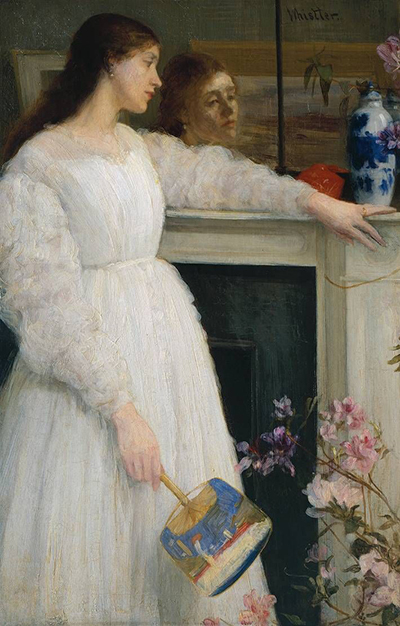
James McNeill Whistler painted the work now called Symphony in White, No. 2: The Little White Girl in 1864. The University of Glasgow catalogue identifies it as YMSM 052, and Tate holds it as N03418. It is oil on canvas, measuring 76.5 × 51.1 centimetres. Early photographs show that Whistler originally signed and dated it “Whistler 1864” at the upper right; the year was later removed.[1][3][5]
Joanna Hiffernan stands in profile beside a pale mantelpiece. Her left arm extends towards a mirror, where her face appears in reflection. Her right hand holds a colourful fan. A red bowl, blue-and-white Chinese vase and pink-lilac azaleas interrupt the range of white, cream and grey. The painting is a portrait-like study of an adult Irish woman, not a picture of an unidentified child.[2][7][8][9]
The numbered title came later. Whistler called the canvas “the little White Girl” in 1864, and the Royal Academy exhibited it under that name in 1865. Only after a third white composition appeared in 1867 did this one become Symphony in White, No. 2. The sequence helps viewers compare colour and arrangement, but it was not the original plan announced when Whistler began the first canvas.[1][2][4]
At a Glance
- CatalogueYMSM 052
- Date1864
- Original titleThe Little White Girl
- NumberingNo. 2 added retrospectively after 1867
- SitterJoanna Hiffernan
- MediumOil on canvas
- Dimensions76.5 × 51.1 cm
- CollectionTate, N03418
- Original frameWhistler design; whereabouts unknown
- Current frameGrau-style, after 1892; modified c.1919
Contents
- The painting at a glance
- Why is it called No. 2?
- How No. 2 differs from the first White Girl
- Joanna Hiffernan is the sitter
- Profile, mirror and averted gaze
- What exactly appears in the mirror?
- Does the reflection show sadness?
- The ring on Hiffernan's hand
- The white muslin dress
- How white is made visible
The painting at a glance
The portrait is vertical and relatively intimate: approximately 30 by 20 inches rather than life-size. Hiffernan is shown to below the knees, turned towards the mantel. Her profile, reflected face and loosely hanging fan create three directions of attention without requiring her to look outward at the spectator.[1][2][5]
White is not one uniform pigment or symbolic statement. Thickly applied paint describes translucent sleeves, fuller skirt, plaster or stone mantel and reflected light. Warmer flesh shows through the fabric at the right arm. Dark hair, the red bowl, blue vase, Japanese fan and flowers create small chromatic interruptions that make neighbouring whites look different.[2][3][8]
The mirror doubles the head but not mechanically. Technical examination shows that Whistler changed the actual head more than the reflected one. Their resulting difference—one more upright and fully in profile, the other at another angle—makes reflection an active pictorial problem rather than a neutral copy.[3]
Why is it called No. 2?
The familiar numbering is retrospective. In correspondence from 1864 Whistler used “the little White Girl.” The Royal Academy catalogue of 1865 did the same. At the 1872 London International Exhibition it appeared simply as The White Girl, wording that could now cause confusion with the earlier full-length canvas.[1][2][4][13]
Whistler began using the expanded title after Symphony in White, No. 3 was shown in 1867. By 1878 he was calling the Tate painting The Little White Girl (Symphony in White No. 2). The Goupil retrospective of 1892 consolidated Symphony in White No. II. The Little White Girl.[2][4]
Numbering the works directs attention to a developing chromatic family. It does not mean Whistler designed three fixed movements in advance. YMSM 038, 052 and 061 differ in dimensions, pose, making, ownership and exhibition history. The musical analogy was an organising language imposed as the group evolved.[1][2]
How No. 2 differs from the first White Girl
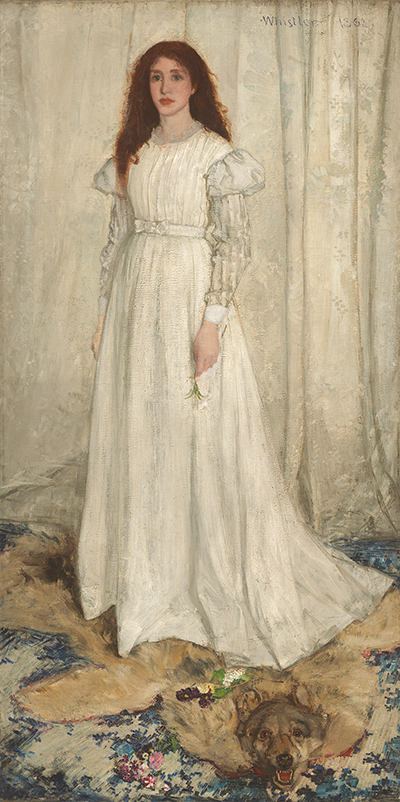
Symphony in White, No. 1 is a near life-size standing figure against a pale curtain and pelt. No. 2 is smaller, cropped to three-quarter length and embedded in a domestic interior. Hiffernan turns away; the mirror offers an indirect face. Objects and reflections share the available space with her.[1][2][7]
The first canvas endured a long and contested making between 1861 and 1863, followed by rejection and exhibition at the Salon des Refusés. No. 2 belongs securely to 1864 and appeared at the Royal Academy in 1865. The later numbering should not cause the first work's difficult history to migrate onto the second.[1][4][12]
Nor should the repeated white dress imply one symbolic story continuing in episodes. Hiffernan's modelling connects the pictures, as do Whistler's experiments with restricted colour. Yet the mantel, mirror, fan, porcelain, flowers and intimate scale give No. 2 a separate visual structure.[2][8][9]
Joanna Hiffernan is the sitter
Joanna Hiffernan was Whistler's Irish-born partner and most important model during the early 1860s. She also handled practical and financial responsibilities and later received legal authority in his affairs. Describing her only as his “mistress” misses the skilled, sustained labour their working relationship required.[7][9]
The title's “little girl” is therefore not biographical identification. Hiffernan was an adult. Victorian titles could use diminutive language for female figures, but a modern account should name the sitter and avoid turning the phrase into an age claim.[2][7][9]
Her body also preserves the painting's revision history. Holding a pose made comparison and change possible; altered arms, head and fan were developed around her repeated presence. Imaging can reveal Whistler's decisions, but it cannot restore Hiffernan's thoughts during the sittings.[3][9]
Profile, mirror and averted gaze
Hiffernan faces to the right, so the viewer sees a clean profile rather than a frontal exchange. Her left forearm lies along the mantel. The relaxed surface of that gesture contrasts with the careful alignment of hand, mirror edge and reflected head.[2][3]
The turned body does not remove her from the painting. It changes how contact occurs. Viewers inspect the visible profile and then search the mirror for another view, only to encounter an image that seems less stable than expected. The right hand and fan pull the eye downward again.[2][6]
This circuit encourages psychological interpretation without fixing one emotion. “Dreamy,” “contemplative,” “careworn” and “sad” have all been used. They are responses to pose and reflection, not entries in a diary. The painting withholds a definite narrative while providing enough visual tension to stimulate one.[2][6][9]
What exactly appears in the mirror?
The mirror contains Hiffernan's face and parts of pictures hanging on the opposite wall. A seascape painting lies behind the reflected head. It is easy to mistake that painted sea for a view beyond the room, but the mirror is reflecting another artwork, not opening onto a coast.[2][6]
Images are therefore nested. Whistler paints a mirror that reflects paintings; the mirror also translates his sitter into a second face. Below, the fan carries a reproduced Hiroshige landscape. The canvas brings different image technologies—oil painting, reflection and woodblock print—into one domestic arrangement.[2][10]
The reflection is not a perfectly synchronised double. Whistler repositioned the principal head by about two centimetres and changed its angle, while the mirrored head received fewer alterations. Their divergence arose through the act of painting. It need not signify a supernatural second self.[3]
Does the reflection show sadness?
Tate commentary has described the reflected face as sad or worn beside Hiffernan's graceful presence. That reading is understandable: the reflected head is darker and awkwardly angled, and the seascape behind it creates distance. Yet no document confirms that Whistler intended a portrait of private sorrow.[6]
Later writers have extended the mismatch into premonition, spiritual encounter or a confrontation between youth and future age. Such themes belonged to Victorian literature and visual culture, but they remain interpretive possibilities. A proposed connection with Lewis Carroll is particularly speculative and should not become an influence claim.[2][6]
The strongest conclusion is formal. The mirror allows one head to carry two treatments. Because Whistler revised them differently, the viewer compares actual and reflected likeness as unequal painted passages. Ambiguity is an effect of construction before it becomes a story.[3][6]
The ring on Hiffernan's hand
A ring is visible on Hiffernan's left hand where it rests near the mantel. Its prominence has encouraged stories that the picture transforms her into a wife or records a private commitment. Whistler and Hiffernan were not legally married, and the ring alone cannot establish a specific promise.[6][7][9]
It is equally unsafe to arrange her paintings as a moral sequence—from sex worker in Wapping, through mistress in the first white canvas, to redeemed wife here. Those are represented roles, art-historical labels and later inferences, not successive documentary identities. Hiffernan's biography does not advance by changing costume.[7][9]
The ring can still matter visually. Its small dark-gold form punctuates the white hand near the mirror and flowers. Description need not suppress it; evidence control means separating what is visible from what the object supposedly proves.[2][6]
The white muslin dress
Hiffernan wears a round-necked white dress with long sleeves. Fashion research compares it with a bleached cotton tarlatan dress from about 1864. The surviving garment helps explain translucency and structure but is not documented as the exact dress used in Whistler's studio.[2][8]
The silhouette is narrower than the wide crinoline fashionable in early-1860s satire. A Punch cartoon from 1863 shows a woman at a mantel with an exaggerated hoop skirt, making the contrast useful. Whistler allows fabric to fall close to the body and gather through folds rather than expanding into a rigid bell.[3][8][17]
Similar pale clothing appears in other Hiffernan pictures, including the first white symphony and studio compositions. Reuse belonged to Whistler's practical wardrobe and colour exploration. It does not make every canvas the same sitting or render dates interchangeable.[2][8]
How white is made visible
Whistler builds white through difference. The dress contains cool, warm, opaque and semi-transparent passages. The mantel has harder horizontal edges. Grey mirror tones recede; flesh introduces pale pink; shadows move towards cream and brown. The result is a restricted field, not an empty one.[2][3]
Adjacent colour strengthens those distinctions. Hiffernan's dark red hair caps the profile. The bowl supplies a concentrated red, the vase blue, the fan stronger blue-green and the azaleas pink-lilac. Each accent changes the apparent temperature of the white beside it.[2][10]
The later word “symphony” is useful here. It asks how separate notes operate together. It does not require viewers to ignore sitter, room or objects. Formal relation and represented content remain simultaneous rather than mutually exclusive.[1][2]
The Japanese fan
Hiffernan holds an Asian fan or hand-screen decorated with Utagawa Hiroshige's The Banks of the Sumida River, published in 1857 as part of Famous Places in the Eastern Capital. A sail swells above a broad blue-green river while more boats and barges occupy the distance.[2][10]
The painted fan brings a river landscape into the Chelsea interior. It also creates a diagonal colour block beside the vertical dress. Its descending point follows the lowered arm, countering the long horizontal of the mantel.[2][3]
An impression of Hiroshige's design entered the Victoria and Albert Museum in 1886 as E.12087-1886. Its colours differ from Whistler's painted object, so it is comparison rather than proof that the museum holds his fan. The physical screen used by Hiffernan has not been traced.[2][10]
How quickly the Hiroshige image reached London
The fan design dates to 1857 and appears in a canvas varnished by May 1864. It therefore crossed from Japanese publication into Whistler's London possession within seven years at most. That short interval shows how rapidly prints and decorated objects moved through international trade.[2][10]
Speed did not guarantee complete knowledge. Whistler could admire strong colour bands, boats and asymmetrical space without possessing full information about Japanese publishing, geography or use. The painted fan documents circulation and selection rather than direct cultural transmission without distortion.[7][10]
At Whistler's bankruptcy sale in 1879, “Japanese hand screens” were listed among his effects. One may have been Hiffernan's fan, but the description is too general to identify it. The cautious conclusion is that comparable objects were dispersed, not that a specific lot is certainly YMSM 052's prop.[2][10]
Chinese porcelain and the English mantel
A small red bowl and larger blue-and-white Chinese vase occupy the mantel. Their curved bodies and compact colour break the long pale shelf. The vessel's blue connects to the fan and to darker reflected pictures without being culturally identical to them.[2][7]
The mantel itself belongs to an English domestic interior. A later photograph of Whistler's Lindsey Row home appears to show the mirror and fireplace, although Glasgow warns that the room identification is uncertain. It is safer to speak of a plausible studio setting than a fully verified reconstruction.[2]
Chinese ceramic, Japanese printed fan, English fireplace and Irish sitter coexist because Whistler gathered and arranged them in Chelsea. Calling the whole scene “Japanese” would reproduce a Victorian collapse of distinct origins. The picture is an authored London assemblage.[2][7][9][10]
The azaleas
Pink and lilac azaleas rise at the lower right and trail across the white dress. They introduce organic irregularity into a composition otherwise dominated by mantel, mirror and upright figure. Stems and petals cross fabric rather than sitting apart as a formal bouquet.[2][3]
Technical examination shows that Whistler applied the final flowers while the dress paint remained wet. Their marks mingle with the underlying white at the edges. Repeated application and removal in this area may also contribute to cracking elsewhere around the former fuller skirt.[3]
The flowers later became important to Swinburne's poetic response, but they existed before the poem. The direction of influence matters: Whistler painted the picture; Swinburne saw it and composed verse. The poet did not supply the original programme.[4][11]
The Lindsey Row setting
Whistler moved to 7 Lindsey Row in March 1863. The house functioned as residence, studio and display environment. Its furnishings allowed everyday English architecture to meet the ceramics, fans and prints he collected.[1][2]
The Little White Girl is often associated with a ground-floor dining room. A photograph reproduced by the Pennells may include the relevant mantel and mirror. Because the identification is not absolute, no precise floor plan or camera reconstruction should be presented as fact.[2]
What the painting itself proves is more limited and more useful. Whistler constructed shallow interior space from a horizontal mantel, mirror plane, reflected wall and cropped flowers. The domestic room supports a carefully designed field rather than functioning as a neutral backdrop.[2][3]
Possible compositional sources
Scholars have compared Whistler's reflective portrait with Ingres's Comtesse d'Haussonville, where a mirror offers another view of a female sitter. A Before the Mirror etching attributed to John Everett Millais provides a closer British example of woman, mantel and reflection.[3][17]
Edward Poynter's The Bunch of Blue Ribbons, exhibited in 1862 and owned by Alexander Ionides, was almost certainly known within Whistler's circle. A contemporary Punch caricature also puts a woman at a mantel, although its purpose is to mock crinoline fashion.[3][17]
These comparisons map a visual environment; they do not prove that Whistler copied one design. He could combine a widespread mirror convention with observed furnishings, Hiffernan's pose and his own collected objects. Multiple precedents are stronger evidence of available possibilities than of a single source.[3][17]
The Rokeby Venus comparison
Tate commentary also compares the reflection with Velázquez's Rokeby Venus. Whistler could have seen that painting at Manchester's Art Treasures Exhibition in 1857. In both works a female figure turns away while a mirror presents an imperfect facial image.[6][17]
The parallel is illuminating but not documentary proof of intention. Velázquez's reclining nude, Cupid-held mirror and mythological identity differ from Whistler's clothed standing model and domestic mantel. The important shared problem is a reflection that refuses to function as a clear second portrait.[6][17]
Using the comparison cautiously prevents a chain of prestige from replacing close looking. Whistler's final mismatch also has a direct technical cause: he moved Hiffernan's principal head farther than the reflected head.[3]
What the x-ray reveals about the arms
X-radiography and raking light show that the final arms were not the first arrangement. Earlier, only Hiffernan's left elbow touched the mantel and her left hand crossed her body. Whistler scraped that passage incompletely before extending the forearm along the shelf.[3]
The right hand originally held another object against the skirt. It may have been an earlier fan suspended by a ribbon or a similarly shaped pouch. Imaging shows a vague dark X, but that evidence cannot distinguish the alternatives.[3]
Changing both arms altered the entire composition. The final left arm stresses the mantel's horizontal, while the hanging right arm and fan form a downward diagonal. The revised pose is simpler in outline yet more strongly tied to room and object.[3]
The changing head and reflection
Infrared and x-ray evidence indicate one or more changes to Hiffernan's head. Whistler made it more upright, pushed it roughly two centimetres left and brought the profile into clearer alignment.[3]
The reflected head was modified less extensively. Consequently, the mirror no longer corresponds exactly to the final principal head. What later viewers read as emotional or spectral difference partly results from unequal revision.[3][6]
That finding does not drain the mirror of meaning. It locates meaning in process. A technical decision produced an enduring psychological invitation: the viewer tries to reconcile two faces that the artist did not make identical.[3]
Dress, flesh and brush size
Examination finds no hidden nude beneath the dress. Where the right arm appears through transparent fabric, Whistler painted pale pink over white rather than revealing an earlier uncovered body. This is a constructed optical effect.[3]
Much of the sleeves was laid with a brush about half an inch, or 12 millimetres, wide. The scale is substantial relative to the figure. Broad handling builds fabric masses while smaller adjustments define hand, face, flowers and fan.[3]
Paint is thick throughout. That evidence directly contradicts a generic story in which Whistler always began with drab underlayers and accumulated only thin translucent coats. His methods changed by period, object and passage; YMSM 052 requires its own technical account.[3]
The fan was painted last
The present Hiroshige fan was applied on a dried layer or in an area reserved while surrounding paint dried. The x-ray renders it dark, unlike lead-white dress passages. This sequence places it after major dress work.[3]
An earlier object occupied a related position, but its design cannot be recovered confidently. Whistler may have changed the fan image, or replaced a bag-like form with the fan. Either possibility shows that Japanese detail was integrated through revision rather than copied as the picture's first immutable idea.[3]
Because the flowers went into wet dress paint while the fan sits on a dry layer, technical evidence establishes different working moments within adjacent areas. “Japonisme technique” is therefore the wrong category: a Japanese image is the subject of one passage, not a universal method of applying oil.[3][10]
Cracks and the fuller earlier skirt
Noticeable cracking near the fireplace corresponds with an earlier, fuller skirt and with repeated application and removal. Whistler did not always scrape passages back to an entirely clean ground. Remaining thickness created a complex foundation for later paint.[3]
Cracking is material evidence, not automatically damage caused by later neglect. It records the strain of multiple layers and altered design. Later conservation must be considered too, but the x-ray locates significant buildup in the original making.[3]
The canvas therefore combines decisiveness and hesitation. Final contours can look spare, while hidden paint demonstrates abandoned possibilities. Restraint was achieved by working through excess rather than avoiding it.[3]
The lost original frame
Whistler designed an elaborate frame in 1864. Its raised outer edge carried cross-hatched ornament. An inner frieze combined incised whorls with six roundels containing stylised rosettes at corners and side midpoints. An incised astragal completed the sight edge.[3][16]
The frame was made in England and may have been constructed by Joseph Green, who supplied frames to Rossetti and other artists. That attribution remains possible rather than proven. Whistler's design role should not be converted into a claim that he personally carved it.[3][16]
Its present whereabouts are unknown. A surviving frame once proposed as this lost object actually belonged with The Golden Screen and has a different number and arrangement of roundels. The comparison rejects an attractive theory without identifying the missing frame.[3][16]
Swinburne's poem was added in 1865
Algernon Charles Swinburne wrote Before the Mirror in April 1865 after seeing the finished painting. He told Whistler that the picture alone suggested the poem and checked his work with Dante Gabriel Rossetti. This sequence makes the verse a response, not Whistler's prior literary source.[4][11]
The text was printed on gold paper and attached over carved patterns on the lower half of the original frame for the Royal Academy. An extract also appeared in the exhibition catalogue. A shortened version entered Poems and Ballads in 1866 with a dedication to Whistler.[4][11][12]
Because the frame was already designed in 1864, it is inaccurate to call the poem an original frame feature. The addition temporarily turned picture, carved border and printed verse into a composite display. It is the only known Whistler frame to have carried text.[3][16]
What *Before the Mirror* can and cannot tell us
Swinburne drew on the rose, reflection and an atmosphere of mixed gladness and sadness. Whistler later praised the poem as an independent artistic tribute. Their exchange exemplifies one art answering another.[4][11]
The verse does not certify that Hiffernan remembered a lover, foresaw ageing or embodied a specific allegory. Swinburne explicitly described his writing as suggested by the picture. His metaphors belong to his poem, not to Hiffernan's documented experience.[4][9][11]
Nor does the poem make Whistler's painting an illustration. The canvas was varnished in 1864, apparently sold before April 1865 and complete enough to prompt the poet. Chronology protects each work's autonomy.[1][4][11][14]
The current Grau-style frame
During preparations for Whistler's 1892 Goupil retrospective, the painting entered a new framing history. The surviving frame is a Grau-style design, oil-gilded on pine and dating from after that campaign. It replaced or succeeded the lost poem-bearing border.[1][3][16]
After the picture entered the national collection in 1919, Tate modified the frame to take removable glazed doors. The glazing protected the densely worked surface. This practical addition belongs to museum custody rather than Whistler's 1865 exhibition design.[3][16]
Viewers therefore encounter a historical sequence: 1864 decorated frame, 1865 poem addition, lost original, 1890s reframing and twentieth-century glazing. Calling today's frame “original” would compress that sequence and put Swinburne's absent text in the wrong object.[3][16]
Royal Academy exhibition in 1865
The Royal Academy listed The Little White Girl as catalogue 530. Whistler had planned to show the first White Girl, but damage associated with transport prevented its display. YMSM 052 was substituted and is the canvas visitors actually saw.[4][12]
It hung in the North Room with another Asian-associated work. Swinburne's verse appeared in the catalogue and on the frame. Painting, poetry and decorative border therefore met a large institutional audience together on 1 May 1865.[4][11][12]
The substitution should not be recast as proof that No. 2 was an inferior replacement. It already belonged to Gerald Potter and had its own carefully prepared display. Its later fame grew from what viewers saw, not from the absent picture's catalogue entry.[4][14]
Royal Academy reception
Tom Taylor's Times review placed Whistler between high genius and daring eccentricity. He treated The Little White Girl as an exquisite achievement while attacking other Asian-associated canvases as impertinent or unfinished. His distinction shows that contemporary viewers did not react to all Whistler's Japoniste works alike.[4][12]
In a later notice Taylor acknowledged the canvas's slight finish and anticipated that many would call it careless. Yet he argued that viewers responsive to subtle colour and suggestive form would remember it deeply. The same handling could register as insufficient labour or deliberate refinement.[4][12]
The Saturday Review admired Whistler's assimilation of Japanese beauty while implying that an English-life subject gave that practice greater legitimacy. Such praise is marked by cultural hierarchy. It valued Japanese art as a resource whose highest result appeared after Western transformation.[4][12]
Reception in 1872
At the London International Exhibition the painting appeared as The White Girl, catalogue 260. Swinburne's verses were still visible around its frame. The Times found the poetry beautiful but difficult and turned back to muslin, colour, pose and reflected face.[4][13]
The reviewer praised the truthful painting of fabric and the work's departure from conventional colour and attitude, while conceding that some would find both uncouth. Thought and passion were said to remain beneath the surface. Again, the response balanced formal admiration with a desire to interpret the sitter.[4][13]
This was more than lukewarm reception. Across 1865 and 1872, critics disagreed over finish, cultural borrowing, beauty and intelligibility. The canvas repeatedly made viewers negotiate between appearance and suggested story.[4][12][13]
Gerald Potter's purchase
Gerald Potter acquired the painting in 1865. A letter of 24 March, possibly from Gerald or his son John Charles, invited Whistler to bring the “White Maid,” if finished, to hang in state. The date implies purchase before the Royal Academy opened and before Swinburne composed his verse.[4][14]
Whistler later remembered receiving £150 or less, but his figures varied. The statement came when he resented the large profit made at resale, so it should be attributed rather than treated as an audited invoice.[4][15]
Gerald and John Charles Potter also played different roles in later loan negotiations. References to “Potter” can hide that distinction. The family retained the work for nearly three decades while Whistler repeatedly sought its public circulation.[4][15]
Whistler's campaign for loans
By the 1880s Whistler argued that a privately owned work disappeared from public reputation unless its owner lent it. He asked the Potters for Brussels, Paris, Munich and other exhibitions, sometimes too late or unsuccessfully.[4][15]
The picture returned for the 1892 Goupil retrospective. A manager initially considered it less interesting than other possible loans; Whistler insisted it was the famous Little White Girl. He also ordered cleaning and varnishing before display.[4][15]
It travelled to Munich later that year. Discussions about purchase for the Neue Pinakothek failed after communications and price expectations became confused. By the time misunderstandings cleared, the institution's funds had been spent.[4][15]
Cleaning in 1892
Stephen Richards cleaned and varnished the canvas for the Goupil exhibition. This was the first recorded cleaning. The intervention took place with Whistler's active direction and formed part of his effort to control how an early picture re-entered public view.[3][15]
The current surface therefore does not preserve only the 1864 varnish. Later treatment layers and artist retouching affect its material history. That fact is neither scandal nor proof of loss; it is normal evidence requiring precise dates and agents.[3]
The frame campaign belonged to the same moment. Surface presentation and border design were coordinated, but painting treatment and reframing remain different operations. Conflating them obscures what was done to canvas and what was done around it.[3][16]
Sale to Arthur Studd
The painting drew attention in Glasgow in 1893 without finding a buyer there. Late that year it was sold through Goupil to Arthur Haythorne Studd, an artist and collector. Studd became a generous lender whom Whistler regarded as a sympathetic confrère.[4][15]
The price needs careful wording. Studd explained that he paid £1,400 for two works: The Little White Girl and Nocturne: Blue and Silver—Cremorne Lights. Whistler complained that Potter had made approximately £1,200 on the pair. Assigning the entire £1,400 to YMSM 052 alone would be misleading.[4][15]
Whistler's resentment reveals the gap between an artist's original income and later market value. It does not prove Potter acted improperly. Potter had owned the works for decades, while Studd paid a package price that correspondence records more clearly than Whistler's original receipts.[4][15]
Antwerp, Venice and Stockholm
At Antwerp in 1894 the work appeared in the American section but outside competition. Exhibition rules favoured recent works, and the 1864 canvas was too old. “Hors concours” here records eligibility rather than aesthetic judgment.[4]
The following year it won one of ten prizes at the first Venice Biennale. Whistler corrected press reports that called it seventh prize as if that were a quality ranking. Seventh described its position in a list whose awards had different eligibility conditions.[4][15]
At Stockholm in 1897 critics again praised the picture. One journalist incorrectly said it had been refused by the Paris Salon long before. The false claim probably confused its history with the first White Girl. Keeping YMSM 038 and 052 separate corrects the error.[4]
Repair and retouching in 1900
Studd lent the painting to the Paris Exposition Universelle in 1900. Before display, Claude Chapuis repaired damage, after which Whistler retouched the affected areas. The artist reported that the picture was again in good order.[3][4][15]
Examination cannot now isolate Whistler's 1900 additions with certainty. Since Richards had cleaned and varnished the canvas in 1892, Whistler's later retouches would have sat above that varnish. The likely removal of the large “1864” date also belongs to this campaign.[1][3]
The painting hung in the American section, and Whistler's group received a gold medal. It later appeared in Edinburgh in 1902 and in memorial exhibitions at Boston in 1904 and Paris in 1905.[4]
Later treatment evidence
A 1954 conservation treatment introduced retouching now visible under ultraviolet at the left edge. The technical record does not support the inherited claim that the painting merely moved from the National Gallery to Tate in 1951 as the next important event.[3][18]
Its condition history is layered: original thick paint and scraping, varnishing by 1864, cleaning and varnishing in 1892, repair and artist retouching in 1900, later museum treatment and protective glazing. Each stage belongs to a different purpose.[3][15][16]
No single phrase such as “untouched masterpiece” or “heavily restored picture” can replace that sequence. Technical evidence is most useful when it preserves the difference between making, repair, display and preventive conservation.[3]
Arthur Studd's bequest to Tate
Studd refused significant offers and continued lending the work. Whistler had once asked him never to give it to an English gallery, reflecting the artist's volatile relation with British institutions. Studd nevertheless bequeathed it to the national collection in 1919.[4][5][15]
The picture entered with a National Gallery number and is now held by Tate as N03418, credited as Arthur Studd's bequest. National Gallery archives record the 1919 gift alongside two other Whistler works from Studd.[4][5]
The collection history is secure even when a current gallery is not. Tate's accessible record did not expose a dependable on-view location during the 25 August 2026 check. Readers should consult the museum before planning a visit.[5]
Why the painting matters
The Little White Girl condenses Whistler's 1860s interests without reducing them to a formula. Restricted colour meets a named sitter; an English room holds Chinese porcelain and a Japanese print; a mirror doubles painting; thick oil imitates translucent fabric.[2][3][7][10]
Its revisions are equally important. X-rays show that the apparently economical arrangement emerged through moved arms, altered head, replaced object, fuller skirt and repeated paint. Simplicity was produced by correction.[3]
The work also acquired meanings after completion. Swinburne answered it in verse; critics contested it; Whistler renumbered it; frames changed; owners lent and sold it; conservators protected it. None of those histories cancels the 1864 canvas, but each affects what later viewers encounter.[1][4][11][16]
Frequently Asked Questions
Imaging reveals earlier arm positions, an uncertain fan-or-pouch object, a fuller skirt and revisions to the head. The current fan was painted late, while flowers were added into wet dress paint. The reflected head changed less than the main one.[3]
Discussion
What changes when a reflected face no longer matches its sitter exactly?
Follow the profile, mirror, fan, porcelain and azaleas, then compare those visible relationships with the revisions revealed by technical examination.
Reader Insights
Where does the mirror clarify the room, and where does it make the figure harder to read?
Which neighbouring colours make the dress, mantel and reflected light appear different?
How does retrospective numbering alter your comparison with the first and third white symphonies?
Join the Conversation
Share a close observation or an object-history question.
References
- Margaret F. MacDonald and Grischka Petri, “Symphony in White, No. 2: The Little White Girl,” YMSM 052, The Paintings of James McNeill Whistler: A Catalogue Raisonné, University of Glasgow, 2021. https://www.whistlerpaintings.gla.ac.uk/catalogue/display/?mid=y052
- Margaret F. MacDonald and Grischka Petri, “Symphony in White, No. 2: The Little White Girl: Subject,” YMSM 052, University of Glasgow, 2021. https://www.whistlerpaintings.gla.ac.uk/catalogue/display/?mid=y052&xml=sub
- Margaret F. MacDonald and Grischka Petri, “Symphony in White, No. 2: The Little White Girl: Technical Description,” YMSM 052, University of Glasgow, 2021; technical analysis by Joyce H. Townsend, Tate. https://www.whistlerpaintings.gla.ac.uk/catalogue/display/?mid=y052&xml=tec
- Margaret F. MacDonald and Grischka Petri, “Symphony in White, No. 2: The Little White Girl: History,” YMSM 052, University of Glasgow, 2021. https://www.whistlerpaintings.gla.ac.uk/catalogue/display/?mid=y052&xml=his
- Tate, “Symphony in White, No. 2: The Little White Girl,” N03418. https://www.tate.org.uk/art/artworks/whistler-symphony-in-white-no-2-the-little-white-girl-n03418
- Frances Fowle, display caption and collection research for Tate N03418, “Symphony in White, No. 2: The Little White Girl.”
- National Gallery of Art, “The Woman in White: Joanna Hiffernan and James McNeill Whistler,” 2022. https://www.nga.gov/exhibitions/woman-white-joanna-hiffernan-and-james-mcneill-whistler
- Margaret F. MacDonald, Patricia de Montfort, Aileen Ribeiro and others, Whistler, Women and Fashion, Yale University Press, 2003, pp. 76–91.
- Margaret F. MacDonald, ed., The Woman in White: Joanna Hiffernan and James McNeill Whistler, National Gallery of Art and Yale University Press, 2020.
- Utagawa Hiroshige, “The Banks of the Sumida River,” 1857, Victoria and Albert Museum E.12087-1886; Margaret F. MacDonald, “Whistler and the Thames,” in An American in London, 2013.
- Algernon Charles Swinburne to James McNeill Whistler, 2 April 1865, GUW 05619 and 05620; Swinburne, Poems and Ballads, London, 1866. https://www.whistler.arts.gla.ac.uk/correspondence/
- Royal Academy of Arts, The Exhibition of the Royal Academy, the Ninety-Seventh, London, 1865, cat. 530; The Times, 8 and 24 May 1865; Saturday Review, 3 June 1865.
- London International Exhibition of 1872: Official Catalogue, Fine Arts Department, cat. 260; The Times, 14 May 1872.
- James McNeill Whistler to Charles Augustus Howell, May 1864, GUW 02788; Potter/Whistler and Anna Matilda Whistler correspondence, 1865. https://www.whistler.arts.gla.ac.uk/correspondence/
- Whistler, Gerald and John Charles Potter, Arthur Haythorne Studd, David Croal Thomson, Stephen Richards and Claude Chapuis correspondence, 1884–1902, The Correspondence of James McNeill Whistler, University of Glasgow. https://www.whistler.arts.gla.ac.uk/correspondence/
- Sarah L. Parkerson Day and University of Glasgow Whistler frame research, including YMSM 052 technical history and “The 1864 Whistler.” https://www.whistlerpaintings.gla.ac.uk/catalogue/essaydisplay/?eid=frames
- Frick Collection, Ingres's Comtesse d'Haussonville; Millais-attributed Before the Mirror; Edward Poynter's The Bunch of Blue Ribbons; Punch, 21 February 1863; National Gallery, Velázquez's Rokeby Venus.
- James McNeill Whistler Waterhouse+ route, HTTP, sitemap, local-image, inherited-prose and protected-live inventories, frozen 25 August 2026.