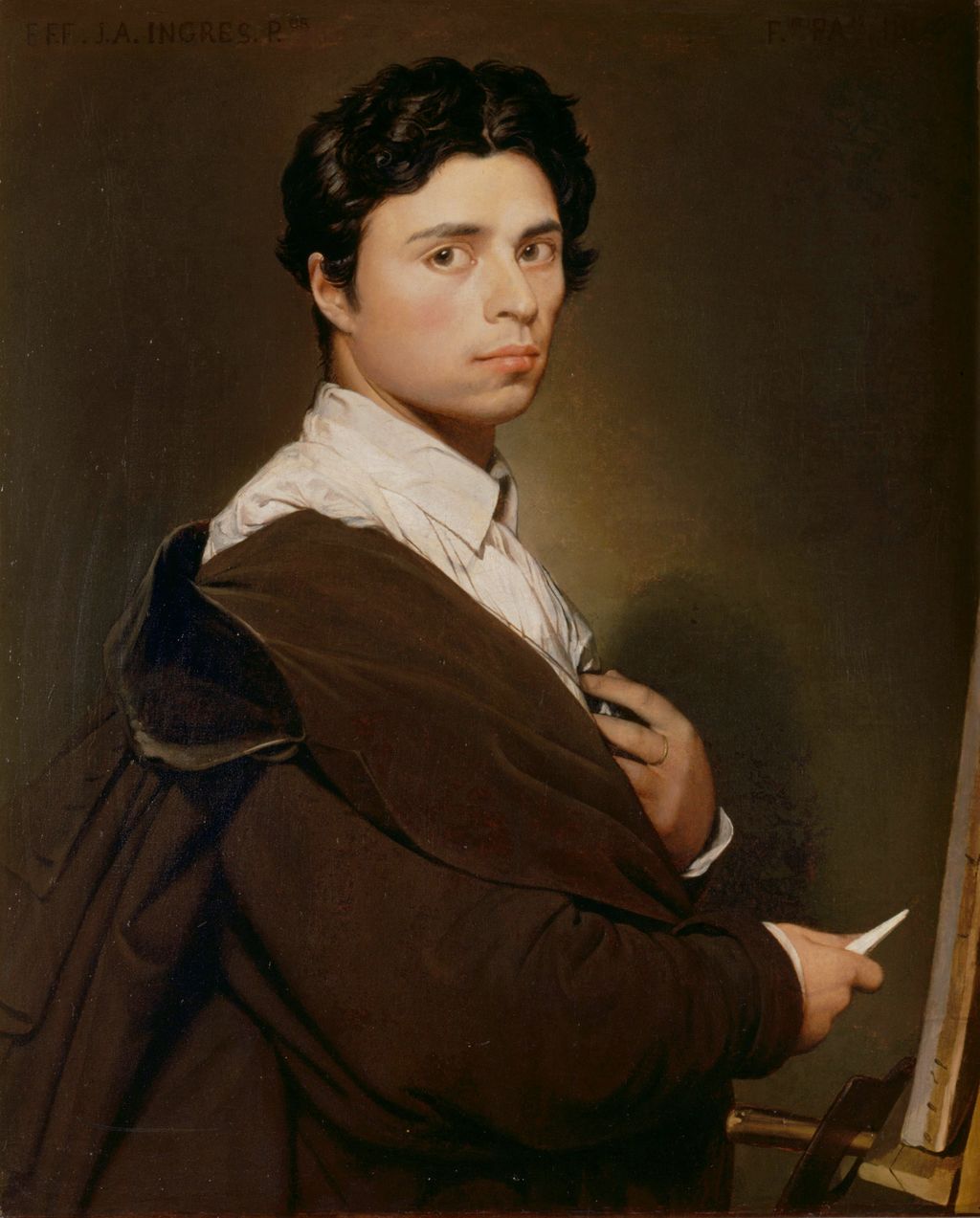
 by Tom Gurney
Tom Gurney BSc (Hons) is an art history expert with over 20 years experience
Published on June 19, 2020 / Updated on October 22, 2026
Email: tomgurney1@gmail.com / Phone: +44 7429 011000
Quotes
“Drawing is the integrity of art”: Ingres gives the act of drawing the weight of an ethical commitment. The sentence becomes more interesting when we read what surrounds it. Drawing, he explains, embraces expression, the forms within an outline, the planes of a body and the modelling that gives it volume. His subject is the painter’s understanding of what is seen. [1]
The eight quotations below develop that argument in different directions. They connect the pencil with attentive looking, compare painting to music and describe the old masters as teachers whose works remain alive. Read beside his paintings and preparatory studies, they reveal a demanding artistic education, with room for practical tools, revision and judgement.
At a Glance
- SourceHenri Delaborde’s Ingres, sa vie, ses travaux, sa doctrine, published in 1870, after Ingres’s death, using the artist’s manuscript notes and letters. [1]
- LanguageThe original passages are French. All English translations of Ingres’s words on this page are our own.
- Main themesDrawing, observation, artistic judgement, musical harmony and learning from nature through the masters. [1]
- How to use themRead the short statements with their surrounding argument and with an actual work of art. An aphorism can sharpen attention without describing every step of a painter’s practice.
Contents
- Where these Ingres quotations come from
- Drawing: integrity, form and colour
- Observation: drawing with the eyes
- Judgement: the painter and the compasses
- Music: learning to hear a painting’s relationships
- Nature and the masters: learning how to see
- Reading the words beside the works
Where these Ingres quotations come from
Delaborde’s book brings together biography, a section headed Notes et pensées—notes and thoughts—and a catalogue of works. Its title identifies manuscript notes and letters as its foundation. The quotations selected here appear in the notes and thoughts, on printed pages 123 and 139; the musical comparison continues onto page 124. This is a posthumous compilation with an editor’s arrangement and framing. It should not be mistaken for a treatise that Ingres himself prepared and published in this form. [1]
That distinction helps us hear the tone of the passages. Some are compressed maxims; others address students directly. Their sequence makes an argument about training and artistic standards, but it does not give us a dated transcript of a single lesson. The printed page is the source for the French wording reproduced below. It does not, by itself, establish when each statement was first written or spoken. [1]
Translation adds another layer. Probité can be carried into English as probity, honesty or integrity. Dessin means drawing, yet Ingres’s explanation gives it a much wider reach than an outline on paper. Reading the French alongside the English makes those choices visible. The English sentences are translations of the published French, rather than words originally uttered by Ingres in English.
Drawing: integrity, form and colour
“Drawing is the integrity of art”
Drawing is the integrity of art. — Ingres, our translation; Delaborde, p. 123. [1]
Le dessin est la probité de l’art. [1] The force of probité is moral: it suggests honesty and uprightness. “Integrity” preserves that force. The statement asks us to take drawing seriously as a responsibility. A convincing surface depends on the quality of the understanding beneath it.
It would be easy to turn this into a judgement about a beautifully clean line. The next passage asks more of us. Ingres’s definition of drawing reaches through the outer edge into the organisation of the whole form. His standard concerns how a figure occupies space, how its parts relate and how its expression becomes legible. [1]
For a viewer, the quotation can become a question: what makes the figure feel coherent? A face may be precisely bounded yet lifeless; a lightly indicated shoulder may carry a convincing sense of weight. The aphorism directs attention towards the decisions that make the image work.
“Drawing does not simply mean reproducing contours”
Drawing does not simply mean reproducing contours. — Ingres, our translation of an excerpt; Delaborde, p. 123. [1]
Dessiner ne veut pas dire simplement reproduire des contours — excerpt. [1] Ingres continues by including expression, inner form, planes and modelling in drawing. Modelling is the rendering of volume: the changes in light and shade that let a cheek turn or an arm appear rounded. A plane is a surface understood in its relation to other surfaces. These are ways of making a body intelligible, even where no emphatic contour is visible. [1]
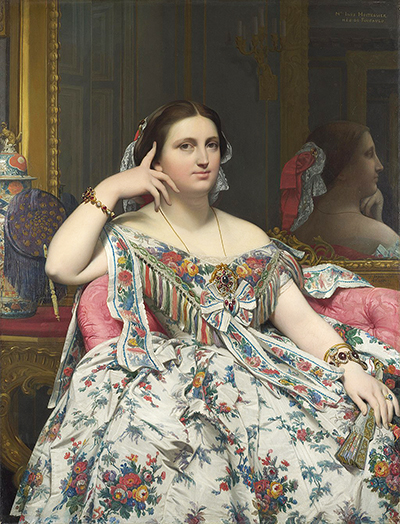
Madame Moitessier offers a concrete example. The National Gallery identifies the seated portrait as a work completed in 1856 and describes the elaborate floral silk of the sitter’s dress, her bare arms and the hand raised to her temple. These elements ask for different kinds of attention: the dress spreads into a broad patterned expanse, while light and shade give the exposed skin its rounded volume. [2]
Reading the quotation beside this portrait changes the task of looking. Follow an arm from its outer silhouette towards the shadows and highlights within it. Then move to the dress, where the mass of the skirt must remain legible beneath the flowers. Drawing, in the sense Ingres outlines, includes the relationship between those large forms and their particulars. It helps explain why an account of his art confined to elegant edges leaves so much unseen.
“Drawing includes everything except tint”
Drawing includes everything except tint. — Ingres, our translation; Delaborde, p. 123. [1]
Le dessin comprend tout, excepté la teinte. [1] The placement of this sentence matters. It follows Ingres’s expansive account of drawing. By assigning expression, planes and modelling to dessin, he has already given it much of the work of painting. The aphorism declares that priority with characteristic brevity. It does not tell us that colour was absent from his practice. [1] Hale found vivid green underpainting beneath the yellow silk in Madame de Senonnes, with delicate drawn facial features and bold brush drawing in the draperies. [3]
That example allows the quotation to retain its strength without turning it into a crude rule about line defeating colour. Ingres’s words establish a hierarchy of artistic understanding; the painting’s construction shows the knowledge of materials required to realise an image. Readers interested in that relationship can explore his style and technique alongside the maxims.
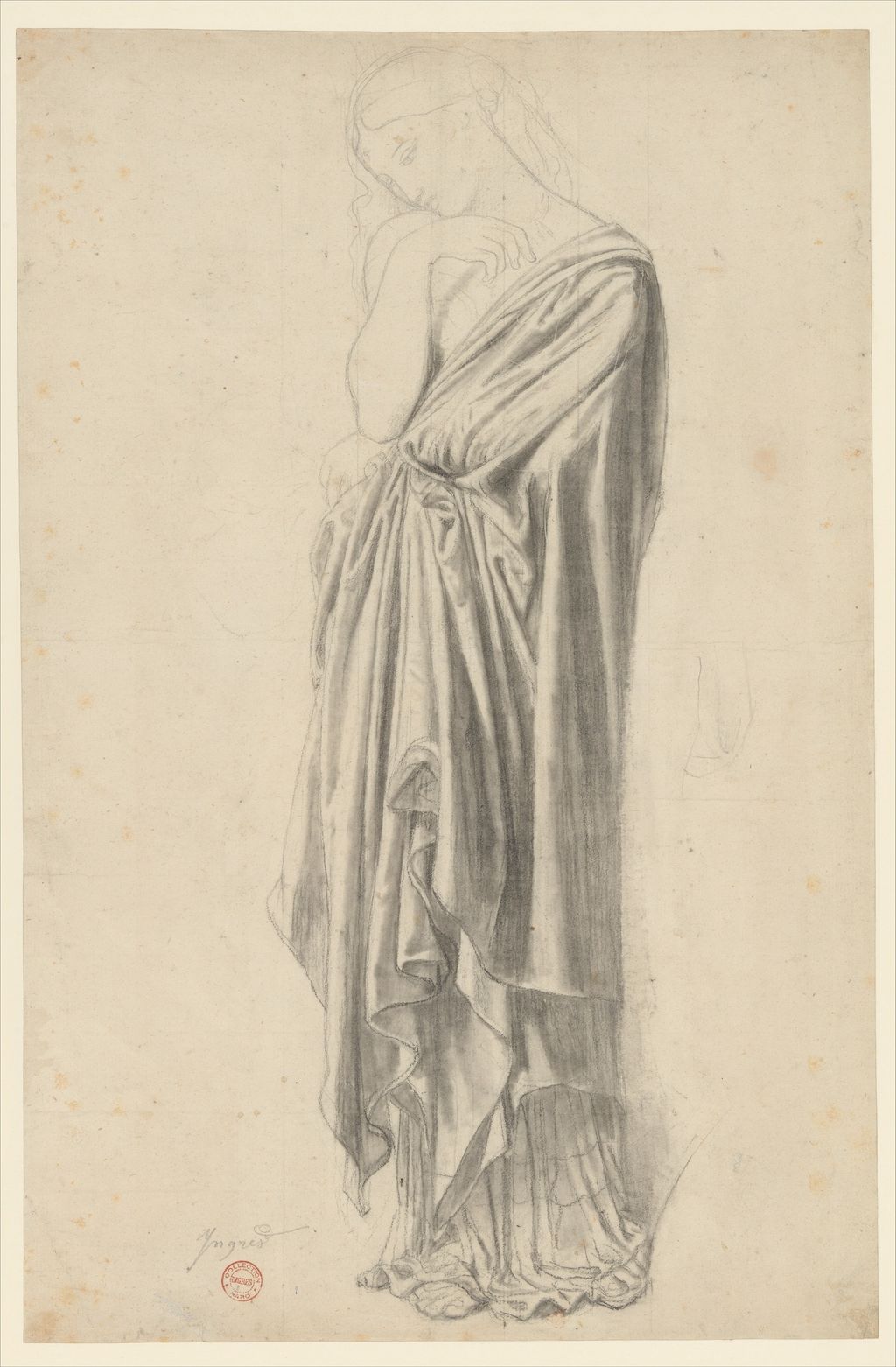
Ingres, Study for the Figure of Stratonice, 1834–40. The Metropolitan Museum of Art, 63.66. [4]
Observation: drawing with the eyes
One must always draw, draw with the eyes when one cannot draw with the pencil. — Ingres, our translation; Delaborde, p. 123. [1]
Il faut toujours dessiner, dessiner des yeux quand on ne peut dessiner avec le crayon. [1] The sentence extends practice beyond the moment when a pencil touches paper. Its continuation joins inspection to practical work: seeing and doing need to advance together. Looking becomes an active discipline, concerned with relationships that can later be tested in a drawing. [1]
This need not mean possessing an extraordinary visual memory. We can apply the thought more plainly. Look at the angle between a wrist and a hand, the distance from an eyebrow to an eyelid, or the width of a patch of light on a sleeve. Each observation involves a comparison. Drawing begins in the effort to notice those relationships, before any mark records them. The Princesse de Broglie studies separate nude figure and dress, with full-scale charcoal arms on tracing paper. The painted thumb and little finger are narrower. [3]
For someone studying Ingres’s drawings, this is a useful corrective to the impression that an assured result must have arrived effortlessly. A finished line can conceal the observations, trials and decisions that made it possible. The quotation recommends a continuing habit, available even when the tools are put away.
Judgement: the painter and the compasses
The painter who relies on his compasses leans on a phantom. — Ingres, our translation; Delaborde, p. 123. [1]
Le peintre qui se fie à son compas s’appuie sur un fantôme. [1] The word to dwell on is “relies”. Compasses can compare distances and help establish proportions. Their measurements cannot decide whether a gesture has vitality or whether the parts of a picture make a persuasive whole. Read in the company of Ingres’s advice about observation, the phantom is the promise that a tool could supply the painter’s judgement. That is an interpretation of the aphorism, rather than a documented prohibition on a particular workshop procedure. Hale’s infrared examination revealed parts of a square grid beneath Madame de Senonnes, with lines 17 centimetres apart. [3] Broglie’s nude and dressed studies have matching grids corresponding to traces beneath the paint; the arm drawing aided transfer. [3]
Measurement and transfer can preserve decisions already made through looking. They can also provide a framework within which further decisions become possible. Neither operation guarantees the character of a face or the expressive movement of a hand. The painter remains responsible for what the framework carries.
The aphorism therefore invites us to distinguish an instrument from the authority we grant it. Ingres’s practice gives us reason to read the sentence as a warning about dependence. A quotation alone cannot serve as an inventory of everything that happened in his studio.
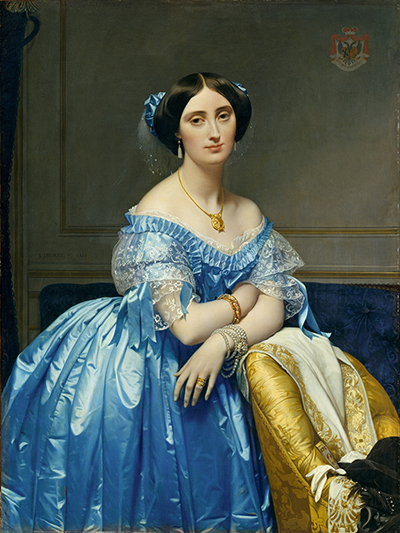
Ingres, The Princesse de Broglie, 1851–1853. [5]
Music: learning to hear a painting’s relationships
If I could make you all musicians, you would gain from it as painters. — Ingres, our translation; Delaborde, p. 123. [1]
Si je pouvais vous rendre tous musiciens, vous y gagneriez comme peintres. [1] The comparison continues across the page turn. Ingres describes harmony in nature, where too much or too little can disturb a scale and produce a false note. He then compares the rightness of forms with the rightness of sounds, asking the pencil and brush to achieve something equivalent to singing in tune. The context concerns proportion, relationship and accuracy of judgement. [1]
Music supplies an especially clear analogy because a note is heard in relation to what surrounds it. A small change can alter the effect of a whole phrase. In painting, a narrow band of dark colour, the interval between figures or the tilt of a head may carry a similar disproportionate force. This is a way to use Ingres’s comparison when looking, rather than evidence for a hidden musical code in his pictures.
His interest in music had a practical basis. Rebecca A. Rabinow’s chronology records violin study and performance with the Toulouse orchestra in 1794–96. Georges Vigne describes Charles Gounod playing Mozart for him in Rome, alongside the composer’s participation in copying engravings under Ingres’s supervision. His life as an artist included music as both a practice and a shared pleasure. [6]
That background gives the analogy texture, but the continuation gives it meaning. Without page 124, the quotation can sound like a general celebration of having several talents. With it, we hear an argument for sensitivity to relationships. It asks the artist to recognise when a visual decision feels as exact—or as jarring—as a note within music.
The French expression violon d’Ingres draws on the painter’s musical activity. The Dictionnaire de l’Académie française defines it as an artistic pursuit, and by extension any activity, enjoyed alongside one’s profession. It is an expression about Ingres, rather than one of the artist’s statements reproduced here. [7]
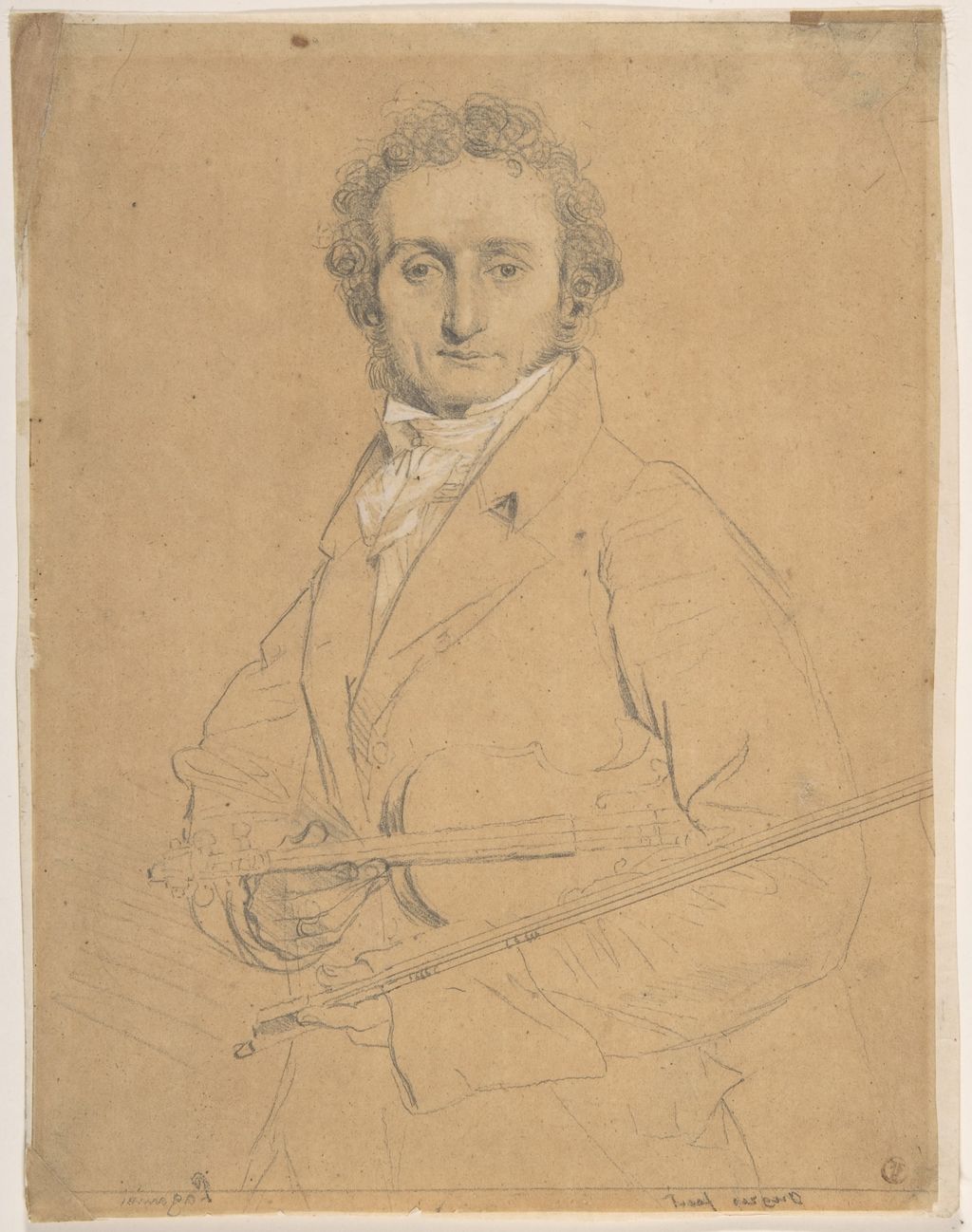
Ingres, Niccolò Paganini, c. 1830. Counterproof or tracing strengthened with graphite and gouache. The Metropolitan Museum of Art, 43.85.10. [8]
Nature and the masters: learning how to see
One must always copy nature and learn to see it well. — Ingres, our translation; Delaborde, p. 139. [1]
Il faut copier la nature toujours et apprendre à la bien voir. [1] This sentence appears in the section on studying antiquity and the masters. Its surroundings are essential: Ingres explains that the purpose of studying earlier art is to learn to see nature. The Louvre becomes a place for educating perception. He challenges the idea that students should go there to find an ideal beauty detached from the natural world. [1]
“Copy” here asks for close study. A student making a copy must work out relationships that a passing glance can overlook: how an arm is positioned, how a dark area supports a light one, how a small figure contributes to the movement of a group. The activity can reveal a previous artist’s decisions. Ingres presents that encounter as a means of developing one’s own sight. [1]
This argument helps us read the art without forcing a choice between observed reality and inherited models. In the seated Madame Moitessier, the pose draws on a Roman wall painting, while the dress belongs to the sitter’s own fashionable world. The National Gallery explains how changes in the gown responded to the long development of the portrait. Past art and contemporary clothing meet within a single figure. [2]
The quotation does not require us to regard every stylised form as a literal transcription of a model. It tells us how Ingres describes the education of the eye. That distinction leaves room to examine the particular choices of a painting: what has been preserved, adjusted, selected or amplified.
Turn, then, to the masters; speak to them; they will answer you, for they are still alive. — Ingres, our translation; Delaborde, p. 139. [1]
Adressez-vous donc aux maîtres, parlez-leur, ils vous répondront, car ils sont encore vivants. [1] The invitation to speak to the masters belongs to the same passage. Their continuing life is a metaphor for what their works can teach. Ingres follows it by describing himself as passing on their instruction. It gives the teacher a role within a chain of learning, directing students towards sources beyond his own authority. [1]
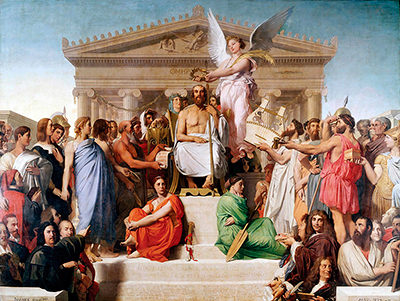
His Apotheosis of Homer makes such a chain visible. The Louvre dates the painting to 1827, identifies Raphael among the assembled figures and connects the composition with Raphael’s Parnassus. Bringing artists and writers from different periods around Homer creates an image of culture sustained through earlier achievements. [9]
There is also a limit to this invitation. The surrounding pages express emphatic preferences for antiquity and the classical masters. Ingres’s argument comes with a hierarchy of values; it is not an open endorsement of every artistic tradition. [1] We can recognise that historical position while still using the practical question it offers: what can this earlier work teach us to notice?
Reading the words beside the works
An aphorism is small enough to remember and forceful enough to be misleading when it stands alone. A useful way to read these is to keep three things together: the sentence, its immediate context and a specific work. The discussion of drawing expands the familiar integrity maxim; the page turn explains the musical analogy; the transfer grids qualify an absolute reading of the compasses warning. [1][3]
For a first comparison, take the instruction to draw with the eyes to one of Ingres’s portraits. Spend a moment following the relationship between a hand, a sleeve and the furniture supporting them. Then return to the whole figure. The point is to let the words make the painting more available to attention, with the painting free to complicate the words.
Artworks directory
Explore 150 paintings, drawings and an original lithograph. This selection includes related versions and studies; dates distinguish completed works from later revisions.
| Name | Date | Medium |
|---|---|---|
| The Apotheosis of Homer | 1827 | Painting |
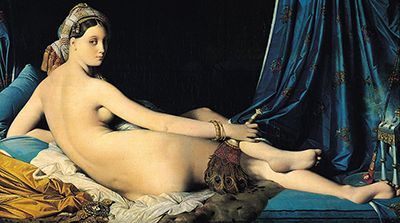
| Grande Odalisque | 1814 | Painting |
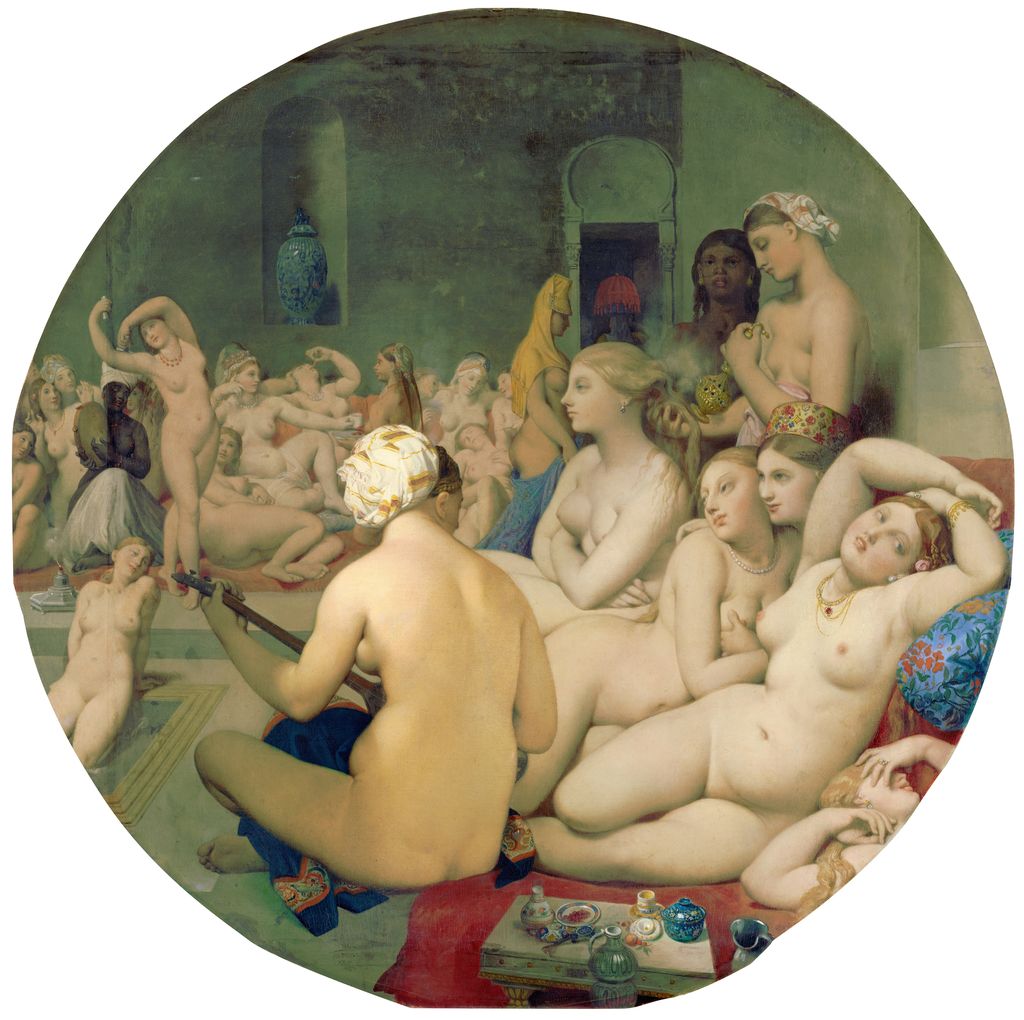
| The Turkish Bath | 1859–1862 | Painting |
| Madame Moitessier Seated | 1856 | Painting |
| Portrait of Monsieur Bertin | 1832 | Painting |
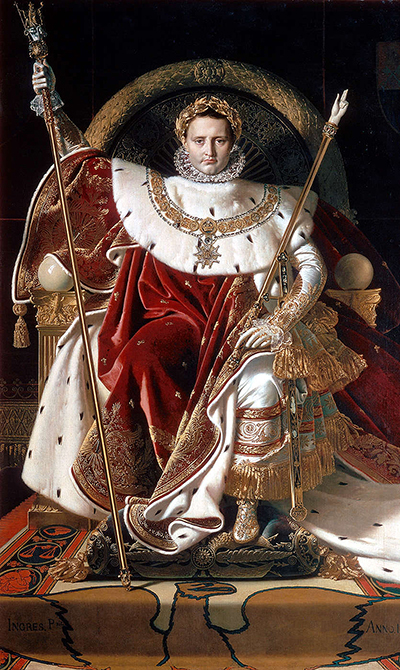
| Napoleon I on His Imperial Throne | 1806 | Painting |
| Odalisque with Slave | 1839 | Painting |
| The Ambassadors of Agamemnon in the Tent of Achilles | 1801 (competition) | Painting |
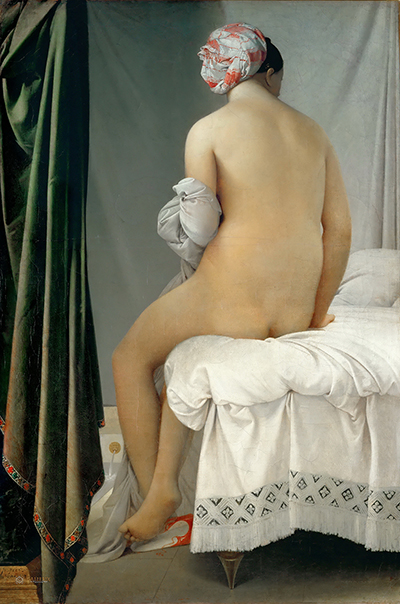
| The Valpinçon Bather | 1808 | Painting |
| The Source | 1856 | Painting |
| Oedipus Explaining the Enigma of the Sphinx | 1808; revised probably before 1827 | Painting |
| The Vow of Louis XIII | 1824 | Painting |
| Antiochus and Stratonice | 1840 | Painting |
| The Comtesse d’Haussonville | 1845 | Painting |
| The Princesse de Broglie | 1851–1853 | Painting |
| Jupiter and Thetis | 1811 | Painting |
| The Dream of Ossian | 1813 | Painting |
| The Martyrdom of Saint Symphorian | 1834 | Painting |
| Venus Anadyomene | 1808–1848 | Painting |
| Portrait of Madame de Senonnes | 1814 | Painting |
| Madame Rivière | 1805 | Painting |
| Mademoiselle Caroline Rivière | 1805 | Painting |
| Portrait of Philibert Rivière | 1805 | Painting |
| Bonaparte First Consul | 1804 | Painting |
| The Death of Leonardo da Vinci | 1818 | Painting |
| Joan of Arc at the Coronation of Charles VII | 1854 | Painting |
| Madame Duvaucey | 1807 | Painting |
| La Belle Zélie | 1806 | Painting |
| Madame Panckoucke | 1811 | Painting |
| Portrait of Charles Marcotte d’Argenteuil | 1810 | Painting |
| Joseph Antoine Moltedo | c.1810 | Painting |
| Madame Leblanc | 1823 | Painting |
| Delphine Ingres-Ramel (Portrait of Madame Ingres) | 1859 | Painting |
| Portrait of Amédée de Pastoret | 1823–1826 | Painting |
| Portrait of Baronne de Rothschild | 1848 | Painting |
| Madame Marcotte de Sainte Marie | 1826 | Painting |
| Madame Gonse | 1852 | Painting |
| Aretino in the Studio of Tintoretto | 1848 | Painting |
| Don Pedro of Toledo Kissing Henry IV’s Sword | 1831/1832 | Painting |
| Raphael and La Fornarina | 1814 | Painting |
| Roger Freeing Angelica | 1819 | Painting |
| Romulus’ Victory over Acron | 1812 | Painting |
| Self-Portrait at the Age of Twenty-Four | 1804; revised 1841–1851 | Painting |
| Male Torso | c.1800 | Painting |
| Odalisque in Grisaille (Ingres and workshop) | c.1824–1834 | Painting |
| The Small Bather | 1826 | Painting |
| The Little Bather Harem Interior | 1828 | Painting |
| Jesus Among the Doctors | 1862 | Painting |
| The Virgin Adoring the Host | 1852 | Painting |
| The Virgin of the Host | 1841 | Painting |
| Virgin of the Adoption | 1858 | Painting |
| Paolo and Francesca | 1814 | Painting |
| Homer Deified (revised composition, Louvre RF5273) | 1865 | Drawing |
| Odalisque with Slave (Louvre RF4622) | 1858 | Drawing |
| Odalisque (Walters Art Museum; Ingres and Paul Flandrin) | 1842 | Painting |
| Madame Moitessier Standing (National Gallery of Art) | 1851 | Painting |
| Jacques-Louis Leblanc (The Metropolitan Museum of Art) | 1823 | Painting |
| Ferdinand-Philippe, Duke of Orléans (Louvre RF2005-13) | 1842 | Painting |
| Ferdinand-Philippe, Duke of Orléans (Versailles MV5207; Ingres and workshop) | 1843 | Painting |
| Ferdinand-Philippe, Duke of Orléans (Versailles MV5209; Ingres and workshop) | 1844 | Painting |
| Antiochus and Stratonice (Musée Fabre; Ingres and Raymond Balze) | 1866 | Painting |
| Antiochus and Stratonice (Kunstmuseum Bern, Gurlitt bequest) | Undated (early dating proposed) | Drawing |
| Composition study for Antiochus and Stratonice (MIB867.2193) | 1806 | Drawing |
| Study for the Figure of Stratonice (Met63.66) | 1834–1840 | Graphite, black chalk and charcoal |
| Nude figure study for Stratonice (Boijmans F II 36 PK) | c.1834–1840 | Drawing |
| Paolo and Francesca (The Barber Institute,54.6) | c.1814–1820 | Painting |
| Paolo and Francesca (The Hyde Collection,1971.24) | c.1855–1860 | Painting |
| Paolo and Francesca (Amsterdam Museum TA10970) | 1820 | Drawing |
| Paolo and Francesca (dedicated to Artaud de Montor) | 1816 | Drawing |
| Study for the Bust of Francesca (MIB867.1398) | 1819 | Drawing |
| Study for the Bust of Francesca (MIB867.1396) | 1819 | Drawing |
| The Archangel Raphael, first idea (MIB867.2488) | 1842 | Drawing |
| The Archangel Raphael (MIB867.2500) | 1842 | Drawing |
| The Archangel Raphael Carrying Human Prayers to God (Chantilly DE513) | 1844 | Drawing |
| Louis-Philippe as Saint Philip, stained-glass study | 1844 | Drawing |
| Marie Frédéric Eugène de Reiset (Ford Collection RBF171-2) | 1844 | Drawing |
| Virgil Reading the Aeneid (Toulouse) | Begun 1811 | Painting |
| Tu Marcellus Eris (Brussels, inv. 1836) | c.1814 (museum dating) | Painting |
| Jean-François Gilibert | 1804 | Painting |
| François-Marius Granet | 1807 (museum dating) | Painting |
| Count Nikolai Dmitrievich Guryev | 1821 | Painting |
| Caroline Murat, Queen of Naples | 1814 | Painting |
| Count Mathieu Molé | 1834 | Painting |
| Cherubini and the Muse of Lyric Poetry (Louvre) | 1842 | Painting |
| Luigi Cherubini (Cincinnati) | 1841 | Painting |
| Comtesse de Rayneval (Louvre RF4505) | 1841 | Drawing |
| Venus on Paphos (Antonie Balaÿ) | c.1852 | Painting |
| Prince Napoléon | 1855 | Painting |
| Study for The Apotheosis of Napoleon I (Petit Palais) | Late 1853 | Painting |
| The Apotheosis of Napoleon I (destroyed ceiling) | 1853 | Painting |
| The Journalist (MIB867.2733) | 1834? | Drawing |
| Henry VIII, after Holbein | c.1815–1820 (?) | Drawing |
| Madame Récamier, after David (MIB867.3637) | Undated (early Paris period) | Drawing |
| Study for Comtesse d’Haussonville (MIB867.259; background possibly by another hand) | 1842–1845 | Drawing |
| La Source (reduced version reported by Delaborde) | Date unrecorded; reported 1870 | Painting |
| Odalisque (autograph lithograph,NGA1946.21.117) | 1825; published1826 | Lithograph |
| Portrait of a Seated Lady | 1814 | Graphite |
| The Kaunitz Sisters (Leopoldine, Caroline, and Ferdinandine) | 1818 | Graphite |
| Portrait of a Man | 1814 | Graphite |
| Study for the Portrait of Louis-François Bertin (1766–1841) | n.d. | Black chalk and graphite |
| Studies for the Cadaver of Acron | ca. 1810–12 | Graphite on wove paper |
| Study for the Drapery of Molière in "The Apotheosis of Homer" | n.d. | Black chalk with stumping |
| Madame Guillaume Guillon Lethière, née Marie-Joseph-Honorée Vanzenne, and her son Lucien Lethière | 1808 | Graphite |
| Niccolò Paganini (1782–1840) | ca. 1830 | Counterproof or tracing strengthened with graphite and gouache on translucent paper |
| Lady Mary Cavendish-Bentinck (?-1843) | 1816 | Graphite |
| Madame Alexandre Lethière and Her Daughter Letizia | ca. 1815 | Graphite |
| Merry Joseph Blondel (1781–1853) | 1809 | Graphite |
| Ursin-Jules Vatinelle (1798–1881) | 1820 | Graphite |
| Bust of a Gypsy Girl (ascribed to Ingres) | 1819 | Graphite on wove paper |
| Study of a Seated Nude Male | n.d. | Graphite |
| The Archangel Raphael (Study for a stained-glass window in the chapel of Notre-Dame de la Compassion-Saint-Ferdinand, Neuilly) | ca. 1842 | Graphite |
| Lancelot-Théodore, comte Turpin de Crissé | probably 1818 | Graphite |
| Study for the Figure of the Iliad in "The Apotheosis of Homer" | ca. 1827 | Graphite and black chalk heightened with white chalk on brown paper |
| Comtesse Turpin de Crissé | probably 1818 | Graphite |
| Nude Figures for L'Âge d'Or, Château de Dampierre | n.d. | Graphite on brownish paper |
| Study of Figures (attributed to Ingres) | n.d. | Graphite |
| Study of Figures (attributed to Ingres) | n.d. | Graphite; squared in graphite |
| Admiral Sir Fleetwood Broughton Reynolds Pellew | 1817 | Graphite on wove paper |
| Madame Jean-Auguste-Dominique Ingres, née Madeleine Chapelle | 1814 | Graphite on off-white wove paper |
| Virgil Reading the Aeneid to Augustus, Livia, and Octavia | 1809/1819 (?) | Pen and black ink, graphite, brush and gray wash, white gouache heightening, Conté crayon on blue paper |
| General Louis-Étienne Dulong de Rosnay | 1818 | Graphite (hard and soft pencils) |
| Madame Alexandre Lethière, née Rosa Meli, and Her Daughter, Letizia | 1815 | Graphite |
| The Lawyer Paul Grand | 1834 | Graphite |
| Jean-Joseph Fournier | 1815 | Graphite |
| Armand Bertin | 1842 | Graphite |
| Madame Armand Bertin, née Marie-Anne-Cécile Dollfuss | 1843 | Graphite |
| The Architect Charles-Victor Famin | 1836 | Graphite |
| Henri Lehmann | 1850 | Graphite |
| Portrait of a Lady | ca. 1815–17 | Graphite |
| Edmond Cavé (1794–1852) | 1844 | Oil on canvas |
| Head of Saint John the Evangelist | probably ca. 1818–20 | Oil on canvas, laid down on wood |
| Madame Edmond Cavé (Marie-Elisabeth Blavot, ca. 1806–1883) | ca. 1831–34 | Oil on canvas |
| Madame Félix Gallois | 1852 | Graphite with touches of gold in oil to highlight jewelry, on buff wove paper. |
| Dr. François Mêlier | 1849 | Graphite with graphite framing lines, corrected with white, on buff wove paper |
| Portrait of Madame Rhode (Rhoda?) | 1810–20 | Graphite on pale buff wove paper |
| Study for "Raphael and the Fornarina"(?) | ca. 1814(?) | Graphite on white wove paper |
| Portrait of Madame Paul Meurice, née Palmyre Granger | ca. 1845–50 | Graphite on wove paper |
| Alexander the Great presenting Campaspe to Apelles | 1810 | Graphite, brush and brown wash; squared in graphite |
| Study of Hands for "Christ Among the Doctors" | 1852–62 | Graphite on tracing paper |
| Study for The Turkish Bath (RF34502) | about 1850 | Pen and brown ink with graphite, partially squared |
| Study for The Turkish Bath (RF23354) | Undated | Pen and brown ink with graphite on joined sheets |
| Study for The Turkish Bath (RF54702) | about 1859 | Pen and brown ink |
| Studies of women for The Turkish Bath (RF12292) | Undated | Black chalk |
| Achilles Receiving the Envoys of Agamemnon (Nationalmuseum sketch, NM2161) | 1801 | Oil on wood |
| Half-Length Bather (Musée Bonnat-Helleu,89) | 1807 | Oil on canvas |
| Oedipus and the Sphinx (National Gallery,NG3290) | about1826 | Oil on canvas |
| Oedipus and the Sphinx (Walters,37.9) | 1864 | Oil on canvas |
| Oedipus and the Valpinçon Bather, after David (MI.867.2035) | Undated | Graphite on tracing paper, after David |
| Study of the Virgin for The Vow of Louis XIII (Dijon,1758) | about1822 | Black chalk, stump and white chalk on brown wove paper |
| First Thought for The Vow of Louis XIII (MI.885.11.21) | 1822 | Oil on canvas |
Frequently Asked Questions
“Drawing is the integrity of art” is a familiar English rendering of Le dessin est la probité de l’art, printed by Delaborde on page 123. “Probity” and “honesty” are other translation choices for probité. The French wording is the common point of reference. [1]
The source passages reproduced here are French. The English versions are our translations. A different English rendering may be reasonable, but it should identify its French source and distinguish translation from original wording.
His statement that drawing includes everything except tint follows a very broad definition of drawing. It establishes the priority he gives to form; it does not establish indifference to colour. [1]
It means a pursuit enjoyed alongside one’s profession, with particular application to an artistic interest. The expression refers to Ingres’s musical practice. It is not presented here as a quotation spoken by him. [7]
The linked scan of Delaborde’s 1870 book contains the eight passages on printed pages 123 and 139. Read page 124 as well for the continuation about musical harmony. The book is a posthumous editorial compilation, so the publication date should not be treated as the date when Ingres first formulated each thought. [1]
Discussion
Look again at the images and ideas explored in Quotes. These editorial prompts invite your observations.
Reader Insights
Compare the compasses quotation with the studies and technical evidence for the Princesse de Broglie. Where might a transfer grid help preserve a decision, and what would still depend on the painter’s eye? Choose one feature—an arm, a hand or the edge of the dress—to make the comparison specific.
Read the statement about drawing with the eyes beside a portrait drawing. Which visible choices suggest selection rather than the copying of every detail?
How does knowing that Delaborde compiled these statements after Ingres’s death affect the way you use them to interpret a painting?
Join the Conversation
Share a detail, comparison or question about Quotes below.
References
- Henri Delaborde, Ingres, sa vie, ses travaux, sa doctrine, d’après les notes manuscrites et les lettres du maître. Paris: Henri Plon, 1870. “Notes et pensées de J. A. D. Ingres”, especially “Du dessin”, pp. 123–124, and “De l’étude de l’antique et des maîtres”, pp. 138–140. The eight French quotations reproduced here are on printed pp. 123 and 139. (in French) View source.
- National Gallery, London, Madame Moitessier. Collection record NG4821; “Overview”, “In-depth” and “Details”. View source.
- Charlotte Hale, “Technical Observations”, in “Portraits by Ingres: Image of an Epoch”: Reflections, Technical Observations, Addenda, and Corrigenda. Metropolitan Museum Journal 35 (2000), pp. 203, 206. View source.
- Supporting image. Ingres, Study for the Figure of Stratonice, 1834–40. The Metropolitan Museum of Art, 63.66. Image source. CC0 / Public domain.
- Supporting image. Ingres, The Princesse de Broglie, 1851–1853. The Metropolitan Museum of Art; Robert Lehman Collection, 1975. Image source. CC0 / Public domain.
- Rebecca A. Rabinow, “Chronology”, p. 545; Georges Vigne, “Ingres and Co.: A Master and His Collaborators”, p. 531. In Gary Tinterow and Philip Conisbee, eds., Portraits by Ingres: Image of an Epoch. New York: The Metropolitan Museum of Art, distributed by Harry N. Abrams, 1999. View source.
- Académie française, “Violon”. Dictionnaire de l’Académie française, 9th edition, sense 1, figurative expression violon d’Ingres. (in French) View source.
- Supporting image. Ingres, Niccolò Paganini, c. 1830. Counterproof or tracing strengthened with graphite and gouache. The Metropolitan Museum of Art, 43.85.10. Bequest of Grace Rainey Rogers, 1943. Image source. CC0 / Public domain.
- Musée du Louvre, Homère déifié, dit aussi L’apothéose d’Homère. Collection record INV5417; “Description”, “Places and dates” and “Object history”. (in French) View source.
- Splash image. Ingres, Self Portrait Aged 24, begun in 1804 and reworked in 1841–51. Musée Condé, Chantilly. Google Art Project via Wikimedia Commons. Image source. Public domain.