 by Tom Gurney
Tom Gurney BSc (Hons) is an art history expert with over 20 years experience
Published on June 19, 2020 / Updated on November 20, 2026
Email: tomgurney1@gmail.com / Phone: +44 7429 011000
Introduction
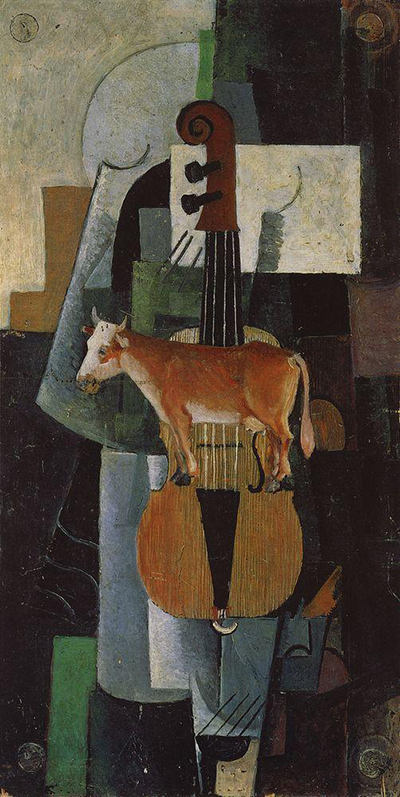
A cow stands across the body of a violin, but the two objects do not share the same believable space. The animal is small enough to rest on the instrument, while fractured dark and light planes cut behind them. Kazimir Malevich made this unlikely pairing in 1913, at a moment when he was testing how far a painting could move from ordinary explanation while still showing recognizable things. [1] [2]
This site's older English title is Cow and Fiddle. The State Russian Museum catalogues the illustrated work as Cow and Violin, accession ЖБ-1550. Both names refer here to the same oil painting on wood, not to MoMA's separately catalogued lithograph with a similar title. “Fiddle” is an ordinary English word for a violin, but the museum title is the reliable way to identify the physical object. [1] [2]
At a Glance
- ArtistKazimir Malevich
- Museum titleCow and Violin
- Site titleCow and Fiddle
- Date1913
- MediumOil on wood
- Dimensions48.8 × 25.8 cm
- CollectionState Russian Museum, Saint Petersburg, ЖБ-1550
Contents
- What is happening in the painting?
- Alogism and the inscription on the reverse
- Date, material and exhibition context
- Two formats for an alogical image
- From the Store to later exhibitions
What is happening in the painting?
The instrument rises through a narrow, upright panel. Its recognizable outline, strings and openings make it legible even when the surrounding space breaks into flat angular areas. The cow crosses its middle. It has a body, legs and head that can be read as an animal, but its scale relative to the violin defeats a literal scene. Neither a field nor a room explains how the objects came together. These observations concern the reproduced image; they do not identify a real cow or an actual instrument. [1] [2]
Look next at the field around them. Brown, green, black and pale passages divide the painting into blocks. Some seem to move behind the violin, while others push forward and interrupt its edges. A viewer can recognize the central objects quickly and still struggle to describe the space they occupy. The National Gallery of Art's 1990 teaching packet places this treatment alongside Malevich's engagement with Synthetic Cubism, where relatively flat areas of colour could build a composition without conventional single-point perspective. That is a stylistic comparison, not proof that a particular Cubist picture supplied this painting's exact design. [2]
The extreme change of scale is decisive. If the cow were life-sized and the violin appropriately small, a familiar narrative might become possible: a musician in a field, perhaps, or an instrument placed near an animal. By reversing those expectations, Malevich makes both things remain identifiable while their relationship becomes strange. The subject is not simply “a cow” or “a violin”; it is the act of bringing them together where ordinary spatial rules cannot settle what we see. [2]
Alogism and the inscription on the reverse
The Russian Museum reports an inscription by Malevich on the reverse of the support that presents the violin-and-cow pairing as an alogical juxtaposition and a challenge to conventional meaning. The NGA packet gives an English translation of the inscription. The wording matters because it ties this particular painted conjunction to Malevich's own interest in disrupting expected connections, rather than asking later viewers to invent a hidden farmyard story. [1] [2]
“Alogical” does not mean that every interpretation is equally supported. The two objects are carefully chosen and clearly pictured. The surprise arises when a viewer tries to make their scale, location and purpose fit a familiar account. The NGA describes the work as part of Malevich's 1913–14 search for relationships beyond normal logic. That institutional reading helps explain the painting's method, while the visible composition lets a reader test it directly. [2]
The painting still contains things from the observable world. It therefore differs sharply from the unpictured colour and shape of Malevich's later Black Square. The path from one to the other is more revealing when the stages stay distinct: here he unsettles the relationship among represented objects; in the 1915 square, he leaves depicted objects behind. The later work does not make the earlier cow a disguised abstract form. [1] [2]
Date, material and exhibition context
The Russian Museum dates ЖБ-1550 to 1913 and records oil on wood, 48.8 × 25.8 centimetres. Its tall, narrow dimensions matter. The violin spans much of the height, and the cow interrupts its centre rather than sitting inside a broad landscape. A digital image can make the work seem larger and more expansive than the physical panel. The museum records its arrival in 1926 through GINKhUK from the Museum of Artistic Culture, a documented point in its collection history rather than a complete provenance. [1]
The NGA packet places Cow and Violin in the 1916 futurist exhibition known as The Store, alongside other Malevich paintings. This is an exhibition-history detail reported by that publication; it does not change the museum's 1913 date for the painting. An original catalogue and installation documentation would allow a fuller account of exactly how viewers encountered it in 1916. [2]
Other objects now carry similar words in their titles. MoMA catalogues Cow and Violin from On New Systems in Art as a lithograph, with its own accession number and a broad 1911–19 date. It is useful evidence that this image or motif had a printed life, but it is not the 48.8 × 25.8-centimetre Russian Museum panel. Museum, medium and accession make the difference checkable. [1] [3]
Two formats for an alogical image
The wood panel stands nearly twice as high as it is wide. That narrow frame helps the instrument act as a vertical spine. The animal interrupts it from the side, setting a much shorter horizontal movement against the direction in which the eye follows the violin. Look at the composition first from the lower edge upwards, then from the cow’s head back across its body. The two routes through the picture make different things seem to dominate. The cow takes up little room, but its unexpected appearance makes it hard to treat as an incidental detail. [1] [2]
The print changes the size and setting of the image. MoMA measures the irregular lithographed composition at 13.3 by 8.1 centimetres and the page at 23 by 17.2 centimetres. On a sheet of those dimensions, the blank paper surrounding the printed image gives it a border and a place in a publication. A viewer can take in the arrangement at reading distance. The painting carries the composition across the whole panel, and the eye has farther to travel from the base of the violin to its upper end. A digital thumbnail can make these differently scaled objects look deceptively similar. [1] [3]
MoMA records the Vitebsk publisher on the print from On New Systems in Art. In that setting a reader could meet the motif through a publication concerned with new approaches to art. The wood panel had already given the cow and violin a literal surface to share. The print made that experiment available on paper. The difference between those two settings explains why the named objects remain distinct even when a book caption or image search brings them together. The museum dates the print within a broad 1911–19 span, so the year 1913 attaches securely to the oil painting and cannot by itself date the impression. [1] [3]
From the Store to later exhibitions
The title of the 1916 exhibition, The Store, gives a useful setting for the NGA’s account of the work’s early display. Seen among other artworks, a familiar instrument could function as one conspicuous element in an experimental group. The same gallery setting cannot be recreated from a list of exhibitors alone. Without an installation view showing this panel, its height on the wall and the works next to it remain open. MoMA has published exhibition-history documentation associating its separate lithograph with the 1985–86 show Contrasts of Form. These records illuminate how an alogical motif has been shown at different times and in different formats. [2] [3]
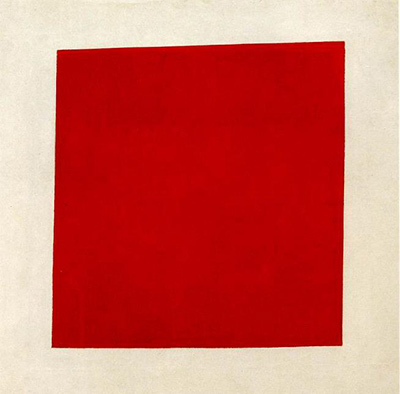
The Russian Museum’s account of a later display in China names the oil alongside Red Square and Malevich’s painted Self-Portrait of 1933. That grouping gives a viewer three sharply different ways of dealing with recognizable things. A cow and a violin still have visible outlines in the 1913 panel. In the museum’s Red Square, geometry occupies the surface and the title’s association with a peasant woman works differently from a painted likeness. The late self-portrait brings back a directly recognizable figure. The sequence helps explain why the small panel holds its place in a career exhibition. In it, recognizability is precisely what makes the disruption work. [1] [2] [4]
Frequently Asked Questions
Is Cow and Fiddle the same painting as Cow and Violin?
For this illustrated page, yes. Cow and Fiddle is the inherited English site title; the State Russian Museum catalogues the pictured 1913 panel as Cow and Violin, ЖБ-1550. [1]
Why is the cow so small?
Is this a Suprematist painting?
It predates the 1915 public presentation of Malevich's nonobjective Suprematist paintings. This 1913 work still depicts a cow and violin, even while disturbing their expected relation. Compare the shift with Black Square and the style and technique guide. [2]
Is the MoMA work the same object?
Discussion
Before reading the explanation, try describing the size of the cow relative to the violin. What happens to your sense of a real place?
Follow the outline of the violin where dark and pale planes cross it. Which parts remain clear, and which become uncertain?
Reader Insights
Look at the animal's legs and the violin body. Which one seems to carry the other?
Imagine both objects at their usual sizes. Would the painting still feel as puzzling?
Compare this work with Black Square: what disappears when Malevich stops depicting recognizable objects?
Join the Conversation
Share a close observation or a source-backed reading of this specific painting.
References
- State Russian Museum, Cow and Violin, ЖБ-1550: illustrated owner record for title, date, medium, dimensions, accession, acquisition note and reported reverse inscription. View source.
- National Gallery of Art, Kazimir Malevich Teaching Packet (1990), PDF pp. 27–28, 52, 58: illustrated work discussion, alogical and Cubist context, and 1916 Store exhibition chronology. View source.
- Museum of Modern Art, Cow and Violin from On New Systems in Art, 981.1983.3: separate lithograph object record, used only to distinguish it from the Russian Museum painting. View source.
- State Russian Museum, report on its Russian avant-garde exhibition in China, in Russian: exhibition scope and the inclusion of the 1913 painting, Red Square and the 1933 Self-Portrait. View source.