 by Tom Gurney
Tom Gurney BSc (Hons) is an art history expert with over 20 years experience
Published on June 19, 2020 / Updated on November 20, 2026
Email: tomgurney1@gmail.com / Phone: +44 7429 011000
Introduction
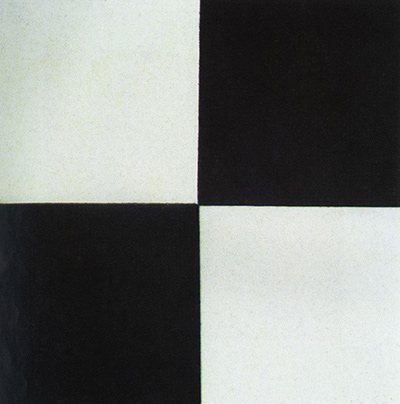
Four equal quadrants meet at the centre of Kazimir Malevich's Four Squares. Two black areas sit diagonally across from one another; the other two areas are white. The division is almost as familiar as a checkerboard, yet its refusal to depict a person, place or object makes the canvas an unusually direct experiment in what four painted fields can do. The work belongs to the Radishchev Art Museum in Saratov. [1] [2]
The museum dates Four Squares to 1915 and says it entered its collection from the State Museum Fund in 1929. A museum-associated Ministry of Culture record identifies it as oil on canvas, 49 × 49 cm. These are facts about this physical painting. They should not be borrowed from Malevich's separate Black Square, whose history and repeated versions present different questions. [1] [2]
At a Glance
- ArtistKazimir Malevich
- TitleFour Squares (Четыре квадрата)
- Date1915
- MediumOil on canvas
- Dimensions49 × 49 cm
- CollectionRadishchev Art Museum, Saratov
- Collection entryFrom the State Museum Fund, 1929
- AccessionЖ-1089 in an illustrated scholarly catalogue; not stated in the accessible museum item
Contents
- What the four squares show
- A separate 1915 painting in the Suprematist moment
- The painting's collection and later display
- Reading the centre and the corners
What the four squares show
The title counts four regions, but the eye can group them in several ways. Read the two black regions together and they form a diagonal that appears to run from the upper right to the lower left. Read the white regions instead and a counter-diagonal appears. Read neither pair as a unit and the canvas becomes a simple two-by-two division. The centre is the only point shared by all four regions. The Radishchev Museum's own account emphasizes the meeting of the black squares there and the sense that they might move apart. That is an interpretation offered by the owner, not evidence that the shapes physically moved or that Malevich made an animated work. [1]
The older site copy described “four individually painted squares on canvas” in two colours. The reproduction shows four quadrants, but the visible image cannot establish the order of the paint layers or whether each quadrant was painted independently. A conservative description is more useful: black and white areas fill the square canvas and meet along vertical and horizontal boundaries. The slight variation in the reproduced surface belongs to a particular low-resolution photograph; it should not be used to infer precise pigments, brushwork or conservation condition. [1] [2]
There is no dominant centrally isolated form of the sort seen in Black Square. Here black goes right to the top and side edges in one quadrant and to the opposite edges in the other. The white regions are equally large parts of the structure. That gives the empty-looking white an active role: changing which pair you attend to changes the apparent direction of the composition. The museum describes Malevich's white in relation to an imagined infinity, but this page need not present that larger philosophical interpretation as a measurable property of the object. [1]
A separate 1915 painting in the Suprematist moment
Malevich showed a group of non-objective works at the Last Futurist Exhibition of Paintings 0.10 in Petrograd in December 1915. The Radishchev Museum describes that exhibition as the public declaration of Suprematism and discusses Black Square, Black Cross and Black Circle in that setting. Its account places Four Squares in the same development of painted forms. It does not, however, document this particular Radishchev canvas as hanging in the famous corner installation. The image of Black Square high across a room corner belongs to the history of that other work and cannot be treated as the exhibition record of Four Squares. [1]
The museum describes Malevich's move from early figurative and Cubo-Futurist experiments toward compositions that do not refer to visible objects. Four Squares makes that change legible with very little visual information. A black region has no need to stand for a window, a field or a body: it can be considered for its size, colour and position. At the same time, the composition is visibly different from a single black shape surrounded by white. Its balanced black-white alternation means neither colour can be discussed in isolation. [1] [3]
Calling Four Squares a “variant” of Black Square risks suggesting that this canvas is another physical version of that famous painting. The Radishchev Museum presents it as an independent 1915 work in its collection. Comparing them is illuminating precisely because their arrangements differ. Black Square places one dark figure inside a pale surround; Four Squares lets both colours reach the edges and divide the entire surface. The two pictures belong to the same broad artistic project without becoming one object or one installation history. [1] [2]

The painting's collection and later display
The Radishchev Museum says the painting came from the State Museum Fund in 1929. This is the collection statement supported by the owner. The inherited page instead asserted that the work was “currently displayed in the Hermitage Museum St Petersburg,” without an object record. That location is inconsistent with the Radishchev ownership and its later documented loan. The collection should be named accurately even when a painting travels. [1]
In 2015 the museum featured the painting in a centenary exhibition devoted to a single work. In 2024 it reported lending Four Squares to the Square and Space: From Malevich to GES-2 exhibition. Neither historical exhibition notice guarantees where it hangs today. Anyone planning a visit should check the museum's current listings rather than relying on a static gallery promise. [1] [4]
An illustrated scholarly figure caption gives the inventory number Ж-1089 for the Radishchev painting, with the same title, year, medium and 49 × 49 cm dimensions. The accessible Ministry of Culture item does not itself display that number. It is useful as a cross-check, but a reader should know which source supplies it. [2] [5]
Reading the centre and the corners
The centre gives the four regions a single point of contact. Look at a corner instead and the arrangement changes character. Each corner belongs to just one field, bounded at the outside by the edge of the canvas. Moving from a corner to the middle means moving from an uninterrupted area to a point where every field is present at once. This explains why the central meeting can feel unstable even though the underlying division is so regular. It also gives the white areas the same compositional reach as the black ones. [1] [2]
The fifty-centimetre scale makes a difference to that experience. A small reproduction lets the eye take in the four-part structure at a glance. The original is large enough for a viewer standing close to shift attention among its separate regions. The arrangement remains legible at both distances, but the picture allows the centre to become an event in its own right rather than simply the middle of a small diagram. [1] [2] [5]
Frequently Asked Questions
Are there four black squares?
No. The composition comprises two black and two white quadrants. The museum describes the black pair as diagonal, meeting at the centre. [1]
Is this another version of Black Square?
Where is Four Squares held?
How large is the painting?
The museum-associated object record gives 49 × 49 cm and identifies the medium as oil on canvas. The digital image used locally on this site is only 400 × 404 pixels, so it is not a substitute for examining the painting. [2]
Discussion
Which pair do you notice first: the two black quadrants or the two white ones?
Follow each diagonal through the shared centre. Does one direction feel stronger?
Reader Insights
The four regions are equal, but your eye may group them into two diagonals.
Compare this edge-to-edge division with the bounded dark form in Black Square.
The museum calls this a separate Radishchev painting, with its own 1929 collection history.
Join the Conversation
Share a close observation or an object-specific source for the Radishchev painting.
References
- Radishchev Art Museum, “Four Squares by Kazimir Malevich: On the centenary of its creation” (2015): owner account of the 1915 painting, composition, Suprematist context and 1929 State Museum Fund transfer. View source.
- Ministry of Culture Artefact / Radishchev Art Museum, Four squares: museum-associated object page for title, date, oil-on-canvas medium, 49 × 49 cm dimensions and collection. View source.
- Radishchev Art Museum, “Russian avant-garde in the Radishchev Museum collection”: owner collection account treating the painting as part of Malevich's non-objective work. View source.
- Radishchev Art Museum, notice of its loan to Square and Space (2024): historical loan and ownership context, not evidence of current display. View source.
- Maria Gough, The Artist as Producer, illustrated figure 17 (accessible PDF): figure caption lists Ж-1089 with year, dimensions, medium and Radishchev credit; accession not shown on the accessible owner item. View source.