Kazimir Malevich.jpg)
 by Tom Gurney
Tom Gurney BSc (Hons) is an art history expert with over 20 years experience
Published on June 19, 2020 / Updated on November 20, 2026
Email: tomgurney1@gmail.com / Phone: +44 7429 011000
Introduction
The black cross stretches beyond a large red oval. A thin black diagonal cuts across its lower stem. Against the pale field, the three forms make an image that can be recognized instantly and still resists a simple explanation. The cross is a familiar shape, but here its painted bars, their intersection and their unequal extensions become the painting's main events. [1] [2]
This is Mystic Suprematism (Black Cross on Red Oval), catalogued by Sotheby's as a 1920–22 oil on canvas measuring 100.2 × 59.2 cm. The former Stedelijk number A 7668 appears in the 2003 Guggenheim exhibition catalogue's illustrated plate of this exact composition. Both identifiers are valuable because the same Guggenheim book prints a different work under the near-identical title Suprematism (Mystic Suprematism). The existing site image matches the A 7668 black-cross and red-oval version. [1] [2]
At a Glance
- ArtistKazimir Malevich
- Auction titleMystic Suprematism (Black Cross on Red Oval)
- Guggenheim titleSuprematism (Mystic Suprematism), printed plate 231
- Date1920–22 in Sotheby's 2015 catalogue and Guggenheim 2003 catalogue
- MediumOil on canvas
- Measurements100.2 × 59.2 cm in Sotheby's; approximately 100.5 × 60 cm in Guggenheim's caption
- Historic museum numberStedelijk A 7668; the work left the museum group in 2008
- Catalogue keyNakov S-613, cited by Sotheby's
- Current collectionNot established by the consulted public records
Contents
- A cross over an oval
- Which *Mystic Suprematism*?
- Date, exhibition and collection history
- Why the arrangement remains striking
- A painting in several exhibition settings
A cross over an oval
The red oval is tall and uneven, a colour mass almost as broad as the picture's central zone. The black cross sits over it but does not fit neatly inside it. Its horizontal arm passes beyond the oval, and the vertical stem reaches above and below. That mismatch prevents the two shapes from reading as one flat emblem. They seem to push against each other's boundaries even though the painting depicts no physical movement. [1] [2]
A narrow black diagonal near the bottom complicates the larger cross. It is small enough to miss at first, then difficult to ignore: it crosses close to the lower stem without mirroring the main horizontal arm. Its slight tilt interrupts any reading of perfect symmetry. The empty-looking white around all three forms is substantial, allowing the black and red areas to hold the eye without a landscape, figure or architectural setting. [1] [2]
The cross shape inevitably invites associations. Sotheby's catalogue essay argues that Malevich approached the cruciform as a plastic, nonobjective form rather than a religious symbol. That is a stated interpretation of the painting, not proof that every viewer or contemporary saw it in the same way. The page can describe what the bars do and report the scholar's reading without declaring that the image possesses one fixed symbolic code. [1]
 in Detail Kazimir Malevich.jpg)
Which Mystic Suprematism?
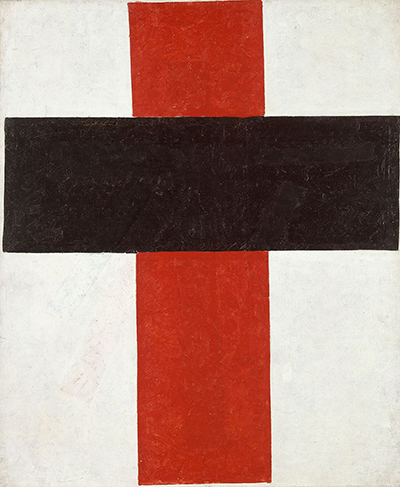
Matthew Drutt's 2003 Guggenheim catalogue reproduces two works under Suprematism (Mystic Suprematism) on facing printed pages. The first, A 7669 on page 230, has a red cross over a black circle with smaller red bars. Its caption gives 72.5 × 51 cm. The second, A 7668 on page 231, has the black cross over a red oval and a small black diagonal. It is the painting on this page. These are not differently coloured copies of a single photograph; the museum numbers, sizes and arrangements establish separate physical works. [2]
Sotheby's 2015 lot identifies the black-cross canvas with catalogue key Nakov S-613. It gives 100.2 × 59.2 cm; the older Guggenheim caption gives approximately 100.5 × 60 cm. The small dimensional difference is left visible because neither consulted source explains the measuring convention. The difference does not erase the much larger, compositional distinction from A 7669. [1] [2]
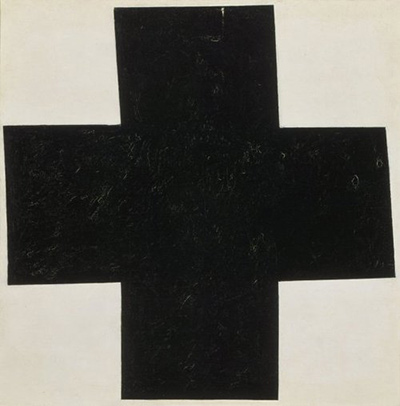
This also keeps the painting separate from the Black Cross of 1915, a single black cruciform on white associated with a different object history. Mystic Suprematism adds the red oval and short diagonal and belongs to the later 1920–22 period in the sources used here. Looking only for the words “black cross” would merge two different paintings. [1] [2] [3]
Date, exhibition and collection history
The 1920–22 date is the one used by Sotheby's and Guggenheim. Sotheby's literature list also records older, looser datings such as “after 1920” and “the 1920s.” The public evidence is sufficient to use the 1920–22 catalogue range, while acknowledging that it is a scholarly dating rather than a dated inscription quoted here. [1] [2]
Sotheby's exhibition list records a 1927 Berlin showing and marks a 1927 Warsaw appearance “possibly.” It documents the painting in the Stedelijk's 1958 first display of the Malevich collection and says it remained in the museum group until 2008. The auction lot later lists the artist's estate and heirs in its provenance. That record does not make the Stedelijk its present owner. The present private holder is not established by the sources used for this page. [1]
The distinction matters for readers seeking to see the painting. A 1958 Stedelijk exhibition and a historic museum number are facts about where it was once catalogued and shown, not a promise that it can be found in an Amsterdam gallery today. The same care applies to Warsaw: a qualified exhibition entry should stay qualified in the article. [1] [2]
The painting also appeared in the 2003–04 Guggenheim/Menil Malevich exhibition according to Sotheby's list, and the exhibition book reproduces it. That pairing of a historical exhibition record and a direct illustrated catalogue gives stronger evidence for identifying the local image than a title-only search would. [1] [2]
Why the arrangement remains striking
Malevich made the black cross one of his reduced Suprematist forms, but this canvas does not merely repeat an earlier sign. The oval changes the proportions and gives the vertical bar a forceful red field to cross. The small diagonal makes the lower zone less static. As the eye moves among those elements, the composition alternates between apparent emblem and visibly constructed painting. [1] [2] [3]
Sotheby's essay places the work within Malevich's reflections on nonobjective painting after his 1915 breakthrough. It uses ambitious language about cosmic forces and the meaning of the cruciform. Those claims are best read as a catalogue interpretation of the work, while the documented object facts—its forms, material, measurements, exhibition history and former museum number—give a reliable base for the viewer's own examination. [1]
A painting in several exhibition settings
Sotheby’s exhibition history lists the canvas in Malevich’s Berlin presentation in 1927 and gives Warsaw as a possible earlier showing. The distinction is important. The work can be placed in the documented Berlin list without assuming exactly the same selection had been shown in Warsaw. The catalogue also records subsequent exhibitions in which the painting could be understood in different company. In 1996 it appeared in a Guggenheim exhibition on twentieth-century abstraction. In 2003 a Paris exhibition presented it within a selection associated with the Stedelijk’s Malevich holdings. Those contexts helped circulate the image and its title. [1] [2]
In the painting itself, the dark cross offers straight edges that can be followed beyond the rounded shape. The rim of the oval is most distinct just where the dark form leaves it open. One shape therefore helps define the other even though their outlines are so different. That exchange also makes this work recognizable across exhibitions and reproductions. The physical canvas kept those relationships even as titles, credits and catalogue descriptions changed around it. [1] [2]
Frequently Asked Questions
When was it made?
Is it still at the Stedelijk?
Is it the same as the red cross on a black circle?
No. The Guggenheim catalogue places that composition on printed page 230 as A 7669. The black cross on red oval is A 7668 on page 231. [2]
How large is the painting?
Does the cross have a religious meaning?
The shape may invite that association. Sotheby's essay instead reads it as a nonobjective formal element. The consulted evidence does not establish a single meaning that every viewer must adopt. [1]
Discussion
How does the cross change when it extends beyond the red oval?
When do you first notice the narrow diagonal near the bottom?
Reader Insights
The 2003 Guggenheim catalogue identifies this composition as historic Stedelijk A 7668.
A different red-cross and black-circle work was catalogued as A 7669.
Sotheby's records its museum history and 1920–22 date; current ownership is not established here.
Join the Conversation
Share a close observation or an object-specific source for historic Stedelijk A 7668.
References
- Sotheby's New York, Mystic Suprematism (Black Cross on Red Oval), lot 8, 2015: 1920–22 date, oil-on-canvas medium, 100.2 × 59.2 cm size, exhibition and provenance entries, Nakov S-613 reference and interpretive essay. View source.
- Matthew Drutt, Kazimir Malevich: Suprematism (Guggenheim, 2003), printed pp. 230–31: illustrated original catalogue showing distinct A 7669 and A 7668 compositions with historic Stedelijk captions. View source.
- Centre Pompidou, Croix [noire], AM 1980-1: distinct 1915 black-cross canvas used for comparison. View source.