 by Tom Gurney
Tom Gurney BSc (Hons) is an art history expert with over 20 years experience
Published on June 19, 2020 / Updated on November 20, 2026
Email: tomgurney1@gmail.com / Phone: +44 7429 011000
Introduction
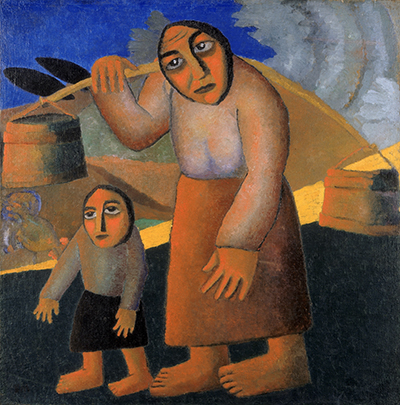
Kazimir Malevich's Peasant Woman with Buckets shows a broad-shouldered woman balancing two pails on a pole while a child stands beside her. Their bodies are simplified but their relationship is clear: the pole stretches across the top of the composition and the smaller figure echoes the older person's solid stance. The painting belongs to the Stedelijk Museum Amsterdam, which catalogues it as Boerenvrouw met emmers, dates it 1912, and assigns object number A 7676. [1] [2]
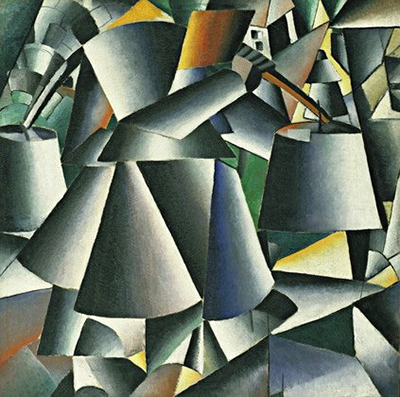
This is easy to confuse with Malevich's differently composed Woman with Pails: Dynamic Arrangement in New York. Both involve a woman and containers, but the Stedelijk picture keeps the woman, child and landscape legible. The Museum of Modern Art canvas breaks a water carrier into interlocking geometric forms. They are separate objects in separate collections. [1] [5]
At a Glance
- ArtistKazimir Malevich
- TitlePeasant Woman with Buckets; Stedelijk title Boerenvrouw met emmers
- Date1912, as catalogued by the Stedelijk
- CollectionStedelijk Museum Amsterdam, A 7676
- SubjectWoman, child and two buckets on a carrying pole
- Medium and sizeThe available public owner item does not state these fields; do not infer them from the MoMA painting
Contents
- Looking at the woman and child
- Where it sits in Malevich's early work
- Titles, catalogue records and a conservation note
- Not the MoMA Woman with Pails
- Two ways of carrying weight
Looking at the woman and child
The woman fills much of the square picture. One arm rises to steady the pole behind her head, while the other hand hangs open before the dark skirt. Her head tilts toward the child and viewer. Her eyes, nose and mouth are described with relatively few marks, but their positioning gives the face an alert, almost mask-like presence. The child is much smaller, close to the left edge, with feet set widely on the dark ground. The two figures share strong, simplified outlines and large hands and feet. These are visible features, not evidence that the artist copied a particular sculpture or portrait. [1] [2]
The carrying pole provides a strong horizontal line above the figures. It connects the pail on the left with the partly cut-off pail on the right. The buckets' placement gives the woman an unmistakable task, while the child makes the scene more than a study of one worker. The pole also creates a compositional bar beneath the blue and grey sky. Its diagonal tilt prevents the picture from settling into a symmetrical arrangement. [1] [2]
Colour separates the main zones: deep blue above, warm brown and ochre through the woman's clothing and the buckets, and near-black across the lower ground. The woman's face and arm carry warmer flesh colours than the child's pale upper body. The darker lower field anchors the heavy feet. The reproduced image is enough to describe those relationships, but it cannot establish exactly how pigments appear under gallery light or whether a particular patch is an original brush stroke rather than a reproduction effect. [1] [2]
Where it sits in Malevich's early work
The Russian cultural portal culture.ru places this woman-and-child painting among Malevich's early peasant subjects, alongside The Mower and Taking in the Rye. Its account describes these pictures as deliberately enlarged and flattened, with recognizable workers rather than the nonobjective shapes of his later Suprematism. That is a useful broad frame for looking at this canvas: the woman remains a person with a visible task, although natural proportions and spatial depth are not his priorities. [3]
The older text on this page proposed direct influences from Gauguin, El Greco and African sculpture. A visual resemblance can invite comparison, but it is not evidence that Malevich used those particular sources for this object. The Russian essay instead points more generally to native folk and icon traditions alongside French modernism in the early avant-garde. Without an object-specific statement from Malevich or a documented visual source, it is more accurate to describe the formal choices and leave a direct chain of influence open. [3]
The woman's work is central, yet the painting supplies no named village, date of a depicted event or biography for either figure. We can say what is shown; we cannot identify the child or assert that the canvas records a particular family's day. Nor does the available museum record say that Malevich painted it from life. The title names a peasant woman and buckets, while the image itself adds the child and a simplified landscape. [1] [2]
Titles, catalogue records and a conservation note
The Stedelijk's Dutch title translates as “Peasant Woman with Buckets.” An accession-labelled reproduction also gives “and Child” in English and Russian, and culture.ru uses the longer phrase. The child is plainly in the picture, so the longer descriptive name is understandable, but the Stedelijk's current title and number control the object identification used here. [1] [2] [3]
The University of Vienna's Database of Modern Exhibitions transcribes a historical catalogue entry titled Woman with Buckets and a Child among Malevich's works. Its list does not attach today's Stedelijk accession or an illustration to that entry. It is a promising exhibition-history lead, not proof on its own that the exact A 7676 canvas was displayed. An exhibition claim would need the original checklist or a further work-level concordance. [4]
The Stedelijk's 2017 annual-report supplement lists Peasant Woman with Buckets, 1912, under “Restoration of frames for paintings.” That statement concerns the frame. It should not be recast as a published finding about the painting's pigments, underdrawing or condition. The current public item record available to this research does not specify the canvas's material support or measurements, despite those details appearing on some secondary sites. They are left unasserted as owner facts here. [1] [6]
Not the MoMA Woman with Pails
MoMA's Woman with Pails: Dynamic Arrangement is dated 1912–13 and numbered 815.1935. Its composition is built from repeated cones and angled planes. The Stedelijk A 7676 picture instead shows an adult and child against a dark ground, with two recognizably suspended buckets. The difference is immediately visible, but the accession numbers protect the distinction even when English titles vary. [1] [5]
This matters because an art-conservation table once called the MoMA work Peasant Woman with Buckets. It listed the New York collection in the same row. Reading only that title could falsely attach its technical description to the Amsterdam painting. Here the museum, composition and object number are kept together. The comparison shows a striking shift in Malevich's pictorial language without pretending that one canvas is a variant or a replacement for the other. [5] [7]
Two ways of carrying weight
The title directs attention to a task that the woman carries out with her whole body. In the Stedelijk picture, the child gives the viewer another scale against which to judge the adult figure. Looking between the two makes the woman’s outline easier to follow where the painted shapes compete for attention. The small figure also changes the balance of the scene. The woman and her burden occupy more room, while the child has enough definition to be seen as a participant. [1] [2]
MoMA’s separately catalogued Woman with Pails offers a different way to see a similar subject. Its square format gives the sweeping planes room to extend around the painted figure. The museum specifies a date of 1912–13 and records a 1912 date on the reverse. Those details distinguish it from the date on the Stedelijk record and explain why a similar English title is an unreliable guide on its own. One can compare the handling of the burden and of the moving figure while preserving each canvas’s identity. [1] [2] [5]
Frequently Asked Questions
When did Malevich paint it?
Where is it?
It is catalogued by the Stedelijk Museum Amsterdam as A 7676. A collection record does not guarantee it is currently on display; check the museum's current visitor information before travelling. [1]
Is the child in the title?
Is it the same painting as Woman with Pails?
No. MoMA's Woman with Pails is 815.1935 in New York, dated 1912–13; the woman-and-child picture is Stedelijk A 7676 in Amsterdam, dated 1912. [1] [5]
Discussion
Look at how the carrying pole links the two buckets across the upper part of the painting.
The woman and child have different scales but related outlines. What does that do to the scene?
Reader Insights
Where do you see the woman's task conveyed most clearly: the pole, the pails or her pose?
How do the blue sky and dark lower field affect the figures' weight?
Compare the scene with MoMA's Woman with Pails. Which parts of the subject survive the change of style?
Join the Conversation
Share a close observation or a source-backed reading of this particular Stedelijk canvas.
References
- Stedelijk Museum Amsterdam, Boerenvrouw met emmers, A 7676: owner title, translated title, date, maker and inventory number; the captured public item omits material and dimensions. View source.
- Wikimedia Commons, accession-labelled reproduction of Peasant Woman with Buckets: composition, descriptive “and Child” title and A 7676; used for identity and visible features, not as a substitute for owner metadata. View source.
- Culture.ru, “Painting in Detail: Malevich's Reaper”: Russian cultural portal's early peasant-series context and identification of the Stedelijk woman-and-child painting. View source.
- University of Vienna, Database of Modern Exhibitions, Malevich entry: historical catalogue-title transcription; exact-object exhibition match unproven. View source.
- Museum of Modern Art, Woman with Pails: Dynamic Arrangement, 815.1935: separately accessioned and compositionally distinct canvas. View source.
- Stedelijk Museum, 2017 Annual Report Supplement 9, printed p. 51: lists frame restoration for the 1912 painting. View source.
- National Gallery of Art, Conservation Research 1996/1997, works-examined table: its Peasant Woman with Buckets row explicitly identifies the MoMA object, illustrating the title collision. View source.