 by Tom Gurney
Tom Gurney BSc (Hons) is an art history expert with over 20 years experience
Published on June 19, 2020 / Updated on November 20, 2026
Email: tomgurney1@gmail.com / Phone: +44 7429 011000
Introduction
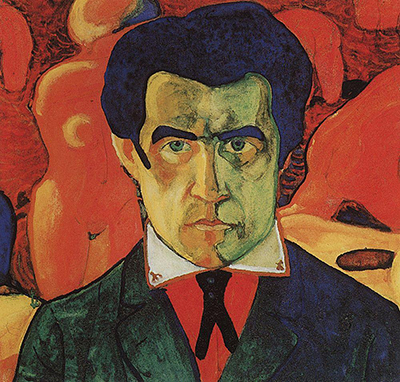
Kazimir Malevich looks directly out of this early Self-Portrait. His hair forms a dark blue cap above a face built from green, yellow, orange and red areas. The figure wears a dark jacket over a red shirt, while large red forms press close behind him. The image is a portrait, but its colour does more than describe ordinary skin, clothing and background. [1] [2]
This is the small work on paper in the Tretyakov Gallery, Moscow, measuring 27 × 26.8 centimetres. A National Gallery of Art publication dates it circa 1908–09 and describes gouache and varnish on paper. The Tretyakov Gallery Magazine dates it 1908–10 and lists watercolour and gouache on paper. Both identify a closely matching work, but their different wording should remain visible rather than be silently merged into a single exact date or medium. [1] [2]
At a Glance
- ArtistKazimir Malevich
- TitleSelf-Portrait
- DateCirca 1908–10 in the cited publications; see dating note below
- MediumWork on paper in gouache; additional materials described differently by the cited publications
- Dimensions27 × 26.8 cm
- CollectionTretyakov Gallery, Moscow
- Earlier collectionGeorge Costakis; donated to the Tretyakov Gallery in 1977
Contents
- Looking closely at the face
- What is behind the artist?
- How the surface helps shape the figures
- Where this portrait fits in Malevich's work
- Which Malevich self-portrait is this?
- Annotated details
Annotated Details from Self-Portrait
This is the early Tretyakov self-portrait examined by the National Gallery of Art. These points isolate visible colour and shape; they do not identify a sitter in the background or settle disputed medium terminology. 12
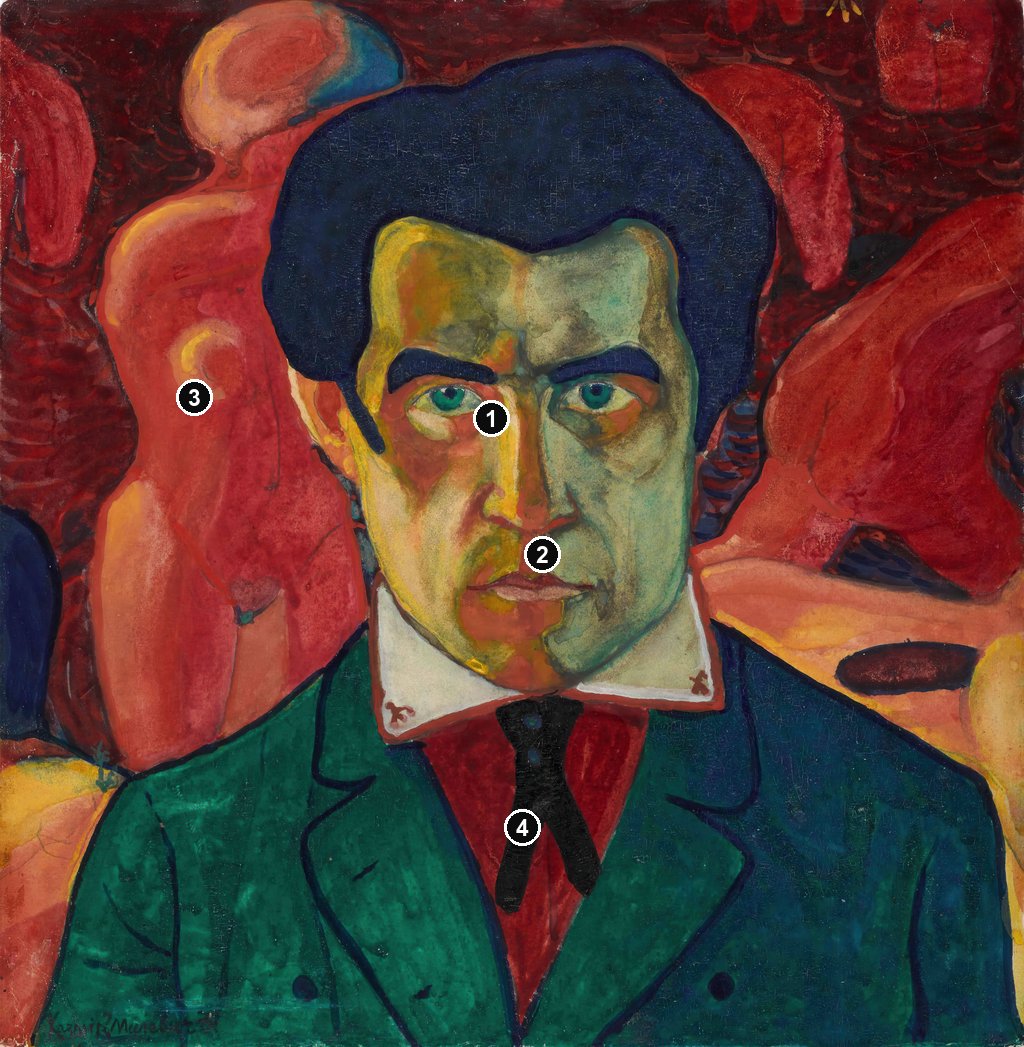
Details from SELF-PORTRAIT
Use the numbered points to compare the direct gaze, contrasting facial colours and unresolved forms around the head. The physical work measures 27 × 26.8 cm.
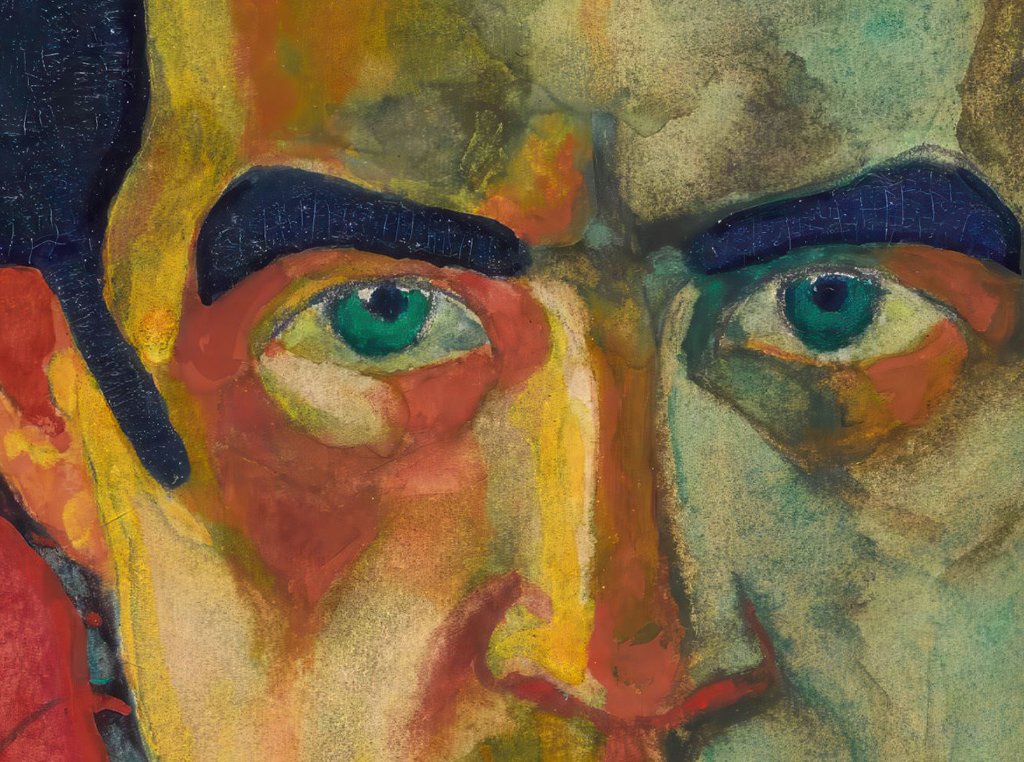
The direct gaze
The eyes look straight outward beneath heavy dark brows. Their position helps hold the face together despite abrupt changes of colour around them. 1
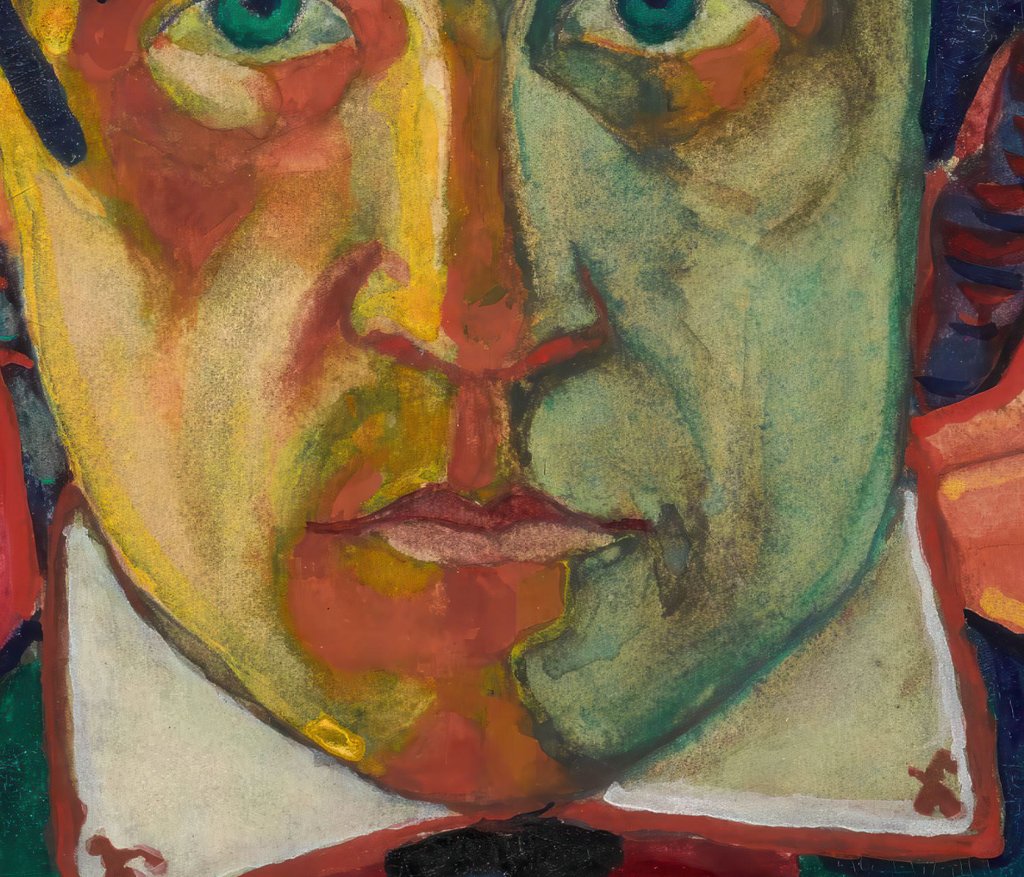
Colour planes across the face
Green and blue-green areas meet yellow, orange and red ones around the nose and cheeks. These are visible divisions of colour, not evidence of a documented pigment formula or of the sitter’s actual complexion. 1
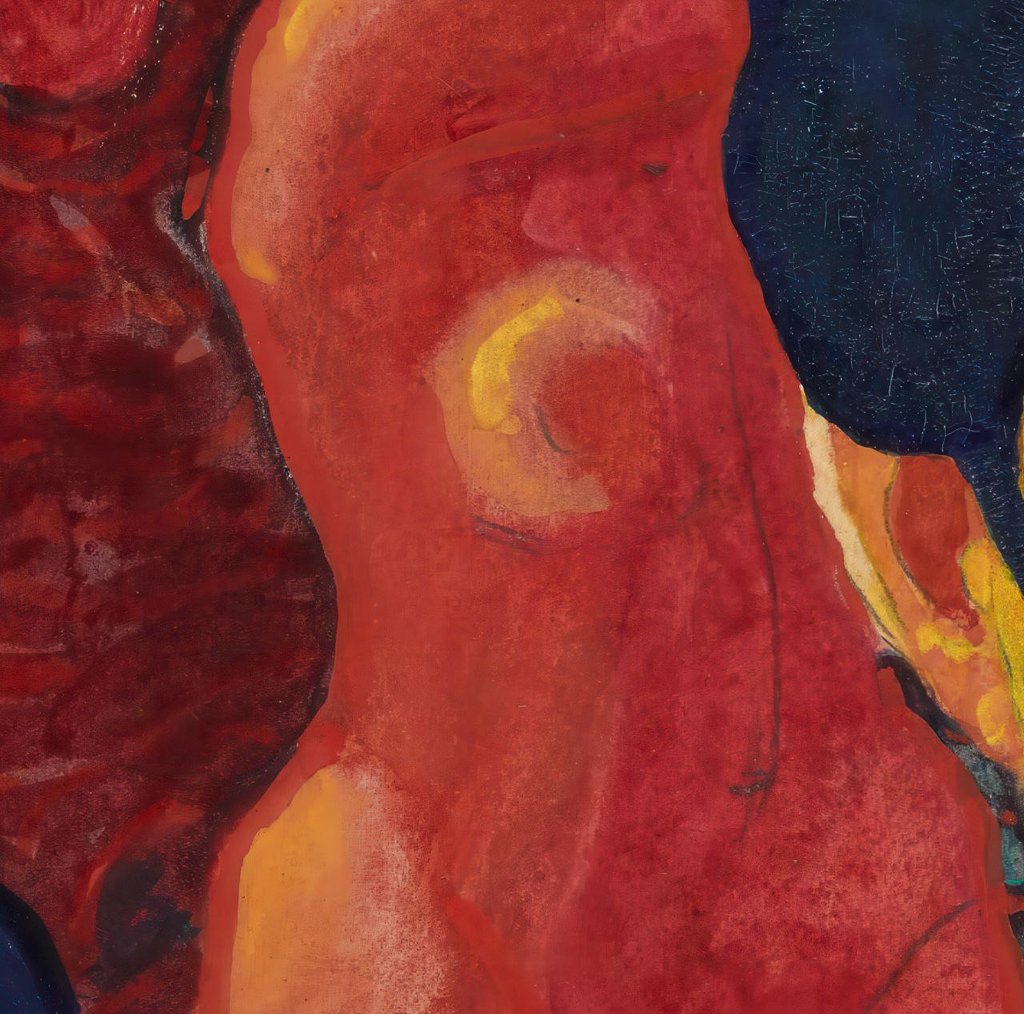
Unresolved red forms
A rounded pale shape and red curving passages sit close behind the dark hair. The NGA describes female-inspired forms but leaves open what, if anything, this space depicts. 1
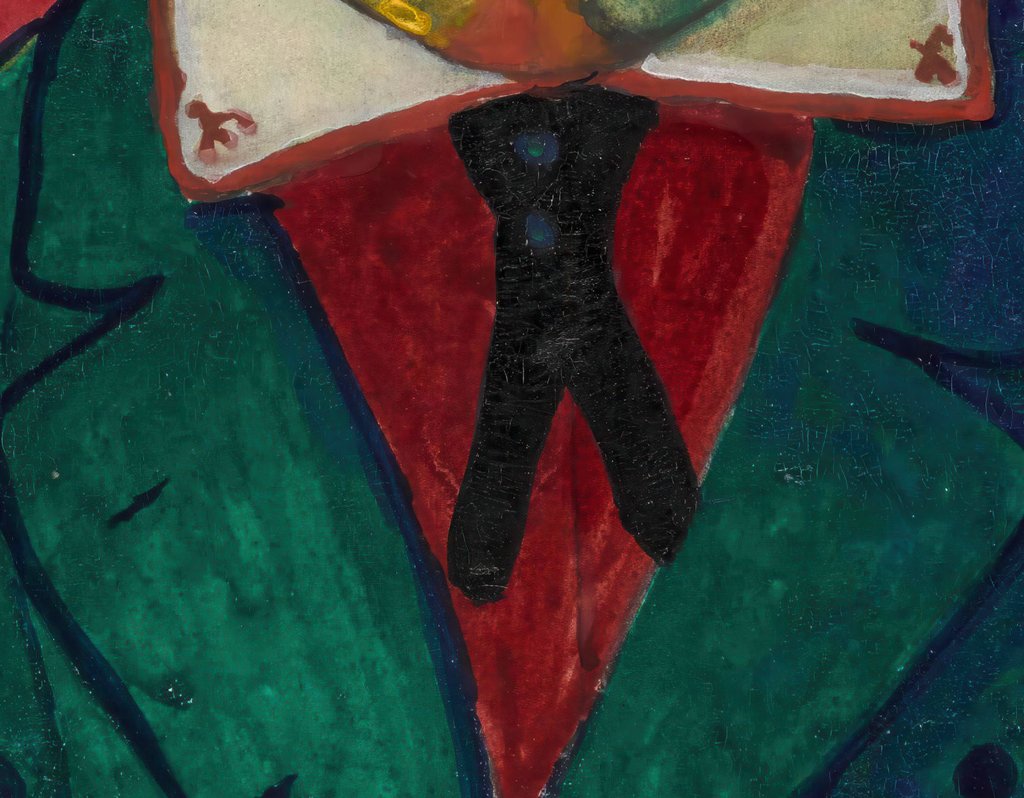
Jacket, shirt and outline
Dark jacket edges frame the red shirt and black tie. The strong outline gives the lower figure a clear silhouette against the busy background. 1
Looking closely at the face
The eyes are nearly level and meet the viewer's gaze. Thick dark brows, the hairline and the jacket frame the brighter face. Malevich divides the cheeks, forehead and nose into forceful colour areas instead of smoothing every transition into a naturalistic skin tone. The two sides of the face are not coloured alike: cool green and blue-green meet warmer yellow, red and orange. Strong outlines keep the head legible even where the interior colours change abruptly. [1]
The National Gallery of Art's 1990 teaching packet describes these passages as sharply contrasting reds and greens, with relatively unblended highlights and shadows that model the planes of the face. It relates the approach to post-Impressionist and early expressionist uses of colour. That is a reading offered by an exhibition publication, not evidence that a particular patch of green records Malevich's actual appearance or a specific feeling. The visible result is more certain: the face remains recognisable while its colour resists ordinary portrait convention. [1]
Enlarged on a screen, the reproduction can make this sheet seem large. The documented original is only a little over a quarter of a metre high. Its compact size matters when judging the boldness of the face and how much visual activity is crowded around it. A digital image cannot reliably establish the sheen of the varnish mentioned in the 1990 publication or decide whether the Tretyakov Magazine's watercolour description applies to every coloured area. [1] [2]
What is behind the artist?
The red background contains curving forms on either side of the head. Some look human, but they do not resolve into a clearly identified scene. The NGA teaching packet calls them shapes inspired by female figures and offers two possible ways to read the space: something depicted behind the sitter, or something pictured in the artist's imagination. It does not establish a documented identity for a model, a particular painting in the studio or a fixed symbolic meaning. [1]
Look especially at the left of the head, where a pale rounded form and a red shape sit close to the dark hair. On the right, broad red passages and small dark openings create a similarly uncertain depth. These shapes make the space less like a plain portrait backdrop. Yet the strongest contact remains between the forward-facing eyes and the viewer; the background invites a second, slower look after the face has seized attention. [1]
How the surface helps shape the figures
The faint forms behind the head are also a record of how Malevich worked. In a study of his painted surfaces, National Gallery of Art conservator Ann Hoenigswald describes fine strokes of a clear coating on the figure at the right. Her study reproduces both the full portrait and a detail of the coated area. She identifies the strokes as a way of defining the curved back of a nude. Malevich then worked over parts of the coating in gouache. A small area of the sheet thus kept evidence of successive decisions about which parts of the figure to bring forward. [5]
The coating could change how much light an area reflected and how saturated its colour appeared. When the coated strokes and the surrounding paint responded differently, the figure’s contours could gain definition even within a close range of reds. The face offers a useful comparison within the same sheet. Its changes from yellow to green are easy to pick out in reproduction. The variation in sheen behind the face depends more on the surface and on how it is lit. Hoenigswald’s detail provides evidence of the handling there, while the full reproduction helps locate it in relation to the sitter. [1] [5]
This also clarifies why the published descriptions of the medium need to stay specific to their sources. The Tretyakov caption names watercolour and gouache. Hoenigswald discusses coating applied in selected passages, including places where Malevich continued working in gouache. The word varnish in the NGA caption therefore tells us something about how a particular area was made. It would be misleading to read it as a description of an evenly varnished sheet or as a precise chemical identification of the coating on the nude’s back. [2] [5]
Where this portrait fits in Malevich's work
The NGA packet places the portrait in Malevich's move beyond late nineteenth-century French models toward the art of the early twentieth-century avant-garde. It names post-Impressionist painters and the Fauves as context for its high-key, freely chosen colour. Those comparisons help explain why a viewer may see expressive colour before conventional likeness. They do not mean that this particular sheet copies a known work by Gauguin, Van Gogh or Matisse. [1]
The same publication suggests the portrait may have appeared at the First Moscow Salon of 1910–11, but immediately says it is uncertain whether this work or another self-portrait was shown. The exhibition therefore belongs in the history of possible identifications, not in a firm exhibition list for this object. The publication does securely describe Malevich as a participant in that event. [1]
The Tretyakov Gallery Magazine and the NGA exhibition packet record a later, clearer ownership point: George Costakis donated the work to the gallery in 1977. Its listing agrees with the NGA packet's collection and dimensions. Together, the dimensions, image, holding and gift distinguish the sheet far more securely than the title by itself. [1] [2]
Which Malevich self-portrait is this?
Malevich made more than one self-portrait, and his abstract art also uses titles that include “self-portrait.” This page concerns the early, colourful, frontal head on paper held by the Tretyakov Gallery. The Russian Museum records a different Self-Portrait (The Artist) from 1933: it is an oil painting on canvas, 73 × 66 centimetres. The historical exhibition listing for the 1915 0.10 show also includes a Malevich work titled Self-Portrait in Two Dimensions. Neither title identifies the small Tretyakov sheet shown here. Keeping image, support, size, date and holding together avoids turning a shared title into a false physical-work match. [1] [2] [3] [4]
The dating should remain approximate. Until an object-level owner record or fuller catalogue entry resolves the difference between the two cited ranges, circa 1908–10 is the most transparent description of their published dates. [1] [2]
Frequently Asked Questions
When was it made?
Is it an oil painting?
Who are the figures behind Malevich?
The NGA publication describes female-inspired forms but does not identify individual sitters or a definite narrative. Their unresolved shapes are part of what a viewer can investigate in the reproduction. [1]
Was it exhibited at the First Moscow Salon?
Possibly, but the NGA packet says it is uncertain whether this particular self-portrait or another one was included. The page therefore does not list the Salon as a confirmed showing of this sheet. [1]
Discussion
Start with the eyes, then look at the colours across the cheeks and forehead. How does the face change as you move from one area to another?
The red background includes forms that are not fully resolved. What can you describe without assigning them a fixed identity?
Reader Insights
Compare the left and right sides of the face. Which colours and outlines make them feel connected?
Trace the border between dark hair and the red forms behind it. Where does the space become uncertain?
Remember that the original is just 27 cm high. How does that size change your sense of the bold colour?
Join the Conversation
Share a close observation or a source-backed reading of this specific early self-portrait.
References
- National Gallery of Art, Kazimir Malevich teaching packet (1990), PDF pp. 17 and 51: illustrated description, circa 1908–09 date, gouache and varnish on paper, dimensions, Tretyakov holding, early exhibition uncertainty and 1977 Costakis gift. View source.
- The Tretyakov Gallery Magazine, Malevich artist and image catalogue, Self-portrait listing for issue 1, 2015: 1908–10 date, watercolour and gouache on paper, dimensions, Tretyakov holding and Costakis donation. View source.
- State Russian Museum, Self-Portrait (The Artist), ЖБ-1516: owner record for the distinct 1933 oil on canvas. View source.
- University of Vienna, Database of Modern Exhibitions, The Last Futurist Exhibition of Paintings 0.10: historical exhibition listing with a Malevich work titled Self-Portrait in Two Dimensions. View source.
- Ann Hoenigswald, “Kazimir Malevich’s Paintings: Surface and Intended Appearance,” in Conservation Research 1996/1997, printed p. 120, figs. 20–21: exact early sheet and evidence for local coating and subsequent gouache. View source.