 by Tom Gurney
Tom Gurney BSc (Hons) is an art history expert with over 20 years experience
Published on June 19, 2020 / Updated on November 20, 2026
Email: tomgurney1@gmail.com / Phone: +44 7429 011000
Introduction
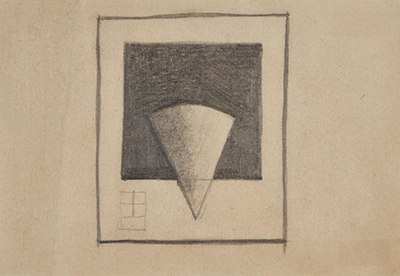
In Square and Cone, a pale, downward-pointing form cuts across a dark square. Both sit within a lightly drawn rectangular boundary on a small sheet of paper. A tiny grid of rectangles appears near the lower left. This is the work reproduced in Sotheby's 2016 catalogue for Russian Pictures, lot 4, which identifies it as a 1915 pencil drawing measuring 11 × 16 cm. [1] [2]
The drawing belongs to Malevich's early Suprematist period, but the sale record does not establish that this particular sheet was exhibited at 0.10 in Petrograd. The exhibition is useful historical context: Malevich introduced Suprematist paintings there in December 1915. The sheet's own appearance, literature and recorded provenance give it an identity independent of that famous show. [1] [3]
At a Glance
- ArtistKazimir Malevich
- TitleSquare and Cone
- Date1915, as catalogued by Sotheby's
- MediumPencil on paper
- Dimensions11 × 16 cm, as catalogued by Sotheby's
- Catalogue referenceNakov S-659, cited in Sotheby's literature
- Recorded ownershipAnna Alexandrovna Leporskaya; Galerie Gmurzynska; subsequent buyer, as listed by Sotheby's
- Current holderNot established by the checked sources
Contents
- What is in the drawing?
- Why is the square dark and the cone light?
- Does the drawing show a real cone?
- Provenance, literature and orientation
- Is this the Tokyo drawing of a black square and white cylinder?
- How the two shapes set the scale
What is in the drawing?
The largest dark shape is a square with visibly worked pencil shading. Its top edge is almost level, while variations in pressure make the interior uneven rather than mechanically black. In front of it, a light form widens into a curved upper rim and tapers to a point below the square. The Sotheby's title calls this a cone. Its outline and shading suggest volume, but the drawing does not place it in a recognizable room or landscape. [1] [2]
A second, thinly ruled rectangle surrounds the central pair. It is not a printed border or a picture frame: the line is part of the drawing. The square sits high within it, and the cone's point approaches the bottom. This enclosure makes the space feel contained, even though the forms themselves lack a ground line or cast shadow. [1] [2]
At lower left, faint short vertical and horizontal lines make a small grid. It is easy to miss when looking only at the dominant square. The grid adds a third scale: a tiny set of divisions below the stark meeting of two large forms. The drawing gives no key that would turn those marks into a building, window or diagram. Their placement is a visible fact; a specific narrative meaning is not documented. [1] [2]
Why is the square dark and the cone light?
The basic contrast is made with one medium, pencil. Heavier shading fills the square, while the tapered form retains much of the paper's pale tone. This produces an overlap without colour: the light cone appears in front of, or cut from, the dark plane. The eye can also read the dark area as a background opening rather than a solid slab. These are competing visual readings of the marks, not claims that the sheet depicts an actual object. [1] [2]
Sotheby's catalogue note treats Malevich's drawings of this period as independent compositions, rather than automatically as preparations for paintings. It points to his use of a freely drawn rectangular enclosure as a space in which forms interact. That interpretation fits the visible border here, but no specific painting has been verified as this drawing's destination or source. [1]
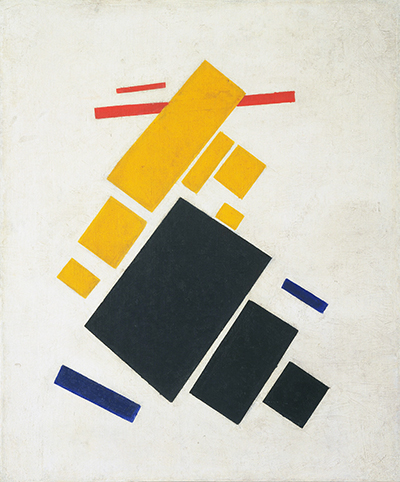
The result is especially striking beside Black Square, where a single dark quadrilateral dominates a pale painted field. Here a pale form interrupts the square and the enclosing line is openly drawn. Malevich's Suprematist Composition: Airplane Flying shows a different 1915 possibility: separate coloured shapes spread through a white field. The comparisons show varied uses of geometric form; they do not establish a sequence of sketches leading to those paintings. [1] [3]

Does the drawing show a real cone?
The title invites a three-dimensional reading, and the curved upper edge gives the pale form a sense of volume. Yet the shape lacks the complete modelling one might expect in a study of a physical object. Its point also crosses the square's lower edge in a way that makes the forms difficult to fit into ordinary depth. Calling it a cone identifies the catalogued shape; it does not make the composition a still life. [1] [2]
This difference matters in discussing Suprematism. MoMA describes Malevich's 1915 public presentation as a move away from depicting the outside world toward relations among geometric forms. Square and Cone is more ambiguous than a fully flat arrangement because one form suggests volume. Its ambiguity is part of what the viewer can inspect, without making the unsupported claim that it was displayed at 0.10. [1] [3]
Provenance, literature and orientation
Sotheby's lists the drawing in the collection of Anna Alexandrovna Leporskaya in Leningrad, then with Galerie Gmurzynska in Cologne, then acquired from that gallery. The 2016 sale page does not identify a present holder. A later auction appearance is not itself proof of where the drawing is now. [1]
The same catalogue cites three publications: Jean-Claude Marcadé's Malévitch (1990, no. 221), Aleksandra Nakov's Kazimir Malewicz: Catalogue Raisonné (2002, S-659), and The Leporskaya Archive (2011, no. 388). Sotheby's specifically says the Marcadé illustration was printed upside down. This is a useful warning when comparing reproductions: the oriented sale image has the square high, the cone pointing down, and the tiny grid at lower left. The cited books are bibliographic witnesses in the sale entry, not texts independently consulted for this article. [1]
Is this the Tokyo drawing of a black square and white cylinder?
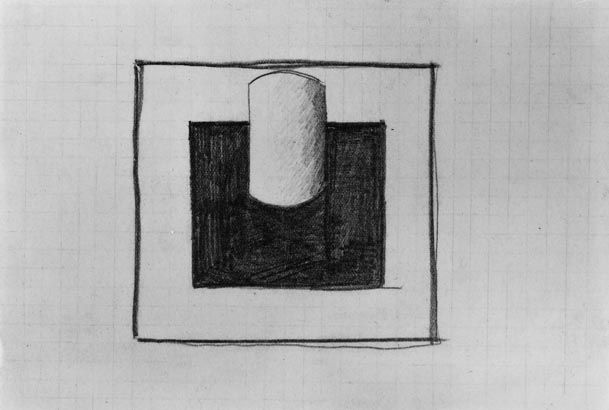
No. The National Museum of Modern Art, Tokyo catalogues D00296, Black Square and White Cylindrical Form, also dated 1915 and made in pencil on paper. Its listed size, 11.2 × 16.4 cm, is close, but the museum's image shows a vertical white cylinder above a dark block. Square and Cone shows a pale form tapering downward and a small grid at lower left. Similar materials, scale and titles do not make the two sheets one object. [1] [4]
How the two shapes set the scale
The dark square supplies an area the eye can grasp relatively quickly. Its edges give a reference for judging the cone’s more gradual taper. The cone in turn draws attention to transitions that are harder to see in a bounded, relatively even block. At the scale of a small sheet the change of tone can seem to establish a volume almost as soon as the outline is recognized. The pale paper around the cone is important here. It lets the edges of the cone alternate between a pronounced line and a softer boundary. [1] [2]
The Tokyo sheet is a useful check on how much depends on the exact form. Its accessioned title specifies a cylinder. A cylinder can keep a consistent width along its length, while the taper in this sheet changes the width of the light shape as the eye moves away from its broader end. The near resemblance between the titles can make these look like interchangeable illustrations of a black square and a light volume. The two pictured shapes lead the eye differently, and the recorded media, sizes and object identifiers belong to their respective sheets. [1] [2] [4]
Frequently Asked Questions
When was it made?
Is it a painting?
No. The documented medium is pencil on paper. The dark square is built with dense pencil shading. [1]
How large is it?
Sotheby's gives 11 × 16 cm. This is a small landscape-format sheet, although reproductions can appear much larger on screen. [1]
Was it a preparatory study for Black Square?
Who owns it now?
The checked 2016 sale entry provides earlier provenance but does not establish a current holder. [1]
Discussion
Does the pale shape read as a solid cone or as a cut-out from the dark square?
What does the tiny grid at lower left do to the balance of the drawing?
Reader Insights
Follow the cone’s point to where it approaches the lower border.
Compare the density of pencil shading in the square and the pale cone.
The Tokyo black-square-and-cylinder drawing is a separate object despite its similar size.
Join the Conversation
Share a close observation or a source-backed detail about this 1915 drawing.
References
- Sotheby's, Russian Pictures, London, 2016, lot 4: Kazimir Malevich, Square and Cone: illustrated object record, date, medium, size, provenance, literature, condition and catalogue note. View source.
- Wikimedia Commons, Malevich — Square and Cone, lot 4: high-resolution reproduction of the Sotheby's lot used solely to inspect and cross-check the composition. View source.
- Museum of Modern Art, Suprematist Composition: Airplane Flying: museum account of Malevich's December 1915 0.10 presentation and separate 1915 painting. View source.
- Independent Administrative Institution National Museum of Art, Black Square and White Cylindrical Form, D00296: accessioned Tokyo drawing with a different pictured composition. View source.