Kazimir Malevich.jpg)
 by Tom Gurney
Tom Gurney BSc (Hons) is an art history expert with over 20 years experience
Published on June 19, 2020 / Updated on November 20, 2026
Email: tomgurney1@gmail.com / Phone: +44 7429 011000
Introduction
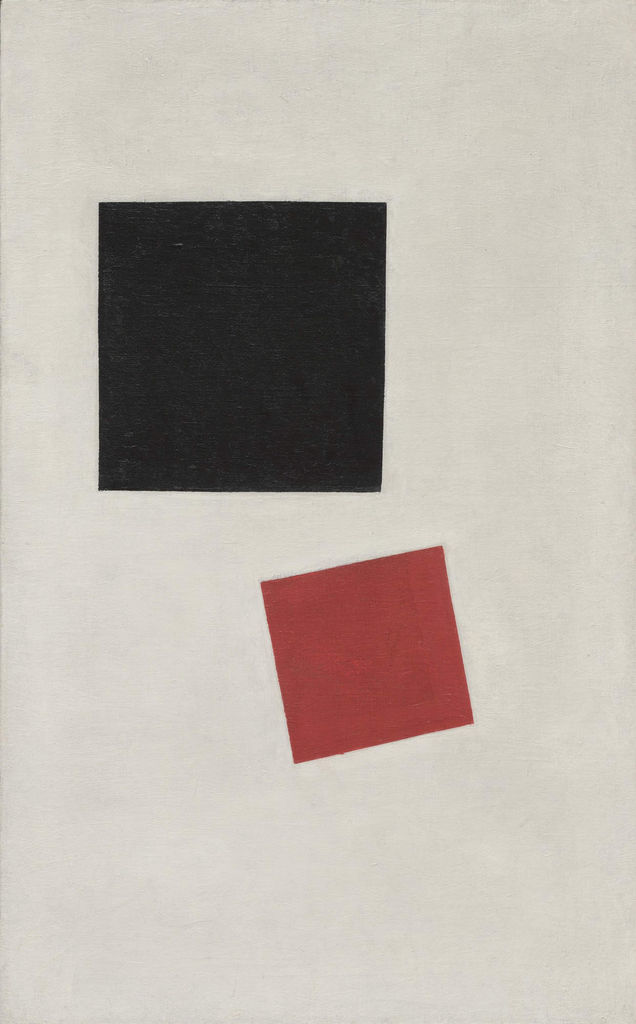
A black rectangle and a blue triangle occupy a white field. The description sounds exhaustive, yet looking at this 1915 painting takes longer than naming its parts. The blue form comes toward the black one from the side in this reproduction; the gap and contact between them are hard to resolve at a glance. Their unequal scale and the white space around them make a compact arrangement feel active. [1] [2]
The Stedelijk Museum Amsterdam identifies the work as Suprematistische compositie (met blauwe driehoek en zwarte rechthoek), dated 1915, accession A 7671. A 2003 Guggenheim catalogue reproduces the same accession under the English title Suprematist Painting: Black Rectangle, Blue Triangle and calls it oil on canvas. The museum's currently accessible item omits medium and dimensions; the medium given below is therefore attributed to the printed catalogue. [1] [2]
At a Glance
- ArtistKazimir Malevich
- Museum titleSuprematistische compositie (met blauwe driehoek en zwarte rechthoek)
- Common English titleSuprematist Composition with Blue Triangle and Black Rectangle
- Date1915 in the Stedelijk record
- MaterialOil on canvas in the 2003 Guggenheim catalogue; omitted from accessible current owner item
- CollectionStedelijk Museum Amsterdam
- Object numberA 7671
- MeasurementsWithheld pending reconciliation of printed catalogue reproduction
Contents
- Two shapes and a white field
- A 1915 Suprematist painting
- Why reproductions can look different
- Collection and interpretation
- Reading the edges in different orientations
Two shapes and a white field
The rectangle is large and dark, while the triangle provides the only strong colour. Neither behaves like a pictured object sitting in a room. The white area acts as a field in which the forms can be placed, separated and visually weighed. The edges therefore matter as much as the shapes' names. A slight change in the relation between triangle, rectangle and margin would change the picture's balance. [1] [2]
The blue triangle seems to press toward the rectangle. Its point and diagonal sides differ sharply from the rectangle's straight parallel edges. This gives the composition a directional quality without requiring a story about one form attacking or supporting the other. Those verbs are possible viewer impressions; no consulted object record assigns a narrative role to either shape. [1]
The image is also less mechanical than the phrase “geometric abstraction” may suggest. The eye can compare the painted boundaries, the two black and blue masses and the apparently empty surrounding canvas. The areas are few enough that each carries unusual weight. The painting invites precise attention to spacing and proportion rather than an attempt to decode a hidden object. [1] [2]
A 1915 Suprematist painting
The date places A 7671 in the year Malevich made his first public Suprematist presentation, including the Black Square. The square became an emblem, but this work shows that the 1915 experiment did not consist of one shape alone. Here two unequal coloured forms are set in relation. The painting tests the expressive possibilities of placement rather than representing a scene. [1] [2] [4]
Matthew Drutt's Guggenheim catalogue discusses Black Rectangle, Blue Triangle alongside Malevich's Boy with Knapsack of the same year. The comparison is apt at a structural level: both place a small number of bold masses against a light ground. But the two paintings are distinct objects with different titles, shapes, collections and accessions. A reader can compare their formal economy without merging them. [2] [5]
The Stedelijk title calls this a “Suprematist composition,” while the Guggenheim catalogue uses “Suprematist painting.” Neither wording makes the blue triangle a sign with a fixed meaning. The consulted sources identify the painting and its place in Malevich's work; they do not provide a reliable object-specific code in which blue stands for one emotion or black for a political force. Such symbolic claims would require evidence beyond colour alone. [1] [2]

Why reproductions can look different
There is a curious issue in the 2003 Guggenheim catalogue. Its small colour reproduction on printed page 27 shows the triangle entering from the side, as in the saved site image. Its larger plate on printed page 129 shows the same titled and numbered painting with the triangle apparently rising from below a more horizontal rectangle. The plate seems rotated relative to the smaller reproduction. [2]
That difference is a question about reproduced orientation. It does not prove that Malevich intended two hanging positions or repainted the canvas. Nor does it establish which orientation is historically authoritative. This page retains the orientation of the existing site image and describes the visible relationship between its forms. Readers comparing books or websites should check the museum accession A 7671 before assuming that two differently oriented images depict separate works. [1] [2]
The catalogue captions do, however, help establish identity. Printed page 129 names A 7671, and page 27 places the painting in an argument about Malevich's 1915 arrangements. An object number is more useful here than a translated title alone: Suprematist Composition, Suprematist Painting and titles naming coloured shapes occur across several different works. [1] [2]
Collection and interpretation
The Metropolitan Museum of Art's research entry on Nikolai Khardzhiev specifically names this 1915 painting at the Stedelijk among the works for which his collection is known. That account provides collection-history context, but its broad narrative should not be turned into an exact object-by-object chain of custody for A 7671. The painting's current institutional identification rests on the Stedelijk accession. [1] [3]
The economy of the composition can make it tempting to move immediately from looking to a sweeping statement about modern art. A more useful first step is local: watch how the triangle changes the apparent direction of the rectangle, and how the white field stops either shape from becoming a background for the other. That visual tension helps explain why a painting with only two coloured forms can sustain repeated looking. [1] [2]
Reading the edges in different orientations
The straight sides of the rectangle give a viewer a relatively stable form to grasp. The triangle ends in a point, so it draws attention away from that stability and gives the surrounding white a more definite direction. Consider the gap between the nearest edges of the two forms. It keeps their colours separate but still lets the two shapes act upon one another. This gap remains physically the same when the image is turned. Where it sits in relation to the top and bottom changes, and that can make one shape feel as though it bears down on the other or rises away from it. [1] [2]
The Guggenheim catalogue’s differing orientations make that change a documented part of the encounter with the painting. They also show how to recognize the work through relationships within the image. The shape of the triangle, the proportions of the dark rectangle and the distance between them remain clues when a reproduction is turned. With Boy with Knapsack, the MoMA object record describes a separate painting in which a red square and a dark square set up another kind of visual exchange. Their historical relation is useful context for the Stedelijk work, while the physical catalogues identify the two canvases independently. [1] [2] [5]
Frequently Asked Questions
Where is the painting?
The Stedelijk Museum Amsterdam catalogues it as A 7671. Consult the museum for current display information. [1]
What is it made of?
Why is the triangle below the rectangle in some reproductions?
Two reproductions in the same 2003 catalogue show apparently different orientations. The source does not explain the difference. The accession A 7671 confirms they refer to the same work; no firm claim about intended hanging orientation follows from the reproductions alone. [2]
What do the blue and black shapes symbolize?
Discussion
How does the blue triangle change the apparent movement of the black rectangle?
What changes when you focus on the white field between and around the shapes?
Reader Insights
The Stedelijk identifies the 1915 work as A 7671.
The 2003 Guggenheim catalogue calls it oil on canvas.
Two catalogue reproductions appear to show different orientations of the same numbered work.
Join the Conversation
Share a close observation or an object-specific source for Stedelijk A 7671.
References
- Stedelijk Museum Amsterdam, Suprematistische compositie (met blauwe driehoek en zwarte rechthoek), A 7671: owner item for title, 1915 date and accession; accessible entry omits medium and dimensions. View source.
- Matthew Drutt, Malevich, Black Square, 1915 (Guggenheim, 2003), printed pp. 27 and 129: original catalogue discussion, captions and differently oriented reproductions of A 7671. View source.
- Metropolitan Museum of Art, “Nikolai Khardzhiev”: research essay naming this 1915 Stedelijk work in Khardzhiev collection context. View source.
- State Tretyakov Gallery, Black Suprematist Square (1915): owner record for a distinct 1915 painting. View source.
- Museum of Modern Art, Painterly Realism: Boy with Knapsack (1915): distinct painting discussed alongside A 7671 by Drutt. View source.