 by Tom Gurney
Tom Gurney BSc (Hons) is an art history expert with over 20 years experience
Published on June 19, 2020 / Updated on November 20, 2026
Email: tomgurney1@gmail.com / Phone: +44 7429 011000
Introduction
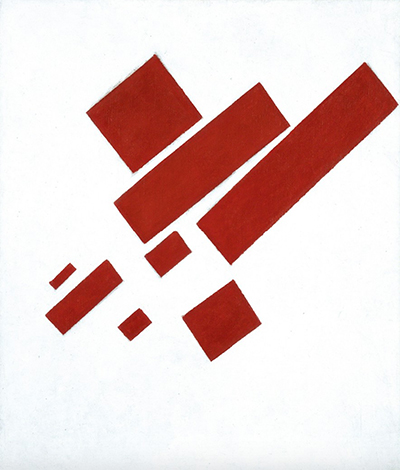
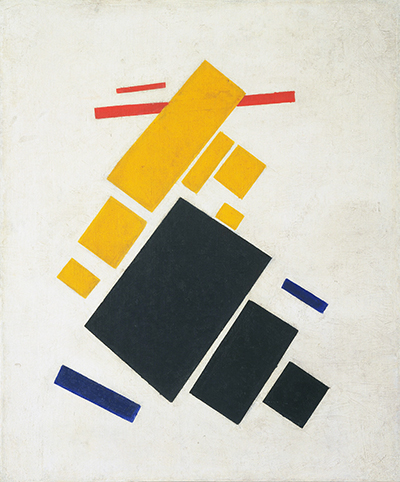
Eight red forms cross a pale field in Kazimir Malevich’s Suprematist Composition (with Eight Red Rectangles). They do not form a row, a conventional pattern or a picture of a recognizable object. Their varied size, tilt and spacing give the quiet surface a sense of movement. The Stedelijk Museum Amsterdam identifies this painting as a 1915 oil on canvas in its collection, accession A 7672. [1]
The site's older title, Suprematist Painting: Eight Red Rectangles, points to this work, but the museum uses Suprematist Composition (with eight red rectangles) as its English rendering of the Dutch title. Both phrases describe the same accession-controlled painting here. Keeping the owner, number and dimensions beside the title distinguishes it from other red geometric paintings of 1915. [1]
At a Glance
- ArtistKazimir Malevich
- Museum titleSuprematistische compositie (met acht rode rechthoeken)
- English titleSuprematist Composition (with eight red rectangles)
- Site's earlier titleSuprematist Painting: Eight Red Rectangles
- Date1915
- MediumOil on canvas
- Dimensions60.2 × 51.6 × 4.4 cm, as catalogued by the Stedelijk
- CollectionStedelijk Museum Amsterdam
- AccessionA 7672
Contents
- Looking at the eight forms
- What lies beneath the red forms?
- A painting at the birth of Suprematism
- From Petrograd to a Paris retrospective
- Collection and title
Looking at the eight forms
The painting asks the eye to count. Several larger forms gather in the upper half, while smaller rectangles and bars are distributed below them. Some are nearly horizontal; others lean. Their edges and intervals keep the arrangement from settling into a strict grid. The museum describes the geometric shapes as floating against a white, apparently boundless space. “Floating” is a useful account of the effect, though the canvas remains a flat painted surface. [1]
Red links shapes that differ sharply in size and orientation. Because the colour recurs, a small bar near the edge still reads as part of the same group as a broad block. Compare a short interval between two red forms with one of the wider pale stretches. The short interval keeps the forms in immediate relation, while the wide one lets the eye pause before it picks up the red again. The colour can therefore serve both as a repeated element and as a way to bring the different intervals to notice. [1]
The title calls all eight forms rectangles, but a painted rectangle need not look like a mechanically exact diagram. Their relations matter more here than perfect mathematical regularity. A short horizontal piece can seem to accelerate a longer diagonal form; a large block can hold the composition in balance against several smaller ones. Following the forms from top to bottom is one way to read the picture, but the white between them allows several routes for the eye. This description is a visual reading, not a statement of Malevich's documented intention for each individual shape.
What lies beneath the red forms?
Andréi Nakov's illustrated 2002 catalogue identifies this Stedelijk canvas as S-45, with accession A 7672. Its entry reports that an X-ray photograph revealed an earlier arrangement: it included triangular forms and was less strictly ordered than the visible composition. This is Nakov's account of a technical image, not an independent re-examination of the radiograph. It shows that Malevich changed this particular canvas while working, but the entry alone does not establish why he made each change. [3]
Nakov’s description gives the visible rectangles a history. A triangle makes one direction especially apparent through the point where two sides meet. A bar or block can suggest a direction through its longer edges, the angle at which it leans and its relation to another form. Working with the narrower vocabulary of rectangles therefore leaves considerable room for change. The painting now depends less on the outline of any single shape than on the way those repeated shapes are put in relation to one another. This is a comparison of visible form with Nakov’s description of the earlier state. The published entry gives no complete sequence of changes or account of how the artist arrived at the final eight forms. [1] [3]
A painting at the birth of Suprematism
Malevich named his new non-objective art Suprematism in 1915. A Guggenheim exhibition account describes the movement as a painting practice built from pure geometric form rather than the depiction of visible things. This canvas makes the idea unusually easy to see: eight red forms and a pale ground carry the picture without a figure, landscape or still life. [2]
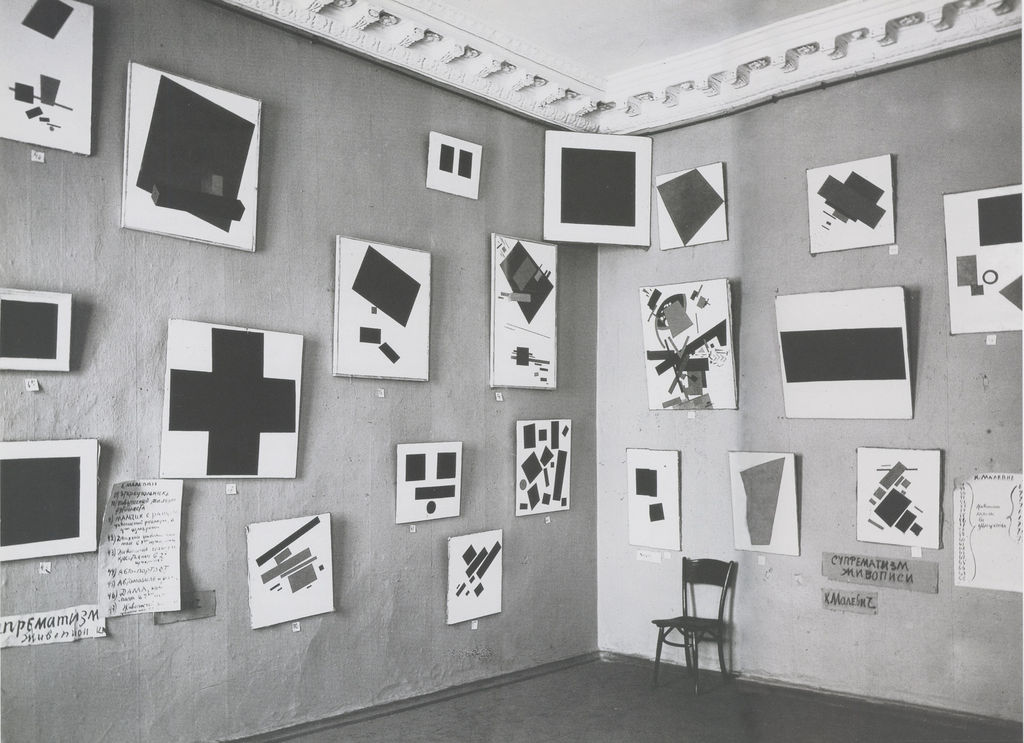
The Stedelijk's object text says this painting first appeared publicly in the Last Futurist Exhibition of Paintings 0.10 in Petrograd in 1915. That claim belongs to this particular museum record. Accounts of the exhibition often focus on the much more famous Black Square and its place high in a room corner. The Stedelijk's exhibition identification for A 7672 does not mean that Eight Red Rectangles occupied that same corner. The two paintings share an exhibition context, not a documented hanging position. [1] [2]
The arrangement is also distinct from Black Square. One bounded dark form dominates the latter's light field. Here the red forms are separate, unequal and dispersed; the spaces between them become part of the rhythm. The work demonstrates how Malevich could develop many relations from a small vocabulary of shapes, even when he kept the palette restricted. It is a specific 1915 experiment, rather than a generic illustration of geometric abstraction. [1] [2]
From Petrograd to a Paris retrospective
The Centre Pompidou lists Peinture suprématiste, huit rectangles rouges, dated 1915, as a loan from the Stedelijk Museum to its 1978 Malevich retrospective. The French title, date and lender identify the painting more specifically than the checklist’s separate entries called simply Peinture suprématiste. The exhibition ran from 15 March to 15 May and covered the artist’s figurative beginnings, the move through Cubo-Futurism and Suprematism, and his later return to figuration. The Pompidou’s archive describes an arrangement by phase and by medium, with a section devoted to Suprematism. [1] [5]
The loan gives the canvas a documented setting very different from its first showing. At the earlier exhibition, its concentration on a single repeated form was part of Malevich’s presentation of a new kind of painting. By 1978, it could be seen within a retrospective that traced the changes in his career. The Pompidou also lists two MoMA loans, Airplane Flying and White on White. They give useful points of comparison alongside the red rectangles. The title Airplane Flying proposes a subject that its shapes leave for the viewer to infer. In White on White, a tilted square emerges through a small tonal difference. Here the contrast is immediate, but the title names the forms and leaves the way they move across the field open. The retrospective listing establishes the loans, while their precise positions in the galleries require installation evidence. [1] [2] [5]

Collection and title
The Stedelijk catalogues the work as accession A 7672. Its current online record gives the date as 1915, the medium as oil on canvas, and the measurements as 60.2 × 51.6 × 4.4 cm. The third measurement describes depth in the museum's listing; the dimensions are quoted as a set rather than silently replaced with figures from another publication. The Stedelijk also records that ownership was recognized in a 2008 agreement with Malevich's heirs. That statement is collection history, not a claim about where the canvas hangs on any particular day. [1]
Nakov's 2002 catalogue gives 57.5 × 48.5 cm for the same accession. The 2003 Guggenheim exhibition catalogue independently prints that figure beside A 7672. The Stedelijk's current online record gives 60.2 × 51.6 × 4.4 cm. These sources do not explain their different measurement bases, so the cause remains unresolved. The museum's current listing supplies the object facts above, while both historical figures remain visible for readers comparing catalogues. [1] [3] [4]
The Dutch title literally identifies a Suprematist composition “with eight red rectangles.” English catalogues and websites may use Composition or Painting before the descriptive phrase. The accession, collection, date and distinctive eight-form arrangement do the work of identifying the physical object. Readers comparing catalogue entries should check those fields instead of assuming that a shared title guarantees the same canvas. [1]
Frequently Asked Questions
When was it painted?
The Stedelijk dates accession A 7672 to 1915. Its record also identifies this painting with the 1915 0.10 exhibition. [1]
Where is the painting held?
It is in the collection of the Stedelijk Museum Amsterdam. Collection ownership does not guarantee that it is currently on public display; check the museum's listings before visiting. [1]
What is it made of and how large is it?
The museum lists oil on canvas and 60.2 × 51.6 × 4.4 cm. [1]
Is Suprematist Painting: Eight Red Rectangles the same work?
English titles vary in whether they use Painting or Composition. The Stedelijk's English rendering is Suprematist Composition (with eight red rectangles). Both refer here to the museum's accession A 7672. [1]
Do the red rectangles symbolize the Russian Revolution?
Discussion
Count the red forms, then look at the white spaces between them. Which seems to organize your first impression?
Follow the different tilts and sizes. Where does your eye pause?
Reader Insights
The Stedelijk identifies this as its 1915 accession A 7672.
The museum places this painting at the 1915 0.10 exhibition.
A colour alone does not prove a political meaning for each form.
Join the Conversation
Share an observation about this painting or a source tied to accession A 7672.
References
- Stedelijk Museum Amsterdam, Suprematistische compositie (met acht rode rechthoeken), accession A 7672: current owner record for title, English rendering, 1915 date, oil-on-canvas medium, measurements, collection, 0.10 exhibition statement, formal interpretation and estate agreement. View source.
- Solomon R. Guggenheim Museum, Kazimir Malevich: Suprematism exhibition overview (2003): institutional account of Suprematism as a geometric painting movement and the distinct Black Square corner installation. View source.
- Andréi Nakov, Kazimir Malewicz: Catalogue raisonné (2002), illustrated p. 189, S-45, author-hosted sample page: accession A 7672, date, medium, alternate measurements and Nakov's description of the X-ray photograph. View source.
- Solomon R. Guggenheim Museum, Kazimir Malevich: Suprematism (2003), catalogue p. 142: identifies Suprematist Painting: Eight Red Rectangles as Stedelijk A 7672 and prints 57.5 × 48.5 cm; digitized copy of the museum catalogue. View source.
- Centre Pompidou, Malevitch, exhibition archive, in French: 1978 dates, room organization and lender checklist. View source.