 by Tom Gurney
Tom Gurney BSc (Hons) is an art history expert with over 20 years experience
Published on June 19, 2020 / Updated on November 20, 2026
Email: tomgurney1@gmail.com / Phone: +44 7429 011000
Introduction
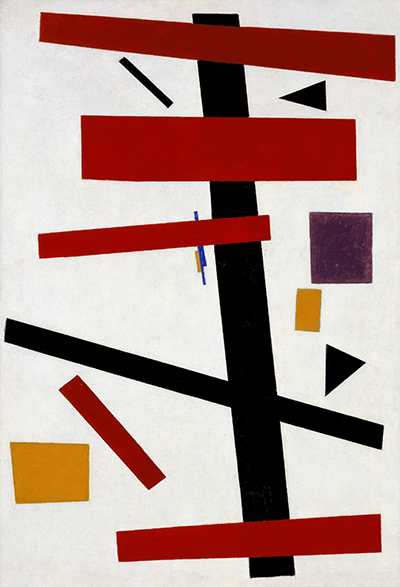
Long red bars cross a dark upright form in Kazimir Malevich's Supremus No. 50. Small black diagonals, yellow squares, a purple area and a narrow blue accent pull attention away from the major crossing lines. The Stedelijk Museum Amsterdam dates the work to 1915, gives its English title as Supremus No. 50 and identifies it as accession A 7663. Its current online item lists dimensions of 101.8 × 70.7 cm, without explaining whether those are the painted surface or an overall framed measurement. [1]
This is a painting with an unusually rich record of looking. Artist Donald Judd wrote closely about its drawn edges, revisions and colour relationships in an essay on Malevich. A later auction catalogue also discusses an archival photograph showing the work hung sideways in Warsaw in 1927. Those accounts enlarge what can responsibly be said about this particular composition; they should be distinguished from the museum's own object facts. [1] [2] [4]
At a Glance
- ArtistKazimir Malevich
- Museum titleSupremus nr. 50
- English titleSupremus No. 50
- Date1915, Stedelijk catalogue
- MediumPainting; exact paint and support not specified in the current Stedelijk item
- Dimensions101.8 × 70.7 cm in the current Stedelijk listing; scope of measurement unspecified
- CollectionStedelijk Museum Amsterdam
- AccessionA 7663
- Ownership noteRecognized by agreement with Malevich's heirs in 2008, according to the museum
Contents
- A structure of long and small shapes
- Judd on how the painting was made
- “Supremus” and the 1915 moment
- A painting shown on its side
- The longer canvas among numbered works
A structure of long and small shapes
The strongest relation is between the long red horizontal forms and the dark vertical. They are not a diagram of a building, a cross seen in a landscape or a coded political emblem. They are painted areas whose length, colour and placement organize a white field. Around them sit much smaller shapes, including dark triangular pieces and touches of yellow, blue and purple. The small forms keep the eye moving to the edges instead of letting the large crossing absorb the entire painting. [1] [2]
Judd's 1973–74 essay describes four long red rectangles as strips that seem to run across two black strips of markedly different sizes. He reads the dark pieces as an X beneath the reds and calls attention to a tiny group of yellow and blue marks. This is Judd's close visual interpretation, written decades after Malevich made the work. It is useful because it gives the reader concrete things to test in the painting, not because it settles every possible reading. [2]
The red and black areas are large enough to form a powerful pair. Judd also emphasizes the much larger white field and small yellow squares as active colours, not vacant background and decoration. A minute blue line and a purple square complicate any description of the work as merely red, black and white. In this account, differences of scale matter as much as differences of hue. [2]
The arrangement may feel lively, but the repeated red bars, main dark crossing and spaced smaller shapes give it a structure. The bars appear to interrupt one another in the middle while the tiny accents pull the eye outward. That tension between the centre and the margins is more specific to this canvas than a broad comparison with other geometric painters. [1] [2]
Judd on how the painting was made
Judd's essay contains rare observations about the physical surface of Supremus No. 50. He reports that shapes were generally painted up to pencil lines on a dry white ground. He noticed a purple square that appeared to have been enlarged and an upper-left passage painted out with an imperfect match to the surrounding white. These are Judd's observations, not findings from a published Stedelijk conservation report. They indicate that the finished geometry involved adjustments. [2]
That evidence corrects a common simplification of Suprematism. A non-objective picture can appear completely planned and machine precise in a reproduction, while close looking reveals edge decisions and revisions. Judd contrasts the looser treatment of white with the flatter, more tightly filled coloured shapes in paintings of this period. His account suggests that the painted surface itself matters; the shapes are not merely a scheme that could be transferred unchanged into any material. [2]
The current Stedelijk item labels the work in its broad “Other” collection category and does not state its paint or support. The museum's 2010 annual report names Supremus No. 50 among framed A-collection works in its paintings discussion. This supports calling it a painting, while the precise material remains unspecified in the consulted owner records. [1] [5]
“Supremus” and the 1915 moment
Malevich introduced Suprematism publicly in 1915 as a form of non-objective art. A Guggenheim exhibition overview describes the new painting in terms of pure geometric form. Supremus No. 50, catalogued in that year by the Stedelijk, shows how a few elementary shapes can create a much more complex relation than the single bounded form of Black Square. [1] [3]
Aleksandra Shatskikh's chapter “The Supremus Society” in Black Square: Malevich and the Origin of Suprematism addresses Malevich's use of the term supremus and the numbered works, including No. 50. The publisher's chapter summary says the numbers expressed a specific logic and connections within the body of work. This is a reminder that “50” is a work designation, not a proven count of the paintings Malevich had made. [6]
Malevich did take works to Warsaw and Berlin in 1927, but Supremus No. 50 should not be turned into a simple story about why he left them abroad or how Soviet policy affected every phase of his painting. What can be stated for this object is more focused: it was part of a documented Western presentation, and its present collection identity is Stedelijk A 7663. [1] [4]
A painting shown on its side
An archival photograph discussed in a Christie's catalogue essay shows Supremus No. 50 hung sideways at the Hotel Polonia exhibition in Warsaw in 1927, with Malevich visible near the work. The catalogue argues that the orientation had his apparent assent. That is a historical interpretation of the photograph rather than an instruction that every modern reproduction should be rotated. It does, however, make orientation an unusually important part of the work's display history. [4]
The Stedelijk's present item reproduces the composition in a vertical arrangement. A sideways historical installation tests how stable the red and black crossing feels when the entire canvas turns. The shapes do not become an illustrated horizon or a landscape simply because the orientation changes. It is better to say that at least one documented 1927 presentation differed from the museum's current upright view, while leaving the exact reasoning for Malevich's choice open. [1] [4]
The Stedelijk labels the object “On view” on the consulted page. That status can change. Its ownership credit says the estate of Malevich recognized the museum's ownership by agreement in 2008; the site should present that as the institution's collection note, not as a new acquisition date or a promise about the painting's location on a future visit. [1]
The longer canvas among numbered works
The near-square form of the Krasnodar Supremus No. 55 offers a useful contrast to the more elongated Stedelijk canvas. The Guggenheim catalogue puts the Krasnodar painting and No. 50 in separate entries, each with its own visual arrangement. Both compositions give bars and planes room to suggest movement. The elongated field of No. 50 makes the difference between its long and short directions especially apparent. When the picture is turned on its side, that difference survives while the longer reach changes its relation to gravity and the viewer’s body. [1] [4] [7]
The Guggenheim plate also puts a documented example of the painting into circulation independently of the old installation photograph. That matters because orientation can be a feature of a particular display or reproduction. To reconstruct how the work was shown at a particular moment, the painting’s own outlines are more dependable than the order of its numbered title. The shapes can be matched even in a photograph where the work appears at an angle, and the photograph can then be interpreted in its own exhibition context. [1] [4] [7]
Frequently Asked Questions
Where is the painting held?
The Stedelijk Museum Amsterdam catalogues it as A 7663. Its object page was marked “On view” when checked, but display status may change. [1]
When was it made?
The current Stedelijk catalogue dates it 1915. Other historical publications can date Supremus works differently; this page keeps the owner date tied to this accession. [1]
How large is it?
The current museum page gives 101.8 × 70.7 cm. It does not clarify the scope of that measurement. A reader should not silently replace it with a smaller figure in a third-party listing or assume that the larger measurement is definitely the unframed canvas. [1]
What is the painting made of?
Was the work intended to be hung sideways?
A Christie's catalogue essay describes a 1927 Warsaw photograph in which it was hung sideways with Malevich present. The photograph documents that installation; it does not prove that all other orientations are wrong. [4]
Discussion
Follow the long red bars, then the black forms that cross them. Which group seems to hold the composition together?
Look for the small yellow, blue and purple accents. What changes when you notice them?
Reader Insights
The Stedelijk dates accession A 7663 to 1915.
Donald Judd observed pencil-guided edges and small revisions on this painting.
A 1927 Warsaw photograph shows the canvas hung sideways.
Join the Conversation
Share an observation or an object-specific source for Stedelijk A 7663.
References
- Stedelijk Museum Amsterdam, Supremus nr. 50, A 7663: owner record for title, 1915 date, current dimensions, collection, display label and 2008 ownership credit; medium omitted. View source.
- Donald Judd, “Malevich” (1973–74), published by Judd Foundation: first-hand critical essay with object-specific visual and surface observations for Supremus No. 50, especially PDF pp. 4 and 6. View source.
- Solomon R. Guggenheim Museum, Kazimir Malevich: Suprematism exhibition overview (2003): museum context for Suprematism and its geometric forms. View source.
- Christie's, Suprematist Composition catalogue essay: discussion of a 1927 Hotel Polonia photograph showing Supremus No. 50 hung sideways; a source for that interpretation, not an owner object record. View source.
- Stedelijk Museum Amsterdam, 2010 annual report, framing section: names Supremus no.50 among framed A-collection works in the paintings section; does not specify paint/support in the cited passage. View source.
- Aleksandra Shatskikh, “The Supremus Society,” in Black Square: Malevich and the Origin of Suprematism (Yale University Press, 2012): publisher-hosted chapter abstract; full chapter not accessible in the consulted view. View source.
- Matthew Drutt, ed., Kazimir Malevich: Suprematism, Guggenheim Museum, 2003, printed pp. 151 and 164: separate illustrated entries for the Stedelijk and Krasnodar canvases. View source.