 by Tom Gurney
Tom Gurney BSc (Hons) is an art history expert with over 20 years experience
Published on June 19, 2020 / Updated on November 20, 2026
Email: tomgurney1@gmail.com / Phone: +44 7429 011000
Introduction
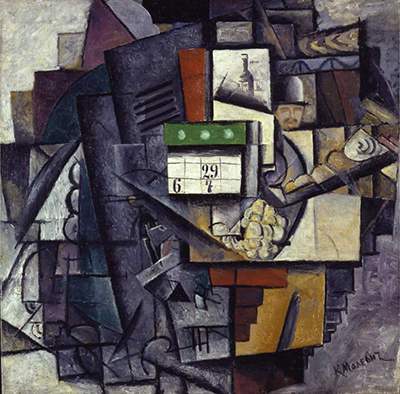
At first glance, Kazimir Malevich's Woman at the Tram Stop looks like a jumble of metal panels, signs, limbs and printed numbers. A timetable-like rectangle near its centre shows 29 above 6 and 7. A hat and partial face appear toward the upper right, but no single figure resolves all the painting's fragments into an ordinary street scene. The Stedelijk Museum Amsterdam catalogues the work as Vrouw bij tramhalte (Woman at the Tram Stop), 1913–1914, accession A 7659. The saved site image matches a reproduction tied to that accession. [1] [3]
The museum title gives us a subject, yet Malevich does not let us see a woman simply waiting beside a clearly drawn tram. Instead, parts of a public scene overlap until looking becomes an act of sorting. A Bozar exhibition publication calls it a Cubo-Futurist work, dates it 1913, and places it in the period immediately before Malevich's move to Suprematism. Its single-year label is a publication choice; the current Stedelijk item uses the broader range. [1] [2]
At a Glance
- ArtistKazimir Malevich
- Museum titleVrouw bij tramhalte
- English titleWoman at the Tram Stop; also Lady on a Tram Station in older reproductions
- Date1913–1914 in the Stedelijk record; 1913 in Bozar's exhibition publication
- CollectionStedelijk Museum Amsterdam
- AccessionA 7659
- Catalogue referenceF-424, as reported by the accession-linked Commons image record
- Medium and sizeNot confirmed by the accessible owner item; conflicting unsourced sizes are excluded from the article
Contents
- What can you actually see in the painting?
- Why is it called Cubo-Futurist?
- What was its early exhibition context?
- Where is it, and how large is it?
- Reading the numbers in the painted street
What can you actually see in the painting?
The canvas is nearly square in the site's reproduction. Its central pale rectangle resembles a timetable or numbered sign. Above it sits a green strip dotted with light circles. Around this group, dark bars and angular panels tilt and intersect. Some look like pieces of a vehicle or shelter, but the image does not provide a complete, stable tram or platform. [3]
At upper right, a small hat and face seem to emerge from the surrounding planes. To their right, a round pale form and a diagonal dark element create another point of recognition, though their exact identity is uncertain. At lower right, ochre and orange blocks provide warmth against the green-grey centre. Red and orange narrow passages punctuate the dark middle. A signature appears near the lower right edge. These are observations from the image; they should not become an invented inventory of identifiable passengers and objects. [3]
The number group is unusually crisp in a picture that fragments almost everything else. It can suggest the printed information of urban travel, but the checked sources do not establish whether 29, 6 and 7 refer to a route, a date, a timetable or a more private association. The article therefore describes the number panel without decoding it. [3]
The painting repeatedly changes how near an object seems. A black diagonal looks as though it passes in front of the number panel; other fragments seem to sit both behind and beside it. There is no single vanishing point or coherent floor. Malevich uses overlapping planes to make the city feel crowded and mobile rather than to reproduce one instant as a photograph might. [2] [3]
Why is it called Cubo-Futurist?
“Cubo-Futurist” describes a meeting of fragmented form and the modern experience of movement. The composition breaks potential people and objects into angular planes, while its tram-stop title and sign-like fragments connect it to urban transport. Bozar places it among works that address the mechanised, accelerated life of Russian cities. That is an exhibition interpretation of the picture's historical setting, not proof of a particular street or tram route. [2]
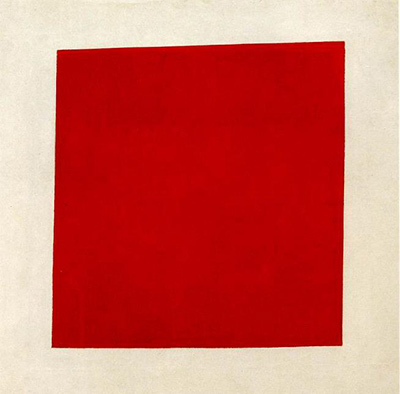
The flattened, interlocking pieces also make the viewer read it differently from Malevich's later geometric abstractions. In Black Square or a Suprematist cross, the basic form is presented in open space. Here, recognisable clues keep emerging from the dense arrangement. Malevich has not abandoned subject matter; he has made it difficult to resolve. [2] [4]
David Galenson's study of artistic exchange describes Woman at a Tram Stop as evidence of Malevich's engagement with synthetic Cubism before his 1915 breakthrough. That is a scholar's account of stylistic development. It does not mean the painting is a collage or that it contains actual pasted paper: the article makes no such material claim without an object-specific technical source. [4]

What was its early exhibition context?
Bozar's publication states that the Cubo-Futurist painting was shown with work by Picasso and Braque at the fourth Bubnovy Valet (Jack of Diamonds) exhibition in early 1914. This places the painting in a public avant-garde setting before Suprematism. The publication labels the work 1913, whereas the current Stedelijk record dates it 1913–1914. Those are different degrees of precision rather than evidence for two paintings. [1] [2]
The same publication connects Malevich's contacts with Futurist poets and his pursuit of an art led by intuition to the shift that followed. The painting's mix of textual signs, scattered forms and uncertain figures belongs to that transition. It should not be described as a fully non-objective work: its title and visual clues still point toward a scene in modern life. [2]
Where is it, and how large is it?
The Stedelijk catalogues the exact painting as A 7659. A Commons reproduction linked to that accession reports oil on canvas and 88 × 88 cm, while the inherited site text claimed approximately 92 × 92 cm without a source. The accessible owner item reviewed for this rewrite did not expose material or measurements. Until a current museum catalogue or technical record settles the discrepancy, the article does not present either number as a confirmed physical dimension. [1] [3]
The site reproduction also has different colour and cropping from the accession-linked Commons file. Their central number panel, figure fragments and signed lower right corner nevertheless match exactly. Colour difference between reproductions is not evidence of a second canvas. [3]
Reading the numbers in the painted street
The numbers are among the easiest marks to recognize. Recognition gives the viewer just enough of a pause to consider what surrounds them. The planes to either side have visible edges and changes of colour but do not immediately resolve into things with names. The panel can thus be read first as part of the painting and then as something that recalls the signage of a street. These two ways of reading can happen almost at the same time. The difference between a readable sign and an uncertain setting is one of the ways the painting keeps the viewer moving. [1] [2] [3]
Bozar places the work in a discussion of the speed and movement associated with the city. A tram stop could suggest a temporary pause within that movement. In the picture the combination of recognizable signs and broken planes keeps the pause from becoming a stable view along a street. No checked source identifies the painted numbers as the route or schedule of a particular tram. It is possible to see them as part of how the city becomes legible in fragments without making them a documentary timetable. [1] [2] [4]
Frequently Asked Questions
Is the woman visible?
What do the numbers 29, 6 and 7 mean?
They are visible on the central sign-like form. No checked object source explains them conclusively, so a timetable or route reading remains a possibility rather than a fact. [3]
Was the painting made in 1913 or 1914?
Is it Suprematist?
Bozar calls it Cubo-Futurist. Its transport subject and dense overlapping fragments precede Malevich's non-objective Suprematism of 1915. [2]
Discussion
Which shapes seem to describe a person, and which seem to belong to the tram stop?
How does the central number panel affect the way you read the surrounding fragments?
Reader Insights
Find the 29, 6 and 7 in the pale central rectangle.
Notice the partial face and hat emerging at upper right.
The current owner gives 1913–1914, while Bozar's publication labels the painting 1913.
Join the Conversation
Share a close observation or a source-backed detail about Stedelijk A 7659.
References
- Stedelijk Museum Amsterdam, Vrouw bij tramhalte, A 7659: accessioned owner item for current title and 1913–1914 date. View source.
- Bozar, exhibition publication, Woman at the Tram Stop entry: museum exhibition text for the 1913 publication date, Cubo-Futurist context and early-1914 Bubnovy Valet showing. View source.
- Wikimedia Commons, Lady on a Tram Station image record: accession-linked visual comparator for A 7659 and a record of the 88 × 88 cm claim; its physical measurements are not adopted as settled owner metadata. View source.
- David Galenson, The Globalization of Advanced Art in the Twentieth Century (NBER Working Paper 14005, 2008), p. 23: scholarly interpretation of this picture's relationship to synthetic Cubism, kept distinct from object facts. View source.