

 by Tom Gurney
Tom Gurney BSc (Hons) is an art history expert with over 20 years experience
Published on August 14, 2026 / Updated on August 14, 2026
Email: tomgurney1@gmail.com / Phone: +44 7429 011000
Paul Gauguin: Introduction
Paul Gauguin (1848–1903) was a French artist who worked in painting, drawing, printmaking, ceramics, carved objects and writing. He developed within the Paris art world, then worked in Brittany, Martinique, Arles, Tahiti and the Marquesas. His broad colour fields, emphatic contours and movement of motifs between media became important to later modern art. [1] [2]
At a Glance
- ArtistPaul Gauguin [1]
- Born7 June 1848, Paris, France [1]
- Died8 May 1903, Atuona, Hiva Oa, Marquesas Islands [1]
- Known forSynthetism, Symbolism and an experimental cross-media practice [1] [2]
- MediaPainting, drawing, printmaking, ceramics, carved objects and writing [1] [2]
- PlacesFrance, Martinique, Brittany, Arles, Tahiti and the Marquesas [1] [3]
Contents
- Paul Gauguin: Introduction
- A career made across places
- How the art works
- Six works, six different questions
- More ways to choose a work
- Approaching the Pacific works
- Paintings are only one part of the record
That formal history cannot be separated from the conditions in which parts of the work were made. Gauguin travelled to territories under French colonial rule, represented Pacific people through his own cultural and commercial aims, and entered exploitative relationships with adolescent Polynesian girls. The art remains influential and contested because questions of form, authorship and power meet inside the same career. [3] [4]
This guide offers routes through those questions rather than one verdict. For a chronological account, begin with the Paul Gauguin biography. For a selective overview of the pictures, use Paul Gauguin paintings. The sections below identify what each deeper route is designed to answer.
A career made across places
Gauguin did not begin as an isolated rebel. He collected modern art, learned from Camille Pissarro and Paul Cézanne, and exhibited with the Impressionists before leaving finance as his main occupation. The biography follows that formation, his marriage and children, economic instability, travel and the public identities he later constructed. [1]
Place changed the available subjects, materials and working relationships, but no location automatically produced a style. In Brittany and Pont-Aven, Gauguin worked among local communities and an international network of artists. The Martinique route examines the difficult 1887 stay and the way paintings edited a colonial city and landscape rather than recording an untouched island. Arles and Vincent van Gogh reconstructs their nine-week collaboration in late 1888 through paintings and correspondence instead of reducing it to its violent ending. [1] [5]
Gauguin first travelled to Tahiti in 1891, returned to France in 1893, sailed back in 1895 and moved to Hiva Oa in the Marquesas in 1901. He died at Atuona two years later. Tahiti and the Marquesas keeps those periods and island groups distinct while placing both within colonial history. [1] [3]
How the art works
Gauguin's mature pictures often replace continuous naturalistic space with bounded areas of colour, strong edges and deliberately compressed relationships between figures and setting. Yet there is no single Gauguin surface. He used linen canvas, coarse burlap, prepared paper, carved blocks, ceramic bodies and wood; he revised compositions and returned to older poses in changed settings. The style and technique guide connects those visual effects to materials and technical evidence. [2]
Synthetism and Symbolism explains the historical labels. Gauguin was central to their development, but not their lone inventor. Émile Bernard, Paul Sérusier and other artists belonged to the exchanges through which simplified shape, non-naturalistic colour, memory and subjective meaning acquired public names. Movement terms are most useful when they clarify a network or a specific work, not when they become a label for everything Gauguin made.
Cross-media practice offers another route. A repeated figure may pass from drawing to print or painting, changing direction and meaning in transfer. A ceramic can reappear inside a self-portrait; a woodcut can condense several pictures into one sequence. The separate guides to prints and woodcuts, drawings and sculpture and ceramics show why those media are not secondary illustrations of the paintings. [2]
Six works, six different questions
There is no neutral list of “best” Gauguins. A more useful beginning is to choose a work by the problem it opens.
- Still Life: Wood Tankard and Metal Pitcher examines an 1880 painting's linen support, ordinary vessels, brushwork and revisions before the better-known Breton and Pacific periods. [6]
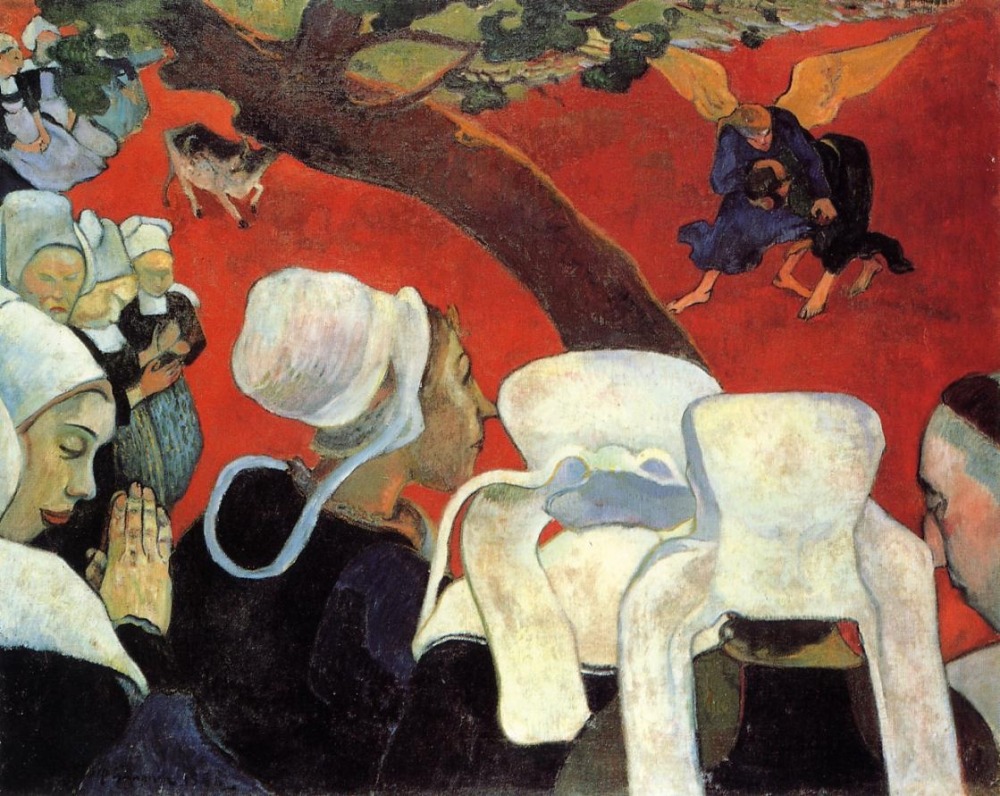
- Vision after the Sermon asks how Breton worshippers and an imagined biblical struggle can occupy one compressed red field. Its current Edinburgh record dates it to Pont-Aven in 1888. [5]
- Van Gogh Painting Sunflowers uses one Arles portrait to explore memory, collaboration and disagreement about working from observation or imagination. [7]
- Ia Orana Maria brings Christian imagery into a Polynesian setting while drawing upon sources that travelled from Europe and Asia. The route separates visible construction from any claim that the canvas documents one shared belief. [8]
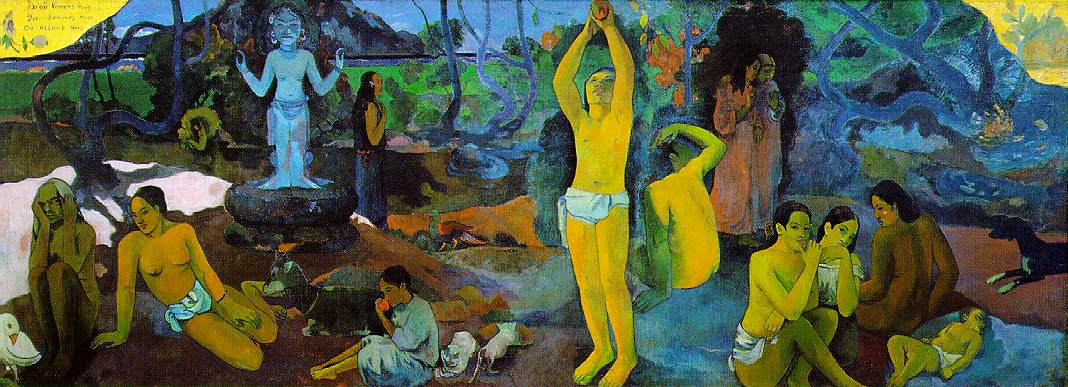
- Where Do We Come From? follows the monumental 1897–98 Boston painting through scale, sequence, coarse support, artist statements and first exhibition. It preserves the difference between Gauguin's proposed meanings and what the object independently supports. [9]
- Contes barbares begins with a late Hiva Oa canvas whose racist French title requires critical framing. A remembered likeness from Gauguin's Breton circle appears beside figures represented in the Marquesas, making memory and colonial classification part of the problem. [10]
These are starting points, not a ranking. The paintings guide offers a wider selective map across period, place, support and recurring motif.
More ways to choose a work
If your question concerns artistic identity, begin with the self-portraits. Gauguin used costume, inscription, caricature and quotation from his own work to offer different versions of himself. Self-Portrait ‘Les Misérables’ belongs to an exchange with Émile Bernard and constructs an outlaw analogy; Self-Portrait with the Yellow Christ places the painter between a reversed fragment of his own religious canvas and an anthropomorphic ceramic. Neither is an unguarded confession. [13]
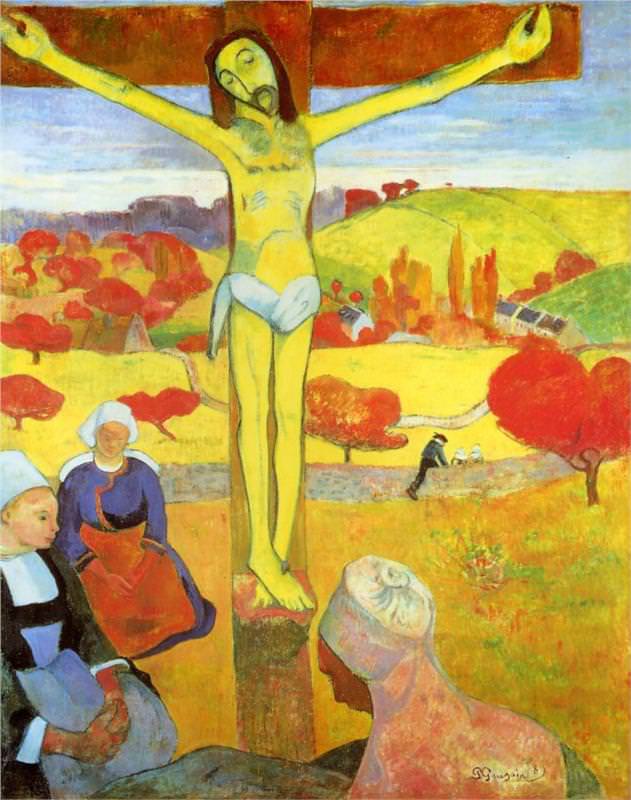
For religion, compare sources before searching for one belief system. The Yellow Christ transforms a Breton polychrome crucifix through colour and landscape, while Ia Orana Maria relocates a Christian revelation and combines it with a pose carried through a photograph of a Javanese relief. Te tamari no atua constructs another Nativity in a bedside setting. The three routes distinguish Christian iconography, local objects, transported images and Gauguin's inventions rather than calling every sacred-looking figure evidence of personal faith. [8] [14]
Landscape routes test how a place is edited. Martinique Landscape omits the colonial city of Saint-Pierre from a viewpoint above it. Street in Tahiti examines compressed settlement space instead of a timeless tropical road. Matamoe follows a repeated woodcutter, peacocks and shifting exhibition titles without allowing one Tahitian word to solve the picture. Together they make apparent remoteness a question about pictorial selection, not proof that a location stood outside modern history. [15]
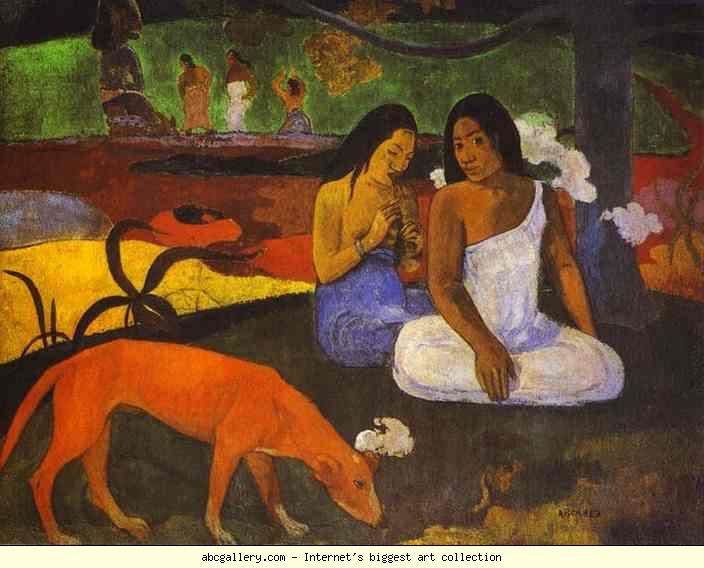
Titles provide a final route into uncertainty. Arearea has circulated with an English gloss, yet its figures, red dog and invented background rite do not resolve into one narrative. Why Are You Angry? asks what a question-title makes viewers assume about an ambiguous domestic scene. The dedicated pages separate painted or catalogued wording, translation, artist anecdote and visible evidence before interpretation begins.
Approaching the Pacific works
Gauguin did not encounter cultures outside history. Tahiti and the Marquesas had their own political and religious histories and were being transformed under French rule. Missionary clothing, colonial streets, imported goods and administrative systems appear within the same world that Gauguin promoted to European audiences as distant from modernity. [3]
The colonial context and relationships page distinguishes Teha'amana, Pau'ura and Vaeoho Marie Rose, records their ages and the limits of the archive, and explains the unequal power held by an adult French settler. It does not invent consent, recover thoughts the sources do not preserve or use one relationship to decode every represented woman. [4]
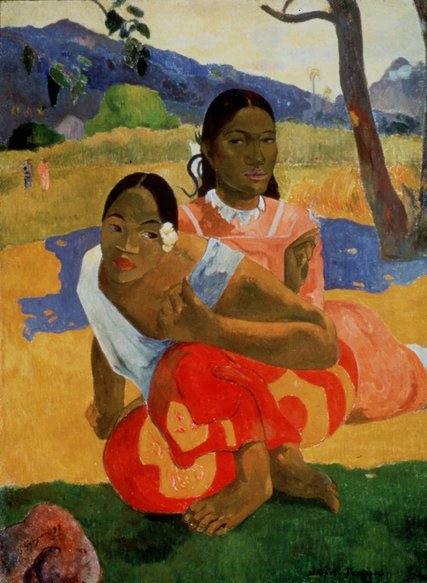
Object pages apply that caution to what can actually be seen. Tahitian Women on the Beach, for example, considers clothing, posture and pictorial distance without pretending that two figures' inner lives are available to the viewer. Questions about borrowed stories and self-presentation lead to Gauguin's writings, Noa Noa and quotes, where manuscript, collaboration, publication and misquotation are kept separate. [11]
Paintings are only one part of the record
The prints route explains zincography, woodcut, monotype and transfer. Drawings distinguishes preparatory study from independent sheet and later repetition. Sculpture and ceramics follows stoneware, carved wood, relief and hybrid objects as sustained fields of experiment. Together they show an artist testing pressure, reversal, texture, volume and recurrence rather than simply translating finished paintings. [2]
Writing and exhibition were also working media for reputation. Gauguin used titles, letters, self-portraits and Noa Noa to shape the artist whom distant readers imagined. Dealers, collectors and museums then selected different versions of the career. Exhibitions, reception and legacy traces that process from lifetime displays to recent reassessment, including named Pacific artistic interventions rather than an invented regional consensus. [12]
The strongest way through Gauguin is to follow the kind of evidence each question needs. Material claims require close object and conservation records; biography needs dated documents; titles and quotations need version control; influence needs a demonstrated encounter rather than resemblance alone; ethical interpretation needs colonial and person-specific history. The routes here are designed to keep those forms of evidence visible—and to keep uncertainty visible when the archive cannot answer.
Related Pages
Frequently Asked Questions
Paul Gauguin (1848–1903) was a French artist who worked in painting, drawing, printmaking, ceramics, carved objects and writing.
- Ia Orana Maria brings Christian imagery into a Polynesian setting while drawing upon sources that travelled from Europe and Asia.
The strongest way through Gauguin is to follow the kind of evidence each question needs.
Discussion
Paul Gauguin (1848–1903) was a French artist who worked in painting, drawing, printmaking, ceramics, carved objects and writing.
Reader Insights
Paul Gauguin (1848–1903) was a French artist who worked in painting, drawing, printmaking, ceramics, carved objects and writing.
A more useful beginning is to choose a work by the problem it opens.
The routes here are designed to keep those forms of evidence visible—and to keep uncertainty visible when the archive cannot answer.
Join the Conversation
Share the visible detail or source that most changed your reading.
References
- National Gallery, London, “Paul Gauguin (1848–1903),” current artist overview: View source
- Art Institute of Chicago, Gauguin Paintings, Sculpture, and Graphic Works at the Art Institute of Chicago, current digital scholarly catalogue: View source
- Elizabeth C. Childs, “A New Chapter: Tahiti and the Marquesas Islands,” National Gallery, London: View source
- Art Institute of Chicago, Merahi metua no Tehamana (Tehamana Has Many Parents or The Ancestors of Tehamana), current scholarly catalogue entry: View source
- National Galleries of Scotland, Vision of the Sermon (Jacob Wrestling with the Angel), 1888, NG 1643, current object record: View source
- Art Institute of Chicago, Still Life: Wood Tankard and Metal Pitcher, 1880, current object record and scholarly catalogue: and View source
- Joost van der Hoeven, Vincent van Gogh Painting Sunflowers, 1888, Contemporaries of Van Gogh 1, Van Gogh Museum current scholarly catalogue: View source
- Metropolitan Museum of Art, Ia Orana Maria (Hail Mary), 1891, 51.112.2, current object record: View source
- Museum of Fine Arts, Boston, Where Do We Come From? What Are We? Where Are We Going?, 1897–98, 36.270, current object record: View source
- Museum Folkwang, Contes barbares, 1902, G 54, current object record and commentary: View source
- Art Institute of Chicago, Noa Noa / Ancien culte mahorie, current scholarly catalogue entry: View source
- National Gallery of Australia, Gauguin's World: Tōna Iho, Tōna Ao, 2024 exhibition and contemporary-legacy project: View source
- Musée d'Orsay, Portrait de l'artiste au Christ jaune, 1890–91, RF 1994 2, current object record: View source
- Buffalo AKG Art Museum, Le Christ jaune (The Yellow Christ), 1889, 1946:4, current object record: View source
- National Galleries of Scotland, Martinique Landscape, 1887, NG 2220, current object record: View source
 Paul Gauguin.jpg)