 by Tom Gurney
Tom Gurney BSc (Hons) is an art history expert with over 20 years experience
Published on June 19, 2020 / Page Updated on November 5, 2026
Email: tomgurney1@gmail.com / Phone: +44 7429 011000
Introduction
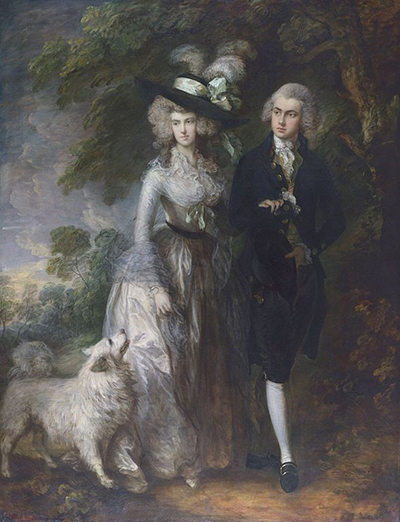
Thomas Gainsborough's Mr and Mrs William Hallett, better known as The Morning Walk, is one of his most elegant late double portraits. It shows William Hallett and Elizabeth Stephen moving together through a wooded setting shortly before their marriage in 1785. The painting can seem effortless: a young couple, fashionable dress, a small dog, soft foliage and fluent handling. Yet that ease is carefully staged. Gainsborough turns courtship, status, costume and movement into a picture of social grace that looks natural only because it is so artfully controlled.
The National Gallery in London records the work as Mr and Mrs William Hallett ('The Morning Walk'), painted in 1785 in oil on canvas.[1] It measures 236.2 by 179.1 centimetres and carries the inventory number NG6209.[1] The painting was bought by the National Gallery in 1954 with a contribution from the Art Fund.[1] Those facts matter because this is not a small domestic image. It is a large, public-scale portrait in which two private sitters are made into an image of cultivated movement.
The sitters were not yet married when Gainsborough painted them. The National Gallery identifies the man as William Hallett and the woman as Elizabeth Stephen, and notes that they were married on 30 July 1785.[1] Judy Egerton's National Gallery catalogue entry gives the same central frame and explains that William was twenty-one while Elizabeth was twenty when the portrait was painted.[2] Youth, courtship and impending marriage are therefore central to the picture, but the work is not simply a wedding anecdote. It is a portrait of two people being fashioned for social visibility.
At a Glance
- ArtistThomas Gainsborough
- SittersWilliam Hallett and Elizabeth Stephen [1]
- Date1785 [1]
- MediumOil on canvas [1]
- Dimensions236.2 × 179.1 cm [1]
- CollectionNational Gallery, London, NG6209 [1]
- MarriageThe sitters married on 30 July 1785 [1][2]
- DogProbably a Pomeranian [2]
- AcquisitionBought in 1954 with an Art Fund contribution [1]
- ExploreBiography; The Blue Boy; Mr and Mrs Andrews; Paintings; Portraits
Contents
- Introduction
- The National Gallery Picture
- William Hallett and Elizabeth Stephen
- The Walking Portrait
- Costume, Colour and Surface
- Wooded Setting and Social Ease
- Marriage Without Property Argument
- Late Portraiture and Controlled Freedom
- Provenance and Reputation
- Why The Morning Walk Matters
The National Gallery Picture
The composition is direct but subtle. William Hallett stands at the left, dressed in black velvet. Elizabeth Stephen stands at the right in white silk, with a broad pale sash and a large black hat. They move arm in arm through trees while a small white dog steps forward below them.[1][2] The figures are close, but they are not absorbed into one another. Each keeps a separate bearing within the shared walk.
The contrast between black and white is the painting's first visual drama. William's dark clothing gives the left side weight and uprightness. Elizabeth's white dress catches light and expands into the surrounding air. The dog repeats her lightness at ground level, while the trees soften the sharp social display of the costumes. Gainsborough balances fashion and landscape so that neither feels merely attached to the other.
The scale gives this fashionable walk unusual authority. A full-length double portrait on this size of canvas asks the viewer to meet the couple almost bodily. They are not glimpsed from a distance. They occupy the vertical field as figures who can command space. Yet the forward movement keeps them from hardening into static display. Gainsborough's problem is how to make formal portraiture look mobile.
That mobility is the key to the work's charm. The couple do not simply stand before a wooded background. They appear to pass through it. The small dog, angled stride, lightly turned bodies and broken foliage all help create the sense of a walk rather than a posed halt. The picture's famous ease comes from that illusion of motion.
The vertical format is worth pausing over. A tall canvas can easily make full-length figures look ceremonial, as if they were arranged for inspection. Gainsborough softens that danger by giving the composition a forward rhythm. The figures fill the height of the painting, but the implied walk prevents them from feeling locked into place. Their grandeur is therefore not the rigid grandeur of the state portrait. It is a lighter, more social grandeur, made for a couple whose fashionable identity depends on appearing graceful rather than monumental.
The setting helps sustain that effect. The trees are close enough to create enclosure, yet loose enough to keep air around the couple. The background does not compete with the sitters as an independent landscape subject. It works like a moving atmosphere, giving the figures privacy, shade and elegance. In this sense, Gainsborough uses landscape as a social instrument. It helps produce the kind of naturalness elite portraiture wanted to claim.
William Hallett and Elizabeth Stephen
The sitter facts are unusually clear. Egerton records William Hallett as the son of William Hallett of Canons and Elizabeth Stephen as the daughter of Stephen and Elizabeth Stephen of Eastington Park in Gloucestershire.[2] They married at St Lawrence, Little Stanmore, on 30 July 1785.[2] Their ages, family identities and marriage date give the painting a precise social occasion without making it a literal ceremony.
Gainsborough was not painting them as a married couple looking back on shared life. He was painting them at the threshold. That threshold matters. Their linked arms and matched forward movement create a visual promise of union, but the picture also preserves individual presentation. William and Elizabeth belong together compositionally, yet their faces, costumes and positions remain distinct.
The portrait therefore avoids both stiffness and sentimentality. It does not turn marriage into a heavy moral statement, and it does not make the pair into playful pastoral figures. Their walk is refined, measured and public. The viewer sees youth and attachment, but also rank, fashion and social rehearsal. Marriage appears here as movement into a shared social role.
Elizabeth's presence is especially strong because her dress controls so much of the light. The whiteness of the silk, the long vertical fall of the gown and the large hat make her both delicate and commanding. William's darker costume frames the scene differently, giving the composition gravity. Gainsborough does not simply make the woman decorative and the man structural; he lets both roles shift as the eye moves.
Their youth also matters. A portrait of a couple before marriage is not the same as a portrait of settled domestic authority. The image looks forward. It presents two people at a public threshold, already joined in the composition but not yet joined by the ceremony named in the records.[1][2] That forward-looking quality gives the painting its morning feeling. The walk is not just an action in a wood; it is a visual metaphor for approach.
Still, the metaphor should not be overplayed. Gainsborough does not turn the couple into allegorical figures of marriage. They remain William Hallett and Elizabeth Stephen, socially specific and fashionably dressed. The painting works because it keeps metaphor and portraiture in balance. The viewer may feel expectation, but the evidence remains the visible body, costume, gesture, dog and setting.
The Walking Portrait
The walking format is one of the painting's great inventions. A full-length portrait traditionally affirms status through stillness. In The Morning Walk, status is affirmed through motion. The couple are presented as people who can move naturally within cultivated surroundings, as if elegance were not an effort but a habit.
That impression should be handled critically. The walk is not evidence that the pair were caught outdoors in a spontaneous moment. It is a painted performance of ease. The setting may evoke nature, but it is not a mapped landscape with documentary purpose. The trees and path help produce a social mood: privacy, leisure, refinement and the freedom of people who can be represented as strolling rather than labouring.
The small dog strengthens the walking effect. Egerton identifies it as probably a Pomeranian, though the exact breed is left with caution.[2] The animal looks outward and forward, just ahead of the couple, making the movement more convincing. It also introduces liveliness at the bottom of the composition, preventing the full-length format from becoming too ceremonial.
The dog has another role too. It marks fashionable domesticity without turning the portrait into a household interior. Companion animals often help soften elite portraits, and here the dog makes the couple's elegance appear affectionate and informal. But it is still part of the staging. Like the costumes and trees, it helps make social status look natural.
The direction of the dog is important. It moves slightly ahead of the couple, as if drawing them onward. That forward placement prevents the lower part of the painting from becoming merely decorative. The dog does not simply fill space; it activates the ground. It also helps the viewer read the couple's linked posture as walking rather than standing. A tiny animal becomes a structural device.
This is characteristic of Gainsborough's intelligence as a portraitist. Small pictorial details often do more than provide charm. A dog, ribbon, hat, path or lifted hand can organise the mood of an entire work. In The Morning Walk, the dog helps convert grandeur into ease. Without it, the couple might seem more remote. With it, the painted social world becomes more immediate.
Costume, Colour and Surface
Costume carries much of the painting's meaning. William's black velvet is not a neutral dark mass. It allows Gainsborough to show subtle differences in tone and surface while setting off Elizabeth's luminous white. The dark suit gives him fashionable seriousness without making him severe. His posture remains relaxed, and the linked arm softens the authority of the clothing.
Elizabeth's dress is more visually expansive. Egerton describes the white silk costume and the dark hat, and the National Gallery's record shows how the figure's pale dress dominates the right side of the painting.[1][2] The dress is fashionable, but it also gives Gainsborough a field of light. White fabric lets him turn portraiture into a study of touch, reflection and movement.
This is where late Gainsborough needs careful description. It is tempting to say only that the brushwork is loose or fluid, but that is too general. In this painting, handling varies according to function. Faces and key details are resolved enough for likeness and social identity. Fabric, foliage and atmosphere are handled with greater freedom. The result is not unfinished carelessness; it is selective finish.
The surface makes the couple feel alive without dissolving them. Elizabeth's dress appears to breathe with the woodland air; William's velvet holds darkness against surrounding light. The paint supports the social fiction that elegance belongs naturally in this setting. Gainsborough makes effort look like air.
The broad hat is part of that fiction too. It casts and gathers darkness near Elizabeth's face, keeping the head from being lost in the pale brilliance of the dress. The hat also gives her outline width and confidence. It belongs to fashion, but it has compositional work to do. Gainsborough often used costume not just to flatter sitters but to solve pictorial problems: how to balance light, how to lead the eye, how to make a figure command space without stiffness.
The result is a portrait in which clothing seems active. William's velvet absorbs light; Elizabeth's silk reflects it; the sash and hat create accents; the dog's whiteness echoes the dress at ground level. Costume becomes a system of movement across the canvas. It is not background information about eighteenth-century fashion. It is the material through which Gainsborough makes social presence visible.
Wooded Setting and Social Ease
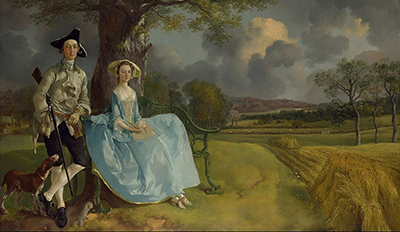
The landscape in The Morning Walk is not the kind of land argument found in Mr and Mrs Andrews. It does not ask the viewer to read fields, estate management, crop, fence and property with the same force. The setting here is wooded, atmospheric and socially theatrical. It gives the couple a stage for movement rather than a mapped possession.
This distinction is essential. Mr and Mrs Andrews is an earlier double portrait in which land and ownership are central to the interpretation.[3] The Morning Walk belongs to a later world of fashionable ease, where the landscape creates grace rather than territorial claim. Both paintings join portraiture to outdoors, but they do so with different social temperatures.
The wooded background in the Hallett portrait creates privacy without seclusion. The couple seem screened by trees, yet they are completely available to view. This is one of the painting's quiet paradoxes. The setting suggests an intimate walk; the scale and polish declare public presentation. Gainsborough makes the private-looking moment suitable for display.
The path is important because it gives direction but not destination. We do not know where the couple are going. The walk is less about arrival than about manner. They move as people trained to inhabit leisure visibly. The landscape becomes a language of refinement: soft enough to avoid harsh display, structured enough to hold the full-length figures.
This is why the wooded setting should not be treated as a simple escape from society. The couple may appear surrounded by nature, but the nature is thoroughly socialised by portrait convention. Trees and shade make the scene look relaxed, yet the whole image is calibrated for public viewing. The walk is private only as a performance of privacy.
That paradox is central to late Gainsborough. His outdoor portraits can seem free because they borrow the looseness of landscape, but they remain portraits made for status, memory and display. In The Morning Walk, the woods do not erase social rank. They make rank look light-footed.
Marriage Without Property Argument
The temptation to compare The Morning Walk with Mr and Mrs Andrews is understandable, but it should remain limited. Both are National Gallery double portraits by Gainsborough. Both involve a couple outdoors. Both connect likeness, landscape and social identity. But their differences are more revealing than their resemblance.
Mr and Mrs Andrews was painted in the early 1750s and includes a strong relation between the sitters and the land around them.[3] The unfinished lap, the agricultural setting and the position of the couple generate questions about property, class and rural order. The Morning Walk, by contrast, is dated 1785 and stages a couple in motion just before marriage.[1][2] Its landscape does not carry the same agricultural argument.
This does not make the Hallett portrait apolitical or empty. Fashionable ease is itself social. The couple's dress, leisure and setting speak of class privilege. But the painting's central idea is not landholding. It is the transformation of courtship into a public image of graceful union. The couple are not seated against their estate; they are walking into a shared future.
That future should not be over-romanticised. Gainsborough gives no documentary promise of marital happiness. He gives a formal image made before the marriage, shaped by family status, portrait convention and painterly ambition. The beauty of the picture lies in the way it makes expectation visible without pretending to know what life will become.
The difference from Mr and Mrs Andrews is also a difference in time. The earlier painting is often discussed in relation to possession, settlement and the visible structure of land.[3] The Hallett portrait is more concerned with approach, motion and the poised image of a couple about to marry. It is less about holding a place than about moving through a social landscape. That distinction lets both works remain sharp. Each is a double portrait outdoors, but each asks its own questions.
The comparison also guards against a lazy reading of Gainsborough's couples. He did not simply repeat one formula. Sometimes land becomes an argument; sometimes movement becomes the argument; sometimes conversation, music, family or fashion carries the weight. The Morning Walk is powerful because it refuses to sit still as a marriage emblem. Its deepest idea is grace in motion.
Late Portraiture and Controlled Freedom
Gainsborough's House describes the artist as a painter for whom landscape remained a continuing passion while portraiture brought greater financial success.[4] The National Gallery's artist account similarly presents him as a leading portraitist who repeatedly brought landscape and outdoor mood into his work.[5] The Morning Walk is a late example of that fusion.
What makes the painting late is not only the date. It is the confidence with which Gainsborough lets formal portraiture loosen. The couple retain status, likeness and social legibility, but the surrounding world is light, mobile and breathable. Costume is not stiffly catalogued; it is animated. Trees are not background furniture; they help generate atmosphere. The dog is not a token; it moves the composition forward.
Controlled freedom is the best way to describe the work. Gainsborough permits softness without losing design. The linked arms, dark-light contrast, dog, path and framing trees hold the painting together. Around those anchors, the handling can become quick, feathery and suggestive. The picture looks easy because its structure is secure.
This control is why the painting has become one of Gainsborough's most popular images. It offers pleasure immediately, but the pleasure is not thin. The longer the viewer looks, the more apparent the construction becomes: the opposing costumes, the staged informality, the forward motion, the carefully calibrated landscape and the social performance of naturalness.
Rosenthal's Paul Mellon Centre study is useful here because it frames Gainsborough's career within a world of artistic production, rivalry, exhibition culture and commercial need.[6] The Morning Walk belongs to that world. It is pleasurable, but its pleasure has work to do. It makes a fashionable commission memorable, demonstrates the painter's late fluency and turns elite ease into a saleable visual ideal.
That commercial and artistic context should not cheapen the picture. Gainsborough's ability was precisely to make the pressures of portraiture produce beauty rather than formula. A young couple needed to be recognised, flattered and socially placed. The painter used that demand as an opportunity to test movement, atmosphere and surface. The commission becomes art because the requirements are transformed rather than merely satisfied.
Provenance and Reputation
Egerton's catalogue entry traces the painting through the Hallett family and later collections before its acquisition by the National Gallery.[2] The National Gallery record gives the public acquisition point: bought in 1954 with an Art Fund contribution.[1] The work's present familiarity is therefore modern as well as eighteenth-century. It became a national public image long after it was painted for a private family context.
That movement changes the painting's meaning. In family ownership, it would have marked particular sitters, marriage and lineage. In the National Gallery, it becomes a major example of Gainsborough's late style and British portraiture. The title still preserves William Hallett and Elizabeth Stephen, but many viewers now meet the work first through its nickname, The Morning Walk.
The nickname is useful but incomplete. It captures the image's movement and freshness, yet it can soften the sitter identities. The fuller title matters because this is not just an elegant walk. It is a portrait of William Hallett and Elizabeth Stephen at a precise moment before marriage. The walk is the format; the sitters are the subject.
The painting's reputation depends on this tension. It is admired as a graceful image even by viewers who know little about the Halletts, but it becomes richer when the sitter evidence returns. Youth, family status, marriage, fashion, dog, landscape and scale all become part of one carefully orchestrated public likeness.
The 1954 acquisition also places the painting within modern public taste. By the mid-twentieth century, the image could be valued not only as a family portrait but as a national example of eighteenth-century British elegance.[1] That modern status has helped the nickname become widely familiar. Yet the museum title keeps the historical sitters visible. The best reading needs both: the memorable poetic name and the precise identities beneath it.
This afterlife is part of the reason the painting can feel almost too familiar. Reproduction encourages quick recognition: the white dress, the black suit, the dog, the walk. Waterhouse+ reading has to slow that recognition down. Familiarity should become a reason to look harder, not a substitute for looking.
Looking Slowly
A slow reading should begin with the linked arms. They are the hinge of the picture. The gesture joins the sitters without making them identical. William's dark figure and Elizabeth's pale figure remain visually distinct, yet the contact between them gives the painting its social and emotional centre.
Then look downward to the dog. The animal's position in front of the couple pulls the eye into motion and gives the lower part of the canvas life. It also lightens the grandeur of the full-length format. Without the dog, the couple might seem too ceremonious. With it, the walk feels active.
Then look at the trees. They do not describe a specific documented place. They shape mood. Their foliage frames the sitters, breaks the light and gives the white dress a softer surrounding world. Gainsborough uses landscape to make social display appear natural and breathable.
Finally, notice the balance between polish and looseness. The picture is refined enough to serve as a grand double portrait, but open enough to feel fresh. That balance is the painting's achievement. Gainsborough makes high style look unforced, while leaving enough evidence of staging for the viewer to recognise the artifice.
Why The Morning Walk Matters
Mr and Mrs William Hallett, The Morning Walk matters because it shows Gainsborough at the height of his late portrait invention. He takes a conventional commission for a young couple and turns it into a moving image of elegance, expectation and social ease. The painting is not deep because it is dramatic. It is deep because it makes grace complicated.
It also matters because it clarifies what a Gainsborough outdoor portrait can be. Not every couple in a landscape is an estate statement. Not every wooded background is topographical evidence. In this work, landscape provides movement, mood and social refinement. The setting helps marriage look graceful before it becomes lived history.
The painting's enduring charm should not be distrusted, but it should be examined. Its beauty comes from costume, youth, movement, dog, trees, surface and scale working together. Gainsborough makes the couple seem almost casually elegant, but nothing in the picture is casual. The Morning Walk remains compelling because it lets viewers enjoy the fiction of effortless grace while quietly showing how much art it takes to produce.
Frequently Asked Questions
Discussion
What makes this carefully staged walk appear effortless?
Reader Insights
How do linked arms, stride and the small dog turn formal portraiture into motion?
Where do black velvet, white silk and wooded light carry the painting’s social meaning?
How does knowing the sitters were not yet married change the image of graceful union?
Join the Conversation
Share your reading below.
References
- National Gallery, London, “Thomas Gainsborough, Mr and Mrs William Hallett ('The Morning Walk').” View source.
- Judy Egerton, “Mr and Mrs William Hallett ('The Morning Walk'),” in National Gallery Catalogues: The British Paintings (London: National Gallery Company and Yale University Press, 2000), National Gallery, London. View source.
- National Gallery, London, “Thomas Gainsborough, Mr and Mrs Andrews.” View source.
- Gainsborough's House, “About Thomas Gainsborough.” View source.
- National Gallery, London, “Thomas Gainsborough.” View source.
- Michael Rosenthal, The Art of Thomas Gainsborough: "A Little Business for the Eye" (New Haven and London: Yale University Press for the Paul Mellon Centre for Studies in British Art, 1999). Publication record.