 by Tom Gurney
Tom Gurney BSc (Hons) is an art history expert with over 20 years experience
Page Created: / Page Updated:
Email: tomgurney1@gmail.com / Phone: +44 7429 011000
Interior in Strandgade, Sunlight on the Floor: Introduction
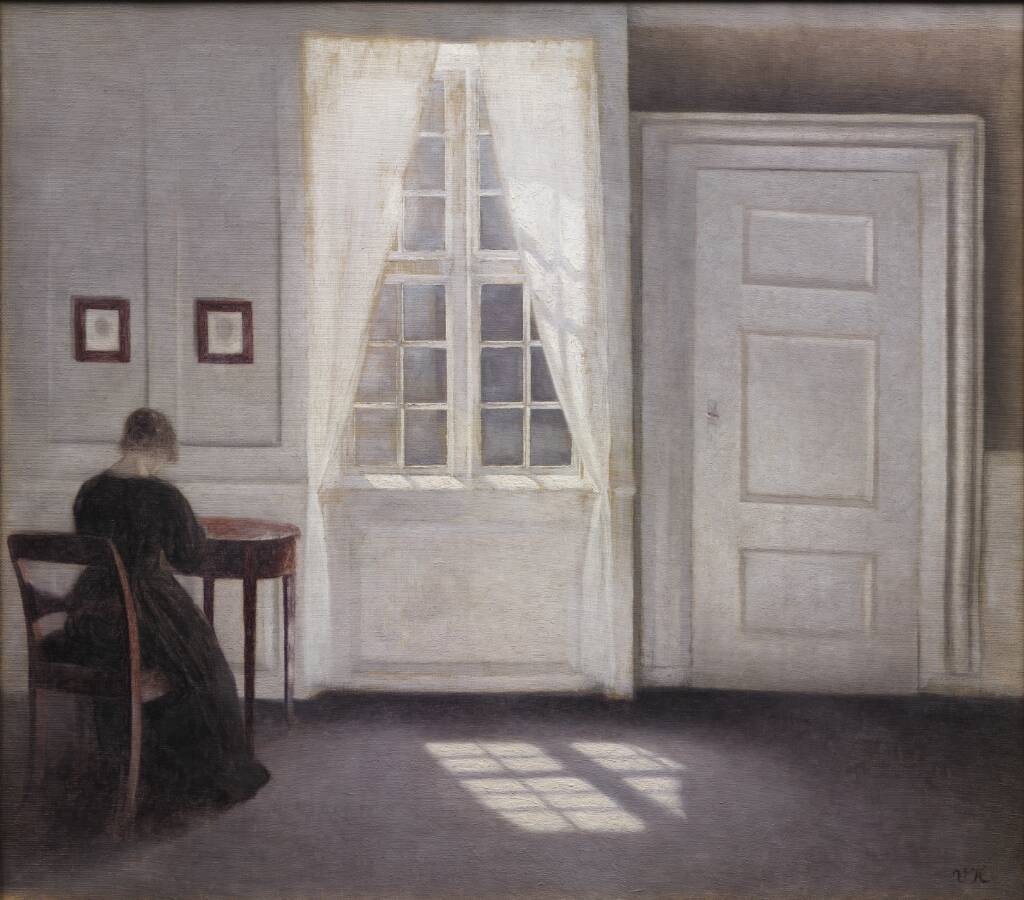
Interior in Strandgade, Sunlight on the Floor is spare without being empty. A curtained window, a closed door, two little framed pictures, a seated woman and a patch of sunshine furnish nearly the entire scene. Their arrangement is exact enough to make every interval count. The bright floor is not merely an atmospheric detail: it is the event that binds the unseen courtyard, the window’s panes and the room’s broad horizontal base.
The painting is SMK KMS3696, made in 1901 in oil on canvas and measuring 46.5 × 52 centimetres. That inventory number matters because Vilhelm Hammershøi returned repeatedly to similar rooms and titles. SMK’s current English title is the one used here, while the Vilhelm Hammershøi Digital Archive (ViHDA) records the same object more briefly as Interior. Strandgade 30, survey 230.[1][2] Its identity must not be merged with the separate 1902 Strandgade interior KMS3697.
At a Glance
- ArtistVilhelm Hammershøi.
- Date and medium1901, oil on canvas.
- Collection and inventorySMK – National Gallery of Denmark, KMS3696.
- Size46.5 × 52 centimetres; ViHDA survey number 230.
- Probable sitterIda Hammershøi, seen from behind at the left.
- Key evidencecourtyard daylight, thin layered paint and a possibly adjusted floor reflection.
Vilhelm Hammershøi in context
Contents
- Introduction
- Which Strandgade Interior Is This?
- What the Painting Shows
- Courtyard Light Without a Clock Time
- Ida at the Edge of the Room
- Floor, Wall and the Cropped Room
- Thin Paint, Coloured Preparation and Revision
- Its Place Among the Strandgade Paintings
Which Strandgade Interior Is This?
KMS3696 is a modest landscape-format canvas, only slightly wider than it is tall. Its present SMK title names the location and the most conspicuous visual occurrence. ViHDA’s shorter title keeps the address but omits the phrase about sunlight. Both labels lead to the same 1901 object, owned by SMK, with matching dimensions and medium.[1][2] The inventory number removes an ambiguity that words alone can create among Hammershøi’s many interiors.
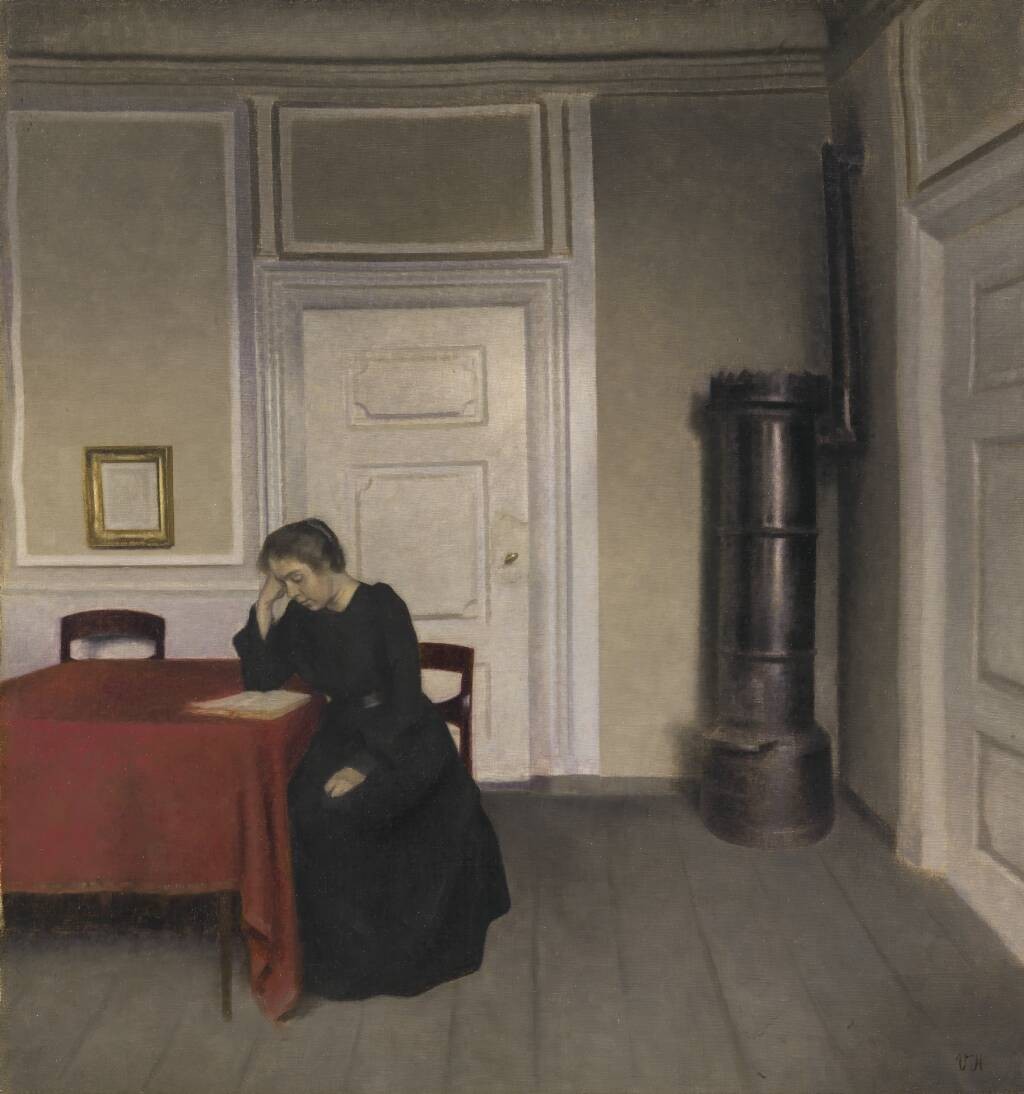
The distinction is especially important beside A Room in the Artist’s Home in Strandgade. That is KMS3697, dated 1902, a taller painting in which Ida sits beside a covered table and a dark stove. It is neither another title nor a second state of KMS3696.[5] The 1901 canvas discussed here has a closed door beside the window, an oval mahogany table at the far left and no red table covering.
The object also has a traceable early history. ViHDA reports that Hammershøi’s mother recorded a purchase in 1901 by the Copenhagen art dealer and frame-maker Otto Lemming; the archive considers KMS3696 the likely painting concerned. SMK received it in 1924 through a bequest.[2] “Likely” is the appropriate word for the proposed sale identification, whereas the museum inventory, acquisition and physical specifications are firm.
What the Painting Shows
The window stands just left of the canvas centre. White curtains part around a grid of dark panes, but they reveal no legible outdoor prospect. Below is pale panelling. A closed, panelled door rises immediately to the right, almost as bright as the window surround yet edged by darker moulding and wall. The right-hand side is largely an unoccupied field of brown-grey, and the upper wall deepens into shadow.
At the left, a woman in a long dark dress sits with her back towards the viewer. Her head inclines towards a small oval table, although the image does not make her activity certain. A wooden chair frames her body with a few brown uprights and diagonals. Two small pictures hang above the table, their dark mahogany-coloured frames punctuating a pale expanse that otherwise carries little decoration. Figure, furniture and pictures are all gathered towards one edge.
The floor fills the lower part of the composition. Across it falls an oblique cluster of pale quadrilaterals, broken by darker bars that recall the window grid. The shape sits away from the opening rather than forming a continuous beam between sill and boards. That gap makes the light read simultaneously as an optical consequence and as a separate painted form. Around it, the floor moves through purple-grey and warmer shadow instead of becoming one neutral band.
This account depends on the exact approved image of KMS3696. It does not transfer details from another white-doored room. Hammershøi’s repeated components are easy to recognise, but the placement here is particular: seated figure low at left, window near the middle, closed door to its right and sunlight isolated in the foreground.
Courtyard Light Without a Clock Time
ViHDA identifies this as a room facing the inner courtyard of the old Strandgade 30 building. Hammershøi made several frontal arrangements at this spot, selecting figures and furniture against the recurring wall, window and door, and he represented the room under differing conditions during the day.[2] The visible diagonal therefore belongs to an observed relationship between sun, courtyard, glazing and floor, not to an invented glow detached from the apartment.
Yet the painting does not yield an exact hour. Neither the institutional object data nor the technical study assigns one, and a slanting patch by itself cannot securely distinguish morning from afternoon without further evidence about orientation, season and date. The most that can be said from the documented record is that changing daylight was one variable Hammershøi explored from this position. The image makes a duration perceptible but leaves its limits open.
That uncertainty is productive. The panes appear to project a temporary grid upon the boards, while the door and panelling seem comparatively fixed. A viewer can imagine the illuminated patch crossing or fading from the floor, but the canvas holds it still. The Strandgade interiors guide places that passing condition within the larger sequence of rooms and viewpoints without converting it into a timetable.
Technical observation adds a further qualification. Raking light suggests that Hammershøi may have shifted the reflection a little to the right and made it slightly shorter.[2] The cautious “may” reflects what surface relief can establish. Even so, the finding shows that the visible shape was considered and adjusted as part of the composition. It should not be treated as an untouched snapshot of a single instant.
Ida at the Edge of the Room
ViHDA describes Ida Hammershøi as the most likely model for the woman seen from behind.[2] That wording retains a small but important degree of uncertainty. Ida was Hammershøi’s wife and a frequent sitter, yet identity must be established for each painting rather than assumed whenever a dark-clothed woman occupies an interior. Her documented roles and appearances are followed more fully in the guide to Ida Hammershøi.
Here the figure’s position is visually clear even though her action and state of mind are not. The dark dress makes a broad descending form against the light wall. Its curved contour differs from the window, door and panelling, while the chair and table connect it back to the room’s more angular structure. Her head is lower than the two framed pictures, and the direction of her body turns attention inward towards the table rather than out towards the viewer.
Nothing in that pose proves sadness, loneliness or withdrawal. Facing away limits access to expression, but limited access is not evidence of a particular emotion. The woman also prevents the room from functioning as a purely architectural arrangement: she supplies scale, bodily weight and an implied activity whose details remain withheld. The tension lies between what can be seen precisely and what cannot responsibly be narrated.
Floor, Wall and the Cropped Room
The composition is frontal, but it does not provide a complete survey of the room. The left edge presses close to the chair, skirt and table; the right edge cuts off the continuation of the wall. Floor extends below and sideways beyond the painted field. These exclusions make the view feel selected from a larger domestic space rather than designed as a symmetrical elevation.
Within that selection, rectangles dominate. Door panels sit inside a door, panes sit inside a window, and the small framed pictures repeat the format in miniature. The sunlit grid relocates a related pattern onto the floor at an angle. Against these nested rectilinear units, the oval tabletop and the sitter’s rounded back act as counterforms. The painting is restrained, but it is not static in design: straight edges, curves and obliques pull in different directions.
The broad wall is equally active. Its light left portion lets the frames and figure register sharply; its darker right passage surrounds the pale door with a muted tonal border. Window white, door white and wall grey are not interchangeable. Small shifts in warmth and value separate one surface from another, while softened edges prevent the scheme from turning into a hard diagram. The result rewards the slower form of looking developed in the overview of Hammershøi’s paintings.
Thin Paint, Coloured Preparation and Revision
ViHDA was built through collaboration among conservators, scientists, imaging specialists and art historians. Its methods include direct examination, infrared reflectography, X-radiography, multiband imaging and material analysis.[3] For KMS3696, those approaches make it possible to distinguish visible colour, preparatory structure and later adjustment rather than describing every effect simply as “grey”.
The canvas carries a thin, industrially applied off-white ground. Black pencil or crayon lines remain locally visible around window bars and the panelling beneath the window. Over the ground, a transparent, diluted preparation established different zones: greenish brown lies below the purple-grey floor, while warm grey supports parts of the wall, door and window.[2] Those underlying colours help the later pale and cool passages retain variation.
The visible paint is relatively thin and has a comparatively simple layer structure. ViHDA finds that an initial application dried before much of the upper painting was worked wet-in-wet. Brush direction generally follows vertical or horizontal architectural divisions. The floor, the panelling below the window and the lightest accents depart from that tendency, allowing the reflection to break the room’s prevailing grid.[2]
Hammershøi usually proceeded from darker passages towards lighter ones in the floor, wall, door and window. Slight impasto becomes most noticeable in the window whites, curtains and sunlight, while the weave remains perceptible elsewhere. The observed palette includes purple-grey across the floor and left wall, greenish grey and brown to the right, pale greys and whites in the architecture, warmer yellow-grey shadows, and dark brown or black in figure and furniture.[2] The surface evidence is explored alongside other exact objects in the light, colour and technique guide.
The possible relocation and reduction of the sun patch is the principal recorded correction; ViHDA notes no other apparent compositional changes.[2] That modest intervention suits the picture’s economy. Its effects do not require a dramatic buried design. A small adjustment to brightness, height or position can alter the balance between window, seated figure and open floor.
Its Place Among the Strandgade Paintings
Hammershøi and Ida lived at Strandgade 30 from 1898 until 1908, when renovation required them to leave. The Hirschsprung Collection situates this apartment within a succession of seven Copenhagen addresses and characterises the interiors as carefully staged arrangements of doors, windows and furniture rather than unedited domestic records.[4] KMS3696 demonstrates that staging through concentration: a few chosen objects and one illumination pattern carry the whole design.
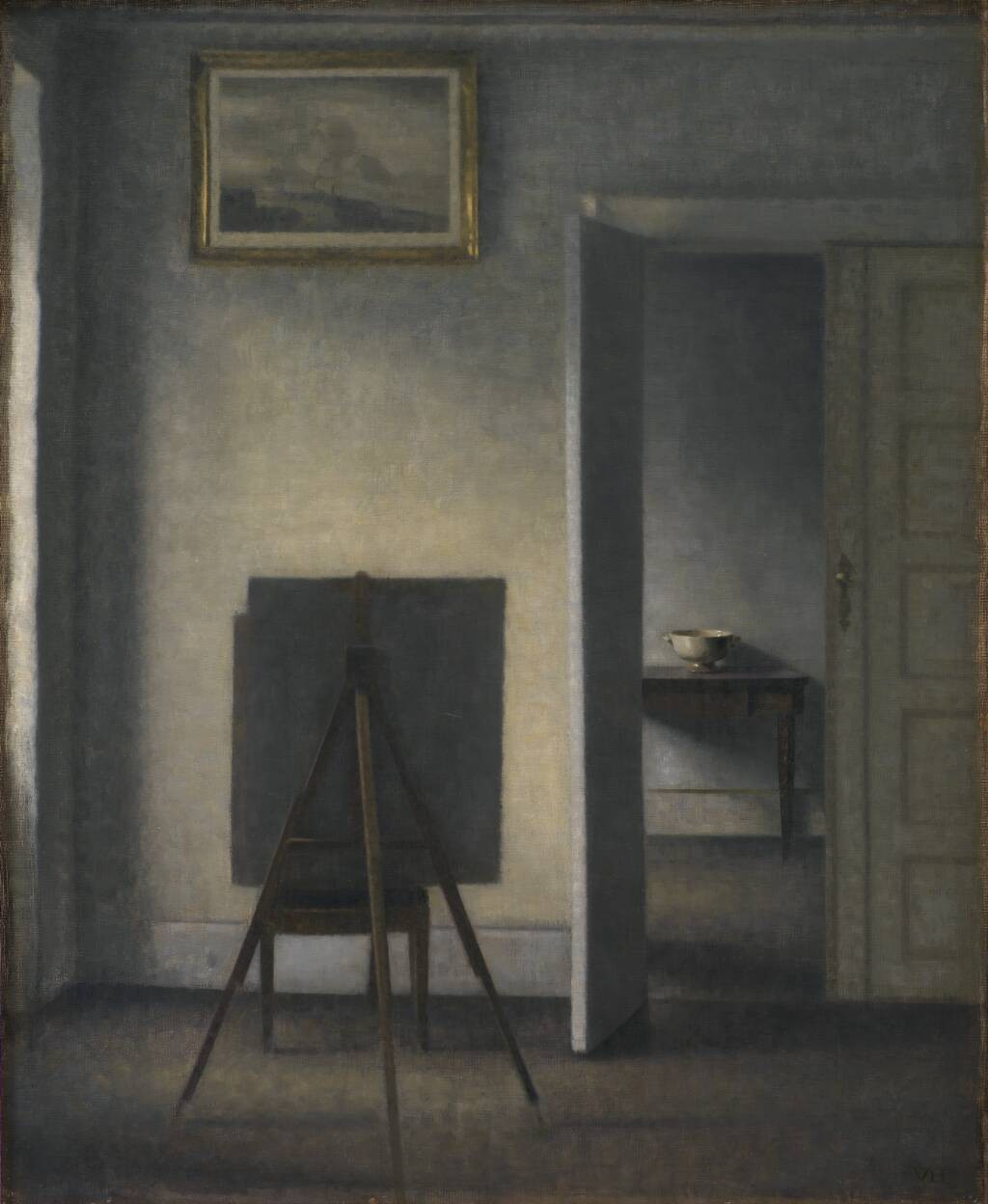
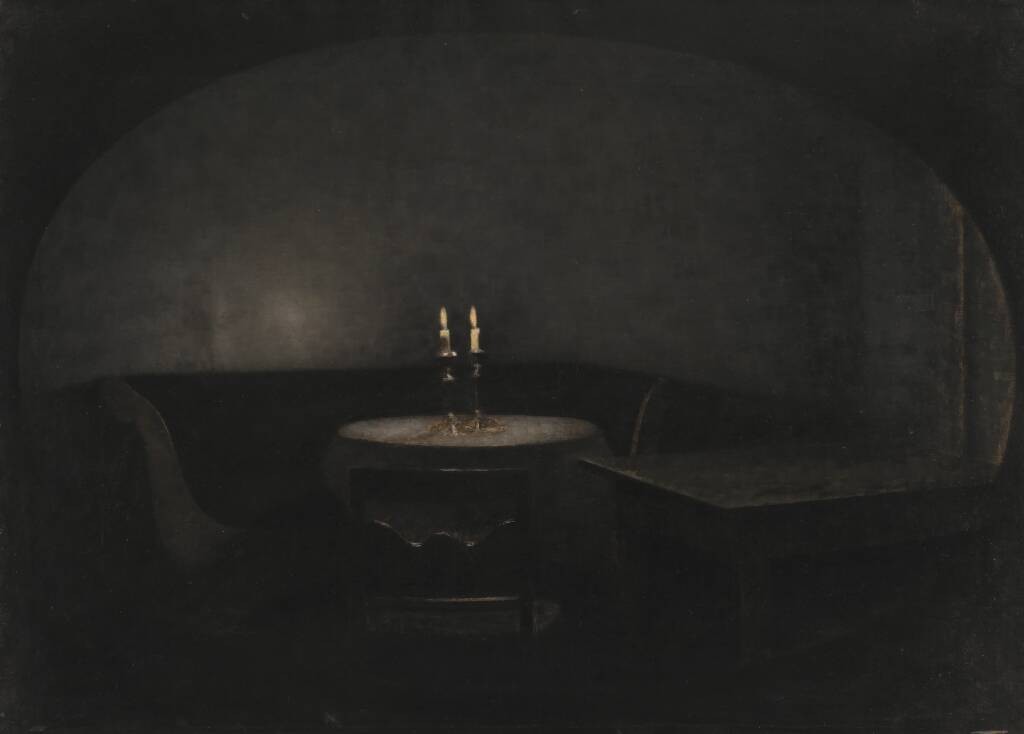
Comparison makes its choices clearer. In KMS3697, painted the following year, the room is taller, Ida is associated with a larger covered table, and a black stove exerts a strong vertical weight.[5] Later, Interior with the Artist’s Easel of 1910 gives studio furniture and an open doorway a different prominence.[6] Interior. Artificial Light of 1909 replaces the broad daylight event with two concentrated candle flames.[7]
These links are comparisons, not claims that every work shows the same chamber. Different dates, addresses, formats and inventory numbers remain decisive. KMS3696 occupies its own position within the sequence: a compact, courtyard-facing interior in which a person is present, narrative is withheld and sunlight becomes the most mobile element in an otherwise measured room.
Researched works directory
This directory covers the 133 paintings currently published by the Vilhelm Hammershøi Digital Archive (ViHDA). It is a researched platform census, not a complete catalogue raisonné of the artist's oeuvre.
| Name | Date | Medium |
|---|---|---|
| A Bakery Shop. Study | 1888 | Painting |
| A Greek Relief. Louvre | 1892 | Painting |
| Amalienborg Square | 1896 | Painting |
| An Ancient Relief. Study | 1878 – 1881 | Painting |
| An Old Woman | 1886 | Painting |
| An Old Woman Standing by a Window | 1885 – 1886 | Painting |
| Artemis | 1893 – 1894 | Painting |
| Bedroom | 1890 | Painting |
| Church of Christiansborg Palace, Copenhagen | 1910 | Painting |
| Church of Sankt Petri, Copenhagen | 1906 | Painting |
| Double Portrait. Vilhelm and Ida Hammershøi | 1892 | Painting |
| Evening in the Drawing Room. Strandgade 30 | 1904 | Painting |
| Evening in the Sitting Room. | 1904 | Painting |
| Evening Interior. Artificial Light. Ida and Frederikke Hammershøi | 1891 | Painting |
| Farm. Refsnæs | 1900 | Painting |
| Five Portraits. Study | 1901 | Painting |
| Frederiksborg Castle | 1893 | Painting |
| From Christianshavns Canal | 1905 | Painting |
| From Frederiksholms Kanal | 1893 | Painting |
| From Kvæsthusbroen | 1908 | Painting |
| From the British Museum. London, Winter | 1906 | Painting |
| From the Church Santo Stefano Rotondo in Rome | 1902 – 1903 | Painting |
| From The Greenlandic Trade Dock. Christianshavn | 1908 | Painting |
| From the Old Christiansborg Palace | 1907 | Painting |
| Hammershøi's palette | Uncertain/Unknown | Painting |
| Head of a Woman. Study for Artemis | 1893 | Painting |
| Houses. Arresødal near Frederiksværk | 1904 | Painting |
| Interior | 1898 | Painting |
| Interior in Louis Seize style. Rahbeks Allé | 1897 | Painting |
| Interior. 'The Four Rooms'. Strandgade 25 | 1914 | Painting |
| Interior. A Young Man Reading | 1898 | Painting |
| Interior. Artificial Light | 1909 | Painting |
| Interior. Attic Room with Table and Chair | 1883 – 1885 | Painting |
| Interior. Frederikke and Anna Hammershøi | 1884 | Painting |
| Interior. From The Great Hall of Lindegården | 1909 | Painting |
| Interior. Ida Hammershøi at a Sewing Table | Uncertain/Unknown | Painting |
| Interior. Living Room in Louis-Seize-Style. Rahbeks Allé 26 | 1893 – 1896 | Painting |
| Interior. Looking out on the Exterior. Strandgade 30 | 1905 | Painting |
| Interior. Strandgade 30 | 1901 | Painting |
| Interior. Strandgade 30 | 1902 | Painting |
| Interior. Strandgade 30 | 1905 | Painting |
| Interior. Study in Sunlight. Strandgade 30 | 1906 | Painting |
| Interior. Sunshine in the Drawing Room III | 1903 | Painting |
| Interior. The Music Room. Strandgade 30 | 1908 | Painting |
| Interior. The Old Stove. Albertinelyst | 1888 | Painting |
| Interior. The Tall Windows | 1913 | Painting |
| Interior. With Empire Sofa. Strandgade 30 | 1907 | Painting |
| Interior. With Four Etchings. Strandgade 30 | 1904 | Painting |
| Interior. With Table, Cupboard and Windsor Chair. Strandgade 25 | 1913 | Painting |
| Interior. With the Artist's Easel | 1910 | Painting |
| Interior. With the Artist's Easel. Bredgade 25 | 1912 | Painting |
| Interior. Woman knitting | 1889 | Painting |
| Interior. Woman Reading | 1910 | Painting |
| Interior. Woman Reading. Bredgade 25 | Uncertain/Unknown | Painting |
| Interior. Woman Sitting Behind a Table | 1910 | Painting |
| Interior. Woman Sweeping | 1899 | Painting |
| Job | 1887 | Painting |
| Job. Study | 1887 | Painting |
| Landscape. At Lyngby Lake | 1888 | Painting |
| Landscape. Early Spring | 1909 | Painting |
| Landscape. Gentofte | 1906 | Painting |
| Landscape. Grønsund, Falster | 1890 | Painting |
| Landscape. Gundsømagle near Roskilde | 1885 | Painting |
| Landscape. Gundsømagle near Roskilde | 1886 | Painting |
| Landscape. Kongevejen near Gentofte. Study | 1892 | Painting |
| Landscape. Near Fortunen | 1901 | Painting |
| Landscape. Near Lejre | 1905 | Painting |
| Landscape. Ryet near Farum Lake | 1896 – 1897 | Painting |
| Landscape. Summer. Near Lejre | 1905 | Painting |
| Landscape. Søndermarken Park in Winter | 1895 – 1896 | Painting |
| Landscape. The Rowan Avenue at Snekkersten | 1906 | Painting |
| Landscape. With a Farmhouse | 1878 – 1879 | Painting |
| Landscape. Young Forest, Trørød, Summer | 1907 | Painting |
| Morning Toilette. Study. Strandgade 25 | 1914 | Painting |
| Nude Female Model | 1884 | Painting |
| Nude Female Model | 1910 | Painting |
| Open Doors. Strandgade 30 | 1905 | Painting |
| Portrait of a Young Girl. Anna Hammershøi | 1885 | Painting |
| Portrait. Anna Hammershøi | 1883 | Painting |
| Portrait. Anna Hammershøi. Profile | Uncertain/Unknown | Painting |
| Portrait. Daniel Jacobson Salter | 1901 | Painting |
| Portrait. Elisabeth Dorothea Rentzmann | Uncertain/Unknown | Painting |
| Portrait. Elisabeth Wandel | 1890 | Painting |
| Portrait. Fini Henriques | Uncertain/Unknown | Painting |
| Portrait. Frederikke Hammershøi | Uncertain/Unknown | Painting |
| Portrait. Frederikke Hammershøi. Study | 1894 | Painting |
| Portrait. Henry Madsen. Study | 1904 | Painting |
| Portrait. Henry Madsen. Study | 1904 | Painting |
| Portrait. Ida Hammershøi | 1894 | Painting |
| Portrait. Ida Hammershøi with a Teacup | 1907 | Painting |
| Portrait. Ida Ilsted | 1890 | Painting |
| Portrait. Ida Ilsted. Study | 1890 | Painting |
| Portrait. Ida Ilsted. Study | 1890 | Painting |
| Portrait. J.F. Willumsen. Study for Five Portraits | 1901 | Painting |
| Portrait. J.F. Willumsen. Study for Five Portraits | 1901 – 1902 | Painting |
| Portrait. Karen Malm | 1914 | Painting |
| Portrait. Karl Madsen | 1890 | Painting |
| Portrait. Kristian Zahrtmann | 1889 | Painting |
| Portrait. Kristian Zahrtmann | 1889 | Painting |
| Portrait. Svend Hammershøi | 1881 | Painting |
| Portrait. Svend Hammershøi | 1892 | Painting |
| Portrait. Svend Hammershøi | 1903 – 1904 | Painting |
| Portrait. Svend Hammershøi. Study for Five Portraits | 1901 | Painting |
| Portrait. Thora Bendix, née Anne Victoria Sundberg | 1896 | Painting |
| Portrait. Thora Bendix. Study | 1896 | Painting |
| Portrait. Thorvald Bindesbøll. Study | 1904 | Painting |
| Portrait. Woman. Possibly Frederikke Juncker-Jensen | 1878 – 1881 | Painting |
| Portrait. Woman. Profile | 1888 | Painting |
| Seated Female Nude | 1889 | Painting |
| Self- Portrait | 1891 | Painting |
| Self-Portrait | 1890 | Painting |
| Self-Portrait | 1914 | Painting |
| Self-Portrait. Spurveskjul, Frederiksdal | 1911 | Painting |
| Self-Portrait. Spurveskjul, Frederiksdal | 1911 | Painting |
| Standing Female Model | 1909 – 1910 | Painting |
| Street in London. Montague Street at the British Museum | 1905 – 1906 | Painting |
| Study of a Model. A Woman seen from the Back | 1888 | Painting |
| Sunbeams or Sunshine. "Dust motes dancing in the sunbeams" | 1900 | Painting |
| The Buildings of the Asiatic Company, seen from St. Annæ Street | 1902 | Painting |
| The Cello Player. Henry Bramsen | 1893 | Painting |
| The Coin Collector. Strandgade 30 | 1904 | Painting |
| The Garden Room. Frederiksberg Allé | 1887 | Painting |
| The Tuesday Forest | 1893 | Painting |
| Three Sailing Boats. Christianshavns Canal | 1905 | Painting |
| Tree Trunks. Arresødal near Frederiksværk | 1904 | Painting |
| View of Christiansborg Palace. Late Autumn | 1890 – 1892 | Painting |
| View of Gentofte Lake . 'Sunshower' | 1903 | Painting |
| View of Gentofte Lake . 'Sunshower'. Study | 1903 | Painting |
| View of Jægersborg Allé. Study | 1892 | Painting |
| White Doors. Strandgade 30 | 1899 | Painting |
| Woman Knitting. Frederikke Hammershøi | 1889 | Painting |
| Young Beechwood. Arresødal near Frederiksværk | 1904 | Painting |
| Young Girl Sewing. Anna Hammershøi | 1887 | Painting |
Frequently Asked Questions
The painting belongs to SMK – National Gallery of Denmark, where its inventory number is KMS3696. SMK records it as an oil on canvas from 1901 measuring 46.5 × 52 centimetres.[1]
ViHDA says that Ida was most likely the woman who posed for the picture.[2] She was Hammershøi’s wife and a frequent sitter, but the institution’s qualified identification should be preserved rather than turned into absolute certainty.
No exact hour is established. The room faced the inner courtyard, and Hammershøi painted this position under different conditions during the day.[2] The angle proves that directional light entered the room, but it cannot on its own identify morning or afternoon.
Possibly. Raking-light examination indicates that the floor reflection may have moved slightly to the right and become a little shorter.[2] This is a cautious technical finding, not evidence for a completely different earlier composition.
Discussion
Use this evidence-led guide as a starting point for close looking rather than a final verdict.
Share an observation about Interior in Strandgade, Sunlight on the Floor or a source that adds useful context.
Reader Insights
Which detail most changes your reading of Interior in Strandgade, Sunlight on the Floor?
How do scale, surface or the current technical evidence shape the encounter?
What remains uncertain when visual inference is separated from documented fact?
Join the Conversation
Add your reading below, keeping observations specific and evidence clear.
References
- SMK Open, Interior in Strandgade, Sunlight on the Floor (KMS3696), accessed 31 August 2026.
- Vilhelm Hammershøi Digital Archive, Interior. Strandgade 30 (KMS3696), accessed 31 August 2026.
- Vilhelm Hammershøi Digital Archive, “About the Project”, accessed 31 August 2026.
- The Hirschsprung Collection, “Vilhelm Hammershøi”, accessed 31 August 2026.
- Vilhelm Hammershøi Digital Archive, Interior. Strandgade 30 (KMS3697), accessed 31 August 2026.
- Vilhelm Hammershøi Digital Archive, Interior with the Artist’s Easel, accessed 31 August 2026.
- Vilhelm Hammershøi Digital Archive, Interior. Artificial Light, accessed 31 August 2026.