 by Tom Gurney
Tom Gurney BSc (Hons) is an art history expert with over 20 years experience
Published on June 19, 2020 / Updated on November 3, 2026
Email: tomgurney1@gmail.com / Phone: +44 7429 011000
Plate 4 of Visions of the Daughters of Albion by Blake: Introduction
A woman floats above a man who has buried his face in his arms. Her body reaches towards him along a broad curve of dark cloth, but he makes no answering movement. Behind them, a pale disc touches the sea’s horizon. William Blake brings the two people close enough to share one small space while leaving the distance between them painfully intact.
The figures are Oothoon and Theotormon from Visions of the Daughters of Albion, Blake’s illuminated poem of 1793. Tate’s separate colour impression of the design, N03374, dates from about 1795. The woman has survived an assault by Bromion and seeks recognition from the man she loves. Theotormon’s jealous withdrawal makes that appeal fruitless. Suspended above him, Oothoon can move and speak, yet cannot make him hear her. [1][2]
At a Glance
- Book design1793 [1][2]
- Separate impressionc.1795; Tate, N03374 [1]
- TechniqueColour-printed relief etching, ink and watercolour [1]
This work across William Blake’s career
Gothic art and antiquarian study
Apprenticeship, 1772–1779 [3]Poetical Sketches
1783 [4]The Marriage of Heaven and Hell
Offered in the 1793 prospectus [6]Night Thoughts
Published selection, 1797 [8]The Ghost of a Flea
c.1819–1820 [10]Job engravings
Agreement 1823; issue 1826 [11]Dante illustrations
1824–1827 [12]Contents
- A miniature taken from a book
- The curve above the crouching figure
- The words that once stood below
- How free is the hovering woman?
- A woman’s claim to be heard
A miniature taken from a book
The title Plate 4 identifies this composition’s place in the poem’s sequence of numbered text plates. It does not mean the fourth leaf counted from the beginning of a complete copy, which also includes a frontispiece, title and Argument. The image originally occupied a little more than the upper third of a page. In its separate form, the writing below has disappeared, and the small scene can be encountered as a complete picture. [1]
The distinction between 1793 and about 1795 follows that change of object. The earlier date belongs to the design in the book; the later date is Tate’s dating of this colour impression. Butlin’s catalogue describes colour-printed relief etching finished in ink and watercolour. Printed forms and subsequent work on the paper together produce the sheet’s appearance. The broken, granular darks of the surrounding cloth and rocks give the pale bodies a strong setting, while fine lines hold their contours. [1]
Its dimensions restore a scale that a large reproduction easily conceals. Tate’s present record labels 75 by 115 millimetres as the support. The historical catalogue gives those same measurements for the image and separately records paper measuring 282 by 245 millimetres. These are different descriptions of the object; the smaller rectangle should not silently stand for the whole sheet described in the older entry. The design itself is only about eleven and a half centimetres wide. [1]
That intimacy suits an image built around a failed personal exchange. We approach closely to make out the woman’s fingers, the link at her ankle and the man’s hidden head. A grand gesture has been compressed into a space that invites private attention. The viewer can give the figures the sustained scrutiny that their own encounter fails to sustain.
The particular sheet also has a collecting history. Tate’s catalogue records John Linnell’s ownership, its sale at Christie’s in March 1918, and its acquisition for the gallery in 1919. Those details belong to the Tate impression. The close correspondence of colour and contour between familiar reproductions helps identify the image, but it does not establish the complete physical history of every reproduction carrying its title. [1]
The curve above the crouching figure
Oothoon stretches diagonally across the upper part of the scene, with her feet at the left and her head turned down towards Theotormon. Her legs form a long taper, while her shoulders, bent arms and loose hair gather into a denser cluster near his head. One hand rises towards her face. The inclination suggests an appeal, but Blake gives us no embracing contact or exchanged look. The man remains beyond the reach of the gesture. [1]
Dark cloth rises from the lower left, sweeps behind her body and turns upwards into a pointed curl. Its successive folds make a broad circulating movement around the pale figure. The shape is large enough to surround her without swallowing her outline. It can initially resemble an enormous wing, yet the picture gives no reason to turn Oothoon into a winged angel. The sweeping material carries the sensation of flight through its own curve.
Look back towards the ankle at the left. A dark band and a length of hanging chain interrupt the body's extended line. The links descend towards the rocky ground as the cloth continues its upward sweep. Movement and constraint occupy the same figure. The hovering body cannot be read as a simple announcement that every bond has fallen away. [1]
Theotormon has a different kind of enclosure. His head rests on his folded arms above his drawn-up knees. Drapery falls in long, almost vertical folds from his shoulders towards his feet, making the crouched body appear narrower and more firmly planted than the woman above. A few exposed toes establish his weight at the bottom of the picture. His pose gathers every possible line of attention back towards himself. [1]
The relation between their coverings is particularly expressive. Her cloth expands into the surrounding air; his drops close to his body. Her pale form extends almost horizontally; his knees and garments make an upright barrier. The two arrangements direct the eye towards a possible meeting above his arms, then prevent that meeting from happening. Blake makes the failure visible without showing either figure turn away in a theatrical gesture.
At the right, restless white-edged water meets a low horizon. Yellow light around the pale half-disc gives way to reddish strokes in the sky. The bright opening is visible beside Theotormon, while the space immediately behind the figures remains dark. A viewer may sense the promise of morning, especially after reading Oothoon’s appeals to a new day. The image alone does not establish whether its light will change his response. [1][2]
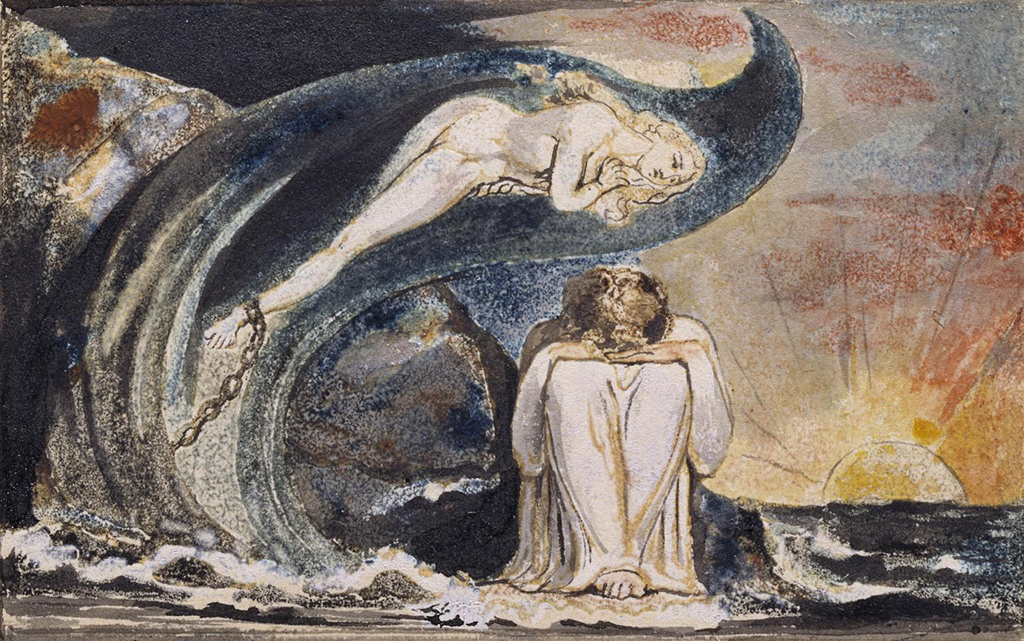
William Blake, Plate4ofVisionsoftheDaughtersofAlbion,c.1795 separate impression of the1793design. Colour-printed relief etching with ink and watercolour; Tate,N03374.
The words that once stood below
The Huntington’s copy E, call number 42625, allows the design to be seen above its original printed company. In the digitised sequence this is the seventh image: the page beginning with the continuation of Theotormon’s questions about discontent and the dwellings of the wretched. The figure design sits over a substantial block of writing, followed by another short line near the foot. The same composition has olive-coloured sweeping cloth, pinkish drapery on the seated man and a purplish sky above the rosy horizon. This identified book copy offers a specific comparison with Tate’s darker separate impression. [13]
The page’s text matters because the pictured appeal refers back to an earlier passage. On poetic plate 2, Oothoon asks why Theotormon weeps at the threshold while she hovers beside him, trying to persuade him. She calls him to rise and describes birds awakening the day. Her appeal joins renewed light with her insistence that the assault has not destroyed her purity. The flying posture therefore carries an argument about her continuing worth. [1][2]
Oothoon later imagines the smallest response that might end her repeated appeals:
Silent I hover all the night, and all day could be silent. If Theotormon once would turn his loved eyes upon me; [2]
The desired change is an act of attention. Her hovering has duration, measured through night and day, while the turn of his eyes would take only a moment. This makes the difference between their postures especially painful: she maintains the effort of approach, while he withholds the simple movement she asks for.
By the time we reach the illustrated fourth poetic plate, Theotormon has begun speaking. His questions, started on the preceding page, ask where thoughts and former joys dwell and whether they can return to comfort present suffering. He can imagine thought travelling through distant times and spaces, but that imagined journey gives Oothoon no immediate answer. Her body hovers above a man whose mind is elsewhere. [2][13]
Bromion then enters the page through speech. He asks about unknown senses and worlds before insisting on law, fire and chains. There is no need to invent a third person hidden in the picture: the printed writing gives a voice to someone the design leaves out. The page ends with Oothoon waiting silently through day and night. The spacious curve above the text thus presides over an exchange in which both men speak and her appeal remains unanswered. [2][13]
Separating the picture from these words changes the viewer’s access to time. Alone, it can look like one instant of attempted consolation. In the book, the hovering recalls an earlier lament, stands above Theotormon’s continuing questions and precedes another period of silence. The design gathers actions and states of mind that the reader encounters at different moments. Its apparent simplicity contains a much longer failure of communication.
This relation between image, speech and the individual copy is central to Blake’s illuminated books. Here it gives a practical reason to return to the complete page after looking closely at the separate print: what surrounds a design can alter what its stillness means.
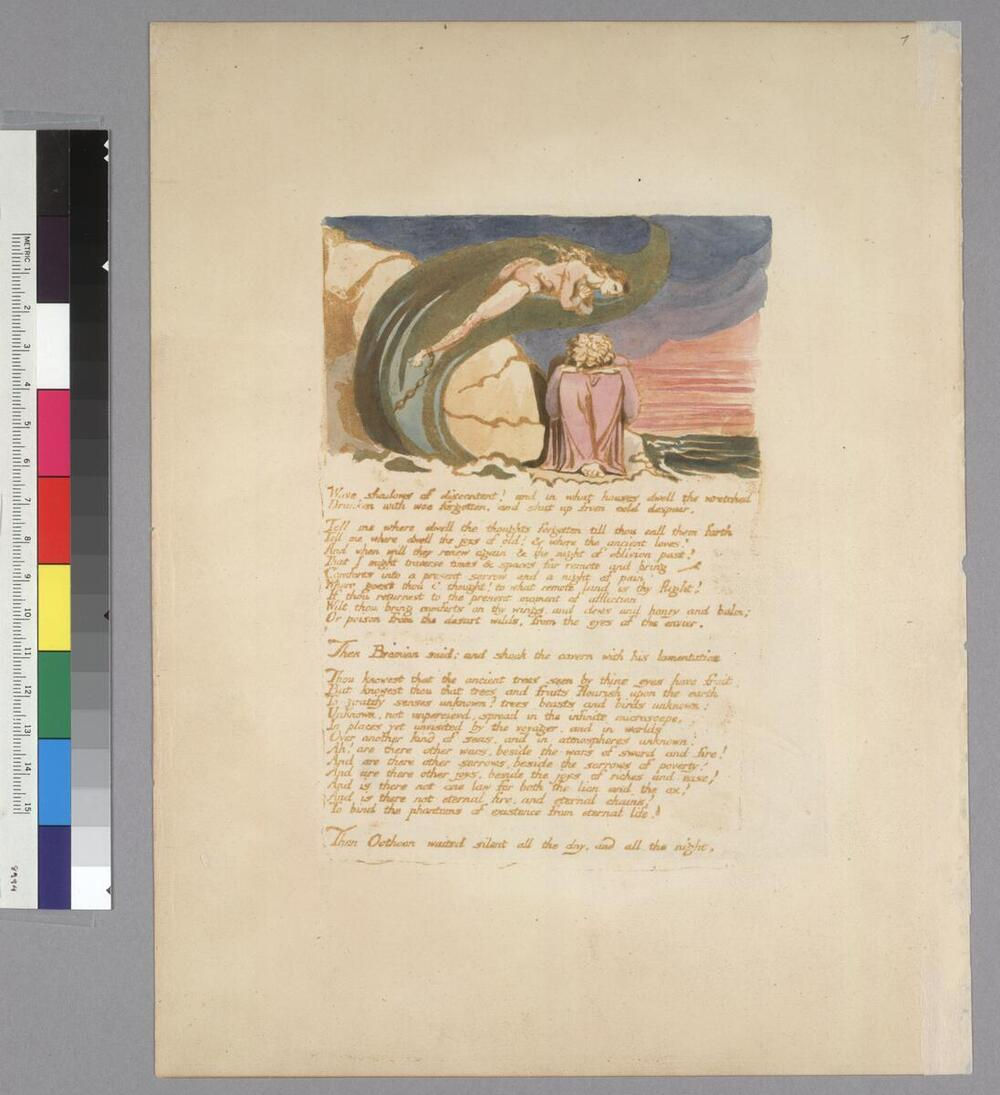
William Blake, Visions of the Daughters of Albion,1793,copyE,poeticplate4. The Huntington Library,SanMarino,California,42625. The complete page retains the words beneath the design; documentary scale and colourbar retained.
Watch: William Blake’s world and working methods
Choose an introduction to Blake, a printing demonstration, or a discussion of his radical ideas.
William Blake: Poet, Artist & Visionary - a genius of early Romanticism in England
An introduction to Blake’s art, poetry and imaginative world.
Watch on YouTubeHow free is the hovering woman?
Oothoon’s movement has drawn particular scholarly attention. Roland A. Duerksen, writing in 1972–73, pointed to her hovering beside Theotormon and read the ankle chain in plate 4 as loosened. He used this activity to question an entirely fixed identification of Oothoon with the submissive bound woman in the book’s frontispiece. His larger argument concerns that other design, but his observation directs attention to a real difficulty here: the woman appears capable of movement while the fastening remains visible. [14]
It is useful to keep both parts of that observation in view. The body rises; the chain hangs. Oothoon has gained the space to address Theotormon, yet the picture preserves a material reminder of captivity. Calling her simply liberated would settle a tension which Blake leaves before the eye. The folds may bear her upwards, but they also circle around the place where she continues to plead.
The poem makes the cost of that pleading clearer. Bromion rapes Oothoon as she travels towards her chosen lover. He then treats her as something possessed and transferable. Theotormon responds through jealousy, accepting a view of her that confuses violence suffered with sexual guilt. Oothoon’s own desire for him supplies no consent to Bromion’s attack, and the lover’s grief does not justify his refusal to recognise her account. [2]
Lucy Cogan’s discussion of Visions emphasises how the responses of others extend the injury beyond the assault itself. Survival does not restore Oothoon to her earlier condition or guarantee that her resistance will be heard. That argument helps explain the emotional force of this two-person image: her movement continues in the very presence of a person whose response deepens her suffering. [15]
Her later speeches resist imposed shame and challenge coercive attachments, but they also include a disturbing fantasy of catching other girls for Theotormon. Cogan stresses that the vocabulary of capture complicates an easy celebration of sexual freedom. For this picture, the implication is a useful restraint on interpretation. Oothoon’s expansive gesture deserves attention without making every later proposal she voices a complete answer to domination. [2][15]
The wider story of the bound figures is explored in the frontispiece to Visions of the Daughters of Albion. Plate 4 changes the arrangement decisively: one woman is now suspended above one withdrawn man, and the unanswered address becomes the central action.
A woman’s claim to be heard
Tate’s 2001 label places Visions beside Mary Wollstonecraft’s A Vindication of the Rights of Woman, published in 1792. The association supplies a contemporary context for a poem whose opening describes the Daughters of Albion as enslaved. It remains a contextual proposal, rather than evidence that Blake set out to illustrate Wollstonecraft’s book. [1]
In chapter II, Wollstonecraft attacks an education that keeps women in childhood and rewards outward obedience at the expense of understanding. She argues for the exercise of reason and the independence it can give a moral being. Later in the same discussion, she imagines the woman who strengthens mind and body becoming her husband’s friend instead of his dependent. These passages offer a useful comparison with the unequal exchange pictured by Blake. [16]
Oothoon has something to say about her own experience. Theotormon’s hidden face makes the possibility of mutual recognition appear suspended. Reading the image beside Wollstonecraft’s argument brings the question of companionship into focus: what kind of love permits one person’s judgement to silence the other? Their writings approach that question differently. Wollstonecraft develops an argument about education and rational friendship; Blake gives Oothoon an urgent, changing poetic voice, with all the contradictions that the complete poem preserves. [2][16]
The ending of Visions refuses a reassuring answer. Oothoon continues to lament each morning, while Theotormon sits by the ocean occupied with terrible shadows. The Daughters echo her sighs. Returning to plate 4 with that ending in mind makes the hovering seem less like an approaching rescue than an appeal which can be renewed without succeeding. [2]
The image nevertheless asks the viewer to attend to the person who has been refused attention. Her pale body remains sharply legible within the dark sweep; her face inclines towards the hidden head; the chain is still there. We can follow the curve around them and look towards the light beyond, but we repeatedly return to the small interval between her gesture and his silence. That interval is the picture’s enduring subject.
Works and designs directory
Browse separate works, impressions and book components. Dates distinguish versions; six Tate copies after Blake are labelled. These records are not a complete catalogue of unique designs.
| Name | Date | Medium |
|---|---|---|
| A Figure Standing in a Gothic Apse, perhaps the Empress Maud. Verso: Detailed Drawings for ‘The Empress Maud in Bed’ | c.1819 | Pencil drawing |
| A Rolling Stone Is Ever Bare of Moss, from Thornton's "Pastorals of Virgil" | 1821 | Wood engraving |
| A Title Page for The Grave | 1806 | Watercolour |
| A Vision of the Last Judgment | 1808 | Watercolour |
| A Vision: The Inspiration of the Poet (Elisha in the Chamber on the Wall) | c.1819–20? | Watercolour |
| Adam and the Beasts, Frontispiece to Hayley's "Ballads" | June 1, 1802 | Engraving |
| Age Teaching Youth | c.1785–90 | Watercolour |
| Alfred and the Neat-Herd’s Wife (after Henry Fuseli) | 1797, published 1798 | Etching and engraving |
| An Allegory of the Bible. Verso: The Shins of an Écorché Male Figure | c.1780–5, ?c.1780 | Watercolour |
| Angel of the Divine Presence Bringing Eve to Adam (The Creation of Eve: "And She Shall be Called Woman) (recto); Sketch for the same (verso) | ca. 1803 | Watercolour |
| Angel of the Revelation (Book of Revelation, chapter 10) | ca. 1803–5 | Watercolour |
| Antaeus setting down Dante and Virgil in the Last Circle of Hell | 1824–1827 | Watercolour |
| Bathsheba at the Bath | c.1799–1800 | Tempera |
| Beatrice Addressing Dante from the Car | 1824–7 | Watercolour |
| Behemoth and Leviathan | 1825–26 | Engraving |
| Behemoth and Leviathan | 1825, reprinted 1874 | Engraving |
| Behemoth and Leviathan | 1826 | Engraving |
| Blasted Trees and Flattened Crops, from Thornton's "Pastorals of Virgil" | 1821 | Wood engraving |
| Boy Returning Joyfully, with Plough and Oxen, from Thornton's "Pastorals of Virgil" | 1821 | Wood engraving |
| Boy Returning Joyfully, with Plough and Oxen, from Thornton's "Pastorals of Virgil" | 1821 | Wood engraving |
| Catherine Blake. Verso: A Man’s Head and Other Drawings | c.1805 | Pencil drawing |
| Cerberus | 1824–7 | Watercolour |
| Cerberus (second version) | 1824–1827 | Watercolour |
| Chaucer’s Canterbury Pilgrims | 1810, reprinted before 1881 | Engraving |
| Christ Appearing to His Disciples After the Resurrection | c.1795 | Colour print |
| Christ Appearing to the Apostles after the Resurrection | c.1795 | Watercolour |
| Christ Blessing the Little Children | 1799 | Tempera |
| Christ in the Carpenter’s Shop: The Humility of the Saviour (after William Blake) | Date not stated | Watercolour |
| Ciampolo the Barrator Tormented by the Devils | 1826–7, reprinted 1892 | Engraving |
| Ciampolo the Barrator Tormented by the Devils | 1826–7, reprinted 1968 | Engraving |
| Circle of Theives: Agnello Brunelleschi Attacked By a Six-Footed Serpent | ca. 1825–27 | Engraving |
| Clarence's Dream (Shakespeare, Richard III, Act 1, Scene 4) | 1774 | Etching and engraving |
| Colinet Mocked by Two Boys, from Thornton's "Pastorals of Virgil" | 1821 | Wood engraving |
| Colinet Rests by a Stream at Night | c.1821, printed 1830 | Wood engraving |
| Colinet Rests by a Stream at Night | 1821, reprinted 1977 | Wood engraving |
| Colinet with his Shepherd’s Pipe, Mocked by Two Boys | c.1821, printed 1830 | Wood engraving |
| Colinet with his Shepherd’s Pipe, Mocked by Two Boys | 1821, reprinted 1977 | Wood engraving |
| Colinet's Journey, Milestone Marked 'LXII Miles to London', from Thornton's "Pastorals of Virgil" | 1821 | Wood engraving |
| Colinet's Journey: Milestone Marked 'LXII Miles to London', from Thornton's "Pastorals of Virgil" | 1821 | Wood engraving |
| Colinet’s Fond Desire Strange Lands to Know | 1821, reprinted 1977 | Wood engraving |
| Colinet’s ‘Fond Desire Strange Lands to Know’ | c.1821, printed 1830 | Wood engraving |
| Composition Sketch for ‘The Fall of the Rebel Angels’? Verso: Standing Figure with Flaming Hair | ?c.1805–10 | Pencil drawing |
| Composition Sketch, Possibly a Subject from Dante. Verso: A Man Standing over a Figure Reclining on a Bed | ?1824–7, ?c.1800–10 | Pencil drawing |
| Composition Sketch. Verso: Standing Figure Holding a Spear | ?c.1805–10 | Pencil drawing |
| Dante and Virgil Approaching the Angel Who Guards the Entrance of Purgatory | 1824–7 | Watercolour |
| Dante and Virgil Penetrating the Forest | 1824–7 | Watercolour |
| Dante in the Empyrean, Drinking at the River of Light | 1824–7 | Watercolour |
| Dante running from the Three Beasts | 1824–1827 | Watercolour |
| Dante Striking against Bocca Degli Abati | 1826–7, reprinted 1892 | Engraving |
| Dante Striking Against Bocca degli Abati | 1826–7, reprinted 1968 | Engraving |
| David Delivered out of Many Waters | c.1805 | Watercolour |
| David Delivered out of Many Waters (after William Blake) | Date not stated | Watercolour |
| Detailed Drawings for ‘A Figure Standing in a Gothic Apse’ | 1819 | Pencil drawing |
| Elohim Creating Adam | 1795–c.1805 | Colour print |
| Enoch | 1806–7 | Lithograph |
| Epitome of James Hervey’s ‘Meditations among the Tombs’ | c.1820–5 | Watercolour |
| Europe. A Prophecy; Frontispiece | ca. 1820 | Relief etching |
| Evening | c.1820/1825 | Watercolour |
| Every Man also Gave him a Piece of Money | 1825, reprinted 1874 | Engraving |
| Every Man also Gave him a Piece of Money. Verso: God the Father with Attendant Angels | c.1821–3 | Watercolour |
| Every One also Gave Him a Piece of Money | 1826 | Engraving |
| Fertilization of Egypt, from Erasmus Darwin's "The Botanic Garden" | 1791 | Engraving |
| First Book of Urizen pl. 10 | 1796, c.1818 | Etching |
| First Book of Urizen pl. 11 | 1796, c.1818 | Etching |
| First Book of Urizen pl. 15 | 1796, c.1818 | Etching |
| First Book of Urizen pl. 17 | 1796, c.1818 | Etching |
| First Book of Urizen pl. 21 | 1796, c.1818 | Etching |
| First Book of Urizen pl. 6 | 1796, c.1818 | Etching |
| Frontispiece to Jerusalem, the Emanation of the Great Albion | [ca. 1804–20] (?) | Engraving |
| Frontispiece to ‘Visions of the Daughters of Albion’ | c.1795 | Relief etching |
| Frontispiece: Thenot and Colinet | c.1821, printed 1830 | Wood engraving |
| George Cumberland's Message Card | 1827 | Engraving |
| God Judging Adam | ca. 1795 | Relief etching |
| God Judging Adam | 1795 | Relief etching |
| Hiding of Moses, from "Remember Me!, or a Pocket Companion" | 1825 | Engraving |
| Homer and the Ancient Poets | 1824–7 | Watercolour |
| Illustration 1 to Milton’s On the Morning of Christ’s Nativity: The Descent of Peace | c.1814–1816 | Watercolour |
| Illustration 1 to Milton’s Paradise Lost: Satan Calling Up His Legions | 1807 | Watercolour |
| Job accepting Charity | 1825–26 | Engraving |
| Job and his Daughters | 1825–26 | Engraving |
| Job and his Daughters | 1825, reprinted 1874 | Engraving |
| Job and His Daughters | 1826 | Engraving |
| Job and His Family | 1825–26 | Engraving |
| Job and his Family | Reprinted 1874; engraved 1828 date is an error | Engraving |
| Job and His Family | 1826 | Engraving |
| Job and his Family Restored to Prosperity | 1825, reprinted 1874 | Engraving |
| Job and his Wife restored to Prosperity | 1825–26 | Engraving |
| Job rebuked by his Friends | 1825–26 | Engraving |
| Job Rebuked by his Friends | 1825, reprinted 1874 | Engraving |
| Job Rebuked by His Friends | 1826 | Engraving |
| Job's Comforters | 1825–26 | Engraving |
| Job's Comforters | 1826 | Engraving |
| Job's Despair | 1825–26 | Engraving |
| Job's Evil Dreams | 1825–26 | Engraving |
| Job's Evil Dreams | 1826 | Engraving |
| Job's Sacrifice | 1825–26 | Engraving |
| Job's Sons and Daughters Overwhelmed by Satan | 1826 | Engraving |
| Job, his Wife and his Friends: The Complaint of Job. Verso: Job’s Wife and Eight Other Sketches | c.1785 | Watercolour |
| Job’s Comforters | 1825, reprinted 1874 | Engraving |
| Job’s Despair | 1825, reprinted 1874 | Engraving |
| Job’s Evil Dreams | 1825, reprinted 1874 | Engraving |
| Job’s Sacrifice | 1825, reprinted 1874 | Engraving |
| Job’s Sons and Daughters Overwhelmed by Satan | 1825, reprinted 1874 | Engraving |
| John Linnell | 1825 | Pencil drawing |
| Joseph of Arimathea Preaching to the Britons | c.1794/1796 | Relief etching |
| Judas Betrays Him | c.1803–5 | Watercolour |
| King John Absolved by Pandulph (after Henry Fuseli) | 1797, published 1798 | Etching and engraving |
| Lamech and his Two Wives | 1795 | Colour print |
| Landscape near Felpham | c.1800 | Watercolour |
| Lear and Cordelia in Prison | c.1779 | Watercolour |
| Los and Orc | c.1792–3 | Watercolour |
| Lower Half of a Woman Playing a Harp. Verso: Seraphim and Other Drawings | c.1785, c.?1807 | Pencil drawing |
| Menalcus Watching Women Dance, from Thornton's "Pastorals of Virgil" | 1821 | Wood engraving |
| Menalcus Watching Women Dance, from Thornton's "Pastorals of Virgil" | 1821 | Wood engraving |
| Moses Indignant at the Golden Calf | c.1799–1800 | Tempera |
| Nebuchadnezzar | 1795–c.1805 | Colour print |
| Newton | 1795–c.1805 | Colour print |
| Oberon, Titania and Puck with Fairies Dancing | c.1786 | Watercolour |
| Pity | ca. 1795 | Relief etching |
| Pity | c.1795 | Colour print |
| Plate 2 of ‘Urizen’: ‘Teach these Souls to Fly’ | ?1796 | Relief etching |
| Plate 3 of ‘Urizen’: Oh! Flames of Furious Desires’ (after William Blake) | Date not stated | Watercolour |
| Plate 4 of ‘Visions of the Daughters of Albion’ | c.1795 | Relief etching |
| Plutus | 1824–7 | Watercolour |
| Preliminary Sketch for ‘Christ Girding Himself with Strength’. Verso: Standing Figure with One Arm Raised | c.1805, c.1805–10 | Pencil drawing |
| Preludium. "The shadowy daughter of Urthona stood before red Orc..." (Plate 3) | 1793 | Relief etching |
| Queen Elizabeth and Essex (after Henry Fuseli) | 1797, published 1798 | Engraving |
| Sabrina's Silvery Flood, from Thornton's "Pastorals of Virgil" | 1821 | Wood engraving |
| Sabrina's Silvery Flood, from Thornton's "Pastorals of Virgil" | 1821 | Wood engraving |
| Sabrina’s Silvery Flood | c.1821, printed 1830 | Wood engraving |
| Sabrina’s Silvery Flood | 1821, reprinted 1977 | Wood engraving |
| Satan Before the Throne of God | 1825–26 | Engraving |
| Satan before the Throne of God | 1825, reprinted 1874 | Engraving |
| Satan before the Throne of God | 1826 | Engraving |
| Satan calling up his Legions | c.1800–05 | Tempera |
| Satan Exulting over Eve | c.1795 | Colour print |
| Satan Going Forth from the Presence of the Lord, and Job’s Charity | 1825, reprinted 1874 | Engraving |
| Satan Going Forth fron the Presence of the Lord | 1825–26 | Engraving |
| Satan in his Original Glory: ‘Thou wast Perfect till Iniquity was Found in Thee’ | c.1805 | Watercolour |
| Satan Smiting Job with Boils | 1825–26 | Engraving |
| Satan Smiting Job with Sore Boils | 1825, reprinted 1874 | Engraving |
| Satan Smiting Job with Sore Boils | c.1826 | Tempera |
| Satan Smiting Job with Sore Boils | 1826 | Engraving |
| Shepherd Chases Away a Wolf, from Thornton's "Pastorals of Virgil" | 1821 | Wood engraving |
| Shepherd Chases Away a Wolf, from Thornton's "Pastorals of Virgil" | 1821 | Wood engraving |
| Sketch for the Title-Page of the Engraved Illustrations to the Book of Job | c.1823/1826 | Pencil drawing |
| Sketch for ‘The Four and Twenty Elders Casting their Crowns before the Divine Throne’. Verso: Standing Figure with Arms at his Side | c.1803, c.1805–10 | Pencil drawing |
| Sketch for ‘Tiriel Supporting the Dying Myratana’. Verso: Sketch for ‘Tiriel Supporting the Dying Myratana’ | c.1786–9 | Pencil drawing |
| Songs of Experience: A Little Boy Lost | [1794] printed ca. 1825 | Relief etching |
| Songs of Experience: A Little Girl Lost | [1794] printed ca. 1825 | Relief etching |
| Songs of Experience: A Poison Tree | [1794] printed ca. 1825 | Relief etching |
| Songs of Experience: Earth's Answer | [1794] printed ca. 1825 | Relief etching |
| Songs of Experience: Frontispiece | [1794] printed ca. 1825 | Relief etching |
| Songs of Experience: Holy Thursday | [1794] printed ca. 1825 | Relief etching |
| Songs of Experience: Infant Sorrow | [1794] printed ca. 1825 | Relief etching |
| Songs of Experience: Introduction | [1794] printed ca. 1825 | Relief etching |
| Songs of Experience: London | [1794] printed ca. 1825 | Relief etching |
| Songs of Experience: My Pretty Rose Tree, Ah! Sun-Flower, The Lilly | [1794] printed ca. 1825 | Relief etching |
| Songs of Experience: Nurses Song | [1794] printed ca. 1825 | Relief etching |
| Songs of Experience: The Angel | [1794] printed ca. 1825 | Relief etching |
| Songs of Experience: The Chimney Sweeper | [1794] printed ca. 1825 | Relief etching |
| Songs of Experience: The Clod & the Pebble | [1794] printed ca. 1825 | Relief etching |
| Songs of Experience: The Fly | [1794] printed ca. 1825 | Relief etching |
| Songs of Experience: The Garden of Love | [1794] printed ca. 1825 | Relief etching |
| Songs of Experience: The Human Abstract | [1794] printed ca. 1825 | Relief etching |
| Songs of Experience: The Little Girl Found (second plate) | [1789] printed ca. 1825 | Relief etching |
| Songs of Experience: The Little Girl Lost | [1789] printed ca. 1825 | Relief etching |
| Songs of Experience: The Little Girl Lost (second plate); The Little Girl Found | [1789] printed ca. 1825 | Relief etching |
| Songs of Experience: The Little Vagabond | [1794] printed ca. 1825 | Relief etching |
| Songs of Experience: The School Boy | [1789] printed ca. 1825 | Relief etching |
| Songs of Experience: The Sick Rose | [1794] printed ca. 1825 | Relief etching |
| Songs of Experience: The Tyger | [1794] printed ca. 1825 | Relief etching |
| Songs of Experience: The Voice of the Ancient Bard | [1789] printed ca. 1825 | Relief etching |
| Songs of Experience: Title-page | [1794] printed ca. 1825 | Relief etching |
| Songs of Experience: To Tirzah | [1794] printed ca. 1825 | Relief etching |
| Songs of Innocence and of Experience, Shewing the Two Contrary States of the Human Soul: Combined Title-page | [1789–94] printed ca. 1825 | Relief etching |
| Songs of Innocence and of Experience: Infant Sorrow | 1794, reprinted 1831 or later | Relief etching |
| Songs of Innocence: A Cradle Song | [1789] printed ca. 1825 | Relief etching |
| Songs of Innocence: A Cradle Song (second plate) | [1789] printed ca. 1825 | Relief etching |
| Songs of Innocence: A Dream | [1794] printed ca. 1825 | Relief etching |
| Songs of Innocence: Frontispiece | [1789] printed ca. 1825 | Relief etching |
| Songs of Innocence: Holy Thursday | [1789] printed ca. 1825 | Relief etching |
| Songs of Innocence: Infant Joy | [1789] printed ca. 1825 | Relief etching |
| Songs of Innocence: Introduction | [1789] printed ca. 1825 | Relief etching |
| Songs of Innocence: Laughing Song | [1789] printed ca. 1825 | Relief etching |
| Songs of Innocence: Little Boy Lost | [1789] printed ca. 1825 | Relief etching |
| Songs of Innocence: Night | [1789] printed ca. 1825 | Relief etching |
| Songs of Innocence: Night (second plate) | [1789] printed ca. 1825 | Relief etching |
| Songs of Innocence: Nurse's Song | [1789] printed ca. 1825 | Relief etching |
| Songs of Innocence: On Anothers Sorrow | [1789] printed ca. 1825 | Relief etching |
| Songs of Innocence: Spring | [1789] printed ca. 1825 | Relief etching |
| Songs of Innocence: Spring (second plate) | [1789] printed ca. 1825 | Relief etching |
| Songs of Innocence: The Blossom | [1789] printed ca. 1825 | Relief etching |
| Songs of Innocence: The Chimney Sweeper | [1789] printed ca. 1825 | Relief etching |
| Songs of Innocence: The Divine Image | [1789] printed ca. 1825 | Relief etching |
| Songs of Innocence: The Ecchoing Green | [1789] printed ca. 1825 | Relief etching |
| Songs of Innocence: The Ecchoing Green (second plate) | [1789] printed ca. 1825 | Relief etching |
| Songs of Innocence: The Lamb | [1789] printed ca. 1825 | Relief etching |
| Songs of Innocence: The Little Black Boy | [1789] printed ca. 1825 | Relief etching |
| Songs of Innocence: The Little Black Boy (second plate) | [1789] printed ca. 1825 | Relief etching |
| Songs of Innocence: The Little Boy Found | [1789] printed ca. 1825 | Relief etching |
| Songs of Innocence: The Shepherd | [1789] printed ca. 1825 | Relief etching |
| Songs of Innocence: Title Page | [1789] printed ca. 1825 | Relief etching |
| St Christopher, Copy from an Engraving? Verso:Part of a Face: Copy from a Plaster Cast: a Daughter of Niobe? | ?c.1779–80 | Pencil drawing |
| The Agony in the Garden | c.1799–1800 | Tempera |
| The Angel Appearing to Zacharias | 1799–1800 | Tempera |
| The Ascent of the Mountain of Purgatory | 1824–7 | Watercolour |
| The Baffled Devils Fighting | 1826–7, reprinted 1892 | Engraving |
| The Baffled Devils Fighting | 1826–7, reprinted 1968 | Engraving |
| The Bard, from Gray | ?1809 | Tempera |
| The Beggar's Opera, Act III | July 1, 1790 | Etching and engraving |
| The Beggar's Opera, Act III | July 1, 1790 | Engraving |
| The Beggar's Opera, Act III | 1790 | Engraving |
| The Blasphemer | c.1800 | Watercolour |
| The Blighted Corn | c.1821, printed 1830 | Wood engraving |
| The Blighted Corn | 1821, reprinted 1977 | Wood engraving |
| The Body of Abel Found by Adam and Eve | c.1826 | Tempera |
| The Body of Christ Borne to the Tomb | c.1799–1800 | Tempera |
| The Book of Job: Title Page | 1825 | Engraving |
| The Book of Thel pl. 6 | 1796, c.1818 | Etching |
| The Circle of Corrupt Officials: The Devils Mauling Each Other | ca. 1825–27 | Engraving |
| The Circle of Corrupt Officials: The Devils Tormenting Ciampolo | ca. 1825–27 | Engraving |
| The Circle of the Lustful: Francesca da Rimini (‘The Whirlwind of Lovers’) | 1826–7, reprinted 1892 | Engraving |
| The Circle of the Lustful: Francesca da Rimini (‘The Whirlwind of Lovers’) | 1826–7, reprinted 1968 | Engraving |
| The Circle of the Lustful: Paolo and Francesca | ca. 1825–27 | Engraving |
| The Circle of the Thieves; Buoso Donati Attacked by the Serpent | ca. 1825–27 | Engraving |
| The Circle of Traitors: Dante's Foot Striking Bocca degli Abbate | ca. 1825–27 | Engraving |
| The Complaint and the Consolation; or, Night Thoughts | 1797 | Etching and engraving |
| The Creation | 1825–26 | Engraving |
| The Crucifixion | c.1825–7 | Pencil drawing |
| The Crucifixion: ‘Behold Thy Mother’ | c.1805 | Watercolour |
| The Dance of Albion (Glad Day) | c.1803/1810 | Engraving |
| The Death of Lucretia, from Allen's "New and Impartial Roman History" | 1797 | Engraving |
| The Death of Saint Joseph | 1803 | Watercolour |
| The Death of the Virgin | 1803 | Watercolour |
| The Descent of Peace [recto] | c.1815 | Pencil drawing |
| The Destruction of Job's Sons | 1825–26 | Engraving |
| The Devils, with Dante and Virgil by the Side of the Pool | 1824–7 | Watercolour |
| The Entombment | c.1805 | Watercolour |
| The Fall of Rosamond (after Thomas Stothard) | 1783 | Etching and engraving |
| The Fall of Satan | 1825–26 | Engraving |
| The Fall of Satan | 1825, reprinted 1874 | Engraving |
| The Fall of Satan | 1826 | Engraving |
| The Four and Twenty Elders Casting their Crowns before the Divine Throne | c.1803–5 | Watercolour |
| The Ghost of a Flea | c.1819–20 | Tempera |
| The Good and Evil Angels | 1795–?c.1805 | Colour print |
| The Good Farmer, Probably the Parable of the Wheat and the Tares. Verso: Rough Sketch of Two or Three Figures in a Landscape | c.1780–5 | Watercolour |
| The Great Red Dragon and the Beast from the Sea | c.1805 | Watercolour |
| The Great Red Dragon and the Woman Clothed with the Sun | c.1805 | Watercolour |
| The Head of the Ghost of a Flea. Verso: A Profile and a Reduced Drawing of Milton’s First Wife | c.1819 | Pencil drawing |
| The Hermit’s Dog, from William Hayley’s "Ballads" | 1805 | Etching and engraving |
| The Hiding of Moses | 1824 | Engraving |
| The House of Death | 1795–c.1805 | Colour print |
| The House of Death | c.1790 | Watercolour |
| The Hypocrites with Caiaphas. Verso: Sketch of a Stooping Figure | 1824–7 | Watercolour |
| The Inscription over the Gate | 1824–7 | Watercolour |
| The Laborious Passage along the Rocks | 1824–7 | Watercolour |
| The Last Trumpet (recto); Two studies of a right eye, a profile of an open-mouthed young man, the head of an eagle, and the head of a lion (verso) | 1780–85 | Pencil drawing |
| The Lord Answering Job out of the Whirlwind | 1825–26 | Engraving |
| The Lord Answering Job out of the Whirlwind | 1825, reprinted 1874 | Engraving |
| The Man Who Taught Blake Painting in his Dreams (counterproof) (after William Blake) | after c.1819–20 | Pencil drawing |
| The Marriage of Heaven and Hell pl. 16 | 1796, c.1818 | Etching |
| The Messengers tell Job of his Misfortunes | 1825–26 | Engraving |
| The Messengers tell Job of his Misfortunes | 1825, reprinted 1874 | Engraving |
| The Night of Enitharmon’s Joy (formerly called ‘Hecate’) | c.1795 | Colour print |
| The Parable of the Wise and Foolish Virgins | ca. 1799–1800 | Watercolour |
| The Parable of the Wise and Foolish Virgins (after William Blake) | Date not stated | Watercolour |
| The Pastorals of Virgil, with a Course of English Reading, Adapted for Schools, Vol. I | 1821 | Wood engraving |
| The Penance of Jane Shore in St Paul’s Church | c.1793 | Watercolour |
| The Pit of Disease: The Falsifiers | 1826–7, reprinted 1892 | Engraving |
| The Pit of Disease: The Falsifiers | 1824–7 | Watercolour |
| The Pit of Disease: The Falsifiers | 1826–7, reprinted 1968 | Engraving |
| The Primaeval Giants Sunk in the Soil | 1824–7 | Watercolour |
| The Punishment of the Thieves | 1824–7 | Watercolour |
| The Raising of Lazarus (after William Blake) | Date not stated | Watercolour |
| The Rest on the Flight into Egypt (The Repose of the Holy Family in Egypt) | 1806 | Watercolour |
| The River of Life | c.1805 | Watercolour |
| The Rock Sculptured with the Recovery of the Ark and the Annunciation | 1824–7 | Watercolour |
| The Serpent Attacking Buoso Donati | 1826–7, reprinted 1892 | Engraving |
| The Serpent Attacking Buoso Donati | 1826–7, reprinted 1968 | Engraving |
| The Serpent Attacking Buoso Donati. Verso: A Man with a Transparent Hood (?) over his Head | 1824–7 | Watercolour |
| The Simoniac Pope | 1824–7 | Watercolour |
| The Six-Footed Serpent Attacking Agnolo Brunelleschi | 1826–7, reprinted 1892 | Engraving |
| The Six-Footed Serpent Attacking Agnolo Brunelleschi | 1826–7, reprinted 1968 | Engraving |
| The Soul Hovering over the Body Reluctantly Parting with Life | c.1805 | Pencil drawing |
| The Spiritual Form of Nelson Guiding Leviathan | c.1805–9 | Tempera |
| The Spiritual Form of Pitt Guiding Behemoth | ?1805 | Tempera |
| The Sun at His Eastern Gate | c.1816–1820 | Watercolour |
| The Temple of Mirth, after Thomas Stothard | 1784 | Engraving |
| The Temptation and Fall of Eve | 1807 | Watercolour |
| The Temptation and Fall of Eve (Illustration to Milton’s Paradise Lost) | 1808 | Watercolour |
| The Thieves and Serpents | 1824–1827 | Watercolour |
| The Vision of Christ | 1825, reprinted 1874 | Engraving |
| The Vision of Eliphaz | 1825–26 | Engraving |
| The Vision of Eliphaz | 1825, reprinted 1874 | Engraving |
| The Vision of God | 1825–26 | Engraving |
| The Wood of the Self-Murderers: The Harpies and the Suicides | 1824–7 | Watercolour |
| The Wrath of Elihu | 1825–26 | Engraving |
| The Wrath of Elihu | 1825, reprinted 1874 | Engraving |
| Thenot and Colinet | 1821, reprinted 1977 | Wood engraving |
| Thenot and Colinet at Supper | c.1821, printed 1830 | Wood engraving |
| Thenot and Colinet at Supper | 1821, reprinted 1977 | Wood engraving |
| Thenot and Colinet Converse Seated between Two Trees | c.1821, printed 1830 | Wood engraving |
| Thenot and Colinet Converse Seated between Two Trees | 1821, reprinted 1977 | Wood engraving |
| Thenot and Colinet Eat Their Evening Meal, from Thornton's "Pastorals of Virgil" | 1821 | Wood engraving |
| Thenot and Colinet Folding their Flocks together at Sunset | c.1821, printed 1830 | Wood engraving |
| Thenot and Colinet Folding their Flocks together at Sunset | 1821, reprinted 1977 | Wood engraving |
| Thenot and Colinet Lead Their Flocks Together, from Thornton's "Pastorals of Virgil" | 1821 | Wood engraving |
| Thenot and Colinet Lead Their Flocks Together, from Thornton's "Pastorals of Virgil" | 1821 | Wood engraving |
| Thenot Remonstrates with Colinet | c.1821, printed 1830 | Wood engraving |
| Thenot Remonstrates with Colinet | 1821, reprinted 1977 | Wood engraving |
| Thenot Remonstrates With Colinet, from Thornton's "Pastorals of Virgil" | 1821 | Wood engraving |
| Thenot Remonstrates With Colinet, from Thornton's "Pastorals of Virgil" | 1821 | Wood engraving |
| Thenot Remonstrates with Colinet, Lightfoot in the Background, from Thornton's "Pastorals of Virgil" | 1821 | Wood engraving |
| Thenot Remonstrates with Colinet: Lightfoot in the Distance | 1821, reprinted 1977 | Wood engraving |
| Thenot Remonstrates with Colinet; Lightfoot in the Distance | c.1821, printed 1830 | Wood engraving |
| Thenot Under a Fruit Tree, from Thornton's "Pastorals of Virgil" | 1821 | Wood engraving |
| Thenot, with Colinet Waving his Arms in Sorrow | c.1821, printed 1830 | Wood engraving |
| Thenot, with Colinet Waving his Arms in Sorrow | 1821, reprinted 1977 | Wood engraving |
| Title Page: Illustrations of the Book of Job | 1825–26 | Engraving |
| Title-Page of ‘The Book of Job’ | 1825, reprinted 1874 | Engraving |
| Tornado–Zeus Battling Typhon, from Erasmus Darwin's "Botanic Garden" | August 1, 1795 | Engraving |
| Tornado–Zeus Battling Typhon, from Erasmus Darwin's "The Botanic Garden" | August 1, 1795 | Engraving |
| Two Figures in a Decorative Border | c.1790 | Pencil drawing |
| Unyok'd Heifers, Loitering Homeward (Return of the Shepherd), from Thornton's "Pastorals of Virgil" | 1821 | Wood engraving |
| Virgil Girding Dante’s Brow with a Rush | 1824–7 | Watercolour |
| Wat Tyler and the Tax-Gatherer (after Henry Fuseli) | 1797, published 1798 | Etching and engraving |
| When the Morning Stars Sang Together | 1825, reprinted 1874 | Engraving |
| When the Morning Stars Sang Together | 1826 | Engraving |
| Winged Figure Flying Through Clouds, from Bell's "Poets" | 1790 | Etching and engraving |
| Winter | c.1820–5 | Tempera |
| ‘A Rolling Stone is ever Bare of Moss’ | c.1821, printed 1830 | Wood engraving |
| ‘A Rolling Stone is ever Bare of Moss’ | 1821, reprinted 1977 | Wood engraving |
| ‘And Unyok’d Heifers, Loitering Homeward, Low’ | c.1821, printed 1830 | Wood engraving |
| ‘And Unyok’d Heifers, Loitering Homewards, Low’ | 1821, reprinted 1977 | Wood engraving |
| ‘Europe’: Fragment of Pages 3 and 4 | 1794–c.1830–5 | Relief etching |
| ‘For him Our Yearly Wakes and Feasts We Hold’ | c.1821, printed 1830 | Wood engraving |
| ‘For him Our Yearly Wakes and Feasts We Hold’ | 1821, reprinted 1977 | Wood engraving |
| ‘Nor Fox, nor Wolf, nor Rat among our Sheep’ | c.1821, printed 1830 | Wood engraving |
| ‘Nor Fox, nor Wolf, nor Rat among our Sheep’ | 1821, reprinted 1977 | Wood engraving |
| ‘Songs of Innocence and of Experience’: ‘Infant Sorrow’ | 1794, reprinted 1831 or later | Relief etching |
| ‘Songs of Innocence and of Experience’: ‘Spring’ | 1794, reprinted 1831 or later | Relief etching |
| ‘Songs of Innocence’: Title-Page | 1789, reprinted 1831 or later | Relief etching |
| ‘Songs of Innocence’: Title-Page | 1789, reprinted 1831 or later | Relief etching |
| ‘With Songs the Jovial Hinds Return from Plow’ | c.1821, printed 1830 | Wood engraving |
| ‘With Songs the Jovial Hinds Return from Plow’ | 1821, reprinted 1977 | Wood engraving |
Frequently Asked Questions
Discussion
Look again at the images and ideas explored in Plate 4 of Visions of the Daughters of Albion by Blake. These editorial prompts invite your observations.
Reader Insights
Oothoon’s cloth expands into the air while Theotormon’s drapery falls close to his crouched body. Their coverings make different kinds of enclosure.
The ankle chain remains visible as the woman hovers. Movement does not settle the question of freedom.
What changes when you read the male speeches and Oothoon’s waiting beneath the design in the complete page?
Join the Conversation
Share a detail, comparison or question about Plate 4 of Visions of the Daughters of Albion by Blake below.
References
- Tate. Plate 4 of ‘Visions of the Daughters of Albion’, N03374, current collection fields; display caption, October 2001; Martin Butlin, catalogue entry B265 in William Blake 1757–1827, Tate Gallery Collections V, 1990, reproduced with the record; official object image. View collection record. View source.
- William Blake. Visions of the Daughters of Albion (1793), complete title, Argument and poetic text, in David V. Erdman, ed., The Complete Poetry and Prose of William Blake, E45–51; ASU digital transcription. Especially poetic plates 2.21–38 and 3.14–4.25, E47–48; 5.21–29, E49; 7.16–29 and 8.11–13, E50–51. Read text. View source.
- Society of Antiquaries of London. “William Blake's drawings of Westminster Abbey,” collection highlight, apprenticeship and antiquarian drawings. View source.
- The Morgan Library & Museum. “175. Poetical Sketches,” 1783, copy X, PML 61487, William Blake's World. View source.
- William Blake. Songs of Innocence and of Experience , title pages; “Introduction,” “The Lamb,” both “The Chimney Sweeper” poems, “The Tyger” and “London,” Erdman digital transcription, Arizona State University. View source.
- William Blake. To the Public , prospectus dated 10 October 1793, E692–693. David V. Erdman edition, electronic transcription. View source.
- Tate; Martin Butlin. Newton , 1795/c.1805, N05058, collection record and catalogue entry in William Blake 1757–1827 , Tate Gallery Collections V (London: Tate Gallery, 1990). View source.
- Sir John Soane's Museum. Edward Young, The Complaint, and the Consolation; or, Night Thoughts (London: R. Noble for R. Edwards, 1797), library reference 3653, collection catalogue. View source.
- William Blake. Exhibition advertisements, conditions of sale and A Descriptive Catalogue , 1809, especially preface and nos. I–V, IX and XI–XVI, E527–550. David V. Erdman edition, electronic transcription. View source.
- Tate; Martin Butlin. The Ghost of a Flea , c.1819–20, N05889, collection record and catalogue entry in William Blake 1757–1827 , Tate Gallery Collections V (1990), including discussion of Varley and Cunningham's testimony. View source.
- Tate; Martin Butlin. Job and his Family , A00012, catalogue introduction to Illustrations to the Book of Job: Engravings , in William Blake 1757–1827 , Tate Gallery Collections V (1990), agreement, publication and textual borders. View source.
- Tate; Martin Butlin. Dante and Virgil Penetrating the Forest , 1824–27, N03351, collection record, 2023 display caption and catalogue entry in William Blake 1757–1827 , Tate Gallery Collections V (1990). View source.
- The Huntington. The visions of the daughters of Albion, copy E, call number 42625, collection record and seventh digitised image, poetic plate 4, beginning “Wave Shadows of discontent? and in what houses dwell the wretched”; official image 22APN4KX3T2Q. View record and page images. View source.
- Roland A. Duerksen. “A Crucial Line in Visions of the Daughters of Albion,” Blake/An Illustrated Quarterly 6.3 (Winter 1972–73), p.72; especially the discussion of Oothoon’s hovering and the ankle chain in plate 4. Read article. View source.
- Lucy Cogan. “Rending the ‘Soft Plains’ of America: Rape and Liberation in the Poetry of William Blake,” European Romantic Review 32.4 (2021), pp.377–397; discussion used here, pp.380–382. View article. Open-access PDF. View source 1. View source 2.
- Mary Wollstonecraft. A Vindication of the Rights of Woman (1792), chapter II, “The Prevailing Opinion of a Sexual Character Discussed”; passages on childhood, obedience, independent virtue, and friendship between husband and wife. Project Gutenberg text reproduced by the Marxists Internet Archive. Read chapter. View source.