 by
Tom Gurney
Tom Gurney BSc (Hons) is an art history expert with over 20 years experience
Email:
tomgurney1@gmail.com
/ Phone:
+44 7429 011000
Portrait Study of Quintijn Simons: Introduction
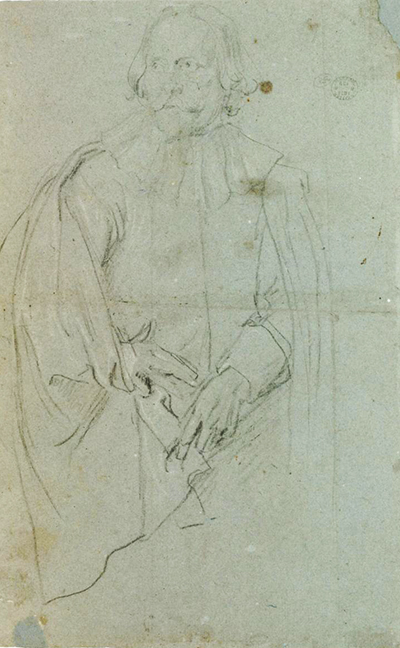
Anthony van Dyck’s Portrait Study of Quintijn Simons , made about 1634, gives more attention to the arrangement of a standing figure than to the details of his face. [1] The cloak, bent arm and hands establish a presence that feels assured even where the chalk barely touches the paper.
At a Glance
- Artist Anthony van Dyck.
- Date About 1634. [1]
- Medium Black and white chalk on blue paper. [1]
- Dimensions 44.3 × 28 cm. [1]
- Collection British Museum, London, museum number 1874,0808.139, verso. [2]
- Related painting Portrait of Quintijn Symons , Mauritshuis, The Hague, inventory number 242. [3]
This work across Anthony van Dyck’s career
Entry of Christ into Jerusalem
about 1617Frans Snyders
about 1620Rinaldo and Armida
1629–1632; Louvre commentary proposes late1631–spring1632Charles I in Three Positions
1635–before June 1636Lord John Stuart and his Brother
about 1638Cupid and Psyche
1639–40Self Portrait
c. 1640Contents
- Building a pose through clothes and hands
- Chalk and open paper
- Two portraits on one sheet
- From drawing to painting and engraving
- What is known about Simons?
Building a pose through clothes and hands
The figure almost fills the narrow sheet, although much of his body remains open paper. His head is lightly outlined near the top; below it, the collar spreads out towards the shoulders. The torso faces towards us while the head turns slightly aside. That small difference gives movement to a figure whose stance otherwise appears settled.
The largest curve lies on the left of the image, where the bent arm makes room beneath the cloak. A few long lines describe its outer fall. Shorter, more crowded strokes gather around the elbow and waist. Follow these marks downwards and the eye arrives at the hands, where the drawing becomes more insistent: fingers, cuff and cloth overlap in a compact knot of diagonals. One hand rests at the hip and the other holds the cloak. [2]
These hands help make the pose legible. The outward elbow broadens the figure, while the lower hand brings the movement back towards the centre. The hanging cloth then draws the eye down the sheet. Van Dyck can suggest a substantial body through these changes of direction without shading the whole costume into a solid mass.
The face has a different degree of finish. Hair, eyes and facial hair are indicated, but the marks remain faint beside the firmer strokes around the waist. The distribution of attention lets us follow the placement of the portrait’s parts, with some decisions stated clearly and others left open. It does not tell us the exact order in which Van Dyck drew the figure or worked on the painted likeness.
Chalk and open paper
The materials help explain this selective finish. The sheet combines dark chalk with white heightening on blue paper. [1] Between the strongest outlines, the support remains visible across broad stretches of the chest and cloak. Instead of filling every fold, Van Dyck lets a few changes in line strength carry the movement of the cloth. The sleeve on the right of the image is especially economical: long boundaries run down towards the cuff, while the surrounding space keeps the hand easy to pick out. The effect is airy, yet the elbow, wrist and fingers still give the figure a clear structure.
Two portraits on one sheet
Simons appears on the reverse, or verso, of a sheet whose front carries Ernestine Yolande with her son . These are two faces of the same physical object. [2] Turning it over takes us from a mother-and-child arrangement to a single standing man. The shared support does not establish that the sitters were present together.
The British Museum bought the sheet from the fifth Earl of Wicklow in 1874; Hugh Howard is recorded as an earlier owner. [2] Its survival on both sides makes it a useful example of how much information a single sheet can preserve. Other drawings by Van Dyck offer further ways of following his work on pose and costume.
Watch: Van Dyck’s art and working methods
Choose a museum introduction, a specialist lecture or a conservation film to continue exploring Van Dyck’s work.
Stijn Alsteens: Drawing for Portraits
Stijn Alsteens explores how portrait drawings prepare and develop a likeness.
Watch on YouTubeFrom drawing to painting and engraving
The related painting is in the Mauritshuis. Dated about 1634–35, it is an oil on canvas measuring 95 × 83.7 cm, with the title Portrait of Quintijn Symons (1592–after 1646) . [3] The change in scale and medium matters: the narrow drawing leaves the figure suspended in open paper, while the canvas is a separate, finished portrait object.
Looking at the canvas beside the drawing reveals how much of the arrangement survives. Simons still turns his head towards the viewer’s left, with one elbow projecting beneath the cloak and his hands gathered at different heights around his waist. In the painting, the collar becomes a broad, bright fan of closely spaced folds. The cuff provides a second white accent lower down, linking the face to the hands across the dark costume. The chalk sketch already establishes the main positions of these features, although their surfaces remain largely undescribed. [3]
The setting changes the experience of the pose. A warm wall rises behind the painted head and body, while an opening at the left admits a strip of sky, trees and landscape. Dark clothing now spreads into a continuous mass, broken by gleaming ridges along the sleeve. Against this substantial painted figure, the drawing’s open torso looks surprisingly light. The comparison makes its economy easier to appreciate: the few lines around the arms preserve an arrangement that can later carry the weight of rich fabric and a fully developed setting. [3]
The British Museum also connects the likeness with an engraving by Pieter de Jode after the painting. [2] The Rijksmuseum’s Dutch catalogue identifies De Jode II as the printmaker and Van Dyck as the painter of the model; its impression, RP-P-OB-7919, combines engraving and etching. It describes a half-length portrait with the sitter’s name and a Latin caption in the margin. [4] These details distinguish the printed portrait from the freely drawn study: the engraved likeness carries identifying words as well as an image.
An impression in the National Gallery of Victoria places Simons within Van Dyck’s Iconography series and is catalogued at about 1645. [5] The series brought together rulers, soldiers, scholars and artists, helping to circulate Van Dyck’s portraits through print. [6] For this little-known sitter, that larger setting matters. His likeness could appear in the company of people whose public standing rested on very different kinds of achievement. The approximate date attached to the NGV engraving is later than the drawing and canvas, but it does not establish when Van Dyck first considered having this particular portrait reproduced.
What is known about Simons?
The name appears as Simons in the drawing’s title and Symons in the Mauritshuis painting’s title. The Mauritshuis describes him as a history painter from Brussels. [3] The Frick Collection adds an important qualification: an inscription on the portrait print gives him that profession, but no surviving work substantiates the claim. [1] This leaves a gap in our knowledge of his art; it does not establish that he never painted historical subjects.
The NGV transcribes the print’s identifying line as “QVINTINVS SIMONS” followed by “BRVXELLENSIS PICTOR HISTORIARVM”: Quintijn Simons, Brussels history painter. The smaller credits name Van Dyck as the painter and De Jode as the engraver. [5] The caption therefore supplies occupational information that the chalk study leaves unstated. It is evidence for how Simons was presented to readers of the print; the Frick’s caution remains essential when we ask which paintings can now be securely connected with that description. [1]
The drawing gives no obvious clue to a particular artistic speciality. No brush or palette interrupts the play of sleeve, cuff and cloak; the sitter’s distinction comes through his pose and dress. We can study that presentation closely even while much of his working life remains unknown.
Artworks directory
A selected directory of paintings, drawings and prints, including works discussed in the articles and the Frick’s 2016 portraiture exhibition. It is not a complete catalogue of Van Dyck’s work. Print titles identify collaborators or later printmakers; disputed and workshop attributions are retained. The exhibition checklist supplies additional object records; current collection information governs the updated article entries. [7]
Frequently Asked Questions
The stronger lines around the arms, hands and cloak suggest particular attention to the pose and costume. The drawing alone cannot establish why the facial features were left faint or exactly how it was used alongside the canvas.
The British Museum identifies Pieter de Jode as the engraver of the related print after Van Dyck’s painting. [2]
Discussion
Look again at the images and ideas explored in Portrait Study of Quintijn Simons. These editorial prompts invite your observations.
Reader Insights
Which marks do most to give the figure weight: the outer contour of the cloak, the bent arm or the hands?
How does the lightly drawn face affect your response to the more firmly stated costume?
What changes when you think of this drawing as one side of a sheet carrying two different portraits?
Join the Conversation
Share a detail, comparison or question about Portrait Study of Quintijn Simons below.
References
- The Frick Collection , Portrait Study of Quintijn Simons, exhibition object 30 verso. English. View source .
- British Museum , Ernestine Yolande and her son, recto; Quintijn Simons, verso, museum number 1874,0808.139. English. View source .
- Mauritshuis , Portrait of Quintijn Symons (1592–after 1646), inventory number 242. English collection record and painting image. View source .
- Rijksmuseum , Portret van Quintijn Simons, RP-P-OB-7919. Dutch collection record, including maker roles, medium and description. View source .
- National Gallery of Victoria , Quintijn Simons, Pieter de Jode II after Anthony van Dyck, X302B-5. English; metadata and transcription of the print’s inscriptions. View source .
- The Frick Collection , The Iconographie. English; exhibition introduction to the print series. View source .
- The Frick Collection, Van Dyck: The Anatomy of Portraiture, online exhibition checklist (2016). View source.