 by
Tom Gurney
Tom Gurney BSc (Hons) is an art history expert with over 20 years experience
Email:
tomgurney1@gmail.com
/ Phone:
+44 7429 011000
Virgin and Child with Two Donors: Introduction
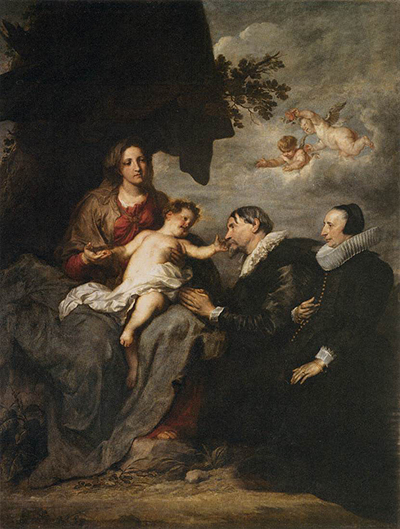
A child reaches across a small gap and touches an elderly man's cheek. Around that slight movement, Anthony van Dyck builds a meeting between sacred figures and recognisable people: a seated Virgin, a turning Christ Child, and two donors dressed in black. The Louvre dates Virgin and Child with Two Donors to about 1630–32. The painting's intimacy is readily visible; the names of the people and the occasion behind their devotion remain uncertain. [1] [2]
At a Glance
- Artist Anthony van Dyck.
- Date About 1630–32.
- Medium Oil on canvas.
- Dimensions 250 × 191 cm in the current Louvre collection record.
- Collection Musée du Louvre, Paris.
- Inventory INV 1231; MR 676.
- French title La Vierge aux donateurs , also La Vierge et l'Enfant avec deux orants à genoux .
- Donors Unidentified with certainty. [1] [2]
This work across Anthony van Dyck’s career
Entry of Christ into Jerusalem
about 1617Frans Snyders
about 1620Rinaldo and Armida
1629–1632; Louvre commentary proposes late1631–spring1632Charles I in Three Positions
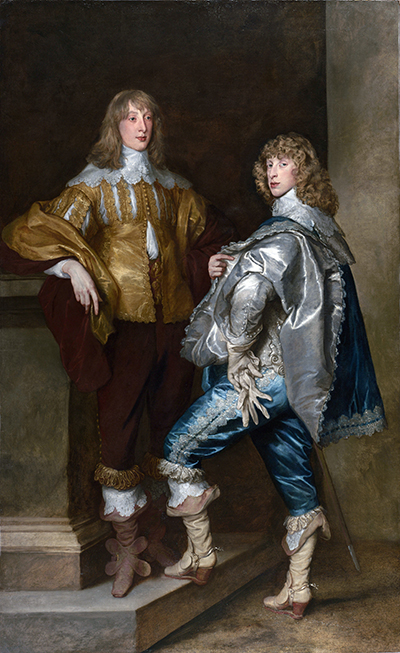
1635–before June 1636Lord John Stuart and his Brother
about 1638Cupid and Psyche
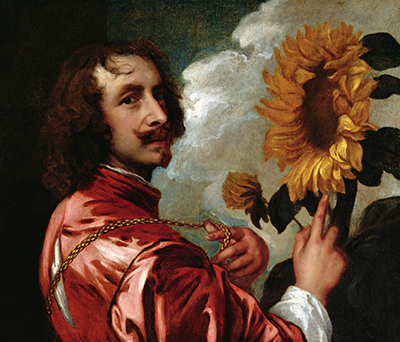
1639–40Self Portrait
c. 1640Contents
- A meeting organised around touch
- Two portraits within the devotional image
- Why the names remain uncertain
- The space around the figures has changed
- A canopy, open sky and a human scale
- From Antwerp to the French royal collection
A meeting organised around touch
The pale body of the Child stretches between two groups. His legs descend across Mary's lap while his torso turns towards the kneeling man. His head tilts in the same direction as his outstretched arm, making his movement easy to follow even before the fingers at the man's face become clear. The reaching arm carries the eye horizontally; the legs draw it back down towards the Virgin's robe. This combination makes him the mobile centre of an otherwise settled gathering.
Van Dyck gives the encounter an unusually small point of contact. The Child does not need an expansive blessing gesture to command attention. The man's face approaches his hand, and the space between them contracts to almost nothing. The surrounding darkness helps: the arm, face and broad white collar stand out as a connected passage of light.
Below this exchange, the man's joined hands occupy another meeting point, close to the Child's drapery and the Virgin's lap. Looking from face to hands, the viewer encounters two different kinds of gesture. The infant reaches freely across the space; the adult holds his hands together. The difference gives the religious encounter its shape. An act of prayer is answered through the familiar action of a child touching a face.
The picture also preserves the Child's bodily awkwardness. One leg hangs at an angle, the other bends across the cloth, and his torso appears to rotate beyond the stable verticals of the adults. That imbalance makes Mary's supporting presence essential. The sacred encounter remains connected to the practical sight of a mother carrying a lively child.
Two portraits within the devotional image
The donors occupy the right side, but they do not form an interchangeable pair. The man bends forward into the encounter. The woman stays more upright behind him, with one hand raised against her chest and the other lower against her black clothing. Her face is turned towards the sacred group; her position allows her profile and white ruff to remain distinct from his.
Their dark garments form a broad, almost continuous mass. Against it, the collars establish different directions. The man's white ruff leads towards the Child; the woman's projects sideways, broadening her silhouette. The pale cuffs and hands create smaller interruptions farther down. Van Dyck can therefore distinguish two people without breaking the visual unity of their clothing.
Age is given specific visible form in their faces. The man's brow, nose and cheek emerge in a closely fitted profile; the woman's features are framed by her head covering and the hard white edge beneath her chin. Neither face is treated as a general emblem of old age. These are the kinds of particular features that make a portrait demand a name, even when the evidence cannot supply one.
The asymmetry has encouraged different accounts of the painting's purpose. The Louvre collection record describes a commemorative epitaph, probably intended for a funerary monument in a chapel. [1] Ducos questions whether either donor was dead. [2] The woman's withdrawal from the central touch could suggest a different devotional role, but position alone cannot establish bereavement. Her raised hand connects her visibly to the encounter, even though the Child's hand reaches the man.
Labelling the woman a widow would turn every gesture into an illustration of that story. Considered first as painted presences, the donors offer two forms of participation in the same act of devotion. Their different distances from the Child can be read clearly without assigning either person a death date.
Why the names remain uncertain
An identification as Jan de Wael and Gertrude de Jode remains conjectural. Ducos proposes the Roettiers family, citing a 1778 story of thanksgiving for a late pregnancy; the account is unverified and its reported coats of arms are invisible. [2]
That late testimony makes a thanksgiving interpretation possible, but does not establish a miraculous birth or identify the sitters securely. A painting offered in thanks and a painting commemorating someone who had died could both bring donors before the Virgin and Child. The distinction concerns the circumstances of the commission, which cannot be recovered simply from the tenderness of the scene.
The neutral English title is consequently useful. Virgin and Child with Two Donors identifies what can be seen without making a disputed family history part of the painting's name. “Donors” describes their represented relationship to the sacred group; it does not tell us who paid, whether both were living, or precisely where the picture first stood.
Watch: Van Dyck’s art and working methods
Choose a museum introduction, a specialist lecture or a conservation film to continue exploring Van Dyck’s work.
Van Dyck, The Anatomy of Portraiture
The Frick curators introduce Van Dyck’s portraits, drawings and prints.
Watch on YouTubeThe space around the figures has changed
Ducos gives 250.5 × 190 cm, an original 194 × 190 cm, and additions after 1709: 40.5 cm above and 16 cm below. His catalogue records balustrading on added canvas. [2] These technical measurements differ slightly from the current collection record's 250 × 191 cm. [1]
The change from a nearly square composition to a tall rectangle alters how the gathering is experienced. In the complete canvas reproduced today, a large dark canopy occupies much of the upper left, while clouded sky opens above the donors. There is also a substantial foreground beneath the figures. The result allows the eye to travel through an outdoor setting before returning to the central hands and faces. The original proportions would have brought the edges closer around the gathering.
This history makes it important to distinguish the present object from Van Dyck's original arrangement. The full height cannot all be used as evidence for his intended balance between figures and empty space. At the same time, the central interaction remains legible within the enlarged canvas. The Child still bridges left and right; the donors still answer the seated Virgin; the hand at the cheek still provides a concentrated point of attention.
Ducos reports altered smalt, a blue pigment, and revisions to earlier pessimistic condition assessments after newer imaging. He records cleaning in 1788 and restoration in 1953–54. [2] The present colour is therefore also part of the object's material history. The subdued appearance of Mary's mantle should not become an unsupported claim that Van Dyck originally wanted this precise colour relationship.
A canopy, open sky and a human scale
The setting gives the encounter shelter without enclosing it. The canopy's dark lower edge hangs above the Virgin, sharply different from the softer transitions in the sky. Branches interrupt its outline. The left side feels covered and still; the right opens towards the little flying figures above the donors.
The angels form a second, smaller gathering. Their bodies curve across the lighter sky, echoing the movement of the Child below without competing with his greater scale. The eye can follow a rising path from the donors' faces towards them, then return along the hanging edge of the canopy. The celestial figures are visible witnesses to the main encounter, rather than another episode requiring a separate story.
Colour also separates and connects the people. Mary's red garment provides the most concentrated warm accent amid the muted landscape and black clothing. The light cloth around the Child spreads across her lap, where its folds help carry his turning body. Across the gap, the donors' white collars answer that cloth. Their dress belongs to the world of portraiture, yet its light and dark shapes participate fully in the devotional composition.
Near the bottom, leaves, uneven earth and the edge of drapery bring the gathering close to the ground. The plants are worth seeing before trying to name or decode them: small irregular shapes interrupt the broad passages of fabric and create a different texture at the figures' feet. Together with the tree and open sky, they make the sacred meeting appear to take place in a continuous, accessible world.
The work offers a particularly close connection between the two interests explored in Van Dyck's religious and mythological paintings and his portraits. The sitters retain their distinctive faces and dress while their bodies become part of a religious action. Looking at the Child's touch and then at the donors' faces brings both kinds of painting into focus.
From Antwerp to the French royal collection
The painting appears in Guillelmus van Hamme's Antwerp estate inventory in 1668. Gabriel Blanchard acquired it in Flanders for Louis XIV in 1685, with the banker Clerx reimbursing him. It was recorded at Versailles in 1695. Evacuated to the château de Montal during the Second World War, it was rehung at the Louvre on 27 June 1945. [1]
Ducos records later church copies retaining the extensions. [2] That last detail helps explain why the enlarged composition can feel familiar: later viewers encountered the painting through versions that carried its altered shape forward. A copy can preserve the appearance of a celebrated object at a particular moment, including changes made after the original artist had finished.
Artworks directory
A selected directory of paintings, drawings and prints, including works discussed in the articles and the Frick’s 2016 portraiture exhibition. It is not a complete catalogue of Van Dyck’s work. Print titles identify collaborators or later printmakers; disputed and workshop attributions are retained. The exhibition checklist supplies additional object records; current collection information governs the updated article entries. [3]
Frequently Asked Questions
Their identities remain uncertain. [2] The faces can be studied as individual portraits without attaching secure names to them.
The touch makes the religious encounter personal and physically immediate. It answers the man's prayer through an intimate gesture. It does not, by itself, prove that the man had died or explain the occasion of the commission.
No. It has later extensions above and below. [2] This matters when judging the amount of space around the figures.
It belongs to the Musée du Louvre in Paris, inventory INV 1231, and is dated about 1630–32. [1] The inventory number distinguishes it from Van Dyck's many other paintings of the Virgin and Child.
Discussion
Look again at the images and ideas explored in Virgin and Child with Two Donors. These editorial prompts invite your observations.
Reader Insights
How does the tiny contact between the Child's hand and the man's cheek organise your view of the larger painting?
What differences do you notice between the two donors' ways of participating in the encounter?
How might the gathering feel different within a nearly square frame, with less space above and below it?
Join the Conversation
Share a detail, comparison or question about Virgin and Child with Two Donors below.
References
- Musée du Louvre , La Vierge aux donateurs ou La Vierge et l'Enfant avec deux orants à genoux, collection record, INV 1231; MR 676. In French. View source .
- Blaise Ducos , Musée du Louvre, Cat. 14: La Vierge aux donateurs (La Madone Roettiers ?), in Antoon Van Dyck. Catalogue raisonné des tableaux du musée du Louvre (2023). In French. View source .
- The Frick Collection, Van Dyck: The Anatomy of Portraiture, online exhibition checklist (2016). View source.