 by Tom Gurney
Tom Gurney BSc (Hons) is an art history expert with over 20 years experience
Published on June 19, 2020 / Updated on November 6, 2026
Email: tomgurney1@gmail.com / Phone: +44 7429 011000
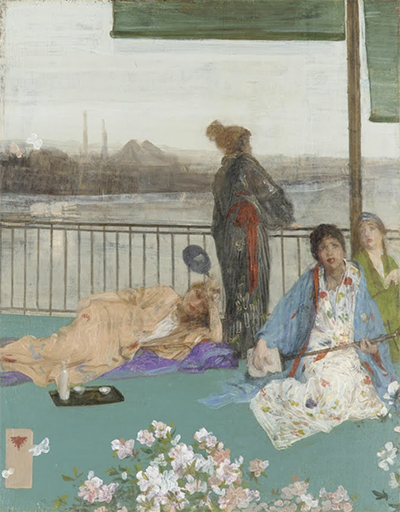
James McNeill Whistler's Variations in Flesh Colour and Green: The Balcony is a small painting with an exceptionally long history of change. The University of Glasgow catalogue identifies it as YMSM 056, and the Smithsonian National Museum of Asian Art records it as F1892.23a-b. Whistler painted it in oil directly on a thick wood panel rather than on canvas.[1][2][4]
The first conception belongs to 1864. A photographed state carried the signature and date “Whistler. 1865,” the picture appeared at the Royal Academy in 1870, and Whistler altered it again after lending and ownership arrangements had placed it outside his studio. YMSM dates the work 1864–1873; the museum describes principal work in 1864–70 with additions during 1870–79. Those formulations are more accurate than a single claim that it was simply completed in 1879.[1][2][4]
Four women occupy a staged balcony above the Thames. They wear garments and use objects associated with East Asia, but they are English or European models in Chelsea, not Japanese women observed in Japan. Behind them, factories, chimneys and a spoil heap on the Battersea bank make metropolitan industry part of the scene.[4][5][15]
At a Glance
- CatalogueYMSM 056
- Date1864–73; additions documented through the 1870s
- SupportOil on coarse wood panel, without gesso
- SiteLindsey Row, Chelsea; Battersea beyond
- FiguresFour staged English/European models
- YMSM dimensions61.4 × 48.8 cm
- NMAA dimensions61.4 × 48.5 cm
- CollectionFreer Gallery of Art, F1892.23a-b
- Current frameGrau-style, c.1892; not original
- DisplayWest Building, Gallery 11
Contents
- The painting at a glance
- A London balcony, not a Japanese view
- Who are the four women?
- Reclining, standing, playing, listening
- Tea things, music and a mixed collection
- The balcony as a threshold
- Flowers, factories and smoke
- What “flesh colour” means
- Why Whistler used musical titles
- The 1864 beginning
The painting at a glance
The vertical panel measures 61.4 × 48.8 centimetres in YMSM. The current museum record gives the same height and a width of 48.5 centimetres. The small difference belongs to the two cataloguing records and should be attributed rather than silently averaged.[1][4]
At the left, a woman reclines in a pink kimono-like robe and raises an open fan. A black tray holding tea things rests in front of her. Near the centre, a second woman in a black, flower-patterned robe stands with her back to the viewer and looks across the railing.[1][4]
A third woman sits farther right in a pale blue robe or jacket over a white flowered dress, playing a shamisen-like lute. The dark hair and partial profile of a fourth seated woman emerge at the right edge. Flowers rise through the foreground, while a vertical pillar, slatted blinds and the close crop make the balcony feel both shallow and densely occupied.[1][5][15]
A London balcony, not a Japanese view
The landscape is the Thames seen from Whistler's home at Lindsey Row in Chelsea. The river passes across the middle distance; the far bank is Battersea, with factory buildings, smoking chimneys and a large mound of industrial waste. The scene's geography is emphatically London.[1][4][9]
The foreground is nevertheless invented and staged. Whistler assembled models, clothing, fan, stringed instrument, vessels, plants and architectural divisions into an image that did not record a normal London household. Its cultural signs were selected for visual effect and for contemporary ideas about East Asian art.[5][15]
Calling the setting Japanese confuses costume with location. Calling it straightforward Chelsea reportage is equally inadequate. The panel joins a recognisable urban view to a constructed interior performance, and the joining—not a choice between the two—is its central operation.[4][5]
Who are the four women?
The women were English or European models dressed for Whistler's composition. The reclining figure, the standing figure at the balustrade, the musician and the partly concealed woman at right do not form a documented gathering of Japanese residents. Clothing cannot establish a sitter's nationality.[4][15]
YMSM discusses the possibility that one figure was an unidentified model called “la Japonaise.” The name describes a role within Whistler's studio culture, not a secure legal identity or complete sitter roster. No dependable evidence assigns all four poses to named women.[1][15]
A later, second-hand story says that Whistler arranged dressed Japanese wooden dolls when developing the group. Dolls may have helped him test costume or placement, but the anecdote cannot replace evidence of live models. The painted bodies differ in posture, scale and revision history in ways that demand more than one simple origin story.[1][15]
Reclining, standing, playing, listening
The four poses distribute attention rather than narrate a clearly named event. The woman at left leans along the lower edge, her pink robe spreading into a broad colour area. Her fan opens a pale, radiating shape beside her face, and the dark tray makes a compact counterweight below.[1]
The central woman presents her back. Her black garment is broken by floral pattern, and her vertical body joins the pillar and railing to the distant view. She is at once a person looking outward and a compositional hinge between the staged group and industrial Battersea.[1][5]
The musician turns the scene back inward. Her pale blue outer garment, white patterned dress and long-necked instrument create crossing diagonals among the balcony's uprights. The fourth woman is cropped and partly obscured, so the group seems to continue beyond the panel rather than posing in a complete frontal row.[1][15]
Tea things, music and a mixed collection
Anna Matilda Whistler described the balcony group in February 1864 and mentioned old Chinese china associated with its tea equipage. Her letter provides rare contemporary evidence for the objects in the studio, although its period terminology needs historical context.[7]
Related-study descriptions use more specific words such as sake bottle and cup. That vocabulary is valuable for those drawings, but it does not make every vessel on the final panel securely identifiable as sake equipment. The black tray and its small containers should be described first as painted tea things unless object-level evidence supports greater precision.[1][7][9]
The collection was mixed. Chinese ceramics, Japanese-associated garments, a fan, print comparisons and a shamisen-like instrument do not collapse into one undifferentiated category. Keeping the objects distinct reveals how Victorian collecting assembled material from different places under broad and often imprecise labels.[5][7][15]
The balcony as a threshold
The balcony is not just a decorative stage. Its blinds, pillar and balustrade organise a boundary between sheltered private activity and a public urban prospect. The women recline, look, play and listen on one side of that threshold; commerce and manufacture continue across the water on the other.[5]
The vertical post divides without completely separating. Railing bars repeat the bodies and instrument, while the suspended blinds establish a ceiling-like limit above. These architectural lines crop the view, turning a broad river landscape into selected intervals.[1][5]
Katherine Roeder and Kit Brooks use this threshold in A Tale of Two Balconies to ask how gender, race, trade and looking converge. The structure makes viewing itself visible: one looks past painted women who are also posed as viewers of London.[5]
Flowers, factories and smoke
Foreground flowers add pink, red and green accents around the women. Their stems rise at the right and interrupt the straight architecture. Because Whistler extended and repainted them, they belong to the panel's history of revision as well as to its final decorative rhythm.[1][2]
Across the Thames, chimneys release small puffs into a pale sky. The factories and spoil heap are not background facts that Whistler forgot to idealise. Their angular masses and muted smoke take part in the same colour arrangement as the robes, plants, water and blinds.[4][5]
It is tempting to call the women and flowers a brilliant fantasy opposed to a sombre industrial reality. That division is too neat. Smoke echoes blossom; river space continues the balcony's horizontal bands; the standing woman connects railing to horizon. London industry is aesthetically transformed, but it is not expelled.[4][5]
What “flesh colour” means
The 1878 title Variations in Flesh-Colour and Green directs attention to repeated colour rather than to a story. Pink moves among exposed faces and hands, the reclining robe and the flowers. Green changes across the floor, foliage, garments and blinds rather than appearing as one uniform hue.[1][11]
The phrase “flesh colour” also carries a racial assumption. In nineteenth-century British usage it could present pale or pinkish white skin as if it were the natural, unnamed colour of human flesh. Whistler's title makes Caucasian skin the default while the staged clothing marks Asian difference.[1][5]
Acknowledging that language does not require discarding the title or pretending that colour relation is unimportant. It allows both facts to remain visible: the words sharpen perception of pink and green intervals, and they encode a hierarchy in which whiteness can go unnamed as universal.[1][5]
Why Whistler used musical titles
The painting entered the Royal Academy in 1870 simply as The Balcony. At the Grosvenor Gallery in 1878 it appeared as Variations in Flesh-Colour and Green. Later records used combinations of “Harmony,” “Variations” and “Balcony,” with punctuation and spelling changing across catalogues.[1][3][11]
Contemporary critics sometimes mocked Whistler's musical naming as pretension or evasiveness. Yet “variations” offers a precise viewing instruction. Skin, robe, blossom, leaf, blind and floor should be compared as related but unequal statements of colour.[1][11]
The preferred modern wording follows YMSM's 1980 standardisation, based chiefly on the 1878 title. It should not be projected backwards onto Anna Whistler's 1864 letter or the 1870 Academy catalogue. The object remained materially continuous while its public identity changed.[1][11]
The 1864 beginning
Anna Whistler's letter of 10–11 February 1864 describes her son's balcony picture as an active studio project. She noticed its group, the balcony setting and the china tea service. Her testimony fixes the conception much earlier than the eventual musical title.[7]
The letter also places the painting within Whistler's collecting and domestic environment. Objects now sorted by museums as Chinese or Japanese could then be grouped under broad terms, and their use within the studio did not require archaeological consistency. The picture developed from access, arrangement and fantasy.[5][7]
This contemporary description does not prove that every visible detail had its present form in February. X-ray evidence and related drawings show extensive later changes. It secures a balcony-and-figures project while leaving the exact state open.[2][7][9]
The signed 1865 state
An early photograph records the inscription “Whistler. 1865.” That signature gave the panel a public-looking date, but Whistler later covered or replaced it. The photographed composition also differs from the surface now in Washington.[1][2]
The date therefore marks a substantial state rather than an irreversible finish. Whistler could sign a work, exhibit it, sell it and still reclaim it for alteration. His practice complicates the ordinary expectation that a date closes the act of making.[1][2][12]
The present lower-left butterfly inside a rectangular cartouche was added around 1870–72, after the initial signature. It is an early important example of Whistler's butterfly device, but it was not present at the panel's inception and should not be used to date the original design.[1][2]
Royal Academy 1870
Whistler exhibited The Balcony at the Royal Academy in 1870 as catalogue 468. The title encouraged viewers to recognise a setting before decoding the later colour terminology. The Academy state had already passed through several years of work.[1][11]
Flowers and the butterfly belong around or after this phase, while other changes continued during the 1870s. The 1870 exhibition is therefore a firm public checkpoint, not the final visible state.[1][2]
When later catalogues renamed the panel, they altered what viewers were primed to notice. “Balcony” foregrounded place and cultural staging; “Variations” foregrounded colour sequence. Neither label exhausts the image, and neither should erase the other's historical moment.[1][11]
Related drawing M.0319
The New York Public Library drawing catalogued as M.0319 records a related arrangement. Its blinds hang lower, the woman at the right appears in profile, and the musician adopts a different pose. These differences make it evidence for development, not a miniature duplicate of the final panel.[2][9]
The drawing helps recover alternatives that Whistler considered and abandoned. Figures, instruments and architectural limits could move independently as he tested the group. Similarity identifies the project; difference reveals work.[2][9]
Calling M.0319 simply “the preparatory drawing” would suggest a linear path from plan to execution. The surviving evidence instead describes feedback among paper designs, a changing panel, photographs and later tracings.[2][9]
Tracing M.0320
M.0320 in the Hunterian is closely related to the painted surface and appears to have been traced from it at a somewhat earlier state. That origin reverses the usual assumption that every drawing necessarily came before the painting.[2][9]
Its relation is valuable because it can preserve features that subsequent repainting displaced. At the same time, a traced record is not a neutral photograph. Line selects and simplifies; the function of the sheet and the purpose of making it remain part of its interpretation.[2][9]
M.0319 and M.0320 therefore occupy different positions in the change sequence. Treating them as interchangeable studies would flatten the very evidence that makes them informative.[2][9]
YMSM 057 and the enlarged project
YMSM 057, Sketch for The Balcony, is a separate oil sketch with a squared surface. The grid suggests enlargement, and Whistler wrote to Henri Fantin-Latour in 1867 that he intended to make an almost life-size picture for the Salon.[2][8][9]
In the same letter he called the balcony colour brilliant and referred to a photograph. The statement records ambition and self-assessment, but it does not supply a modern pigment analysis. “Brilliant” describes the effect Whistler valued, not a list of chemically identified materials.[2][8]
No surviving enlarged version is securely documented. YMSM 057 must not be merged with the Freer panel, and the proposed Salon work should not be invented as a completed lost masterpiece. The secure facts are the squared sketch, the letter and the unrealised or untraced plan.[2][8][9]
What the x-ray reveals
Examination shows that a standing figure once occupied the place where the reclining woman now lies. Whistler covered that vertical body and inserted the lower, extended pose. Lines of the veranda remain visible through the recliner's waist, materially exposing the late adjustment.[2]
Possible sloping masts and another standing figure also appear among the underlying changes. Because some forms are difficult to interpret, they should be described as possible removed elements rather than reconstructed as a complete lost composition.[2]
The central standing woman's head changed more than once and was subsequently restored by several hands. What looks like one calm pose is the meeting point of artist revision, material damage and later intervention.[2][17]
Blinds, pole, flowers and shoreline
The hanging blinds originally descended farther into the scene. Raising them opened more of the distant view and altered the relation between interior shelter and outdoor prospect. The main vertical pole also moved about two inches from an earlier position farther left.[2]
Whistler repainted and extended the flowers upward and towards the right. He added or adjusted butterflies, the lower-left cartouche, puffs of smoke and shoreline detail. These are not random repairs but linked decisions about the panel's edges, accents and spatial balance.[2]
The current painting is consequently both early and late. Its core was conceived in 1864 and signed in 1865, yet important bodies, plants, marks and landscape details belong to later states. A single completion date suppresses that productive instability.[1][2][4]
Paint directly on wood
Whistler worked on a thick, coarse-grained wooden panel without a gesso preparation. The grain therefore participates in the painted surface instead of being buried beneath a smooth white ground. That material choice distinguishes the object from his balcony drawings, squared sketch and projected large canvas.[2][9]
Direct painting did not prevent revision. New forms cross earlier architecture, and covered elements remain detectable beneath the surface. The support carried multiple campaigns precisely because Whistler continued to treat it as available for change.[2]
Walter Sickert later admired the material painting of the dark tray and small cups. His attention is useful because those objects are not only ethnographic signs; they are passages of black, light and reflective touch. Technical description should nevertheless stop short of inventing pigments that the sources do not identify.[2]
The butterfly replaced a signature
Whistler's butterfly developed from the letters of his name into a compact emblem. On this panel it superseded the straightforward “Whistler. 1865” inscription and sits within a rectangular cartouche at the lower left.[1][2][4]
Because the change occurred around 1870–72, the mark records revision and re-presentation. It can be called an early major butterfly, but not the first-state signature and not evidence that every present detail existed in 1865.[1][2]
The museum has associated the butterfly's metamorphosis with transformation. That is an illuminating interpretation for a repeatedly changed picture, not an exclusive code that fixes what the device meant in every context.[4]
Japonisme beyond a source hunt
Older accounts often sought one print that Whistler copied. The panel certainly responds to Japanese art and commodities, but its long sequence of additions makes a single-source explanation improbable. Poses, colour, balcony structure and landscape could come from different observations at different moments.[1][5]
The 2024 NMAA project proposes a more reciprocal method. It asks what artists selected, discarded and adapted, how objects travelled, and how global exchange was structured by unequal power. “Influence” is not abolished; it is made specific enough to examine.[5]
That approach also returns agency to the painting's London content. Whistler did not merely paste an exotic foreground over a neutral Thames. He used East Asian visual possibilities to reorganise how an industrial British river could be framed and seen.[4][5]
Harunobu: an unlikely direct source
A print by Suzuki Harunobu has been proposed because it includes women, architectural framing and related domestic motifs. YMSM notes, however, that the elements are arranged differently. General resemblance does not establish direct dependence.[1]
The comparison can still clarify how radically Whistler recomposed such material. His four women occupy different depths, the open Thames carries industrial distance, and the standing back-view figure anchors a vertical panel developed over years.[1][5]
The responsible conclusion is graded: Harunobu belongs to the comparative field, but this print is unlikely to be the specific compositional source. Rejecting direct copying does not deny Whistler's broader engagement with Japanese prints.[1][5]
Kiyonaga and moon-viewing on the Sumida
Torii Kiyonaga's A Party Viewing the Moon on the Sumida River offers a closer comparison. Women gather beside water, music contributes to sociability, and an elevated or bounded foreground opens towards a river view. Colour and mood connect private gathering to landscape.[1][10]
The comparison is productive because the Sumida and Thames are both urban rivers without becoming equivalent places. Whistler adapts the general relation among figures, music, balcony and distance to an industrial Chelsea prospect.[5][10]
Kiyonaga's The Fourth Month also resembles aspects of the group, tea equipment and patterned clothing. Yet Whistler's access to the relevant impression before Beatrice Philip acquired it in 1888 is not secure. Formal closeness cannot repair a missing transmission history.[1][10]
Hokusai's Sazaidō as a modern comparison
Hokusai's The Sazaidō of Gohyakurakanji shows people looking from an elevated, strongly framed structure towards a distant landscape. Its beams, balcony edge and staged acts of viewing make it a revealing companion for Whistler's panel.[5][6]
The National Museum of Asian Art brought the works into dialogue in 2024. That curatorial act is modern comparative scholarship, not proof that Whistler copied the Freer impression. The print entered the collection later, and no secure document places this particular sheet before him.[5][6]
Comparison matters without genealogy. It can show how two artists used architectural boundaries to organise bodies, landscape and looking, while preserving differences in time, medium, geography and circulation.[5][6]
Is the spoil heap Mount Fuji?
The museum notes that the smoke-veiled mound across the Thames can evoke Mount Fuji as pictured by Hokusai or Hiroshige. Its triangular rise turns an industrial spoil heap into a distant landmark within the carefully bounded view.[4]
“Evokes” is the correct level of certainty. The painted mound is Battersea industry, not an actual Japanese mountain, and no single Fuji print has been proved as its template. Several visual memories could make the resemblance legible.[4][5]
The most interesting result is not that reality disguises itself as fantasy. London waste, smoke and river become capable of carrying associations formed through Japanese landscape art. The industrial site remains materially and politically present even as its shape travels imaginatively.[4][5]
The 1878 return and frame dispute
George John Cavafy acquired the panel from Whistler, reportedly for thirty guineas. The artist's later recollection of that price was interested: he was defending his continuing authority and the increased value of a picture he had sold in the mid-to-late 1870s.[3][12]
Whistler repeatedly borrowed the work back and altered it. Around the 1878 Grosvenor exhibition, he also arranged a new Foord & Dickinson frame. When Cavafy refused the frame bill, disagreement about payment intensified into a wider dispute over possession, care and value.[2][12][14]
Sale had not ended Whistler's sense of authorship. Yet his desire to improve or reframe the panel did not automatically cancel Cavafy's ownership. Their quarrel shows how revision could blur the practical boundary between studio work and a collector's property.[3][12]
Three frames, none safely called the original survivor
Frame research reconstructs three stages. A possible oriental cassetta frame made around 1864 is lost. Its exact design and maker cannot be recovered with certainty, so it remains a probable first presentation rather than a surviving original object.[2][14]
Around 1878 Whistler ordered a reeded Flat Whistler frame from Foord & Dickinson. It carried a painted seigaiha, or wave, pattern and a butterfly. That border linked the picture's presentation to the decorative system within it, but the frame itself is also lost.[2][12][14]
The current Grau-style frame dates from about 1892 and may have been made in America for Edward Guthrie Kennedy. It is historically important, but it is neither the probable 1864 cassetta nor the documented 1878 Whistler design. “Current frame” and “original frame” are not interchangeable.[2][4][14]
The four-picture transaction of 1892
After George Cavafy's death, the family marketed four Whistler paintings together: The Balcony, Harmony in Blue and Silver: Trouville, The Last of Old Westminster and Battersea Reach. The group attracted dealers and collectors on both sides of the Atlantic.[3][12]
Goupil offered £500, Cavafy sought £600, and Kennedy ultimately paid £650 for the four works. None of those figures is the individual price of The Balcony. Dividing or assigning the package amount without evidence would manufacture a market record.[3][12]
Kennedy retained the balcony panel but returned the Trouville seascape, YMSM 064, to Whistler. The two paintings therefore took different paths immediately after the same transaction: the seascape went back to the artist and ultimately to Isabella Stewart Gardner, while The Balcony moved towards Freer.[3][12]
Whistler, Richards and the 1892 examination
Whistler probably sent the panel to Stephen Richards for examination during the 1892 sale campaign. Correspondence mentions the possibility of cleaning or attention, but surviving accounts conflict about whether Richards performed material treatment or charged only for looking.[2][13]
Whistler considered taking the picture to Paris for further touching. He then said he could add nothing. The statement is striking after decades of alteration, but it records one decision in 1892 rather than proof that the work had possessed a stable final state since the 1860s.[2][13]
During the New York retrospective that year, the wood panel checked or split. The event separates uncertain Richards intervention from a documented support problem. Conservation history must preserve that distinction.[2][13][16]
Freer's purchase
Charles Lang Freer bought the painting from Kennedy on 27 September 1892 for $2,900. The National Museum of Asian Art provenance also names H. Wunderlich & Co. in the dealer history. This is the panel's documented individual purchase price, unlike the earlier Cavafy package figures.[3][4][16]
Freer made Whistler central to a collection that brought American and European art into conversation with Asian traditions. That historical framework helps explain the panel's later institutional setting, but it should not be projected backwards as Whistler's complete intention in 1864.[5][16]
Freer signed the deed gifting his collection to the United States in 1906. The completed Freer Gallery received the object in 1920. Ownership history thus separates acquisition by Freer from physical transfer into the public museum.[4][16]
Conservation after Freer
The panel's long material history continued in the collection. Conservators glued a split in 1921 and attached a cradle to the back in 1922. Those interventions addressed the behaviour of the wood support rather than revising Whistler's composition.[2][17]
Flaking, losses and earlier damage led to further repairs. Records document infilling, retouching and revarnishing in 1954, 1958 and 1965. These actions helped stabilise and present a surface already complicated by Whistler's repeated changes.[2][17]
The head of the central standing woman is especially compromised by alteration and restoration by several hands. That fact does not make the entire painting a ruin, just as conservation does not make it untouched. The object survives through a layered combination of original work, revision, damage and care.[2][17]
Exhibitions and changing public identities
The Royal Academy showed The Balcony in 1870. It was exhibited in Paris in 1873 and at the Grosvenor Gallery in 1878 under the “Variations” title. Later appearances included Paris in 1889, Goupil's London exhibition and New York in 1892.[1][3][11]
It continued to circulate at Pittsburgh in 1897 and Buffalo in 1901, followed by later museum exhibitions. The sequence matters because it repeatedly placed the old panel before new publics after material and framing changes.[3][4][11]
Catalogue wording shifted among The Balcony, Variations in Flesh-Colour and Green, and harmony variants. One should not retroactively replace every historical title with the current preferred form. The changing names are evidence of how Whistler and others re-presented the same object.[1][3][11]
The painting in Gallery 11
The current National Museum of Asian Art record places F1892.23a-b in Gallery 11 of the West Building for Ruffled Feathers: Creating Whistler's Peacock Room. The display is scheduled through 21 January 2027, according to the page checked on 25 August 2026.[4]
An archived museum page says that the work is not currently on view. That older field is superseded for present-status reporting by the live object record. Because galleries can still change, prospective visitors should confirm with the museum before travelling.[4]
The present display places the panel within Whistler's wider decorative practice and conflicts around the Peacock Room. This is a twenty-first-century interpretive setting, not evidence for how the painting was installed at Lindsey Row, the Royal Academy or Cavafy's home.[4][16]
The inherited web page and image
The existing standalone route, canonical address, sitemap entry and paintings-hub link are retained as implementation evidence. Its 389-word body is not a source for this account. It incorrectly calls the staged models Japanese and compresses a decades-long change sequence into a single completion story.[18]
It also treats Kunisada, Hokusai and Hiroshige as direct sources, calls the vessels sake equipment without sufficient object control, turns the Battersea mound into a definitive Fuji quotation and detaches the butterfly from its later chronology. Those claims have been replaced by individually graded evidence.[1][2][4][5][10][18]
The locally resolved reproduction remains a later implementation candidate. The museum separately offers a CC0 image and IIIF record. Image choice, rights, crop and technical quality belong to a future implementation gate; neither option authorises a change to the protected live site during editorial preparation.[4][18]
Why *The Balcony* matters
The panel refuses an easy division between Western reality and Japanese fantasy. Its women are London models, its objects come from a mixed collection, and its river carries Battersea industry. Japanese prints and goods offered ways to reorganise those materials, not a complete foreign scene ready to copy.[4][5][7][15]
Its material history is equally resistant to simplicity. A work begun in 1864, signed in 1865 and exhibited in 1870 acquired a new reclining figure, raised blinds, shifted architecture, extended flowers, revised smoke, a butterfly and different frames. Even the wood and central head preserve later damage and repair.[1][2][17]
Whistler's “variations” therefore name more than colour. Pinks and greens move across the visible surface, while figures, titles, signatures, frames, owners and exhibition contexts vary across time. The painting is coherent not because change stopped, but because Whistler repeatedly made new relations from what remained.[1][2][5]
Frequently Asked Questions
The Freer Gallery of Art, part of the Smithsonian National Museum of Asian Art, owns accession F1892.23a-b. Its live record, checked on 25 August 2026, reports the work displayed in West Building Gallery 11.[4]
Discussion
How does the balcony join a staged private interior to industrial London?
Trace the railing, blinds, figures, flowers, river, smoke and distant works, then ask where the composition separates those worlds and where colour binds them together.
Reader Insights
Which lines make the balcony feel enclosed, and which open it towards Battersea?
How do costume, fan, instrument and tea things construct a scene rather than document Japan?
Where might the long sequence of altered figures and flowers remain visible?
Join the Conversation
Share a close observation or an object-history question.
References
- Margaret F. MacDonald and Grischka Petri, “Variations in Flesh Colour and Green: The Balcony,” YMSM 056, The Paintings of James McNeill Whistler: A Catalogue Raisonné, University of Glasgow, 2021. https://www.whistlerpaintings.gla.ac.uk/catalogue/display/?mid=y056&xml=sub
- Margaret F. MacDonald and Grischka Petri, “Variations in Flesh Colour and Green: The Balcony: Technical Description,” YMSM 056, University of Glasgow, 2021. https://www.whistlerpaintings.gla.ac.uk/catalogue/display/?mid=y056&xml=tec
- Margaret F. MacDonald and Grischka Petri, “Variations in Flesh Colour and Green: The Balcony: History,” YMSM 056, University of Glasgow, 2021. https://www.whistlerpaintings.gla.ac.uk/catalogue/display/?mid=y056&xml=his
- Smithsonian National Museum of Asian Art, “Variations in Flesh Colour and Green: The Balcony,” F1892.23a-b, current object record, provenance, exhibition and display data. https://asia.si.edu/explore-art-culture/collections/search/edanmdm:fsg_F1892.23a-b/
- Katherine Roeder and Kit Brooks, A Tale of Two Balconies: Whistler and Hokusai, Washington, DC: National Museum of Asian Art; London: D Giles, 2024; National Museum of Asian Art exhibition essay.
- Katsushika Hokusai, The Sazaidō of Gohyakurakanji, from Thirty-six Views of Mount Fuji, ca 1830–31, National Museum of Asian Art, F1974.63. https://asia.si.edu/explore-art-culture/collections/search/edanmdm:fsg_F1974.63/
- Anna Matilda Whistler to James H. Gamble, 10–11 February 1864, GUW 06522, The Correspondence of James McNeill Whistler, University of Glasgow. https://www.whistler.arts.gla.ac.uk/correspondence/
- James McNeill Whistler to Henri Fantin-Latour, June/July 1867, GUW 08045, The Correspondence of James McNeill Whistler, University of Glasgow. https://www.whistler.arts.gla.ac.uk/correspondence/freetext/display/?cid=8045
- James McNeill Whistler, related balcony works: M.0319, New York Public Library; M.0320, Hunterian Art Gallery; and YMSM 057 Sketch for The Balcony, object and catalogue records.
- Torii Kiyonaga, A Party Viewing the Moon on the Sumida River and The Fourth Month, Museum of Fine Arts Boston object records and comparison scholarship in YMSM 056.
- Royal Academy, 1870, cat. 468; Grosvenor Gallery, 1878; Paris, 1889; and Goupil Gallery, 1892 exhibition catalogues and contemporary reviews, as documented in YMSM 056.
- James McNeill Whistler to John Cavafy, 1878, GUW 00549; Cavafy, Edward Guthrie Kennedy and John Chandler Bancroft correspondence, 1892, University of Glasgow.
- James McNeill Whistler, Stephen Richards and Edward Guthrie Kennedy correspondence, June–October 1892, University of Glasgow.
- Sarah L. Parkerson Day, Whistler frame research report for Variations in Flesh Colour and Green: The Balcony, Smithsonian National Museum of Asian Art, 2017.
- Susan Grace Galassi, Margaret F. MacDonald and Aileen Ribeiro, Whistler, Women and Fashion, New York: Frick Collection; New Haven: Yale University Press, 2003.
- Charles Lang Freer and James McNeill Whistler correspondence; Smithsonian National Museum of Asian Art, history of the Freer collection and Gallery.
- National Museum of Asian Art conservation records for F1892.23a-b, 1921–65, summarised in YMSM 056 technical documentation.
- James McNeill Whistler Waterhouse+ route, sitemap, hub, local-image, carryover, inherited-prose and protected-live inventories, frozen 25 August 2026.