

 by Tom Gurney
Tom Gurney BSc (Hons) is an art history expert with over 20 years experience
Published on June 19, 2020 / Updated on August 21, 2026
Email: tomgurney1@gmail.com / Phone: +44 7429 011000
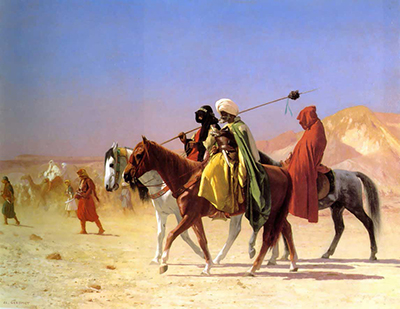
Three riders move across a strip of brilliant sand. Their horses advance in profile, robes lift colour against the pale ground, and a more distant procession extends the journey towards barren hills. Jean-Léon Gérôme's Riders Crossing the Desert makes steady movement feel monumental within a panel only 41 by 56 centimetres.
Painted in 1870, the work has also been known as Arabs Crossing the Desert. Sotheby's now uses the more descriptive title Riders Crossing the Desert, while its catalogue preserves the historical alternatives in earlier Goupil and Ackerman records.[1]
The change is useful. Clothing and setting can suggest a cultural context, but they do not prove each rider's ethnicity. The current title stays with what the painting visibly establishes.
At a Glance
- ArtistJean-Léon Gérôme
- Current titleRiders Crossing the Desert
- Historical titleArabs Crossing the Desert
- Date1870
- MediumOil on panel
- Dimensions41 × 56 cm (16 × 22 in.)
- Current statusPrivate collection following its 2019 sale
- CatalogueAckerman 208
- Former collectionNajd Collection
- Museum historyLong-term loan to The Metropolitan Museum of Art, 2007–16[1]
A Procession Built like a Frieze
The nearest riders form a horizontal sequence across the panel. Their bodies and horses overlap enough to become a group, but each remains readable.
This frieze-like arrangement gives the figures the clarity of relief sculpture. Movement travels laterally rather than rushing into depth. Hooves, legs and robes repeat with controlled variation.
Behind them, smaller travellers continue the route. The distant line prevents the foreground group from being an isolated portrait and implies a caravan larger than the frame can contain.[1]
The low horizon leaves an expanse of bright atmosphere above the figures. They are visually exposed, with little shelter or interruption.
Despite the implication of distance, the pace appears measured. Gérôme chooses endurance over dramatic speed. The horses walk; the caravan advances through accumulated steps.
Heat Made Visible
Heat cannot be painted directly, so Gérôme constructs it through light, colour and the scarcity of shadow.
Sand reflects a brightness that reduces the landscape's tonal range. Strong colours in the riders' garments stand out against this near-blank field.
The distant hills are barren and sharply bounded. They offer scale but little promise of relief. No vegetation or water interrupts the journey.
Sotheby's describes the foreground as “pin-sharp” against more distant travellers.[1] The contrast creates atmospheric depth while also dividing experience: we inspect the nearest riders; the rest become evidence of distance.
The picture's calm makes the conditions feel more severe. Nothing visibly breaks down, yet every element—light, ground, horizon—insists on exposure.
Travel and Photographic Sources
Gérôme first travelled in the Egyptian desert in 1856. He returned in 1868 with companions including his brother-in-law Albert Goupil, who made photographs during the expedition.[1]
Sotheby's connects Riders Crossing the Desert to sketches and photographic material from these journeys.[1] Such sources help explain the wide, panoramic organisation and precise description of landscape and costume.
Photography did not copy reality directly into paint. A photograph selects a viewpoint, fixes a fraction of time and excludes everything outside its edge. Gérôme could then combine photographic information with sketches, props and compositional decisions.
The panel's clarity is therefore a made effect. The riders are placed at ideal intervals; the landscape has been simplified; the receding caravan extends the narrative exactly where the composition needs it.
Source material gives the fiction authority, while arrangement gives it meaning.
Egypt in 1870: Movement and Modernisation
The painting's desert appears timeless. Riders, horses and barren mountains seem removed from industrial change.
Yet Sotheby's places the work against a rapidly modernising Egypt. Steam travel shortened journeys from Europe, railways connected major cities and the Suez Canal opened in 1869, the year before Gérôme painted the panel.[1]
Gérôme himself attended the canal's inauguration as part of a French delegation. He therefore knew an Egypt shaped by international engineering, trade and imperial competition.
None of that appears here. The absence is not a factual error within the depicted patch of desert; travellers on horseback continued to exist. It is a choice about which Egypt the European art market would see.
The panel concentrates on traditional movement and harsh landscape, allowing modern systems to remain outside the frame. Its apparent timelessness is produced at a precise historical moment.
The Orientalist Promise of Access
Gérôme's travels allowed him to claim unusual familiarity with the places he painted. His precision offered European and American collectors the sensation of access to a distant world.
That access was unequal. France's political, military and economic involvement in North Africa and the eastern Mediterranean shaped the conditions under which artists travelled and audiences consumed their images.
Modern accounts of Orientalism examine how accurate details could support broader fantasies: the East as unchanging, theatrical, dangerous or available for inspection.[2]
Riders Crossing the Desert is not inaccurate because it omits a railway from an open landscape. Its cultural work lies in repetition and selection. A traditional caravan becomes the enduring image, while modern Egypt becomes the missing context.
This does not erase the panel's extraordinary control of light and movement. It changes the questions asked of that control.
From Goupil to the Najd Collection
Goupil & Cie. handled the work by 1871, and its stock books recorded titles including Caravan in the Desert and Arabs Crossing the Desert. Photogravure later helped circulate the composition.[1]
The painting passed through American collections and eventually entered the Najd Collection, a major private assembly of Orientalist art.
From November 2007 to October 2016 it was on long-term loan to the Metropolitan Museum of Art. A loan does not transfer ownership; the work remained private.[1]
Sotheby's sold it from the Najd Collection in October 2019. The public catalogue does not identify the buyer, so its present location should be described simply as a private collection.
This history demonstrates how a small panel could move through dealer, reproduction, collector and museum systems while retaining the intimacy of a close-viewed object.
Direction without Destination
The riders know where they are going, but the viewer does not. Gérôme provides motion without a named departure or arrival.
That omission turns the journey into a condition rather than an episode. The caravan is always crossing.
The foreground group offers specificity—colours, tack, posture—while the absent destination produces generality. They can stand for travel, persistence or exposure.
The painting's beauty depends on this narrowing. We are not asked to follow a commercial, familial or political purpose. We are asked to watch figures measure themselves against space.
Modern interpretation can admire that economy while refusing to treat it as complete cultural description. The panel captures a brilliantly constructed journey, not an entire society.
Artist Up Close
Begin with the horses' legs and follow their repeated rhythm across the foreground. The frieze advances through small differences.
Then move to the receding caravan. Its reduced scale expands the landscape far beyond the panel.
Finally, compare the brightest garment with the sand. Gérôme uses colour to hold the human group against overwhelming light.
Frequently Asked Questions
Discussion
Which detail in Riders Crossing the Desert most changes how you read Gérôme's balance of spectacle, evidence and invention?
Reader Insights
Which detail in Riders Crossing the Desert most changes how you read the scene's balance of evidence, staging and spectacle?
Set this page beside the Gérôme biography, paintings overview and related works to test how travel, studio practice and the Salon shaped the image.
What should a careful modern reading preserve, question or leave uncertain when looking at this work today?
Join the Conversation
Share a thoughtful observation about Riders Crossing the Desert, Gérôme's method, or the wider context that would help another reader look more carefully.
References
- Sotheby's. “Jean-Léon Gérôme, Riders Crossing the Desert.” Important Works from the Najd Collection, lot 14, 22 October 2019 View source.
- Jennifer Meagher. “Orientalism in Nineteenth-Century Art.” Heilbrunn Timeline of Art History, The Metropolitan Museum of Art View source.