

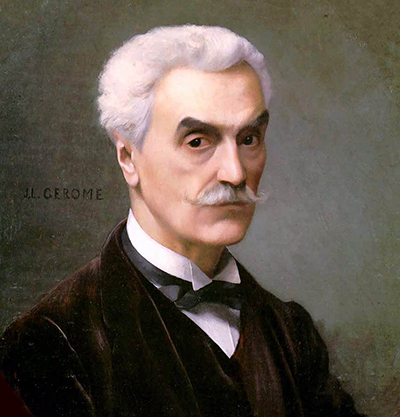
 by Tom Gurney
Tom Gurney BSc (Hons) is an art history expert with over 20 years experience
Published on June 19, 2020 / Updated on August 21, 2026
Email: tomgurney1@gmail.com / Phone: +44 7429 011000
Jean-Léon Gérôme could make a vanished world appear almost touchable. Marble floors, worn stone, patterned cloth, sunlit dust and polished metal all seem to have been patiently observed. Yet the conviction of his pictures is never simply documentary. Gérôme arranged the past—and the places Europeans of his time called the “Orient”—as carefully controlled spectacles. His art asks where the viewer stands, what the viewer is permitted to see and how persuasive detail can turn reconstruction into apparent truth.
Born in 1824 and active until his death in 1904, Gérôme moved through several distinct artistic identities: Néo-Grec painter, history painter, traveller, Orientalist, influential teacher, commercially successful image-maker and, late in life, sculptor fascinated by colour. He was one of the best-known French artists of the nineteenth century. He was also an opponent of Impressionism whose reputation fell sharply after his death. The renewed study of academic art, Orientalism, reproduction and mass visual culture has since made his work newly consequential—without making it less contested.[1][2]
This guide follows the art rather than attempting a full life story. It explains the principal subjects, working methods and questions that connect Gérôme's paintings, drawings and sculptures.
At a Glance
- Full nameJean-Léon Gérôme
- Born11 May 1824, Vesoul, France
- Died10 January 1904, Paris, France
- FieldsPainting, sculpture and teaching
- TrainingStudio of Paul Delaroche in Paris
- Early breakthroughYoung Greeks Attending a Cock Fight, exhibited at the Salon of 1847
- Major subjectsAntiquity, French history, religious history, travel-derived scenes, Orientalist subjects, studio allegories and animals
- TeachingProfessor at the École des Beaux-Arts from 1864
- Late-career focusSculpture and experiments with polychromy[1][2]
From Delaroche's Studio to the Néo-Grecs
Gérôme arrived in Paris as a young man and entered the studio of Paul Delaroche, a leading painter of historical subjects. Delaroche's example offered more than academic technique. His pictures often made history immediate through an emotionally charged incident, recognisable setting and carefully selected moment. Gérôme would develop those possibilities in his own distinctive way.[1]
The work that established his name was Young Greeks Attending a Cock Fight, painted in 1846 and shown at the 1847 Salon. Instead of presenting antiquity as a procession of exemplary heroes, Gérôme showed a sensuous, intimate scene: two nearly nude young people beside fighting birds, against a luminous Mediterranean setting. The painting became associated with the Néo-Grecs, a loose group of artists who treated ancient life through anecdote, archaeology, elegance and sometimes deliberate provocation.[2]
That label is useful, but it does not describe Gérôme's whole career. His early classical subjects range from playful domesticity to religious images filtered through Greek form. Théophile Gautier captured the mixture in an 1848 review when he wrote that Gérôme was heading towards Calvary “but his route takes him via Athens.”[3] The remark recognised how strongly the artist's religious and historical subjects remained shaped by the visual language of antiquity.
History Arranged as Spectacle
Gérôme became famous for historical paintings that look both meticulously reconstructed and theatrically composed. He studied objects, architecture, texts and earlier images, then chose a viewpoint that made the past operate as drama.
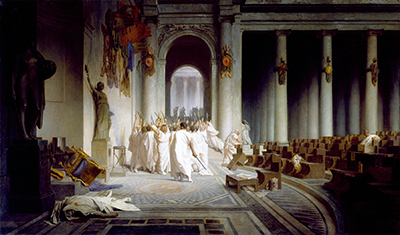
Sometimes the decisive event occurs before the viewer arrives. In The Death of Caesar, the assassins are already leaving while Caesar's body lies almost abandoned in the vast Senate chamber. In The Execution of Marshal Ney, the firing squad has moved out of view, leaving the body against a wall and turning aftermath into accusation. In Jerusalem, Christ himself is unseen; only the shadows of the crosses enter the foreground. Gérôme repeatedly withheld the obvious climax and asked traces, spaces and spectators to carry its force.
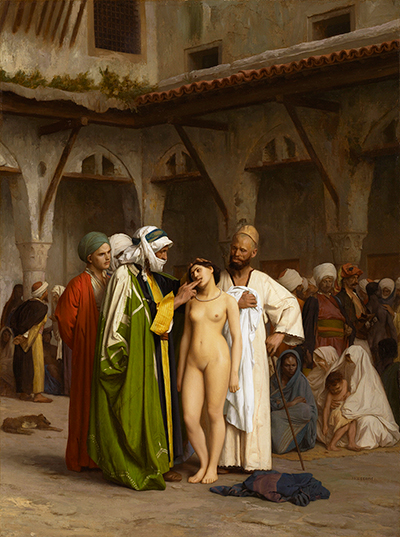
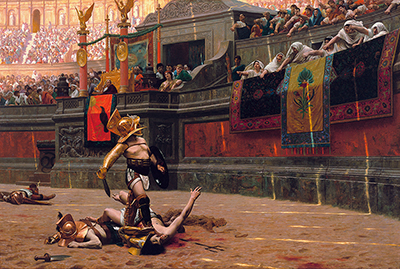
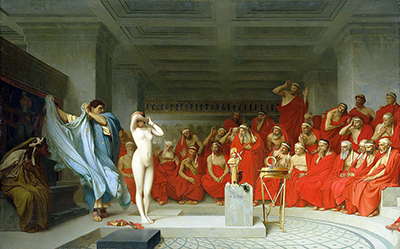
Elsewhere, he made looking part of the subject. Pollice Verso places a defeated gladiator beneath a crowd demanding death. Phryne before the Areopagus centres on a woman's exposed body and the reactions of men judging her. Three separate slave-market paintings organise human beings as objects of inspection and sale. The viewer never stands outside these systems of display. Gérôme's compositions often offer an extraordinarily clear view, but that privilege can be ethically uncomfortable.
His reconstructions should therefore be approached as arguments, not windows. Archaeological detail may reveal serious research while the scene as a whole remains invented, selective or based on a disputed historical tradition. The precision is part of how the argument persuades.
Travel, Collection and the Paris Studio
Gérôme travelled to Constantinople in 1853 and undertook a major journey in Egypt in 1856. Further travels took him through Egypt, the Holy Land, Asia Minor and other territories governed by the Ottoman Empire. He drew, collected objects and costumes, and used photographs made or gathered during these journeys. The material enlarged his store of visual evidence.[1][2]
It did not turn every later picture into eyewitness reportage. Gérôme could combine a remembered building, a studio model, textiles from a collection, photographic information and an invented event in one smooth pictorial world. The Paris studio was a place where fragments acquired during travel could be rearranged for viewers who might interpret finish as proof.
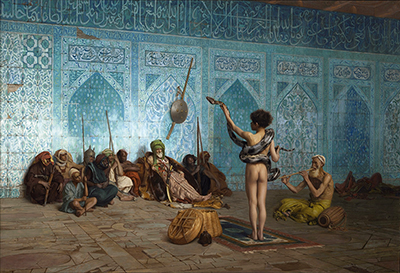
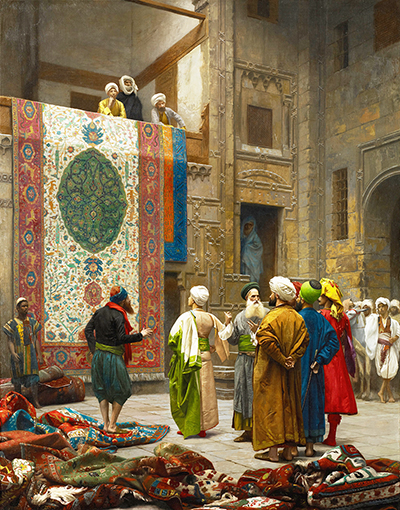
That distinction is central to his Orientalist paintings. In nineteenth-century European art, “Orientalism” describes a broad field of images concerned with North Africa, the Middle East and parts of the Ottoman world. These works emerged from travel and genuine curiosity, but also from unequal political relations, colonial expansion and a market eager for scenes of difference. Artists frequently mixed observed detail with fantasy.[4]
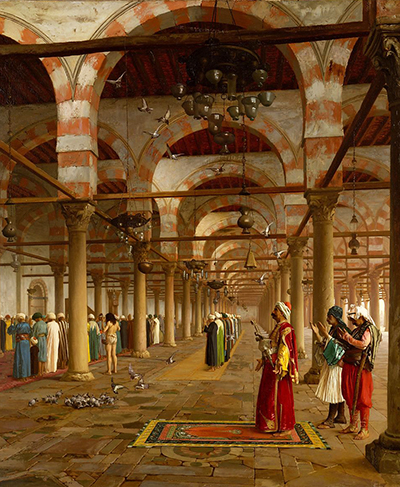
Gérôme's mosques, baths, markets, military figures and desert crossings must be read within that history. Prayer in the Mosque, for example, draws architectural material from Cairo but constructs a service Gérôme is unlikely to have witnessed in the form shown. Pool in a Harem offers entry to a gendered interior inaccessible to the male European painter. Bashi-Bazouk combines a studio model and assembled textiles into an identity made convincing through costume.
The problem is not solved by choosing between “accurate” and “imaginary.” A painting can describe individual surfaces accurately while constructing a broader fantasy. Modern study asks how Gérôme turned specific places, people and objects into images for European and American consumption, and how race, gender, religion, enslavement and colonial power structure the pleasure of looking.[4][5]
The Finished Surface
Gérôme's paintings are often described as highly finished. Brushwork recedes so that stone, skin, cloth and metal appear to occupy the picture without drawing attention to the paint that made them. This control distinguished his work from the visibly broken handling associated with Impressionism, but “smooth” does not mean mechanically uniform.
He used edges, colour and light to direct the eye. A bright body may be set against a darker crowd; a red garment may punctuate a carefully restrained setting; broad areas of stone or sand may delay access to the narrative. In the largest history paintings, architecture establishes hierarchy and scale. In small panels, concentrated textures can make the act of inspection feel intimate.
The polished surface is also rhetorical. By minimising visible revision, Gérôme gives reconstructed events an air of completion. The viewer sees the result, not the uncertainty behind it. Drawings, studies and related versions restore some of that hidden process. They show him testing poses, distributions of figures and changes of viewpoint before the finished picture closed over those decisions.
Goupil and the International Image Market
Gérôme's fame cannot be understood through Salon exhibitions alone. From 1859 he developed a close relationship with the art dealer and publisher Adolphe Goupil; in 1863 he married Goupil's daughter Marie. Through the Goupil network, his compositions circulated internationally as photographs, engravings and other reproductions, while original paintings reached wealthy collectors in Europe and the United States.[2]
Reproduction changed the scale on which a painting could operate. A privately owned canvas might become familiar to people who never saw it. The most successful compositions could exist simultaneously as singular objects, saleable photographs and points of reference in wider visual culture. Gérôme's careful contours and legible narratives adapted readily to such circulation.
This commercial reach contributed to both his renown and later criticism. Yet market success does not by itself explain the pictures. Reproduction belonged to the life of the work rather than serving as an afterthought. Gérôme worked at a moment when new image technologies were transforming how art acquired an audience. His career links the official Salon, the dealer's stock book, photography, print distribution and the rise of an international collecting public.[2][6]
Drawing and Teaching
Drawing underlies the apparent certainty of Gérôme's finished art. Surviving sheets range from rapid studies of bodies and animals to carefully organised compositional designs. They record different kinds of thought: looking, remembering, inventing and preparing.
His importance as a teacher extended that practice beyond his own studio. Appointed professor at the École des Beaux-Arts in 1864, Gérôme taught generations of French and international students. His pupils did not form a single stylistic school, but they encountered a system in which drawing, construction and close study of the figure were fundamental.[1]
The three-part Cours de dessin, published by Charles Bargue and Gérôme between 1867 and 1870, offered a sequence of lithographic plates for copying: first isolated parts and casts, then master drawings, and finally the living model.[7] The course has sometimes been treated as a transparent record of Gérôme's personal teaching. It is better understood as a collaborative publication connected to a wider academic culture. Even so, it demonstrates the value placed on disciplined looking and the gradual construction of form.
From Painted Sculpture to Coloured Marble
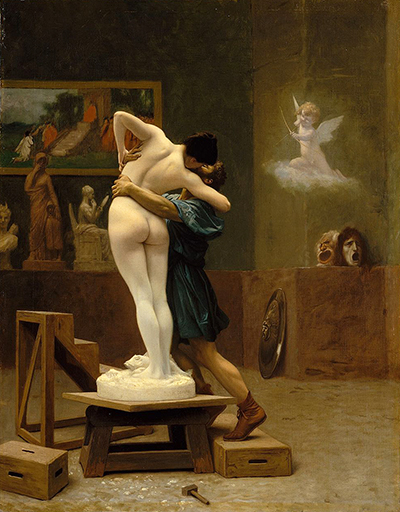
Gérôme's late turn to sculpture was not an abandonment of painting. It opened a conversation between the two media. The Musée d'Orsay dates his first exhibited sculpture, The Gladiators, to 1878. Thereafter sculpted bodies reappeared inside paintings, paintings imagined statues coming alive, and coloured surfaces complicated the usual division between white marble and living flesh.[2]
Around 1890 he developed Tanagra, a personification of the ancient figurines excavated in Greece. In Working in Marble, Gérôme represented himself sculpting the larger figure in a studio populated by his own works. Pygmalion and Galatea turned a myth of animation into a direct meditation on artistic making. Multiple painted viewpoints circle a body that also existed as a polychrome sculpture.
Polychromy was crucial to this experimentation. Ancient Greek and Roman sculptures could be painted, gilded or otherwise coloured; the whiteness admired by later European taste often resulted from loss. Gérôme applied pigmented wax to marble and explored colour in sculptural reductions.[2] His reconstructions were not neutral archaeological restorations, but they challenged the assumption that classical sculpture had always been pure white.
In these works, the old academic distinction between the arts becomes unstable. Sculpture provides volume; painting provides atmosphere, colour and transformation. Gérôme uses one medium to ask what the other can make believable.
Was Gérôme Anti-Modern?
Gérôme opposed Impressionism and resisted the official recognition of artists whose work he believed threatened standards he valued. That hostility is part of his history, not a footnote. It also helped later generations position him as everything modern art had rejected: smooth, anecdotal, institutional and commercial.[1][2]
But the label “anti-modern” becomes misleading if it ends the discussion. Gérôme engaged closely with photography, mechanical reproduction, international image markets and the visual appetites of a mass audience. In a 1902 preface he declared photography an art and credited it with forcing artists to abandon old routines and see what they had previously missed.[8] His polished technique differed from the avant-garde's, yet his career was deeply entangled with modern forms of image production and circulation.
His reputation declined during much of the twentieth century as academic painting fell outside dominant accounts of modern art. Later scholarship went beyond restoring an unfairly neglected master. It found in Gérôme a complex case through which to study spectatorship, Orientalism, gender, colonial power, archaeology, commerce and the relationship between elite painting and popular imagery.[5][6]
The result is a more demanding view. Technical brilliance cannot make the ideological structures of a picture disappear. Nor does criticism of those structures require ignoring the intelligence of its composition. Gérôme matters because his paintings make persuasion visible—sometimes seductively, sometimes disturbingly.
How to Explore Gérôme's Work
The paintings guide groups the works by subject and method, from Néo-Grec pictures and Roman spectacle to Orientalist scenes and late studio allegories. Individual artwork pages then provide the object facts, source traditions, close looking and cultural context particular to each composition.
The drawings guide follows the less visible work beneath the finished surfaces: figure studies, compositional sheets, observational drawing and the Bargue–Gérôme course. The verified quotations page separates Gérôme's own published words from conversations recollected after his death.
Across all these routes, accuracy is the beginning of inquiry rather than its end. Ask what kind of truth the picture claims, how it constructs that claim and where it places you as a viewer. His art rarely allows looking to remain passive.
Frequently Asked Questions
Discussion
Which detail in Jean-Léon Gérôme: Paintings, Sculpture and the Art of Spectacle most changes how you read Gérôme's balance of spectacle, evidence and invention?
Reader Insights
Which Gérôme painting best shows how polished surface can turn a staged scene into persuasive spectacle?
Compare the Roman, Orientalist and sculpture-related works to see how Gérôme returned to questions of looking, performance and authority.
Where does the page help you separate Gérôme's technical brilliance from the assumptions his images ask viewers to accept?
Join the Conversation
Share a thoughtful observation about Gérôme's paintings, sculpture, teaching or visual legacy that would help another reader look more carefully.
References
- Bibliothèque nationale de France. “Jean-Léon Gérôme (1824–1904): bibliographie sélective.” February 2025 View source.
- Musée d'Orsay. “The Spectacular Art of Jean-Léon Gérôme (1824–1904).” Exhibition presentation, 19 October 2010–23 January 2011 View source.
- Sotheby's. “Jean-Léon Gérôme, The Virgin, the Infant Jesus and Saint John.” European Art, lot 6, 2017; quoting and translating Théophile Gautier, La Presse, 27 April 1848 View source.
- Jennifer Meagher. “Orientalism in Nineteenth-Century Art.” Heilbrunn Timeline of Art History, The Metropolitan Museum of Art, October 2004 View source.
- Mary Roberts. “Gérôme in Istanbul.” In Scott Allan and Mary Morton, eds., Reconsidering Gérôme, pp. 118–134. Los Angeles: J. Paul Getty Museum, 2010 View source.
- Marc Gotlieb. “Gérôme's Cinematic Imagination.” In Scott Allan and Mary Morton, eds., Reconsidering Gérôme, pp. 54–64. Los Angeles: J. Paul Getty Museum, 2010 View source.
- Charles Bargue and Jean-Léon Gérôme. Cours de dessin. Three parts. Paris: Goupil, 1867–70. Gallica, Bibliothèque nationale de France: Part 1, Part 2, Part 3, View source 1 View source 2 View source 3.
- Jean-Léon Gérôme. Preface to Émile Bayard, Le Nu esthétique. Paris: Bernard, 1902. Bibliothèque nationale de France catalogue record View source.