

 by Tom Gurney
Tom Gurney BSc (Hons) is an art history expert with over 20 years experience
Published on June 19, 2020 / Updated on August 21, 2026
Email: tomgurney1@gmail.com / Phone: +44 7429 011000
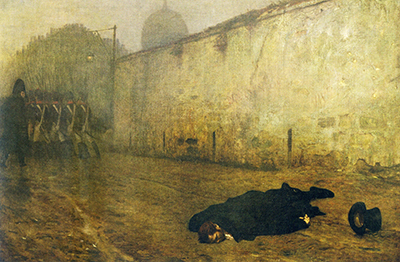
Marshal Michel Ney lies alone beside a stained wall. His hat has fallen; his body folds against the ground; the firing squad marches away at the far right. Jean-Léon Gérôme does not show the shots. He shows the first seconds in which a celebrated soldier has become an abandoned corpse.
Painted in 1867–68, the work was exhibited under a title precise enough to sound like an official record: 7 December 1815, Nine o'Clock in the Morning. The date and hour fix the historical event, while the composition refuses its heroic action. The viewer arrives after the executioners have turned their backs.[1][2]
Ney's death remained politically charged in nineteenth-century France. He had served Napoleon, accepted the restored Bourbon monarchy and then rejoined Napoleon during the Hundred Days. Convicted of high treason, he was shot near the Luxembourg Gardens on 7 December 1815.[3]
Gérôme transforms that contested memory into an image of aftermath, isolation and state violence.
At a Glance
- ArtistJean-Léon Gérôme
- Common titleThe Execution of Marshal Ney
- Salon title7 December 1815, Nine o'Clock in the Morning
- Date1867–68; some records use 1868
- MediumOil on canvas
- Dimensionsapproximately 65.2 × 104.2 cm (25 11/16 × 41 in.)
- CollectionSheffield Museums
- AccessionVIS.1844
- CatalogueAckerman 170[1][2]
The Event Has Already Happened
Ney's body occupies the lower left, close to the viewer. The firing squad appears far away, moving towards the opposite edge. The distance between them is the painting's central fact.
Gérôme uses the broad wall to separate death from procedure. Its stained surface stretches across the canvas like an impersonal barrier. Bullet marks or impact traces connect the body to the action that has just occurred, but no weapon remains pointed at him.
The soldiers' retreat prevents confrontation. They neither inspect the result nor acknowledge the viewer. Their orderly movement contrasts with the collapsed, irregular shape of Ney's body.
This is not a battlefield death surrounded by comrades. Ney wears civilian clothing and dies within a controlled state execution. The setting denies the military glory associated with his career.
The fallen hat contributes to that stripping of status. A marshal's identity survives in the title and historical knowledge; visually, Gérôme gives us a vulnerable body beside masonry.
7 December 1815
Michel Ney was one of Napoleon's most famous marshals. After Napoleon's first abdication, Ney pledged allegiance to Louis XVIII. When Napoleon returned from Elba in 1815, Ney changed sides and joined him. Following the defeat at Waterloo and the second Bourbon restoration, Ney was arrested and tried for high treason.[3]
The Chamber of Peers condemned him to death on 6 December. He was executed the following morning on the avenue de l'Observatoire. The French Senate's historical account records troops and a crowd gathered for the shooting.[3]
Gérôme suppresses most of those witnesses. The painting is not a complete illustrated report. It isolates the corpse, wall and departing squad to make the result more forceful than the public ceremony.
Accounts of Ney's final words vary and became part of his legend. The canvas does not require one version, and the manuscript should not turn a disputed phrase into a caption. Gérôme's silence is more reliable: whatever Ney said, the scene occurs after speech has ended.
The title's exact hour creates a documentary tone while the picture edits the event radically. Historical specificity and artistic selection work together.
Trial, Treason and Political Memory
Ney's execution divided opinion. To supporters of the restored monarchy, he had betrayed an oath and rallied to a returning usurper. To Bonapartists and later admirers, the Bourbon state punished one of France's greatest soldiers in a politically driven trial.
Gérôme painted more than fifty years after the event, during the Second Empire of Napoleon III. The Napoleonic past had become a field of national memory, official symbolism and popular legend.
The image does not stage a courtroom argument. Its sympathy emerges through composition. Ney is alone and physically close; the state's agents are anonymous and receding. The viewer remains with the person who has been killed.
That choice can encourage the interpretation of judicial murder, but the phrase should be presented as a political judgment rather than neutral fact. Gérôme makes the execution look cold and ignoble; he does not repaint the entire legal record.
The wall also avoids a triumphant Bonapartist monument. There is no imperial emblem, raised flag or heroic final pose. Memory is carried by damage and abandonment.
The First Sketch
The Fondation Custodia owns a study inscribed as Gérôme's first sketch for the Marshal Ney painting and dated 1867.[2] The compact drawing already explores the relation between the fallen body and the execution setting.
Comparing study and canvas shows that aftermath was not a last-minute avoidance of action. It belonged to the conception. Gérôme was interested in what remains when the firing stops.
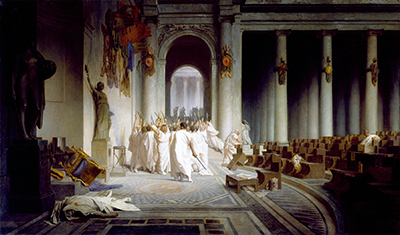
The Fondation connects the composition with The Death of Caesar: both show a famous man left after a politically charged killing while those responsible withdraw.[2] The comparison is useful, but the paintings remain distinct. Caesar's body lies in a reconstructed ancient Senate chamber; Ney falls beside a modern Paris wall.
The differences sharpen Gérôme's method. Monumental architecture makes Caesar's abandonment historical and theatrical. Blank masonry makes Ney's death immediate and stripped of ceremony.
The study is also evidence against the illusion that Gérôme's smooth paintings appeared fully formed. The final surface conceals the earlier search for placement, angle and balance.
A History Painting without Heroic Action
Traditional history painting often selected a decisive gesture: an oath, battle, sacrifice or death at its climax. Gérôme selects a consequence.
The body tells us that violence occurred. The marching squad tells us that the state has completed its task. The empty area between them turns completion into moral distance.
This choice makes the viewer reconstruct time. We imagine the command, volley and fall before the fixed instant; we imagine removal and burial afterwards. The canvas becomes one frame within a longer sequence.
Gérôme's contemporaries could read the title as a clock stopped at nine. The event is both precisely dated and permanently unfinished as a question of justice.
The absence of melodramatic gesture makes small details more important. A hat, wall mark or soldier's receding back carries information that a crowded execution scene might obscure.
The Ethics of the Viewpoint
The viewer stands close to Ney, approximately at the level of the body, while the squad recedes. This position assigns sympathy without a visible mourner.
No figure inside the painting responds to the death. The audience must supply recognition. Gérôme turns historical spectatorship into an encounter between viewer and corpse.
At the same time, the picture offers visual access to a man's death as a spectacle. The formal beauty of the wall, restrained colour and calibrated distance can aestheticise political violence.
The work's ethical force lies in that tension. It condemns or questions abandonment through an image whose control makes abandonment compelling to look at.
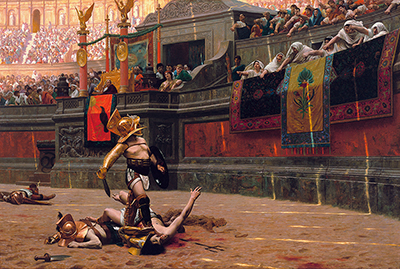
Unlike Gérôme's arena crowds, there is no painted audience to absorb blame. We occupy the only sustained position of witness.
Artist Up Close
Begin with Ney's hat and body. Notice how fallen objects replace the ceremonial signs of a marshal.
Then follow the wall towards the firing squad. Gérôme uses empty masonry to turn physical distance into moral separation.
Finally, read the full title again. Its exact date and hour sound documentary, while the canvas presents a highly selective aftermath. The friction between record and composition is the work's strength.
Frequently Asked Questions
Discussion
Which detail in The Execution of Marshal Ney most changes how you read Gérôme's balance of spectacle, evidence and invention?
Reader Insights
Which detail in The Execution of Marshal Ney most changes how you read the scene's balance of evidence, staging and spectacle?
Set this page beside the Gérôme biography, paintings overview and related works to test how travel, studio practice and the Salon shaped the image.
What should a careful modern reading preserve, question or leave uncertain when looking at this work today?
Join the Conversation
Share a thoughtful observation about The Execution of Marshal Ney, Gérôme's method, or the wider context that would help another reader look more carefully.
References
- Sheffield Museums. “The Execution of Marshal Ney.” Collection record, VIS.1844 View source.
- Fondation Custodia. “Study for ‘The Execution of Marshal Ney.’” Collection record, 2015-T.3 View source.
- Sénat. “Le procès du maréchal Ney: L'exécution.” Historical dossier on the execution of 7 December 1815 View source.