

 by Tom Gurney
Tom Gurney BSc (Hons) is an art history expert with over 20 years experience
Published on June 19, 2020 / Updated on August 21, 2026
Email: tomgurney1@gmail.com / Phone: +44 7429 011000
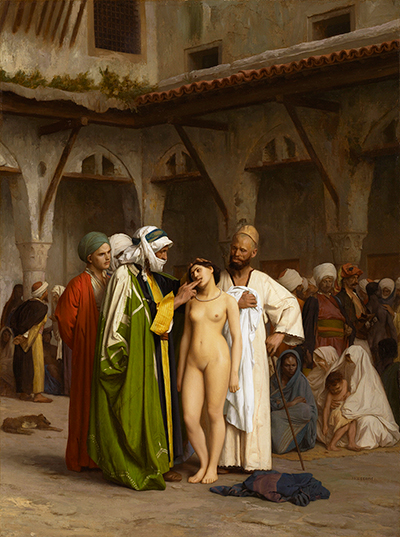
A man forces open a woman's mouth to inspect her teeth. She stands naked on a raised platform while clothed buyers gather below. Jean-Léon Gérôme renders skin, stone, textiles and gesture with great control, but the scene's apparent clarity serves an act of dehumanisation: a person is being examined as merchandise.
Painted in 1866, The Slave Market is one of Gérôme's best-known Orientalist works and one of his most ethically difficult. Its power comes from the collision between polished beauty and organised violence. The painting does not show enslavement as abstract history. It makes bodily inspection its central action and offers the modern museum viewer a position disturbingly close to that of the buyers.
The picture contains observed or researched details, yet the Clark Art Institute's scholarly catalogue demonstrates that its setting and figures were constructed from varied sources. It should not be treated as a neutral record of one market Gérôme witnessed. It is a European image of slavery, made for sale to viewers whose access to the scene was part of its appeal.[1]
At a Glance
- ArtistJean-Léon Gérôme
- TitleThe Slave Market
- Date1866
- MediumOil on canvas
- Dimensions84.6 × 63.3 cm (33 5/16 × 24 15/16 in.)
- CollectionClark Art Institute, Williamstown, Massachusetts
- Accession1955.53
- CatalogueAckerman 111[1]
Inspection as the Centre of the Painting
The woman's body forms a bright vertical against the worn architecture. Gérôme makes her exposure total. She has no garment, barrier or shadow sufficient to withdraw her from inspection. The man beside her controls her head with one hand and reaches into her mouth with the other.
The gesture resembles the examination of an animal's health and age before purchase. It denies speech at the same moment that it inspects the mouth. Her body is made available to touch and vision, while her capacity to answer is physically suppressed.
Below the platform, potential buyers occupy a lower spatial position but hold the social power. Their clothing, weapons and concentrated gazes contrast with her nakedness. Gérôme gives them individual poses without allowing any to interrupt the sale. The market operates through their attention.
The raised stone slab functions like a stage. It separates the woman from the group, ensures that her body can be seen and turns the market into a performance. The damaged wall and doorway behind her suggest an aged urban setting, but Gérôme does not give enough secure evidence to identify one exact place. The architecture produces credibility and enclosure rather than a verifiable address.
Colour intensifies the unequal roles. Pale flesh receives strong light; layered garments carry darker reds, whites and earth tones. The formal contrast is visually effective because it is also political. The enslaved person is stripped of social markers while those evaluating her retain clothing, mobility and collective authority.
A Constructed Market
Gérôme travelled in Egypt and other Ottoman territories and returned with drawings, photographs, objects and memories that could be used in Paris. The Clark catalogue identifies his wider practice of combining such material rather than documenting every scene as a single observed event.[1]
That distinction is especially important here. A work about slavery can gain authority from the viewer's belief that “this is exactly what happened.” Gérôme's finish encourages that belief. Stone looks worn, textiles look specific and the inspection gesture looks captured from life. Yet plausibility has been produced by arrangement.
The painting may reflect knowledge of slave trading that continued within the nineteenth-century Ottoman world, while its composition also belongs to European artistic and literary traditions of imagining markets, harems and exposed women. The Clark's catalogue discusses proposed textual and visual sources without reducing the work to one securely proven incident.[1] Any source relationship must therefore be described as evidence or possibility, not as an eyewitness origin story.
Studio construction does not mean the subject was wholly fictitious. Enslavement and slave trading were historical realities. The question is how Gérôme selected and staged that reality for viewers situated outside it. The painting compresses a complicated institution into one sexualised inspection, making a woman's exposed body the principal carrier of its claim to truth.
Slavery, Gender and Racialisation
The painting's title identifies the system clearly: this is a market in people. Its composition then makes gender central to how that system is visualised. A naked woman is surrounded by clothed men who can look, touch, judge and purchase.
The scene links commercial possession to sexual access. Even if no explicit sexual act occurs, the woman's forced nudity and the scrutiny of male buyers position her body as both commodity and spectacle. The intended European or American viewer receives a comparable visual privilege without appearing inside the market.
Race also structures the image, though the figures' precise identities should not be assigned from skin or costume alone. Nineteenth-century Orientalist art often organised bodies through visual hierarchies that presented non-European people as types. In Gérôme's painting, differences of skin, clothing and role help produce an imagined social order legible to a Western market.[2]
These issues cannot be solved by praising technical skill and then adding a warning. They are inside the technique. Gérôme's control of texture makes the woman's skin available to prolonged viewing; his clear spatial arrangement makes the act of sale immediately understandable; his suppression of visible brushwork makes construction feel like observation.
The result is not a contradiction between form and politics. Form is how the politics of looking becomes persuasive.
Orientalism and the Privileged Viewer
Orientalism in nineteenth-century art involved more than pictures with Middle Eastern or North African settings. It was a system through which European artists and audiences represented diverse societies during an age of colonial expansion and unequal power. Travel could provide real knowledge, while fantasy, commerce and inherited stereotypes shaped what audiences expected to see.[2][3]
Linda Nochlin's influential essay “The Imaginary Orient” drew attention to Gérôme's apparent absence of modern European presence from such scenes. The Western viewer can imagine witnessing a self-contained, timeless world without confronting the political conditions that made this access possible.[3] That argument became a major point of departure for later discussion, although subsequent scholarship has added more detailed accounts of travel, objects, photography, Ottoman contexts and the art market.
The Slave Market exemplifies the problem of invisible access. No European tourist stands beside the buyers, yet the composition grants the external viewer an unimpeded view. The audience can inspect everyone while remaining uninspected.
The painting's later museum setting changes but does not erase that structure. A present-day viewer may condemn the sale, study Gérôme's method or examine the history of Orientalism. The visual invitation to look at the exposed body still remains. Responsible viewing begins by recognising that invitation rather than pretending critical distance makes it disappear.
Three Different Slave-Market Paintings
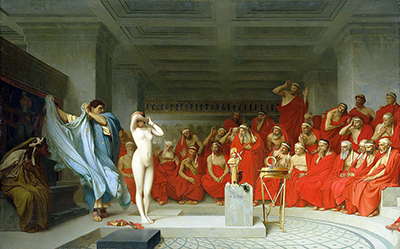
Gérôme's repeated use of the subject can cause title confusion. This 1866 Clark painting is the Orientalist Slave Market. It is distinct from two works of about 1884 set in ancient Rome.
The State Hermitage Museum owns a vertical composition often titled Slave Market in Ancient Rome or Sale of a Slave Woman. The Walters Art Museum owns A Roman Slave Market, in which an auctioneer presents an exposed woman to a crowded audience. Different dimensions, collections, compositions and cultural settings establish three separate objects.[1][4]
The distinction matters for interpretation. All three paintings organise human display and sale, but “Rome” can displace violence safely into antiquity while the 1866 work placed slavery within Gérôme's nineteenth-century Orientalist field. Their shared premise should not erase their different historical claims.
Beauty and Violence
Gérôme's refinement can make the picture difficult to categorise emotionally. The surfaces are beautiful; the event is brutal. Treating the beauty as an accidental wrapper would underestimate how the painting works.
The viewer is drawn by colour, finish and controlled composition. Those pleasures prolong attention to the woman's exposure. At the same time, the invasive examination is so central that it resists becoming mere decoration. The picture makes aesthetic attraction and moral repulsion coexist.
This tension does not guarantee that Gérôme intended a critique of slavery. The painting offers no rescuing figure, no clearly marked abolitionist argument and no release from the market's visual order. Its ethical force for modern audiences arises from what it shows and how it positions us, not from an unproven claim about the artist's private verdict.
We can acknowledge the painting's formal intelligence without allowing that intelligence to neutralise its subject. We can also criticise its unequal spectatorship without pretending the picture has lost its ability to persuade. The work remains important because it demonstrates how visual mastery can make domination look authoritative.
Artist Up Close
Begin with the two hands at the woman's face. One controls her head; the other enters her mouth. Gérôme compresses the market's violence into a gesture small enough to be missed if the naked body alone holds attention.
Then compare the platform with a theatrical stage. The stone raises the woman for collective sight while the wall behind her prevents retreat.
Finally, locate your own viewpoint. You are close enough to inspect the inspection, yet no figure can return your gaze in a way that threatens your position. That security is part of the painting's historical meaning.
Frequently Asked Questions
Discussion
Which detail in The Slave Market most changes how you read Gérôme's balance of spectacle, evidence and invention?
Reader Insights
Which detail in The Slave Market most changes how you read the scene's balance of evidence, staging and spectacle?
Set this page beside the Gérôme biography, paintings overview and related works to test how travel, studio practice and the Salon shaped the image.
What should a careful modern reading preserve, question or leave uncertain when looking at this work today?
Join the Conversation
Share a thoughtful observation about The Slave Market, Gérôme's method, or the wider context that would help another reader look more carefully.
References
- Clark Art Institute. “Slave Market.” In Sarah Lees, ed., Nineteenth-Century European Paintings at the Sterling and Francine Clark Art Institute, vol. 1, collection catalogue, object 1955.53 View source.
- Jennifer Meagher. “Orientalism in Nineteenth-Century Art.” Heilbrunn Timeline of Art History, The Metropolitan Museum of Art, October 2004 View source.
- Linda Nochlin. “The Imaginary Orient.” Art in America 71, no. 5 (May 1983): 118–31, 187–91. Reprinted in The Politics of Vision. New York: Harper & Row, 1989
- Walters Art Museum. “A Roman Slave Market.” Collection record, 37.885 View source.