

 by Tom Gurney
Tom Gurney BSc (Hons) is an art history expert with over 20 years experience
Published on June 19, 2020 / Updated on August 21, 2026
Email: tomgurney1@gmail.com / Phone: +44 7429 011000
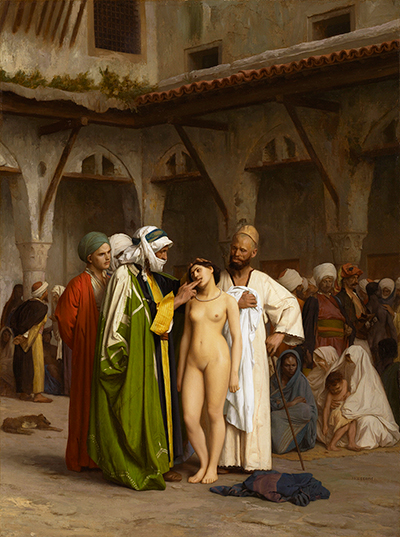
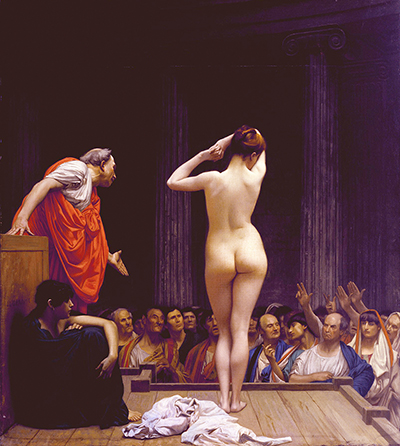
An auctioneer presents a naked woman to a mass of reaching men. She stands above them, but elevation gives her no power. One arm covers her face; the other is held or directed by the seller as the crowd converts inspection into bids.
Jean-Léon Gérôme painted A Roman Slave Market around 1884. The ancient setting gives the scene the prestige of history painting, while the exposed body supplies its visual centre. The Walters Art Museum's current interpretation addresses that double function directly: Gérôme foregrounds the sensuality of the nude and his slave-market images circulated as prints and photographs, offering titillation despite their brutal subject.[1]
The work is not a neutral archaeological reconstruction, nor can it be reduced to an attractive nude with an unfortunate title. Display, sale and spectatorship are the composition.
At a Glance
- ArtistJean-Léon Gérôme
- TitleA Roman Slave Market
- Dateca. 1884
- MediumOil on canvas
- Dimensions64.1 × 56.9 cm (25 1/4 × 22 3/8 in.)
- CollectionWalters Art Museum, Baltimore
- AccessionAcquired by Henry Walters, 1917; 37.885[1]
The Woman and the Crowd
Gérôme compresses the market into a confrontation between one standing body and many faces. The woman occupies open space on the platform, brightly visible against the darker mass below. The buyers overlap so densely that individual bodies become difficult to separate.
Their hands break out of the crowd. Some point or bid; others appear to reach. Gérôme uses repeated arms and faces to turn commercial desire into physical pressure. The woman is not touched by every man, but their attention surrounds her.
Her covered face creates an asymmetry. She cannot see those assessing her, while they can examine her without obstruction. The gesture suggests humiliation and refusal, yet it also leaves her body more anonymous and available to the painting's external viewer.
The auctioneer mediates the exchange. Positioned close to her, he controls presentation and directs attention. His clothed body marks his freedom of movement; her nakedness identifies forced availability.
The architecture is secondary to this human arrangement. Gérôme supplies enough stone and setting to establish antiquity, but the picture's real structure is a theatre: raised performer, active presenter and responsive audience.
Drawings before the Finished Canvas
The Walters preserves related studies that make Gérôme's process unusually visible. Study for “Slave Market at Rome” (37.2620) concerns the broader composition, while Study for “The Roman Slave Market” (37.2783) focuses on the standing female figure.[2][3]
The figure study once belonged to a notebook associated with Aimé Morot, Gérôme's pupil and son-in-law, before the notebook was dismembered.[3] Its current separation limits any attempt to reconstruct a complete sequence, but the museum's title securely connects the pose to the painting.
In graphite, the woman's body can be examined as a problem of balance, contour and weight. In the finished scene, those formal decisions become the means by which an enslaved person is exposed for sale. Preparation does not sit outside the ethical meaning. It shows how deliberately Gérôme constructed the focal body.
The drawings also challenge the apparent effortlessness of the painted surface. The final canvas suppresses hesitation, while the studies preserve stages of search. Gérôme's visual certainty was made through repeated decisions.
Roman Slavery and the Nineteenth-Century Nude
Slavery was widespread in ancient Roman society. People entered enslavement through birth, warfare, sale, punishment, kidnapping and other routes, and they came from many ethnic and geographical backgrounds. Roman law treated enslaved people as property, even though their occupations and personal experiences varied greatly.[4]
The historical reality gives Gérôme's subject a basis, but it does not dictate his composition. The painting selects a young, light-skinned female nude as the exemplary body of Roman sale. That choice belongs to the nineteenth-century visual culture in which classical subject matter could authorise nudity for Salon and collecting audiences.
The Walters notes that Gérôme's emphasis may also have resonated with contemporary European fascination with enslaved Circassian women after Russia's conquest of the Caucasus, but presents this as a possible influence rather than a secure identity for the figure.[1] The woman should not be labelled Circassian as fact.
Her body therefore carries several histories at once: actual Roman enslavement, the academic nude, nineteenth-century interest in racialised beauty and the market for reproduced Orientalist and classical images.
Titillation and Moral Distance
Ancient Rome can operate as a shield. Viewers may condemn a civilisation safely separated from their own time while continuing to inspect the body the painting makes available.
Gérôme complicates that comfort by showing the woman's shame. Her covered face makes coercion impossible to miss. Yet the same gesture prevents reciprocal looking and allows her nude body to remain the composition's most sustained visual attraction.
This tension is why the Walters' discussion of titillation matters.[1] The painting's circulation through prints and photographs took the image beyond the owner of the original canvas. A scene of brutal sale could be reproduced, purchased and viewed through the language of high art.
It would be too easy to conclude that the distress automatically makes the work a condemnation. No rescuing figure appears; no viewer inside the market refuses the transaction. It would be equally reductive to say that the painting contains no critical force. The crowd's leering compression and the woman's self-protective gesture expose the humiliation clearly.
The work remains unresolved because exposure functions as both subject and attraction.
The Market and the Art Market
At the level of narrative, buyers compete for the woman. Outside the image, collectors and consumers encountered the painted or reproduced nude. The analogy is not exact—an artwork is not a person—but Gérôme's composition encourages reflection on the language shared by the two systems: display, inspection, desire and purchase.
Gérôme's relationship with Goupil helped his images travel through photographs and mechanical reproductions. The Walters records that female slave-market subjects circulated widely.[1][5] Reproduction multiplied the number of viewers who could occupy the crowd's position without being present before the original.
That afterlife belongs to the painting's meaning. A carefully rendered ancient market became a modern commodity. Its polished surface and legible drama were well suited to circulation.
The result also demonstrates why provenance and reproduction history should accompany visual analysis. The scene does not stop at the frame. It enters economic networks that echo, in altered and ethically unequal ways, its own focus on viewing and possession.
Three Markets, Three Objects
This Walters painting is often confused with Gérôme's other slave markets. The State Hermitage Museum owns a larger vertical canvas, Slave Market in Ancient Rome, dated 1884 and populated by several exposed and waiting figures. The Clark Art Institute owns the 1866 Orientalist The Slave Market, in which a woman's teeth are inspected.[6]
The Walters work is the compact Roman composition: approximately 1884, 64.1 × 56.9 cm, accession 37.885.[1] Its concentrated crowd and single standing woman distinguish it from the Hermitage scene.
Keeping the objects separate prevents borrowed dimensions and false narratives. It also allows comparison to become meaningful. Gérôme repeatedly altered the number of bodies, the cultural setting and the mechanics of looking while preserving sale as the central violence.
Artist Up Close
Begin with the woman's covered face. Her arm removes identity at the moment her body is most public.
Then count how many hands emerge from the crowd. Their repetition makes desire collective and turns the buyers into a single force.
Finally, move mentally from the graphite figure study to the finished canvas. The pose was carefully built before it became the centre of an imagined auction. Technique and meaning cannot be separated.
Frequently Asked Questions
Discussion
Which detail in A Roman Slave Market most changes how you read Gérôme's balance of spectacle, evidence and invention?
Reader Insights
Which detail in A Roman Slave Market most changes how you read the scene's balance of evidence, staging and spectacle?
Set this page beside the Gérôme biography, paintings overview and related works to test how travel, studio practice and the Salon shaped the image.
What should a careful modern reading preserve, question or leave uncertain when looking at this work today?
Join the Conversation
Share a thoughtful observation about A Roman Slave Market, Gérôme's method, or the wider context that would help another reader look more carefully.
References
- Walters Art Museum. “A Roman Slave Market.” Collection record, 37.885 View source.
- Walters Art Museum. “Study for ‘Slave Market at Rome.’” Collection record, 37.2620 View source.
- Walters Art Museum. “Study for ‘The Roman Slave Market.’” Collection record, 37.2783 View source.
- British Museum. “Slavery in Ancient Rome.” Nero: The Man Behind the Myth View source.
- Musée d'Orsay. “The Spectacular Art of Jean-Léon Gérôme (1824–1904).” Exhibition presentation, 19 October 2010–23 January 2011 View source.
- Clark Art Institute. “Slave Market.” In Sarah Lees, ed., Nineteenth-Century European Paintings at the Sterling and Francine Clark Art Institute, object 1955.53 View source.