


 by Tom Gurney
Tom Gurney BSc (Hons) is an art history expert with over 20 years experience
Published on June 19, 2020 / Updated on August 21, 2026
Email: tomgurney1@gmail.com / Phone: +44 7429 011000
A woman's head fills a circular field. Ram's horns curve from her hair, joining human beauty to animal form without supplying a complete myth. Jean-Léon Gérôme's painting is often called La Bacchante, but the French national collection record uses the more exact title Tête de femme coiffée de cornes de bélier—Head of a Woman Wearing Ram's Horns.[1]
Signed and dated 1853, the work is an oil-on-canvas tondo 47.5 centimetres in diameter. It is a painting, despite the sculptural concentration of its cropped head and the temptation to treat it as a relief or decorative medallion.[1]
The image's force lies in suspended identity. Is this a follower of Bacchus, a theatrical masquerade, an allegory or an invented ancient portrait? The horns encourage interpretation but do not settle it.
At a Glance
- ArtistJean-Léon Gérôme
- Controlled titleHead of a Woman Wearing Ram's Horns
- French titleTête de femme coiffée de cornes de bélier
- Alternative titleLa Bacchante
- Date1853
- MediumOil on canvas
- FormatTondo
- Diameter47.5 cm (18 11/16 in.)
- CollectionMusée d'Arts de Nantes
- Inventory987
- AcquisitionPurchased at the Salon; acquired 1854[1]
A Face inside a Circle
The circular format changes how a portrait can behave. There are no stable corners and little space for background narrative.
The curve gathers attention towards face, hair and horns. Everything appears contained within a self-sufficient emblem.
Cropping increases immediacy. The viewer cannot follow the figure into a full pose or environment, so identity must be inferred from expression and attribute.
The tondo also recalls antique medallions, Renaissance portrait forms and decorative architectural roundels. Gérôme uses that history without making the work imitate one specific ancient object.
Circle and head reinforce one another: both are read as complete forms even when the body is absent.
Horns as Attribute and Ornament
The ram's horns are the painting's decisive interruption. Without them, the image might be a refined female head; with them, portrait becomes mythic or allegorical.
Their curve echoes the tondo's boundary. Animal anatomy is integrated into decorative design.
Horns carried many associations in ancient Mediterranean cultures, including divinity, sacrifice, fertility, wilderness and power. Ram's horns could belong to different gods and symbolic traditions.
The cited museum record does not assign Gérôme's woman to one named deity or ritual.[1] It would therefore be misleading to treat the horns as a code with only one answer.
Their ambiguity is productive. They make the head strange while leaving her self-possession intact.
Why “La Bacchante”?
A Bacchante is a female follower of Bacchus, the Roman god identified with the Greek Dionysus. In art and literature, Bacchantes or maenads can represent ecstatic worship, dance, wine and the loosening of ordinary social control.
The alternative title places Gérôme's figure within that imaginative field. It encourages viewers to read her beauty as charged by ritual or intoxication.
Yet the painting does not show a dance, thyrsus, wine vessel, procession or violent frenzy. The woman is isolated from narrative evidence.
La Bacchante should therefore remain an established interpretive title rather than proof that one episode of Dionysian myth is represented.
The more descriptive museum title has an advantage: it records exactly what can be verified—a woman's head and ram's horns.
Calm versus Ecstasy
The Bacchante tradition often emphasises movement. Gérôme's tondo suppresses the body that would dance.
This creates tension between title and form. Ecstasy is imagined through attribute, while the visible head remains composed enough for prolonged study.
The stillness may make the figure more uncanny. An outwardly calm woman bears signs of a force beyond ordinary identity.
Gérôme's finish contributes to this containment. Line and surface are controlled, leaving little trace of painterly frenzy.
Instead of depicting Dionysian abandon, he makes it latent. Myth has been compressed into portrait scale.
Painting That Resembles Sculpture
The isolated head and round format can recall a relief, cameo or architectural ornament. Gérôme's modelling gives face and horns a sense of volume.
But the French state record is unambiguous: the domain and object type are painting, the support is canvas and the technique is oil.[1]
This medium matters. Light, flesh and material are created through colour on a flat surface rather than carved projection.
The work anticipates Gérôme's later fascination with the boundary between painting and sculpture. Decades before he exhibited sculpture, he was already making painted bodies feel object-like.
Correctly naming the medium allows that illusion to be appreciated. The tondo looks sculptural because painting has made it so.
1853 and Gérôme's Early Career
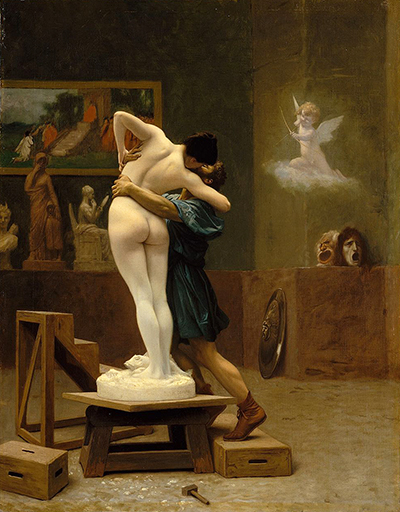
Gérôme completed the work six years after his Salon breakthrough with Young Greeks Attending a Cock Fight. He remained associated with refined antique subjects and the Néo-Grec taste for archaeological intimacy.
The Bacchante belongs to this world without presenting an entire ancient room. It condenses antiquity into a face and attribute.
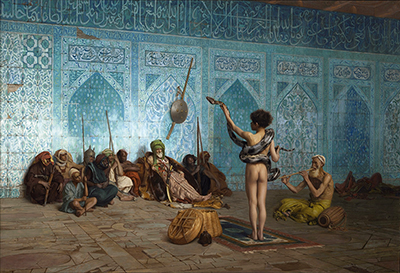
In 1853 Gérôme also made a short visit to Constantinople, but no cited source ties this particular mythic head to that journey. Its classical language should not be forced into travel biography.
The work instead demonstrates his range within a compact format. He could create a Salon object from iconographic uncertainty rather than elaborate narrative.
Its purchase for Nantes soon after exhibition gave it an early public collection history.[1]
Beauty, Otherness and the Female Head
The painting invites aesthetic inspection of a woman's face while denying her a personal name. The horns make her more memorable and less socially ordinary.
This combination belongs to a long tradition in which female bodies embody abstract forces—beauty, nature, temptation or ecstasy—rather than individual lives.
Gérôme's cropping intensifies that transformation. Without hands, clothing or setting, the figure cannot act outside the identity assigned by title and attribute.
At the same time, her facial presence can resist complete reduction to symbol. Expression remains available to interpretation.
The work holds person and emblem together. The viewer is asked to look at a woman and at an idea made through her.
From Salon Purchase to Nantes
The canvas is signed and dated 1853. The French collection record states that it was purchased at the Salon and entered the Nantes museum in 1854.[1]
Its inventory number is 987. The municipal ownership and early acquisition provide a clear continuity absent from many Gérôme works that moved repeatedly through private markets.
Public status also helps preserve the descriptive title and object type. Later reproductions may favour the shorter La Bacchante, but the museum record keeps material facts visible.
The title pair should be used together. One offers iconographic tradition; the other protects direct description.
That balance suits a painting whose mystery depends on both what it shows and what it withholds.
Artist Up Close
Begin with the outer edge and follow the horns' curve. Gérôme makes attribute and format echo one another.
Then imagine the head without the horns. Notice how completely those forms change genre from portrait to mythic image.
Finally, study the modelling of face and hair. The painting produces a sculptural impression without leaving the flat canvas.
Frequently Asked Questions
Discussion
Which detail in Head of a Woman Wearing Ram's Horns (La Bacchante) most changes how you read Gérôme's balance of spectacle, evidence and invention?
Reader Insights
Which detail in Head of a Woman Wearing Ram's Horns (La Bacchante) most changes how you read the scene's balance of evidence, staging and spectacle?
Set this page beside the Gérôme biography, paintings overview and related works to test how travel, studio practice and the Salon shaped the image.
What should a careful modern reading preserve, question or leave uncertain when looking at this work today?
Join the Conversation
Share a thoughtful observation about Head of a Woman Wearing Ram's Horns (La Bacchante), Gérôme's method, or the wider context that would help another reader look more carefully.
References
- French Ministry of Culture, POP/Joconde. “Jean-Léon Gérôme, Tête de femme coiffée de cornes de bélier.” Collection record, Musée d'Arts de Nantes, inventory 987 View source.