

 by Tom Gurney
Tom Gurney BSc (Hons) is an art history expert with over 20 years experience
Published on June 19, 2020 / Updated on August 21, 2026
Email: tomgurney1@gmail.com / Phone: +44 7429 011000
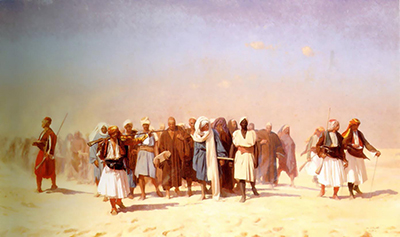
A line of men advances through blowing sand. Some are linked at the wrists; mounted guards move beside them; other bodies fade into the dust until the procession nearly disappears. Jean-Léon Gérôme's Egyptian Recruits Crossing the Desert presents military recruitment as compulsion, exposure and exhausting movement rather than patriotic spectacle.
Gérôme signed and dated the painting in 1857, the year it appeared at the Paris Salon. He had returned from his first extended journey in Egypt with sketches, photographs and remembered encounters. Yet the canvas is a composed work made for exhibition, not an unedited report from the road.[1][2]
Its power comes from a visual contradiction. Gérôme's foreground is sharply observed, while the people at the rear lose their identities in sand. The state counts recruits; the desert makes them vanish.
At a Glance
- ArtistJean-Léon Gérôme
- TitleEgyptian Recruits Crossing the Desert
- French Salon titleRecrues égyptiennes traversant le désert
- Date1857
- MediumOil on canvas
- Dimensions62 × 106 cm (24 1/4 × 41 3/4 in.)
- Current statusPrivate collection following its 2021 sale
- CatalogueAckerman 67
- ExhibitedParis Salon, 1857, no. 1157[1]
A Procession without a Hero
The painting stretches horizontally because its subject is a line. Gérôme does not organise the recruits around a single commanding figure. Movement passes from body to body and continues beyond the visible group.
At the front, men bend against the conditions. Their garments, feet and restraints are legible. Mounted guards occupy a different physical level, their elevation turning supervision into a structural fact.
Farther back, distinction collapses. The wind absorbs edges, colour and faces. A group becomes a sequence of marks and then an atmospheric trace.
This recession refuses the usual military promise of ordered ranks. The procession is controlled by guards, but the desert makes that control look precarious. Dust breaks the line even while compulsion keeps it moving.
There is no arrival in view. Gérôme gives neither barracks nor town, and the destination remains unknown. The painting makes crossing itself the event.
Recruits, Restraints and Coercion
The title calls the men recruits, while the visible bonds make clear that enlistment is not voluntary. Sotheby's has described them as conscripts and, in its later press account, as handcuffed prisoners being led under guard.[1][2]
Those terms illuminate different aspects of the same image but should not be collapsed. “Recruit” names a military destination; “prisoner” interprets the conditions of transport. The canvas supplies restraints, guards and forced progress, not the biographies or legal status of each individual.
Gérôme does not depict an abstract policy document. He shows what coercion feels like in bodies: shortened steps, lowered heads, limited movement and dependence on armed escorts.
His controlled finish intensifies rather than sensationalises the suffering. There is no central outcry. Hardship is distributed across the line, allowing the eye to discover it gradually.
The result can evoke compassion without making the painter a neutral witness. Gérôme selected the viewpoint, arranged the spacing and converted an encounter into a Salon picture for European viewers.
The Desert as an Active Force
Many nineteenth-century desert scenes use empty space to promise freedom, danger or sublime solitude. Here the landscape works upon people already deprived of choice.
Dust is the painting's most active element. It enters eyes and lungs, hides the ground and erases the rear of the column. Gérôme makes air visible by showing what it removes.
The precise foreground and dissolving distance produce two kinds of time. Nearby figures are caught in an exact instant; distant ones seem to have been walking indefinitely.
The low, restricted palette binds bodies to earth. Colour does not offer release from the conditions. Even garments that can be distinguished at the front lose intensity as they recede.
This atmosphere prevents the desert from becoming decorative scenery. It is part of the coercive system represented: an environment through which vulnerable people are forced to travel.
Travel, Sketches and Photographs
Gérôme travelled in Egypt in 1856 with artists including Frédéric Auguste Bartholdi. The journey supplied studies and visual material for several works exhibited in 1857.[1]
Sotheby's attributes the origin of this composition to a scene Gérôme encountered at Asyut and says that sketches and photographs informed the finished work.[2] That is valuable provenance for the idea, but it does not make every arrangement on the canvas eyewitness fact.
Photographs can preserve bodies, clothing and terrain while still reflecting a camera's placement and a photographer's decisions. A painter can then separate, combine or reorder those elements.
Gérôme's academic construction is visible in the clarity of the foreground group and the calculated loss of information behind it. Observation provides the vocabulary; composition creates the argument.
The distinction matters especially in Orientalist art. Travel gave European artists forms of access unavailable to viewers at home, and the art market turned that access into authority. Detailed surfaces could persuade audiences that they were seeing Egypt directly, even when a scene had been rebuilt in Paris.[3]
The 1857 Salon and a Medium Correction
The canvas appeared at the Paris Salon of 1857 as no. 1157. It belonged to a group of Egyptian subjects that established Gérôme as a major painter of the region soon after his first journey.[1]
Its support requires a small but important correction. Older catalogues, including entries derived from Ackerman, described the work as painted on panel. The 2021 Sotheby's record, prepared with assistance from catalogue-raisonné specialist Emily M. Weeks, identifies oil on canvas.[1]
Current examination of the object should outrank inherited repetition. The correction also helps keep this large horizontal work distinct from Gérôme's many smaller Orientalist panels.
The painting has a complex private provenance and has appeared repeatedly on the market. After belonging to the Najd Collection, it was offered by Sotheby's in 2021 and remains privately held; the public record does not identify its current owner.[1]
Compassion and the Colonial Gaze
The recruits are the painting's emotional subject, but they do not control how their situation is explained. Gérôme gives them no names, voices or destination. Their suffering is made available to a distant exhibition audience.
That imbalance does not cancel the sympathy in the composition. It defines its limits. The canvas can condemn or mourn coercion while still converting Egyptian lives into a compelling French art object.
Modern viewers can hold both facts together. The restraints and exhausting weather deserve attention; so does the visual system that makes European looking appear authoritative.
Gérôme's exceptional technical control is therefore ethically double. It preserves a memorable image of forced movement, and it makes a constructed account look self-evidently true.
The most responsible reading neither dismisses the canvas as fantasy nor accepts it as transparent documentation. It asks what the picture shows, what its sources support and what the men crossing the desert are never allowed to tell us.
Artist Up Close
Begin with the wrists of the nearest figures. The restraints transform the meaning of the word “recruits.”
Then follow the procession into the dust. Notice the point at which a person becomes only a pale vertical mark.
Finally, compare the heights of walkers and mounted guards. Gérôme builds power into the physical levels of the group.
Frequently Asked Questions
Discussion
Which detail in Egyptian Recruits Crossing the Desert most changes how you read Gérôme's balance of spectacle, evidence and invention?
Reader Insights
Which detail in Egyptian Recruits Crossing the Desert most changes how you read the scene's balance of evidence, staging and spectacle?
Set this page beside the Gérôme biography, paintings overview and related works to test how travel, studio practice and the Salon shaped the image.
What should a careful modern reading preserve, question or leave uncertain when looking at this work today?
Join the Conversation
Share a thoughtful observation about Egyptian Recruits Crossing the Desert, Gérôme's method, or the wider context that would help another reader look more carefully.
References
- Sotheby's. “Jean-Léon Gérôme, Egyptian Recruits Crossing the Desert.” The Orientalist Sale including Works from the Najd Collection, lot 9, 30 March 2021 View source.
- Sotheby's. “Over Thirty Further Works from the Legendary Najd Collection Head to Auction.” Press release, 19 February 2020, revised sale schedule May 2020 View source.
- Jennifer Meagher. “Orientalism in Nineteenth-Century Art.” Heilbrunn Timeline of Art History, The Metropolitan Museum of Art View source.