

 by Tom Gurney
Tom Gurney BSc (Hons) is an art history expert with over 20 years experience
Published on June 19, 2020 / Updated on August 21, 2026
Email: tomgurney1@gmail.com / Phone: +44 7429 011000
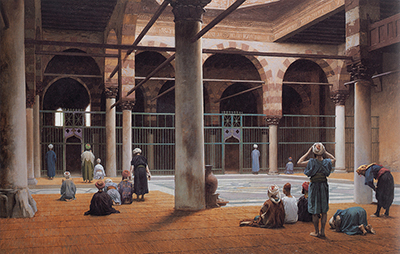
Jean-Léon Gérôme's Interior of a Mosque opens sideways rather than upward. Repeated supports, patterned surfaces and scattered figures lead the eye through a long, quiet space. No single act explains the room. Architecture, light and human presence accumulate slowly.
Painted in the 1890s, the canvas belongs to Gérôme's late career and is held by the Memorial Art Gallery in Rochester, New York. Its institutional title does not identify a particular mosque or city.[1]
That restraint matters. Gérôme made several mosque interiors, and their convincing details can tempt viewers to name a building or ritual without evidence. This work should be read first as the object it is: a carefully staged interior whose location remains unspecified.
At a Glance
- ArtistJean-Léon Gérôme
- TitleInterior of a Mosque
- Date1890s
- MediumOil on canvas
- Dimensions59.4 × 89.9 cm (23 3/8 × 35 3/8 in.)
- CollectionMemorial Art Gallery, University of Rochester
- Accession1957.18
- Collection historyHiram Sibley Collection[1]
A Room without a Single Plot
Many Gérôme paintings can be summarised through one dramatic action: a verdict, a sale, a death or a performance. Interior of a Mosque resists that structure.
Figures occupy different parts of the room without forming one obvious narrative group. Some sit or stand, while others seem absorbed into the scale of the architecture. Their separation gives the space a lived rhythm.
The composition is horizontal, encouraging the eye to travel rather than settle. Repeated vertical elements divide the width into intervals, like measures in a piece of music.
No figure dominates enough to become a hero. Human scale instead helps the viewer estimate the breadth and height of the interior.
This dispersed organisation creates quiet without emptiness. The room feels active in a low register: people enter, wait, converse, rest or attend to purposes the painting does not fully specify.
Architecture as the Principal Subject
The title names an interior, and Gérôme treats the built environment as more than background. Supports, openings, wall surfaces and floor patterns carry as much visual weight as the people.
Repeated forms establish depth. Each vertical support marks a nearer or farther plane, allowing the eye to move through a space too wide to grasp at once.
Pattern creates another kind of order. It can flatten surfaces into ornament, then bend with perspective to describe floor or wall. Gérôme's control of these shifts makes decoration perform structural work.
Light gathers across selected planes rather than producing theatrical revelation. It clarifies stone, plaster, textile and clothing while preserving recesses.
The result is an architecture made persuasive through relationships. A viewer need not know the building's name to understand how column, floor and figure create spatial coherence.
An Unnamed Mosque
The Memorial Art Gallery's record calls the painting simply Interior of a Mosque.[1] It does not supply the name of a building, so the manuscript should not invent one.
That is particularly important because Gérôme reused architectural observations. Travel sketches, photographs, collected objects and memories could be combined in Paris. A convincing room may contain accurate components without corresponding exactly to one site.
Nineteenth-century European viewers often treated precision as proof of direct access. In Orientalist painting, however, detailed settings can be composites shaped by the studio and the expectations of the art market.[2]
Leaving the mosque unnamed is therefore a positive act of interpretation. It distinguishes what the object record establishes from what resemblance might suggest.
It also respects the diversity of Islamic architecture. A decorative feature or type of support is not exclusive to one monument, city or period.
Not Prayer in the Mosque
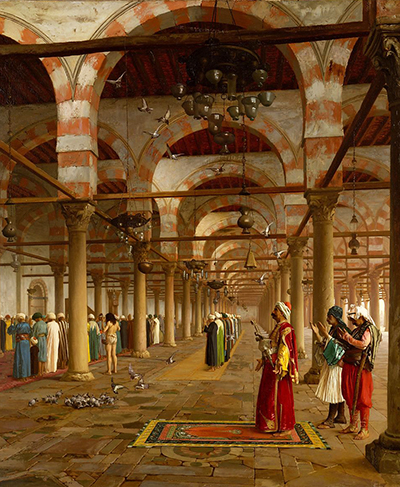
This late interior is sometimes confused with Gérôme's better-known Prayer in the Mosque at the Metropolitan Museum of Art. They are distinct physical paintings.
The Met work is dated 1871 and shows a regular line of worshippers within an interior related to the Mosque of Amr ibn al-As in Cairo. It measures 88.9 × 74.9 cm and bears the accession number 87.15.130.[3]
The Rochester canvas dates from the 1890s, is wider than it is tall, measures 59.4 × 89.9 cm and has accession number 1957.18.[1]
The difference is also compositional. Prayer in the Mosque uses repeated bodies to make communal worship its dominant rhythm. Interior of a Mosque disperses people through a broader architectural field.
Keeping the two records apart prevents architecture, date and interpretation from migrating between them. A claim appropriate to one scene cannot be transferred simply because both titles contain the word “mosque.”
Figures and the Ethics of Observation
The people in the painting invite close looking but do not supply individual identities. Gérôme distinguishes poses and clothing while leaving names and circumstances unknown.
This anonymity can make the figures feel like natural occupants of the architecture—evidence that the room is being used. It can also reduce them to elements within a European picture of Islamic life.
The tension is characteristic of Gérôme's art. Technical specificity creates vivid presence, yet the arrangement often keeps the represented people at an observational distance from the viewer.
The responsible response is not to manufacture stories for them. A seated figure need not be assigned a profession; a standing group need not be declared part of a named ceremony.
Close looking should remain close to what is visible: distance between bodies, direction of attention, relation to the floor and scale within the architecture.
A Late-Career Atmosphere
By the 1890s, Gérôme had spent decades developing paintings of historical and imagined interiors. He had also become increasingly engaged with sculpture, though he continued to paint.
This canvas does not depend on the sharp narrative surprise found in many earlier works. Its authority lies in sustained atmosphere and spatial management.
The repeated architectural forms reveal the discipline of an academic painter who could make a room legible across a relatively modest canvas. The subdued activity also suggests confidence: the scene does not need melodrama to hold attention.
Yet “late” should not be mistaken for direct or documentary. The same mature control that creates calm can conceal the decisions behind it.
The room feels available to inspection because Gérôme removes many obstacles between viewer and interior. That clarity is an artistic construction.
Looking without Naming
An unnamed setting changes the viewer's task. Instead of testing the picture against a famous monument, we can ask how it produces a sense of place.
Repetition offers continuity. Pattern offers cultural and material richness. Figures offer use and scale. Light joins these ingredients into an apparently unified room.
The painting thereby demonstrates how little narrative information is needed for spatial conviction. It is enough for forms to agree with one another.
But conviction is not identity. The better Gérôme persuades us that the interior exists, the more important it becomes to admit that the cited record does not tell us where.
That limit makes the page more accurate and the looking more attentive. Uncertainty is not a gap to be filled with a famous name.
Artist Up Close
Begin with the nearest vertical support and follow its repetitions into depth. Each recurrence measures another interval of space.
Then trace the floor patterns. Notice how decoration becomes a perspective grid without losing its surface beauty.
Finally, compare the isolated figures. Their varied spacing keeps the long room from becoming rigidly symmetrical.
Frequently Asked Questions
Discussion
Which detail in Interior of a Mosque most changes how you read Gérôme's balance of spectacle, evidence and invention?
Reader Insights
Which detail in Interior of a Mosque most changes how you read the scene's balance of evidence, staging and spectacle?
Set this page beside the Gérôme biography, paintings overview and related works to test how travel, studio practice and the Salon shaped the image.
What should a careful modern reading preserve, question or leave uncertain when looking at this work today?
Join the Conversation
Share a thoughtful observation about Interior of a Mosque, Gérôme's method, or the wider context that would help another reader look more carefully.
References
- Memorial Art Gallery, University of Rochester. “Jean-Léon Gérôme, Interior of a Mosque.” Collection record, accession 1957.18 View source.
- Jennifer Meagher. “Orientalism in Nineteenth-Century Art.” Heilbrunn Timeline of Art History, The Metropolitan Museum of Art View source.
- The Metropolitan Museum of Art. “Jean-Léon Gérôme, Prayer in the Mosque.” Collection record, 87.15.130 View source.