

 by Tom Gurney
Tom Gurney BSc (Hons) is an art history expert with over 20 years experience
Published on June 19, 2020 / Updated on August 21, 2026
Email: tomgurney1@gmail.com / Phone: +44 7429 011000
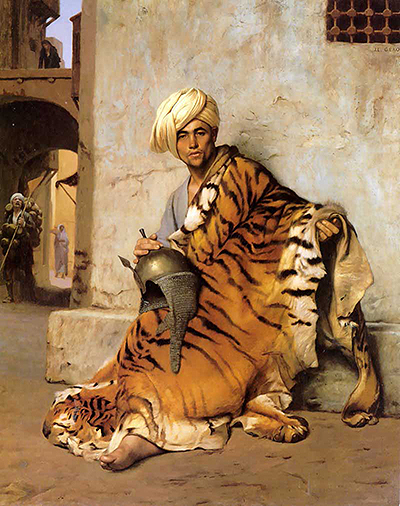
A young merchant stands in a narrow Cairo street almost engulfed by his wares. A tiger skin falls over his shoulders; one hand presents a helmet with its curtain of chain mail; weapons and metalwork turn the human figure into a travelling display.
Jean-Léon Gérôme called the composition Brocanteur de gloire—literally a dealer in used glory. The title makes the merchandise more than costume. Fur, armour and weapons carry fantasies of courage, conquest and rank, while the seller turns those fantasies into goods.
There is an important date warning. A closely related Gérôme composition is associated with 1869, but the documented canvas catalogued by Christie's as Brocanteur de gloire (The Pelt Merchant, Cairo) is dated 1880 and measures 61.5 × 50.2 cm. Until the specific site image is matched to a version, those records must not be blended.[1][2]
At a Glance
- ArtistJean-Léon Gérôme
- Controlled titleBrocanteur de gloire (The Pelt Merchant, Cairo)
- Documented version date1880
- MediumOil on canvas
- Dimensions61.5 × 50.2 cm (24 1/4 × 19 3/4 in.)
- Current statusPrivate collection
- CatalogueAckerman 191
- Version cautionA related autograph merchant composition is dated 1869; the two must remain distinct[1][2]
A Body Built from Merchandise
The merchant's body is both concealed and made powerful by the objects he carries. The tiger skin hides much of his torso, but shoulder, hands, face and forward foot allow the viewer to reconstruct a firm pose beneath it.
Christie's catalogue draws attention to a diagonal linking head, hand, helmet and foot.[1] That line prevents the heavy merchandise from making the figure static. His body seems to turn through the burden.
The hands are especially active. One secures or displays the helmet, while the other manages the skin. Fingers give precision to a figure otherwise enlarged by fur and metal.
Gérôme keeps the face visible above this abundance. The merchant does not disappear into picturesque goods; his direct presence organises them. Yet the title invites us to see him partly through what he sells.
The result is a portrait-like encounter without a named sitter. Individual alertness and commercial type occupy the same body.
Fur, Metal and Painted Skill
The subject offers Gérôme a catalogue of surfaces. The tiger skin requires stripes, dense fur, curling edges and changes of light across an uneven pelt. The helmet asks for hard reflection; the chain mail breaks light into hundreds of small units.
These are not incidental details. They advertise the painter's own control. The merchant displays luxury and military objects, while Gérôme displays his ability to make each material convincing.
Warm orange and yellow in the fur are set against a cooler blue wall. The contrast pushes the figure forward from the narrow street. A patch of sky at the rear repeats and intensifies the wall's cool colour.[1]
The shallow setting avoids the distractions of a large marketplace. We are brought close to the seller, where textures can be examined almost as if they were within reach.
This nearness also turns looking into a form of shopping. The viewer assesses pelt, armour and figure together. Gérôme's finish makes the painted goods desirable even when their original histories are unknown.
What Does “Dealer in Glory” Mean?
The French word brocanteur suggests a trader in second-hand or miscellaneous goods. Gloire elevates the objects from used equipment to remnants of heroic reputation.
A helmet may once have signified military office; a weapon may imply combat; a tiger skin can suggest dangerous mastery over an exotic animal. On the merchant's body, these associations are gathered, rearranged and offered for sale.
The title is witty because glory is supposed to be earned, not purchased. Gérôme shows its visible signs circulating through commerce.
That wit also reaches painting. European collectors could acquire an image of Cairo, martial splendour and animal luxury without leaving home. The canvas itself becomes another portable commodity of glory.
The seller's dignity prevents the joke from becoming simple ridicule. He commands the display. What remains uncertain is whether the title admires his authority, amuses itself with theatrical excess or does both at once.
Gérôme's Studio Vocabulary
Christie's notes that the helmet and tiger skin belonged to Gérôme's familiar collection of accessories and appeared in other paintings.[1] The Cairo street may feel spontaneous, but its principal objects formed part of a reusable studio vocabulary.
This practice was central to Gérôme's method. Travel supplied garments, weapons, photographs and architectural memories. In Paris, he could combine them with posed models and reconstructed settings.
Reuse is visible evidence of construction, not proof of carelessness. A prop can be painted with extraordinary accuracy while participating in a fictional encounter.
The merchant is therefore not a transparent sample of Cairo street life. He is a model performing a plausible commercial identity with selected objects.
This distinction helps explain Gérôme's peculiar authority. Because each surface appears exact, viewers may extend that trust to the whole scene. Modern scholarship on Orientalism asks us to separate observed ingredients from the claims produced by their arrangement.[3]
Cairo as a Narrow Stage
The alley provides depth but very little independent information. Its walls and opening locate the figure within a city while leaving him visually isolated.
That economy makes the street behave like a stage set. The cool wall is backdrop; the distant figures or openings establish scale; the merchant steps forward into concentrated light.
Gérôme repeatedly used architectural fragments to create convincing spaces without depicting a complete, verifiable site. Here the street does not need a name because its role is compositional.
The absence of a named location should be respected. Identifying a specific Cairo quarter or monument from atmosphere alone would convert plausibility into unsupported fact.
At the same time, the generic setting participates in a European market for images of the “Orient” as visually abundant and outside modern change. The work's precision does not place it beyond that cultural system.
Why 1869 and 1880 Must Remain Separate
The existing page tradition often gives 1869. Christie's, however, identifies its signed oil-on-canvas version as painted in 1880, with a documented Goupil and Knoedler provenance, and catalogues it as Ackerman 191.[1]
Ackerman's catalogue also distinguishes closely related Cairo merchant works and versions.[2] Similar figures, props and titles have encouraged metadata to migrate from one picture to another.
The safest public account is therefore conditional. If the work meant is the Christie's canvas measuring 61.5 × 50.2 cm, its date is 1880. If a different autograph composition is shown, that object's own record must govern.
This is more than clerical caution. A decade affects how the picture fits Gérôme's travel, market and studio practice. Support and dimensions also help establish which physical painting is under discussion.
Until a later image-matching stage is authorised, the conflict should remain visible rather than be solved by confidence alone.
A Merchant or a Display?
The painting encourages two ways of looking. We can meet a strong, attentive young seller, or we can inventory pelt, helmet, chain mail and weapons.
Gérôme refuses to let either reading disappear. The face arrests the eye, but the textures continually pull it outward. The model's body gives the goods coherence; the goods create his pictorial identity.
That tension belongs to Orientalist representation. A person can appear vividly individual while being organised for an outside viewer as a carrier of cultural signs.
The title adds another layer by turning signs of martial prestige into second-hand stock. Glory is detached from its original owner, worn by a seller and transferred through money.
What looks at first like a sumptuous street portrait is therefore also a painting about circulation: of objects, identities, images and desire.
Artist Up Close
Begin with the diagonal from the merchant's face to the helmet and down towards his forward foot. It gives movement to the vertical composition.
Then compare the soft edge of fur with the repeated points of chain mail. Gérôme makes touch imaginable through paint.
Finally, look past the figure to the blue wall and distant opening. The cool setting is designed to release the warm pelt towards us.
Frequently Asked Questions
Discussion
Which detail in Brocanteur de gloire (The Pelt Merchant, Cairo) most changes how you read Gérôme's balance of spectacle, evidence and invention?
Reader Insights
Which detail in Brocanteur de gloire (The Pelt Merchant, Cairo) most changes how you read the scene's balance of evidence, staging and spectacle?
Set this page beside the Gérôme biography, paintings overview and related works to test how travel, studio practice and the Salon shaped the image.
What should a careful modern reading preserve, question or leave uncertain when looking at this work today?
Join the Conversation
Share a thoughtful observation about Brocanteur de gloire (The Pelt Merchant, Cairo), Gérôme's method, or the wider context that would help another reader look more carefully.
References
- Christie's. “Jean-Léon Gérôme, Brocanteur de gloire (The Pelt Merchant, Cairo).” Lot 3811861, object record and catalogue essay View source.
- Gerald M. Ackerman. Jean-Léon Gérôme: His Life, His Work. Revised edition. Paris: ACR Édition, 2000, catalogue nos. 190–191
- Jennifer Meagher. “Orientalism in Nineteenth-Century Art.” Heilbrunn Timeline of Art History, The Metropolitan Museum of Art View source.