

 by Tom Gurney
Tom Gurney BSc (Hons) is an art history expert with over 20 years experience
Published on June 19, 2020 / Updated on August 21, 2026
Email: tomgurney1@gmail.com / Phone: +44 7429 011000
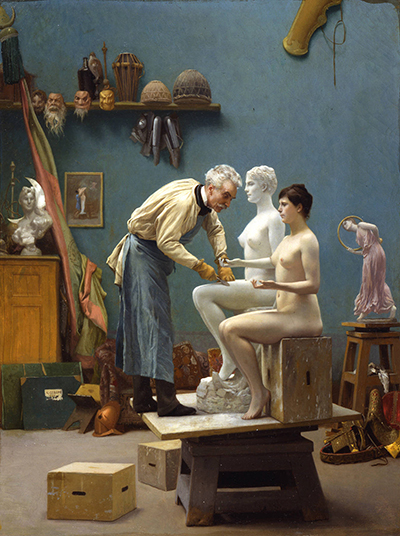
Jean-Léon Gérôme stands in his studio before the marble figure of Tanagra. A living model shares the space with statue, casts, tools and paintings. The artist seems to offer access to work in progress, yet every object has been arranged for a second act of creation: the making of a painted self-portrait.
Completed in 1890, Working in Marble, or The Artist Sculpting Tanagra belongs to the year Gérôme exhibited Tanagra and made coloured sculpture central to his late career.[1][2]
The painting is therefore more than a record of carving. It is an argument about how art crosses media. A painter represents himself as a sculptor, uses colour to describe coloured marble and places a living body beside the body he is making.
At a Glance
- ArtistJean-Léon Gérôme
- TitleWorking in Marble, or The Artist Sculpting Tanagra
- Date1890
- MediumOil on canvas
- DimensionsApproximately 50.5 × 39.4 cm
- CollectionDahesh Museum of Art, New York
- Accession1995.104
- Sculpture representedGérôme's marble Tanagra, also completed in 1890[1][2]
The Artist inside His Own Workshop
Gérôme had painted studios before, but here the maker's identity is unmistakable. He represents himself at work rather than standing for a formal portrait.
Working clothes and tools replace the polished costume of public status. His body bends towards the sculpture, suggesting concentration and physical labour.
The pose nevertheless constructs authority. Gérôme occupies the position from which material is transformed. The viewer sees the studio through the artist who organises it.
Around him, earlier works and fragments create a compressed career. Painting and sculpture do not occupy separate rooms; they compete and cooperate within one field.
The dense environment makes creativity appear continuous. There is always another surface to carve, colour, draw or paint.
Woman, Statue and Double
The living model and Tanagra establish the picture's most important comparison. One body breathes and shifts; the other is fixed in marble. Their proximity invites the viewer to measure art against life.
This is not a neutral exercise in anatomy. The model's presence helps explain the sculpture's form, but it also turns the studio into a theatre of looking.
Gérôme holds a privileged position as both maker and narrator. He chooses how living body, sculpted body and painted body will be seen.
The canvas adds another transformation. The model and statue are equally made of paint for us. Oil colour can represent warm skin and cool stone, then complicate the difference by showing pigment applied to marble.
Life and art are therefore not arranged in a simple hierarchy. Each becomes a model for the other.
What Is Tanagra?
Gérôme's marble Tanagra personifies the ancient Boeotian city associated with small terracotta figurines discovered in large numbers during the nineteenth century. The seated female figure holds a smaller statuette, joining monumental marble to the collectible antiquities that inspired her.[2]
The sculpture was shown at the Salon of 1890. It marked a new phase in Gérôme's work, when he pursued polychromy—the application of colour to sculpture—with unusual commitment.[2]
The name connects modern French making to ancient Greece, but Tanagra is not an excavated classical statue. It is Gérôme's contemporary invention about antiquity.
Within the painting, that layered status becomes visible. The artist works on a modern sculpture that personifies an ancient place while holding the image of an ancient-style figurine.
The workshop becomes a chain of representations rather than a direct return to the past.
Painting the Coloured Marble
White marble dominates popular modern ideas of classical sculpture, but ancient Greek and Roman statues were often coloured. Nineteenth-century discoveries and scholarship made polychromy a subject of intense debate.
Gérôme embraced colour as a way to renew sculpture. The Musée d'Orsay describes Tanagra as the turning point in this project and records his use of pigmented wax intended to approximate an ancient method.[2]
Working in Marble allows painting to demonstrate that position. Colour is not cosmetic decoration added after form; it participates in the creation of presence.
The canvas also performs an optical joke. Paint persuades us that we are seeing pigment on marble. The medium traditionally associated with colour explains why sculpture need not remain colourless.
Gérôme's smooth finish helps the argument. Skin, stone, metal and studio dust are separated through painted effects, even though all share the same canvas surface.
Pygmalion without a Miracle
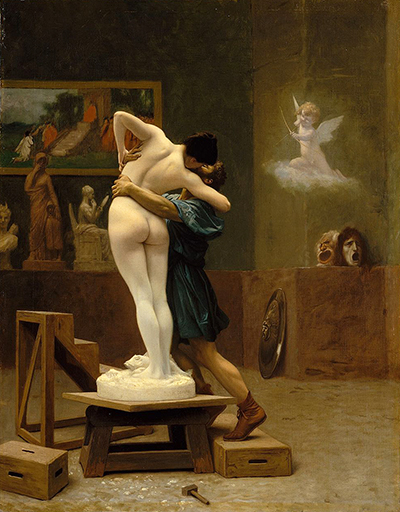
The studio scene inevitably recalls Pygmalion, the sculptor whose creation becomes alive. Gérôme explored that myth directly in his paintings of Pygmalion and Galatea around the same period.[3]
Here no supernatural transformation occurs. The model is already alive, the sculpture remains an object and Gérôme continues to work.
Yet the Pygmalion idea survives as artistic ambition. Carving gives shape; colour gives warmth; painting gives the entire process another form of life.
The comparison is also self-promotional. By placing himself between living model and increasingly lifelike statue, Gérôme becomes the modern master capable of crossing boundaries.
Modern viewers should also notice the gendered structure of that myth. The male artist acts and authors; the female model and statue are arranged for his work and for the audience's gaze.
The painting celebrates creation while revealing the unequal roles through which that celebration is staged.
A Studio Scene, Not an Unedited Document
The density of specific objects can make the canvas feel documentary. It probably preserves valuable information about Gérôme's studio and works.
But a painted self-portrait is never equivalent to an accidental photograph. Gérôme chose the moment, viewpoint, neighbouring objects and relationship between model and sculpture.
The Musée d'Orsay describes his workshop as both place of invention and subject of art. Gérôme mixed the practical reality of making with references to Pygmalion and his own career.[2]
That self-fashioning does not make the scene false. It makes it purposeful.
The artist wants to be remembered at labour, surrounded by proof of range and mastery. Disorder is legible enough to suggest activity but controlled enough to frame him.
Painting and Sculpture in Conversation
Gérôme began exhibiting sculpture relatively late, in 1878, after decades of success as a painter. He did not abandon one medium for the other.[2]
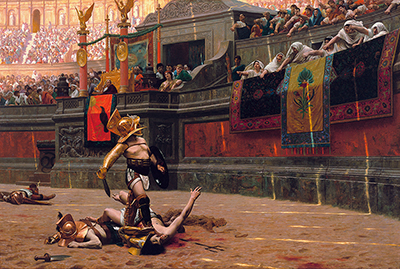
Instead, motifs moved between them. Painted gladiators became sculpture; sculptures appeared inside paintings; colour challenged the supposed purity of marble.
Working in Marble makes that conversation literal. Sculpture supplies the activity, painting supplies the image and self-portraiture supplies the maker.
Even the viewer participates in the exchange. We look at a painting in order to imagine the surface of a sculpture, then compare it with a represented living body.
The title says “working,” not “finished.” Gérôme defines artistic identity through transition: stone becoming figure, sculpture receiving colour and one medium explaining another.
Artist Up Close
Begin with Gérôme's working posture. It turns a celebrated professor and Salon artist into a body engaged with resistant material.
Then move between model and statue. Ask which differences belong to flesh and marble, and which are effects of paint.
Finally, scan the surrounding works. The studio operates as a condensed retrospective of Gérôme's practice.
Frequently Asked Questions
Discussion
Which detail in Working in Marble, or The Artist Sculpting Tanagra most changes how you read Gérôme's balance of spectacle, evidence and invention?
Reader Insights
Which detail in Working in Marble, or The Artist Sculpting Tanagra most changes how you read the scene's balance of evidence, staging and spectacle?
Set this page beside the Gérôme biography, paintings overview and related works to test how travel, studio practice and the Salon shaped the image.
What should a careful modern reading preserve, question or leave uncertain when looking at this work today?
Join the Conversation
Share a thoughtful observation about Working in Marble, or The Artist Sculpting Tanagra, Gérôme's method, or the wider context that would help another reader look more carefully.
References
- Dahesh Museum of Art. “Jean-Léon Gérôme, Working in Marble, or The Artist Sculpting Tanagra.” Collection record, 1995.104 View source.
- Musée d'Orsay. “Jean-Léon Gérôme (1824–1904): The Spectacular Art of Jean-Léon Gérôme,” sections “In the Studio” and “Gérôme as Sculptor: The Father of Polychromy.” 2010 exhibition presentation View source.
- The Metropolitan Museum of Art. “Jean-Léon Gérôme, Pygmalion and Galatea.” Collection record, 27.200 View source.