 by Tom Gurney
Tom Gurney BSc (Hons) is an art history expert with over 20 years experience
Published on June 19, 2020 / Updated on November 20, 2026
Email: tomgurney1@gmail.com / Phone: +44 7429 011000
Introduction
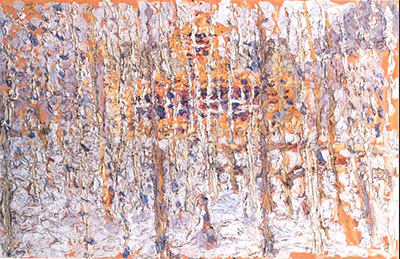
Before the black squares and weightless geometric forms, Kazimir Malevich painted a small landscape in which a house can be hard to find. Thin trunks and short coloured marks spread across the surface. Look past them and a yellow-orange building begins to emerge. The painting invites a viewer to alternate between seeing a place and seeing the marks that make it. [1] [2]
The State Russian Museum owns the work as Landscape with a Yellow House (Winter Landscape), inventory Ж-9411. It dates it to circa 1906 and records oil and wax tempera on cardboard, 19.2 × 29.5 centimetres. The image is also circulated under an “Autumn Landscape” title, but the museum's title identifies the physical work more precisely. [1] [3]
At a Glance
- ArtistKazimir Malevich
- Museum titleLandscape with a Yellow House (Winter Landscape)
- DateCirca 1906
- MediumOil and wax tempera on cardboard
- Dimensions19.2 × 29.5 cm
- CollectionState Russian Museum, Saint Petersburg, Ж-9411
- Also encountered asAutumn Landscape with Yellow House
Contents
- Looking closely: where is the house?
- An early experiment in seeing and paint
- Size, material and the museum record
- From coloured marks to a house
Looking closely: where is the house?
The building sits behind a loose screen of upright trunks and branches. Its warm yellow and orange passages are strongest near the upper centre, but the verticals cross them, so the house never becomes a clean silhouette. Pale ground occupies much of the lower half. Short strokes of blue, orange and mauve interrupt it. Trees, house and ground share a busy network of marks instead of separating into tidy zones. These are observations from the reproduction; it does not establish an exact outdoor location or season. [1]
At a glance, the light ground and bare-looking trees may make the museum's subtitle Winter Landscape plausible. An “Autumn Landscape” label used on another reproduction suggests a different season. Neither title should be treated as proof of the weather on the day Malevich worked. Describing what is visible—pale ground, fine trunks and a partly hidden house—lets a reader examine the image without forcing a seasonal narrative onto it. [1] [3]
The State Russian Museum describes the technique as pointillist: small patches of comparatively distinct colour build the scene as the eye combines them at a distance. This is an art-historical characterization of the work. It should not imply that every mark is a regular dot or that the painting follows a strict rule. The short strokes and vertical lines work together with colour patches; the result seems to flicker between pattern and place. [1]
An early experiment in seeing and paint
The museum places this circa-1906 picture in Malevich's early engagement with Impressionism. It recounts his response to paintings in Sergei Shchukin's Moscow collection, including Monet's Rouen Cathedral series. That context helps explain why changes of light and colour mattered to him. It does not establish a direct model for this particular house, and no available source identifies the building or says that he painted it outdoors. [1]
Art historian Daniel Kalman Phillips reads this picture alongside another Malevich Landscape from about the same year. For Phillips, the repeated vertical marks form a screen that resists easy entry into the pictured space. A viewer knows from the title to look for a house, but its presence remains visually uncertain. He argues that the material marks insist on being noticed even as they describe nature. This is a scholarly interpretation, not a statement by Malevich about what he intended the painting to mean. [2]
The comparison is useful because the work still belongs to landscape painting. The visible trunks and building supply a recognizable subject. Yet its surface does not behave like a transparent window. The near-continuous mesh of marks makes the viewer work to distinguish the yellow form from its surroundings. That tension appears long before Malevich formulated Suprematism, although it would be misleading to describe this early scene as a disguised Black Square. Its questions are specific to a small painted landscape. [1] [2]
Size, material and the museum record
The original measures less than thirty centimetres across. On a screen it can appear much larger, so its compact physical scale is easy to miss. The museum's medium is also precise: oil and wax tempera on cardboard. “Oil painting” alone loses one component, while “oil on canvas” would be wrong for Ж-9411. Nothing in the public object record supports a claim that its support was later changed or that a canvas version is the same work. [1]
The museum's brief acquisition entry says the work came from Malevich's heirs in 1936 and notes a 1977 transfer involving the USSR Ministry of Culture. Those catalogue lines give useful anchors, but they are not a full ownership or exhibition history. Phillips cites an earlier Russian Museum catalogue for a 1908 display of two landscapes as Studies. His citation is a lead for research into the painting's early exhibition history, rather than proof on its own of every detail of that showing. [1] [2]
The small digital image has another practical limit. It lets us describe the placement of the house, the tree network and the broad contrast of warm and cool marks. It cannot settle the painting's precise colour in person, the thickness of individual paint deposits or conservation questions. Those would require a high-quality image, technical study or direct examination. [1]
From coloured marks to a house
Try to locate the building before following the painted marks to either side. Its yellow area can draw the eye, yet the nearby dabs keep it from separating completely from the landscape. The Russian Museum describes the way the touches of colour resolve into a scene from farther away. Up close, the relationship of neighbouring touches comes forward again. This change can be seen in the house itself. Colour both identifies a building and lets its edges participate in the treatment of the surrounding field. [1] [2]
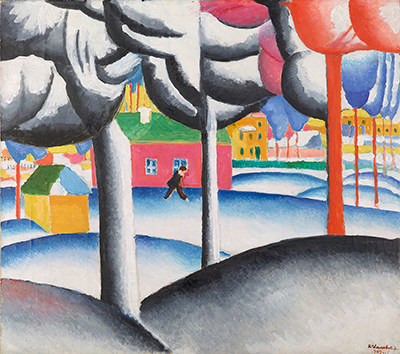
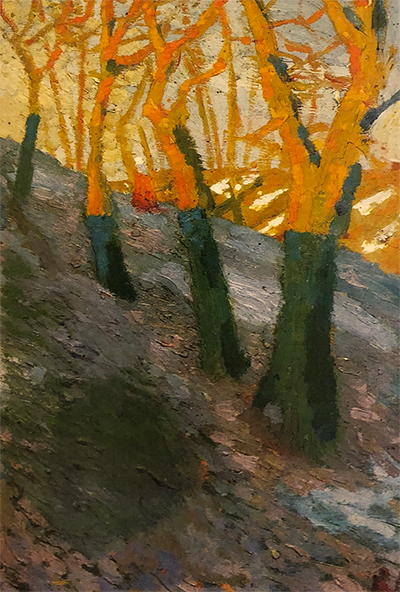
The horizontal proportions also matter. The eye can move sideways across several coloured areas before coming back to the yellows. In Trees, the catalogue records a narrow upright object in which the trunks give that movement a very different direction. Here the low format gives more space to the search across the landscape. That comparison explains why the house can be less immediately conspicuous than the work’s title suggests. The title offers a place to begin looking, while successive colours provide a reason to move out from that point. [1] [2] [4]
The museum’s description of oil and wax tempera on cardboard belongs to the physical work, while its account of pointillist handling describes how the marks act together. Those facts answer different questions. The close texture of a digital reproduction can give a useful impression of the placement of colour, but the degree of gloss or the thickness of a particular touch would need examination of the original. Looking at the image is enough to follow how the house emerges among the marks. [1] [2]
Frequently Asked Questions
When did Malevich paint it?
The State Russian Museum catalogues it as circa 1906. That approximation is more accurate than treating 1906 as a documented exact completion date. [1]
Is the title “Autumn Landscape” or “Winter Landscape”?
What is it made of?
The museum records oil and wax tempera on cardboard, 19.2 × 29.5 cm. That support and medium are part of the object's identity, not interchangeable with other Malevich landscapes. [1]
Why is the house difficult to see?
Discussion
Try finding the house before reading the title. Which marks reveal it, and which interrupt it?
The museum's title includes Winter Landscape, while this site's older URL says Autumn Landscape. What can the image itself tell us about season?
Reader Insights
Trace one tree trunk from top to bottom. How does it affect the depth of the scene?
Look from a distance and then close up. Does the house become easier or harder to identify?
Compare the pale ground with the warmer passages around the building. How do short marks connect them?
Join the Conversation
Share a close observation or a source-backed reading of this specific painting.
References
- State Russian Museum, Landscape with a Yellow House (Winter Landscape), Ж-9411: illustrated owner record for title, date, medium, dimensions, collection number, brief acquisition entry and museum interpretation. View source.
- Daniel Kalman Phillips, Kazimir Malevich and Russian Modernism (University of Chicago PhD dissertation, 2017), PDF pp. 44–45: close reading of this painting and comparison with another circa-1906 landscape. View source.
- Wikimedia Commons, Malevich Landscape With Yellow House.JPG: image file page using the “Autumn Landscape” title and giving the same owner, dimensions and Ж-9411 accession; consulted for the alternate title, not as the source for physical-work facts. View source.
- Christie’s, Trees, illustrated lot 1478621: separate small landscape for the format comparison. View source.