 by Tom Gurney
Tom Gurney BSc (Hons) is an art history expert with over 20 years experience
Published on June 19, 2020 / Updated on November 20, 2026
Email: tomgurney1@gmail.com / Phone: +44 7429 011000
Introduction
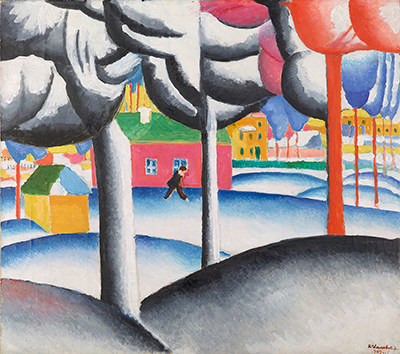
Large, heavily simplified trees frame a snowy town. Grey and black branches spread across the top, while a red trunk rises at the right and a small dark figure moves past a red building in the middle distance. This colourful winter scene is Kazimir Malevich's Landscape (Winter) in Museum Ludwig, Cologne, inventory ML 01300. The saved image on this page matches the painting reproduced in the museum's 2023 press kit. Its owner archive dates the canvas after 1927 and records oil on canvas, 48.5 × 54 cm. [1] [2]
The precise year is less settled than many online captions suggest. Different sections of the same Museum Ludwig press kit label the work 1927 and 1928, while the accession-linked archive uses the broader “after 1927.” An earlier “1909” label appears in the history of an online reproduction. This article follows the owner's accession-linked date, reports the museum's two narrower labels and keeps this canvas distinct from other works called Winter Landscape. [1] [2] [3]
At a Glance
- ArtistKazimir Malevich
- Owner titleLandschaft (Der Winter), translated Landscape (Winter)
- Date followed hereAfter 1927, Museum Ludwig archive
- Other museum labels1927 in press kit p. 13; 1928 in the same press kit p. 43
- MediumOil on canvas
- Dimensions48.5 × 54 cm
- CollectionMuseum Ludwig, Cologne, ML 01300
- Visual focusSnow, dark stylized trees, bright buildings and a small figure
Contents
- Identifying the Cologne painting
- Looking closely at the winter scene
- How should the date be understood?
- Winter landscape after Suprematism
- Collection history and what remains unknown
- Two winter pictures at different scales
Identifying the Cologne painting
The Museum Ludwig press kit pictures the same arrangement as this site's saved image: dark swollen boughs at the top, pale trunks at left and centre, a red vertical at right, a red building near the centre and a dark rounded snowbank across the lower foreground. The press image carries the Rheinisches Bildarchiv Köln reproduction identifier rba_d033964_01. The accession-linked Cologne archive uses that same reproduction identifier and names ML 01300, giving a strong object match across two institutional records. [1] [2]
The archive's German title is Landschaft (Der Winter), rendered there as Landscape (Winter). The inherited page title “Winter” is a short form; it does not name a second painting. Museum Ludwig's documentation gives oil on canvas, 48.5 × 54 cm, and records the work as part of a 2011 donation from the Ludwig Collection, with the city of Cologne named as owner. These object-specific facts are more reliable than an unsourced date attached to a circulating JPEG. [1] [2]
The press kit was prepared for an exhibition of Ukrainian modernism. It places Malevich's painting among works by artists associated with the region, but its captions are not consistent on the year: the illustrated press-images page says 1927, and the illustrated works list says 1928. The archive says after 1927. These can be reported together without converting one into an established exact date. [1] [2]
Looking closely at the winter scene
The trees dominate the space. Their thick grey trunks rise through the image and branch into broad, rounded limbs that almost form a canopy. Snow sits on some of the upper forms like white patches. The red-orange vertical on the right supplies a sharp change from the greys; nearby pink and blue shapes make the wooded edge feel more chromatic than a naturalistic winter view might. [2]
The foreground is a sequence of rounded white and grey mounds, divided by dark contours. Beyond it, a red low building holds a square light window. Yellow and green buildings stand farther back. Near the red wall, a very small dark figure introduces human movement without dominating the landscape. The scene suggests a settlement, but the checked Museum Ludwig records do not give its name or establish that Malevich depicted a particular observed street. [1] [2]
Distance is compressed. The strong trunks occupy the foreground, while the colourful houses sit close behind them rather than receding through a carefully measured perspective. A bright blue patch of ground or shadow near the buildings contrasts with the black-grey snowbank in front. The shapes are recognizable as trees, houses and winter ground, but the painting asks us to notice their weight, rhythm and colour as much as their descriptive role. [2]
The close-up reproduction makes it tempting to assign every shape a fixed natural object. That would oversimplify the painted design. Some rounded grey forms can be read as snow-laden branches, others as trunks or shadows. Malevich's broad transitions leave those boundaries visually active. The tiny walker is one of the few details that supplies a clear scale, making the trees and foreground forms seem almost monumental. [2]
How should the date be understood?
The accession-linked archive's “after 1927” is the broadest owner date. The press kit's 1927 and 1928 are different labels within a single museum publication, not evidence for two physically different winter canvases. Both sections give the same 48.5 × 54 cm oil painting and reproduce the same composition; the archive supplies the single accession ML 01300. A careful catalogue-style caption therefore gives after 1927 and notes the more specific alternatives. [1] [2]
The Wikimedia Commons file for this image shows another dating hazard. Its current descriptive fields use after 1927 and ML 01300, but an older upload note called the picture 1909. That is evidence of how labels circulate and change online, not a reason to treat 1909 as the museum's current date. The museum records checked here place the work later. [1] [3]
Malevich also painted a different Landscape with a Yellow House (Winter Landscape), catalogued by the Russian Museum at circa 1906. It is a small, more painterly scene with a different accession and composition. A separately documented private Winter Landscape is reported at 36.8 × 34.5 cm and dated 1929 in its own catalogue. Neither should be merged into Museum Ludwig's 48.5 × 54 cm ML 01300 merely because an English title contains “winter.” [1] [4] [5]
Winter landscape after Suprematism
Malevich's Black Square made a non-objective form the focus in 1915. In Landscape (Winter), recognizable trees, houses and a small person return. Yet their outlines and colours are organized with a boldness that resists a simple story of abandoning modernist form. Grey trunks work almost as large shaped bands; the red vertical and bright houses punctuate them like independent colour accents. This is a visual comparison, not proof that the winter painting encodes a specific Suprematist diagram. [1] [2] [6]
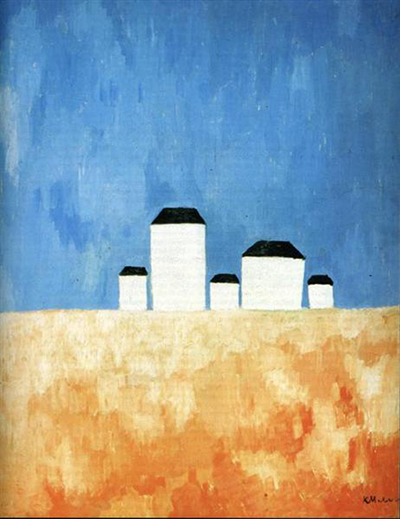
The site has another later landscape, Landscape with Five Houses, whose sparse white buildings and open fields offer a striking contrast. Here dense trees and intense colour make an enclosed, crowded composition; there the houses stand apart. These works show how flexible Malevich's late handling of landscape could be. A shared period does not mean a shared site, commission or exact working method. [1] [2]
In the 2023 press kit, Museum Ludwig placed Landscape (Winter) within a wider exhibition of Ukrainian modernism. That curatorial setting gives readers an entry into Malevich's regional artistic context, but the press kit does not itself establish the location of the winter scene. The local page therefore describes the pictured snow and town without assigning them to Kyiv, Nemchinovka or any other unverified place. [2]
Collection history and what remains unknown
The Cologne archive records the work with Museum Ludwig and a 2011 Ludwig Collection donation, naming the city of Cologne as owner. It does not, in the publicly transcribed object data checked for this page, provide a full chain of previous owners or a current gallery location. The 2023 press kit documents the work as part of an exhibition publication, but it does not prove the canvas is on view today. [1] [2]
The saved image is useful for following the tree shapes, bright buildings and small figure, but its resolution is limited for examining brushwork or paint layers. A digital reproduction also varies by screen and cannot establish the exact colour and surface of the oil painting. Object-specific conservation findings would be needed for claims about underdrawing, coatings or painting sequence. [1]
Two winter pictures at different scales
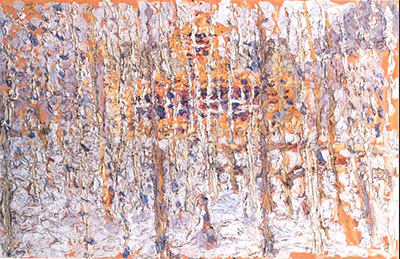
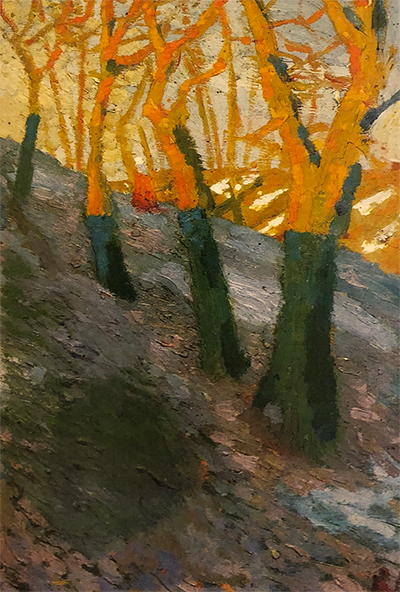
The smaller Russian Museum Landscape with a Yellow House provides a winter image with a securely independent record. Its medium is oil and wax tempera on cardboard, and its proportions are wider than those of the Cologne oil on canvas. The Russian Museum describes dots of separate colours coming together as the viewer takes in the image. These differences give a better starting point for comparison than the shared word winter. The materials and the way the marks organize the field belong to each object’s own record. [1] [2] [4]
Look at the distance between nearby marks and the quieter passages beyond them. A winter scene can suggest depth by putting a broad pale area between a viewer and a darker form. The more compact picture can achieve a related effect using small changes between the dabs of colour. Each work lets the eye shift between recognizing a season and seeing how the physical surface guides that recognition. Their separate holdings, formats and dates keep a comparison of handling from turning into a second title for the same painting. [1] [2] [4]
Frequently Asked Questions
Is this a 1909 or a late-1920s painting?
What is the painting's full title?
The Cologne archive gives Landschaft (Der Winter) and an English translation, Landscape (Winter). “Winter” is this site's shorter inherited title. [1]
Where is it held?
The painting is recorded with Museum Ludwig, Cologne, inventory ML 01300. The checked sources do not establish current display status. [1]
Is it the Russian Museum's Winter Landscape?
Discussion
Which shapes first tell you this is a winter landscape?
How do the bright houses and red trunk change your sense of the grey trees and snow?
Reader Insights
Find the small walking figure near the red building. How does it change the scale of the trees?
Look at the rounded snowbanks and branches. Where do their outlines become nearly abstract shapes?
The museum gives several late-1920s dates. What can the image itself tell us, and what requires a collection record?
Join the Conversation
Share a close observation or a source-backed detail about Museum Ludwig ML 01300.
References
- Rheinisches Bildarchiv Köln / Museum Ludwig, Landschaft (Der Winter), ML 01300: accession-linked owner archive, after-1927 date, oil on canvas, 48.5 × 54 cm, reproduction identifier and 2011 collection note. View source.
- Museum Ludwig, Ukrainian Modernism press kit (2023), pp. 13 and 43: exact illustrated painting; p. 13 labels it 1927 and p. 43 labels it 1928. View source.
- Wikimedia Commons, Winter Landscape (Malevich, 1930).jpg file history: documents the old 1909 upload caption and later after-1927/ML 01300 description; used to trace public-label drift, not to override the owner. View source.
- State Russian Museum, Landscape with a Yellow House (Winter Landscape), Ж-9411: separate circa-1906 winter painting. View source.
- Winter Landscape sale booklet, 1929, 36.8 × 34.5 cm: a distinct reported private canvas; used only for title-collision control. View source.
- Smarthistory, Charles Cramer and Kim Grant, “Suprematism, Part I: Kazimir Malevich”: 1915 historical context for comparing late figuration to Suprematism. View source.