 by Tom Gurney
Tom Gurney BSc (Hons) is an art history expert with over 20 years experience
Published on June 19, 2020 / Updated on November 20, 2026
Email: tomgurney1@gmail.com / Phone: +44 7429 011000
Introduction
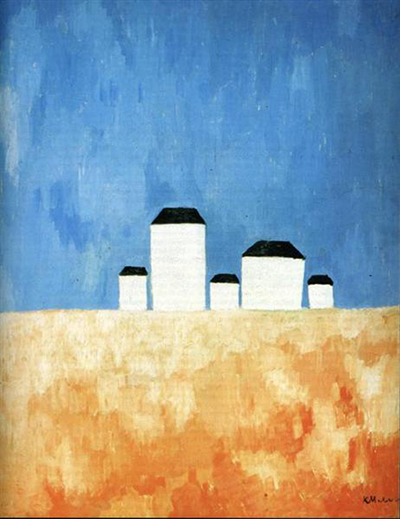
Kazimir Malevich's Landscape with Five Houses reduces a settlement to a line of five white forms between two broad painted fields. The dark roofs make the forms readable as buildings, yet they have no visible doors, windows or people. The apparent simplicity raises a useful question: how much information does a painting need before we call it a landscape rather than an arrangement of shapes and colour? [1] [2]
This is a specific late canvas, not a generic example of Malevich's houses. The State Russian Museum dates it 1928–1929, records it as oil on canvas measuring 83 × 62 centimetres, and assigns inventory number Ж-9496. The painting's arrangement of all five houses, horizon, sky and foreground matches the museum's illustrated record. [1]
At a Glance
- ArtistKazimir Malevich
- TitleLandscape with Five Houses
- Date1928–1929, as catalogued by the owner
- MediumOil on canvas
- Dimensions83 × 62 cm
- CollectionState Russian Museum, Saint Petersburg, Ж-9496
- Visual focusFive white roofed forms, a blue upper field and a mottled earth-coloured lower field
Contents
- Looking closely: five houses and two fields
- A late landscape after Suprematism
- What makes a house?
- Another landscape built around houses
- The painting’s collection record
Looking closely: five houses and two fields
The five buildings occupy a narrow strip around the boundary between blue and ochre. One house near the centre is taller than its neighbours; another to its right is broader. Three small forms make the group asymmetrical. Their white faces stand out strongly against the darker blue behind them, while the nearly black roofs make each silhouette legible with very few marks. No roads, fences or trees fix the distance between the viewer and this row. Those are observations of the reproduced painting, not evidence of a particular village. [1]
The two large colour fields do much of the compositional work. Blue takes up the upper part, while the lower portion shifts through cream, orange and muted red. The foreground is not a smooth single-colour band: irregular strokes and lighter patches give it a worked surface. The blue also varies, especially around the centre. The painting therefore differs from a perfectly flat diagram, even though its small forms could almost be reduced to quadrilaterals and trapezoids. [1] [2]
This tension matters when reading the title. Landscape identifies a subject, but the painting gives only enough markers to suggest it. The dark caps become roofs because of their position atop white upright forms; the horizontal division becomes a horizon because buildings sit upon it. The eye completes a scene from these sparse cues. At the same time, the broad blue and ochre areas remain conspicuously paint. Calling the image simply “abstract” loses the stubborn presence of houses; calling it a straightforward village view loses the construction of the scene. [1] [2]
A late landscape after Suprematism
The owner date places Landscape with Five Houses in Malevich's later return to recognizable subjects. The Russian Museum discusses 1928 as a new stage in his work on its page for the separate Head of a Peasant: figurative subjects coexist there with concerns about colour, shape and space inherited from Suprematism. That statement supplies period context, not a documented explanation written for this particular landscape. [1] [3]
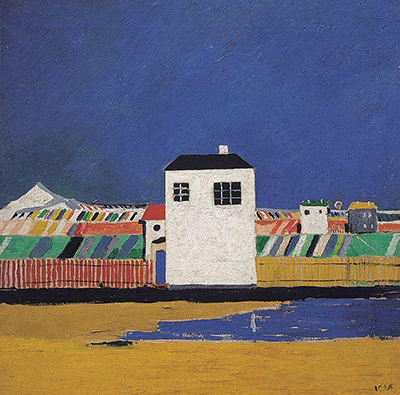
Art historian Marie E. Gasper-Hulvat compares this painting with the distinct Landscape with a White House in the Russian Museum. In her reading, the white-house picture still emphasizes a near building against more distant ones; the five-house image makes that foreground and background distinction harder to maintain. The buildings are small and similar in construction, while most of the canvas is blue and mottled earth colour. Her comparison gives a way to test how this landscape preserves both representation and Malevich's long concern with the autonomy of painted form. It should be read as a scholarly interpretation, not as a definitive symbolic key. [2]
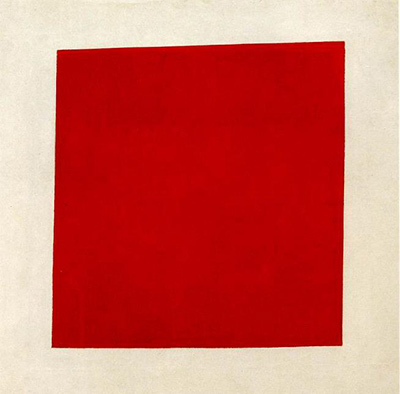
The painting should also be kept separate from Black Square. The 1915 square suppresses the recognizable landscape altogether. Here, even a small row of houses changes the viewing task: one begins to ask where the buildings stand and whether the lower field is soil. Yet the organization into simple shapes makes that recognition unusually deliberate. Malevich's later work did not have to choose between pure geometry and naturalistic description as two sealed categories. [1] [2] [3]
What makes a house?
In its Russian-language commentary on the canvas, the Russian Museum compares the five buildings with Malevich’s Red House. The museum asks how far the buildings owe their identity to the dark trapezoids perched on the white walls. Imagine covering the roofs while leaving the rest visible. The line of white blocks would still run along a horizontal boundary, but it would offer much less evidence of a settlement. Put the roofs back and the forms become legible almost at once. Their placement does as much to name them as their outlines do. [1] [4]
The comparison with Red House also makes the repetition in the smaller forms worth looking at. In Five Houses, each unit can vary in height, width or spacing without giving up the same basic construction. A row suggests a community of buildings, even though the painting supplies few clues about how a person might reach or go inside one. The museum connects that economy of form with the artist’s exploration of a kind of figuration informed by Suprematism. Its commentary even suggests a comparison with his architectural projects. That proposal makes sense as a way of thinking about the unfamiliar buildings. The physical painting records a group of shapes on canvas, with no plan or measurements for an actual structure. [1] [4]
Another landscape built around houses
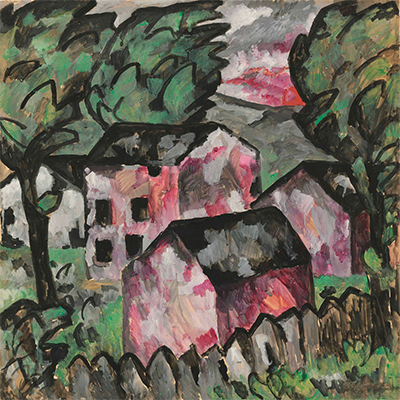
The earlier Landscape of 1911, also shown under the title Landscape with Three Red Houses, offers a different solution to a similar problem. In the illustrated Christie’s catalogue entry, houses sit within a much busier arrangement of hillside, trees and intense pink and orange areas. The catalogue measures the work at 106 centimetres square, appreciably larger than the upright 83 by 62 centimetre Russian Museum painting. The earlier work’s expansive format lets the coloured areas around the buildings compete for attention. In the late canvas a thin strip does most of the work of telling us where the buildings stand. [1] [5]
The difference matters when titles travel through catalogues and exhibitions. Christie’s records the three-house picture in the 2013–14 Amsterdam retrospective that travelled to Bonn and London. That exhibition history belongs to the early work. Its documented title variation helps explain why a reference to a Malevich landscape with houses needs a date, an illustration or an inventory number before it can be connected to the five-house canvas. As a visual comparison, the two works show how much Malevich could change the structure of a landscape while returning to a closely related motif. [1] [5]
The painting’s collection record
The Russian Museum's public record gives a secure current catalogue identity, date range, medium, size and inventory number. Its acquisition note mentions receipt from Malevich's heirs in 1936 and a 1977 transfer to the USSR Ministry of Culture. That compressed note is not a complete ownership history or proof of where the painting was first shown. The record does not identify the houses, provide Malevich's own interpretation, or say that the view was painted directly from life. [1]
Colour descriptions are similarly limited. A digital reproduction allows us to discuss the relative expanse of blue, the light house forms and the textured lower field. It cannot guarantee the precise colour a visitor would see under gallery lighting. Nor does the available reproduction support claims about minute brush marks, underpainting or conservation findings. Those questions require closer technical evidence. [1]
Frequently Asked Questions
When was it painted?
The State Russian Museum dates its canvas to 1928–1929. Some secondary catalogues give other approximate dates; this page follows the institution that catalogues the physical work. [1]
Where is the painting?
It belongs to the State Russian Museum, Saint Petersburg, under inventory number Ж-9496. A collection record is not a promise that it is currently on display, so check the museum before travelling to see it. [1]
Are the five houses a real place?
The public museum record does not name a location. The forms can be described as houses, but attaching them to a particular village would require evidence not present in the sources used here. [1]
Is this an abstract painting?
It retains a recognizable landscape subject while simplifying houses and dividing most of the canvas into broad colour areas. Gasper-Hulvat's comparison with Landscape with a White House highlights how this picture complicates an ordinary foreground/background reading. “Abstract” and “landscape” each describe part of what a viewer sees. [1] [2]
Discussion
The scene is spare enough to make each cue matter. Which marks make the white forms read as houses?
Consider how the broad blue and mottled lower field alter your sense of near and far.
Reader Insights
Find the tallest house and then look at the smallest. Do their different sizes alone create distance?
How does the uneven lower field change your reading of an otherwise simple horizontal division?
Compare the later landscape with Black Square. What changes when a recognizable subject returns?
Join the Conversation
Share a close observation or a source-backed reading of this specific canvas.
References
- State Russian Museum, Landscape with Five Houses, Ж-9496: illustrated owner record for title, artist, date, medium, dimensions, inventory and acquisition note. View source.
- Marie E. Gasper-Hulvat, Malevich's Post-Suprematist Paintings and the Construction of History (PhD dissertation, Bryn Mawr College, 2012), figure list and PDF pp. 220–221: exact accession and comparative interpretation of the five-house and white-house landscapes. View source.
- State Russian Museum, Head of a Peasant, Ж-9488: the museum's account of Malevich's 1928–29 figurative phase, used for period context only. View source.
- State Russian Museum, commentary on Landscape with Five Houses, in Russian: comparison with Red House, the roof silhouettes and architectural analogy. View source.
- Christie’s, Landscape, illustrated lot 6155243: separately identified 1911 three-house work, dimensions, alternate title and exhibition record. View source.