 by Tom Gurney
Tom Gurney BSc (Hons) is an art history expert with over 20 years experience
Published on June 19, 2020 / Updated on November 20, 2026
Email: tomgurney1@gmail.com / Phone: +44 7429 011000
Introduction
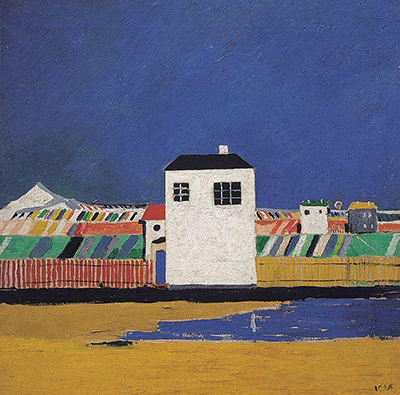
Kazimir Malevich's Landscape with a White House sets a tall white building against a wide, dark blue sky. The building's black roof, barred windows and narrow blue side door make it unusually specific. Behind it, smaller houses and striped ground recede into a compact ribbon of colour. The picture invites a double reading: it is a place with recognizable buildings, and it is an arrangement of horizontal bands, blocks and contrasts. [1]
The artwork is documented as 1928–1929 and State Russian Museum inventory Ж-9392 in Marie E. Gasper-Hulvat's illustrated doctoral research. Her detailed account of the white central house, blue side door and two smaller houses matches the image preserved on this site. Christie's independently names Landscape with a White House among Malevich's later landscapes in the Russian Museum. Neither source establishes a named village, a precise day of creation or the artist's own explanation of this scene. [1] [2]
At a Glance
- ArtistKazimir Malevich
- TitleLandscape with a White House; also published without the article as Landscape with White House
- Date1928–1929 in Gasper-Hulvat's catalogue; some later accounts use circa 1930 [1, 2]
- CollectionState Russian Museum, Saint Petersburg, Ж-9392 [1, 2]
- Medium and dimensionsNot confirmed from a direct public owner item in the sources used here
- Visual focusOne large white house, smaller houses behind it, striped fields and a blue sky
Contents
- What is in the painting?
- Foreground and background
- After the black square
- What can the records establish?
- A near building and a distant group
What is in the painting?
The central building almost divides the horizon. Its white front rises from the narrow bands of land; the black roof has a crisp, shallow slope. Two dark, crossbarred windows sit high on the facade. A small projection at the left carries a blue vertical doorway beneath a dark cap. These details make the house more than a blank geometric block. Yet its nearly rectangular front and roof also keep Malevich's interest in simple shapes close to the surface. [1]
Two much smaller buildings sit to the right. Their pale walls, dark roofs and dark openings echo the main house, but their edges and marks look looser. Another pale roof and low forms appear at left. There is no crowd, road or narrative incident. The scene is built from the relationship among buildings, ground and sky. The dark blue upper area occupies a large share of the painting and gives the white house an unusually forceful silhouette. [1]
The ground is organized in strips. Behind the main house, short slanting strokes of green, orange, red and dark blue suggest cultivated rows or patterned fields. A yellow fence-like band runs across the right; red and black marks run across the left. In front, black, ochre and blue areas form broader horizontal zones. The near yellow area and blue patch need not be assigned a precise material or location to see how they pull the eye across the painting. These are descriptions of the reproduced image, not proof of a particular site. [1]
Foreground and background
Gasper-Hulvat uses this painting to examine how Malevich differentiates near and far. She points to the relatively straight edges and legible crossbars of the main house, compared with the smaller houses whose outlines, roofs and openings are less exact. In her interpretation, the central building teaches the viewer how to recognize the more abbreviated buildings behind it. The repeated house form keeps the background readable even when its details are reduced. [1]
This is more subtle than saying the picture simply turns a landscape into geometry. The main facade is flat and bright, but it has an entrance, windows and a chimney. The smaller forms remain houses, even as they approach coloured marks. Scale, sharper drawing and overlap organize a sense of distance. The painting therefore combines a clear spatial hierarchy with patches that can be appreciated for their colour and rhythm. [1]
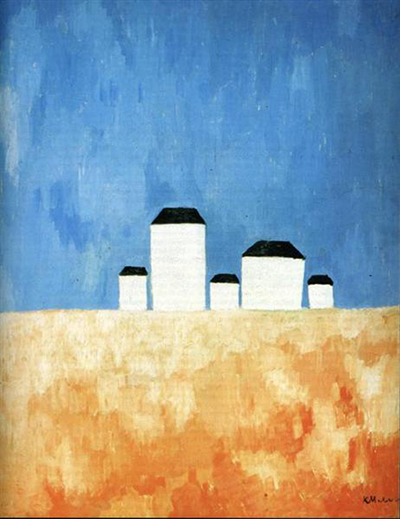
Compare Landscape with Five Houses, another Russian Museum work that Gasper-Hulvat discusses beside this one. There, a row of five small white forms shares a similar level of simplification. The white-house picture gives one building visual priority; the five-house picture makes it harder to decide which house, if any, occupies the foreground. That comparison is the scholar's reading of two distinct paintings, not an artist-written programme for either work. [1] [3]
After the black square
Malevich first presented Black Square in 1915 as part of his Suprematist turn away from depicting ordinary objects. This later landscape plainly names and shows things in the world. Its return to houses does not erase his concern with the visual force of rectangles, horizontal bands and strong colour boundaries. The white front can be seen as a wall and as a painted plane at the same time. [1] [4]
Christie's places the white-house work among the landscapes of Malevich's later years. Its broad historical account calls this return to landscape the early 1930s, while Gasper-Hulvat gives this particular Russian Museum canvas the narrower 1928–1929 range. The two formulations should not be flattened into an exact date. The dissertation's object-specific dating is used here, with the difference disclosed. [1] [2]
The Russian Museum's account of its separate late Head of a Peasant identifies a renewed stage of figurative work around 1928–1929. That context helps explain why a recognizable landscape belongs to Malevich's mature career. It does not establish that this white house stands near a particular town, that Malevich painted outdoors, or that a specific political event is hidden in its colours. [4]
What can the records establish?
The strongest exact-object identification available for this local page is Gasper-Hulvat's named Russian Museum inventory number and her close description of the composition. Christie's separately corroborates the title and collection. A direct online owner catalogue item for Ж-9392 was not found during this review. For that reason the page does not present an unverified measurement as an official museum fact. Reproductions and print sellers vary in the dates and dimensions they attach to this image; those listings are not a substitute for a checked collection record. [1] [2]
The site image is useful for looking at the whole composition and its broad colour relationships. It cannot reliably show the exact surface texture, restoration history or colour under museum lighting. Claims about underpainting, the artist's technique in microscopic detail or current display location would require evidence beyond the sources cited here. [1]
A near building and a distant group
Look first at the building nearest the viewer, then let the eye follow the smaller shapes towards the horizon. The change of scale is one of the clearest ways to read the apparent distance despite the broad areas of colour. The house has a definite edge and a place in the painted field. Farther away the marks can be read as a group before each one is made out individually. This gives the landscape two kinds of space to offer the viewer, a relatively immediate foreground and an arrangement that draws attention away from it. [1]
The separately catalogued Landscape with Five Houses makes the effect of the nearer house easier to see. The Russian Museum gives the other canvas its own inventory number, Ж-9496. Its repeated pale buildings sit much closer to one level in the painted field. In the white-house picture, the nearest form has more power to determine how the other buildings are seen. The works’ related titles draw attention to the subject, while their difference in placement gives a reason to read them side by side. [1] [3]
Frequently Asked Questions
When was it painted?
Where is it?
Is the painting abstract?
It depicts houses and a landscape, yet it uses broad colour areas and strongly simplified forms. The foreground building supplies recognizable details; more distant buildings use fewer marks. Gasper-Hulvat's comparison with Landscape with Five Houses shows how much the balance between place and painted plane can shift within Malevich's late work. [1] [3]
Does the house represent a known place?
Discussion
Look at the large white house and the smaller buildings to its right. Which details make them read as the same kind of object?
How do the striped land and broad blue sky change your sense of the house's scale?
Reader Insights
Compare the straight window bars on the central house with the marks on the smaller houses.
Trace the horizontal bands across the lower half. Where does a field become a painted colour strip?
Compare this picture with Landscape with Five Houses. Which one makes foreground and background clearer?
Join the Conversation
Share a close observation or a source-backed detail about this specific Russian Museum painting.
References
- Marie E. Gasper-Hulvat, Malevich's Post-Suprematist Paintings and the Construction of History (PhD dissertation, Bryn Mawr College, 2012), figure list and printed pp. 210–212, 273: Russian Museum Ж-9392, 1928–1929, precise description and analysis of the white-house painting. View source.
- Christie's, “The road to Suprematism—Kazimir Malevich's Landscape” (2018): names Landscape with a White House among Malevich's later Russian Museum landscapes; broad period context. View source.
- State Russian Museum, Landscape with Five Houses, Ж-9496: separate owner item used to identify the comparison work, not as metadata for the white-house canvas. View source.
- State Russian Museum, Head of a Peasant, Ж-9488: museum account of the late figurative phase, used only as period context. View source.