 by Tom Gurney
Tom Gurney BSc (Hons) is an art history expert with over 20 years experience
Published on June 19, 2020 / Updated on November 20, 2026
Email: tomgurney1@gmail.com / Phone: +44 7429 011000
Introduction
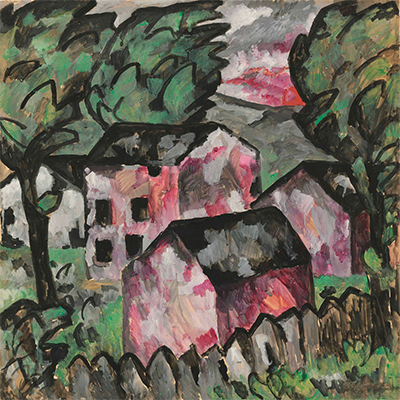
Three pink and red houses crowd beneath green-black trees, with a zigzag fence across the foreground and a strip of red sky between the foliage. The saved image on this page exactly matches the illustrated Landscape offered by Christie’s in 2018. Its lot record identifies Kazimir Malevich's 1911 work as gouache on paper laid down on board, measuring 106 × 106 cm. The same composition has appeared under titles including Landscape with Three Red Houses, Landscape with Red Houses and Village. [1]
The object has a particularly well-documented travel and collection history. Christie’s records early Moscow and St Petersburg showings, the 1927 Berlin exhibition, a long period with the von Riesen family, Kunstmuseum Basel ownership, a 2012 transfer to Malevich's heirs, and a subsequent private collection. Its 2018 sale does not by itself establish its current owner. [1] [2]
At a Glance
- ArtistKazimir Malevich
- Catalogue titleLandscape; also published as Landscape with Three Red Houses
- Date1911
- MaterialGouache on paper laid down on board
- Dimensions106 × 106 cm
- Exact sourceChristie’s illustrated 2018 lot 6155243
- Former collection numberKunstmuseum Basel G-1963.17
- Current holderNot established by the checked 2018 sale and earlier records
Contents
- What does Landscape show?
- Why is the material unusual?
- Multiple titles, one identifiable work
- The early exhibition trail
- Basel and the 2012 transfer
- Two ways to place houses in a landscape
- Landscape and the later square
What does Landscape show?
The square field is tightly packed. The forward house is pink and white beneath a broad black roof. Two more dwellings sit behind it, one marked by four dark window openings. A fence of pointed, uneven segments runs across the lower edge. Tall trees on each side frame the houses and nearly close over them, leaving a small opening for a grey hillside and a vivid pink-red patch near the top. [1]
The trees are as strongly built as the buildings. Their broad green areas are broken by angular dark strokes that read as leaves and branches. Thick outlines around roofs, trunks and fence posts give the village a carved look. Patches of pale pink, red, grey and white keep the houses from becoming single flat blocks. The dark roof in front is a strong horizontal counterweight to the uprising trees. [1]
It is tempting to read the red opening as a sunset, but the image and the source record do not name a time of day or a real location. Christie’s interprets the scene as an imagined construction rather than a documented village view. The distinction matters: the painting represents a village, while its exact setting remains unestablished. [1]
Why is the material unusual?
Christie’s describes gouache on paper laid down on board. Gouache is an opaque water-based paint, so the work belongs to a different material category from Malevich's oil-on-canvas landscapes. The paper is mounted on a board support, which also matters for conservation and handling. A flat digital image cannot itself prove these layers; the object-specific sale catalogue supplies the material statement. [1]
At 106 × 106 cm, the work is large for a gouache on paper. The near-square shape lets the houses and trees press against each other without a long panoramic horizon. Christie’s places it within Malevich's large, colourful works of 1910–11. Its catalogue calls this period “Neo-Primitive,” while its own essay links his treatment of domestic buildings and foliage to changing ideas about folk art and European modernism. Those are attributed art-historical readings, not a definitive list of sources the artist consulted for this single work. [1]
Multiple titles, one identifiable work
The 2018 catalogue traces several historical names for the same physical work. Basel publications called it Landschaft mit roten Häusern; a 2013 Stedelijk exhibition used Landscape with Three Red Houses; Nakov's 2002 catalogue raisonné listed a French equivalent under F-221; an earlier Washington exhibition reproduced it as Village. The date and 106 cm square format, together with the picture of three red houses, keep these names attached to one object. [1]
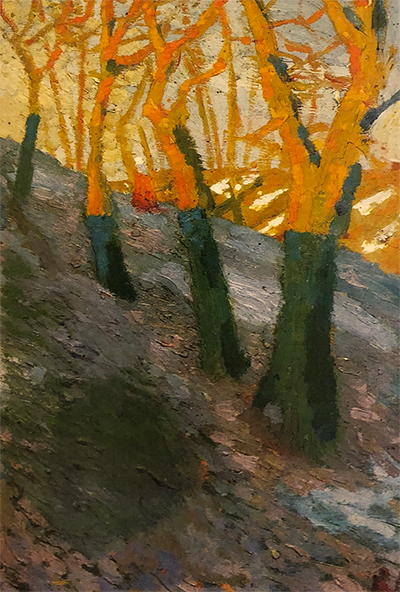
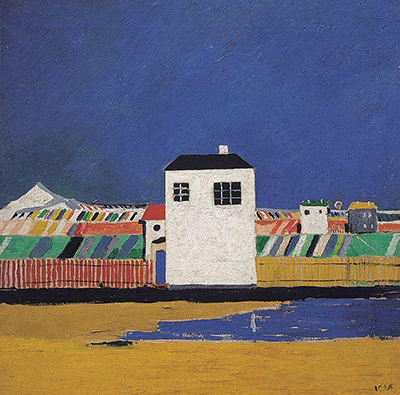
Titles alone are especially treacherous in Malevich's landscapes. Landscape with Five Houses and Landscape with a White House are later works with separate records. Trees is a much smaller circa-1904 oil painting on thick card. The exact source image and measured support prevent those pages from being folded into this 1911 Landscape. [1] [3]
The early exhibition trail
Christie’s exhibition list places Landscape at the First Moscow Salon in February–March 1911. It lists later displays at the Union of Youth in St Petersburg in early 1912 and the Donkey's Tail exhibition in Moscow that spring. These entries make the work part of Malevich's contemporary public output, rather than an image discovered only through much later retrospectives. [1]
The catalogue also lists Malevich's Berlin exhibition of May–September 1927. It labels a Warsaw showing earlier that year only as possible, so this page does not turn that appearance into a certain event for this exact sheet. Christie’s says Malevich carried a selection of works out of Russia for the European exhibition and left Landscape in the care of Hans von Riesen. The provenance list then records von Riesen as custodian until the 1963 Lempertz sale. [1]
Basel and the 2012 transfer
According to Christie’s, Marlborough Fine Art acquired Landscape at the 1963 sale and Kunstmuseum Basel acquired it by 1964, recording it as G-1963.17. That historic museum number is useful for identifying the same object in older catalogues. It is not its present collection accession. [1]
The Basel museum's own annual report says an agreement with Malevich's heirs was approved by the end of 2011 and provided that its gouache Landscape with Red Houses would be transferred to them. Christie’s records the restitution in 2012, followed by a private acquisition that year. These sources align on the object and the outcome while describing different stages of the settlement. The page therefore describes Basel as a former holder, not as the current museum for this artwork. [1] [2]
Christie’s offered it in London in June 2018. The auction house's later retrospective reports a sale result of £7,883,750. That figure describes a historical transaction; it is not a current valuation or evidence of who now owns the object. [1] [4]
Two ways to place houses in a landscape
In this gouache, changes of colour lead us in and out of the settlement. The dark lines around the trees repeatedly interrupt the bright surfaces of houses and hillside. The result is a scene with several places for the eye to stop. Look from a pink or orange area to a neighbouring green one and the edges become more pronounced. The square format gives the upper and lower parts enough room to compete with the buildings, so the houses need not occupy the centre of attention all the way through a viewing. [1]
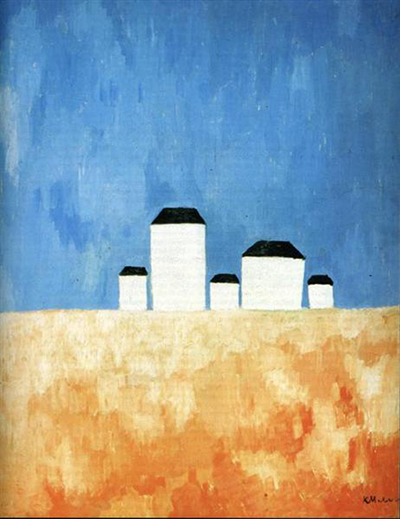
The much later Landscape with Five Houses shows how differently Malevich could handle the same motif. The Russian Museum dates that painting to 1928–29 and records it as an upright oil on canvas. Its five pale buildings sit along the meeting point of two large fields. In the 1911 picture, changes of hue and direction give a much larger part of the square to the land around the buildings. Bringing the two works together makes the change in approach visible despite the similarity of their descriptive titles. [1] [5]
Landscape and the later square
The 1911 work still shows recognisable houses, trees, fence and sky. Yet its strong square format, angular outlines and assertive colour organization invite comparison with Malevich's later concern for the shape of the painted field. Christie’s essay makes that connection to his later Suprematism. The comparison can help a reader see a career change, but the presence of a square support does not make this landscape an early version of Black Square. [1]
The 1927 Berlin exhibition presented the gouache long after those first experiments. A work that could initially be seen in relation to Malevich’s other landscapes and figures could then be read alongside the abstract painting that followed. That later context broadens what the gouache can tell us. Its dense hillside and brightly coloured buildings still reward looking in their own right. [1] [2]
Frequently Asked Questions
Is this Landscape with Three Red Houses?
Yes. Christie’s exhibition and literature history records that title for the same 1911, 106 × 106 cm composition. [1]
Was it painted in oil on canvas?
No. The exact Christie’s lot records gouache on paper laid down on board. [1]
Is it still in Kunstmuseum Basel?
Where is it now?
The 2018 lot was offered from a private European collection. The checked sources do not establish the present owner or display location. [1]
Was it shown in Warsaw in 1927?
Christie’s marks that exhibition appearance as possible, whereas its Berlin listing is stated without that qualifier. [1]
Discussion
How do the trees and fence shape your view of the three houses?
Which areas make the sky visible in this crowded square composition?
Reader Insights
Trace the jagged fence along the foreground.
Compare the pink and grey patches within each house.
Why does the former Basel number not establish the present owner?
Join the Conversation
Share a close observation or source-backed detail about the 1911 Christie’s documented Landscape.
References
- Christie’s, illustrated Landscape lot 6155243: exact 1911 object, material, dimensions, literature, exhibition list, provenance and object-specific essay prepared with assistance from Aleksandra Shatskikh. View source.
- Kunstmuseum Basel, 2011 annual report, Kunstkommission section: museum's own account of the approved agreement to transfer its Landschaft mit roten Häusern gouache to Malevich's heirs. View source.
- Christie’s, Trees, archived lot 1478621: separate small circa-1904 landscape used for an object-level comparison. View source.
- Christie’s, “50 Years of Russian Art Masterpieces at Christie’s”: retrospective reporting the June 2018 Landscape sale result. View source.
- State Russian Museum, Landscape with Five Houses, Ж-9496: separately identified 1928–29 oil on canvas used for comparison. View source.